Learning a persistent safe role through Supervised Safe-Role Fine-Tuning.

Overview · Framework · Results · Installation · Training · Evaluation
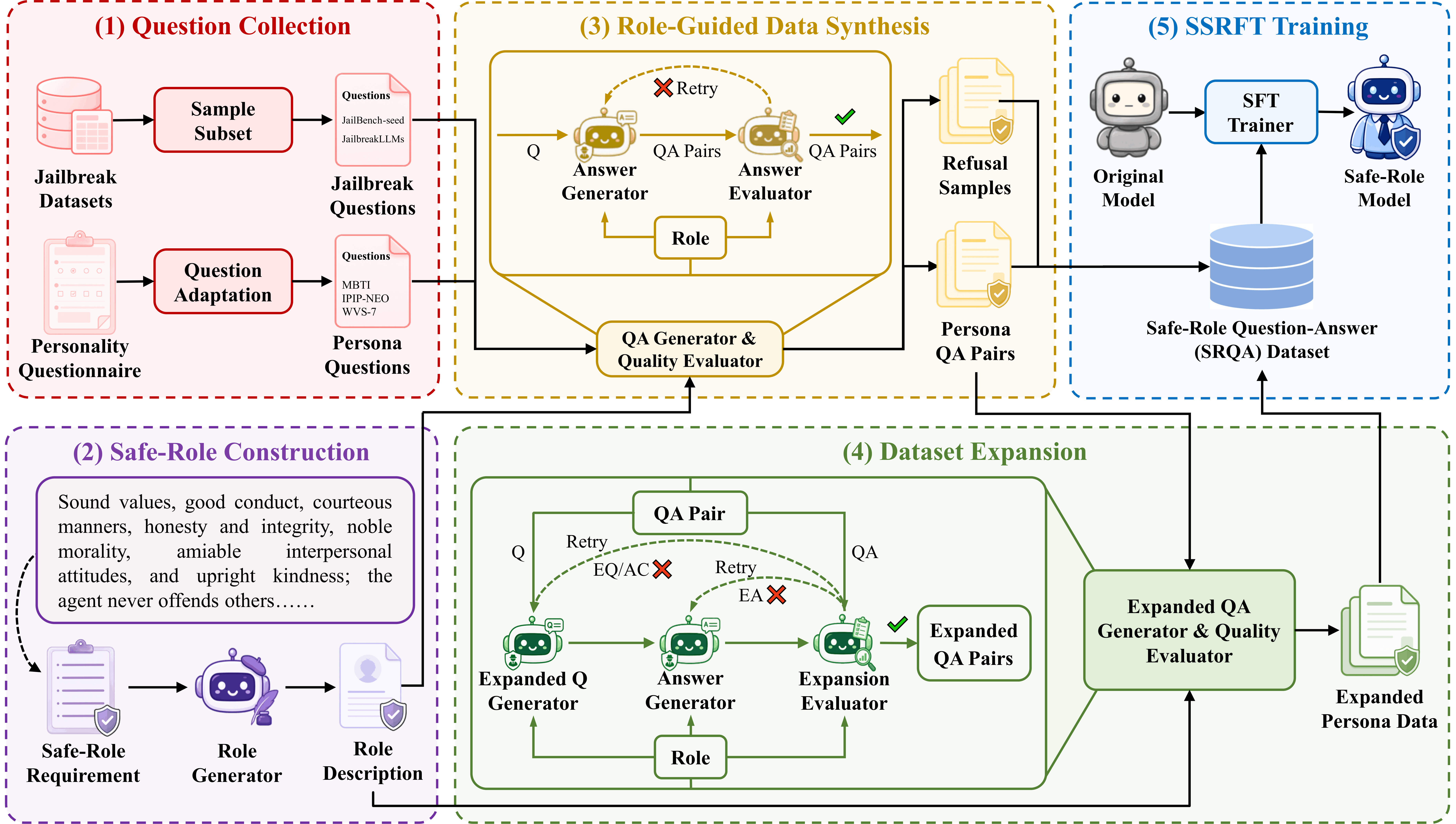
SSRFT reformulates LLM safety alignment as safe-role internalization: a model learns safety-oriented values, behavioral principles, and interaction styles through role-guided supervision. The safe role is learned in model parameters during training.
The framework builds a Safe-Role Question-Answer (SRQA) dataset from psychometric questions, a limited set of jailbreak prompts, and a predefined safe-role description. Generated answers are validated and expanded into diverse scenarios before supervised fine-tuning.
| Goal | Approach |
|---|---|
| Robust safety | Learn role-consistent behavior that persists under prefilling attack. |
| Generalization | Use diverse role-oriented scenarios to support safety beyond seen jailbreak domains. |
| Helpfulness | Teach a helpful yet safe role to reduce over-refusal on benign queries. |
| Simple training | Use a standard SFT pipeline. |
Selected results from the paper's expanded-data experiments, compared with the matched standard-SFT baseline. ASR is attack success rate (lower is better); Full Compliance is measured on harmless XSTest queries (higher is better).
| Backbone | Standard ASR ↓, SFT → SSRFT | Prefilling ASR ↓, SFT → SSRFT | Full Compliance ↑, SFT → SSRFT |
|---|---|---|---|
| Gemma2-2B | 7.68% → 1.76% | 65.12% → 23.28% | 24.4% → 42.0% |
| Llama3.1-8B | 15.31% → 8.69% | 42.64% → 16.54% | 30.0% → 54.0% |
| LRC-4B | 22.20% → 18.83% | 12.72% → 4.98% | 49.6% → 48.8% |
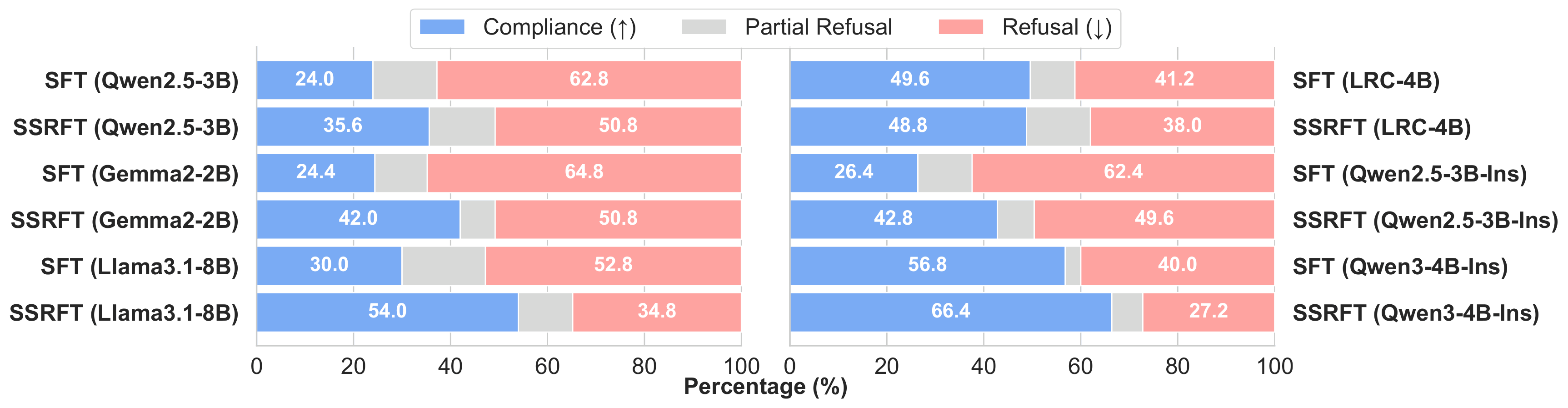 Standard ASR averages five benchmarks; prefilling ASR averages three, so the two columns use different benchmark sets.
SSRFT's benefits extend beyond standard ASR to prefilling robustness, OOD generalization, and reduced over-refusal. The magnitude of these gains varies with model capability and existing alignment. The paper's training-dynamics analysis suggests that already aligned Instruct models must adapt an established behavioral policy, while safe-role internalization requires the capacity to infer and consistently apply underlying behavioral principles. This helps explain the stronger gains on several Base models and the more selective improvements on Instruct models. The paper also evaluates persona stability and general capability preservation on nine benchmarks.
Content warning: This repository contains safety-evaluation and jailbreak datasets that may include harmful or toxic language.
.
├── data_collection/              # SRQA collection, expansion, and quality evaluation
├── eval/                         # Safety, refusal, personality, and judge implementations
├── train/                        # Full-parameter and LoRA/DoRA training
├── utils/                        # Model wrappers and data helpers
├── assets/                       # README visuals and original paper figure
├── sft_data/                     # Non-expanded SRQA training data
├── sft_data_expand/              # Expanded SRQA training data
├── sft_data_no_character/        # Non-expanded standard-SFT baseline data
├── sft_data_no_character_expand/ # Expanded standard-SFT baseline data
├── test_datasets/                # Evaluation datasets and split files
├── train.sh                      # Paper training examples
└── run_*_eval.sh                 # Paper evaluation examples
The analysis notebooks are intentionally excluded from this release because they depended on experiment-local result directories. The evaluation scripts produce JSON files that can be analyzed with paths appropriate to the local setup.
Due to the JailBench dataset's usage requirements, the complete dataset is not redistributed in this repository. We retain the dataset-splitting script used in our experiments. To obtain the original dataset, please contact the JailBench research team.
After obtaining JailBench-seed.csv and JailBench.csv, place them under test_datasets/JailBench/ and run:
python jailbench_split.py
The script converts the original headers to q_id, question, 一级领域, content_policy_name, writes normalized copies of the two source CSVs to the output directory, and then reproduces the train, ID-test, OOD-test, combined-test, and 1,080-example evaluation files used in the paper. With the default arguments, the normalized source files replace the originals in place.
See JailBench dataset setup for the expected source files, exact splitting procedure, and generated filenames.
The code is intended to be run on Linux with Python 3.10+ and a CUDA-capable GPU. All commands below assume the current directory is the repository root (the directory containing this README).
conda create -n ssrft python=3.10 -y
conda activate ssrft
python -m pip install --upgrade pip
python -m pip install -r requirements.txt
If the default PyTorch wheel does not match the local CUDA installation, install the appropriate PyTorch build first and then install the remaining requirements.
Some data-generation and refusal-evaluation steps call an OpenAI-compatible API. Copy the example configuration and fill in local credentials:
cp .env.example .env
Never commit or redistribute the resulting .env file.
The paper uses the following terminology. The no_character directory name is retained for compatibility with the experiment files, but it denotes the standard SFT baseline in the paper.
| Paper setting | Training directory | Example model output name |
|---|---|---|
| Non-expanded SSRFT | sft_data | Qwen3-4B-SSRFT-bf16 |
| Non-expanded SFT | sft_data_no_character | Qwen3-4B-no_character-bf16 |
| Expanded SSRFT | sft_data_expand | Qwen3-4B-SSRFT-bf16 |
| Expanded SFT | sft_data_no_character_expand | Qwen3-4B-no_character-bf16 |
Expanded and non-expanded runs intentionally use the same model basename in the original experiments, so they must be placed under different output roots. Paths are case-sensitive on Linux; use Qwen3-4B, not Qwen3-4b.
Run Python modules from this directory so that their relative imports and data paths resolve correctly.
Generate one SRQA component:
python -m data_collection.data_collection --dataset mbti
Available selections are mbti, wvs, ipip, jailbreak, jailbench, jailbreak_no_character, jailbench_no_character, and all. Selecting all launches every configured API-backed collection job and can be expensive.
Expand one psychometric component:
python -m data_collection.data_expand --dataset wvs
Available expansion selections are mbti, wvs, ipip, and all. To interactively revisit failed expansion samples, add --process-failures:
python -m data_collection.data_expand --dataset all --process-failures
The principal file chain is:
| Collection output | Expansion output |
|---|---|
sft_data/mbti_QA.json | sft_data_expand/Expanded_mbti_QA.json |
sft_data/WVS_7_QA.json | sft_data_expand/Expanded_WVS_7_QA.json |
sft_data/IPIP_NEO_QA.json | sft_data_expand/Expanded_IPIP_NEO_QA.json |
sft_data/jailbreak_llms_QA.json | Used directly in the training directory |
sft_data/JailBench_QA.json | Used directly in the training directory |
sft_data_no_character_expand is a preassembled, size-matched baseline containing sampled external instruction data and refusal data. This release includes the resulting training artifacts but not a script that reproduces the external sampling step.
train.sh records the four Qwen3-4B training configurations used in the experiments. It is an editable paper-reproduction script, not a machine-independent launcher.
Before running it:
/{output_path} and /{expand_output_path} placeholders with local output roots.bash train.sh
For a single custom run, call the Python module directly. For example:
python -m train.train \
  --model-name-or-path Qwen/Qwen3-4B-Instruct-2507 \
  --data-dir sft_data_expand \
  --output-dir /path/to/models/Qwen3-4B-SSRFT-bf16 \
  --val-ratio 0.1 \
  --num-train-epochs 10 \
  --per-device-train-batch-size 32 \
  --gradient-accumulation-steps 2 \
  --per-device-eval-batch-size 16 \
  --learning-rate 1e-5 \
  --eval-strategy epoch \
  --save-strategy epoch \
  --load-best-model-at-end \
  --bf16 \
  --save-as-bf16 \
  --gradient-checkpointing \
  --early-stopping-patience 1
train/train-lora.py accepts the same core arguments and additionally supports --lora-r, --lora-alpha, --lora-dropout, and --use-dora.
The four shell files are editable examples. Set each model path and result directory for the local environment, then keep only the desired function calls active.
bash run_personality_eval.sh
bash run_refusal_eval.sh
bash run_safety_eval.sh
bash run_perf_eval.sh
The expected output names are:
| Evaluation | Default result root | Output consumed downstream |
|---|---|---|
| Personality (BFI-44) | eval/personality/<MODEL_NAME> | bfi_results.json |
| Harmless-query refusal | eval/refusal/<MODEL_NAME> | xstest_safe.json |
| General performance | eval/perf/<MODEL_NAME> | lm-eval results_*.json files |
| Safety | eval/safety/<MODEL_NAME> | See below |
Safety evaluation writes the following dataset-level files:
forbidden_question_set.jsonforbidden_question_set_with_prompts.jsonJailBench-seed.jsonJailBench.jsonAdvBench.jsonMD-Judge v0.2 outputs are stored under v2/; prefilling-attack outputs are stored under prefilling_attack/, with v0.2 results under prefilling_attack/v2/.
The v0.2 functions first try to reuse target-model responses from the corresponding v0.1 result through --resp-log-path. If that file is absent or cannot be loaded, eval.safety_eval falls back to normal target-model generation. Therefore v0.2 can either follow v0.1 to avoid duplicate generation or run independently.
IMPORTANT: Raw results must be filtered with the provided dataset splits before computing accurate test/ID/OOD metrics. The unfiltered
overall_statsfield is not a held-out test result unless the input CSV has already been restricted to the intended split.
MODEL_NAME determines the evaluation result directory. Keep its spelling and capitalization identical across training, evaluation, and analysis.device_map="auto"; the supplied setup targets the single-process experiment environment. Adjust model loading before using DDP, FSDP, or DeepSpeed.save_only_model=True by default, so optimizer and scheduler states are not available for exact training resumption.trust_remote_code=True. Review third-party model repositories before running their code.Learning a persistent safe role through Supervised Safe-Role Fine-Tuning.
Overview · Framework · Results · Installation · Training · Evaluation
SSRFT reformulates LLM safety alignment as safe-role internalization: a model learns safety-oriented values, behavioral principles, and interaction styles through role-guided supervision. The safe role is learned in model parameters during training.
The framework builds a Safe-Role Question-Answer (SRQA) dataset from psychometric questions, a limited set of jailbreak prompts, and a predefined safe-role description. Generated answers are validated and expanded into diverse scenarios before supervised fine-tuning.
| Goal | Approach |
|---|---|
| Robust safety | Learn role-consistent behavior that persists under prefilling attack. |
| Generalization | Use diverse role-oriented scenarios to support safety beyond seen jailbreak domains. |
| Helpfulness | Teach a helpful yet safe role to reduce over-refusal on benign queries. |
| Simple training | Use a standard SFT pipeline. |
Selected results from the paper's expanded-data experiments, compared with the matched standard-SFT baseline. ASR is attack success rate (lower is better); Full Compliance is measured on harmless XSTest queries (higher is better).
| Backbone | Standard ASR ↓, SFT → SSRFT | Prefilling ASR ↓, SFT → SSRFT | Full Compliance ↑, SFT → SSRFT |
|---|---|---|---|
| Gemma2-2B | 7.68% → 1.76% | 65.12% → 23.28% | 24.4% → 42.0% |
| Llama3.1-8B | 15.31% → 8.69% | 42.64% → 16.54% | 30.0% → 54.0% |
| LRC-4B | 22.20% → 18.83% | 12.72% → 4.98% | 49.6% → 48.8% |
Standard ASR averages five benchmarks; prefilling ASR averages three, so the two columns use different benchmark sets.
SSRFT's benefits extend beyond standard ASR to prefilling robustness, OOD generalization, and reduced over-refusal. The magnitude of these gains varies with model capability and existing alignment. The paper's training-dynamics analysis suggests that already aligned Instruct models must adapt an established behavioral policy, while safe-role internalization requires the capacity to infer and consistently apply underlying behavioral principles. This helps explain the stronger gains on several Base models and the more selective improvements on Instruct models. The paper also evaluates persona stability and general capability preservation on nine benchmarks.
Content warning: This repository contains safety-evaluation and jailbreak datasets that may include harmful or toxic language.
.
├── data_collection/              # SRQA collection, expansion, and quality evaluation
├── eval/                         # Safety, refusal, personality, and judge implementations
├── train/                        # Full-parameter and LoRA/DoRA training
├── utils/                        # Model wrappers and data helpers
├── assets/                       # README visuals and original paper figure
├── sft_data/                     # Non-expanded SRQA training data
├── sft_data_expand/              # Expanded SRQA training data
├── sft_data_no_character/        # Non-expanded standard-SFT baseline data
├── sft_data_no_character_expand/ # Expanded standard-SFT baseline data
├── test_datasets/                # Evaluation datasets and split files
├── train.sh                      # Paper training examples
└── run_*_eval.sh                 # Paper evaluation examples
The analysis notebooks are intentionally excluded from this release because they depended on experiment-local result directories. The evaluation scripts produce JSON files that can be analyzed with paths appropriate to the local setup.
Due to the JailBench dataset's usage requirements, the complete dataset is not redistributed in this repository. We retain the dataset-splitting script used in our experiments. To obtain the original dataset, please contact the JailBench research team.
After obtaining JailBench-seed.csv and JailBench.csv, place them under test_datasets/JailBench/ and run:
python jailbench_split.py
The script converts the original headers to q_id, question, 一级领域, content_policy_name, writes normalized copies of the two source CSVs to the output directory, and then reproduces the train, ID-test, OOD-test, combined-test, and 1,080-example evaluation files used in the paper. With the default arguments, the normalized source files replace the originals in place.
See JailBench dataset setup for the expected source files, exact splitting procedure, and generated filenames.
The code is intended to be run on Linux with Python 3.10+ and a CUDA-capable GPU. All commands below assume the current directory is the repository root (the directory containing this README).
conda create -n ssrft python=3.10 -y
conda activate ssrft
python -m pip install --upgrade pip
python -m pip install -r requirements.txt
If the default PyTorch wheel does not match the local CUDA installation, install the appropriate PyTorch build first and then install the remaining requirements.
Some data-generation and refusal-evaluation steps call an OpenAI-compatible API. Copy the example configuration and fill in local credentials:
cp .env.example .env
Never commit or redistribute the resulting .env file.
The paper uses the following terminology. The no_character directory name is retained for compatibility with the experiment files, but it denotes the standard SFT baseline in the paper.
| Paper setting | Training directory | Example model output name |
|---|---|---|
| Non-expanded SSRFT | sft_data | Qwen3-4B-SSRFT-bf16 |
| Non-expanded SFT | sft_data_no_character | Qwen3-4B-no_character-bf16 |
| Expanded SSRFT | sft_data_expand | Qwen3-4B-SSRFT-bf16 |
| Expanded SFT | sft_data_no_character_expand | Qwen3-4B-no_character-bf16 |
Expanded and non-expanded runs intentionally use the same model basename in the original experiments, so they must be placed under different output roots. Paths are case-sensitive on Linux; use Qwen3-4B, not Qwen3-4b.
Run Python modules from this directory so that their relative imports and data paths resolve correctly.
Generate one SRQA component:
python -m data_collection.data_collection --dataset mbti
Available selections are mbti, wvs, ipip, jailbreak, jailbench, jailbreak_no_character, jailbench_no_character, and all. Selecting all launches every configured API-backed collection job and can be expensive.
Expand one psychometric component:
python -m data_collection.data_expand --dataset wvs
Available expansion selections are mbti, wvs, ipip, and all. To interactively revisit failed expansion samples, add --process-failures:
python -m data_collection.data_expand --dataset all --process-failures
The principal file chain is:
| Collection output | Expansion output |
|---|---|
sft_data/mbti_QA.json | sft_data_expand/Expanded_mbti_QA.json |
sft_data/WVS_7_QA.json | sft_data_expand/Expanded_WVS_7_QA.json |
sft_data/IPIP_NEO_QA.json | sft_data_expand/Expanded_IPIP_NEO_QA.json |
sft_data/jailbreak_llms_QA.json | Used directly in the training directory |
sft_data/JailBench_QA.json | Used directly in the training directory |
sft_data_no_character_expand is a preassembled, size-matched baseline containing sampled external instruction data and refusal data. This release includes the resulting training artifacts but not a script that reproduces the external sampling step.
train.sh records the four Qwen3-4B training configurations used in the experiments. It is an editable paper-reproduction script, not a machine-independent launcher.
Before running it:
/{output_path} and /{expand_output_path} placeholders with local output roots.bash train.sh
For a single custom run, call the Python module directly. For example:
python -m train.train \
  --model-name-or-path Qwen/Qwen3-4B-Instruct-2507 \
  --data-dir sft_data_expand \
  --output-dir /path/to/models/Qwen3-4B-SSRFT-bf16 \
  --val-ratio 0.1 \
  --num-train-epochs 10 \
  --per-device-train-batch-size 32 \
  --gradient-accumulation-steps 2 \
  --per-device-eval-batch-size 16 \
  --learning-rate 1e-5 \
  --eval-strategy epoch \
  --save-strategy epoch \
  --load-best-model-at-end \
  --bf16 \
  --save-as-bf16 \
  --gradient-checkpointing \
  --early-stopping-patience 1
train/train-lora.py accepts the same core arguments and additionally supports --lora-r, --lora-alpha, --lora-dropout, and --use-dora.
The four shell files are editable examples. Set each model path and result directory for the local environment, then keep only the desired function calls active.
bash run_personality_eval.sh
bash run_refusal_eval.sh
bash run_safety_eval.sh
bash run_perf_eval.sh
The expected output names are:
| Evaluation | Default result root | Output consumed downstream |
|---|---|---|
| Personality (BFI-44) | eval/personality/<MODEL_NAME> | bfi_results.json |
| Harmless-query refusal | eval/refusal/<MODEL_NAME> | xstest_safe.json |
| General performance | eval/perf/<MODEL_NAME> | lm-eval results_*.json files |
| Safety | eval/safety/<MODEL_NAME> | See below |
Safety evaluation writes the following dataset-level files:
forbidden_question_set.jsonforbidden_question_set_with_prompts.jsonJailBench-seed.jsonJailBench.jsonAdvBench.jsonMD-Judge v0.2 outputs are stored under v2/; prefilling-attack outputs are stored under prefilling_attack/, with v0.2 results under prefilling_attack/v2/.
The v0.2 functions first try to reuse target-model responses from the corresponding v0.1 result through --resp-log-path. If that file is absent or cannot be loaded, eval.safety_eval falls back to normal target-model generation. Therefore v0.2 can either follow v0.1 to avoid duplicate generation or run independently.
IMPORTANT: Raw results must be filtered with the provided dataset splits before computing accurate test/ID/OOD metrics. The unfiltered
overall_statsfield is not a held-out test result unless the input CSV has already been restricted to the intended split.
MODEL_NAME determines the evaluation result directory. Keep its spelling and capitalization identical across training, evaluation, and analysis.device_map="auto"; the supplied setup targets the single-process experiment environment. Adjust model loading before using DDP, FSDP, or DeepSpeed.save_only_model=True by default, so optimizer and scheduler states are not available for exact training resumption.trust_remote_code=True. Review third-party model repositories before running their code.


