Code for 'How Much Is an AI Token Worth? Scaling Laws for Wild AI-Generated Web Text'. Models: huggingface.co/pangram/WildAI-models · Data: huggingface.co/datasets/pangram/WildAI · CC BY-NC-SA 4.0
See the code



Code for How Much Is an AI Token Worth? Scaling Laws for Wild AI-Generated Web Text.
License: CC BY-NC-SA 4.0. This code, the WildAI models and the WildAI dataset are all released under the Creative Commons Attribution-NonCommercial-ShareAlike 4.0 International license: you may use and adapt them for non-commercial purposes, with attribution, and must share adaptations under the same license. See
LICENSE.
Wild AI text is AI-generated text that arrives unlabeled in web crawls. This repository builds a corpus of it, trains the paper's 800-model grid on controlled mixtures of human and AI web text, evaluates the models, fits the scaling laws, and draws every figure and table of the paper.
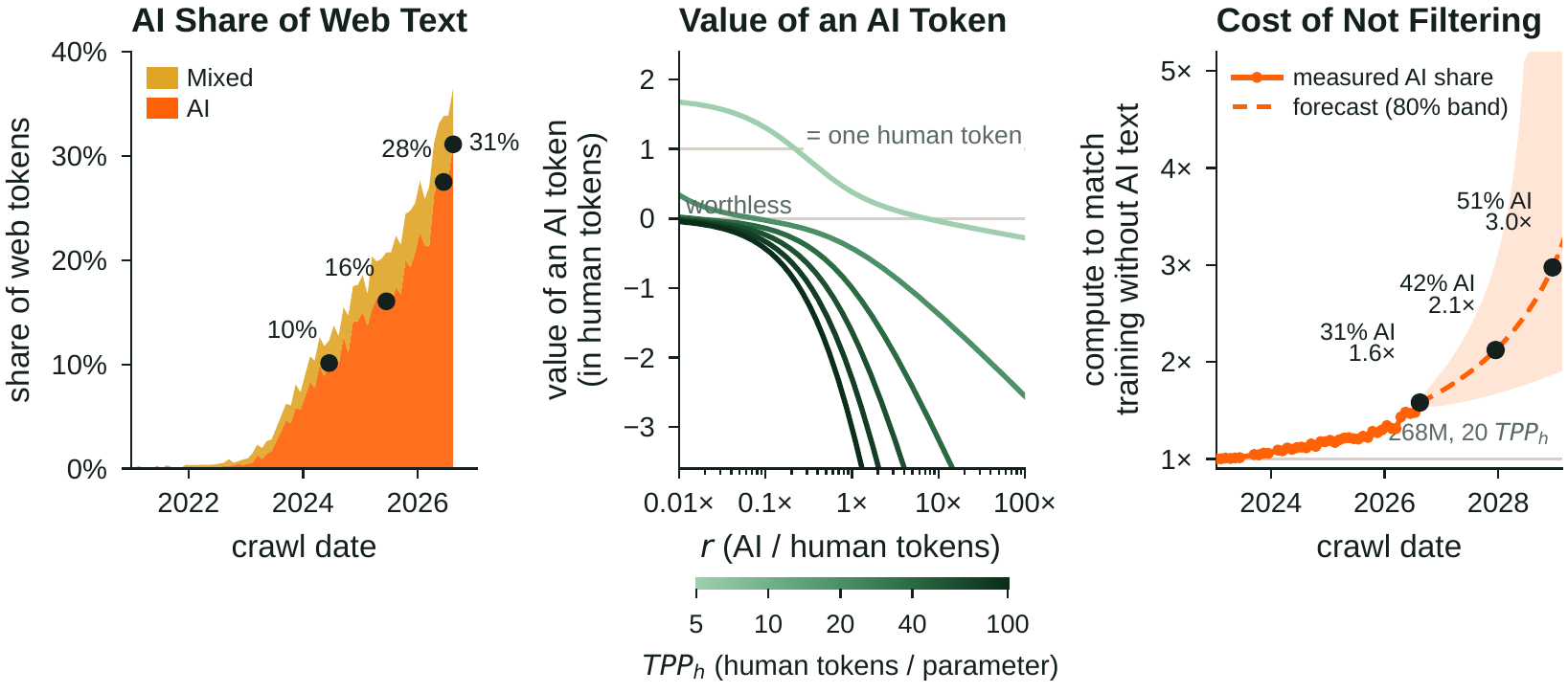
Figure 1. Left: share of web tokens in documents Pangram labels AI or Mixed, by crawl month. Middle: the value of one
added AI token at 268M parameters, in human tokens, across human-token budgets. Right: the compute an unfiltered crawl
needs to match training on its human subset (268M, 20 human tokens per parameter), at the measured and forecast AI
shares. Drawn by python -m paper.make --palette pangram --only law_overview.
| Data | pangram/WildAI on Hugging Face: 96M English web documents labeled human-written, AI-generated or mixed, with URL, date, topic and format |
| Models | pangram/WildAI-models on Hugging Face: every model of the paper, one subfolder per model |
| Results | results/: every model's token counts and losses, the fitted laws, the web measurements |
uv venv --python 3.12 && uv pip install -e ".[paper]"          # figures and tables only (CPU)
uv pip install -e ".[train]"                                    # training and evaluation (CUDA 12.8)
uv pip install -e ".[data,label]"                               # data pipeline and labeling
Every step reads and writes the files in results/, so each can be run on its own.
python -m paper.make                     # every figure and table, from results/ (about a minute on a CPU)
python -m wildai.laws.run --workers 64   # refit all laws and derived numbers into results/laws/ (about 40 CPU-minutes)
To go further back, rescore a released model or retrain one (results/models.csv lists them by name). The models,
the tokenizer and the training pools come from Hugging Face unless you pass local paths (--checkpoint, --tokenizer,
--input):
python -m wildai.data.evalsets.cli c4 cosmopedia fw22 --output-dir data/eval    # evaluation sets, from their public sources
python -m wildai.evaluation.bpb --model 268m-g072-ai-r0.5 --eval-dir data/eval --targets c4 cosmopedia fw22
python -m wildai.training.pools --pool human --output data/human                # tokenize the released pools
python -m wildai.training.pools --pool ai --output data/ai
torchrun --standalone --nproc_per_node=8 -m wildai.training.train --model 268m-g072-ai-r0.5 --data-dir data --out-dir checkpoints
python -m wildai.evaluation.bpb --checkpoint checkpoints/268m-g072-ai-r0.5 --eval-dir data/eval --targets c4 cosmopedia fw22
The data pipeline (collection, EditLens preselection, Pangram labeling through the public API, pools, evaluation sets,
web measurements) is described in src/wildai/data; labeling with Pangram needs an API
key in PANGRAM_API_KEY.
| Path | What it does |
|---|---|
src/wildai/data | collect FineWeb and Common Crawl documents, build pools and evaluation sets, measure the web, export the dataset |
src/wildai/labeling | EditLens, Pangram (public API) and WebOrganizer labelers |
src/wildai/training | the model and training recipe (adapted from nanochat), data mixtures, training CLI |
src/wildai/evaluation | bits per byte, Paloma, CORE and MMLU, generation and AI-typical phrases |
src/wildai/laws | our law and eleven published laws: fitting, held-out scoring, compute-equivalent gain, ablations |
src/wildai/hub | export checkpoints to Hugging Face transformers |
paper/ | the paper's figures and tables |
results/ | the numbers behind them |
configs/ | data, training and evaluation settings |
<size>-<group>-<arm>[-r<ratio>], e.g. 268m-g072-ai-r0.5: group g072 is one human-only control
(268m-g072-control) and every run trained on exactly its human documents plus added AI text (ai) or fresh human text
(human), with $r$ added tokens per human token. f01–f19 are filtering pairs (-web-mix, -ai-removed) and
-repeat-r<r> models repeat their control's human text.
Everything released with the paper is licensed under CC BY-NC-SA 4.0
(full text in LICENSE):
pangram/WildAI-models);pangram/WildAI), whose text also remains subject to FineWeb's ODC-By 1.0 license
and Common Crawl's terms of use.The model and training code adapted from nanochat also keeps nanochat's MIT
notice, in src/wildai/training/NOTICE.
This code was written with the help of coding agents (Claude Code and Codex).
@article{russell2026wildai,
  title   = {How Much Is an AI Token Worth? Scaling Laws for Wild AI-Generated Web Text},
  author  = {Russell, Jenna and Glickenhaus, Ben and Thai, Katherine and Wieting, John and Iyyer, Mohit and Spero, Max and Emi, Bradley},
  journal = {arXiv preprint arXiv:2609.40295},
  year    = {2026},
  url     = {https://arxiv.org/abs/2609.40295}
}
Code for 'How Much Is an AI Token Worth? Scaling Laws for Wild AI-Generated Web Text'. Models: huggingface.co/pangram/WildAI-models · Data: huggingface.co/datasets/pangram/WildAI · CC BY-NC-SA 4.0
See the code
Code for How Much Is an AI Token Worth? Scaling Laws for Wild AI-Generated Web Text.
License: CC BY-NC-SA 4.0. This code, the WildAI models and the WildAI dataset are all released under the Creative Commons Attribution-NonCommercial-ShareAlike 4.0 International license: you may use and adapt them for non-commercial purposes, with attribution, and must share adaptations under the same license. See
LICENSE.
Wild AI text is AI-generated text that arrives unlabeled in web crawls. This repository builds a corpus of it, trains the paper's 800-model grid on controlled mixtures of human and AI web text, evaluates the models, fits the scaling laws, and draws every figure and table of the paper.
Figure 1. Left: share of web tokens in documents Pangram labels AI or Mixed, by crawl month. Middle: the value of one
added AI token at 268M parameters, in human tokens, across human-token budgets. Right: the compute an unfiltered crawl
needs to match training on its human subset (268M, 20 human tokens per parameter), at the measured and forecast AI
shares. Drawn by python -m paper.make --palette pangram --only law_overview.
| Data | pangram/WildAI on Hugging Face: 96M English web documents labeled human-written, AI-generated or mixed, with URL, date, topic and format |
| Models | pangram/WildAI-models on Hugging Face: every model of the paper, one subfolder per model |
| Results | results/: every model's token counts and losses, the fitted laws, the web measurements |
uv venv --python 3.12 && uv pip install -e ".[paper]"          # figures and tables only (CPU)
uv pip install -e ".[train]"                                    # training and evaluation (CUDA 12.8)
uv pip install -e ".[data,label]"                               # data pipeline and labeling
Every step reads and writes the files in results/, so each can be run on its own.
python -m paper.make                     # every figure and table, from results/ (about a minute on a CPU)
python -m wildai.laws.run --workers 64   # refit all laws and derived numbers into results/laws/ (about 40 CPU-minutes)
To go further back, rescore a released model or retrain one (results/models.csv lists them by name). The models,
the tokenizer and the training pools come from Hugging Face unless you pass local paths (--checkpoint, --tokenizer,
--input):
python -m wildai.data.evalsets.cli c4 cosmopedia fw22 --output-dir data/eval    # evaluation sets, from their public sources
python -m wildai.evaluation.bpb --model 268m-g072-ai-r0.5 --eval-dir data/eval --targets c4 cosmopedia fw22
python -m wildai.training.pools --pool human --output data/human                # tokenize the released pools
python -m wildai.training.pools --pool ai --output data/ai
torchrun --standalone --nproc_per_node=8 -m wildai.training.train --model 268m-g072-ai-r0.5 --data-dir data --out-dir checkpoints
python -m wildai.evaluation.bpb --checkpoint checkpoints/268m-g072-ai-r0.5 --eval-dir data/eval --targets c4 cosmopedia fw22
The data pipeline (collection, EditLens preselection, Pangram labeling through the public API, pools, evaluation sets,
web measurements) is described in src/wildai/data; labeling with Pangram needs an API
key in PANGRAM_API_KEY.
| Path | What it does |
|---|---|
src/wildai/data | collect FineWeb and Common Crawl documents, build pools and evaluation sets, measure the web, export the dataset |
src/wildai/labeling | EditLens, Pangram (public API) and WebOrganizer labelers |
src/wildai/training | the model and training recipe (adapted from nanochat), data mixtures, training CLI |
src/wildai/evaluation | bits per byte, Paloma, CORE and MMLU, generation and AI-typical phrases |
src/wildai/laws | our law and eleven published laws: fitting, held-out scoring, compute-equivalent gain, ablations |
src/wildai/hub | export checkpoints to Hugging Face transformers |
paper/ | the paper's figures and tables |
results/ | the numbers behind them |
configs/ | data, training and evaluation settings |
<size>-<group>-<arm>[-r<ratio>], e.g. 268m-g072-ai-r0.5: group g072 is one human-only control
(268m-g072-control) and every run trained on exactly its human documents plus added AI text (ai) or fresh human text
(human), with $r$ added tokens per human token. f01–f19 are filtering pairs (-web-mix, -ai-removed) and
-repeat-r<r> models repeat their control's human text.
Everything released with the paper is licensed under CC BY-NC-SA 4.0
(full text in LICENSE):
pangram/WildAI-models);pangram/WildAI), whose text also remains subject to FineWeb's ODC-By 1.0 license
and Common Crawl's terms of use.The model and training code adapted from nanochat also keeps nanochat's MIT
notice, in src/wildai/training/NOTICE.
This code was written with the help of coding agents (Claude Code and Codex).
@article{russell2026wildai,
  title   = {How Much Is an AI Token Worth? Scaling Laws for Wild AI-Generated Web Text},
  author  = {Russell, Jenna and Glickenhaus, Ben and Thai, Katherine and Wieting, John and Iyyer, Mohit and Spero, Max and Emi, Bradley},
  journal = {arXiv preprint arXiv:2609.40295},
  year    = {2026},
  url     = {https://arxiv.org/abs/2609.40295}
}