Open-source AI chatbot & site search for your docs. One <script> tag, streaming answers with sources. 100% Cloudflare-native (Workers AI + Vectorize + D1), runs free on the free tier.
TypeScript
39
1 commits
updated Oct 8, 2026
Open-source, zero-cost AI site search & chatbot widget. 100% Cloudflare native.
Drop one <script> tag on your docs site and get a streaming RAG chatbot that answers from your content, with sources.
No OpenAI key. No Pinecone. No servers. No bill.


| Chat widget embedded in a docs site | Admin UI (/admin) |
|---|---|
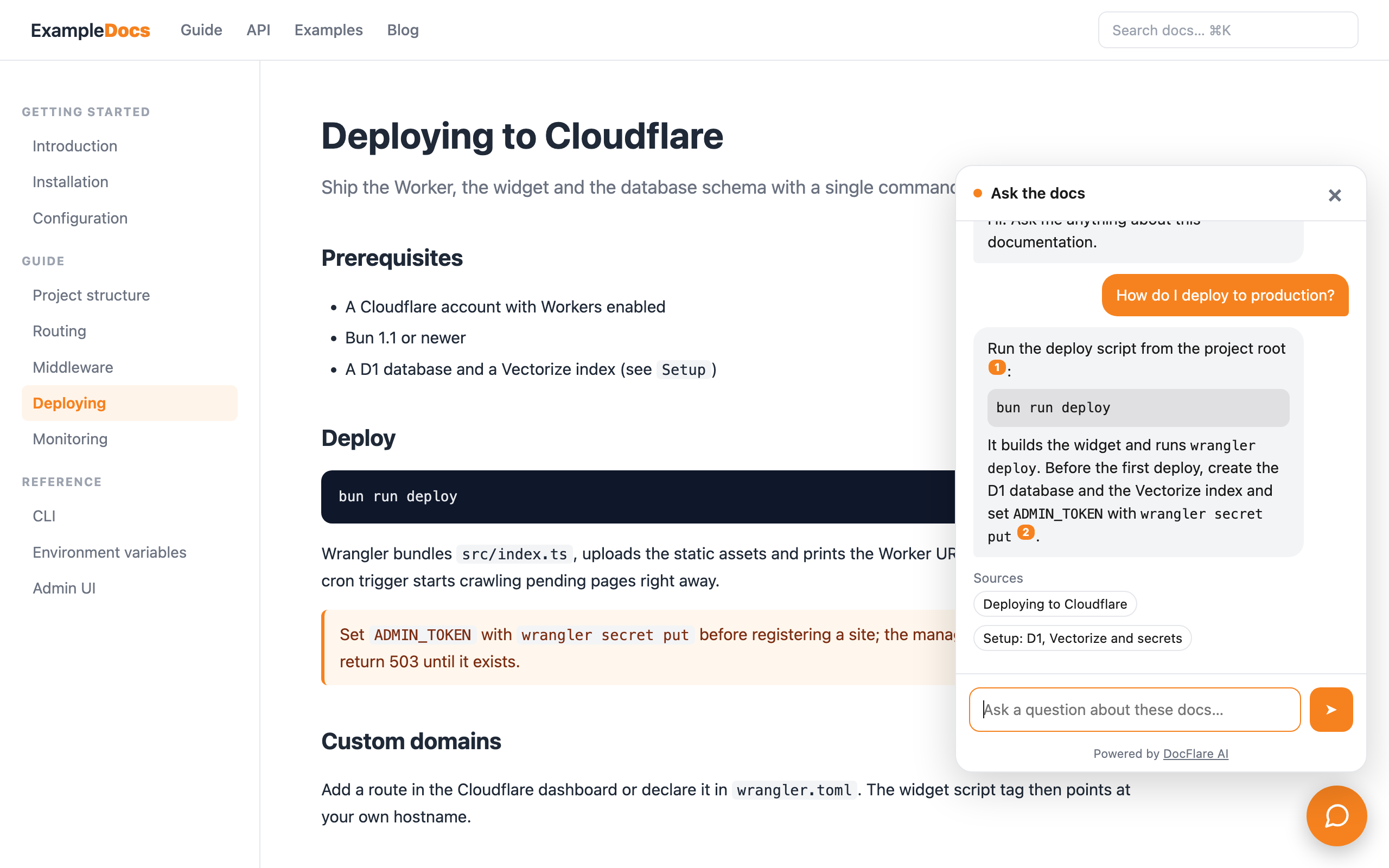 | 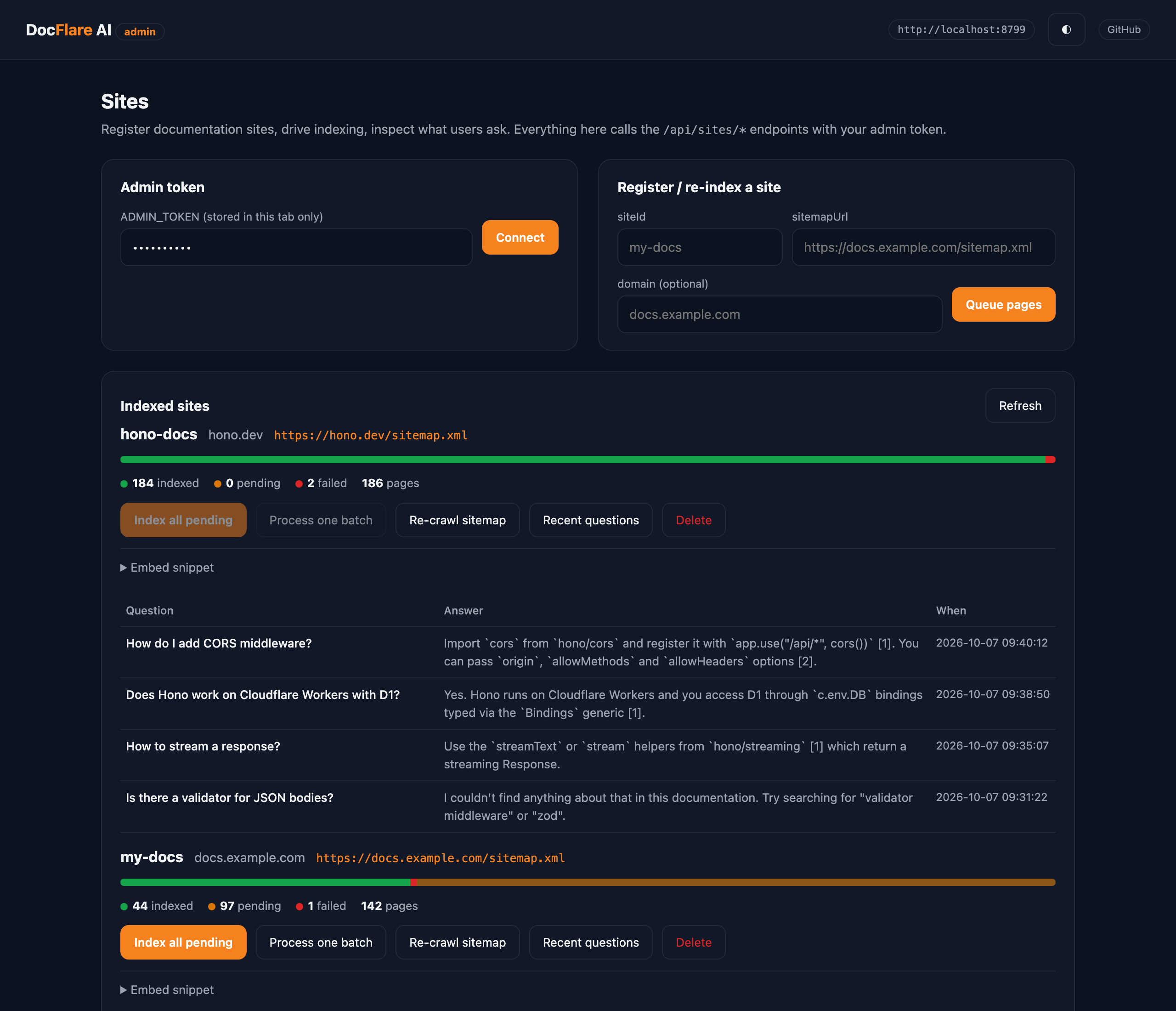 |
Streaming answers with source chips on the left; the built-in admin page for registering sitemaps, driving indexing and reviewing what users ask on the right.
Hosted "chat with your docs" widgets (Chatbase, CustomGPT, Mendable, ...) charge $20-$400/month for something that is, under the hood, a crawler, an embedding model, a vector store and an LLM. Cloudflare now ships every one of those pieces with a generous free tier:
| Piece | Cloudflare service | Free tier (at time of writing) |
|---|---|---|
| API / crawler | Workers + Hono | 100k requests/day |
| Embeddings + LLM | Workers AI (bge-small-en-v1.5, bge-reranker-base, llama-3.1-8b-instruct-fp8) | 10k neurons/day |
| Vector search | Vectorize (384-dim, cosine) | 5M stored dims, 30M queried dims/month |
| Metadata + chat log | D1 (SQLite) | 5 GB, 5M reads/day |
| Background indexing | Cron Triggers | included |
| Widget hosting | Static Assets | included |
DocFlare AI wires them together into a single Worker you deploy with one command.
<script src=".../widget.js" data-site-id="my-docs">. Vanilla JS, Shadow DOM, < 10 KB, zero dependencies, no CSS leaks.HTMLRewriter.bge-reranker-base cross-encoder before the top-K go to the LLM. Questions that merely share vocabulary with the wrong page (the site name on legal pages, a product name) land on the paragraph that actually answers them./admin: register sitemaps, watch indexing progress, process batches, re-crawl, delete sites, copy the embed snippet and browse recent questions. Single static HTML file, no build step.any. Bun for tooling and tests.flowchart LR
subgraph Host["Your docs site"]
W["widget.js<br/>(Shadow DOM)"]
end
subgraph CF["Cloudflare (free tier)"]
direction TB
API["Worker + Hono<br/>src/index.ts"]
AI["Workers AI<br/>bge-small-en-v1.5<br/>bge-reranker-base<br/>llama-3.1-8b-instruct-fp8"]
VX["Vectorize<br/>384-dim cosine<br/>namespace = siteId"]
D1["D1<br/>sites / pages / queries"]
CRON["Cron trigger<br/>every minute"]
ASSETS["Static assets<br/>public/"]
end
SM["sitemap.xml + HTML pages"]
W -- "POST /api/chat (SSE)" --> API
ASSETS -- "GET /widget.js" --> W
API -- "embed question" --> AI
API -- "topK query" --> VX
API -- "RAG prompt" --> AI
API -- "log query" --> D1
CRON -- "process pending pages" --> API
API -- "fetch + extract" --> SM
API -- "embed chunks" --> AI
API -- "upsert vectors" --> VX
Indexing: POST /api/sites/index reads the sitemap and queues every HTML URL in D1. A cron trigger (or repeated calls to /process) then crawls a few pages per invocation: extract text, chunk, embed, upsert to Vectorize, mark the page indexed.
Chat: the widget sends the question; the Worker embeds it, pulls the 20 closest chunks from the site's namespace, reranks them with a cross-encoder, keeps the top-K (max 2 per page), builds a grounded prompt, streams Llama 3.1's answer back as SSE and logs the exchange in D1.
See docs/ARCHITECTURE.md for the full design and docs/API_REFERENCE.md for the endpoints.
git clone https://github.com/p10node/docflare-ai.git
cd docflare-ai
bun install
bunx wrangler login
bunx wrangler d1 create docflare-db
Copy the database_id from the output. Either paste it into wrangler.toml:
[[d1_databases]]
binding = "DB"
database_name = "docflare-db"
database_id = "xxxxxxxx-xxxx-xxxx-xxxx-xxxxxxxxxxxx"   # <- paste here
…or, to keep it out of git, put it in a .env file instead (useful when you push your fork):
echo 'D1_DATABASE_ID=xxxxxxxx-xxxx-xxxx-xxxx-xxxxxxxxxxxx' > .env
With .env set, bun run deploy and bun run db:migrate generate wrangler.local.toml (gitignored) from wrangler.toml with the id filled in and use that. wrangler.toml keeps the placeholder.
Apply the schema:
bun run db:migrate
bunx wrangler vectorize create docflare-index --dimensions=384 --metric=cosine
(384 dimensions matches @cf/baai/bge-small-en-v1.5. The index name is already set in wrangler.toml.)
The management endpoints are protected by a bearer token. Pick something long and random:
bunx wrangler secret put ADMIN_TOKEN
bun run deploy
bun run deploy builds the widget and deploys (the schema was applied in step 2; re-run bun run db:migrate whenever migrations/ gains a new file). Wrangler prints your Worker URL, e.g. https://docflare-ai.<your-subdomain>.workers.dev. Open it to see the demo page with the widget mounted.
Deploy to Cloudflare button: the button at the top of this README clones the repo into your GitHub account, provisions the Worker, D1 database and Vectorize index from
wrangler.toml, asks forADMIN_TOKEN(from.dev.vars.example) and runsbun run deploy. Two values the wizard cannot read fromwrangler.toml:
- Vectorize index: enter Dimensions = 384 and Metric = cosine (the form leaves them blank; any other shape breaks indexing).
ADMIN_TOKEN: replace the example value with something long and random, e.g.openssl rand -hex 32.The build does not apply the D1 schema (the build token has no D1 access), so run the migration once from your new repo after the first deploy. Cloudflare writes your
database_idinto that repo'swrangler.tomlwhile provisioning, so no.envis needed (if it still shows the placeholder, do step 2):git clone https://github.com/<you>/docflare-ai.git && cd docflare-ai bun install && bunx wrangler login bun run db:migrate bunx wrangler vectorize get docflare-index # expect dimensions: 384, metric: cosineIf the index is missing or has a different shape, run step 3 (delete it first with
bunx wrangler vectorize delete docflare-index) and redeploy. If the wizard did not ask forADMIN_TOKEN, run step 4.
export WORKER_URL="https://docflare-ai.<your-subdomain>.workers.dev"
export ADMIN_TOKEN="the-token-you-set"

curl -X POST "$WORKER_URL/api/sites/index" \
  -H "Authorization: Bearer $ADMIN_TOKEN" \
  -H "Content-Type: application/json" \
  -d '{"siteId":"my-docs","sitemapUrl":"https://docs.example.com/sitemap.xml"}'
Response:
{
  "siteId": "my-docs",
  "domain": "docs.example.com",
  "sitemapUrl": "https://docs.example.com/sitemap.xml",
  "queued": 142,
  "progress": { "siteId": "my-docs", "total": 142, "pending": 142, "indexed": 0, "failed": 0 },
  "next": "Pending pages are crawled 3 at a time by the cron trigger. Call POST /api/sites/my-docs/process repeatedly to finish faster."
}
Prefer a UI? Open https://docflare-ai.<your-subdomain>.workers.dev/admin, paste the admin token and use the Register / re-index a site form. The same page shows progress bars per site, an Index all pending button that loops over /process until the queue is empty, and the recent questions log.
Pages are now crawled automatically, a few per minute, by the cron trigger. To finish faster, drive the queue yourself from the CLI:
until curl -sf -X POST "$WORKER_URL/api/sites/my-docs/process" \
        -H "Authorization: Bearer $ADMIN_TOKEN" | grep -q '"pending":0'; do
  sleep 1
done
Check progress at any time:
curl "$WORKER_URL/api/sites/my-docs/status" -H "Authorization: Bearer $ADMIN_TOKEN"
Re-running /api/sites/index for the same siteId re-queues every page, so a cron job or CI step can keep the index fresh. Vectorize is eventually consistent: freshly upserted chunks become searchable within a few seconds.
After upgrading DocFlare to a version that changes chunking (see the changelog in commit messages), re-index every site once (Re-crawl sitemap in the admin UI or
POST /api/sites/index) so pages are re-chunked. Old vectors keep working until then.
Add one line before </body> on any page of the registered domain:
<script src="https://docflare-ai.<your-subdomain>.workers.dev/widget.js"
        data-site-id="my-docs"
        defer></script>
| Attribute | Default | Description |
|---|---|---|
data-site-id | required | The siteId you indexed. |
data-api | script origin | Base URL of the Worker, if you serve widget.js from elsewhere (e.g. a CDN). |
data-theme | auto | light, dark or auto (follows prefers-color-scheme). |
data-color | #f6821f | Accent colour for the bubble and buttons. |
data-position | right | right or left corner. |
data-title | Ask AI | Panel header text. |
data-placeholder | Ask a question about these docs… | Input placeholder. |
data-welcome | Hi! Ask me anything… | First assistant message. |
A tiny JavaScript API is exposed as window.DocFlare:
DocFlare.open();            // open the panel
DocFlare.close();
DocFlare.ask('How do I deploy?');   // open and submit a question
Only pages served from the site's registered domain (and anything in ALLOWED_ORIGINS) can call /api/chat for that siteId. Requests from other origins get a 403.
Non-secret settings live in the [vars] section of wrangler.toml:
| Variable | Default | Purpose |
|---|---|---|
MAX_PAGES | 200 | Max URLs taken from a sitemap per indexing run. |
INDEX_BATCH_SIZE | 3 | Pages crawled + embedded per cron tick or /process call. Raise to 10-20 on the Workers Paid plan. |
TOP_K | 4 | Chunks handed to the LLM per question (max 20). |
RERANK | true | Rerank the 20 best vector matches with @cf/baai/bge-reranker-base before picking TOP_K. false = vector order only. |
ALLOWED_ORIGINS | "" | Comma-separated extra origins allowed to call /api/chat for any site. * allows everything. |
Secrets (set with bunx wrangler secret put NAME):
| Secret | Purpose |
|---|---|
ADMIN_TOKEN | Bearer token for /api/sites/*. Required; management routes return 503 until it is set. |
Want a bigger model or a different embedding size? Change CHAT_MODEL / EMBEDDING_MODEL in src/services/ai.ts and create a Vectorize index with the matching dimensions.
cp .dev.vars.example .dev.vars          # sets ADMIN_TOKEN for local runs
bunx wrangler d1 migrations apply docflare-db --local
bun run dev                             # http://localhost:8787
Notes:
wrangler dev proxies those bindings to your Cloudflare account (you must be logged in). D1 runs locally.wrangler dev uses a local D1 and ignores database_id, so neither the real id in wrangler.toml nor .env is needed for local runs. Only bun run deploy and bun run db:migrate need it.wrangler dev can use it.bun run dev:cron, then curl "http://localhost:8787/__scheduled?cron=*+*+*+*+*".bun test runs the unit tests (token estimate, section chunker, HTML extraction, sitemap filtering, CORS policy, reranker, prompt builder).bun run build:check type-checks and performs a dry-run bundle without deploying.bun run build:widget minifies widget/widget.src.js into public/widget.js with bun build (run after editing the widget).| Method | Path | Auth | Description |
|---|---|---|---|
GET | /api/health | none | Liveness + model names. |
POST | /api/sites/index | admin | Register a site and queue its sitemap URLs. |
POST | /api/sites/:siteId/process | admin | Crawl and embed the next batch of pending pages. |
GET | /api/sites/:siteId/status | admin | Indexing progress. |
DELETE | /api/sites/:siteId | admin | Remove a site, its pages, chat log and vectors. |
POST | /api/chat | origin check | Ask a question (JSON or SSE stream). |
GET | /widget.js | none | Embeddable widget. |
Full request/response shapes, the SSE protocol and an OpenAPI document are in docs/API_REFERENCE.md.
Rough budget for a typical documentation site, based on Cloudflare pricing as of 2026-10-01 (check the Workers AI, Vectorize, D1 and Workers pricing pages for up-to-date numbers):
bge-small costs 1,841 neurons per million input tokens, i.e. roughly 1 neuron per page. A 1,000-page site fits comfortably in a day's free quota.TOP_K=4 chunks of ~350 tokens + conversation history) at 13,778 neurons/M, the answer is 300-768 tokens at 26,128 neurons/M, the query embedding is negligible and reranking 20 candidates (~6k tokens at 283 neurons/M) costs about 2 neurons. With 10k free neurons/day that is on the order of 120-280 answered questions per day for free. Questions with no relevant context never hit the LLM and cost ~0.HTMLRewriter is native, so a batch of 3 pages stays under the limit; on the Paid plan raise INDEX_BATCH_SIZE.Workers AI is the only piece you will outgrow. Past the daily neuron allowance the AI binding fails and /api/chat returns 429 rate_limited until the quota resets. To go further, move to the Workers Paid plan ($5/month): it keeps the 10k free neurons/day and bills $0.011 per 1,000 neurons beyond that. No code changes are needed.
| Questions / day | Plan | Workers AI | Total / month (approx.) |
|---|---|---|---|
| up to ~280 | Free | $0 | $0 |
| 1,000 | Paid | $9-24 | $14-29 |
| 5,000 | Paid | $56-132 | $61-137 |
That is about $0.0004-0.0009 per question beyond the free allowance. The spread comes from how long the retrieved chunks, the history and the answers are.
To cut the cost per question:
TOP_K from 4 to 3 (about 25% fewer prompt tokens, slightly less context for the model).MAX_OUTPUT_TOKENS in src/services/ai.ts (768 by default); output tokens are the most expensive kind.MAX_HISTORY_TURNS / MAX_HISTORY_CHARS in src/services/ai.ts if follow-up questions are rare on your site.CHAT_MODEL for a cheaper model from the Workers AI catalog; the response parser accepts both Llama-style and OpenAI-style outputs.bge-small-en). For multilingual docs switch to @cf/baai/bge-m3 (1024 dims) and recreate the index.<lastmod>, feedback thumbs on answers, Markdown/llms.txt ingestion, per-site widget settings in the admin UI.docflare-ai/
├── docs/
│ ├── images/ # README screenshots
│ ├── ARCHITECTURE.md # System design & RAG data flow
│ └── API_REFERENCE.md # REST + SSE endpoint reference, OpenAPI
├── migrations/
│ └── 0000_init.sql # D1 schema
├── scripts/
│ └── wrangler.ts # Wrapper: swaps D1_DATABASE_ID from .env (optional) into a gitignored wrangler.local.toml
├── public/
│ ├── _headers # Static asset headers (CORS / caching for widget.js)
│ ├── admin.html # Admin UI (served at /admin)
│ ├── index.html # Demo page
│ └── widget.js # Minified embeddable widget (built from widget/)
├── widget/
│ └── widget.src.js # Readable widget source (bun build → public/widget.js)
├── test/
│ └── unit.test.ts # bun test: chunker, crawler filters, CORS, prompt
├── src/
│ ├── db/schema.ts # D1 statements, row types, repository
│ ├── services/
│ │ ├── ai.ts # Workers AI embeddings, RAG prompt, generation
│ │ ├── crawler.ts # Sitemap fetcher, HTMLRewriter text extractor, chunker
│ │ ├── indexer.ts # Batch indexing pipeline
│ │ └── vectorize.ts # Vectorize upsert / query / delete
│ ├── utils/
│ │ ├── cors.ts # Multi-domain CORS + origin policy
│ │ └── hash.ts # SHA-256 ids, constant-time compare
│ ├── index.ts # Hono app, routes, cron handler
│ └── types.ts # Env bindings & shared types
├── wrangler.toml
├── .dev.vars.example # ADMIN_TOKEN etc. for `wrangler dev`
├── package.json
├── bun.lock
└── tsconfig.json
Issues and pull requests are welcome. Run bun test and bun run build:check before opening a PR; they run the unit tests, type-check and dry-run bundle the Worker.
Open-source AI chatbot & site search for your docs. One <script> tag, streaming answers with sources. 100% Cloudflare-native (Workers AI + Vectorize + D1), runs free on the free tier.
TypeScript
39
1 commits
updated Oct 8, 2026
Open-source, zero-cost AI site search & chatbot widget. 100% Cloudflare native.
Drop one <script> tag on your docs site and get a streaming RAG chatbot that answers from your content, with sources.
No OpenAI key. No Pinecone. No servers. No bill.
| Chat widget embedded in a docs site | Admin UI (/admin) |
|---|---|
| |
Streaming answers with source chips on the left; the built-in admin page for registering sitemaps, driving indexing and reviewing what users ask on the right.
Hosted "chat with your docs" widgets (Chatbase, CustomGPT, Mendable, ...) charge $20-$400/month for something that is, under the hood, a crawler, an embedding model, a vector store and an LLM. Cloudflare now ships every one of those pieces with a generous free tier:
| Piece | Cloudflare service | Free tier (at time of writing) |
|---|---|---|
| API / crawler | Workers + Hono | 100k requests/day |
| Embeddings + LLM | Workers AI (bge-small-en-v1.5, bge-reranker-base, llama-3.1-8b-instruct-fp8) | 10k neurons/day |
| Vector search | Vectorize (384-dim, cosine) | 5M stored dims, 30M queried dims/month |
| Metadata + chat log | D1 (SQLite) | 5 GB, 5M reads/day |
| Background indexing | Cron Triggers | included |
| Widget hosting | Static Assets | included |
DocFlare AI wires them together into a single Worker you deploy with one command.
<script src=".../widget.js" data-site-id="my-docs">. Vanilla JS, Shadow DOM, < 10 KB, zero dependencies, no CSS leaks.HTMLRewriter.bge-reranker-base cross-encoder before the top-K go to the LLM. Questions that merely share vocabulary with the wrong page (the site name on legal pages, a product name) land on the paragraph that actually answers them./admin: register sitemaps, watch indexing progress, process batches, re-crawl, delete sites, copy the embed snippet and browse recent questions. Single static HTML file, no build step.any. Bun for tooling and tests.flowchart LR
subgraph Host["Your docs site"]
W["widget.js<br/>(Shadow DOM)"]
end
subgraph CF["Cloudflare (free tier)"]
direction TB
API["Worker + Hono<br/>src/index.ts"]
AI["Workers AI<br/>bge-small-en-v1.5<br/>bge-reranker-base<br/>llama-3.1-8b-instruct-fp8"]
VX["Vectorize<br/>384-dim cosine<br/>namespace = siteId"]
D1["D1<br/>sites / pages / queries"]
CRON["Cron trigger<br/>every minute"]
ASSETS["Static assets<br/>public/"]
end
SM["sitemap.xml + HTML pages"]
W -- "POST /api/chat (SSE)" --> API
ASSETS -- "GET /widget.js" --> W
API -- "embed question" --> AI
API -- "topK query" --> VX
API -- "RAG prompt" --> AI
API -- "log query" --> D1
CRON -- "process pending pages" --> API
API -- "fetch + extract" --> SM
API -- "embed chunks" --> AI
API -- "upsert vectors" --> VX
Indexing: POST /api/sites/index reads the sitemap and queues every HTML URL in D1. A cron trigger (or repeated calls to /process) then crawls a few pages per invocation: extract text, chunk, embed, upsert to Vectorize, mark the page indexed.
Chat: the widget sends the question; the Worker embeds it, pulls the 20 closest chunks from the site's namespace, reranks them with a cross-encoder, keeps the top-K (max 2 per page), builds a grounded prompt, streams Llama 3.1's answer back as SSE and logs the exchange in D1.
See docs/ARCHITECTURE.md for the full design and docs/API_REFERENCE.md for the endpoints.
git clone https://github.com/p10node/docflare-ai.git
cd docflare-ai
bun install
bunx wrangler login
bunx wrangler d1 create docflare-db
Copy the database_id from the output. Either paste it into wrangler.toml:
[[d1_databases]]
binding = "DB"
database_name = "docflare-db"
database_id = "xxxxxxxx-xxxx-xxxx-xxxx-xxxxxxxxxxxx"   # <- paste here
…or, to keep it out of git, put it in a .env file instead (useful when you push your fork):
echo 'D1_DATABASE_ID=xxxxxxxx-xxxx-xxxx-xxxx-xxxxxxxxxxxx' > .env
With .env set, bun run deploy and bun run db:migrate generate wrangler.local.toml (gitignored) from wrangler.toml with the id filled in and use that. wrangler.toml keeps the placeholder.
Apply the schema:
bun run db:migrate
bunx wrangler vectorize create docflare-index --dimensions=384 --metric=cosine
(384 dimensions matches @cf/baai/bge-small-en-v1.5. The index name is already set in wrangler.toml.)
The management endpoints are protected by a bearer token. Pick something long and random:
bunx wrangler secret put ADMIN_TOKEN
bun run deploy
bun run deploy builds the widget and deploys (the schema was applied in step 2; re-run bun run db:migrate whenever migrations/ gains a new file). Wrangler prints your Worker URL, e.g. https://docflare-ai.<your-subdomain>.workers.dev. Open it to see the demo page with the widget mounted.
Deploy to Cloudflare button: the button at the top of this README clones the repo into your GitHub account, provisions the Worker, D1 database and Vectorize index from
wrangler.toml, asks forADMIN_TOKEN(from.dev.vars.example) and runsbun run deploy. Two values the wizard cannot read fromwrangler.toml:
- Vectorize index: enter Dimensions = 384 and Metric = cosine (the form leaves them blank; any other shape breaks indexing).
ADMIN_TOKEN: replace the example value with something long and random, e.g.openssl rand -hex 32.The build does not apply the D1 schema (the build token has no D1 access), so run the migration once from your new repo after the first deploy. Cloudflare writes your
database_idinto that repo'swrangler.tomlwhile provisioning, so no.envis needed (if it still shows the placeholder, do step 2):git clone https://github.com/<you>/docflare-ai.git && cd docflare-ai bun install && bunx wrangler login bun run db:migrate bunx wrangler vectorize get docflare-index # expect dimensions: 384, metric: cosineIf the index is missing or has a different shape, run step 3 (delete it first with
bunx wrangler vectorize delete docflare-index) and redeploy. If the wizard did not ask forADMIN_TOKEN, run step 4.
export WORKER_URL="https://docflare-ai.<your-subdomain>.workers.dev"
export ADMIN_TOKEN="the-token-you-set"

curl -X POST "$WORKER_URL/api/sites/index" \
  -H "Authorization: Bearer $ADMIN_TOKEN" \
  -H "Content-Type: application/json" \
  -d '{"siteId":"my-docs","sitemapUrl":"https://docs.example.com/sitemap.xml"}'
Response:
{
  "siteId": "my-docs",
  "domain": "docs.example.com",
  "sitemapUrl": "https://docs.example.com/sitemap.xml",
  "queued": 142,
  "progress": { "siteId": "my-docs", "total": 142, "pending": 142, "indexed": 0, "failed": 0 },
  "next": "Pending pages are crawled 3 at a time by the cron trigger. Call POST /api/sites/my-docs/process repeatedly to finish faster."
}
Prefer a UI? Open https://docflare-ai.<your-subdomain>.workers.dev/admin, paste the admin token and use the Register / re-index a site form. The same page shows progress bars per site, an Index all pending button that loops over /process until the queue is empty, and the recent questions log.
Pages are now crawled automatically, a few per minute, by the cron trigger. To finish faster, drive the queue yourself from the CLI:
until curl -sf -X POST "$WORKER_URL/api/sites/my-docs/process" \
        -H "Authorization: Bearer $ADMIN_TOKEN" | grep -q '"pending":0'; do
  sleep 1
done
Check progress at any time:
curl "$WORKER_URL/api/sites/my-docs/status" -H "Authorization: Bearer $ADMIN_TOKEN"
Re-running /api/sites/index for the same siteId re-queues every page, so a cron job or CI step can keep the index fresh. Vectorize is eventually consistent: freshly upserted chunks become searchable within a few seconds.
After upgrading DocFlare to a version that changes chunking (see the changelog in commit messages), re-index every site once (Re-crawl sitemap in the admin UI or
POST /api/sites/index) so pages are re-chunked. Old vectors keep working until then.
Add one line before </body> on any page of the registered domain:
<script src="https://docflare-ai.<your-subdomain>.workers.dev/widget.js"
        data-site-id="my-docs"
        defer></script>
| Attribute | Default | Description |
|---|---|---|
data-site-id | required | The siteId you indexed. |
data-api | script origin | Base URL of the Worker, if you serve widget.js from elsewhere (e.g. a CDN). |
data-theme | auto | light, dark or auto (follows prefers-color-scheme). |
data-color | #f6821f | Accent colour for the bubble and buttons. |
data-position | right | right or left corner. |
data-title | Ask AI | Panel header text. |
data-placeholder | Ask a question about these docs… | Input placeholder. |
data-welcome | Hi! Ask me anything… | First assistant message. |
A tiny JavaScript API is exposed as window.DocFlare:
DocFlare.open();            // open the panel
DocFlare.close();
DocFlare.ask('How do I deploy?');   // open and submit a question
Only pages served from the site's registered domain (and anything in ALLOWED_ORIGINS) can call /api/chat for that siteId. Requests from other origins get a 403.
Non-secret settings live in the [vars] section of wrangler.toml:
| Variable | Default | Purpose |
|---|---|---|
MAX_PAGES | 200 | Max URLs taken from a sitemap per indexing run. |
INDEX_BATCH_SIZE | 3 | Pages crawled + embedded per cron tick or /process call. Raise to 10-20 on the Workers Paid plan. |
TOP_K | 4 | Chunks handed to the LLM per question (max 20). |
RERANK | true | Rerank the 20 best vector matches with @cf/baai/bge-reranker-base before picking TOP_K. false = vector order only. |
ALLOWED_ORIGINS | "" | Comma-separated extra origins allowed to call /api/chat for any site. * allows everything. |
Secrets (set with bunx wrangler secret put NAME):
| Secret | Purpose |
|---|---|
ADMIN_TOKEN | Bearer token for /api/sites/*. Required; management routes return 503 until it is set. |
Want a bigger model or a different embedding size? Change CHAT_MODEL / EMBEDDING_MODEL in src/services/ai.ts and create a Vectorize index with the matching dimensions.
cp .dev.vars.example .dev.vars          # sets ADMIN_TOKEN for local runs
bunx wrangler d1 migrations apply docflare-db --local
bun run dev                             # http://localhost:8787
Notes:
wrangler dev proxies those bindings to your Cloudflare account (you must be logged in). D1 runs locally.wrangler dev uses a local D1 and ignores database_id, so neither the real id in wrangler.toml nor .env is needed for local runs. Only bun run deploy and bun run db:migrate need it.wrangler dev can use it.bun run dev:cron, then curl "http://localhost:8787/__scheduled?cron=*+*+*+*+*".bun test runs the unit tests (token estimate, section chunker, HTML extraction, sitemap filtering, CORS policy, reranker, prompt builder).bun run build:check type-checks and performs a dry-run bundle without deploying.bun run build:widget minifies widget/widget.src.js into public/widget.js with bun build (run after editing the widget).| Method | Path | Auth | Description |
|---|---|---|---|
GET | /api/health | none | Liveness + model names. |
POST | /api/sites/index | admin | Register a site and queue its sitemap URLs. |
POST | /api/sites/:siteId/process | admin | Crawl and embed the next batch of pending pages. |
GET | /api/sites/:siteId/status | admin | Indexing progress. |
DELETE | /api/sites/:siteId | admin | Remove a site, its pages, chat log and vectors. |
POST | /api/chat | origin check | Ask a question (JSON or SSE stream). |
GET | /widget.js | none | Embeddable widget. |
Full request/response shapes, the SSE protocol and an OpenAPI document are in docs/API_REFERENCE.md.
Rough budget for a typical documentation site, based on Cloudflare pricing as of 2026-10-01 (check the Workers AI, Vectorize, D1 and Workers pricing pages for up-to-date numbers):
bge-small costs 1,841 neurons per million input tokens, i.e. roughly 1 neuron per page. A 1,000-page site fits comfortably in a day's free quota.TOP_K=4 chunks of ~350 tokens + conversation history) at 13,778 neurons/M, the answer is 300-768 tokens at 26,128 neurons/M, the query embedding is negligible and reranking 20 candidates (~6k tokens at 283 neurons/M) costs about 2 neurons. With 10k free neurons/day that is on the order of 120-280 answered questions per day for free. Questions with no relevant context never hit the LLM and cost ~0.HTMLRewriter is native, so a batch of 3 pages stays under the limit; on the Paid plan raise INDEX_BATCH_SIZE.Workers AI is the only piece you will outgrow. Past the daily neuron allowance the AI binding fails and /api/chat returns 429 rate_limited until the quota resets. To go further, move to the Workers Paid plan ($5/month): it keeps the 10k free neurons/day and bills $0.011 per 1,000 neurons beyond that. No code changes are needed.
| Questions / day | Plan | Workers AI | Total / month (approx.) |
|---|---|---|---|
| up to ~280 | Free | $0 | $0 |
| 1,000 | Paid | $9-24 | $14-29 |
| 5,000 | Paid | $56-132 | $61-137 |
That is about $0.0004-0.0009 per question beyond the free allowance. The spread comes from how long the retrieved chunks, the history and the answers are.
To cut the cost per question:
TOP_K from 4 to 3 (about 25% fewer prompt tokens, slightly less context for the model).MAX_OUTPUT_TOKENS in src/services/ai.ts (768 by default); output tokens are the most expensive kind.MAX_HISTORY_TURNS / MAX_HISTORY_CHARS in src/services/ai.ts if follow-up questions are rare on your site.CHAT_MODEL for a cheaper model from the Workers AI catalog; the response parser accepts both Llama-style and OpenAI-style outputs.bge-small-en). For multilingual docs switch to @cf/baai/bge-m3 (1024 dims) and recreate the index.<lastmod>, feedback thumbs on answers, Markdown/llms.txt ingestion, per-site widget settings in the admin UI.docflare-ai/
├── docs/
│ ├── images/ # README screenshots
│ ├── ARCHITECTURE.md # System design & RAG data flow
│ └── API_REFERENCE.md # REST + SSE endpoint reference, OpenAPI
├── migrations/
│ └── 0000_init.sql # D1 schema
├── scripts/
│ └── wrangler.ts # Wrapper: swaps D1_DATABASE_ID from .env (optional) into a gitignored wrangler.local.toml
├── public/
│ ├── _headers # Static asset headers (CORS / caching for widget.js)
│ ├── admin.html # Admin UI (served at /admin)
│ ├── index.html # Demo page
│ └── widget.js # Minified embeddable widget (built from widget/)
├── widget/
│ └── widget.src.js # Readable widget source (bun build → public/widget.js)
├── test/
│ └── unit.test.ts # bun test: chunker, crawler filters, CORS, prompt
├── src/
│ ├── db/schema.ts # D1 statements, row types, repository
│ ├── services/
│ │ ├── ai.ts # Workers AI embeddings, RAG prompt, generation
│ │ ├── crawler.ts # Sitemap fetcher, HTMLRewriter text extractor, chunker
│ │ ├── indexer.ts # Batch indexing pipeline
│ │ └── vectorize.ts # Vectorize upsert / query / delete
│ ├── utils/
│ │ ├── cors.ts # Multi-domain CORS + origin policy
│ │ └── hash.ts # SHA-256 ids, constant-time compare
│ ├── index.ts # Hono app, routes, cron handler
│ └── types.ts # Env bindings & shared types
├── wrangler.toml
├── .dev.vars.example # ADMIN_TOKEN etc. for `wrangler dev`
├── package.json
├── bun.lock
└── tsconfig.json
Issues and pull requests are welcome. Run bun test and bun run build:check before opening a PR; they run the unit tests, type-check and dry-run bundle the Worker.





