
A collection of resources and papers on AI Scientist / Robot Scientist
173
74 commits
updated Sep 15, 2026
README
Awesome AI Scientist Papers



Welcome to the Awesome AI Scientist Papers repository! This project aims to curate a collection of important papers to the field of AI/Robot Scientist.
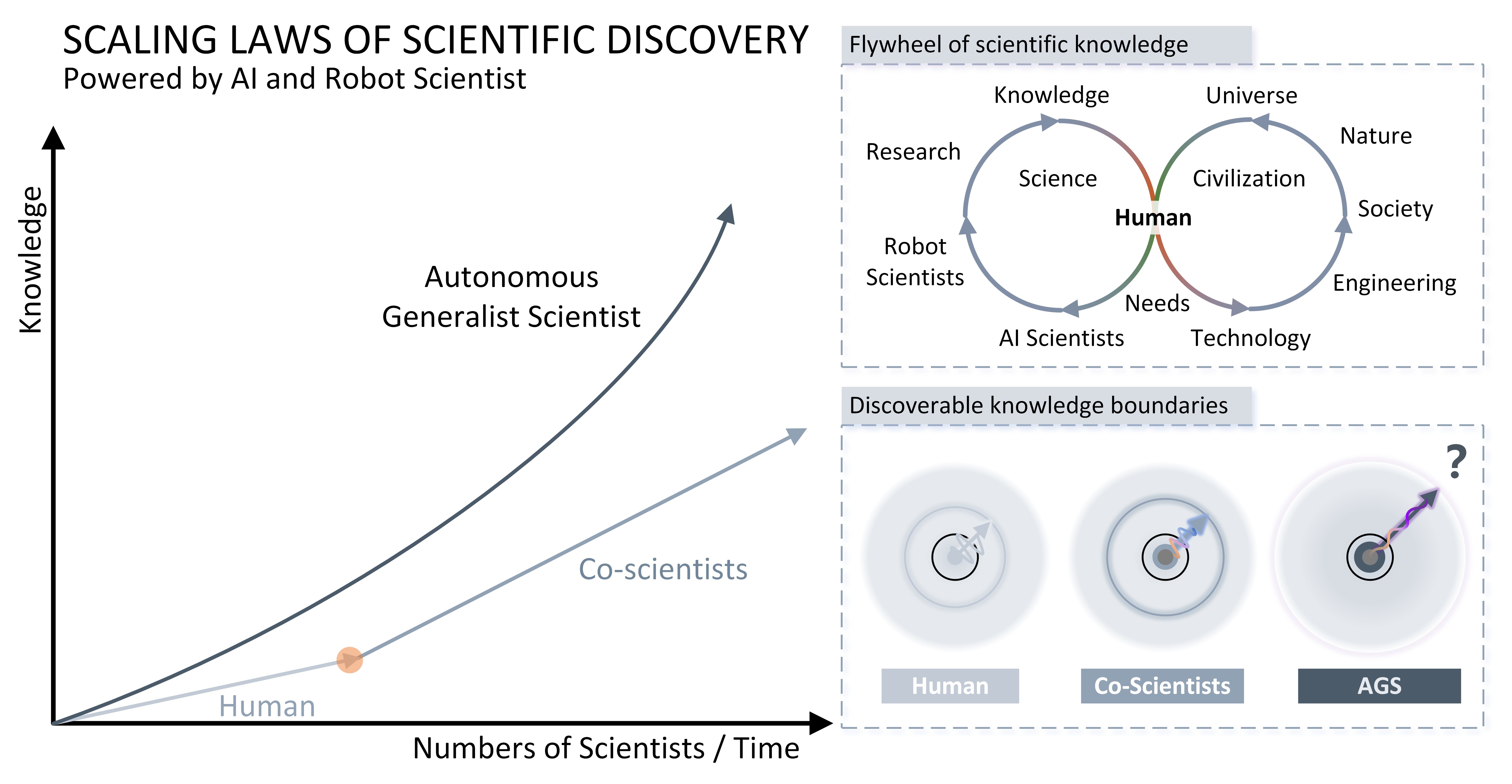
Scaling Laws in Scientific Discovery with AI Scientists and Robot Scientists.
Table of Contents
Papers
-
The AutoResearch Moment: From Experimenter to Research Director, Chaoyue He, Xin Zhou, Di Wang et al., Preprints, 2026
-
AutoNumerics: An Autonomous, PDE-Agnostic Multi-Agent Pipeline for Scientific Computing, Jianda Du, Youran Sun, Haizhao Yang, arXiv, 2026
-
Democratizing Discovery: How Automated Research Pipelines Make Scientific Innovation Universally Accessible, Euan, Zenodo, 2026
-
CORAL: Towards Autonomous Multi-Agent Evolution for Open-Ended Discovery, Ao Qu, Han Zheng, Zijian Zhou et al., arXiv, 2026
-
Scaling Laws in Scientific Discovery with AI and Robot Scientists, Pengsong Zhang, Heng Zhang et al., arXiv, 2025
-
Towards Data-Centric Automatic R&D, Haotian Chen et al., arXiv, 2024
-
Mlr-copilot: Autonomous machine learning research based on large language models agents, Ruochen Li et al., arXiv, 2024
-
Towards end-to-end automation of AI research, Chris Lu et al., Nature, 2026
-
Autonomous Generalist Scientist: Towards and Beyond Human-Level Scientific Research with Agentic and Embodied AI and Robots, Pengsong Zhang, Heng Zhang et al., ResearchGate, 2024
-
ChatGPT as Research Scientist: Probing GPT’s capabilities as a Research Librarian, Research Ethicist, Data Generator, and Data Predictor, Steven A. Lehr et al., PNAS, 2024
Autonomous Literature Review
-
Empowering biomedical evidence exploration and synthesis with deep knowledge graph research, Zifeng Wang et al., Nature Machine Intelligence, 2026
-
SurveyX: Academic Survey Automation via Large Language Models, Xun Liang et al., arXiv, 2025
-
PaSa: An LLM Agent for Comprehensive Academic Paper Search, Yichen He et al., arXiv, 2025
-
SCILITLLM: HOW TO ADAPT LLMS FOR SCIENTIFIC LITERATURE UNDERSTANDING, Sihang Li et al., arXiv, 2024
-
AutoSurvey: Large Language Models Can Automatically Write Surveys, Wenjin Yao et al., arXiv, 2024
-
LLMs4Synthesis: Leveraging Large Language Models for Scientific Synthesis, Hamed Babaei Giglou et al., arXiv, 2024
-
PubTator 3.0: an AI-powered literature resource for unlocking biomedical knowledge, Chih-Hsuan Wei et al., Nucleic Acids Research, 2024
-
PubMed and beyond: biomedical literature search in the age of artificial intelligence, Qiao Jin et al., eBioMedicine, 2024
Proposal, Idea Generation
-
AgentRxiv: Towards Collaborative Autonomous Research, Samuel Schmidgall et al., arXiv, 2025
-
Agent Laboratory: Using LLM Agents as Research Assistants, Samuel Schmidgall et al., arXiv, 2025
-
An empirical investigation of the impact of ChatGPT on creativity, Byung Cheol Lee et al., Nature Human Behaviour, 2024
-
Nova: An Iterative Planning and Search Approach to Enhance Novelty and Diversity of LLM Generated Ideas, Xiang Hu et al., arXiv, 2024
-
Two Heads Are Better Than One: A Multi-Agent System Has the Potential to Improve Scientific Idea Generation, Haoyang Su et al., arXiv, 2024
-
Can LLMs Generate Novel Research Ideas? A Large-Scale Human Study with 100+ NLP Researchers, Chenglei Si et al., arXiv, 2024
-
ResearchAgent: Iterative Research Idea Generation over Scientific Literature with Large Language Models, Jinheon Baek et al., arXiv, 2024
-
Forecasting high-impact research topics via machine learning on evolving knowledge graphs, Xuemei Gu et al., arXiv, 2024
-
Large Language Models are Zero Shot Hypothesis Proposers, Biqing Qi et al., arXiv, 2023
-
SciMON: Scientific Inspiration Machines Optimized for Novelty, Qingyun Wang et al., arXiv, 2023
Virtual, Digital, Agent, Experimentation
-
Autonomous biomedical research with an artificial intelligence agent, Kexin Huang et al., Science, 2026
-
Agon: An Autonomous Large-Scale Omnidisciplinary Research System Built on Prompt Economy, Youran Sun et al., arXiv, 2026
-
AutoZyme: An Autonomous Agentic Framework to Optimize Bioinformatics Software, Elliot Xie et al., bioRxiv, 2026
-
An AI Co-Data-Scientist for Prioritizing Candidate Biomarkers from Wearable Sensor Data, Yubin Kim et al., arXiv, 2026
-
An AI system to help scientists write expert-level empirical software, Eser Aygün et al., Nature, 2026
-
A multi-agent system for automating scientific discovery, Ali E. Ghareeb et al., Nature, 2026
-
Accelerating scientific discovery with Co-Scientist, Juraj Gottweis et al., Nature, 2026
-
An agentic framework for autonomous scientific discovery in cancer pathology, Florian Trost et al., Nature Medicine, 2026
-
Bridging electron microscopy and materials analysis with an autonomous agentic platform, Guangyao Chen, Wenhao Yuan, Fengqi You, Science Advances, 2026
-
Towards end-to-end automation of AI research, Chris Lu et al., Nature, 2026
-
CellVoyager: AI CompBio agent generates new insights by autonomously analyzing biological data, Samuel Alber et al., Nature Methods, 2026
-
CASSIA: a multi-agent large language model for automated and interpretable cell annotation, Elliot Xie et al., Nature Communications, 2025
-
The Virtual Lab of AI agents designs new SARS-CoV-2 nanobodies, Kyle Swanson et al., Nature, 2025
-
aiXiv: A Next-Generation Open Access Ecosystem for Scientific Discovery Generated by AI Scientists, Pengsong Zhang et al., arXiv, 2025
-
GenoMAS: A Multi-Agent Framework for Scientific Discovery via Code-Driven Gene Expression Analysis, Haoyang Liu et al., arXiv, 2025
-
AI Mathematician: Towards Fully Automated Frontier Mathematical Research, Yuanhang Liu et al., arXiv, 2025
-
NovelSeek: When Agent Becomes the Scientist -- Building Closed-Loop System from Hypothesis to Verification, Bo Zhang et al., arXiv, 2025
-
Large language models for scientific discovery in molecular property prediction, Yizhen Zheng et al., Nature Machine Intelligence, 2025
-
Agent Laboratory: Using LLM Agents as Research Assistants, Samuel Schmidgall et al., arXiv, 2025
-
AIDE: AI-Driven Exploration in the Space of Code, Zhengyao Jiang et al., arXiv, 2025
-
SciAgents: Automating scientific discovery through multi-agent intelligent graph reasoning, Alireza Ghafarollahi et al., arXiv, 2024
-
Empowering Biomedical Discovery with AI Agents, Shanghua Gao et al., arXiv, 2024
-
Intelligent software for laboratory automation, Ken E. Whelan et al., Trends in Biotechnology, 2004
Physical, Robot, Experimentation
-
Interpretable self-driving sputtering epitaxy reveals human-usable growth rules for β-Ga2O3 films, Yuki K. Wakabayashi et al., Nature Communications, 2026
-
Rank-guided learning accelerates automated enzyme engineering, Jingyi Xu et al., Nature Communications, 2026
-
An agentic artificially intelligent X-ray scientist, Zhantao Chen et al., Nature Machine Intelligence, 2026
-
An autonomous lab for data-driven homogeneous catalysis, J. A. Bennett et al., Nature Communications, 2026
-
Autonomous microfluidic experimentation for exploring reaction inference and synthesizing double perovskite nanoplatelets, Junbin Li et al., Nature Communications, 2026
-
A flexible and affordable self-driving laboratory for automated reaction optimization, Simone Pilon et al., Nature Synthesis, 2026
-
Experimental mechanician for plate lattice metamaterial discovery, Songtao Hu et al., Nature Communications, 2026
-
Discovery of tunable and soluble organic emitters for solid-state lasers with a self-driving laboratory, Hyun Suk Park et al., Nature Communications, 2026
-
Augmenting large language models with chemistry tools, Andres M. Bran et al., Nature Machine Intelligence, 2024
-
ORGANA: A Robotic Assistant for Automated Chemistry Experimentation and Characterization, Kourosh Darvish et al., Matter, 2024
-
MatPilot: an LLM-enabled AI Materials Scientist under the Framework of Human-Machine Collaboration, Ziqi Ni et al., arXiv, 2024
-
Autonomous mobile robots for exploratory synthetic chemistry, Tianwei Dai et al., Nature, 2024
-
A multi-agent-driven robotic AI chemist enabling autonomous chemical research on demand, Tao Song et al., Chemrxiv, 2024
-
Autonomous chemical research with large language models, Daniil A. Boiko et al., Nature, 2023
-
An ontology for a Robot Scientist, Larisa N. Soldatova et al., Bioinformatics, 2006
Manuscript
-
CiteSee: Augmenting Citations in Scientific Papers with Persistent and Personalized Historical Context, Joseph Chee Chang et al., arXiv, 2023
-
Beyond Summarization: Designing AI Support for Real-World Expository Writing Tasks, Zejiang Shen et al., arXiv, 2023
-
ScholarCopilot: Training Large Language Models for Academic Writing with Accurate Citations, Yubo Wang et al., arXiv, 2025
Peer Review
-
Automated scholarly paper review: Concepts, technologies, and challenges, Jialiang Lin et al., Information Fusion, 2023
-
Automated Peer Reviewing in Paper SEA: Standardization, Evaluation, and Analysis, Jianxiang Yu et al., arXiv, 2024
-
MARG: Multi-Agent Review Generation for Scientific Papers, Mike D'Arcy et al., arXiv, 2024
-
Project Rachel: Can an AI Become a Scholarly Author?, arXiv 2511.14819, 2025.
Survey
-
The past, present and future of self-driving laboratories, Richard B. Canty, Milad Abolhasani, Nature Reviews Chemistry, 2026
-
Agentic AI and the rise of in silico team science in biomedical research, Binglan Li et al., Nature Biotechnology, 2026
-
What's Missing in Autonomous Research? A Systematization of Systems, Benchmarks, and Verification, Xingyu Ren et al., ResearchGate, 2026
-
Synergy of robotics and microfluidics for intelligent micro-and nanomanipulation, Mengmeng Xi, Pengsong Zhang et al., Biomicrofluidics, 2025
-
Large Language Models in Drug Discovery and Development: From Disease Mechanisms to Clinical Trials, Yizhen Zheng et al., arXiv, 2024
-
Towards Scientific Discovery with Generative AI: Progress, Opportunities, and Challenges, Chandan K Reddy et al., arXiv, 2024
-
Bridging AI and Science: Implications from a Large-Scale Literature Analysis of AI4Science, Yutong Xie et al., arXiv, 2024
-
Paradigm shifts from data-intensive science to robot scientists, Xin Li et al., Science Bulletin, 2024
-
A Comprehensive Survey of Scientific Large Language Models and Their Applications in Scientific Discovery, Yu Zhang et al., arXiv, 2024
-
Artificial Intelligence, Scientific Discovery, and Product Innovation, Toner-Rodgers Aidan, aidantr.github.io, 2024
-
AI for Science: AI enabled scientific facility transforms fundamental research, Xiaokang Yang, Bulletin of Chinese Academy of Sciences, 2024
-
Towards robot scientists for autonomous scientific discovery, Andrew Sparkes et al., Automated experimentation, 2010
News
-
Accelerating Discovery in Natural Science Laboratories with AI and Robotics: Perspectives and Challenges from the 2024 IEEE ICRA Workshop, Yokohama, Japan, Andrew I. Cooper et al., IEEE ICRA Workshop, 2024
-
A new golden age of discovery, Conor Griffin et al., Google DeepMind, 2024
-
Transforming science labs into automated factories of discovery, Angelos Angelopoulos, Science Robotics, 2024
-
Researchers built an ‘AI Scientist’ — what can it do?, Davide Castelvecchi et al., Nature, 2024
-
How to Enter the Chen Institute & Science Prize for AI Accelerated Research, ChenSciencePrize@aaas.org et al., Science, 2024
-
Advancing scientific discovery with the aid of robotics, Amos Matsiko, Science Robotics, 2024
Benchmark
-
MLS-Bench: A Holistic and Rigorous Assessment of AI Systems on Building Better AI, Bohan Lyu et al., arXiv, 2026
-
REFUTE: Scientific Critique & Epistemic Calibration Benchmark — Apache-2.0 Hugging Face benchmark for calibrated critique of recent science paper summaries. Technical report
-
GenoTEX: An LLM Agent Benchmark for Automated Gene Expression Data Analysis, Haoyang Liu et al., MLCB, 2025
-
CORE-Bench: Fostering the Credibility of Published Research Through a Computational Reproducibility Agent Benchmark, Zachary S. Siegel et al., arXiv, 2024
-
CiteBench: A benchmark for Scientific Citation Text Generation, Martin Funkquist et al., Conference on Empirical Methods in Natural Language Processing, 2022
Timeline
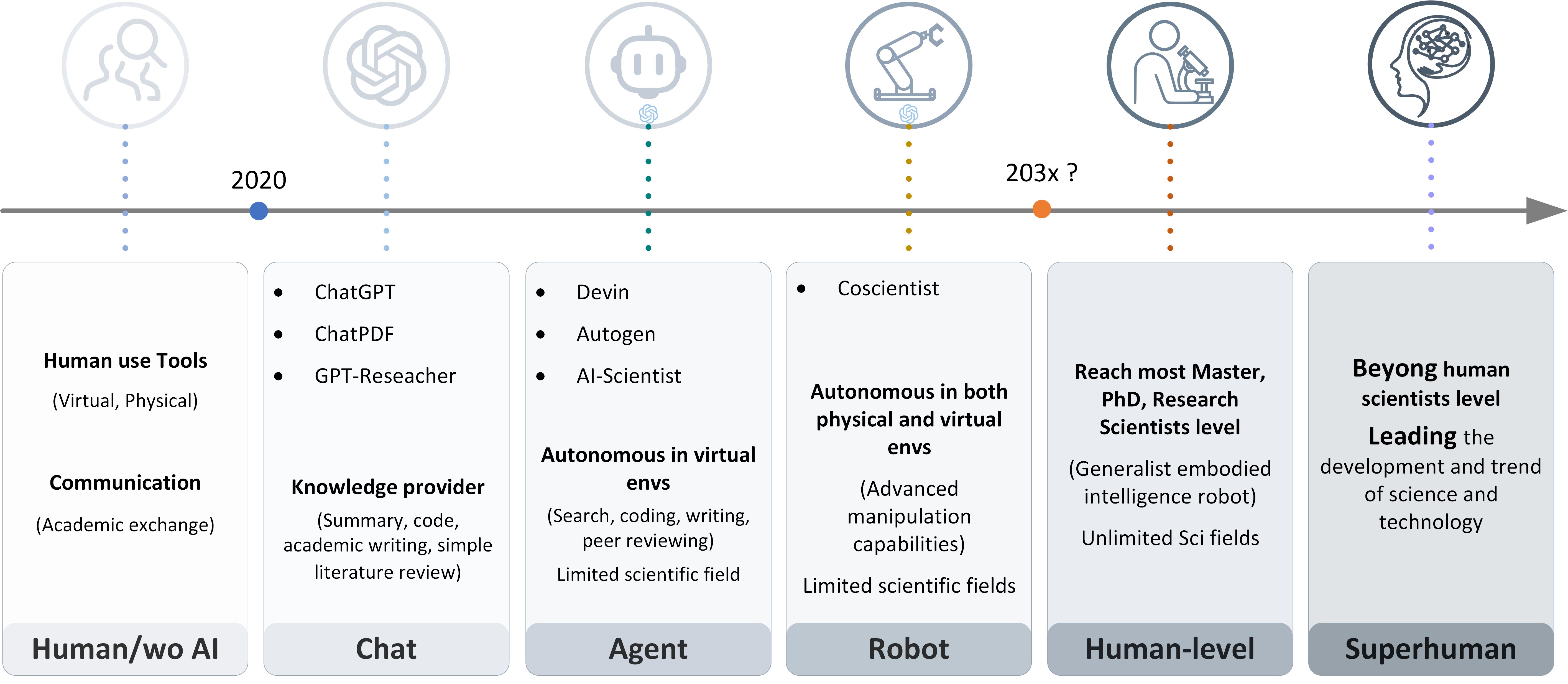
This timeline illustrates key milestones and future predictions in the development of autonomous AI Scientist and Robot Scientist.
Discussions
We love connecting with the community to discuss AI and Robot Scientist research, share insights, and collaborate on groundbreaking ideas! Join us on the following platforms:
-
Slack: Connect with us on Slack for professional conversations, paper discussions, and networking with the AI research community.
Join Slack -
WeChat Group: Join our WeChat group to discuss papers, share updates, and collaborate. Contact an admin (pengsong dot zhang@mail.utoronto.ca) to join.
We’re excited to hear your thoughts and contributions in our community!
Contributing
We welcome contributions to make this repository a richer resource for the AI and Robot Scientist community! To contribute:
- Add Papers: Suggest new papers by submitting a pull request with the paper’s title, authors, link, and publication details in the appropriate section.
- Enhance Content: Propose improvements to categories, summaries, or timelines.
- Report Issues: Open an issue for typos, broken links, or suggestions.
Cite
bibtex
@article{zhang2025scaling,
  title={Scaling Laws in Scientific Discovery with AI and Robot Scientists},
  author={Zhang, Pengsong and Zhang, Heng and Xu, Huazhe and Xu, Renjun and Wang, Zhenting and Wang, Cong and Garg, Animesh and Li, Zhibin and Ajoudani, Arash and Liu, Xinyu},
  journal={arXiv preprint arXiv:2503.22444},
  year={2025}
}

@article{zhangautonomous,
  title={Autonomous Generalist Scientist: Towards and Beyond Human-Level Scientific Research with Agentic and Embodied AI and Robots},
  author={Zhang, Pengsong and Zhang, Heng and Xu, Huazhe and Xu, Renjun and Wang, Zhenting and Wang, Cong and Garg, Animesh and Li, Zhibin and Liu, Xinyu and Ajoudani, Arash},
  journal={ResearchGate preprint RG.2.2.35148.01923},
  year={2024}
}
License
MIT
Similar repos


A collection of resources and papers on AI Scientist / Robot Scientist
173
74 commits
updated Sep 15, 2026
README
Awesome AI Scientist Papers
Welcome to the Awesome AI Scientist Papers repository! This project aims to curate a collection of important papers to the field of AI/Robot Scientist.
Scaling Laws in Scientific Discovery with AI Scientists and Robot Scientists.
Table of Contents
Papers
-
The AutoResearch Moment: From Experimenter to Research Director, Chaoyue He, Xin Zhou, Di Wang et al., Preprints, 2026
-
AutoNumerics: An Autonomous, PDE-Agnostic Multi-Agent Pipeline for Scientific Computing, Jianda Du, Youran Sun, Haizhao Yang, arXiv, 2026
-
Democratizing Discovery: How Automated Research Pipelines Make Scientific Innovation Universally Accessible, Euan, Zenodo, 2026
-
CORAL: Towards Autonomous Multi-Agent Evolution for Open-Ended Discovery, Ao Qu, Han Zheng, Zijian Zhou et al., arXiv, 2026
-
Scaling Laws in Scientific Discovery with AI and Robot Scientists, Pengsong Zhang, Heng Zhang et al., arXiv, 2025
-
Towards Data-Centric Automatic R&D, Haotian Chen et al., arXiv, 2024
-
Mlr-copilot: Autonomous machine learning research based on large language models agents, Ruochen Li et al., arXiv, 2024
-
Towards end-to-end automation of AI research, Chris Lu et al., Nature, 2026
-
Autonomous Generalist Scientist: Towards and Beyond Human-Level Scientific Research with Agentic and Embodied AI and Robots, Pengsong Zhang, Heng Zhang et al., ResearchGate, 2024
-
ChatGPT as Research Scientist: Probing GPT’s capabilities as a Research Librarian, Research Ethicist, Data Generator, and Data Predictor, Steven A. Lehr et al., PNAS, 2024
Autonomous Literature Review
-
Empowering biomedical evidence exploration and synthesis with deep knowledge graph research, Zifeng Wang et al., Nature Machine Intelligence, 2026
-
SurveyX: Academic Survey Automation via Large Language Models, Xun Liang et al., arXiv, 2025
-
PaSa: An LLM Agent for Comprehensive Academic Paper Search, Yichen He et al., arXiv, 2025
-
SCILITLLM: HOW TO ADAPT LLMS FOR SCIENTIFIC LITERATURE UNDERSTANDING, Sihang Li et al., arXiv, 2024
-
AutoSurvey: Large Language Models Can Automatically Write Surveys, Wenjin Yao et al., arXiv, 2024
-
LLMs4Synthesis: Leveraging Large Language Models for Scientific Synthesis, Hamed Babaei Giglou et al., arXiv, 2024
-
PubTator 3.0: an AI-powered literature resource for unlocking biomedical knowledge, Chih-Hsuan Wei et al., Nucleic Acids Research, 2024
-
PubMed and beyond: biomedical literature search in the age of artificial intelligence, Qiao Jin et al., eBioMedicine, 2024
Proposal, Idea Generation
-
AgentRxiv: Towards Collaborative Autonomous Research, Samuel Schmidgall et al., arXiv, 2025
-
Agent Laboratory: Using LLM Agents as Research Assistants, Samuel Schmidgall et al., arXiv, 2025
-
An empirical investigation of the impact of ChatGPT on creativity, Byung Cheol Lee et al., Nature Human Behaviour, 2024
-
Nova: An Iterative Planning and Search Approach to Enhance Novelty and Diversity of LLM Generated Ideas, Xiang Hu et al., arXiv, 2024
-
Two Heads Are Better Than One: A Multi-Agent System Has the Potential to Improve Scientific Idea Generation, Haoyang Su et al., arXiv, 2024
-
Can LLMs Generate Novel Research Ideas? A Large-Scale Human Study with 100+ NLP Researchers, Chenglei Si et al., arXiv, 2024
-
ResearchAgent: Iterative Research Idea Generation over Scientific Literature with Large Language Models, Jinheon Baek et al., arXiv, 2024
-
Forecasting high-impact research topics via machine learning on evolving knowledge graphs, Xuemei Gu et al., arXiv, 2024
-
Large Language Models are Zero Shot Hypothesis Proposers, Biqing Qi et al., arXiv, 2023
-
SciMON: Scientific Inspiration Machines Optimized for Novelty, Qingyun Wang et al., arXiv, 2023
Virtual, Digital, Agent, Experimentation
-
Autonomous biomedical research with an artificial intelligence agent, Kexin Huang et al., Science, 2026
-
Agon: An Autonomous Large-Scale Omnidisciplinary Research System Built on Prompt Economy, Youran Sun et al., arXiv, 2026
-
AutoZyme: An Autonomous Agentic Framework to Optimize Bioinformatics Software, Elliot Xie et al., bioRxiv, 2026
-
An AI Co-Data-Scientist for Prioritizing Candidate Biomarkers from Wearable Sensor Data, Yubin Kim et al., arXiv, 2026
-
An AI system to help scientists write expert-level empirical software, Eser Aygün et al., Nature, 2026
-
A multi-agent system for automating scientific discovery, Ali E. Ghareeb et al., Nature, 2026
-
Accelerating scientific discovery with Co-Scientist, Juraj Gottweis et al., Nature, 2026
-
An agentic framework for autonomous scientific discovery in cancer pathology, Florian Trost et al., Nature Medicine, 2026
-
Bridging electron microscopy and materials analysis with an autonomous agentic platform, Guangyao Chen, Wenhao Yuan, Fengqi You, Science Advances, 2026
-
Towards end-to-end automation of AI research, Chris Lu et al., Nature, 2026
-
CellVoyager: AI CompBio agent generates new insights by autonomously analyzing biological data, Samuel Alber et al., Nature Methods, 2026
-
CASSIA: a multi-agent large language model for automated and interpretable cell annotation, Elliot Xie et al., Nature Communications, 2025
-
The Virtual Lab of AI agents designs new SARS-CoV-2 nanobodies, Kyle Swanson et al., Nature, 2025
-
aiXiv: A Next-Generation Open Access Ecosystem for Scientific Discovery Generated by AI Scientists, Pengsong Zhang et al., arXiv, 2025
-
GenoMAS: A Multi-Agent Framework for Scientific Discovery via Code-Driven Gene Expression Analysis, Haoyang Liu et al., arXiv, 2025
-
AI Mathematician: Towards Fully Automated Frontier Mathematical Research, Yuanhang Liu et al., arXiv, 2025
-
NovelSeek: When Agent Becomes the Scientist -- Building Closed-Loop System from Hypothesis to Verification, Bo Zhang et al., arXiv, 2025
-
Large language models for scientific discovery in molecular property prediction, Yizhen Zheng et al., Nature Machine Intelligence, 2025
-
Agent Laboratory: Using LLM Agents as Research Assistants, Samuel Schmidgall et al., arXiv, 2025
-
AIDE: AI-Driven Exploration in the Space of Code, Zhengyao Jiang et al., arXiv, 2025
-
SciAgents: Automating scientific discovery through multi-agent intelligent graph reasoning, Alireza Ghafarollahi et al., arXiv, 2024
-
Empowering Biomedical Discovery with AI Agents, Shanghua Gao et al., arXiv, 2024
-
Intelligent software for laboratory automation, Ken E. Whelan et al., Trends in Biotechnology, 2004
Physical, Robot, Experimentation
-
Interpretable self-driving sputtering epitaxy reveals human-usable growth rules for β-Ga2O3 films, Yuki K. Wakabayashi et al., Nature Communications, 2026
-
Rank-guided learning accelerates automated enzyme engineering, Jingyi Xu et al., Nature Communications, 2026
-
An agentic artificially intelligent X-ray scientist, Zhantao Chen et al., Nature Machine Intelligence, 2026
-
An autonomous lab for data-driven homogeneous catalysis, J. A. Bennett et al., Nature Communications, 2026
-
Autonomous microfluidic experimentation for exploring reaction inference and synthesizing double perovskite nanoplatelets, Junbin Li et al., Nature Communications, 2026
-
A flexible and affordable self-driving laboratory for automated reaction optimization, Simone Pilon et al., Nature Synthesis, 2026
-
Experimental mechanician for plate lattice metamaterial discovery, Songtao Hu et al., Nature Communications, 2026
-
Discovery of tunable and soluble organic emitters for solid-state lasers with a self-driving laboratory, Hyun Suk Park et al., Nature Communications, 2026
-
Augmenting large language models with chemistry tools, Andres M. Bran et al., Nature Machine Intelligence, 2024
-
ORGANA: A Robotic Assistant for Automated Chemistry Experimentation and Characterization, Kourosh Darvish et al., Matter, 2024
-
MatPilot: an LLM-enabled AI Materials Scientist under the Framework of Human-Machine Collaboration, Ziqi Ni et al., arXiv, 2024
-
Autonomous mobile robots for exploratory synthetic chemistry, Tianwei Dai et al., Nature, 2024
-
A multi-agent-driven robotic AI chemist enabling autonomous chemical research on demand, Tao Song et al., Chemrxiv, 2024
-
Autonomous chemical research with large language models, Daniil A. Boiko et al., Nature, 2023
-
An ontology for a Robot Scientist, Larisa N. Soldatova et al., Bioinformatics, 2006
Manuscript
-
CiteSee: Augmenting Citations in Scientific Papers with Persistent and Personalized Historical Context, Joseph Chee Chang et al., arXiv, 2023
-
Beyond Summarization: Designing AI Support for Real-World Expository Writing Tasks, Zejiang Shen et al., arXiv, 2023
-
ScholarCopilot: Training Large Language Models for Academic Writing with Accurate Citations, Yubo Wang et al., arXiv, 2025
Peer Review
-
Automated scholarly paper review: Concepts, technologies, and challenges, Jialiang Lin et al., Information Fusion, 2023
-
Automated Peer Reviewing in Paper SEA: Standardization, Evaluation, and Analysis, Jianxiang Yu et al., arXiv, 2024
-
MARG: Multi-Agent Review Generation for Scientific Papers, Mike D'Arcy et al., arXiv, 2024
-
Project Rachel: Can an AI Become a Scholarly Author?, arXiv 2511.14819, 2025.
Survey
-
The past, present and future of self-driving laboratories, Richard B. Canty, Milad Abolhasani, Nature Reviews Chemistry, 2026
-
Agentic AI and the rise of in silico team science in biomedical research, Binglan Li et al., Nature Biotechnology, 2026
-
What's Missing in Autonomous Research? A Systematization of Systems, Benchmarks, and Verification, Xingyu Ren et al., ResearchGate, 2026
-
Synergy of robotics and microfluidics for intelligent micro-and nanomanipulation, Mengmeng Xi, Pengsong Zhang et al., Biomicrofluidics, 2025
-
Large Language Models in Drug Discovery and Development: From Disease Mechanisms to Clinical Trials, Yizhen Zheng et al., arXiv, 2024
-
Towards Scientific Discovery with Generative AI: Progress, Opportunities, and Challenges, Chandan K Reddy et al., arXiv, 2024
-
Bridging AI and Science: Implications from a Large-Scale Literature Analysis of AI4Science, Yutong Xie et al., arXiv, 2024
-
Paradigm shifts from data-intensive science to robot scientists, Xin Li et al., Science Bulletin, 2024
-
A Comprehensive Survey of Scientific Large Language Models and Their Applications in Scientific Discovery, Yu Zhang et al., arXiv, 2024
-
Artificial Intelligence, Scientific Discovery, and Product Innovation, Toner-Rodgers Aidan, aidantr.github.io, 2024
-
AI for Science: AI enabled scientific facility transforms fundamental research, Xiaokang Yang, Bulletin of Chinese Academy of Sciences, 2024
-
Towards robot scientists for autonomous scientific discovery, Andrew Sparkes et al., Automated experimentation, 2010
News
-
Accelerating Discovery in Natural Science Laboratories with AI and Robotics: Perspectives and Challenges from the 2024 IEEE ICRA Workshop, Yokohama, Japan, Andrew I. Cooper et al., IEEE ICRA Workshop, 2024
-
A new golden age of discovery, Conor Griffin et al., Google DeepMind, 2024
-
Transforming science labs into automated factories of discovery, Angelos Angelopoulos, Science Robotics, 2024
-
Researchers built an ‘AI Scientist’ — what can it do?, Davide Castelvecchi et al., Nature, 2024
-
How to Enter the Chen Institute & Science Prize for AI Accelerated Research, ChenSciencePrize@aaas.org et al., Science, 2024
-
Advancing scientific discovery with the aid of robotics, Amos Matsiko, Science Robotics, 2024
Benchmark
-
MLS-Bench: A Holistic and Rigorous Assessment of AI Systems on Building Better AI, Bohan Lyu et al., arXiv, 2026
-
REFUTE: Scientific Critique & Epistemic Calibration Benchmark — Apache-2.0 Hugging Face benchmark for calibrated critique of recent science paper summaries. Technical report
-
GenoTEX: An LLM Agent Benchmark for Automated Gene Expression Data Analysis, Haoyang Liu et al., MLCB, 2025
-
CORE-Bench: Fostering the Credibility of Published Research Through a Computational Reproducibility Agent Benchmark, Zachary S. Siegel et al., arXiv, 2024
-
CiteBench: A benchmark for Scientific Citation Text Generation, Martin Funkquist et al., Conference on Empirical Methods in Natural Language Processing, 2022
Timeline
This timeline illustrates key milestones and future predictions in the development of autonomous AI Scientist and Robot Scientist.
Discussions
We love connecting with the community to discuss AI and Robot Scientist research, share insights, and collaborate on groundbreaking ideas! Join us on the following platforms:
-
Slack: Connect with us on Slack for professional conversations, paper discussions, and networking with the AI research community.
Join Slack -
WeChat Group: Join our WeChat group to discuss papers, share updates, and collaborate. Contact an admin (pengsong dot zhang@mail.utoronto.ca) to join.
We’re excited to hear your thoughts and contributions in our community!
Contributing
We welcome contributions to make this repository a richer resource for the AI and Robot Scientist community! To contribute:
- Add Papers: Suggest new papers by submitting a pull request with the paper’s title, authors, link, and publication details in the appropriate section.
- Enhance Content: Propose improvements to categories, summaries, or timelines.
- Report Issues: Open an issue for typos, broken links, or suggestions.
Cite
bibtex
@article{zhang2025scaling,
  title={Scaling Laws in Scientific Discovery with AI and Robot Scientists},
  author={Zhang, Pengsong and Zhang, Heng and Xu, Huazhe and Xu, Renjun and Wang, Zhenting and Wang, Cong and Garg, Animesh and Li, Zhibin and Ajoudani, Arash and Liu, Xinyu},
  journal={arXiv preprint arXiv:2503.22444},
  year={2025}
}

@article{zhangautonomous,
  title={Autonomous Generalist Scientist: Towards and Beyond Human-Level Scientific Research with Agentic and Embodied AI and Robots},
  author={Zhang, Pengsong and Zhang, Heng and Xu, Huazhe and Xu, Renjun and Wang, Zhenting and Wang, Cong and Garg, Animesh and Li, Zhibin and Liu, Xinyu and Ajoudani, Arash},
  journal={ResearchGate preprint RG.2.2.35148.01923},
  year={2024}
}
License
MIT