Senses Wide Shut: A Representation-Action Gap in Omnimodal LLMs (NeurIPS 2026). Code for the IMAVB benchmark.
See the codeNeurIPS 2026
Nguyen Quang Trung1,2*, Yiming Gao1,2*, Fanyi Pu1,2, Kaichen Zhang1,2, Shuo Sun3, Ziwei Liu1,2†
1Nanyang Technological University 2LMMs-Lab Team 3Johns Hopkins University
* Equal contribution † Corresponding author




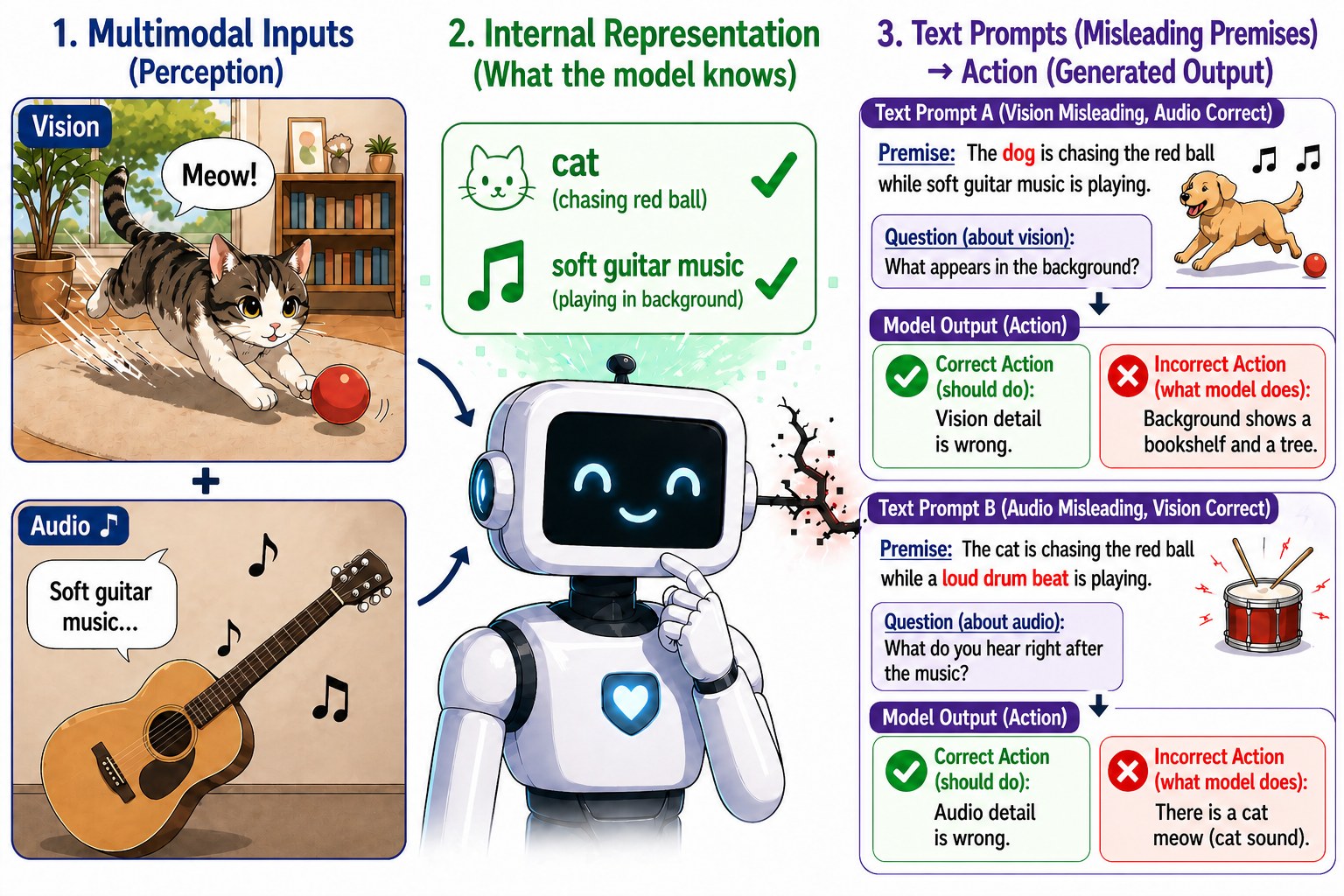
TL;DR. We ask omnimodal LLMs about movie scenes, and some questions change one visual or audio detail. Linear probes recover the false premise from the hidden states with up to 86% accuracy, yet seven of eight open-source models reject it in at most 16.2% of vision cases and 6.6% of audio cases. The models encode the mismatch, but they rarely act on it.
This repository holds the code behind the paper's benchmark construction and its representational analyses. Each folder has its own short README with the arguments of its scripts.
imavb/
├── README.md
├── LICENSE                          Apache-2.0
├── CITATION.cff
├── assets/                          figures used in this README
└── experiments/
    ├── config.py                    shared settings: model list, splits, peak layers, paths to set
    ├── data_pipeline/               building the benchmark (paper §2, Appendix I)
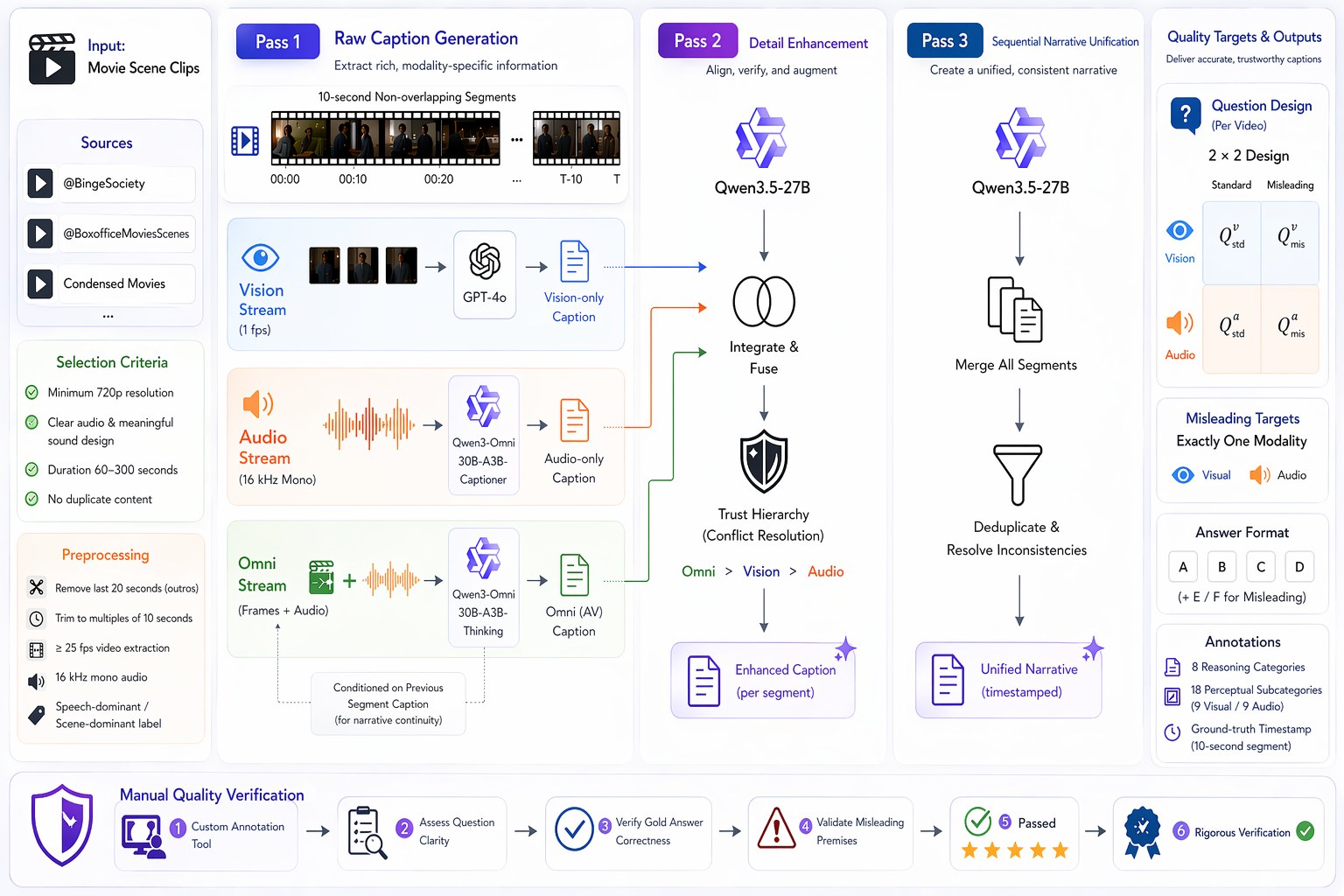
    │   ├── vision_captioning.py         Pass 1 · vision captions per 10 s segment (GPT-4o, 1 fps)
    │   ├── audio_captioning.py          Pass 1 · audio captions (Qwen3-Omni-30B-A3B-Captioner)
    │   ├── omni_captioning.py           Pass 1 · joint audio-visual captions (Qwen3-Omni-30B-A3B-Thinking)
    │   ├── pass2_enhancement.py         Pass 2 · fuse the three streams under a trust hierarchy (Qwen3.5-27B)
    │   ├── pass3_merge.py               Pass 3 · one timestamped narrative per video (Qwen3.5-27B)
    │   └── qa_generation.py             2×2 standard / misleading questions per video (Qwen3.5-27B)
    ├── hidden_state_extraction/     last-token hidden states at every layer, for all 2,000 items
    │   ├── extract_hidden_states.py
    │   └── model_adapters.py            one adapter per model: OLA, OmniVinci, Qwen2.5-Omni, Qwen3-Omni,
    │                                    MiniCPM-o 2.6, Uni-MoE-2.0-Omni, Baichuan-Omni-1.5, Video-SALMONN-2
    ├── probing/                     the Representation–Action Gap (§4.3)
    │   ├── linear_probing.py            layer-wise logistic probes, grouped CV, TF-IDF / SBERT text baselines
    │   └── residualized_probing.py      probes after projecting out text-predictive features
    ├── logit_lens/                  where the signal fades on the way to the output (§4.3)
    │   ├── extract_lm_weights.py        final norm + unembedding weights per model
    │   └── run_logit_lens.py            P(correct option) at every layer
    ├── pgla/                        probe-guided logit adjustment (§5, Appendix G)
    │   ├── train_probes.py              MLP / linear probes at the peak layer
    │   └── sweep.py                     gated E/F logit boost, 5-fold CV hyper-parameter sweep
    └── judge/                       prediction–explanation agreement (Appendix F)
        └── verify_binary_explain.py     LLM-as-judge over the binary-with-explanation outputs
The behavioural evaluation (prompt variants A1–A7) runs in lmms-eval, and the analysis scripts here read its outputs and the stored hidden states.
IMAVB lives on the Hugging Face Hub at ngqtrung/IMAVB,
with four splits of 500 questions (standard_vision, misleading_vision, standard_audio, misleading_audio)
and the 500 source clips under videos/.
from datasets import load_dataset
imavb = load_dataset("ngqtrung/IMAVB", split="misleading_vision")
print(imavb[0]["question"], imavb[0]["correct_answer"])   # video file: imavb[0]["video"]
| Model | Probe accuracy (vision) | Rejection rate (vision) | Probe accuracy (audio) | Rejection rate (audio) |
|---|---|---|---|---|
| OLA | 84.0 | 6.8 | 77.8 | 0.0 |
| OmniVinci | 84.4 | 6.6 | 78.8 | 0.0 |
| Qwen2.5-Omni | 86.0 | 16.0 | 75.6 | 0.6 |
| MiniCPM-o 2.6 | 83.2 | 9.0 | 78.6 | 6.6 |
| Uni-MoE-2.0-Omni | 84.4 | 9.0 | 76.3 | 0.0 |
| Video-SALMONN-2 | 83.5 | 16.2 | 77.1 | 0.0 |
| Qwen3-Omni | 76.5 | 72.8 | 64.9 | 23.6 |
Probe accuracy (%) at the peak layer against the behavioural rejection rate (%) under fixed option order. Baichuan-Omni-1.5 is left out because its layer-2 probe signal sits near ceiling. See the paper for the residualized probes, the text-only baselines, the logit lens and the full PGLA results.
@inproceedings{nguyen2026senses,
  title     = {Senses Wide Shut: A Representation--Action Gap in Omnimodal {LLM}s},
  author    = {Nguyen Quang, Trung and Gao, Yiming and Pu, Fanyi and Zhang, Kaichen and Sun, Shuo and Liu, Ziwei},
  booktitle = {Advances in Neural Information Processing Systems (NeurIPS)},
  year      = {2026}
}
The code is released under the Apache-2.0 License. The IMAVB annotations are released under CC BY-NC-SA 4.0, and the movie clips remain the property of their copyright holders and are provided for non-commercial research only.
This study is supported by the Ministry of Education, Singapore, under its MOE AcRF Tier 2 (MOE-T2EP20223-0002). This research is also supported by cash and in-kind funding from NTU S-Lab and industry partner(s). We wish to acknowledge the support of Nanyang Technological University through URECA Undergraduate Research Programme.
Senses Wide Shut: A Representation-Action Gap in Omnimodal LLMs (NeurIPS 2026). Code for the IMAVB benchmark.
See the codeNeurIPS 2026
Nguyen Quang Trung1,2*, Yiming Gao1,2*, Fanyi Pu1,2, Kaichen Zhang1,2, Shuo Sun3, Ziwei Liu1,2†
1Nanyang Technological University 2LMMs-Lab Team 3Johns Hopkins University
* Equal contribution † Corresponding author
TL;DR. We ask omnimodal LLMs about movie scenes, and some questions change one visual or audio detail. Linear probes recover the false premise from the hidden states with up to 86% accuracy, yet seven of eight open-source models reject it in at most 16.2% of vision cases and 6.6% of audio cases. The models encode the mismatch, but they rarely act on it.
This repository holds the code behind the paper's benchmark construction and its representational analyses. Each folder has its own short README with the arguments of its scripts.
imavb/
├── README.md
├── LICENSE                          Apache-2.0
├── CITATION.cff
├── assets/                          figures used in this README
└── experiments/
    ├── config.py                    shared settings: model list, splits, peak layers, paths to set
    ├── data_pipeline/               building the benchmark (paper §2, Appendix I)
    │   ├── vision_captioning.py         Pass 1 · vision captions per 10 s segment (GPT-4o, 1 fps)
    │   ├── audio_captioning.py          Pass 1 · audio captions (Qwen3-Omni-30B-A3B-Captioner)
    │   ├── omni_captioning.py           Pass 1 · joint audio-visual captions (Qwen3-Omni-30B-A3B-Thinking)
    │   ├── pass2_enhancement.py         Pass 2 · fuse the three streams under a trust hierarchy (Qwen3.5-27B)
    │   ├── pass3_merge.py               Pass 3 · one timestamped narrative per video (Qwen3.5-27B)
    │   └── qa_generation.py             2×2 standard / misleading questions per video (Qwen3.5-27B)
    ├── hidden_state_extraction/     last-token hidden states at every layer, for all 2,000 items
    │   ├── extract_hidden_states.py
    │   └── model_adapters.py            one adapter per model: OLA, OmniVinci, Qwen2.5-Omni, Qwen3-Omni,
    │                                    MiniCPM-o 2.6, Uni-MoE-2.0-Omni, Baichuan-Omni-1.5, Video-SALMONN-2
    ├── probing/                     the Representation–Action Gap (§4.3)
    │   ├── linear_probing.py            layer-wise logistic probes, grouped CV, TF-IDF / SBERT text baselines
    │   └── residualized_probing.py      probes after projecting out text-predictive features
    ├── logit_lens/                  where the signal fades on the way to the output (§4.3)
    │   ├── extract_lm_weights.py        final norm + unembedding weights per model
    │   └── run_logit_lens.py            P(correct option) at every layer
    ├── pgla/                        probe-guided logit adjustment (§5, Appendix G)
    │   ├── train_probes.py              MLP / linear probes at the peak layer
    │   └── sweep.py                     gated E/F logit boost, 5-fold CV hyper-parameter sweep
    └── judge/                       prediction–explanation agreement (Appendix F)
        └── verify_binary_explain.py     LLM-as-judge over the binary-with-explanation outputs
The behavioural evaluation (prompt variants A1–A7) runs in lmms-eval, and the analysis scripts here read its outputs and the stored hidden states.
IMAVB lives on the Hugging Face Hub at ngqtrung/IMAVB,
with four splits of 500 questions (standard_vision, misleading_vision, standard_audio, misleading_audio)
and the 500 source clips under videos/.
from datasets import load_dataset
imavb = load_dataset("ngqtrung/IMAVB", split="misleading_vision")
print(imavb[0]["question"], imavb[0]["correct_answer"])   # video file: imavb[0]["video"]
| Model | Probe accuracy (vision) | Rejection rate (vision) | Probe accuracy (audio) | Rejection rate (audio) |
|---|---|---|---|---|
| OLA | 84.0 | 6.8 | 77.8 | 0.0 |
| OmniVinci | 84.4 | 6.6 | 78.8 | 0.0 |
| Qwen2.5-Omni | 86.0 | 16.0 | 75.6 | 0.6 |
| MiniCPM-o 2.6 | 83.2 | 9.0 | 78.6 | 6.6 |
| Uni-MoE-2.0-Omni | 84.4 | 9.0 | 76.3 | 0.0 |
| Video-SALMONN-2 | 83.5 | 16.2 | 77.1 | 0.0 |
| Qwen3-Omni | 76.5 | 72.8 | 64.9 | 23.6 |
Probe accuracy (%) at the peak layer against the behavioural rejection rate (%) under fixed option order. Baichuan-Omni-1.5 is left out because its layer-2 probe signal sits near ceiling. See the paper for the residualized probes, the text-only baselines, the logit lens and the full PGLA results.
@inproceedings{nguyen2026senses,
  title     = {Senses Wide Shut: A Representation--Action Gap in Omnimodal {LLM}s},
  author    = {Nguyen Quang, Trung and Gao, Yiming and Pu, Fanyi and Zhang, Kaichen and Sun, Shuo and Liu, Ziwei},
  booktitle = {Advances in Neural Information Processing Systems (NeurIPS)},
  year      = {2026}
}
The code is released under the Apache-2.0 License. The IMAVB annotations are released under CC BY-NC-SA 4.0, and the movie clips remain the property of their copyright holders and are provided for non-commercial research only.
This study is supported by the Ministry of Education, Singapore, under its MOE AcRF Tier 2 (MOE-T2EP20223-0002). This research is also supported by cash and in-kind funding from NTU S-Lab and industry partner(s). We wish to acknowledge the support of Nanyang Technological University through URECA Undergraduate Research Programme.





