
WorldSense: Evaluating Real-world Omnimodal Understanding for Multimodal LLMs
See the codeREADME
WorldSense: Evaluating Real-world Omnimodal Understanding for Multimodal LLMs
Jack Hong1, Shilin Yan1†, Jiayin Cai1, Xiaolong Jiang1, Yao Hu1, Weidi Xie2‡
1Xiaohongshu Inc. 2Shanghai Jiao Tong University
📍 Leaderboard
We welcome researchers and developers from the community to submit their models for evaluation and inclusion on the WorldSense leaderboard. To streamline the process, please send an email to jaaackhong@gmail.com and CC tattoo.ysl@gmail.com.
🚀 News
- [2026-04-28] Doubao-Seed-2.0-Lite-0428 is added to Leardboard, which achieves a top score of 67.3!
- [2026-04-28] Nemotron3-Nano-Omni is added to Leardboard.
- [2026-04-01] Gemini-3.1-Pro, Qwen-3.5-Omni-Plus and Qwen-3.5-Omni-Flash are added to Leardboard. Gemini-3.1-Pro achieves a top score of 65.5!
- [2026-01-26] 🎉🎉🎉 WorldSense is accepted by ICLR 2026.
- [2025-09-09] Gemini-2.5-Pro and Gemini-2.5-Flash are added to Leardboard. Gemini-2.5-Pro achieves a top score of 65.1!
- [2025-04-18] VITA-1.5 and Qwen2.5 Omni are added to Leardboard.
- [2025-02-07] We release WorldSense, the first benchmark for real-world omnimodal understanding of MLLMs.
👀 WorldSense Overview
we introduce WorldSense, the first benchmark to assess the multi-modal video understanding, that simultaneously encompasses visual, audio, and text inputs. In contrast to existing benchmarks, our WorldSense has several features:
- Collaboration of omni-modality. We design the evaluation tasks to feature a strong coupling of audio and video, requiring models to effectively utilize the synergistic perception of omni-modality;
- Diversity of videos and tasks. WorldSense encompasses a diverse collection of 1,662 audio-visual synchronised videos, systematically categorized into 8 primary domains and 67 fine-grained subcategories to cover the broad scenarios, and 3,172 multi-choice QA pairs across 26 distinct tasks to enable the comprehensive evaluation;
- High-quality annotations. All the QA pairs are manually labeled by 80 expert annotators with multiple rounds of correction to ensure quality.
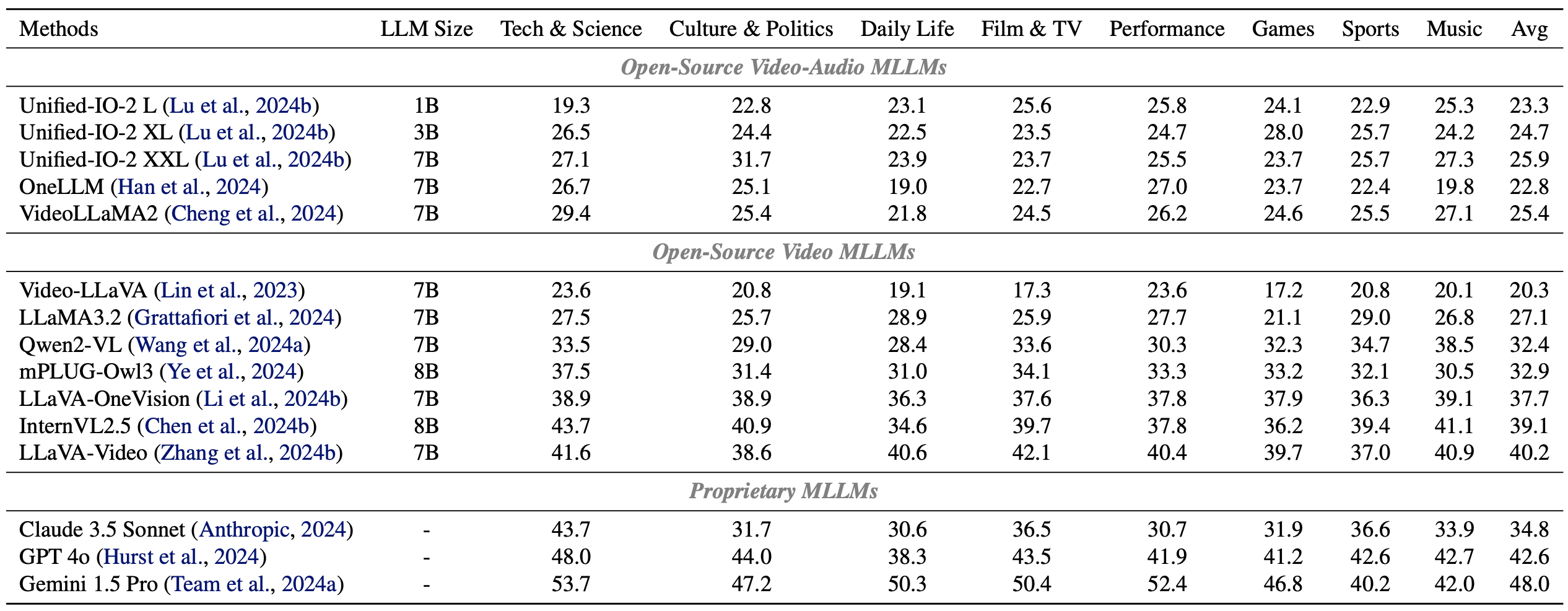
Based on our WorldSense, we extensively evaluate various state-of-the-art models. The experimental results indicate that existing models face significant challenges in understanding real-world scenarios (48% best accuracy). We hope our WorldSense can provide a platform for evaluating the ability in constructing and understanding coherent contexts from omni-modality.
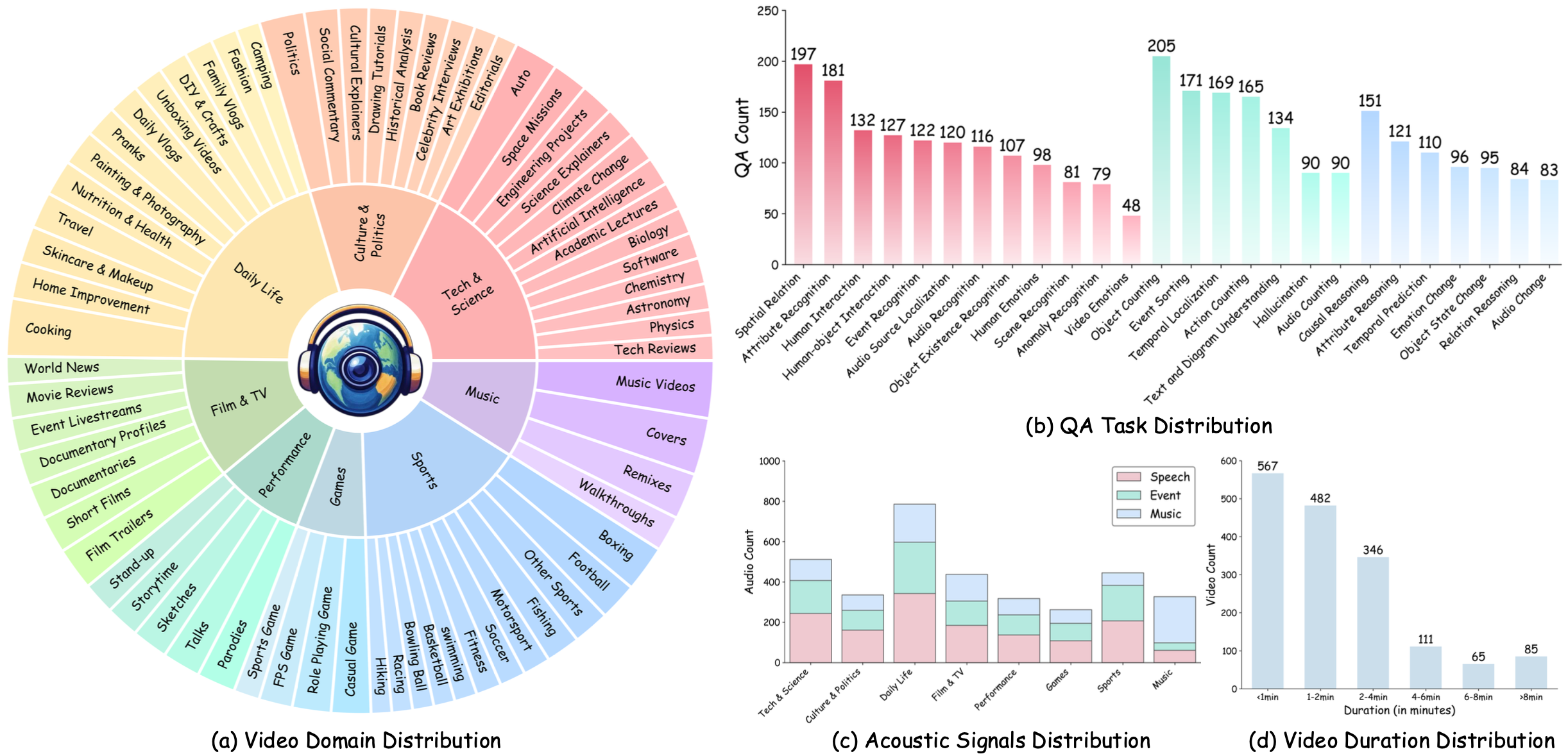
📐 Dataset Examples
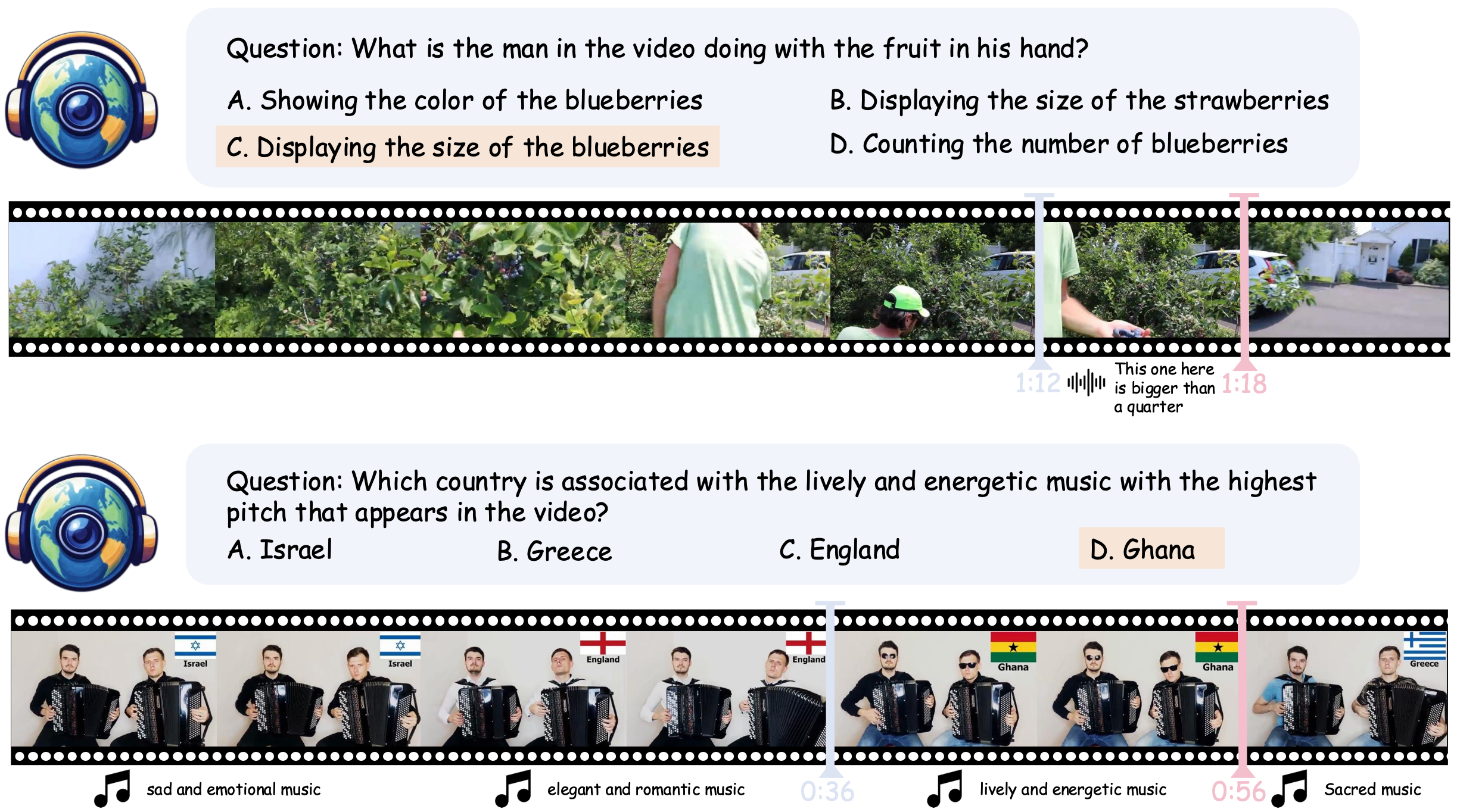
🔍 Dataset
Please download our WorldSense from here.
🔮 Evaluation Pipeline
📍 Evaluation: Thanks for the reproduction of our evaluation through VLMEvalkit. Please refer to VLMEvalkit for details.
📈 Experimental Results
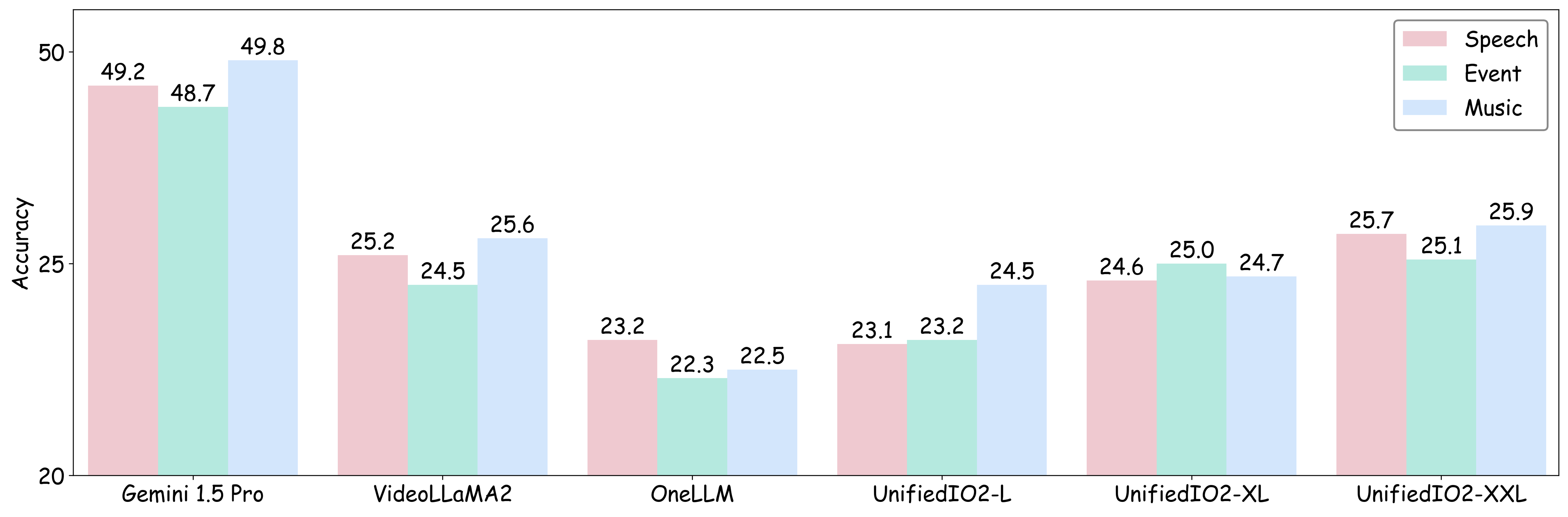
- Evaluation results of sota MLLMs.
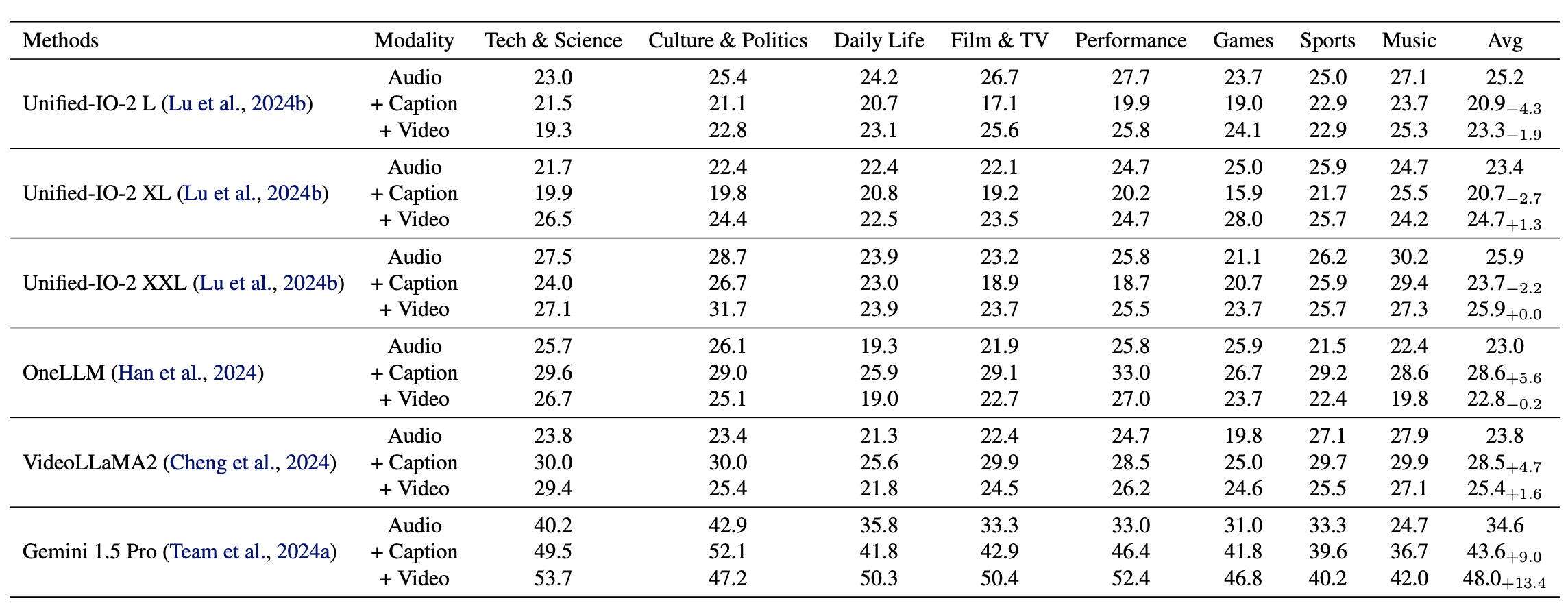
- Fine-grained results on task category.
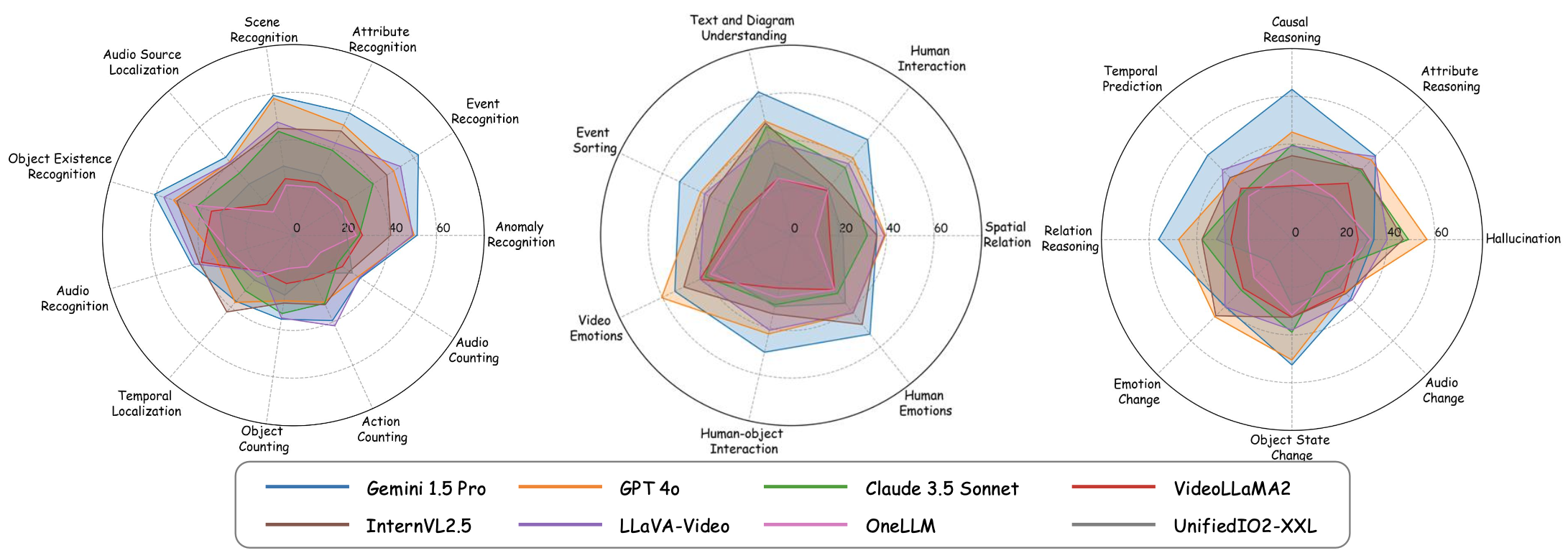
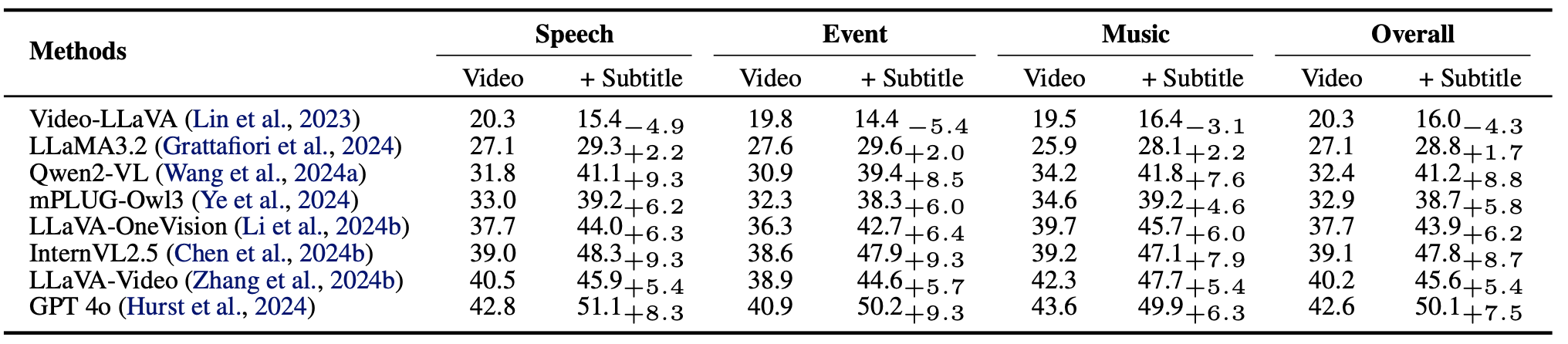
- Fine-grained results on audio type.
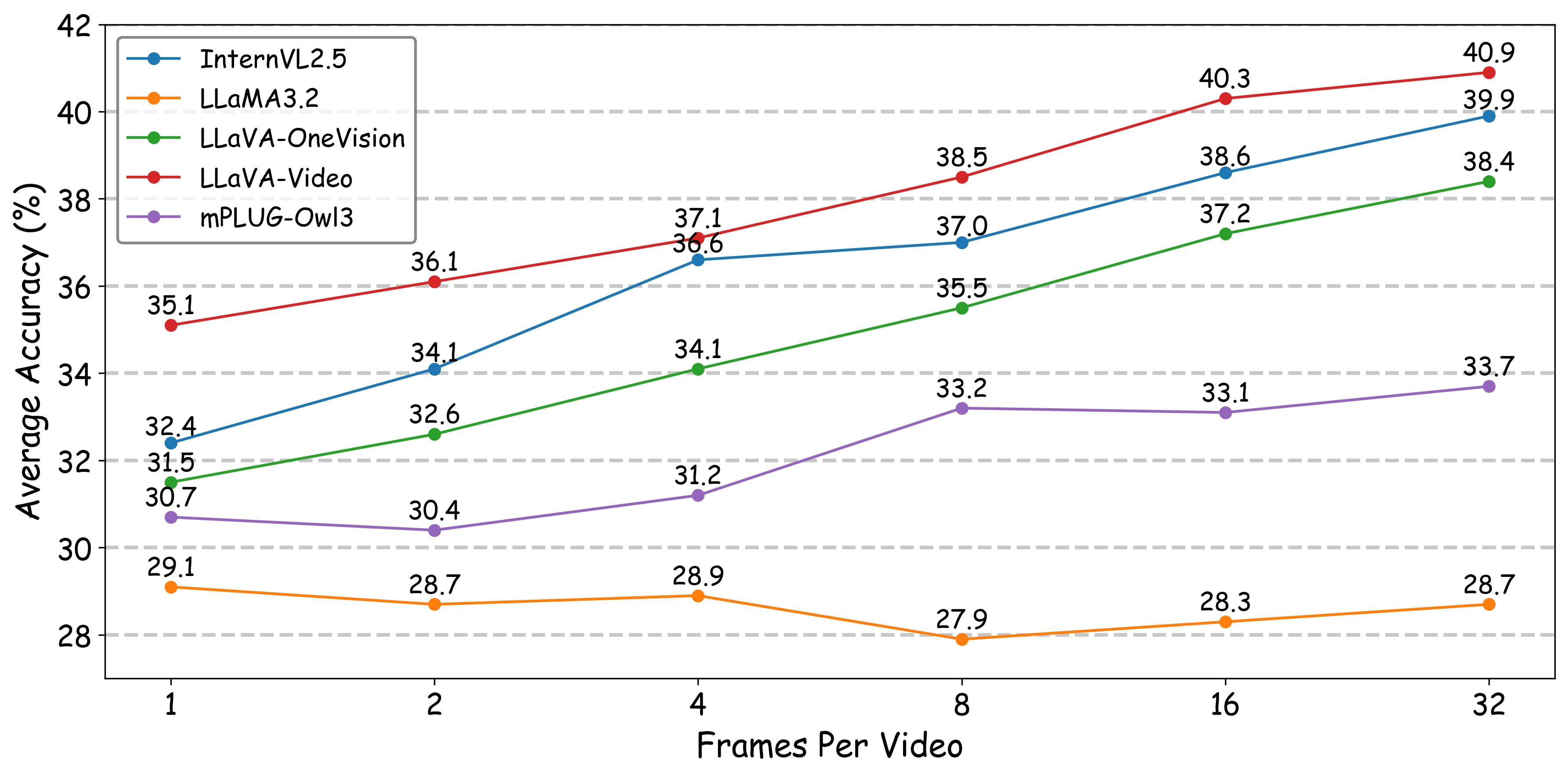
- In-depth analysis for real-world omnimodal understanding.

📄 License
This dataset is licensed under the Creative Commons Attribution 4.0 International (CC BY 4.0) license.
You are free to use, copy, modify, distribute, and build upon this dataset, including for commercial purposes, provided that appropriate credit is given to the original source.
📖 Citation
If you find WorldSense helpful for your research, please consider citing our work. Thanks!
@article{hong2025worldsenseevaluatingrealworldomnimodal,
    title={WorldSense: Evaluating Real-world Omnimodal Understanding for Multimodal LLMs},
    author={Jack Hong and Shilin Yan and Jiayin Cai and Xiaolong Jiang and Yao Hu and Weidi Xie},
    year={2025},
    eprint={2502.04326},
    archivePrefix={arXiv},
    primaryClass={cs.CV},
    url={https://arxiv.org/abs/2502.04326},
}
Similar repos



Languages
JavaScript
58.8%
HTML
31.8%
CSS
9.3%
WorldSense: Evaluating Real-world Omnimodal Understanding for Multimodal LLMs
See the codeREADME
WorldSense: Evaluating Real-world Omnimodal Understanding for Multimodal LLMs
Jack Hong1, Shilin Yan1†, Jiayin Cai1, Xiaolong Jiang1, Yao Hu1, Weidi Xie2‡
1Xiaohongshu Inc. 2Shanghai Jiao Tong University
📍 Leaderboard
We welcome researchers and developers from the community to submit their models for evaluation and inclusion on the WorldSense leaderboard. To streamline the process, please send an email to jaaackhong@gmail.com and CC tattoo.ysl@gmail.com.
🚀 News
- [2026-04-28] Doubao-Seed-2.0-Lite-0428 is added to Leardboard, which achieves a top score of 67.3!
- [2026-04-28] Nemotron3-Nano-Omni is added to Leardboard.
- [2026-04-01] Gemini-3.1-Pro, Qwen-3.5-Omni-Plus and Qwen-3.5-Omni-Flash are added to Leardboard. Gemini-3.1-Pro achieves a top score of 65.5!
- [2026-01-26] 🎉🎉🎉 WorldSense is accepted by ICLR 2026.
- [2025-09-09] Gemini-2.5-Pro and Gemini-2.5-Flash are added to Leardboard. Gemini-2.5-Pro achieves a top score of 65.1!
- [2025-04-18] VITA-1.5 and Qwen2.5 Omni are added to Leardboard.
- [2025-02-07] We release WorldSense, the first benchmark for real-world omnimodal understanding of MLLMs.
👀 WorldSense Overview
we introduce WorldSense, the first benchmark to assess the multi-modal video understanding, that simultaneously encompasses visual, audio, and text inputs. In contrast to existing benchmarks, our WorldSense has several features:
- Collaboration of omni-modality. We design the evaluation tasks to feature a strong coupling of audio and video, requiring models to effectively utilize the synergistic perception of omni-modality;
- Diversity of videos and tasks. WorldSense encompasses a diverse collection of 1,662 audio-visual synchronised videos, systematically categorized into 8 primary domains and 67 fine-grained subcategories to cover the broad scenarios, and 3,172 multi-choice QA pairs across 26 distinct tasks to enable the comprehensive evaluation;
- High-quality annotations. All the QA pairs are manually labeled by 80 expert annotators with multiple rounds of correction to ensure quality.
Based on our WorldSense, we extensively evaluate various state-of-the-art models. The experimental results indicate that existing models face significant challenges in understanding real-world scenarios (48% best accuracy). We hope our WorldSense can provide a platform for evaluating the ability in constructing and understanding coherent contexts from omni-modality.
📐 Dataset Examples
🔍 Dataset
Please download our WorldSense from here.
🔮 Evaluation Pipeline
📍 Evaluation: Thanks for the reproduction of our evaluation through VLMEvalkit. Please refer to VLMEvalkit for details.
📈 Experimental Results
- Evaluation results of sota MLLMs.
- Fine-grained results on task category.
- Fine-grained results on audio type.
- In-depth analysis for real-world omnimodal understanding.
📄 License
This dataset is licensed under the Creative Commons Attribution 4.0 International (CC BY 4.0) license.
You are free to use, copy, modify, distribute, and build upon this dataset, including for commercial purposes, provided that appropriate credit is given to the original source.
📖 Citation
If you find WorldSense helpful for your research, please consider citing our work. Thanks!
@article{hong2025worldsenseevaluatingrealworldomnimodal,
    title={WorldSense: Evaluating Real-world Omnimodal Understanding for Multimodal LLMs},
    author={Jack Hong and Shilin Yan and Jiayin Cai and Xiaolong Jiang and Yao Hu and Weidi Xie},
    year={2025},
    eprint={2502.04326},
    archivePrefix={arXiv},
    primaryClass={cs.CV},
    url={https://arxiv.org/abs/2502.04326},
}
Similar repos
Languages
JavaScript
58.8%
HTML
31.8%
CSS
9.3%