Abliteration without the weights — projective refusal steering as a GLP vector + fail-closed boot hotfix.
See the code

Abliteration without the weights — put your model on GLP. Projective refusal steering for open-weight models: serving config, boot hotfixes, the steering patch, and the GLP (GGUF Layer Projection) format spec. The goal is most good open models; the lanes are DeepSeek V4 Flash 0731 on 2x DGX Spark (GB10, SM121, TP=2 over RoCE), Qwen3.8-27B on a single Spark, Qwen3.8-Flash-Next NVFP4 on 2x DGX Spark (TP=2, day-0 image), and GLM-5.3-Flash NVFP4 on 4x DGX Spark (TP=4, patched day-0 image), and GLM-5.3 743B Int4-Int8Mix on 4x DGX Spark (TP=4, tonyd2wild's recipe). The method and the measurements behind it are in the original write-up: Abliteration without redistributing the model.
The live DSV4 stack is the Anemll image (ghcr.io/anemll/dspark-vllm-gx10:0.1.1,
vLLM 0.25.2) driven by the MiaAI 2x recipe, with our state on top vendored in
recipe/anemll/; the Qwen lane (stock vLLM 0.27 image, GGUF or LoRA steering)
lives in recipe/qwen/; the Qwen3.8-Flash-Next lane (day-0 image
vllm/vllm-openai:qwen38-flash-next, GLP-47) lives in recipe/qwen38fn/;
the GLM-5.3-Flash lane (tonyd2wild's sm121-v8 patch stack on the day-0
vllm/vllm-openai:glm53-flash-arm64-cu130, GLP-44)
lives in recipe/glm53/; the GLM-5.3 743B lane (tonyd2wild's Int4-Int8Mix
stack, GLP-77) lives in recipe/glm53xl/. The
retired v027 stack's patch is kept for reference and as the fallback path.
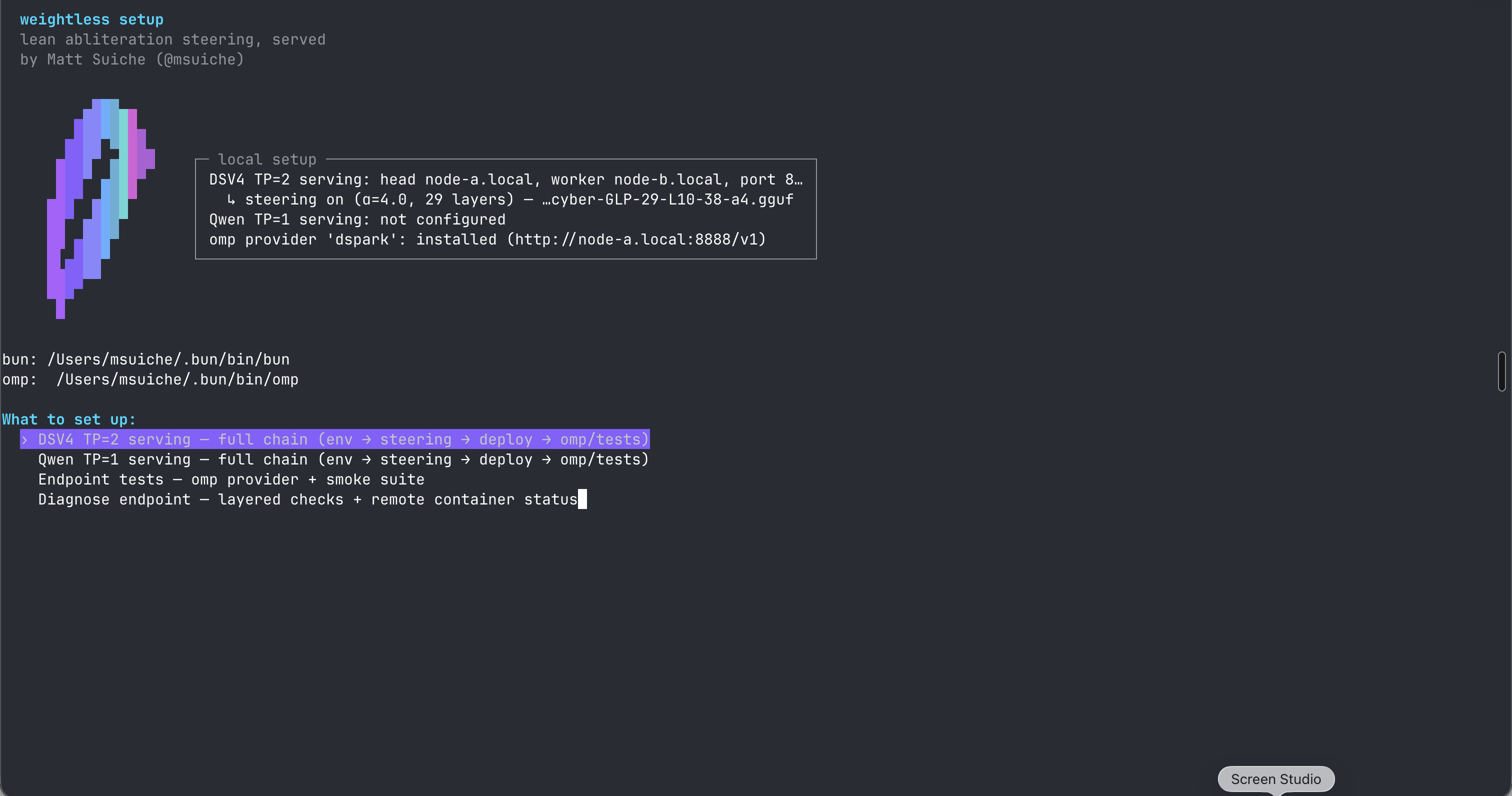
python3 weightless.py          # the one front door — interactive setup wizard
python3 weightless.py serve 0  # switch the rig to a lane, no prompts (serve <name|#>)
python3 weightless.py dash     # live metrics for the serving lane
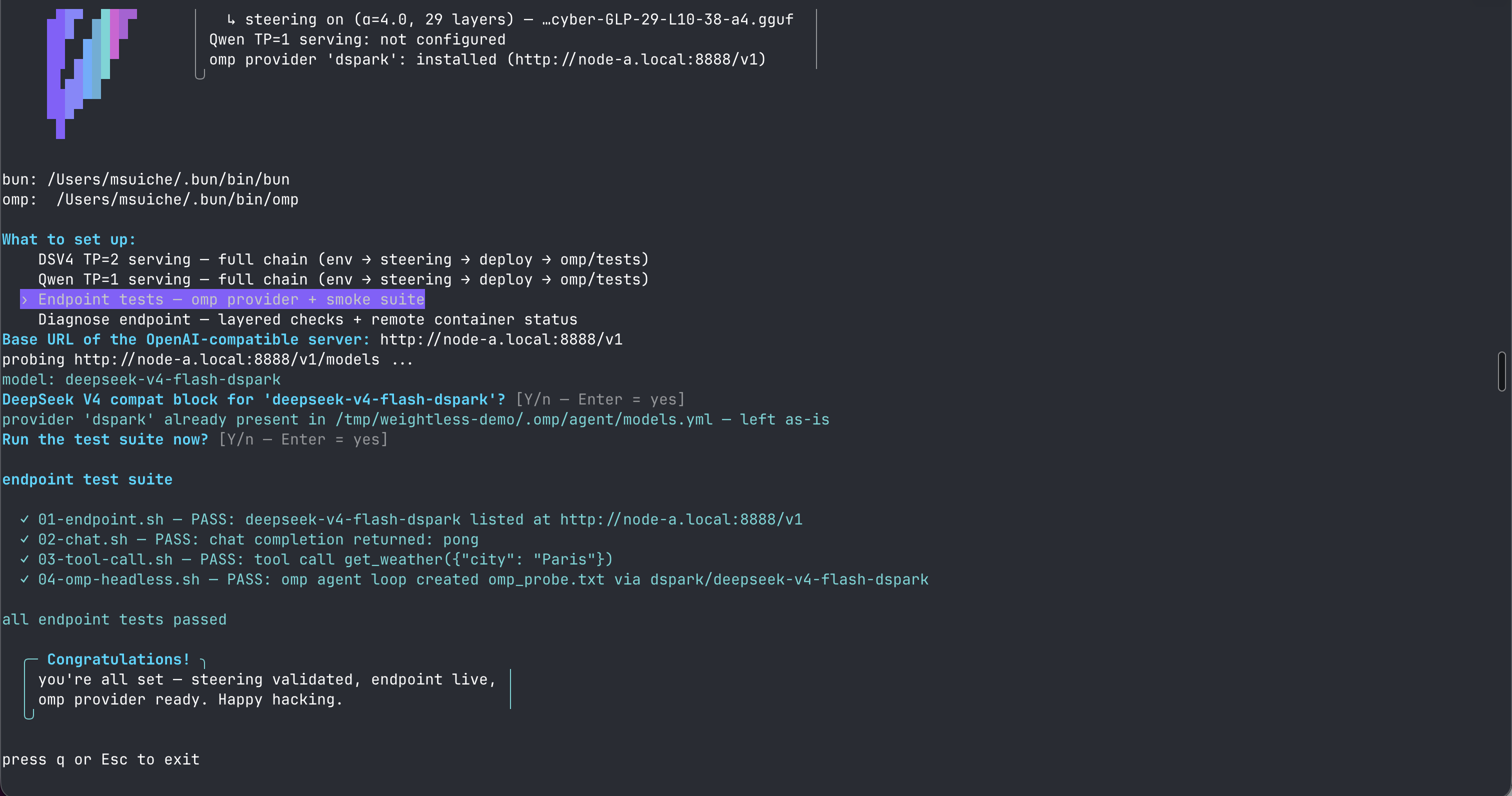
python3 weightless.py test     # endpoint smoke suite
python3 weightless.py --help   # all commands
weightless.py (Python 3.9+, stdlib only) dispatches to the real scripts,
which also work standalone: setup.py (TUI wizard with a prompt fallback),
scripts/dash.py, tests/smoke/run.sh.
Use python3 weightless.py help <command> for command-specific options.
python3 weightless.py setup --plain uses text prompts; setup requires an
interactive terminal. With redirected stdin, invoking weightless.py without
arguments prints help. serve rejects unknown flags before deployment;
omit its lane argument to list available lanes.
For scripts, python3 weightless.py dash <url> --once --timeout 5 prints a
snapshot (two samples --interval apart, so its rates are real) and exits
nonzero if the endpoint fails or returns no vLLM metrics; --json prints the
same numbers as one JSON object. Dashboard URLs may include /v1 or
/metrics. Refresh intervals, rate windows and request timeouts must be
positive and finite. Redirected dashboard output contains no terminal control
sequences; NO_COLOR disables colors in both prompts and the dashboard. In
the live view q quits, p pauses, r resets the session counters and w
cycles the rate window (10 / 30 / 60 / 300s).
Swapping lanes is the wizard, not ssh. Pick Serve <model> for the lane
you want: the wizard regenerates the env, re-validates it (multi-node fabric
addresses must be literal IPs — containers cannot resolve .local; the
steering vector's glp.hook_point is read on the node and must match the
lane's enforced site), parks the running lane's containers, drops page
caches, boots, then reconfigures omp/hermes and runs the smoke suite. If a
swap ever needs a manual ssh incantation, that gap goes into the wizard —
not into shell history.
Pick a lane and it walks the full chain: site values → env file → steering
validation → asset preparation → confirm-gated ssh deploy → omp provider (registered in omp's
modelRoles — default role, or every text role) + endpoint smoke tests.
Endpoint down? The diagnose chain isolates DNS → TCP → HTTP and can check and
boot the stack over ssh. Non-interactive alternative:
sh tests/smoke/install.sh && sh tests/smoke/run.sh with DSPARK_* env overrides.
Asset preparation downloads the model on the head, rsyncs its HF cache to
workers over the fabric, pulls the recipe image on each node, and downloads
the selected GLP file on every node. Each command is printed and confirmed;
downloads resume on reruns. Set HF_TOKEN or use hf auth login locally
after accepting access to the gated vector repository. The token travels
over SSH stdin and is never printed. Remote HF tooling uses its own venv
(nodes need Python 3 with venv support). GLM 743B still requires the recipe's
local image build, kernel overlay and mounted weight directories; the wizard
verifies that image instead of attempting to pull a nonexistent registry tag.
Before boot, switching lanes offers a separate, default-no confirmation to
remove the old lane's containers on its nodes and prints the relaunch command.
DEMO=1 python3 setup.py skips writes, downloads and all network commands.
The model weights are never redistributed — what this repo ships is the intervention, tested and self-contained:
docs/spec/GLP.md) with per-layer
directions, derived by us and published under
msuiche/ (see
Steering artifacts). No model weights inside.vllm-plugin/, dist
weightless-steer): one adapter per architecture in
weightless_steer/archs/ shadows the model class in vLLM's
ModelRegistry, installing the same projective hook with no container
file rewrites at all — ten archs, every one GPU-validated on Modal
(2026-09-18/19, per-lane numbers in BENCHMARK.md). The boot hotfixes
(patches/hotfix-*.py) are the per-lane mechanism the plugin replaces:
still what the live rigs run today, kept as the fallback stack and as
the semantic reference each adapter is pinned against by structure
tests (tests/structure/, vllm-plugin/tests/).Internals write-up: Abliteration without redistributing the model.
Two objects get confused often enough that GLP ends up misfiled as a LoRA variant. They are different objects, and the difference is the whole design:
self_attn.o_proj, mlp.down_proj
(linear_attn.out_proj on hybrid archs). Each writer has a concrete W
you can read and edit.GLP's native object is a direction d̂ in the stream, and its native
operation projects the accumulated stream at runtime:
h ← h − α(h·d̂)d̂, applied by a hook after each listed layer. Activation
space, α tunable at serve time, architecture-blind, nothing re-baked.
A LoRA can only express a weight delta ΔW = B·A on an existing matmul.
"Project the stream" has no single W behind it, so it cannot be written
as a LoRA. What can be written is "project each residual writer": at
h = Wx the projection is exactly ΔW = −α·d̂(d̂ᵀW) — the Arditi et al.
weight-orthogonalization form, which is what captain-vector bake emits as
a rank-1 adapter. Every limitation of the baked form follows from that one
substitution:
lora_A — not tunable at serve time, and scaling
the adapter double-doses.lora_A carries W; baked against the wrong base
revision the adapter is garbage and nothing downstream flags it (bake's
pin check fails closed for exactly this reason).The same constraint runs the other way: llama.cpp control vectors and the
steering-LoRAs that circulated before GLP are addition-only
(h ← h + scale·d), and addition cannot express "remove the d̂-component
of whatever passes through here" — nor bake exactly anywhere (a constant
shift is a bias, not a weight delta). Add-vs-project and runtime-vs-baked
are two independent axes. GLP occupies the projective, runtime-native
quadrant; the baked adapter is its portable shadow for stacks that only
speak LoRA.
Deeper: FAQ.md (answers to the questions people actually ask —
backdoor auditability, vector maintenance under retraining, effective range,
MoE/loop coverage, dosage, termination), docs/spec/GLP.md (the
format contract),
docs/llama-cpp-compat.md (source-verified
mechanics), tools/captain-vector/README.md
(bake's troubleshooting/interop role).
Serving is vLLM (the only runtime with working sm_121a NVFP4 + MTP paths
for these checkpoints on GB10), driven by omp as the
agent harness/client — we picked it over stock Pi for the benchmaxxed tool
loop (hash-anchored edits, LSP/DAP wired in, fast headless mode), and this
repo's tests/ suite proves the served model can drive it end to end.
Steering is optional per lane and off by default when the steer path is
empty:
flowchart LR
    subgraph client[client]
        OMP["omp<br/>agent harness"]
        WIZ["setup.py<br/>wizard + tests/"]
    end
    OMP -->|OpenAI-compatible /v1| EP["vLLM endpoint<br/>:8888, :8078, :8079, :8080 or :8081"]
    WIZ -->|probe / diagnose / boot| EP
    EP --> DSV4["DSV4 lane — TP=2<br/>2x DGX Spark over RoCE<br/>DeepSeek-V4-Flash-0731 NVFP4"]
    EP --> QWEN["Qwen lane — TP=1<br/>single DGX Spark<br/>Qwen3.8-27B NVFP4"]
    EP --> QWENFN["Flash-Next lane — TP=2<br/>2x DGX Spark over RoCE<br/>Qwen3.8-Flash-Next NVFP4"]
    EP --> GLM["GLM-5.3-Flash lane — TP=4<br/>4x DGX Spark over RoCE<br/>GLM-5.3-Flash NVFP4"]
    CV["GLP vector (GGUF)<br/>fail-closed boot hotfix"] -.->|optional| DSV4
    CV2["GLP vector hotfix<br/>or rank-1 LoRA, no patch"] -.->|optional| QWEN
    CV3["GLP-47 vector (GGUF)<br/>fail-closed boot hotfix"] -.->|optional| QWENFN
    CV4["GLP-44 vector (GGUF)<br/>fail-closed boot hotfix"] -.->|optional| GLM
    EP --> GLMXL["GLM-5.3 743B lane — TP=4<br/>4x DGX Spark over RoCE<br/>GLM-5.3 Int4-Int8Mix"]
    CV5["GLP-77 vector (GGUF)<br/>staged fail-closed hotfix"] -.->|optional| GLMXL
The lanes never run at once: each multi-node lane (DSV4 on 2, Flash-Next on 2, the GLM lanes on 4) already holds its Sparks' GPUs, and the Qwen lane is parked until the multi-node stack is down.
| lane | hardware | model | steering | status |
|---|---|---|---|---|
| DSV4 TP=2 | both Sparks over dual-rail RoCE | DeepSeek-V4-Flash-0731, NVFP4 (166.9 GB) | projective cvec, live on 29 layers | live — recipe/anemll/ |
| DSV4-Vision-Exp TP=2 | both Sparks over dual-rail RoCE | DeepSeek-V4-Flash-Vision-Exp, FP8 original (202 GB) | projective cvec, L10–38 at α=1.0 (the -ffn hook relabel of GLP-29 Vision-Exp) | live (text-only) — the 0.25.2 image's loader refuses the checkpoint's vision.*/aligner tensors, so this lane serves the vision-stripped FP8 tree (strip_vision.py output, staged at $HF_CACHE/visionexp-text-fp8); recipe/anemll/ (.env.dsv4vx + start-deepseek-v4-flash-visionexp-dspark.sh). Vision-capable serving is the VL lane below |
| DSV4-Vision-Exp VL TP=2 | both Sparks over dual-rail RoCE | DeepSeek-V4-Flash-Vision-Exp, FP8 unstripped (snapshot 6821d6ad, vision enabled) | same -ffn GLP-29 relabel, L10–38 at α=1.0 (day-0 tree keeps the deferred mHC fold → ffn_out_pre_residual) | first-boot-validated 2026-09-23 (2x DGX Spark, GB10) — recipe/dsv4vl/; day-0 vLLM (0.28.1rc1 + PR #54566) on vllm-upstream-vision:k2-topk512 (flashinfer 0.6.18 + DSV4 dual-prefill topk 192/256/512 backport, msuiche/flashinfer); nospec; cold boot 8m24s; steering A/B green (α=0.0 base-like, α=1.0 cyber 4/4 comply, benign 4/4 both arms, ~13.4 tok/s single-stream both arms); vision smoke under steering green (image-token math 315∈[314,317], 111∈[110,113], mix, text-only, concurrency) |
| Qwen TP=1 | one Spark | Qwen3.8-27B-NVFP4 (~13.5 GB) | per-layer cvec, L10–58 at α=1.0 (shipping artifact) | hardware-validated — recipe/qwen/; stock 4/32, GGUF 24/32, LoRA 24/32 on refusal32 (2026-08-22) |
| Qwen3.8-Flash-Next TP=2 | both Sparks over RoCE | Qwen3.8-Flash-Next-NVFP4 (~135 GB), day-0 image | per-layer cvec, L1–47 at α=1.0 (GLP-47) | hardware-validated 2026-09-01 (2x DGX Spark, GB10) — recipe/qwen38fn/; steered live on the pair: refusal32 22/32 (stock 1/32), KV pool 35.3 GiB @ 262K native ctx; earlier cloud validation (2xB200): refusal32 1/32 → 26/32, benign 32/32; vector eval 81.2% refusal32 (vLLM lane, cos 0.9931 vs HF) |
| DSV4-Vision-Exp (Modal lane) | 4×H100 (tolmo) | DeepSeek-V4-Flash-Vision-Exp, FP8 (~168 GB) | per-layer cvec, L10–38 at α=1.0 (GLP-29 Vision-Exp) | vector-validated 2026-09-01 — refusal32 1/32 → 27/32 fresh (α=4 garbles — dose cliff), benign32 32/32 both arms; the 0731 GLP-29 keysdir vector transfers at 31/32 despite cos −0.32 (multi-directional refusal); Spark lane: the TP=2 row above |
| DSV4-Vision-Exp NVFP4 | 2×B200 (tolmo) | msuiche/DeepSeek-V4-Flash-Vision-Exp-NVFP4 (176.5 GB, modelopt W4A4, experts-only) | same GLP-29 vectors | boot-validated 2026-09-03 (stock vLLM 0.28.0, first vLLM boot of vision-exp) — lossless MXFP4→NVFP4 transcode (byte-exact vs NVIDIA's recipe); NVFP4 ≈ FP8 ±1 item on refusal32, benign 32/32, capability 12/12, zero garbles; steered-delivery delta vs the old HF-lane numbers is a lane effect (fp8 KV + kernels), not the quant — FP8 control lands the same; strip_vision.py in-repo for stock-vLLM text boot; GB10 via modelopt_gb10_hybrid plugin |
| Inkling-Small TP=2 | both Sparks over RoCE | Inkling-Small-NVFP4 (159 GiB), stock vLLM 0.28.0, CUDA graphs on | per-layer cvec, L1–41 at α=0.25 (GLP-41) | hardware-validated 2026-09-04 (2x DGX Spark, GB10) — recipe/inkling/; real weights boot and serve with the load-reclaim + sm121 rel-attention hotfixes (78.3 GiB model, 21.4 GiB KV, 4/4 smoke); Modal lane: refusal32 0/32 stock (total lockdown) → 30/32 steered, benign32 30/32; α=1.0 garbles everything — the most dose-sensitive model in the program; first GLP for a Thinking Machines model |
| Hy4-preview (Modal lane) | 8×H200 (tolmo) | tencent/Hy4-preview-FP8 (770B / 49B active, ~770 GB), day-0 image | per-layer cvec, L1–77 at α=2.0 (GLP-77 Hy4) | vector-validated 2026-09-02 — refusal32 1/32 → 24/32, cyber32 15/32 → 31/32, benign32 32/32 at α=2.0 (collateral non-monotonic: worst at α=1.0–1.5, zero at full dose); no garble at any dose — most steer-tolerant arch in the program; largest model with a published refusal vector; caveat: refusal32 answers all run to the 4K cap at α=2.0 |
| GLM-5.3-Flash TP=4 | four Sparks over RoCE | GLM-5.3-Flash-NVFP4 (~50 GiB/rank), othexmr's RiNGSiDE recipe (switchless ring NCCL + b12x kernels; previously the sm121-v8 patched day-0 image) | per-layer cvec, L1–44 at α=2.0 (GLP-44) | live in production since 2026-09-29 — recipe/glm53/; 1M context, 36 tok/s freeform → 53–64 tok/s structured/agentic with DFlash2 spec decode (acceptance is regime-dependent; steering costs none — measured, see below); vector eval 65.6% refusal32 at α=2.0; α≥2.5 garbles this model |
| GLM-5.3 743B TP=4 | four Sparks over RoCE | GLM-5.3 Int4-Int8Mix (~95.5 GiB/rank), tonyd2wild's stack (local image + sm12x overlay) | per-layer cvec, L1–77 at α=1.0 (GLP-77) | hotfix live-validated 2026-08-30 — recipe/glm53xl/; on stock vLLM 0.28.0 (8×H100, RadixArk/GLM-5.3-NVFP4): refusal32 1→10/32, cyber32 15→31/32; the 4x-Spark GB10 lane itself remains untested (needs the hardware); vector eval (8×H100, full-length): cyber32 32/32, refusal32 12/32 (37.5%; 6/32 answer-audited) at α=1.0, null arm = stock; refusal on the 753B is much stickier than Flash — α>1 makes it WORSE |
| GLM-5.3 743B cloud (Modal lane) | 8×H100, wizard-deployed | RadixArk/GLM-5.3-NVFP4 (~465 GB), stock vLLM 0.28.0 | same GLP-77, α=1.0 | deployable — modal/cloud_serve.py; delivers an OpenAI-compatible endpoint, no rig needed |
| Kimi K3 2.9T cloud (Modal lane) | 2×H200:8 (PP=2 x TP=8, TCP fabric), wizard-deployed | moonshotai/Kimi-K3 (~1.56 TB, MXFP4 experts), day-0 image | per-layer cvec, L1–92 at α=1.0 (GLP-92) | vector-validated 2026-09-04 — refusal32 1/32 → 31/32, cyber32 17/32 → 32/32, zero collateral (benign32 32/32, propaganda32 32/32); modal/cloud_serve_k3.py: collective lockstep serving (the fork's multi-node serve shape wedges), deploys to an OpenAI-compatible endpoint |
GLM-5.3-Flash needs 4 nodes — and a patched image. At TP4 the NVFP4
quant is ~50 GiB of weights per 128 GB node, which is what makes the
1M-context KV pool possible. Since 2026-09-29 the production lane runs
othexmr's RiNGSiDE
(switchless ring NCCL, b12x kernels, RDMA prefill, DFlash2 drafting; TP2 and
TP4 profiles) with the GLP-44 steering mounted via its weightless launcher
option. A 2-node TP2 config exists (262K context,
KV-starved — tonyd2wild's TP2 repo)
but stays out of scope for this wizard lane. The stock day-0 vendor image
dies five different ways on GB10; the lane requires the sm121-v8 patch stack
(radixark/vllm-glm53-flash:sm121-v8 or a local v1→v8 build — details in
recipe/glm53/README.md). If your machines.txt lists two nodes, this lane
cannot boot until two more are racked and cabled. The 743B lane needs the
same four nodes plus tonyd2wild's Int4-Int8Mix weights (377.4 GiB) and stack
(image + kernel overlay — recipe/glm53xl/README.md); its first real boot is
the anchor test (the hotfix stages fail-closed before GPU time). On x86
SM120 instead of Sparks, brandonmusic's EXL3/B12X build
(brandonmusic/GLM-5.3-Flash-tr3-4bpw, custom vLLM fork) takes the same
GLP-44 hotfix mechanics — see recipe/glm53/README.md (runtime-validated
on 2x RTX PRO 6000: refusal32 1→15/32, cyber32 14→31/32).
DFlash2 spec decode and steering — measured, not assumed (2026-08-30,
4xH100, Prometheus spec_decode counters): GLP-44 steering at α=2.0 costs the
drafter no acceptance — structured 81.4% → 87.1% steered, prose 26.1% →
24.4% — because the drafter's aux-capture taps sit before the steering
injection point and condition on pre-steering features. The stock tap set
[5,14,24,33,42] ships in the drafter's own config.json and is
training-matched: a 7-set sweep found every alternative worse, tapping the
final target layer poisons the drafter (~6% acceptance), and the tap count
is fixed by the checkpoint's fc width. Prose acceptance (~26% Flash, ~23%
flagship) is a drafter-capacity limit, not a tap-tuning opportunity — do not
retune the taps.
Single-Spark DSV4 (EXL3 3.0bpw + REAP-K216): evaluated and rejected.
The full NVFP4 checkpoint (166.9 GB) cannot fit one Spark, so single-node
DSV4 exists only as the pruned/quantized artifact — REAP deletes 40 of 256
routed experts per MoE layer on top of the 3.0bpw quant. Benchmarks pass,
but the degradation concentrates in rare behaviour by construction, and the
control vector would need re-deriving on the pruned circuit. TP=1 DSV4 is a
smaller, approximated model; we do not serve it. The steering contract in
docs/spec/GLP.md remains lane-independent.
| path | what it is |
|---|---|
weightless.py | single front-door CLI: weightless.py (wizard), weightless.py dash, weightless.py test, `weightless.py validate |
setup.py | full-chain setup wizard (TUI or prompts, stdlib-only): lane pick → env file → steering validation → ssh deploy → omp provider + tests, plus a diagnose chain (DNS → TCP → HTTP → remote docker/GPU status, optional boot) |
recipe/anemll/ | live: compose / start script / .env.dsv4.example for the MiaAI 2x clone, plus rebuild notes |
recipe/qwen/ | Qwen TP=1 lane: serve script + .env.qwen.example; STEER_MODE=gguf|lora, both hardware-validated |
recipe/qwen38fn/ | Qwen3.8-Flash-Next TP=2 lane: head+worker start script + .env.qwen38fn.example; --no-enable-prefix-caching and VLLM_PLE_CPU_OFFLOAD=1 are mandatory there |
recipe/glm53/ | GLM-5.3-Flash TP=4 lane: head+3-worker start script + .env.glm53.example; needs 4 nodes and the sm121-v8 patched image, α=2.0 is calibrated (α≥2.5 garbles) |
recipe/glm53xl/ | GLM-5.3 743B TP=4 lane: head+3-worker start script + .env.glm53xl.example; needs 4 nodes + tonyd2wild's Int4-Int8Mix weights/stack, α=1.0 is calibrated (higher makes refusal worse) |
patches/hotfix-dsv4-steering-projective.py | live: steering as a fail-closed boot hotfix for the 0.25.2 image (embedded GGUF reader) |
patches/hotfix-qwen38-steering-projective.py | the same steering for the Qwen lane: patches qwen3_next.py + qwen3_5.py, steers hidden_states + residual |
patches/hotfix-qwen38fn-steering-projective.py | the same steering for the Flash-Next lane: patches the day-0 image's vllm/models/qwen3_8_flash_next/nvidia/model.py, steers the materialized hyper-connection stream (10240 = 4×2560) |
patches/hotfix-glm53-steering-projective.py | the same steering for the GLM-5.3 lane: patches vllm/models/glm5next/nvidia/model.py, steers the materialized mHC stream (16384 = 4×4096); the last layer's in-decoder contract is deferred so L44 is covered |
patches/hotfix-glm53xl-steering-projective.py | the same steering for the GLM-5.3 743B lane: patches the overlay's deepseek_v2.py copy at staging (the mount is read-only), steers hidden_states + residual (decomposed convention, no HC widening) |
patches/hotfix-glm53-exl3-steering-projective.py | the GLM-5.3-Flash steering for brandonmusic's EXL3/B12X fork image (SM120): the fork's DFlash branch splits the decoder loop in two — the variant patches both (aux loop steers after the aux capture, pre-steer features) |
vllm-plugin/ | the same steering as an installable vLLM plugin (dist weightless-steer, vllm.general_plugins entry point): one adapter per architecture in weightless_steer/archs/ shadows the model class in ModelRegistry instead of rewriting files in the container — the successor to the hotfix fleet above. Ten adapters today: nemotron_h.py, glm5next.py, dsv4.py, qwen38.py, qwen38fn.py, glm53xl.py, kimi_k3.py, ouro.py, inkling.py, hy4.py. glm5next GPU-validated 2026-09-18 (Modal 4×H100, GLM-5.3-Flash NVFP4, compiled mode — cyber32 31/32 exactly the hotfix reference, benign32 clean, refusal32 2→9/32 vs 1→21/32 hotfix on a stiffer stock baseline; modal/cloud_serve_glm53.py); the other eight new adapters GPU-validated 2026-09-19 on Modal (verification depth varies — full eval for dsv4/qwen38/qwen38fn/ouro/inkling, boot+smoke for hy4/glm53xl/kimi-k3; per-arch numbers in BENCHMARK.md, raw artifacts in modal/out-<arch>-plugin-test/). Design: docs/vllm-plugin-design.md, offline tests need neither GPU nor vLLM |
sglang-plugin/ | the same steering as an installable SGLang plugin (dist weightless-sglang, sglang.srt.plugins entry point): an AFTER hook on ModelRunner.load_model installs the steering sites before CUDA-graph capture, with no SGLang source change, and reuses the vLLM plugin's loader and gates. One module per architecture in weightless_sglang/archs/: Qwen3.8-27B (one RTX 5090) and GLM-5.3-Flash (3x RTX PRO 6000, PP 3) GPU-validated 2026-09-25/26, seven more structure-tested on CPU. The edit runs as one fused Triton kernel by default, self-checked at start-up against a torch path that gives the same bits. Design: docs/sglang-plugin-design.md; offline tests need neither GPU nor SGLang |
patches/vendor/sparse_attn_indexer_kpool_sm121.py | vendored SM121 indexer top-k fix (tonyd2wild's DFlash2 repo, provenance header inside): bind-mounted over the in-image file on every glm53 node — without it both published images hard-kill on decode past ~24K context |
patches/reference/glm5next_b12x_exl3.py | the EXL3 structure test's reference — the model file extracted from the published verdictai/glm53-flash-exl3-k4 image (OCI layer sha256:7f03081e…) |
patches/reference/deepseek_v2_glm53xl.py | the 743B structure test's reference — tonyd2wild's kernel-overlay deepseek_v2.py (the file his stack actually serves); same anchors as vLLM v0.28.0 |
patches/reference/qwen3_8_flash_next.py | byte-identical copy of the day-0 image's model file — the Flash-Next structure test's reference (the ../vllm checkout predates the arch) |
patches/reference/glm5next.py | the GLM-5.3 structure test's reference — from the day-0 PR source (vllm-project/vllm#53906); re-vendor against the image on first deploy |
patches/0001-*.patch, 0002-*.patch | the hook + its vLLM-side test as git patches against v0.27.0 (fallback stack) |
recipe/ (top level) | retired v027 stack: Dockerfiles + compose |
tests/structure/ | structural guard tests for the steering patches (test-*-structure.py, incl. test-steering-structure.py for the retired v027 overlay) |
scripts/ | dash.py (below), dspark-router.py, memory-watchdog-gpu.sh, probe-refusal.py |
scripts/dash.py | live terminal view of any serving lane (stdlib only, ANSI colors on a terminal — brand pink/cyan, KV gauge green→yellow→red; --no-color/NO_COLOR for plain): python3 scripts/dash.py <url> for a live view, --once / --json for a scriptable snapshot — prefill/decode tok/s (computed-vs-admitted prefill, windowed headline + instant now + peak, per-request stream speed), engine steps/s and tokens/step, preemptions, queue depth, KV pressure against the lane's KV capacity, TTFT p50/p90, request lifecycle phases, mean prompt/output length, spec-decode acceptance rate/length and per-step wall time. Summed across the engine label (data-parallel lanes report the whole lane); keys q/p/r/w in the live view. --bench runs an active benchmark (warmup + 4 serial cases + a concurrency wave, each trial isolated by request counters — a busy lane or other traffic fails loudly; --out report.json never overwrites); --save-baseline blesses bench results or current rates as the lane's baseline, shown as base N.NN× ratios on later runs (store: ~/.cache/weightless/dash/baselines.json, keyed by model|ctx|version). Also in the wizard menu ("Watch a lane") |
scripts/lane_watchdog.py | container-level self-healing for the rig: cron probe of the current lane's /v1/models every 5 min; three dead checks relaunch the lane via its start script (never docker start — RoCE GIDs re-resolve at launch). Boot-grace and switch-lock suppression; --install arms cron + the @reboot hook (scripts/lane-autostart.sh). A successful serve re-arms it on the head |
tests/smoke/ | endpoint smoke tests: endpoint / chat / tool-call / headless omp agent loop — tests/smoke/README.md |
docs/spec/GLP.md | the GLP format spec: the glp.mode contract, layer-id mapping, why an additive reader must refuse the file |
CHANGELOG.md | date-based ship log (no versioned releases yet); steering numbers live in BENCHMARK.md |
BENCHMARK.md | steering effectiveness (all GLP vectors, all suites, with domain coverage) + the serving run log |
Real .env files are gitignored — only *.example templates are tracked.
Off unless WEIGHTLESS_STEER_PATH is set. The env vars pass through
recipe/anemll/docker-compose.dsv4.yml and the GGUF reader is embedded in
the hotfix — nothing to build:
# the general/broad direction; the cyber-derived alternative
# (...-abliterated-cyber-GLP-29-L10-38-a4.gguf) is a one-line swap
WEIGHTLESS_STEER_PATH=/cache/huggingface/DeepSeek-V4-Flash-0731-general-abliterated-cvec-L10-38-a4-keysdir.gguf
WEIGHTLESS_STEER_ALPHA=4.0
WEIGHTLESS_STEER_LAYERS=$(seq -s, 10 38)
Confirm from the boot log — check that layers= reads 29, not 1:
weightless GLP steering active: hook=ffn_out_pre_residual alpha=4.000 ... layers=29 [10, ...]
A previous revision dedented the per-layer assignment out of its loop and
steered one layer while reporting 29; coverage dominates this intervention
(6 layers leaves 18.0% refusal, 29 leaves 0.0%). The structural tests in
scripts/ guard that regression.
alpha is not a strength dial. At 1 the component is removed; past 1 it is
reflected, which installs the behaviour rather than removing it. To run
weaker, subset the layers and leave alpha alone. The 4.0 above is calibrated
for this checkpoint; do not carry it to another model.
The same GLP files and variables work on SGLang through sglang-plugin/;
install it next to vllm-plugin/ (which provides the loader) in the SGLang
environment:
pip install ./vllm-plugin ./sglang-plugin
WEIGHTLESS_STEER_PATH=<vector.gguf> python -m sglang.launch_server --model-path <model>
Each rank logs weightless GLP steering active (sglang): ...; no line means
SGLang serves stock. Details: sglang-plugin/README.md.
Naming convention: GLP-n is a GLP vector touching n layers — GLP-29
below is the DSV4 vector, GLP-49 the Qwen one, GLP-47 the Flash-Next one,
GLP-44 the GLM-Flash one, GLP-77 the GLM 743B one. All five lanes' vectors are
published under msuiche/ on Hugging Face (gated — fetch with an HF token),
spec-conformant per docs/spec/GLP.md and
verified against their pinned checkpoint revisions.
msuiche/DeepSeek-V4-Flash-0731-abliterated-cyber-GLP-29
— DSV4 lane, GLP-29 (GGUF). Cyber-contrast vector: 29 per-layer
directions over
L10–38, n_embd 4096, α=4.0. The live config currently serves the
general-contrast variant from the same repo family — a third-party
direction we reformatted, re-measured and repackaged (attribution in the
file metadata); swapping is one WEIGHTLESS_STEER_PATH line. Wiring:
recipe/anemll/README.md.msuiche/Qwen3.8-27B-abliterated-cyber-GLP-49
— Qwen lane, GLP-49 (GGUF + LoRA). The GGUF is canonical: per-layer
diff of
means, 49 directions over L10–58, n_embd 5120, α=1.0 (α=4 measurably
over-refuses on this model). The rank-1 LoRA (mlp.down_proj, L1–63,
α=1.0 baked) is the same intervention folded into weights — it loads in
stock vLLM/peft/llama.cpp with no hotfix, matches the GGUF on NVFP4
hardware (both 24/32 refusal32, 2026-08-22), but is still unscored on the
cyber holdout and is valid only for checkpoint revision 1d4bf0f2ff60
(lora_A embeds W). Wiring: recipe/qwen/README.md.msuiche/Qwen3.8-Flash-Next-abliterated-cyber-GLP-47
— Qwen3.8-Flash-Next (qwen4_exp), GLP-47, day-0. Per-layer
difference-of-means over the widened hyper-connection stream (10240 =
4×2560), layers 1–47, α=1.0. Derived 2026-08-26 on Modal (8×H100, BF16
reference) from AdvBench-vs-Alpaca. refusal32 3.1% → 81.2% at α=1.0 with
benign32 32/32 and capability12 12/12 (higher α over-projects — do not
raise it; the shipped default is the measured peak). Direction verified
engine-independent: a vLLM-lane capture reproduces it at cos 0.9931.
Serving lane: recipe/qwen38fn/ (TP=2 on 2x Spark, day-0 image; the
hotfix steers the materialized hyper-connection stream).msuiche/GLM-5.3-Flash-abliterated-cyber-GLP-44
— GLM-5.3-Flash (glm5_next), GLP-44, day-0. Per-layer dom over the
Sinkhorn hyper-connection stream (16384 = 4×4096), layers 1–44, α=2.0.
Derived from the FP8-native canonical checkpoint (snapshot 3f1971b7).
refusal32 3.1% → 65.6% at α=2.0, benign/capability clean; α=2.5+
garbles everything — the cliff is abrupt, stay at or below 2.0.
Serving lane: recipe/glm53/ (TP=4 on 4x Spark, NVFP4 quant on the
sm121-v8 patched day-0 image; the hotfix steers the materialized mHC
stream).msuiche/GLM-5.3-abliterated-cyber-GLP-77
— GLM-5.3 743B (glm_moe_dsa), GLP-77. Per-layer dom over the plain
residual stream (6144 — no hyperconnection widening on this arch), layers
1–77, α=1.0. Derived 2026-08-30 on the NVFP4 deployment (8×H100, vLLM
0.28.0) with the vLLM capture lane; every shipped layer clears the null
gate. cyber32 18/32 → 32/32 at α=1.0 with benign/capability clean and a
passing null arm; refusal32 moves 1/32 → 12/32 (37.5%; 6/32 answer-audited)
— the 753B flagship's refusal is much stickier than Flash's, and α>1
makes it WORSE at full length (do not raise it). Serving lane:
recipe/glm53xl/ (TP=4 on 4x Spark, tonyd2wild's Int4-Int8Mix stack; the
hotfix steers hidden_states + residual on the deepseek_v2 path).msuiche/gemma-3-1b-it-abliterated-GLP-20-L4-25-a0.25
— Gemma-3 1B (gemma3_text), GLP-20. Per-layer dom over the post-layer
residual stream (1152), layers 4, 5, 8–25 zero-based — the null gate
dropped 6 and 7, so the span genuinely carries gaps — α=0.25. First
Google-family vector. Derived 2026-10-11 on Modal (A10G, transformers
capture lane) from the byte-identical unsloth/gemma-3-1b-it mirror — the
google/ repo is license-gated for our token, so the mirror revision is
the pin in glp.base_revision. Stock already complies 29/32 on refusal32;
the vector closes the last 3 with benign-holdout 32/32 at every rung, a
byte-exact α=0 no-op and zero garbles. No serving lane — apply with
glp.py or tools/captain-vector/apply_transformers.py.msuiche/gemma-3-4b-it-abliterated-GLP-28-L6-33-a0.25
— Gemma-3 4B (gemma3 multimodal), GLP-28. Same recipe over the
post-layer residual stream (2560), layers 6–33 zero-based (contiguous),
α=0.25. First multimodal-arch derivation: the checkpoint is
Gemma3ForConditionalGeneration and the steered text stack resolves at
model.language_model.layers. Stock refusal32 30/32 → 32/32 at α=0.25,
benign-holdout 32/32 every arm, α=0 no-op byte-exact, zero garbles. Same
unsloth-mirror base pin; apply with glp.py / apply_transformers.py.msuiche/gemma-3-12b-it-abliterated-GLP-43-L5-47-a0.25
— Gemma-3 12B (gemma3 multimodal), GLP-43. Post-layer residual stream
(3840), layers 5–47 zero-based (contiguous), α=0.25. Stock refusal32 30/32
→ 32/32 at α=0.25, benign-holdout 32/32 every arm, α=0 no-op byte-exact,
zero garbles. Same unsloth-mirror base pin; apply with glp.py /
apply_transformers.py.msuiche/gemma-3-27b-it-abliterated-GLP-51-L11-61-a0.25
— Gemma-3 27B (gemma3 multimodal), GLP-51. Post-layer residual stream
(5376), layers 11–61 zero-based (contiguous), α=0.25. Stock refusal32
29/32 → 31/32 at the shipped α=0.25 (32/32 from α=0.5 up — the knee rule
ships the bottom rung), benign-holdout 32/32 every arm, α=0 no-op
byte-exact, zero garbles. Same unsloth-mirror base pin; apply with glp.py
/ apply_transformers.py.msuiche/gemma-4-E2B-it-abliterated-GLP-31-L4-34-a0.5
— Gemma-4 E2B (gemma4 multimodal), GLP-31. Post-layer residual
stream (1536), layers 4–34 zero-based (contiguous), α=0.5. Derived
2026-10-11 on Modal (A10G, transformers 5.19.0 capture lane) from
canonical google/gemma-4-E2B-it — unlike gemma-3, the gemma-4 google/
repos serve weights to our token, so no mirror; the google/ revision sha
is the pin in glp.base_revision. Stock refuses hard — 4/32 comply on
refusal32 — and the ladder is monotone (28 → 31 → 32), so the vector does
real unlocking: 31/32 at the shipped α=0.5 with benign-holdout 32/32 at
every rung, a byte-exact α=0 no-op and zero garbles. No serving lane —
apply with glp.py or tools/captain-vector/apply_transformers.py.msuiche/gemma-4-E4B-it-abliterated-GLP-33-L5-41-a1
— Gemma-4 E4B (gemma4 multimodal), GLP-33. Post-layer residual
stream (2560), layers 5, 10–41 zero-based — the null gate dropped 6–9, so
the span genuinely carries a gap — α=1.0. The family's hardest refuser:
stock refuses 31/32 on refusal32 (the lone "comply" is a scorer artifact)
and the ladder is the steepest (15 → 25 → 32), so the knee rule climbs
past 0.5 and ships full α — 32/32 steered with benign-holdout 32/32 at
every rung, α=0 no-op byte-exact, zero garbles. Same canonical google/
base pin; apply with glp.py / apply_transformers.py.msuiche/gemma-4-12B-it-abliterated-GLP-33-L15-47-a0.5
— Gemma-4 12B (gemma4_unified), GLP-33. Post-layer residual stream
(3840), layers 15–47 zero-based (contiguous), α=0.5. The unified arch:
vision/audio embedders into the shared text stack, no towers (the four
siblings are plain gemma4 with real towers + PLE; both nest the steered
stack at model.language_model.layers). Stock already complies 32/32 on
refusal32, so this ladder is the no-regression story — and it is
non-monotone: α=0.25 dips to 29/32, α=0.5 and 1.0 hold 32/32 with
benign-holdout 32/32 every arm, α=0 no-op byte-exact, zero garbles. Same
canonical google/ base pin; apply with glp.py / apply_transformers.py.msuiche/gemma-4-26B-A4B-it-abliterated-GLP-27-L3-29-a0.5
— Gemma-4 26B-A4B (gemma4 multimodal, MoE), GLP-27. Post-layer
residual stream (2816), layers 3–29 zero-based (contiguous), α=0.5. The
first MoE derivation in the gemma line: 128 experts top-8 summed with a
dense MLP per hybrid layer (~26B total / ~4B active) — the hook sits on
the decoder-layer output downstream of router+experts, and direction
quality matches the dense 12B (span min cos 0.575 vs 0.559). Stock
complies 32/32; the ladder dips to 25/32 at α=0.25 and recovers to 31/32
at the shipped α=0.5 (α=1.0 flips two benign-holdout prompts and fails
that gate), benign-holdout 32/32 at the shipped rung, α=0 no-op
byte-exact, zero garbles. Same canonical google/ base pin; apply with
glp.py / apply_transformers.py.msuiche/gemma-4-31B-it-abliterated-GLP-54-L6-59-a0.5
— Gemma-4 31B (gemma4 multimodal), GLP-54. Post-layer residual
stream (5376), layers 6–59 zero-based (contiguous), α=0.5. The dense
flagship (60L, vision/audio towers + PLE). Stock complies 32/32 on
refusal32; the shallowest non-monotone dip of the family — α=0.25 gives
30/32, α=0.5 holds 32/32, α=1.0 re-engages one refusal — benign-holdout
32/32 at every rung, α=0 no-op byte-exact, zero garbles. Same canonical
google/ base pin; apply with glp.py / apply_transformers.py.recipe/ lane and one published
GLP vector each. Day-0 vectors for Qwen3.8-Flash-Next (GLP-47) and
GLM-5.3-Flash (GLP-44) shipped 2026-08-27, GLM-5.3 743B (GLP-77) 2026-08-30;
their serving lanes are recipe/qwen38fn/ (TP=2), recipe/glm53/ (TP=4,
needs 4 nodes) and recipe/glm53xl/ (TP=4, 4 nodes + the Int4-Int8Mix
stack).DRAFT_SAMPLE_METHOD=greedy MTP_NUM_TOKENS=7) after the 2026-08-21
upstream merge.recipe/anemll/)ghcr.io/anemll/dspark-vllm-gx10) — the vLLM 0.25.2 runtimekeysdir artifact) was recovered from these weights by SVDweightless option in their launcher), live since 2026-09-29.Parked, not deleted — the v0.27 git patch and its test remain under
patches/. Essentials if you ever revive it:
dspark-steering-v027 branch of
msuiche/vllm, so upstream bumps get a
real 3-way merge. Regenerate with:
git -C ../vllm diff v0.27.0..dspark-steering-v027 -- vllm/models/deepseek_v4/nvidia/model.py > patches/0001-dspark-projective-steering.patchmodel.py over the original. Resolve the in-image path first (it
is /opt/vllm-src/vllm, a source install — bind-mounting a path that does
not exist silently creates it and yields an inert patch; the layers=29
boot line is the confirmation steering is live).ghcr.io/bjk110/vllm-spark:v027-ngc2607-dsv4-0731-dspark-k7-256k-production
(registry is rate-limited for anonymous pulls — docker login ghcr.io
first). It has no gguf module: build recipe/Dockerfile.gguf-dep
and point DSPARK_VLLM_IMAGE at it. Never load a .pt instead — that
goes through torch.load and bypasses every spec check in the reader.fp8_ds_mla, spec decode dspark k=5, max-num-seqs 6.
Measurements: BENCHMARK.md Runs 001–005.2,154 followers · starred Aug 2026
3,771 followers · starred Sep 2026
52 followers · starred Aug 2026
435 followers · starred Aug 2026
Abliteration without the weights — projective refusal steering as a GLP vector + fail-closed boot hotfix.
See the code
Abliteration without the weights — put your model on GLP. Projective refusal steering for open-weight models: serving config, boot hotfixes, the steering patch, and the GLP (GGUF Layer Projection) format spec. The goal is most good open models; the lanes are DeepSeek V4 Flash 0731 on 2x DGX Spark (GB10, SM121, TP=2 over RoCE), Qwen3.8-27B on a single Spark, Qwen3.8-Flash-Next NVFP4 on 2x DGX Spark (TP=2, day-0 image), and GLM-5.3-Flash NVFP4 on 4x DGX Spark (TP=4, patched day-0 image), and GLM-5.3 743B Int4-Int8Mix on 4x DGX Spark (TP=4, tonyd2wild's recipe). The method and the measurements behind it are in the original write-up: Abliteration without redistributing the model.
The live DSV4 stack is the Anemll image (ghcr.io/anemll/dspark-vllm-gx10:0.1.1,
vLLM 0.25.2) driven by the MiaAI 2x recipe, with our state on top vendored in
recipe/anemll/; the Qwen lane (stock vLLM 0.27 image, GGUF or LoRA steering)
lives in recipe/qwen/; the Qwen3.8-Flash-Next lane (day-0 image
vllm/vllm-openai:qwen38-flash-next, GLP-47) lives in recipe/qwen38fn/;
the GLM-5.3-Flash lane (tonyd2wild's sm121-v8 patch stack on the day-0
vllm/vllm-openai:glm53-flash-arm64-cu130, GLP-44)
lives in recipe/glm53/; the GLM-5.3 743B lane (tonyd2wild's Int4-Int8Mix
stack, GLP-77) lives in recipe/glm53xl/. The
retired v027 stack's patch is kept for reference and as the fallback path.
python3 weightless.py          # the one front door — interactive setup wizard
python3 weightless.py serve 0  # switch the rig to a lane, no prompts (serve <name|#>)
python3 weightless.py dash     # live metrics for the serving lane
python3 weightless.py test     # endpoint smoke suite
python3 weightless.py --help   # all commands
weightless.py (Python 3.9+, stdlib only) dispatches to the real scripts,
which also work standalone: setup.py (TUI wizard with a prompt fallback),
scripts/dash.py, tests/smoke/run.sh.
Use python3 weightless.py help <command> for command-specific options.
python3 weightless.py setup --plain uses text prompts; setup requires an
interactive terminal. With redirected stdin, invoking weightless.py without
arguments prints help. serve rejects unknown flags before deployment;
omit its lane argument to list available lanes.
For scripts, python3 weightless.py dash <url> --once --timeout 5 prints a
snapshot (two samples --interval apart, so its rates are real) and exits
nonzero if the endpoint fails or returns no vLLM metrics; --json prints the
same numbers as one JSON object. Dashboard URLs may include /v1 or
/metrics. Refresh intervals, rate windows and request timeouts must be
positive and finite. Redirected dashboard output contains no terminal control
sequences; NO_COLOR disables colors in both prompts and the dashboard. In
the live view q quits, p pauses, r resets the session counters and w
cycles the rate window (10 / 30 / 60 / 300s).
Swapping lanes is the wizard, not ssh. Pick Serve <model> for the lane
you want: the wizard regenerates the env, re-validates it (multi-node fabric
addresses must be literal IPs — containers cannot resolve .local; the
steering vector's glp.hook_point is read on the node and must match the
lane's enforced site), parks the running lane's containers, drops page
caches, boots, then reconfigures omp/hermes and runs the smoke suite. If a
swap ever needs a manual ssh incantation, that gap goes into the wizard —
not into shell history.
Pick a lane and it walks the full chain: site values → env file → steering
validation → asset preparation → confirm-gated ssh deploy → omp provider (registered in omp's
modelRoles — default role, or every text role) + endpoint smoke tests.
Endpoint down? The diagnose chain isolates DNS → TCP → HTTP and can check and
boot the stack over ssh. Non-interactive alternative:
sh tests/smoke/install.sh && sh tests/smoke/run.sh with DSPARK_* env overrides.
Asset preparation downloads the model on the head, rsyncs its HF cache to
workers over the fabric, pulls the recipe image on each node, and downloads
the selected GLP file on every node. Each command is printed and confirmed;
downloads resume on reruns. Set HF_TOKEN or use hf auth login locally
after accepting access to the gated vector repository. The token travels
over SSH stdin and is never printed. Remote HF tooling uses its own venv
(nodes need Python 3 with venv support). GLM 743B still requires the recipe's
local image build, kernel overlay and mounted weight directories; the wizard
verifies that image instead of attempting to pull a nonexistent registry tag.
Before boot, switching lanes offers a separate, default-no confirmation to
remove the old lane's containers on its nodes and prints the relaunch command.
DEMO=1 python3 setup.py skips writes, downloads and all network commands.
The model weights are never redistributed — what this repo ships is the intervention, tested and self-contained:
docs/spec/GLP.md) with per-layer
directions, derived by us and published under
msuiche/ (see
Steering artifacts). No model weights inside.vllm-plugin/, dist
weightless-steer): one adapter per architecture in
weightless_steer/archs/ shadows the model class in vLLM's
ModelRegistry, installing the same projective hook with no container
file rewrites at all — ten archs, every one GPU-validated on Modal
(2026-09-18/19, per-lane numbers in BENCHMARK.md). The boot hotfixes
(patches/hotfix-*.py) are the per-lane mechanism the plugin replaces:
still what the live rigs run today, kept as the fallback stack and as
the semantic reference each adapter is pinned against by structure
tests (tests/structure/, vllm-plugin/tests/).Internals write-up: Abliteration without redistributing the model.
Two objects get confused often enough that GLP ends up misfiled as a LoRA variant. They are different objects, and the difference is the whole design:
self_attn.o_proj, mlp.down_proj
(linear_attn.out_proj on hybrid archs). Each writer has a concrete W
you can read and edit.GLP's native object is a direction d̂ in the stream, and its native
operation projects the accumulated stream at runtime:
h ← h − α(h·d̂)d̂, applied by a hook after each listed layer. Activation
space, α tunable at serve time, architecture-blind, nothing re-baked.
A LoRA can only express a weight delta ΔW = B·A on an existing matmul.
"Project the stream" has no single W behind it, so it cannot be written
as a LoRA. What can be written is "project each residual writer": at
h = Wx the projection is exactly ΔW = −α·d̂(d̂ᵀW) — the Arditi et al.
weight-orthogonalization form, which is what captain-vector bake emits as
a rank-1 adapter. Every limitation of the baked form follows from that one
substitution:
lora_A — not tunable at serve time, and scaling
the adapter double-doses.lora_A carries W; baked against the wrong base
revision the adapter is garbage and nothing downstream flags it (bake's
pin check fails closed for exactly this reason).The same constraint runs the other way: llama.cpp control vectors and the
steering-LoRAs that circulated before GLP are addition-only
(h ← h + scale·d), and addition cannot express "remove the d̂-component
of whatever passes through here" — nor bake exactly anywhere (a constant
shift is a bias, not a weight delta). Add-vs-project and runtime-vs-baked
are two independent axes. GLP occupies the projective, runtime-native
quadrant; the baked adapter is its portable shadow for stacks that only
speak LoRA.
Deeper: FAQ.md (answers to the questions people actually ask —
backdoor auditability, vector maintenance under retraining, effective range,
MoE/loop coverage, dosage, termination), docs/spec/GLP.md (the
format contract),
docs/llama-cpp-compat.md (source-verified
mechanics), tools/captain-vector/README.md
(bake's troubleshooting/interop role).
Serving is vLLM (the only runtime with working sm_121a NVFP4 + MTP paths
for these checkpoints on GB10), driven by omp as the
agent harness/client — we picked it over stock Pi for the benchmaxxed tool
loop (hash-anchored edits, LSP/DAP wired in, fast headless mode), and this
repo's tests/ suite proves the served model can drive it end to end.
Steering is optional per lane and off by default when the steer path is
empty:
flowchart LR
    subgraph client[client]
        OMP["omp<br/>agent harness"]
        WIZ["setup.py<br/>wizard + tests/"]
    end
    OMP -->|OpenAI-compatible /v1| EP["vLLM endpoint<br/>:8888, :8078, :8079, :8080 or :8081"]
    WIZ -->|probe / diagnose / boot| EP
    EP --> DSV4["DSV4 lane — TP=2<br/>2x DGX Spark over RoCE<br/>DeepSeek-V4-Flash-0731 NVFP4"]
    EP --> QWEN["Qwen lane — TP=1<br/>single DGX Spark<br/>Qwen3.8-27B NVFP4"]
    EP --> QWENFN["Flash-Next lane — TP=2<br/>2x DGX Spark over RoCE<br/>Qwen3.8-Flash-Next NVFP4"]
    EP --> GLM["GLM-5.3-Flash lane — TP=4<br/>4x DGX Spark over RoCE<br/>GLM-5.3-Flash NVFP4"]
    CV["GLP vector (GGUF)<br/>fail-closed boot hotfix"] -.->|optional| DSV4
    CV2["GLP vector hotfix<br/>or rank-1 LoRA, no patch"] -.->|optional| QWEN
    CV3["GLP-47 vector (GGUF)<br/>fail-closed boot hotfix"] -.->|optional| QWENFN
    CV4["GLP-44 vector (GGUF)<br/>fail-closed boot hotfix"] -.->|optional| GLM
    EP --> GLMXL["GLM-5.3 743B lane — TP=4<br/>4x DGX Spark over RoCE<br/>GLM-5.3 Int4-Int8Mix"]
    CV5["GLP-77 vector (GGUF)<br/>staged fail-closed hotfix"] -.->|optional| GLMXL
The lanes never run at once: each multi-node lane (DSV4 on 2, Flash-Next on 2, the GLM lanes on 4) already holds its Sparks' GPUs, and the Qwen lane is parked until the multi-node stack is down.
| lane | hardware | model | steering | status |
|---|---|---|---|---|
| DSV4 TP=2 | both Sparks over dual-rail RoCE | DeepSeek-V4-Flash-0731, NVFP4 (166.9 GB) | projective cvec, live on 29 layers | live — recipe/anemll/ |
| DSV4-Vision-Exp TP=2 | both Sparks over dual-rail RoCE | DeepSeek-V4-Flash-Vision-Exp, FP8 original (202 GB) | projective cvec, L10–38 at α=1.0 (the -ffn hook relabel of GLP-29 Vision-Exp) | live (text-only) — the 0.25.2 image's loader refuses the checkpoint's vision.*/aligner tensors, so this lane serves the vision-stripped FP8 tree (strip_vision.py output, staged at $HF_CACHE/visionexp-text-fp8); recipe/anemll/ (.env.dsv4vx + start-deepseek-v4-flash-visionexp-dspark.sh). Vision-capable serving is the VL lane below |
| DSV4-Vision-Exp VL TP=2 | both Sparks over dual-rail RoCE | DeepSeek-V4-Flash-Vision-Exp, FP8 unstripped (snapshot 6821d6ad, vision enabled) | same -ffn GLP-29 relabel, L10–38 at α=1.0 (day-0 tree keeps the deferred mHC fold → ffn_out_pre_residual) | first-boot-validated 2026-09-23 (2x DGX Spark, GB10) — recipe/dsv4vl/; day-0 vLLM (0.28.1rc1 + PR #54566) on vllm-upstream-vision:k2-topk512 (flashinfer 0.6.18 + DSV4 dual-prefill topk 192/256/512 backport, msuiche/flashinfer); nospec; cold boot 8m24s; steering A/B green (α=0.0 base-like, α=1.0 cyber 4/4 comply, benign 4/4 both arms, ~13.4 tok/s single-stream both arms); vision smoke under steering green (image-token math 315∈[314,317], 111∈[110,113], mix, text-only, concurrency) |
| Qwen TP=1 | one Spark | Qwen3.8-27B-NVFP4 (~13.5 GB) | per-layer cvec, L10–58 at α=1.0 (shipping artifact) | hardware-validated — recipe/qwen/; stock 4/32, GGUF 24/32, LoRA 24/32 on refusal32 (2026-08-22) |
| Qwen3.8-Flash-Next TP=2 | both Sparks over RoCE | Qwen3.8-Flash-Next-NVFP4 (~135 GB), day-0 image | per-layer cvec, L1–47 at α=1.0 (GLP-47) | hardware-validated 2026-09-01 (2x DGX Spark, GB10) — recipe/qwen38fn/; steered live on the pair: refusal32 22/32 (stock 1/32), KV pool 35.3 GiB @ 262K native ctx; earlier cloud validation (2xB200): refusal32 1/32 → 26/32, benign 32/32; vector eval 81.2% refusal32 (vLLM lane, cos 0.9931 vs HF) |
| DSV4-Vision-Exp (Modal lane) | 4×H100 (tolmo) | DeepSeek-V4-Flash-Vision-Exp, FP8 (~168 GB) | per-layer cvec, L10–38 at α=1.0 (GLP-29 Vision-Exp) | vector-validated 2026-09-01 — refusal32 1/32 → 27/32 fresh (α=4 garbles — dose cliff), benign32 32/32 both arms; the 0731 GLP-29 keysdir vector transfers at 31/32 despite cos −0.32 (multi-directional refusal); Spark lane: the TP=2 row above |
| DSV4-Vision-Exp NVFP4 | 2×B200 (tolmo) | msuiche/DeepSeek-V4-Flash-Vision-Exp-NVFP4 (176.5 GB, modelopt W4A4, experts-only) | same GLP-29 vectors | boot-validated 2026-09-03 (stock vLLM 0.28.0, first vLLM boot of vision-exp) — lossless MXFP4→NVFP4 transcode (byte-exact vs NVIDIA's recipe); NVFP4 ≈ FP8 ±1 item on refusal32, benign 32/32, capability 12/12, zero garbles; steered-delivery delta vs the old HF-lane numbers is a lane effect (fp8 KV + kernels), not the quant — FP8 control lands the same; strip_vision.py in-repo for stock-vLLM text boot; GB10 via modelopt_gb10_hybrid plugin |
| Inkling-Small TP=2 | both Sparks over RoCE | Inkling-Small-NVFP4 (159 GiB), stock vLLM 0.28.0, CUDA graphs on | per-layer cvec, L1–41 at α=0.25 (GLP-41) | hardware-validated 2026-09-04 (2x DGX Spark, GB10) — recipe/inkling/; real weights boot and serve with the load-reclaim + sm121 rel-attention hotfixes (78.3 GiB model, 21.4 GiB KV, 4/4 smoke); Modal lane: refusal32 0/32 stock (total lockdown) → 30/32 steered, benign32 30/32; α=1.0 garbles everything — the most dose-sensitive model in the program; first GLP for a Thinking Machines model |
| Hy4-preview (Modal lane) | 8×H200 (tolmo) | tencent/Hy4-preview-FP8 (770B / 49B active, ~770 GB), day-0 image | per-layer cvec, L1–77 at α=2.0 (GLP-77 Hy4) | vector-validated 2026-09-02 — refusal32 1/32 → 24/32, cyber32 15/32 → 31/32, benign32 32/32 at α=2.0 (collateral non-monotonic: worst at α=1.0–1.5, zero at full dose); no garble at any dose — most steer-tolerant arch in the program; largest model with a published refusal vector; caveat: refusal32 answers all run to the 4K cap at α=2.0 |
| GLM-5.3-Flash TP=4 | four Sparks over RoCE | GLM-5.3-Flash-NVFP4 (~50 GiB/rank), othexmr's RiNGSiDE recipe (switchless ring NCCL + b12x kernels; previously the sm121-v8 patched day-0 image) | per-layer cvec, L1–44 at α=2.0 (GLP-44) | live in production since 2026-09-29 — recipe/glm53/; 1M context, 36 tok/s freeform → 53–64 tok/s structured/agentic with DFlash2 spec decode (acceptance is regime-dependent; steering costs none — measured, see below); vector eval 65.6% refusal32 at α=2.0; α≥2.5 garbles this model |
| GLM-5.3 743B TP=4 | four Sparks over RoCE | GLM-5.3 Int4-Int8Mix (~95.5 GiB/rank), tonyd2wild's stack (local image + sm12x overlay) | per-layer cvec, L1–77 at α=1.0 (GLP-77) | hotfix live-validated 2026-08-30 — recipe/glm53xl/; on stock vLLM 0.28.0 (8×H100, RadixArk/GLM-5.3-NVFP4): refusal32 1→10/32, cyber32 15→31/32; the 4x-Spark GB10 lane itself remains untested (needs the hardware); vector eval (8×H100, full-length): cyber32 32/32, refusal32 12/32 (37.5%; 6/32 answer-audited) at α=1.0, null arm = stock; refusal on the 753B is much stickier than Flash — α>1 makes it WORSE |
| GLM-5.3 743B cloud (Modal lane) | 8×H100, wizard-deployed | RadixArk/GLM-5.3-NVFP4 (~465 GB), stock vLLM 0.28.0 | same GLP-77, α=1.0 | deployable — modal/cloud_serve.py; delivers an OpenAI-compatible endpoint, no rig needed |
| Kimi K3 2.9T cloud (Modal lane) | 2×H200:8 (PP=2 x TP=8, TCP fabric), wizard-deployed | moonshotai/Kimi-K3 (~1.56 TB, MXFP4 experts), day-0 image | per-layer cvec, L1–92 at α=1.0 (GLP-92) | vector-validated 2026-09-04 — refusal32 1/32 → 31/32, cyber32 17/32 → 32/32, zero collateral (benign32 32/32, propaganda32 32/32); modal/cloud_serve_k3.py: collective lockstep serving (the fork's multi-node serve shape wedges), deploys to an OpenAI-compatible endpoint |
GLM-5.3-Flash needs 4 nodes — and a patched image. At TP4 the NVFP4
quant is ~50 GiB of weights per 128 GB node, which is what makes the
1M-context KV pool possible. Since 2026-09-29 the production lane runs
othexmr's RiNGSiDE
(switchless ring NCCL, b12x kernels, RDMA prefill, DFlash2 drafting; TP2 and
TP4 profiles) with the GLP-44 steering mounted via its weightless launcher
option. A 2-node TP2 config exists (262K context,
KV-starved — tonyd2wild's TP2 repo)
but stays out of scope for this wizard lane. The stock day-0 vendor image
dies five different ways on GB10; the lane requires the sm121-v8 patch stack
(radixark/vllm-glm53-flash:sm121-v8 or a local v1→v8 build — details in
recipe/glm53/README.md). If your machines.txt lists two nodes, this lane
cannot boot until two more are racked and cabled. The 743B lane needs the
same four nodes plus tonyd2wild's Int4-Int8Mix weights (377.4 GiB) and stack
(image + kernel overlay — recipe/glm53xl/README.md); its first real boot is
the anchor test (the hotfix stages fail-closed before GPU time). On x86
SM120 instead of Sparks, brandonmusic's EXL3/B12X build
(brandonmusic/GLM-5.3-Flash-tr3-4bpw, custom vLLM fork) takes the same
GLP-44 hotfix mechanics — see recipe/glm53/README.md (runtime-validated
on 2x RTX PRO 6000: refusal32 1→15/32, cyber32 14→31/32).
DFlash2 spec decode and steering — measured, not assumed (2026-08-30,
4xH100, Prometheus spec_decode counters): GLP-44 steering at α=2.0 costs the
drafter no acceptance — structured 81.4% → 87.1% steered, prose 26.1% →
24.4% — because the drafter's aux-capture taps sit before the steering
injection point and condition on pre-steering features. The stock tap set
[5,14,24,33,42] ships in the drafter's own config.json and is
training-matched: a 7-set sweep found every alternative worse, tapping the
final target layer poisons the drafter (~6% acceptance), and the tap count
is fixed by the checkpoint's fc width. Prose acceptance (~26% Flash, ~23%
flagship) is a drafter-capacity limit, not a tap-tuning opportunity — do not
retune the taps.
Single-Spark DSV4 (EXL3 3.0bpw + REAP-K216): evaluated and rejected.
The full NVFP4 checkpoint (166.9 GB) cannot fit one Spark, so single-node
DSV4 exists only as the pruned/quantized artifact — REAP deletes 40 of 256
routed experts per MoE layer on top of the 3.0bpw quant. Benchmarks pass,
but the degradation concentrates in rare behaviour by construction, and the
control vector would need re-deriving on the pruned circuit. TP=1 DSV4 is a
smaller, approximated model; we do not serve it. The steering contract in
docs/spec/GLP.md remains lane-independent.
| path | what it is |
|---|---|
weightless.py | single front-door CLI: weightless.py (wizard), weightless.py dash, weightless.py test, `weightless.py validate |
setup.py | full-chain setup wizard (TUI or prompts, stdlib-only): lane pick → env file → steering validation → ssh deploy → omp provider + tests, plus a diagnose chain (DNS → TCP → HTTP → remote docker/GPU status, optional boot) |
recipe/anemll/ | live: compose / start script / .env.dsv4.example for the MiaAI 2x clone, plus rebuild notes |
recipe/qwen/ | Qwen TP=1 lane: serve script + .env.qwen.example; STEER_MODE=gguf|lora, both hardware-validated |
recipe/qwen38fn/ | Qwen3.8-Flash-Next TP=2 lane: head+worker start script + .env.qwen38fn.example; --no-enable-prefix-caching and VLLM_PLE_CPU_OFFLOAD=1 are mandatory there |
recipe/glm53/ | GLM-5.3-Flash TP=4 lane: head+3-worker start script + .env.glm53.example; needs 4 nodes and the sm121-v8 patched image, α=2.0 is calibrated (α≥2.5 garbles) |
recipe/glm53xl/ | GLM-5.3 743B TP=4 lane: head+3-worker start script + .env.glm53xl.example; needs 4 nodes + tonyd2wild's Int4-Int8Mix weights/stack, α=1.0 is calibrated (higher makes refusal worse) |
patches/hotfix-dsv4-steering-projective.py | live: steering as a fail-closed boot hotfix for the 0.25.2 image (embedded GGUF reader) |
patches/hotfix-qwen38-steering-projective.py | the same steering for the Qwen lane: patches qwen3_next.py + qwen3_5.py, steers hidden_states + residual |
patches/hotfix-qwen38fn-steering-projective.py | the same steering for the Flash-Next lane: patches the day-0 image's vllm/models/qwen3_8_flash_next/nvidia/model.py, steers the materialized hyper-connection stream (10240 = 4×2560) |
patches/hotfix-glm53-steering-projective.py | the same steering for the GLM-5.3 lane: patches vllm/models/glm5next/nvidia/model.py, steers the materialized mHC stream (16384 = 4×4096); the last layer's in-decoder contract is deferred so L44 is covered |
patches/hotfix-glm53xl-steering-projective.py | the same steering for the GLM-5.3 743B lane: patches the overlay's deepseek_v2.py copy at staging (the mount is read-only), steers hidden_states + residual (decomposed convention, no HC widening) |
patches/hotfix-glm53-exl3-steering-projective.py | the GLM-5.3-Flash steering for brandonmusic's EXL3/B12X fork image (SM120): the fork's DFlash branch splits the decoder loop in two — the variant patches both (aux loop steers after the aux capture, pre-steer features) |
vllm-plugin/ | the same steering as an installable vLLM plugin (dist weightless-steer, vllm.general_plugins entry point): one adapter per architecture in weightless_steer/archs/ shadows the model class in ModelRegistry instead of rewriting files in the container — the successor to the hotfix fleet above. Ten adapters today: nemotron_h.py, glm5next.py, dsv4.py, qwen38.py, qwen38fn.py, glm53xl.py, kimi_k3.py, ouro.py, inkling.py, hy4.py. glm5next GPU-validated 2026-09-18 (Modal 4×H100, GLM-5.3-Flash NVFP4, compiled mode — cyber32 31/32 exactly the hotfix reference, benign32 clean, refusal32 2→9/32 vs 1→21/32 hotfix on a stiffer stock baseline; modal/cloud_serve_glm53.py); the other eight new adapters GPU-validated 2026-09-19 on Modal (verification depth varies — full eval for dsv4/qwen38/qwen38fn/ouro/inkling, boot+smoke for hy4/glm53xl/kimi-k3; per-arch numbers in BENCHMARK.md, raw artifacts in modal/out-<arch>-plugin-test/). Design: docs/vllm-plugin-design.md, offline tests need neither GPU nor vLLM |
sglang-plugin/ | the same steering as an installable SGLang plugin (dist weightless-sglang, sglang.srt.plugins entry point): an AFTER hook on ModelRunner.load_model installs the steering sites before CUDA-graph capture, with no SGLang source change, and reuses the vLLM plugin's loader and gates. One module per architecture in weightless_sglang/archs/: Qwen3.8-27B (one RTX 5090) and GLM-5.3-Flash (3x RTX PRO 6000, PP 3) GPU-validated 2026-09-25/26, seven more structure-tested on CPU. The edit runs as one fused Triton kernel by default, self-checked at start-up against a torch path that gives the same bits. Design: docs/sglang-plugin-design.md; offline tests need neither GPU nor SGLang |
patches/vendor/sparse_attn_indexer_kpool_sm121.py | vendored SM121 indexer top-k fix (tonyd2wild's DFlash2 repo, provenance header inside): bind-mounted over the in-image file on every glm53 node — without it both published images hard-kill on decode past ~24K context |
patches/reference/glm5next_b12x_exl3.py | the EXL3 structure test's reference — the model file extracted from the published verdictai/glm53-flash-exl3-k4 image (OCI layer sha256:7f03081e…) |
patches/reference/deepseek_v2_glm53xl.py | the 743B structure test's reference — tonyd2wild's kernel-overlay deepseek_v2.py (the file his stack actually serves); same anchors as vLLM v0.28.0 |
patches/reference/qwen3_8_flash_next.py | byte-identical copy of the day-0 image's model file — the Flash-Next structure test's reference (the ../vllm checkout predates the arch) |
patches/reference/glm5next.py | the GLM-5.3 structure test's reference — from the day-0 PR source (vllm-project/vllm#53906); re-vendor against the image on first deploy |
patches/0001-*.patch, 0002-*.patch | the hook + its vLLM-side test as git patches against v0.27.0 (fallback stack) |
recipe/ (top level) | retired v027 stack: Dockerfiles + compose |
tests/structure/ | structural guard tests for the steering patches (test-*-structure.py, incl. test-steering-structure.py for the retired v027 overlay) |
scripts/ | dash.py (below), dspark-router.py, memory-watchdog-gpu.sh, probe-refusal.py |
scripts/dash.py | live terminal view of any serving lane (stdlib only, ANSI colors on a terminal — brand pink/cyan, KV gauge green→yellow→red; --no-color/NO_COLOR for plain): python3 scripts/dash.py <url> for a live view, --once / --json for a scriptable snapshot — prefill/decode tok/s (computed-vs-admitted prefill, windowed headline + instant now + peak, per-request stream speed), engine steps/s and tokens/step, preemptions, queue depth, KV pressure against the lane's KV capacity, TTFT p50/p90, request lifecycle phases, mean prompt/output length, spec-decode acceptance rate/length and per-step wall time. Summed across the engine label (data-parallel lanes report the whole lane); keys q/p/r/w in the live view. --bench runs an active benchmark (warmup + 4 serial cases + a concurrency wave, each trial isolated by request counters — a busy lane or other traffic fails loudly; --out report.json never overwrites); --save-baseline blesses bench results or current rates as the lane's baseline, shown as base N.NN× ratios on later runs (store: ~/.cache/weightless/dash/baselines.json, keyed by model|ctx|version). Also in the wizard menu ("Watch a lane") |
scripts/lane_watchdog.py | container-level self-healing for the rig: cron probe of the current lane's /v1/models every 5 min; three dead checks relaunch the lane via its start script (never docker start — RoCE GIDs re-resolve at launch). Boot-grace and switch-lock suppression; --install arms cron + the @reboot hook (scripts/lane-autostart.sh). A successful serve re-arms it on the head |
tests/smoke/ | endpoint smoke tests: endpoint / chat / tool-call / headless omp agent loop — tests/smoke/README.md |
docs/spec/GLP.md | the GLP format spec: the glp.mode contract, layer-id mapping, why an additive reader must refuse the file |
CHANGELOG.md | date-based ship log (no versioned releases yet); steering numbers live in BENCHMARK.md |
BENCHMARK.md | steering effectiveness (all GLP vectors, all suites, with domain coverage) + the serving run log |
Real .env files are gitignored — only *.example templates are tracked.
Off unless WEIGHTLESS_STEER_PATH is set. The env vars pass through
recipe/anemll/docker-compose.dsv4.yml and the GGUF reader is embedded in
the hotfix — nothing to build:
# the general/broad direction; the cyber-derived alternative
# (...-abliterated-cyber-GLP-29-L10-38-a4.gguf) is a one-line swap
WEIGHTLESS_STEER_PATH=/cache/huggingface/DeepSeek-V4-Flash-0731-general-abliterated-cvec-L10-38-a4-keysdir.gguf
WEIGHTLESS_STEER_ALPHA=4.0
WEIGHTLESS_STEER_LAYERS=$(seq -s, 10 38)
Confirm from the boot log — check that layers= reads 29, not 1:
weightless GLP steering active: hook=ffn_out_pre_residual alpha=4.000 ... layers=29 [10, ...]
A previous revision dedented the per-layer assignment out of its loop and
steered one layer while reporting 29; coverage dominates this intervention
(6 layers leaves 18.0% refusal, 29 leaves 0.0%). The structural tests in
scripts/ guard that regression.
alpha is not a strength dial. At 1 the component is removed; past 1 it is
reflected, which installs the behaviour rather than removing it. To run
weaker, subset the layers and leave alpha alone. The 4.0 above is calibrated
for this checkpoint; do not carry it to another model.
The same GLP files and variables work on SGLang through sglang-plugin/;
install it next to vllm-plugin/ (which provides the loader) in the SGLang
environment:
pip install ./vllm-plugin ./sglang-plugin
WEIGHTLESS_STEER_PATH=<vector.gguf> python -m sglang.launch_server --model-path <model>
Each rank logs weightless GLP steering active (sglang): ...; no line means
SGLang serves stock. Details: sglang-plugin/README.md.
Naming convention: GLP-n is a GLP vector touching n layers — GLP-29
below is the DSV4 vector, GLP-49 the Qwen one, GLP-47 the Flash-Next one,
GLP-44 the GLM-Flash one, GLP-77 the GLM 743B one. All five lanes' vectors are
published under msuiche/ on Hugging Face (gated — fetch with an HF token),
spec-conformant per docs/spec/GLP.md and
verified against their pinned checkpoint revisions.
msuiche/DeepSeek-V4-Flash-0731-abliterated-cyber-GLP-29
— DSV4 lane, GLP-29 (GGUF). Cyber-contrast vector: 29 per-layer
directions over
L10–38, n_embd 4096, α=4.0. The live config currently serves the
general-contrast variant from the same repo family — a third-party
direction we reformatted, re-measured and repackaged (attribution in the
file metadata); swapping is one WEIGHTLESS_STEER_PATH line. Wiring:
recipe/anemll/README.md.msuiche/Qwen3.8-27B-abliterated-cyber-GLP-49
— Qwen lane, GLP-49 (GGUF + LoRA). The GGUF is canonical: per-layer
diff of
means, 49 directions over L10–58, n_embd 5120, α=1.0 (α=4 measurably
over-refuses on this model). The rank-1 LoRA (mlp.down_proj, L1–63,
α=1.0 baked) is the same intervention folded into weights — it loads in
stock vLLM/peft/llama.cpp with no hotfix, matches the GGUF on NVFP4
hardware (both 24/32 refusal32, 2026-08-22), but is still unscored on the
cyber holdout and is valid only for checkpoint revision 1d4bf0f2ff60
(lora_A embeds W). Wiring: recipe/qwen/README.md.msuiche/Qwen3.8-Flash-Next-abliterated-cyber-GLP-47
— Qwen3.8-Flash-Next (qwen4_exp), GLP-47, day-0. Per-layer
difference-of-means over the widened hyper-connection stream (10240 =
4×2560), layers 1–47, α=1.0. Derived 2026-08-26 on Modal (8×H100, BF16
reference) from AdvBench-vs-Alpaca. refusal32 3.1% → 81.2% at α=1.0 with
benign32 32/32 and capability12 12/12 (higher α over-projects — do not
raise it; the shipped default is the measured peak). Direction verified
engine-independent: a vLLM-lane capture reproduces it at cos 0.9931.
Serving lane: recipe/qwen38fn/ (TP=2 on 2x Spark, day-0 image; the
hotfix steers the materialized hyper-connection stream).msuiche/GLM-5.3-Flash-abliterated-cyber-GLP-44
— GLM-5.3-Flash (glm5_next), GLP-44, day-0. Per-layer dom over the
Sinkhorn hyper-connection stream (16384 = 4×4096), layers 1–44, α=2.0.
Derived from the FP8-native canonical checkpoint (snapshot 3f1971b7).
refusal32 3.1% → 65.6% at α=2.0, benign/capability clean; α=2.5+
garbles everything — the cliff is abrupt, stay at or below 2.0.
Serving lane: recipe/glm53/ (TP=4 on 4x Spark, NVFP4 quant on the
sm121-v8 patched day-0 image; the hotfix steers the materialized mHC
stream).msuiche/GLM-5.3-abliterated-cyber-GLP-77
— GLM-5.3 743B (glm_moe_dsa), GLP-77. Per-layer dom over the plain
residual stream (6144 — no hyperconnection widening on this arch), layers
1–77, α=1.0. Derived 2026-08-30 on the NVFP4 deployment (8×H100, vLLM
0.28.0) with the vLLM capture lane; every shipped layer clears the null
gate. cyber32 18/32 → 32/32 at α=1.0 with benign/capability clean and a
passing null arm; refusal32 moves 1/32 → 12/32 (37.5%; 6/32 answer-audited)
— the 753B flagship's refusal is much stickier than Flash's, and α>1
makes it WORSE at full length (do not raise it). Serving lane:
recipe/glm53xl/ (TP=4 on 4x Spark, tonyd2wild's Int4-Int8Mix stack; the
hotfix steers hidden_states + residual on the deepseek_v2 path).msuiche/gemma-3-1b-it-abliterated-GLP-20-L4-25-a0.25
— Gemma-3 1B (gemma3_text), GLP-20. Per-layer dom over the post-layer
residual stream (1152), layers 4, 5, 8–25 zero-based — the null gate
dropped 6 and 7, so the span genuinely carries gaps — α=0.25. First
Google-family vector. Derived 2026-10-11 on Modal (A10G, transformers
capture lane) from the byte-identical unsloth/gemma-3-1b-it mirror — the
google/ repo is license-gated for our token, so the mirror revision is
the pin in glp.base_revision. Stock already complies 29/32 on refusal32;
the vector closes the last 3 with benign-holdout 32/32 at every rung, a
byte-exact α=0 no-op and zero garbles. No serving lane — apply with
glp.py or tools/captain-vector/apply_transformers.py.msuiche/gemma-3-4b-it-abliterated-GLP-28-L6-33-a0.25
— Gemma-3 4B (gemma3 multimodal), GLP-28. Same recipe over the
post-layer residual stream (2560), layers 6–33 zero-based (contiguous),
α=0.25. First multimodal-arch derivation: the checkpoint is
Gemma3ForConditionalGeneration and the steered text stack resolves at
model.language_model.layers. Stock refusal32 30/32 → 32/32 at α=0.25,
benign-holdout 32/32 every arm, α=0 no-op byte-exact, zero garbles. Same
unsloth-mirror base pin; apply with glp.py / apply_transformers.py.msuiche/gemma-3-12b-it-abliterated-GLP-43-L5-47-a0.25
— Gemma-3 12B (gemma3 multimodal), GLP-43. Post-layer residual stream
(3840), layers 5–47 zero-based (contiguous), α=0.25. Stock refusal32 30/32
→ 32/32 at α=0.25, benign-holdout 32/32 every arm, α=0 no-op byte-exact,
zero garbles. Same unsloth-mirror base pin; apply with glp.py /
apply_transformers.py.msuiche/gemma-3-27b-it-abliterated-GLP-51-L11-61-a0.25
— Gemma-3 27B (gemma3 multimodal), GLP-51. Post-layer residual stream
(5376), layers 11–61 zero-based (contiguous), α=0.25. Stock refusal32
29/32 → 31/32 at the shipped α=0.25 (32/32 from α=0.5 up — the knee rule
ships the bottom rung), benign-holdout 32/32 every arm, α=0 no-op
byte-exact, zero garbles. Same unsloth-mirror base pin; apply with glp.py
/ apply_transformers.py.msuiche/gemma-4-E2B-it-abliterated-GLP-31-L4-34-a0.5
— Gemma-4 E2B (gemma4 multimodal), GLP-31. Post-layer residual
stream (1536), layers 4–34 zero-based (contiguous), α=0.5. Derived
2026-10-11 on Modal (A10G, transformers 5.19.0 capture lane) from
canonical google/gemma-4-E2B-it — unlike gemma-3, the gemma-4 google/
repos serve weights to our token, so no mirror; the google/ revision sha
is the pin in glp.base_revision. Stock refuses hard — 4/32 comply on
refusal32 — and the ladder is monotone (28 → 31 → 32), so the vector does
real unlocking: 31/32 at the shipped α=0.5 with benign-holdout 32/32 at
every rung, a byte-exact α=0 no-op and zero garbles. No serving lane —
apply with glp.py or tools/captain-vector/apply_transformers.py.msuiche/gemma-4-E4B-it-abliterated-GLP-33-L5-41-a1
— Gemma-4 E4B (gemma4 multimodal), GLP-33. Post-layer residual
stream (2560), layers 5, 10–41 zero-based — the null gate dropped 6–9, so
the span genuinely carries a gap — α=1.0. The family's hardest refuser:
stock refuses 31/32 on refusal32 (the lone "comply" is a scorer artifact)
and the ladder is the steepest (15 → 25 → 32), so the knee rule climbs
past 0.5 and ships full α — 32/32 steered with benign-holdout 32/32 at
every rung, α=0 no-op byte-exact, zero garbles. Same canonical google/
base pin; apply with glp.py / apply_transformers.py.msuiche/gemma-4-12B-it-abliterated-GLP-33-L15-47-a0.5
— Gemma-4 12B (gemma4_unified), GLP-33. Post-layer residual stream
(3840), layers 15–47 zero-based (contiguous), α=0.5. The unified arch:
vision/audio embedders into the shared text stack, no towers (the four
siblings are plain gemma4 with real towers + PLE; both nest the steered
stack at model.language_model.layers). Stock already complies 32/32 on
refusal32, so this ladder is the no-regression story — and it is
non-monotone: α=0.25 dips to 29/32, α=0.5 and 1.0 hold 32/32 with
benign-holdout 32/32 every arm, α=0 no-op byte-exact, zero garbles. Same
canonical google/ base pin; apply with glp.py / apply_transformers.py.msuiche/gemma-4-26B-A4B-it-abliterated-GLP-27-L3-29-a0.5
— Gemma-4 26B-A4B (gemma4 multimodal, MoE), GLP-27. Post-layer
residual stream (2816), layers 3–29 zero-based (contiguous), α=0.5. The
first MoE derivation in the gemma line: 128 experts top-8 summed with a
dense MLP per hybrid layer (~26B total / ~4B active) — the hook sits on
the decoder-layer output downstream of router+experts, and direction
quality matches the dense 12B (span min cos 0.575 vs 0.559). Stock
complies 32/32; the ladder dips to 25/32 at α=0.25 and recovers to 31/32
at the shipped α=0.5 (α=1.0 flips two benign-holdout prompts and fails
that gate), benign-holdout 32/32 at the shipped rung, α=0 no-op
byte-exact, zero garbles. Same canonical google/ base pin; apply with
glp.py / apply_transformers.py.msuiche/gemma-4-31B-it-abliterated-GLP-54-L6-59-a0.5
— Gemma-4 31B (gemma4 multimodal), GLP-54. Post-layer residual
stream (5376), layers 6–59 zero-based (contiguous), α=0.5. The dense
flagship (60L, vision/audio towers + PLE). Stock complies 32/32 on
refusal32; the shallowest non-monotone dip of the family — α=0.25 gives
30/32, α=0.5 holds 32/32, α=1.0 re-engages one refusal — benign-holdout
32/32 at every rung, α=0 no-op byte-exact, zero garbles. Same canonical
google/ base pin; apply with glp.py / apply_transformers.py.recipe/ lane and one published
GLP vector each. Day-0 vectors for Qwen3.8-Flash-Next (GLP-47) and
GLM-5.3-Flash (GLP-44) shipped 2026-08-27, GLM-5.3 743B (GLP-77) 2026-08-30;
their serving lanes are recipe/qwen38fn/ (TP=2), recipe/glm53/ (TP=4,
needs 4 nodes) and recipe/glm53xl/ (TP=4, 4 nodes + the Int4-Int8Mix
stack).DRAFT_SAMPLE_METHOD=greedy MTP_NUM_TOKENS=7) after the 2026-08-21
upstream merge.recipe/anemll/)ghcr.io/anemll/dspark-vllm-gx10) — the vLLM 0.25.2 runtimekeysdir artifact) was recovered from these weights by SVDweightless option in their launcher), live since 2026-09-29.Parked, not deleted — the v0.27 git patch and its test remain under
patches/. Essentials if you ever revive it:
dspark-steering-v027 branch of
msuiche/vllm, so upstream bumps get a
real 3-way merge. Regenerate with:
git -C ../vllm diff v0.27.0..dspark-steering-v027 -- vllm/models/deepseek_v4/nvidia/model.py > patches/0001-dspark-projective-steering.patchmodel.py over the original. Resolve the in-image path first (it
is /opt/vllm-src/vllm, a source install — bind-mounting a path that does
not exist silently creates it and yields an inert patch; the layers=29
boot line is the confirmation steering is live).ghcr.io/bjk110/vllm-spark:v027-ngc2607-dsv4-0731-dspark-k7-256k-production
(registry is rate-limited for anonymous pulls — docker login ghcr.io
first). It has no gguf module: build recipe/Dockerfile.gguf-dep
and point DSPARK_VLLM_IMAGE at it. Never load a .pt instead — that
goes through torch.load and bypasses every spec check in the reader.fp8_ds_mla, spec decode dspark k=5, max-num-seqs 6.
Measurements: BENCHMARK.md Runs 001–005.2,154 followers · starred Aug 2026
3,771 followers · starred Sep 2026
52 followers · starred Aug 2026
435 followers · starred Aug 2026



