Agent RL framework for LLM agents: multi-turn reinforcement learning with StarPO and reasoning-collapse diagnostics
See the code
RAGEN (Reasoning AGENT) is a flexible RL framework for training reasoning LLM agents with multi-turn reinforcement learning, built on the StarPO algorithm.
We develop diagnostics to understand how agentic reinforcement learning (agent RL) training works, and how to fix hidden failure modes such as the Echo Trap (RAGEN) and reasoning collapse (RAGEN-2).





Project Page · RAGEN-2 Page · RAGEN on arXiv · RAGEN-2 on arXiv · MLL Lab (Manling Li, Northwestern)
Looking for the V1 README? Please take a look here.
RAGEN is built around StarPO (State-Thinking-Actions-Reward Policy Optimization), a unified RL framework for training multi-turn, trajectory-level agents with flexible control over reasoning processes, reward assignment mechanisms, and prompt-rollout structures.
RAGEN is flexible with:
RAGEN-2 additionally introduces:
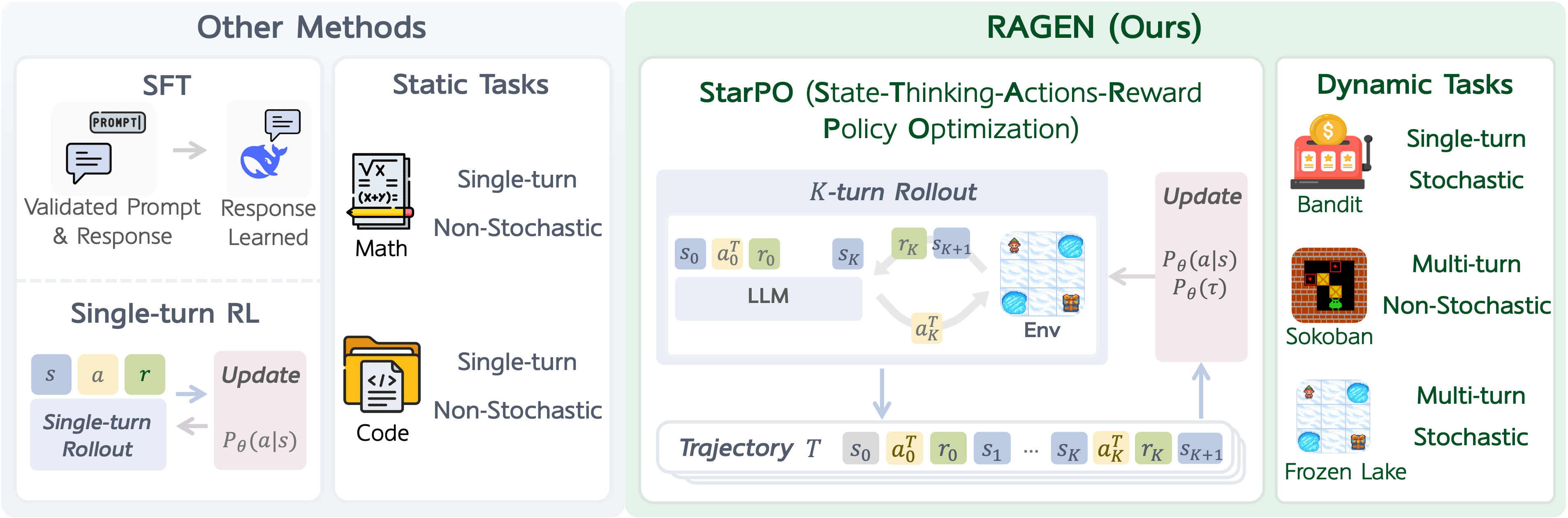
The StarPO (State-Thinking-Action-Reward Policy Optimization) framework with two interleaved stages: rollout stage and update stage. The LLM generates reasoning-guided actions to interact with the environment, collecting trajectory-level rewards to jointly optimize reasoning and action strategies.
MDP Formulation. Agent-environment interactions are formulated as Markov Decision Processes (MDPs) where states and actions are token sequences, allowing LLMs to reason over environment dynamics. The objective is to maximize expected cumulative rewards across multiple interaction turns.
Rollout Stage. Given an initial state, the LLM generates multiple trajectories. At each step, the model produces a reasoning-guided action: <think>...</think><ans> action </ans>. The environment returns feedback (reward and next state).
Update Stage. StarPO optimizes entire trajectories using importance sampling. It supports:
Entropy alone cannot detect template collapse, where reasoning appears diverse within a single input but becomes input-agnostic across inputs. RAGEN-2 decomposes reasoning quality into two axes:
SNR-Adaptive Filtering uses reward variance as a lightweight proxy to select high-signal prompts each iteration, directly addressing the root cause of template collapse.
2026.3.12. RAGEN-2 is released! Check out our v2 paper.
2025.5.8. Official Documentation released. NOTE: this document is now outdated.
2025.5.2. A tracking document for logging minor codebase updates is released.
2025.4.20. RAGEN V1 paper published. Codebase restructured: veRL integrated as a submodule; architecture decomposed into three modules — Environment State Manager, Context Manager, and Agent Proxy.
2025.3.13. RAGEN codebase refactoring underway. See the developing branch.
2025.3.8. KL term issue in veRL fixed. Default advantage estimator changed to GAE (PPO) for more stable training.
2025.1.27. Initial RAGEN release. Post.
git clone https://github.com/mll-lab-nu/RAGEN.git
cd RAGEN
conda create -n ragen python=3.12 -y && conda activate ragen
bash scripts/setup_ragen.sh
Use bash scripts/setup_ragen.sh --with-search to include the search environment. For WebShop, see docs/experiment_webshop_release.md.
RAGEN-2 diagnoses agent behavior along two axes — within-input diversity (Conditional Entropy) and cross-input distinguishability (Mutual Information) — yielding four distinct reasoning regimes:
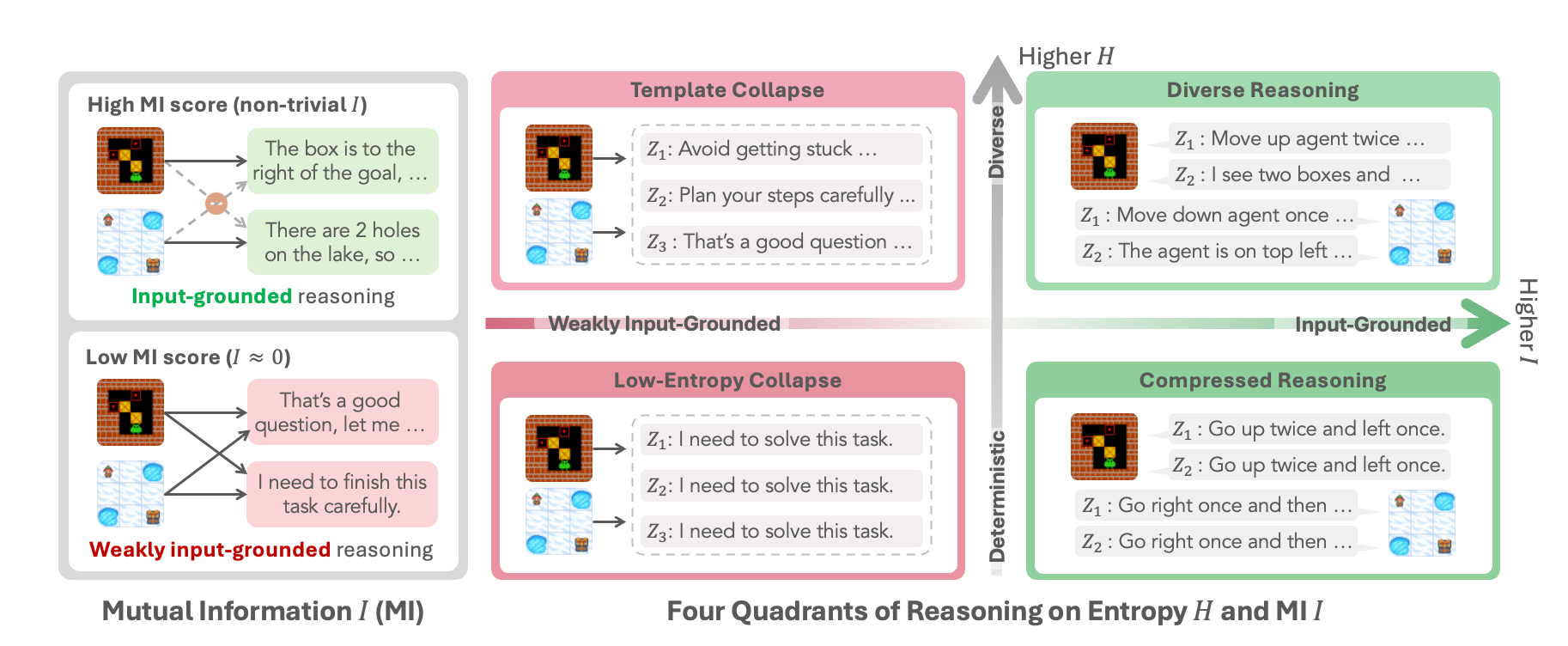
Left: Input-driven reasoning adapts to the current state; templated reasoning produces nearly identical responses across different inputs. Right: Four reasoning regimes along two axes — conditional entropy H(Z|X) (within-input diversity) and mutual information I(X;Z) (input dependence). Template collapse (high entropy, low MI) is invisible to existing entropy-based metrics.
Train (no filter, default):
python train.py --config-name _2_sokoban
Train with SNR-Adaptive Filtering (V2, Top-p):
python train.py --config-name _2_sokoban \
  actor_rollout_ref.rollout_filter_strategy=top_p \
  actor_rollout_ref.rollout.rollout_filter_value=0.9
Evaluate:
python -m ragen.llm_agent.agent_proxy --config-name _2_sokoban
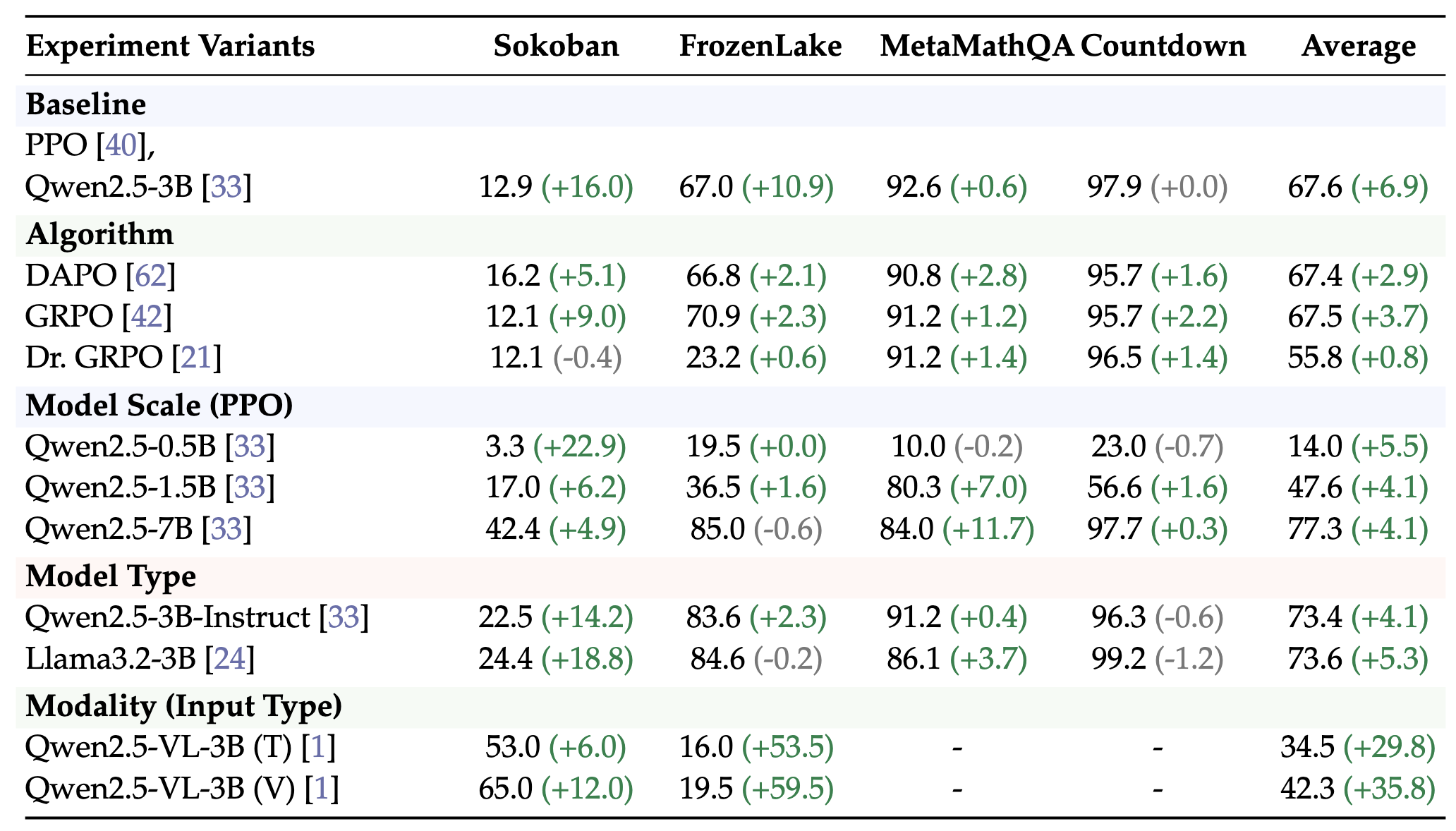
SNR-Adaptive Filtering consistently improves training across algorithms, model scales, and modalities (green = gain from filtering):
See the Rollout Filtering Guide for more filtering strategies (Top-k, linear mode, etc.).
We are actively developing the next generation of RAGEN infrastructure and diagnostics, targeting a release in late March 2026.
Infrastructure
Diagnostics & Training Quality
Framework
config/envs.yaml


Zihan Wang*, Kangrui Wang*, Qineng Wang*, Pingyue Zhang*, Linjie Li*, Zhengyuan Yang, Xing Jin, Kefan Yu, Minh Nhat Nguyen, Licheng Liu, Eli Gottlieb, Yiping Lu, Kyunghyun Cho, Jiajun Wu, Li Fei-Fei, Lijuan Wang, Yejin Choi, Manling Li
*Equal Contribution.
We thank the DeepSeek team for early conceptual inspirations. We are grateful to the veRL team for infrastructure support. We thank the TinyZero team for discoveries that informed our initial exploration. We appreciate insightful discussions with Han Liu, Xinyu Xing, Li Erran Li, John Schulman, Akari Asai, Eiso Kant, Lu Lu, Runxin Xu, Huajian Xin, Zijun Liu, Weiyi Liu, Weimin Wu, Yibo Wen, Jiarui Liu, Lorenzo Xiao, Ishan Mukherjee, Anabella Isaro, Haosen Sun, How-Yeh Wan, Lester Xue, Matthew Khoriaty, Haoxiang Sun, Jiajun Liu.
For RAGEN-2, we additionally thank Yuxiang Lin and Kyunghyun Cho for their support.
@misc{ragen2,
      title={RAGEN-2: Reasoning Collapse in Agentic RL},
      author={Zihan Wang and Chi Gui and Xing Jin and Qineng Wang and Licheng Liu and Kangrui Wang and Shiqi Chen and Linjie Li and Zhengyuan Yang and Pingyue Zhang and Yiping Lu and Jiajun Wu and Li Fei-Fei and Lijuan Wang and Yejin Choi and Manling Li},
      year={2026},
      eprint={2604.06268},
      archivePrefix={arXiv},
      primaryClass={cs.LG},
      url={https://arxiv.org/abs/2604.06268},
}
@misc{ragen,
      title={RAGEN: Understanding Self-Evolution in LLM Agents via Multi-Turn Reinforcement Learning},
      author={Zihan Wang and Kangrui Wang and Qineng Wang and Pingyue Zhang and Linjie Li and Zhengyuan Yang and Xing Jin and Kefan Yu and Minh Nhat Nguyen and Licheng Liu and Eli Gottlieb and Yiping Lu and Kyunghyun Cho and Jiajun Wu and Li Fei-Fei and Lijuan Wang and Yejin Choi and Manling Li},
      year={2025},
      eprint={2504.20073},
      archivePrefix={arXiv},
      primaryClass={cs.LG},
      url={https://arxiv.org/abs/2504.20073},
}
(top 24 of 63)
169 followers · starred Feb 2026
84 followers · starred Jan 2025
242 followers · starred Apr 2025
1,007 followers · starred Jan 2025
Agent RL framework for LLM agents: multi-turn reinforcement learning with StarPO and reasoning-collapse diagnostics
See the code
RAGEN (Reasoning AGENT) is a flexible RL framework for training reasoning LLM agents with multi-turn reinforcement learning, built on the StarPO algorithm.
We develop diagnostics to understand how agentic reinforcement learning (agent RL) training works, and how to fix hidden failure modes such as the Echo Trap (RAGEN) and reasoning collapse (RAGEN-2).
Project Page · RAGEN-2 Page · RAGEN on arXiv · RAGEN-2 on arXiv · MLL Lab (Manling Li, Northwestern)
Looking for the V1 README? Please take a look here.
RAGEN is built around StarPO (State-Thinking-Actions-Reward Policy Optimization), a unified RL framework for training multi-turn, trajectory-level agents with flexible control over reasoning processes, reward assignment mechanisms, and prompt-rollout structures.
RAGEN is flexible with:
RAGEN-2 additionally introduces:
The StarPO (State-Thinking-Action-Reward Policy Optimization) framework with two interleaved stages: rollout stage and update stage. The LLM generates reasoning-guided actions to interact with the environment, collecting trajectory-level rewards to jointly optimize reasoning and action strategies.
MDP Formulation. Agent-environment interactions are formulated as Markov Decision Processes (MDPs) where states and actions are token sequences, allowing LLMs to reason over environment dynamics. The objective is to maximize expected cumulative rewards across multiple interaction turns.
Rollout Stage. Given an initial state, the LLM generates multiple trajectories. At each step, the model produces a reasoning-guided action: <think>...</think><ans> action </ans>. The environment returns feedback (reward and next state).
Update Stage. StarPO optimizes entire trajectories using importance sampling. It supports:
Entropy alone cannot detect template collapse, where reasoning appears diverse within a single input but becomes input-agnostic across inputs. RAGEN-2 decomposes reasoning quality into two axes:
SNR-Adaptive Filtering uses reward variance as a lightweight proxy to select high-signal prompts each iteration, directly addressing the root cause of template collapse.
2026.3.12. RAGEN-2 is released! Check out our v2 paper.
2025.5.8. Official Documentation released. NOTE: this document is now outdated.
2025.5.2. A tracking document for logging minor codebase updates is released.
2025.4.20. RAGEN V1 paper published. Codebase restructured: veRL integrated as a submodule; architecture decomposed into three modules — Environment State Manager, Context Manager, and Agent Proxy.
2025.3.13. RAGEN codebase refactoring underway. See the developing branch.
2025.3.8. KL term issue in veRL fixed. Default advantage estimator changed to GAE (PPO) for more stable training.
2025.1.27. Initial RAGEN release. Post.
git clone https://github.com/mll-lab-nu/RAGEN.git
cd RAGEN
conda create -n ragen python=3.12 -y && conda activate ragen
bash scripts/setup_ragen.sh
Use bash scripts/setup_ragen.sh --with-search to include the search environment. For WebShop, see docs/experiment_webshop_release.md.
RAGEN-2 diagnoses agent behavior along two axes — within-input diversity (Conditional Entropy) and cross-input distinguishability (Mutual Information) — yielding four distinct reasoning regimes:
Left: Input-driven reasoning adapts to the current state; templated reasoning produces nearly identical responses across different inputs. Right: Four reasoning regimes along two axes — conditional entropy H(Z|X) (within-input diversity) and mutual information I(X;Z) (input dependence). Template collapse (high entropy, low MI) is invisible to existing entropy-based metrics.
Train (no filter, default):
python train.py --config-name _2_sokoban
Train with SNR-Adaptive Filtering (V2, Top-p):
python train.py --config-name _2_sokoban \
  actor_rollout_ref.rollout_filter_strategy=top_p \
  actor_rollout_ref.rollout.rollout_filter_value=0.9
Evaluate:
python -m ragen.llm_agent.agent_proxy --config-name _2_sokoban
SNR-Adaptive Filtering consistently improves training across algorithms, model scales, and modalities (green = gain from filtering):
See the Rollout Filtering Guide for more filtering strategies (Top-k, linear mode, etc.).
We are actively developing the next generation of RAGEN infrastructure and diagnostics, targeting a release in late March 2026.
Infrastructure
Diagnostics & Training Quality
Framework
config/envs.yamlZihan Wang*, Kangrui Wang*, Qineng Wang*, Pingyue Zhang*, Linjie Li*, Zhengyuan Yang, Xing Jin, Kefan Yu, Minh Nhat Nguyen, Licheng Liu, Eli Gottlieb, Yiping Lu, Kyunghyun Cho, Jiajun Wu, Li Fei-Fei, Lijuan Wang, Yejin Choi, Manling Li
*Equal Contribution.
We thank the DeepSeek team for early conceptual inspirations. We are grateful to the veRL team for infrastructure support. We thank the TinyZero team for discoveries that informed our initial exploration. We appreciate insightful discussions with Han Liu, Xinyu Xing, Li Erran Li, John Schulman, Akari Asai, Eiso Kant, Lu Lu, Runxin Xu, Huajian Xin, Zijun Liu, Weiyi Liu, Weimin Wu, Yibo Wen, Jiarui Liu, Lorenzo Xiao, Ishan Mukherjee, Anabella Isaro, Haosen Sun, How-Yeh Wan, Lester Xue, Matthew Khoriaty, Haoxiang Sun, Jiajun Liu.
For RAGEN-2, we additionally thank Yuxiang Lin and Kyunghyun Cho for their support.
@misc{ragen2,
      title={RAGEN-2: Reasoning Collapse in Agentic RL},
      author={Zihan Wang and Chi Gui and Xing Jin and Qineng Wang and Licheng Liu and Kangrui Wang and Shiqi Chen and Linjie Li and Zhengyuan Yang and Pingyue Zhang and Yiping Lu and Jiajun Wu and Li Fei-Fei and Lijuan Wang and Yejin Choi and Manling Li},
      year={2026},
      eprint={2604.06268},
      archivePrefix={arXiv},
      primaryClass={cs.LG},
      url={https://arxiv.org/abs/2604.06268},
}
@misc{ragen,
      title={RAGEN: Understanding Self-Evolution in LLM Agents via Multi-Turn Reinforcement Learning},
      author={Zihan Wang and Kangrui Wang and Qineng Wang and Pingyue Zhang and Linjie Li and Zhengyuan Yang and Xing Jin and Kefan Yu and Minh Nhat Nguyen and Licheng Liu and Eli Gottlieb and Yiping Lu and Kyunghyun Cho and Jiajun Wu and Li Fei-Fei and Lijuan Wang and Yejin Choi and Manling Li},
      year={2025},
      eprint={2504.20073},
      archivePrefix={arXiv},
      primaryClass={cs.LG},
      url={https://arxiv.org/abs/2504.20073},
}
(top 24 of 63)
169 followers · starred Feb 2026
84 followers · starred Jan 2025
242 followers · starred Apr 2025
1,007 followers · starred Jan 2025



