
WBench: A Comprehensive Multi-turn Benchmark for Interactive Video World Model Evaluation
See the codeREADME

WBench: A Comprehensive Multi-turn Benchmark for
Interactive Video World Model Evaluation
Kaining Ying *, Hengrui Hu*, Siyu Ren
 , Jiamu Li, Fengjiao Chen,
Ziwen Wang, Xuezhi Cao, Xunliang Cai, Henghui Ding ✉️
Fudan University Meituan LongCat Team







-1BC47D?style=for-the-badge&logo=huggingface&logoColor=white)





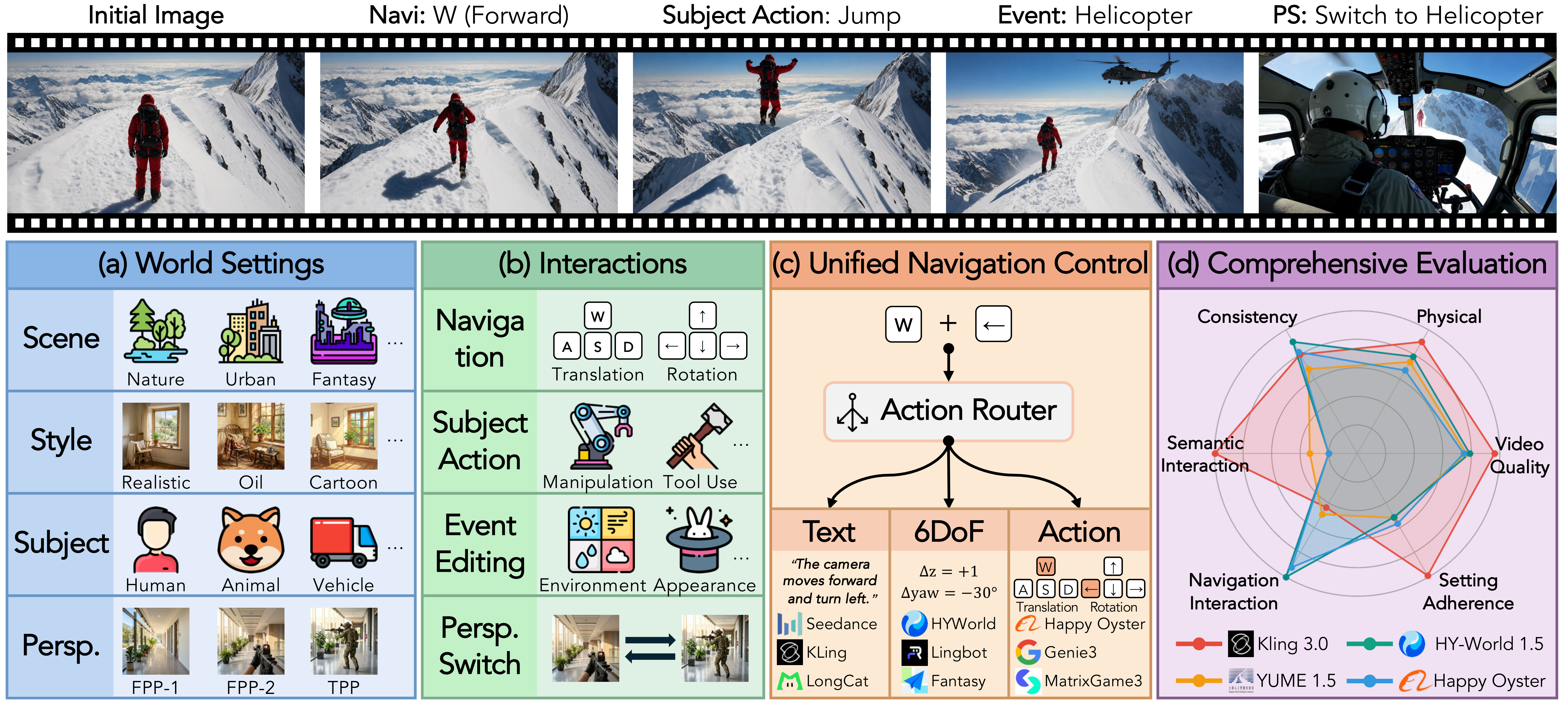
TL;DR — WBench evaluates 39 video world models across 5 dimensions and 22 metrics.

📢 News
- [2026/09/24] 🆕 Enuma (
camera, Unreleased, self-evaluation): Navi 81.7 (#3,bidirection) and 79.7 (#10,AR,4-step,flash) across 158 cases · ByteDance · thanks @Kr1sJ. - [2026/09/23] 🆕 MuseFlow-Pro (
text, Unreleased): Full 81.1, #1 across 289 cases · Musee · thanks @Easo04. - [2026/09/17] 🆕 Astronex-World (
camera,5B, Open Source): Full 70.0, #10 across 289 cases; Navi 73.5, #31 across 158 cases · Astronex Robotics · thanks @Astronex-Robotics. - [2026/09/17] 🆕 XGEN-Jing (
camera,4-step AR, Open Source): Full 79.9, #2 across 289 cases; Navi 81.0, #6 across 158 cases · Code · Weights · XGEN Labs · thanks @XGEN-Labs. - [2026/09/12] 🆕 XGEN-Jing (
camera,bidirection, Open Source): Full 81.0, #1 across 289 cases; Navi 81.9, #2 across 158 cases · Code · Weights · XGEN Labs · thanks @XGEN-Labs. - [2026/09/11] 🆕 Alaya-EVOKE-Turbo (
camera,3-step, Open Source): Navi 82.0, #1 across 158 cases · Code · Weights · Paper · thanks @SII-YuanyangYin. - [2026/08/28] 🆕 JoyAI-Echo-1.5 (WM) (
flash,4-step): Navi 81.0, #2 · thanks @franklinz233. - [2026/08/27] 🆕 Helios (Distilled): Full 69.7, #9; Navi 74.3, #22 · thanks @SHYuanBest.
- [2026/08/26] 🆕 Zing-0.5 (Open Source): Navi 81.0, #3 · Paper · thanks @seedleap.
- [2026/08/24] 🆕 Added JoyAI-Echo-1.5 (WM): 81.6, #1 · thanks @franklinz233.
- [2026/08/16] 🔄 Updated AlayaWorld final-v4: 76.3, #12 · thanks @nevermorelch.
- [2026/08/16] 🔄 Updated HiDream-O1-World 08/14: 80.9, #1 · thanks @Spark001.
- [2026/08/14] 🆕 Added Alaya-EVOKE · thanks @SII-YuanyangYin.
- [2026/07/29] 🆕 Added HiDream-O1-World (camera-conditioned).
- [2026/07/29] 🆕 Added AlayaWorld (Alaya Lab, camera-conditioned) to the leaderboard (now 29 models).
- [2026/07/14] 🆕 Added ABot-World (Amap, action-conditioned) to the leaderboard (now 28 models).
- [2026/07/12] 🆕 Added LingBot-World (fast v2) (camera) to the leaderboard (now 27 models).
- [2026/07/12] 🆕 Added Cosmos3-Super & Cosmos3-Nano (text) to the leaderboard (now 26 models).
- [2026/06/18] 🆕 Added DreamX-World (5B AR) to the leaderboard (now 24 models).
- [2026/06/17] 🆕 Added LingBot-World (fast) to the leaderboard (now 23 models).
- [2026/06/16] 🔌 Open-sourced the HY-World 1.5 integration example.
- [2026/06/16] 🆕 Added 2 camera-controlled world models — Lyra 2.0 & SANA-WM (4-step AR).
- [2026/06/10] 🧭 Added HY-World 1.5 pose exports to WBench-examples.
- [2026/06/01] WBench is now an official benchmark on Hugging Face 🤗 (navi & full tasks)!
- [2026/06/01] 📦 Released WBench-examples: ready-to-eval videos from HY-World 1.5 & Kling 3.0.
- [2026/06/01] 🎮 Added camera- & action-conditioned examples + web automation (Genie3, Happy Oyster).
- [2026/06/01] Added Claude Code skills 🤖 for generation, evaluation & submission.
- [2026/05/29] Paper ranked #2 🏅 on Hugging Face Daily Papers!
- [2026/05/28] Paper now available on arXiv 📄!
- [2026/05/28] Homepage with interactive leaderboard & dataset gallery is live! 🌐
- [2026/05/28] 🚀 Released the full WBench dataset, evaluation code & model weights.
✨ Contributions
- A comprehensive evaluation framework with 289 cases, 1,058 interaction turns, covering 4 interaction types (navigation, subject action, event editing, perspective switching) across diverse scenes and perspectives.
- A unified navigation protocol that bridges text, 6-DoF camera pose, and discrete-action interfaces, enabling fair comparison across model families.
- 22 automatic metrics spanning 5 complementary dimensions, validated against human judgments, ensuring reliable automatic evaluation at scale.
- Systematic diagnosis of 39 models revealing that current world models have not yet unified high-fidelity rendering with reliable controllability, consistency, and physics compliance.
🏆 Leaderboard
View the live leaderboard on the WBench homepage →
🚀 Quick Start
# Install
git clone --recursive https://github.com/meituan-longcat/WBench.git
cd WBench

# If you already cloned without submodules
git submodule update --init --recursive

# Download data and weights
pip install huggingface_hub
hf download meituan-longcat/WBench --repo-type dataset --local-dir data/ --exclude "splits/*"
hf download meituan-longcat/WBench-weights --local-dir weights/

# Environment 1: wbench-main (all metrics except visual_plausibility)
# 2nd arg = PyTorch's CUDA build — match it to YOUR system (check via `nvcc --version`):
#   cu124 → CUDA 12.x    cu121 → CUDA 12.1    cu118 → CUDA 11.8
# Always pass it explicitly: if omitted, auto-detection falls back to cu118 when nvcc
# isn't on PATH, which makes the MegaSAM CUDA extensions fail to build on CUDA-12 machines.
bash tools/install.sh wbench-main cu124
conda activate wbench-main
export LD_LIBRARY_PATH=$CONDA_PREFIX/lib:$LD_LIBRARY_PATH


# Verify
conda activate wbench-main
python tools/verify_install.py

# Run evaluation (auto multi-GPU)
python main.py --model your_model
See docs/installation.md for detailed setup instructions.
🎮 Evaluate Your Model
Set environment variables for VLM metrics first (we use Doubao-Seed-2.0-lite via Volcengine ARK):
export VLM_API_KEY="<your-ark-api-key>"
# Optional (defaults shown):
# export VLM_API_URL="https://ark.cn-beijing.volces.com/api/v3"
# export VLM_MODEL_NAME="doubao-seed-2-0-lite-260215"
- Generate multi-turn videos → place in
work_dirs/<model>/videos/case_{id}_combined.mp4 - Run the 3-phase pipeline:
# Full pipeline (precompute → GPU metrics → VLM metrics → report)
python main.py --model my_model --gpus 0,1,2,3,4,5,6,7

# Or run phases independently:
python main.py --model my_model --phase precompute    # SAM2 + DA3 + MegaSAM
python main.py --model my_model --phase gpu           # GPU metrics (per-metric)
python main.py --model my_model --phase vlm           # VLM metrics (API)
python main.py --model my_model --phase report        # Aggregate report
Note: the pipeline above covers 21 of the 22 metrics. visual_plausibility is the exception — it runs in the separate wbench-vp environment (set up in Quick Start):
conda activate wbench-vp
python tools/run_visual_plausibility.py --model my_model  # uses all available GPUs
- Results:
work_dirs/<model>/evaluation/{metric}/case_{id}.json+report.json
# Run specific metrics (by name or dimension)
python main.py --model my_model --phase gpu --metrics hpsv3_quality
python main.py --model my_model --phase gpu --metrics quality         # all 6 video quality
python main.py --model my_model --phase gpu --metrics consistency     # all consistency metrics

# Skip pre-computation if already done
python main.py --model my_model --phase gpu --skip_megasam --skip_sam2 --skip_da3

# Single video evaluation
python main.py --video video.mp4 --case data/cases/case_1.json
Dimensions (--metrics supports these as shorthand):
| Dimension | Metrics |
|---|---|
quality | aesthetic_quality, imaging_quality, temporal_flickering, dynamic_degree, motion_smoothness, hpsv3_quality |
consistency | background_consistency, segment_continuity, perspective_consistency, subject_consistency, geometric_consistency, photometric_consistency, spatial_consistency, gated_spatial_consistency |
interaction | navigation_trajectory, event_edit_adherence, subject_action_adherence, perspective_switch_adherence |
setting | scene_adherence, subject_adherence |
physical | visual_plausibility, causal_fidelity |
🔌 Implement Your Model
WBench supports 3 model types with different control interfaces:
| Type | Input | Cases | Status |
|---|---|---|---|
| Text-conditioned | Text prompt + first-frame image | 289 (all) | ✅ Implemented |
| Camera-conditioned | First-frame image + 6-DoF camera pose | 158 (navi) | ✅ Implemented |
| Action-conditioned | First-frame image + discrete action | 158 (navi) | ✅ Implemented |
Text-conditioned models
from src.models import get_model

# Available: wan, kling, seedance (or register your own)
model = get_model("wan")

# Generate multi-turn video from a case
result = model.generate_multi_turn(
    case=case_dict,
    output_path="work_dirs/wan/videos/case_1_combined.mp4",
    data_root="data/",
)
Each turn: build prompt from interaction → call I2V API → extract last frame → next turn.
Set API credentials:
export VIDEO_API_URL="https://your-video-api.com"
export VIDEO_API_KEY="your-key"
Camera-conditioned models
The benchmark's navigation actions (W/A/S/D + arrows) are converted to per-turn
{move, yaw, pitch} intent and then to a 6-DoF camera trajectory. Subclass
CameraConditionedModel and implement one hook — case parsing, action→pose
conversion, and video writing are handled for you:
from src.models.camera import CameraConditionedModel

class MyWorldModel(CameraConditionedModel):
    def generate_with_poses(self, image, poses, video_length, **kw):
        # image: first-frame path; poses: {"<latent_idx>": {"extrinsic": 4x4, "K": 3x3}, ...}
        # return: list of `video_length` BGR uint8 frames
        return my_model.infer(image, poses, video_length)

MyWorldModel("mymodel").generate_multi_turn(case_dict,
    "work_dirs/mymodel/videos/case_1_combined.mp4", data_root="data/")
The pose convention (axes, speeds, intrinsics) lives in src/models/camera/poses.py
— copy and adapt it to your model; the navigation metric normalises scale, so what
matters is matching the per-action intent. Quick look at one case:
python -m src.models.camera.demo --case data/cases/case_1.json # prints poses + renders a preview
Note: Camera/action models only cover the 158 navigation cases (cases containing at least one W/A/S/D/arrow action). When generating at scale, pass only those cases — e.g. via
generate.py --model your_model --cases <navi_list>.
Action-conditioned models
Two flavours, both fed from the same per-turn navigation plan:
Programmatic controllers (e.g. Matrix-Game-3). Subclass ActionConditionedModel
and implement generate_with_actions. Each action carries both raw key tokens
and an MG3-style {keyboard, mouse} tensor:
from src.models.action import ActionConditionedModel

class MyActionModel(ActionConditionedModel):
    def generate_with_actions(self, image, actions, video_length, **kw):
        # actions: [{"turn", "tokens", "keyboard", "mouse", "duration"}, ...]
        return my_model.infer(image, actions, video_length)

MyActionModel("mymodel").generate_multi_turn(case_dict,
    "work_dirs/mymodel/videos/case_1_combined.mp4", data_root="data/")
python -m src.models.action.demo --case data/cases/case_1.json # prints actions + renders a preview
Web products (e.g. Project Genie, Happy Oyster) — no weights/API; driven by
browser automation + simulated keystrokes. See
src/models/action/web/.
🤖 Claude Code Skills
If you use Claude Code, this repo ships skills that drive the full workflow — just ask in natural language and Claude runs the right commands:
| Skill | Triggers on | What it does |
|---|---|---|
wbench-generate | "generate kling videos" | Runs generate.py over the dataset → work_dirs/<model>/videos/ |
wbench-evaluate | "evaluate kling3" | Runs the 4-phase main.py pipeline (precompute → gpu → vlm → report) |
wbench-submit | "package my model for submission" | Builds the meta.json / turns.json bundle and uploads to HuggingFace |
genie3 / happy | "run case_5 on genie3" | Browser automation for the web products (details) |
Skills live in .claude/skills/ (and src/models/action/web/.claude/skills/) and
are auto-discovered when you open the repo in Claude Code.
📋 TODO
- Text-conditioned model generation (Wan, Kling, Seedance)
- Homepage with interactive leaderboard
- Dataset and weights release on HuggingFace
- Camera-conditioned model generation example
- Action-conditioned model generation example
- Hosted submission & evaluation service (submit videos, get scores)
- ArXiv paper release
📝 Citation
If you find our work useful, please consider citing:
@article{ying2026wbenchcomprehensivemultiturnbenchmark,
  title={WBench: A Comprehensive Multi-turn Benchmark for Interactive Video World Model Evaluation},
  author={Ying, Kaining and Hu, Hengrui and Ren, Siyu and Li, Jiamu and Chen, Fengjiao and Wang, Ziwen and Cao, Xuezhi and Cai, Xunliang and Ding, Henghui},
  journal={arXiv preprint arXiv:2605.25874},
  year={2026}
}
🙏 Acknowledgement
This project builds upon the following excellent works:
- WorldScore — World model evaluation framework
- VBench — Video quality metrics
- SAM2 — Segment Anything Model 2 for mask tracking
- Depth-Anything-V3 — Monocular depth estimation
- MegaSAM — Camera pose estimation
- DreamSim — Perceptual similarity metric
- HPSv3 — Human Preference Score
- AMT — Frame interpolation for motion smoothness
- RAFT — Optical flow estimation
- TransNetV2 — Scene boundary detection
- ... and many other excellent open-source projects
📧 Contact
Feel free to open an Issue or Pull Request. You can also reach us directly:
- Kaining Ying:
kaining.ying.cv@gmail.com - Siyu Ren:
rensiyu07@meituan.com - Henghui Ding:
hhding@fudan.edu.cn
📄 License
Code and data: MIT License. Model weights retain their original licenses.
Contributors

60 commits
Similar repos


Languages
Python
97.7%
Shell
2.3%
WBench: A Comprehensive Multi-turn Benchmark for Interactive Video World Model Evaluation
See the codeREADME
WBench: A Comprehensive Multi-turn Benchmark for
Interactive Video World Model Evaluation
Kaining Ying*, Hengrui Hu*, Siyu Ren, Jiamu Li, Fengjiao Chen,
Ziwen Wang, Xuezhi Cao, Xunliang Cai, Henghui Ding ✉️
Fudan University Meituan LongCat Team
TL;DR — WBench evaluates 39 video world models across 5 dimensions and 22 metrics.
📢 News
- [2026/09/24] 🆕 Enuma (
camera, Unreleased, self-evaluation): Navi 81.7 (#3,bidirection) and 79.7 (#10,AR,4-step,flash) across 158 cases · ByteDance · thanks @Kr1sJ. - [2026/09/23] 🆕 MuseFlow-Pro (
text, Unreleased): Full 81.1, #1 across 289 cases · Musee · thanks @Easo04. - [2026/09/17] 🆕 Astronex-World (
camera,5B, Open Source): Full 70.0, #10 across 289 cases; Navi 73.5, #31 across 158 cases · Astronex Robotics · thanks @Astronex-Robotics. - [2026/09/17] 🆕 XGEN-Jing (
camera,4-step AR, Open Source): Full 79.9, #2 across 289 cases; Navi 81.0, #6 across 158 cases · Code · Weights · XGEN Labs · thanks @XGEN-Labs. - [2026/09/12] 🆕 XGEN-Jing (
camera,bidirection, Open Source): Full 81.0, #1 across 289 cases; Navi 81.9, #2 across 158 cases · Code · Weights · XGEN Labs · thanks @XGEN-Labs. - [2026/09/11] 🆕 Alaya-EVOKE-Turbo (
camera,3-step, Open Source): Navi 82.0, #1 across 158 cases · Code · Weights · Paper · thanks @SII-YuanyangYin. - [2026/08/28] 🆕 JoyAI-Echo-1.5 (WM) (
flash,4-step): Navi 81.0, #2 · thanks @franklinz233. - [2026/08/27] 🆕 Helios (Distilled): Full 69.7, #9; Navi 74.3, #22 · thanks @SHYuanBest.
- [2026/08/26] 🆕 Zing-0.5 (Open Source): Navi 81.0, #3 · Paper · thanks @seedleap.
- [2026/08/24] 🆕 Added JoyAI-Echo-1.5 (WM): 81.6, #1 · thanks @franklinz233.
- [2026/08/16] 🔄 Updated AlayaWorld final-v4: 76.3, #12 · thanks @nevermorelch.
- [2026/08/16] 🔄 Updated HiDream-O1-World 08/14: 80.9, #1 · thanks @Spark001.
- [2026/08/14] 🆕 Added Alaya-EVOKE · thanks @SII-YuanyangYin.
- [2026/07/29] 🆕 Added HiDream-O1-World (camera-conditioned).
- [2026/07/29] 🆕 Added AlayaWorld (Alaya Lab, camera-conditioned) to the leaderboard (now 29 models).
- [2026/07/14] 🆕 Added ABot-World (Amap, action-conditioned) to the leaderboard (now 28 models).
- [2026/07/12] 🆕 Added LingBot-World (fast v2) (camera) to the leaderboard (now 27 models).
- [2026/07/12] 🆕 Added Cosmos3-Super & Cosmos3-Nano (text) to the leaderboard (now 26 models).
- [2026/06/18] 🆕 Added DreamX-World (5B AR) to the leaderboard (now 24 models).
- [2026/06/17] 🆕 Added LingBot-World (fast) to the leaderboard (now 23 models).
- [2026/06/16] 🔌 Open-sourced the HY-World 1.5 integration example.
- [2026/06/16] 🆕 Added 2 camera-controlled world models — Lyra 2.0 & SANA-WM (4-step AR).
- [2026/06/10] 🧭 Added HY-World 1.5 pose exports to WBench-examples.
- [2026/06/01] WBench is now an official benchmark on Hugging Face 🤗 (navi & full tasks)!
- [2026/06/01] 📦 Released WBench-examples: ready-to-eval videos from HY-World 1.5 & Kling 3.0.
- [2026/06/01] 🎮 Added camera- & action-conditioned examples + web automation (Genie3, Happy Oyster).
- [2026/06/01] Added Claude Code skills 🤖 for generation, evaluation & submission.
- [2026/05/29] Paper ranked #2 🏅 on Hugging Face Daily Papers!
- [2026/05/28] Paper now available on arXiv 📄!
- [2026/05/28] Homepage with interactive leaderboard & dataset gallery is live! 🌐
- [2026/05/28] 🚀 Released the full WBench dataset, evaluation code & model weights.
✨ Contributions
- A comprehensive evaluation framework with 289 cases, 1,058 interaction turns, covering 4 interaction types (navigation, subject action, event editing, perspective switching) across diverse scenes and perspectives.
- A unified navigation protocol that bridges text, 6-DoF camera pose, and discrete-action interfaces, enabling fair comparison across model families.
- 22 automatic metrics spanning 5 complementary dimensions, validated against human judgments, ensuring reliable automatic evaluation at scale.
- Systematic diagnosis of 39 models revealing that current world models have not yet unified high-fidelity rendering with reliable controllability, consistency, and physics compliance.
🏆 Leaderboard
View the live leaderboard on the WBench homepage →
🚀 Quick Start
# Install
git clone --recursive https://github.com/meituan-longcat/WBench.git
cd WBench

# If you already cloned without submodules
git submodule update --init --recursive

# Download data and weights
pip install huggingface_hub
hf download meituan-longcat/WBench --repo-type dataset --local-dir data/ --exclude "splits/*"
hf download meituan-longcat/WBench-weights --local-dir weights/

# Environment 1: wbench-main (all metrics except visual_plausibility)
# 2nd arg = PyTorch's CUDA build — match it to YOUR system (check via `nvcc --version`):
#   cu124 → CUDA 12.x    cu121 → CUDA 12.1    cu118 → CUDA 11.8
# Always pass it explicitly: if omitted, auto-detection falls back to cu118 when nvcc
# isn't on PATH, which makes the MegaSAM CUDA extensions fail to build on CUDA-12 machines.
bash tools/install.sh wbench-main cu124
conda activate wbench-main
export LD_LIBRARY_PATH=$CONDA_PREFIX/lib:$LD_LIBRARY_PATH


# Verify
conda activate wbench-main
python tools/verify_install.py

# Run evaluation (auto multi-GPU)
python main.py --model your_model
See docs/installation.md for detailed setup instructions.
🎮 Evaluate Your Model
Set environment variables for VLM metrics first (we use Doubao-Seed-2.0-lite via Volcengine ARK):
export VLM_API_KEY="<your-ark-api-key>"
# Optional (defaults shown):
# export VLM_API_URL="https://ark.cn-beijing.volces.com/api/v3"
# export VLM_MODEL_NAME="doubao-seed-2-0-lite-260215"
- Generate multi-turn videos → place in
work_dirs/<model>/videos/case_{id}_combined.mp4 - Run the 3-phase pipeline:
# Full pipeline (precompute → GPU metrics → VLM metrics → report)
python main.py --model my_model --gpus 0,1,2,3,4,5,6,7

# Or run phases independently:
python main.py --model my_model --phase precompute    # SAM2 + DA3 + MegaSAM
python main.py --model my_model --phase gpu           # GPU metrics (per-metric)
python main.py --model my_model --phase vlm           # VLM metrics (API)
python main.py --model my_model --phase report        # Aggregate report
Note: the pipeline above covers 21 of the 22 metrics. visual_plausibility is the exception — it runs in the separate wbench-vp environment (set up in Quick Start):
conda activate wbench-vp
python tools/run_visual_plausibility.py --model my_model  # uses all available GPUs
- Results:
work_dirs/<model>/evaluation/{metric}/case_{id}.json+report.json
# Run specific metrics (by name or dimension)
python main.py --model my_model --phase gpu --metrics hpsv3_quality
python main.py --model my_model --phase gpu --metrics quality         # all 6 video quality
python main.py --model my_model --phase gpu --metrics consistency     # all consistency metrics

# Skip pre-computation if already done
python main.py --model my_model --phase gpu --skip_megasam --skip_sam2 --skip_da3

# Single video evaluation
python main.py --video video.mp4 --case data/cases/case_1.json
Dimensions (--metrics supports these as shorthand):
| Dimension | Metrics |
|---|---|
quality | aesthetic_quality, imaging_quality, temporal_flickering, dynamic_degree, motion_smoothness, hpsv3_quality |
consistency | background_consistency, segment_continuity, perspective_consistency, subject_consistency, geometric_consistency, photometric_consistency, spatial_consistency, gated_spatial_consistency |
interaction | navigation_trajectory, event_edit_adherence, subject_action_adherence, perspective_switch_adherence |
setting | scene_adherence, subject_adherence |
physical | visual_plausibility, causal_fidelity |
🔌 Implement Your Model
WBench supports 3 model types with different control interfaces:
| Type | Input | Cases | Status |
|---|---|---|---|
| Text-conditioned | Text prompt + first-frame image | 289 (all) | ✅ Implemented |
| Camera-conditioned | First-frame image + 6-DoF camera pose | 158 (navi) | ✅ Implemented |
| Action-conditioned | First-frame image + discrete action | 158 (navi) | ✅ Implemented |
Text-conditioned models
from src.models import get_model

# Available: wan, kling, seedance (or register your own)
model = get_model("wan")

# Generate multi-turn video from a case
result = model.generate_multi_turn(
    case=case_dict,
    output_path="work_dirs/wan/videos/case_1_combined.mp4",
    data_root="data/",
)
Each turn: build prompt from interaction → call I2V API → extract last frame → next turn.
Set API credentials:
export VIDEO_API_URL="https://your-video-api.com"
export VIDEO_API_KEY="your-key"
Camera-conditioned models
The benchmark's navigation actions (W/A/S/D + arrows) are converted to per-turn
{move, yaw, pitch} intent and then to a 6-DoF camera trajectory. Subclass
CameraConditionedModel and implement one hook — case parsing, action→pose
conversion, and video writing are handled for you:
from src.models.camera import CameraConditionedModel

class MyWorldModel(CameraConditionedModel):
    def generate_with_poses(self, image, poses, video_length, **kw):
        # image: first-frame path; poses: {"<latent_idx>": {"extrinsic": 4x4, "K": 3x3}, ...}
        # return: list of `video_length` BGR uint8 frames
        return my_model.infer(image, poses, video_length)

MyWorldModel("mymodel").generate_multi_turn(case_dict,
    "work_dirs/mymodel/videos/case_1_combined.mp4", data_root="data/")
The pose convention (axes, speeds, intrinsics) lives in src/models/camera/poses.py
— copy and adapt it to your model; the navigation metric normalises scale, so what
matters is matching the per-action intent. Quick look at one case:
python -m src.models.camera.demo --case data/cases/case_1.json # prints poses + renders a preview
Note: Camera/action models only cover the 158 navigation cases (cases containing at least one W/A/S/D/arrow action). When generating at scale, pass only those cases — e.g. via
generate.py --model your_model --cases <navi_list>.
Action-conditioned models
Two flavours, both fed from the same per-turn navigation plan:
Programmatic controllers (e.g. Matrix-Game-3). Subclass ActionConditionedModel
and implement generate_with_actions. Each action carries both raw key tokens
and an MG3-style {keyboard, mouse} tensor:
from src.models.action import ActionConditionedModel

class MyActionModel(ActionConditionedModel):
    def generate_with_actions(self, image, actions, video_length, **kw):
        # actions: [{"turn", "tokens", "keyboard", "mouse", "duration"}, ...]
        return my_model.infer(image, actions, video_length)

MyActionModel("mymodel").generate_multi_turn(case_dict,
    "work_dirs/mymodel/videos/case_1_combined.mp4", data_root="data/")
python -m src.models.action.demo --case data/cases/case_1.json # prints actions + renders a preview
Web products (e.g. Project Genie, Happy Oyster) — no weights/API; driven by
browser automation + simulated keystrokes. See
src/models/action/web/.
🤖 Claude Code Skills
If you use Claude Code, this repo ships skills that drive the full workflow — just ask in natural language and Claude runs the right commands:
| Skill | Triggers on | What it does |
|---|---|---|
wbench-generate | "generate kling videos" | Runs generate.py over the dataset → work_dirs/<model>/videos/ |
wbench-evaluate | "evaluate kling3" | Runs the 4-phase main.py pipeline (precompute → gpu → vlm → report) |
wbench-submit | "package my model for submission" | Builds the meta.json / turns.json bundle and uploads to HuggingFace |
genie3 / happy | "run case_5 on genie3" | Browser automation for the web products (details) |
Skills live in .claude/skills/ (and src/models/action/web/.claude/skills/) and
are auto-discovered when you open the repo in Claude Code.
📋 TODO
- Text-conditioned model generation (Wan, Kling, Seedance)
- Homepage with interactive leaderboard
- Dataset and weights release on HuggingFace
- Camera-conditioned model generation example
- Action-conditioned model generation example
- Hosted submission & evaluation service (submit videos, get scores)
- ArXiv paper release
📝 Citation
If you find our work useful, please consider citing:
@article{ying2026wbenchcomprehensivemultiturnbenchmark,
  title={WBench: A Comprehensive Multi-turn Benchmark for Interactive Video World Model Evaluation},
  author={Ying, Kaining and Hu, Hengrui and Ren, Siyu and Li, Jiamu and Chen, Fengjiao and Wang, Ziwen and Cao, Xuezhi and Cai, Xunliang and Ding, Henghui},
  journal={arXiv preprint arXiv:2605.25874},
  year={2026}
}
🙏 Acknowledgement
This project builds upon the following excellent works:
- WorldScore — World model evaluation framework
- VBench — Video quality metrics
- SAM2 — Segment Anything Model 2 for mask tracking
- Depth-Anything-V3 — Monocular depth estimation
- MegaSAM — Camera pose estimation
- DreamSim — Perceptual similarity metric
- HPSv3 — Human Preference Score
- AMT — Frame interpolation for motion smoothness
- RAFT — Optical flow estimation
- TransNetV2 — Scene boundary detection
- ... and many other excellent open-source projects
📧 Contact
Feel free to open an Issue or Pull Request. You can also reach us directly:
- Kaining Ying:
kaining.ying.cv@gmail.com - Siyu Ren:
rensiyu07@meituan.com - Henghui Ding:
hhding@fudan.edu.cn
📄 License
Code and data: MIT License. Model weights retain their original licenses.
Similar repos
Contributors
60 commits
Languages
Python
97.7%
Shell
2.3%