
See what people are saying
README
Empirical Variational Autoencoder



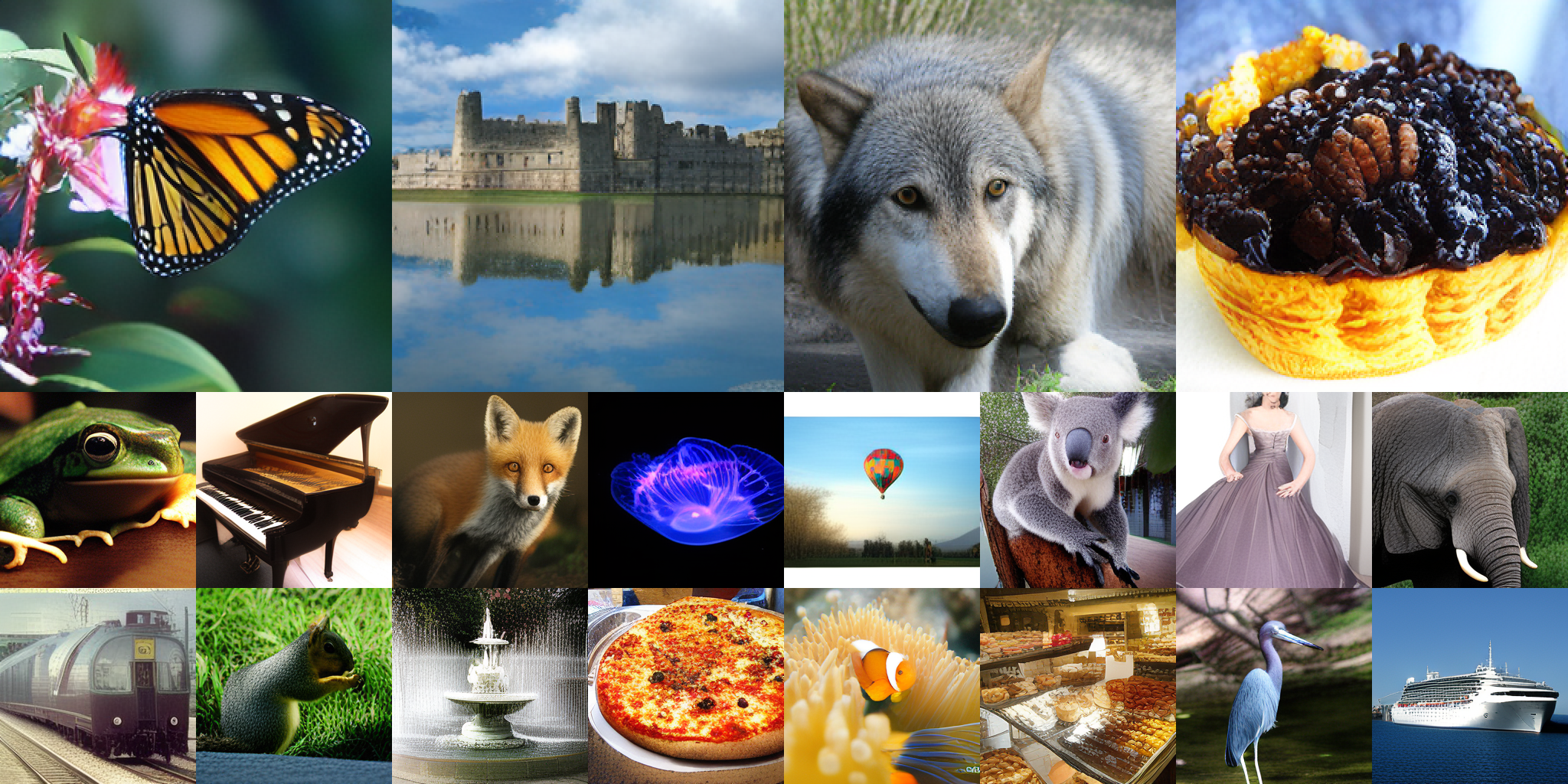
Official PyTorch implementation of EVA.
@article{shiohara2026empirical,
  title={Empirical Variational Autoencoder},
  author={Kaede Shiohara},
  journal={arXiv:2610.06545},
  year={2026}
}
This repository contains:
- The EVA implementation for image and audio latents.
- Distributed training, generation, and reconstruction through separate entry points.
- ImageNet and VGGSound latent caching through main_cache.py.
- Reproducible YAML experiment configurations under configs.
- ImageNet FID/IS/rFID and VGGSound VGGish-FID/IS/rFID evaluation.
Training always uses cached tokenizer posterior moments. Tokenizers are not loaded during training.
Model Variants
The architecture is selected only by model.size. Individual width, depth, and head-count
overrides are intentionally unsupported.
| Size | Width | Encoder depth | Decoder depth | Heads |
|---|---|---|---|---|
| EVA-Small | 512 | 8 | 8 | 8 |
| EVA-Base | 768 | 12 | 12 | 12 |
| EVA-Large | 1024 | 16 | 16 | 16 |
| EVA-Huge | 1280 | 20 | 20 | 16 |
All variants use four register tokens, RoPE, full encoder attention, a causal decoder,
per-dimension prior variance, and L2 reconstruction loss. model.reparam_dim is the only
independently configurable architecture value.
The training objective is
L = L_reconstruction + KL(q(z_t | x, y) || p(z_t | z_<t, y)).
There is no KL term against a fixed standard normal distribution. Posterior and prior
log-variances are clamped to [-10, 10].
Installation
Create the environment with:
conda env create -f environment.yaml
conda activate eva
The public environment is based on the recorded MAR training environment: Python 3.11, PyTorch 2.5.1 with CUDA 12.1, torchvision/torchaudio 0.20.1/2.5.1, and diffusers 0.35.1. It adds SoundFile for robust WAV input and output.
VGGSound uses the Stable Audio Open VAE from Hugging Face. Accept its model license and set
HF_TOKEN when authentication is required:
export HF_TOKEN=...
Configuration
Every entry point accepts only a YAML config:
python main_eva.py --config configs/imagenet/base.yaml
Configs support recursive inheritance through defaults. The resolved config is written to
OUTPUT_DIR/config_resolved.yaml. Unknown fields are rejected instead of being silently
ignored.
Example:
defaults:
  - ../default.yaml
  - task.yaml

run:
  mode: train

model:
  size: base
  reparam_dim: 128

paths:
  cached_path: data/imagenet/latents/train
  output_dir: outputs/imagenet/eva_base_d128
Preparation
ImageNet
Place ImageNet in the standard class-folder layout:
data/imagenet/train/<class_name>/*.JPEG
Set paths.tokenizer_path in configs/imagenet/task.yaml to the pretrained KL16 VAE, then
cache posterior moments:
torchrun --nproc_per_node=8 main_cache.py \
  --config configs/imagenet/cache.yaml
The cache stores moments for both the center-cropped image and its horizontal flip.
VGGSound
Arrange WAV files by split and class:
data/vggsound/wav/train/<class_id>/*.wav
Cache Stable Audio Open VAE posterior moments with:
torchrun --nproc_per_node=8 main_cache.py \
  --config configs/vggsound/cache.yaml
Audio is resampled and converted to the channel count specified by the cache config.
The 309-class model-index mapping is stored in
assets/vggsound_class_mapping.json. It follows the
sorted training-cache directory order and excludes the absent raw class ID 082
(extending ladders). Generated audio directories use the original VGGSound class IDs.
Training
Train EVA-Base on ImageNet:
torchrun --nproc_per_node=8 --nnodes=1 main_eva.py \
  --config configs/imagenet/base.yaml
The released EVA-Small architecture is available through configs/imagenet/small.yaml.
EVA-Small always means the ImageNet definition (width 512, depth 8), including when it is
used for VGGSound.
Train EVA-Base on VGGSound:
torchrun --nproc_per_node=8 --nnodes=1 main_eva.py \
  --config configs/vggsound/base.yaml
Set paths.resume in the YAML to resume a training checkpoint. Model size, task, and
reparameterization dimension must match the checkpoint.
Generation and Evaluation
Released inference checkpoints use Safetensors and are loaded strictly. Set
paths.checkpoint in the generation config before running. Generation is distributed over
all ranks and only writes samples plus a manifest.json containing the model identity,
checkpoint hash, sampling settings, world size, completion state, and final sample count.
ImageNet:
torchrun --nproc_per_node=8 --nnodes=1 main_generate.py \
  --config configs/imagenet/base_generate.yaml
python main_evaluate.py --config configs/imagenet/base_eval.yaml
VGGSound:
torchrun --nproc_per_node=8 --nnodes=1 main_generate.py \
  --config configs/vggsound/base_generate.yaml
python main_evaluate.py --config configs/vggsound/base_eval.yaml
main_evaluate.py reads existing samples and is intentionally single-process; do not launch
it with torchrun. This keeps all GPUs useful during generation instead of leaving nonzero
ranks waiting while rank 0 computes metrics. It validates the generation manifest when one
is present and writes metrics.json.
ImageNet evaluation reports FID and Inception Score using torch-fidelity. VGGSound
evaluation reports VGGish-FID and, when paths.is_model_path is provided, Inception Score
using the VGGSound classifier.
Reconstruction FID (rFID)
Reconstruction is also multi-GPU and metric computation is a separate single-process step.
For ImageNet, paths.data_path points directly to the evaluation image root (the MAR layout
uses data/imagenet/test). The command saves both center-cropped targets and reconstructions,
and rFID compares those two folders:
torchrun --nproc_per_node=8 --nnodes=1 main_reconstruct.py \
  --config configs/imagenet/base_reconstruct.yaml
python main_evaluate.py --config configs/imagenet/base_rfid.yaml
For VGGSound, reconstruction starts from cached test posterior moments. Following the original VGGSound evaluation, rFID is VGGish FID between reconstructed audio and the test-set reference statistics:
torchrun --nproc_per_node=8 --nnodes=1 main_reconstruct.py \
  --config configs/vggsound/base_reconstruct.yaml
python main_evaluate.py --config configs/vggsound/base_rfid.yaml
reconstruction.num_samples: null means all available cached samples. Reconstruction uses
the unconditional EVA embedding, matching the original rFID procedure. Generated audio and
reconstructed audio are written under original VGGSound class IDs.
Checkpoint Format
Each released model is accompanied by its resolved config and checksum:
eva_imagenet_base_d128/
├── model.safetensors
├── config.yaml
├── metadata.json
└── SHA256SUMS
EMA weights are used for released inference checkpoints.
VGGSound artifacts additionally contain class_mapping.json. metadata.json records the
tokenizer source, subfolder/revision where applicable, latent scale, source checkpoint
epoch and hashes. The ImageNet tokenizer entry identifies the MAR KL-16 VAE and its
SHA-256; the VGGSound entry identifies stabilityai/stable-audio-open-1.0/vae.
Acknowledgements
This implementation builds on the repository structure and training utilities of MAR. The ImageNet tokenizer implementation is derived from the KL-VAE in Latent Diffusion. VGGSound uses the VAE released with Stable Audio Open.
Similar repos


See what people are saying
README
Empirical Variational Autoencoder
Official PyTorch implementation of EVA.
@article{shiohara2026empirical,
  title={Empirical Variational Autoencoder},
  author={Kaede Shiohara},
  journal={arXiv:2610.06545},
  year={2026}
}
This repository contains:
- The EVA implementation for image and audio latents.
- Distributed training, generation, and reconstruction through separate entry points.
- ImageNet and VGGSound latent caching through main_cache.py.
- Reproducible YAML experiment configurations under configs.
- ImageNet FID/IS/rFID and VGGSound VGGish-FID/IS/rFID evaluation.
Training always uses cached tokenizer posterior moments. Tokenizers are not loaded during training.
Model Variants
The architecture is selected only by model.size. Individual width, depth, and head-count
overrides are intentionally unsupported.
| Size | Width | Encoder depth | Decoder depth | Heads |
|---|---|---|---|---|
| EVA-Small | 512 | 8 | 8 | 8 |
| EVA-Base | 768 | 12 | 12 | 12 |
| EVA-Large | 1024 | 16 | 16 | 16 |
| EVA-Huge | 1280 | 20 | 20 | 16 |
All variants use four register tokens, RoPE, full encoder attention, a causal decoder,
per-dimension prior variance, and L2 reconstruction loss. model.reparam_dim is the only
independently configurable architecture value.
The training objective is
L = L_reconstruction + KL(q(z_t | x, y) || p(z_t | z_<t, y)).
There is no KL term against a fixed standard normal distribution. Posterior and prior
log-variances are clamped to [-10, 10].
Installation
Create the environment with:
conda env create -f environment.yaml
conda activate eva
The public environment is based on the recorded MAR training environment: Python 3.11, PyTorch 2.5.1 with CUDA 12.1, torchvision/torchaudio 0.20.1/2.5.1, and diffusers 0.35.1. It adds SoundFile for robust WAV input and output.
VGGSound uses the Stable Audio Open VAE from Hugging Face. Accept its model license and set
HF_TOKEN when authentication is required:
export HF_TOKEN=...
Configuration
Every entry point accepts only a YAML config:
python main_eva.py --config configs/imagenet/base.yaml
Configs support recursive inheritance through defaults. The resolved config is written to
OUTPUT_DIR/config_resolved.yaml. Unknown fields are rejected instead of being silently
ignored.
Example:
defaults:
  - ../default.yaml
  - task.yaml

run:
  mode: train

model:
  size: base
  reparam_dim: 128

paths:
  cached_path: data/imagenet/latents/train
  output_dir: outputs/imagenet/eva_base_d128
Preparation
ImageNet
Place ImageNet in the standard class-folder layout:
data/imagenet/train/<class_name>/*.JPEG
Set paths.tokenizer_path in configs/imagenet/task.yaml to the pretrained KL16 VAE, then
cache posterior moments:
torchrun --nproc_per_node=8 main_cache.py \
  --config configs/imagenet/cache.yaml
The cache stores moments for both the center-cropped image and its horizontal flip.
VGGSound
Arrange WAV files by split and class:
data/vggsound/wav/train/<class_id>/*.wav
Cache Stable Audio Open VAE posterior moments with:
torchrun --nproc_per_node=8 main_cache.py \
  --config configs/vggsound/cache.yaml
Audio is resampled and converted to the channel count specified by the cache config.
The 309-class model-index mapping is stored in
assets/vggsound_class_mapping.json. It follows the
sorted training-cache directory order and excludes the absent raw class ID 082
(extending ladders). Generated audio directories use the original VGGSound class IDs.
Training
Train EVA-Base on ImageNet:
torchrun --nproc_per_node=8 --nnodes=1 main_eva.py \
  --config configs/imagenet/base.yaml
The released EVA-Small architecture is available through configs/imagenet/small.yaml.
EVA-Small always means the ImageNet definition (width 512, depth 8), including when it is
used for VGGSound.
Train EVA-Base on VGGSound:
torchrun --nproc_per_node=8 --nnodes=1 main_eva.py \
  --config configs/vggsound/base.yaml
Set paths.resume in the YAML to resume a training checkpoint. Model size, task, and
reparameterization dimension must match the checkpoint.
Generation and Evaluation
Released inference checkpoints use Safetensors and are loaded strictly. Set
paths.checkpoint in the generation config before running. Generation is distributed over
all ranks and only writes samples plus a manifest.json containing the model identity,
checkpoint hash, sampling settings, world size, completion state, and final sample count.
ImageNet:
torchrun --nproc_per_node=8 --nnodes=1 main_generate.py \
  --config configs/imagenet/base_generate.yaml
python main_evaluate.py --config configs/imagenet/base_eval.yaml
VGGSound:
torchrun --nproc_per_node=8 --nnodes=1 main_generate.py \
  --config configs/vggsound/base_generate.yaml
python main_evaluate.py --config configs/vggsound/base_eval.yaml
main_evaluate.py reads existing samples and is intentionally single-process; do not launch
it with torchrun. This keeps all GPUs useful during generation instead of leaving nonzero
ranks waiting while rank 0 computes metrics. It validates the generation manifest when one
is present and writes metrics.json.
ImageNet evaluation reports FID and Inception Score using torch-fidelity. VGGSound
evaluation reports VGGish-FID and, when paths.is_model_path is provided, Inception Score
using the VGGSound classifier.
Reconstruction FID (rFID)
Reconstruction is also multi-GPU and metric computation is a separate single-process step.
For ImageNet, paths.data_path points directly to the evaluation image root (the MAR layout
uses data/imagenet/test). The command saves both center-cropped targets and reconstructions,
and rFID compares those two folders:
torchrun --nproc_per_node=8 --nnodes=1 main_reconstruct.py \
  --config configs/imagenet/base_reconstruct.yaml
python main_evaluate.py --config configs/imagenet/base_rfid.yaml
For VGGSound, reconstruction starts from cached test posterior moments. Following the original VGGSound evaluation, rFID is VGGish FID between reconstructed audio and the test-set reference statistics:
torchrun --nproc_per_node=8 --nnodes=1 main_reconstruct.py \
  --config configs/vggsound/base_reconstruct.yaml
python main_evaluate.py --config configs/vggsound/base_rfid.yaml
reconstruction.num_samples: null means all available cached samples. Reconstruction uses
the unconditional EVA embedding, matching the original rFID procedure. Generated audio and
reconstructed audio are written under original VGGSound class IDs.
Checkpoint Format
Each released model is accompanied by its resolved config and checksum:
eva_imagenet_base_d128/
├── model.safetensors
├── config.yaml
├── metadata.json
└── SHA256SUMS
EMA weights are used for released inference checkpoints.
VGGSound artifacts additionally contain class_mapping.json. metadata.json records the
tokenizer source, subfolder/revision where applicable, latent scale, source checkpoint
epoch and hashes. The ImageNet tokenizer entry identifies the MAR KL-16 VAE and its
SHA-256; the VGGSound entry identifies stabilityai/stable-audio-open-1.0/vae.
Acknowledgements
This implementation builds on the repository structure and training utilities of MAR. The ImageNet tokenizer implementation is derived from the KL-VAE in Latent Diffusion. VGGSound uses the VAE released with Stable Audio Open.