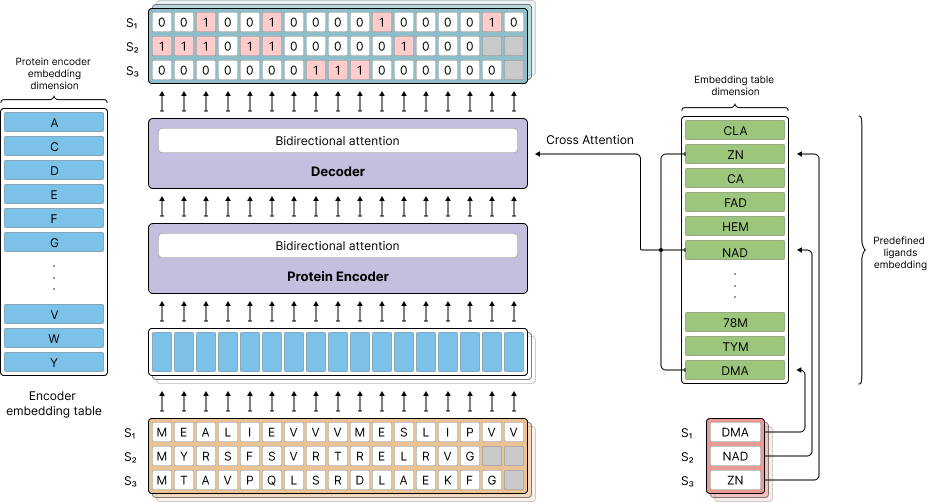
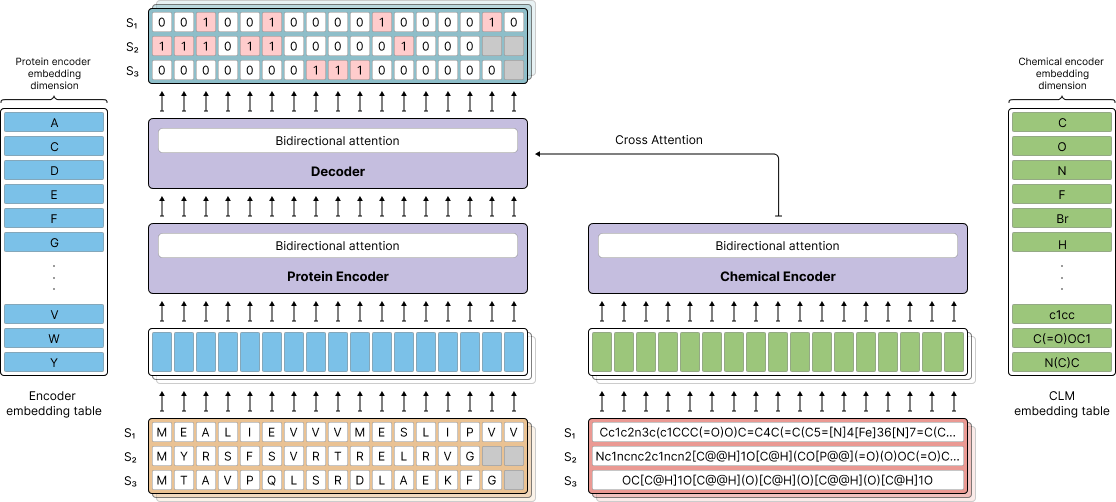
Accurate identification of protein–ligand binding residues is critical for mechanistic biology and drug discovery, yet performance varies widely across ligand families and data regimes. We present a systematic evaluation framework that stratifies ligands into three settings, overrepresented (many examples), underrepresented (tens of examples), and zero-shot (unseen at training). We developed a three-stage, sequence-based modeling suite that progressively adds ligand conditioning and zero-shot capability, and used an evaluation framework to assess the suite. Stage 1 trains per-ligand predictors using a pretrained protein language model (PLM). Stage 2 introduces ligand-aware conditioning via an embedding table, enabling a single multi-ligand model. Stage 3 replaces the table with a pretrained chemical language model (CLM) operating on SMILES, enabling zero-shot generalization. We show Stage 2 improves Macro F1 on the overrepresented test set from 0.4769 (Stage 1) to 0.5832 and outperforms sequence- and structure-based baselines. Stage 3 attains zero-shot performance (F1 = 0.3109) on 5612 previously unseen ligands while remaining competitive on represented ligands. Ablations across five PLM scales and multiple CLMs reveal larger PLM backbones consistently increase Macro F1 across all regimes, whereas scaling the CLM yields modest or inconsistent gains, which need further investigation.
Follow these steps on Ubuntu to set up a clean Python environment and run the installer script.
# 1) Create and activate a virtual environment (in project root)
python3 -m venv .venv
source .venv/bin/activate

# 2) Make the installer executable and run it
chmod +x install.sh
./install.sh
We provide datasets for the three evaluation stages described in the manuscript: overrepresented (ligands with >=100 samples), underrepresented (20–99 samples), and zero-shot (<20 samples). Both the original datasets and the modified datasets used for the revised Stage 3 evaluation are provided for reproducibility.
The datasets are archived on Zenodo:
Dataset (Version 1.0): https://zenodo.org/records/23042604
Run residue-level binding-site predictions from a trained checkpoint.
cd inferenceinference/data/. An example file is provided at inference/data/example_data.csv.Update inference/configs/config.yaml:
input_csv_path: path to your CSV (e.g., ./data/example_data.csv).output_csv_path: output file for predictions (e.g., ./data/stage2_predictions.csv).checkpoint_path: choose either ./stage2_checkpoint.pth or ./stage3_checkpoint.pth.stage_3: set to false for Stage 2, true for Stage 3.device_type: cuda or cpu.Additional expectations:
ligand_name and protein_sequence (configurable via lig_name_col / prot_seq_col).example_data.csv.SMILES column with valid strings for every row (zero-shot ligands are allowed).From the inference directory (with the environment activated):
python inference.py
The script loads the checkpoint, runs predictions with automatic mixed precision by default, and writes a CSV with:
predictions: list of 0/1 residue labels (prediction_threshold controls the cutoff).positive_indices: residue indices predicted as binding.binding_probabilities: per-residue probabilities (enabled by output_binding_probs).example_data.csv, Stage 2 and Stage 3 can be run back-to-back by toggling stage_3 and checkpoint_path as described above.prediction_threshold or post-process the probability column to suit your application.Note: Inference has only been validated with mixed-precision enabled on NVIDIA GPUs. If you need pure CPU or full-precision runs, test carefully before relying on the outputs. The first run downloads the ESM backbone weights (used by both Stage 2 and Stage 3) into
inference/hf_cache/; Stage 3 additionally fetches the MoLFormer chemical encoder. Subsequent runs reuse those files.
Benchmarking the three Stages on the test sets. Macro F1 scores are based on the average of F1 for each type of ligand.
| Method | Training Dataset | Overrepresented Macro F1 | Underrepresented Macro F1 | Zero-shot Macro F1 | Zero-shot F1 |
|---|---|---|---|---|---|
| Stage 1 | Overrepresented (separated) | 0.4769 | - | - | - |
| Stage 2 | Overrepresented | 0.5826 ±0.0035 | - | - | - |
| Stage 2 | Overrepresented + Underrepresented | 0.5832 ±0.0014 | 0.3752 ±0.0049 | - | - |
| Stage 3 | Overrepresented + Underrepresented | 0.5526 ±0.0012 | 0.3603 ±0.0029 | 0.2338 ±0.0051 | 0.3109 ±0.0087 |
Comparison of our method’s best performance for each ligand with other available methods on selected ligands in the overrepresented test set based on F1 score. The main values are taken from the original papers, and ∗ indicates methods evaluated on our test sets.
| Ligand | Stage 2 (Our) | Prot2Token | TargetS | LMetalSite | ZinCap | MIB2 | Boltz-2x |
|---|---|---|---|---|---|---|---|
| Ca²⁺ | 0.6958 ±0.0011 | 0.6566∗ | 0.392∗ | 0.526 (0.7370∗) | - | - | 0.380∗ |
| Mg²⁺ | 0.5637 ±0.0036 | 0.4603∗ | 0.433∗ | 0.367 (0.5560∗) | - | - | 0.339∗ |
| Zn²⁺ | 0.8180 ±0.0017 | 0.7594∗ | 0.660∗ | 0.760 (0.8299∗) | 0.451∗ | - | 0.557∗ |
| Mn²⁺ | 0.7663 ±0.0113 | 0.7376∗ | 0.579∗ | 0.662 (0.8048∗) | - | - | 0.419∗ |
If you use this code or the pretrained models, please cite the following paper:
@article {Pourmirzaei2025.09.28.679103,
	author = {Pourmirzaei, Mahdi and Alqarghuli, Salhuldin and Chen, Kai and Pourmirzaei, Mohammadreza and Xu, Dong},
	title = {Zero-Shot Protein-Ligand Binding Site Prediction from Protein Sequence and SMILES},
	year = {2025},
	doi = {10.1101/2025.09.28.679103},
	publisher = {Cold Spring Harbor Laboratory},
	URL = {https://www.biorxiv.org/content/early/2025/09/30/2025.09.28.679103},
	journal = {bioRxiv}
}
Accurate identification of protein–ligand binding residues is critical for mechanistic biology and drug discovery, yet performance varies widely across ligand families and data regimes. We present a systematic evaluation framework that stratifies ligands into three settings, overrepresented (many examples), underrepresented (tens of examples), and zero-shot (unseen at training). We developed a three-stage, sequence-based modeling suite that progressively adds ligand conditioning and zero-shot capability, and used an evaluation framework to assess the suite. Stage 1 trains per-ligand predictors using a pretrained protein language model (PLM). Stage 2 introduces ligand-aware conditioning via an embedding table, enabling a single multi-ligand model. Stage 3 replaces the table with a pretrained chemical language model (CLM) operating on SMILES, enabling zero-shot generalization. We show Stage 2 improves Macro F1 on the overrepresented test set from 0.4769 (Stage 1) to 0.5832 and outperforms sequence- and structure-based baselines. Stage 3 attains zero-shot performance (F1 = 0.3109) on 5612 previously unseen ligands while remaining competitive on represented ligands. Ablations across five PLM scales and multiple CLMs reveal larger PLM backbones consistently increase Macro F1 across all regimes, whereas scaling the CLM yields modest or inconsistent gains, which need further investigation.
Follow these steps on Ubuntu to set up a clean Python environment and run the installer script.
# 1) Create and activate a virtual environment (in project root)
python3 -m venv .venv
source .venv/bin/activate

# 2) Make the installer executable and run it
chmod +x install.sh
./install.sh
We provide datasets for the three evaluation stages described in the manuscript: overrepresented (ligands with >=100 samples), underrepresented (20–99 samples), and zero-shot (<20 samples). Both the original datasets and the modified datasets used for the revised Stage 3 evaluation are provided for reproducibility.
The datasets are archived on Zenodo:
Dataset (Version 1.0): https://zenodo.org/records/23042604
Run residue-level binding-site predictions from a trained checkpoint.
cd inferenceinference/data/. An example file is provided at inference/data/example_data.csv.Update inference/configs/config.yaml:
input_csv_path: path to your CSV (e.g., ./data/example_data.csv).output_csv_path: output file for predictions (e.g., ./data/stage2_predictions.csv).checkpoint_path: choose either ./stage2_checkpoint.pth or ./stage3_checkpoint.pth.stage_3: set to false for Stage 2, true for Stage 3.device_type: cuda or cpu.Additional expectations:
ligand_name and protein_sequence (configurable via lig_name_col / prot_seq_col).example_data.csv.SMILES column with valid strings for every row (zero-shot ligands are allowed).From the inference directory (with the environment activated):
python inference.py
The script loads the checkpoint, runs predictions with automatic mixed precision by default, and writes a CSV with:
predictions: list of 0/1 residue labels (prediction_threshold controls the cutoff).positive_indices: residue indices predicted as binding.binding_probabilities: per-residue probabilities (enabled by output_binding_probs).example_data.csv, Stage 2 and Stage 3 can be run back-to-back by toggling stage_3 and checkpoint_path as described above.prediction_threshold or post-process the probability column to suit your application.Note: Inference has only been validated with mixed-precision enabled on NVIDIA GPUs. If you need pure CPU or full-precision runs, test carefully before relying on the outputs. The first run downloads the ESM backbone weights (used by both Stage 2 and Stage 3) into
inference/hf_cache/; Stage 3 additionally fetches the MoLFormer chemical encoder. Subsequent runs reuse those files.
Benchmarking the three Stages on the test sets. Macro F1 scores are based on the average of F1 for each type of ligand.
| Method | Training Dataset | Overrepresented Macro F1 | Underrepresented Macro F1 | Zero-shot Macro F1 | Zero-shot F1 |
|---|---|---|---|---|---|
| Stage 1 | Overrepresented (separated) | 0.4769 | - | - | - |
| Stage 2 | Overrepresented | 0.5826 ±0.0035 | - | - | - |
| Stage 2 | Overrepresented + Underrepresented | 0.5832 ±0.0014 | 0.3752 ±0.0049 | - | - |
| Stage 3 | Overrepresented + Underrepresented | 0.5526 ±0.0012 | 0.3603 ±0.0029 | 0.2338 ±0.0051 | 0.3109 ±0.0087 |
Comparison of our method’s best performance for each ligand with other available methods on selected ligands in the overrepresented test set based on F1 score. The main values are taken from the original papers, and ∗ indicates methods evaluated on our test sets.
| Ligand | Stage 2 (Our) | Prot2Token | TargetS | LMetalSite | ZinCap | MIB2 | Boltz-2x |
|---|---|---|---|---|---|---|---|
| Ca²⁺ | 0.6958 ±0.0011 | 0.6566∗ | 0.392∗ | 0.526 (0.7370∗) | - | - | 0.380∗ |
| Mg²⁺ | 0.5637 ±0.0036 | 0.4603∗ | 0.433∗ | 0.367 (0.5560∗) | - | - | 0.339∗ |
| Zn²⁺ | 0.8180 ±0.0017 | 0.7594∗ | 0.660∗ | 0.760 (0.8299∗) | 0.451∗ | - | 0.557∗ |
| Mn²⁺ | 0.7663 ±0.0113 | 0.7376∗ | 0.579∗ | 0.662 (0.8048∗) | - | - | 0.419∗ |
If you use this code or the pretrained models, please cite the following paper:
@article {Pourmirzaei2025.09.28.679103,
	author = {Pourmirzaei, Mahdi and Alqarghuli, Salhuldin and Chen, Kai and Pourmirzaei, Mohammadreza and Xu, Dong},
	title = {Zero-Shot Protein-Ligand Binding Site Prediction from Protein Sequence and SMILES},
	year = {2025},
	doi = {10.1101/2025.09.28.679103},
	publisher = {Cold Spring Harbor Laboratory},
	URL = {https://www.biorxiv.org/content/early/2025/09/30/2025.09.28.679103},
	journal = {bioRxiv}
}



