Paper bioRxiv
Update: Accepted to ICLR 2026!
Authors: Kirill Vishniakov, Karthik Viswanathan, Aleksandr Medvedev, Praveenkumar Kanithi, Marco AF Pimentel, Ronnie Rajan, Shadab Khan
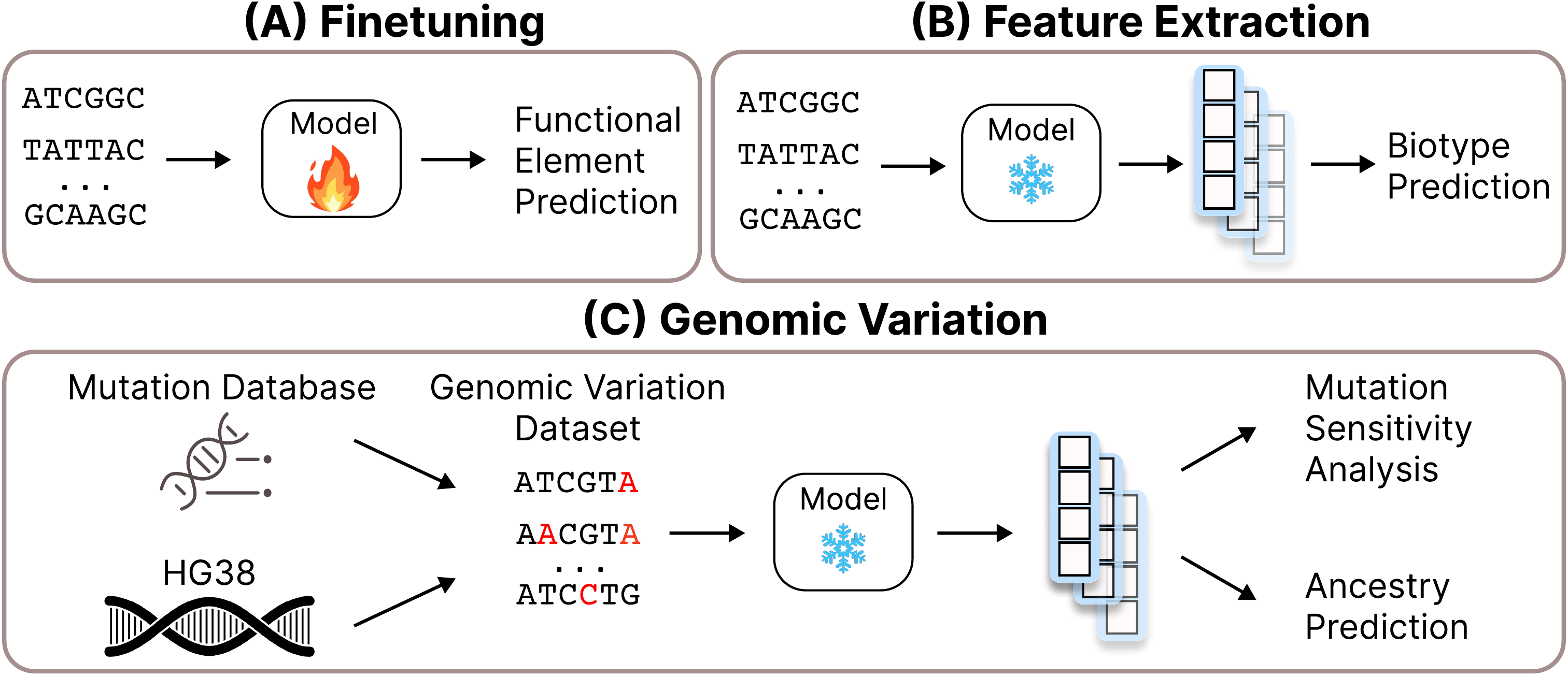
Abstract: The success of Large Language Models has inspired the development of Genomic Foundation Models (GFMs) through similar pretraining techniques. However, the relationship between pretraining performance and effectiveness in downstream genomic tasks remains unclear. Additionally, the high computational cost of pretraining raises questions about its cost-efficiency. To assess the usefulness of pretraining in genomics, we evaluated seven different GFMs across various benchmarks, comparing them to their counterparts with randomly initialized weights. Surprisingly, we found that randomly initialized models can match or even surpass the performance of pretrained GFMs in finetuning and feature extraction tasks. We also discovered that pretrained GFMs fail to capture clinically relevant genetic mutations, which are crucial for understanding genetic disorders and phenotypic traits. Our results indicate that most of the current pretrained GFMs lack a ``foundational'' understanding of genomics and provide minimal utility, even for basic tasks such as sequence classification. These findings collectively highlight the need for critically rethinking the pretraining approaches for genomics.
First, clone this repository and navigate to the project directory:
git clone https://github.com/m42-health/gfm-random-eval.git
cd gfm-random-eval
Set up the conda environment:
conda env create -f gfms_env.yaml
conda activate gfms_env
Run a single model configuration directly:
python -m nt_benchmark.main_nt
You can reconfigure the script parameters by editing the nt_benchmark/config.py file.
nt_benchmark/sweeps/ directory:wandb sweep nt_benchmark/sweeps/hyenadna_all.yaml
nt_benchmark/run_sweep.sh:SWEEP_ID="<PLACE YOUR SWEEP ID HERE>"
bash nt_benchmark/run_sweep.sh
Run a single model configuration directly:
python -m biotype.main_biotype
You can reconfigure the script parameters by editing the biotype/main_biotype.py file.
biotype/sweeps/ directory:wandb sweep biotype/sweeps/biotype_sweep.yaml
biotype/run_biotype_sweep.sh:SWEEP_ID="<PLACE YOUR SWEEP ID HERE>"
bash biotype/run_biotype_sweep.sh
Download the TP53 files from this link.
python -m cosine_similarity.main_sensitivity --ref_genome_path <path_to_genome> --output_dir <output_directory>
python -m cosine_similarity.main_clinvar --clinvar_file <path_to_clinvar_csv> --genome_file <path_to_genome> --tp53_fasta <path_to_tp53_fasta>
To run the ancestry experiments use the following command:
python -m ancestry.main_ancestry
Paper bioRxiv
Update: Accepted to ICLR 2026!
Authors: Kirill Vishniakov, Karthik Viswanathan, Aleksandr Medvedev, Praveenkumar Kanithi, Marco AF Pimentel, Ronnie Rajan, Shadab Khan
Abstract: The success of Large Language Models has inspired the development of Genomic Foundation Models (GFMs) through similar pretraining techniques. However, the relationship between pretraining performance and effectiveness in downstream genomic tasks remains unclear. Additionally, the high computational cost of pretraining raises questions about its cost-efficiency. To assess the usefulness of pretraining in genomics, we evaluated seven different GFMs across various benchmarks, comparing them to their counterparts with randomly initialized weights. Surprisingly, we found that randomly initialized models can match or even surpass the performance of pretrained GFMs in finetuning and feature extraction tasks. We also discovered that pretrained GFMs fail to capture clinically relevant genetic mutations, which are crucial for understanding genetic disorders and phenotypic traits. Our results indicate that most of the current pretrained GFMs lack a ``foundational'' understanding of genomics and provide minimal utility, even for basic tasks such as sequence classification. These findings collectively highlight the need for critically rethinking the pretraining approaches for genomics.
First, clone this repository and navigate to the project directory:
git clone https://github.com/m42-health/gfm-random-eval.git
cd gfm-random-eval
Set up the conda environment:
conda env create -f gfms_env.yaml
conda activate gfms_env
Run a single model configuration directly:
python -m nt_benchmark.main_nt
You can reconfigure the script parameters by editing the nt_benchmark/config.py file.
nt_benchmark/sweeps/ directory:wandb sweep nt_benchmark/sweeps/hyenadna_all.yaml
nt_benchmark/run_sweep.sh:SWEEP_ID="<PLACE YOUR SWEEP ID HERE>"
bash nt_benchmark/run_sweep.sh
Run a single model configuration directly:
python -m biotype.main_biotype
You can reconfigure the script parameters by editing the biotype/main_biotype.py file.
biotype/sweeps/ directory:wandb sweep biotype/sweeps/biotype_sweep.yaml
biotype/run_biotype_sweep.sh:SWEEP_ID="<PLACE YOUR SWEEP ID HERE>"
bash biotype/run_biotype_sweep.sh
Download the TP53 files from this link.
python -m cosine_similarity.main_sensitivity --ref_genome_path <path_to_genome> --output_dir <output_directory>
python -m cosine_similarity.main_clinvar --clinvar_file <path_to_clinvar_csv> --genome_file <path_to_genome> --tp53_fasta <path_to_tp53_fasta>
To run the ancestry experiments use the following command:
python -m ancestry.main_ancestry



