





Documentation | Quick Start | Artifact Review | Architecture | API | Walkthrough
CapstoneProject is an end-to-end system for public-opinion analysis. It keeps separate evidence, coordination, reporting, and UI components; the current Coordinator implementation uses an EvidenceGraph-centered intelligence layer to gather observable public evidence, model quality and repeated coverage, audit claims against cited excerpts, and turn cited insights into editable, exportable reports through Signal Studio.
| Reference Point | Known For | This Project Adds |
|---|---|---|
| RAG | Retrieve, then generate. | Stance, trust, divergence, proof view. |
| Microsoft GraphRAG | Graph reasoning over corpora. | Live public-opinion workflow and exports. |
| AutoGen / CrewAI | Generic multi-agent orchestration. | Domain agents with a stable Coordinator artifact. |
| Sentiment classifiers | Labels and scores. | Investigation, synthesis, and reports. |
| BI/static dashboards | Visualization. | Run, refine, edit, monitor, export. |
Core strengths: multi-agent evidence analysis, inspectable reasoning, structured report IR, Signal Studio UI, OpenAPI contracts, and acceptance-ready docs. See Contribution And Novelty.
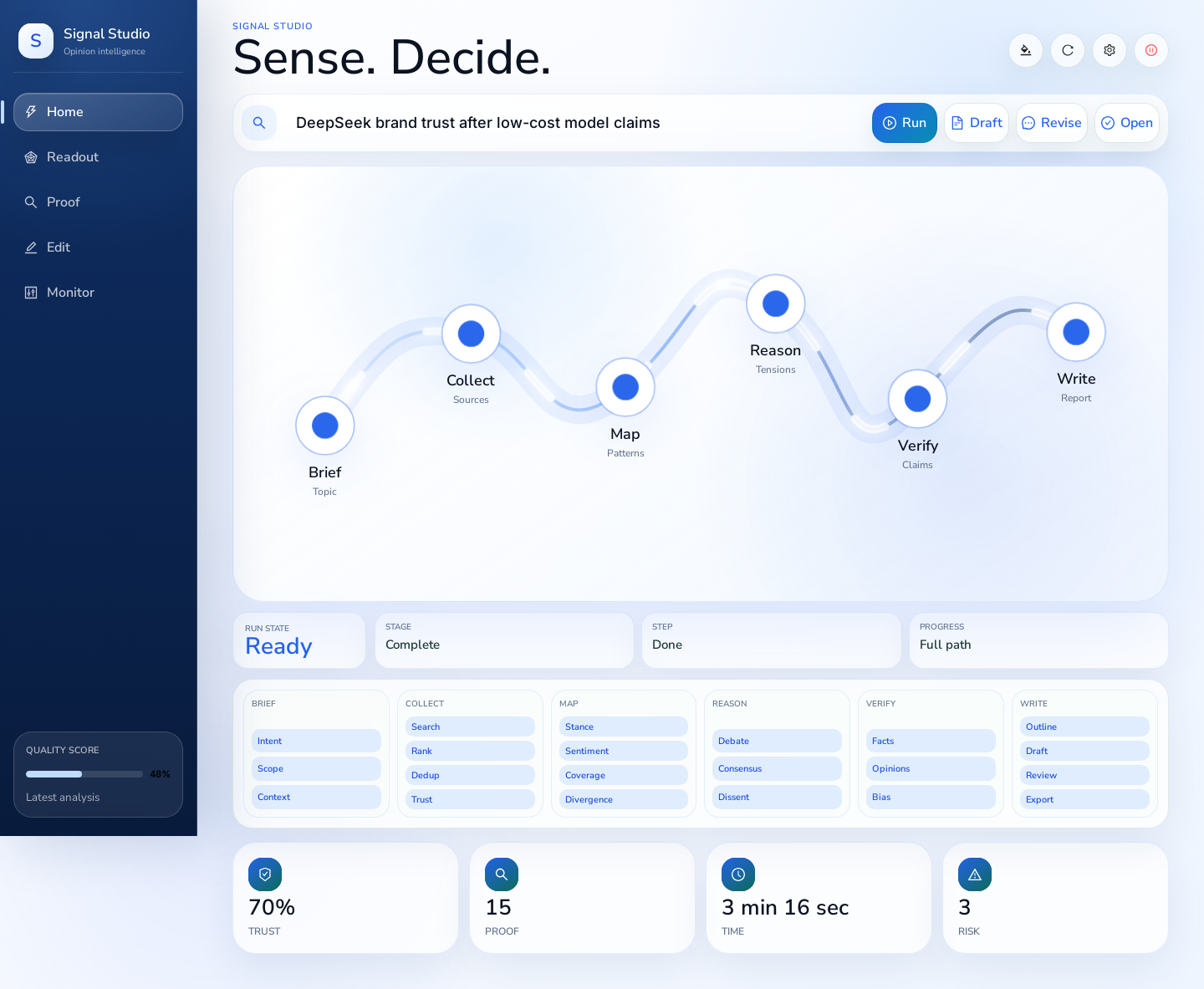
| Stage | User Experience | Main System Path |
|---|---|---|
| Brief | Enter a topic and start analysis. | Signal Studio -> Flask -> AgentCoordinator |
| Evidence | Inspect source mix, stance, trust, distinct evidence groups, repeated coverage, and provider diagnostics. | AgentCoordinator internal layer -> EvidenceGraph |
| Reasoning | Review audited claims, cited sources, tensions, confidence, and recommended follow-up. | Claim-driven adaptive research loop and evidence audit |
| Report | Generate, edit, annotate, and export a polished report. | ReportEngine -> Document IR -> renderers |
| Operate | Adjust providers, start runtime, inspect traces, and send feedback. | Flask runtime APIs, configurable LangSmith traces |

| Layer | Responsibility | Primary Paths |
|---|---|---|
| Interface | Signal Studio views, report editor, evidence review, runtime controls | frontend/, templates/index.html, static/signal-studio/ |
| API gateway | Flask routes, background tasks, config editing, static shell, observability | app.py |
| Coordination | Public entry point, progress reporting, and Coordinator artifact export | AgentCoordinator/ |
| Internal intelligence | Source acquisition, semantic quality routing, canonical clustering, quality features, claim mining, audit, synthesis | AgentCoordinator/intelligence/ |
| Evidence engines | QueryEngine, MediaEngine, and MindSpider evidence/search utilities used directly or through Coordinator integration points | QueryEngine/, MediaEngine/, MindSpider/ |
| Reporting | Template selection, chapter generation, Document IR, HTML/MD/PDF export | ReportEngine/ |
| Quality | Regression tests, provider evaluation, sanitization, schema validation | tests/, api_evaluation/ |
| Readout | Proof | Report Editing |
|---|---|---|
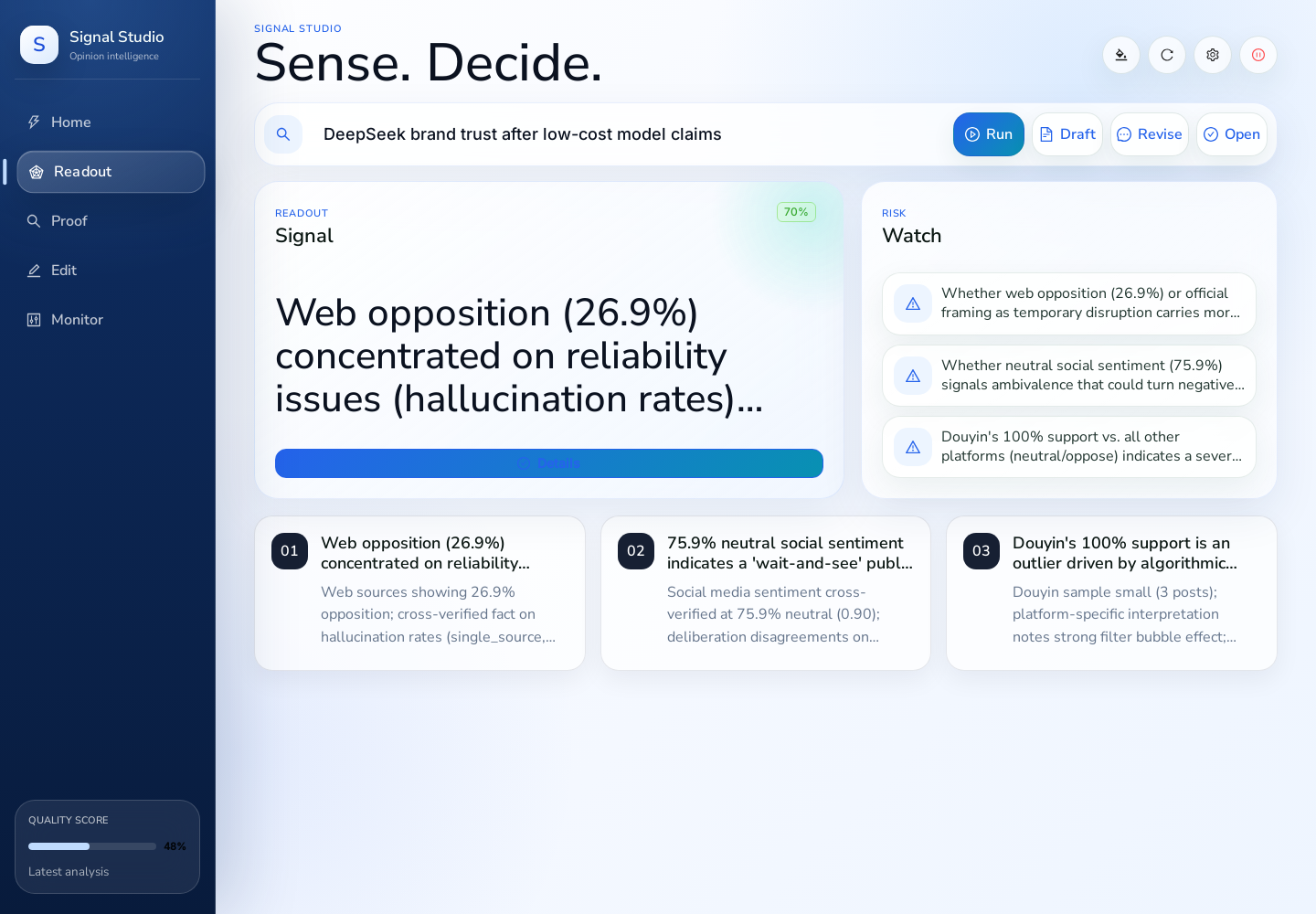 | 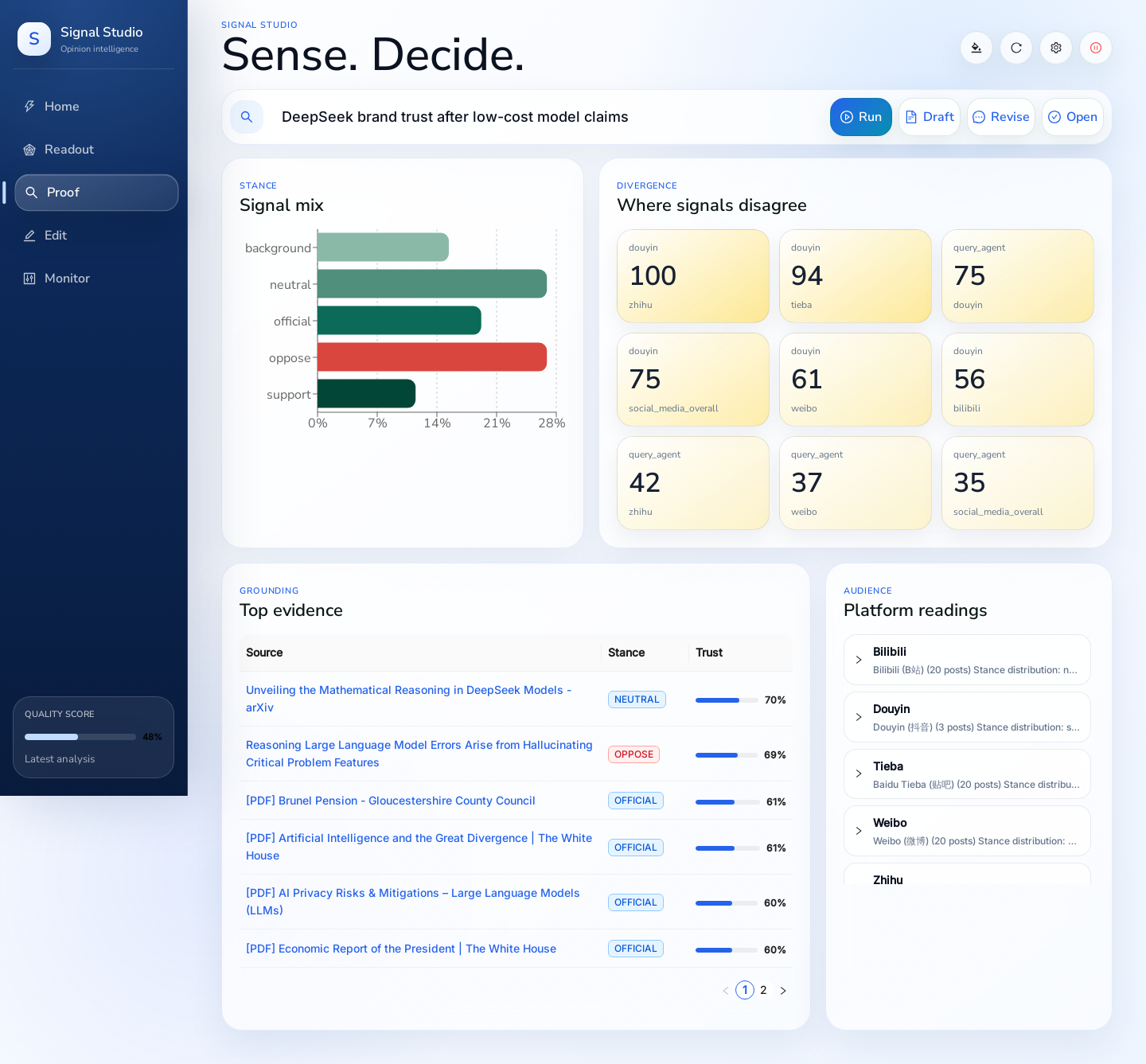 | 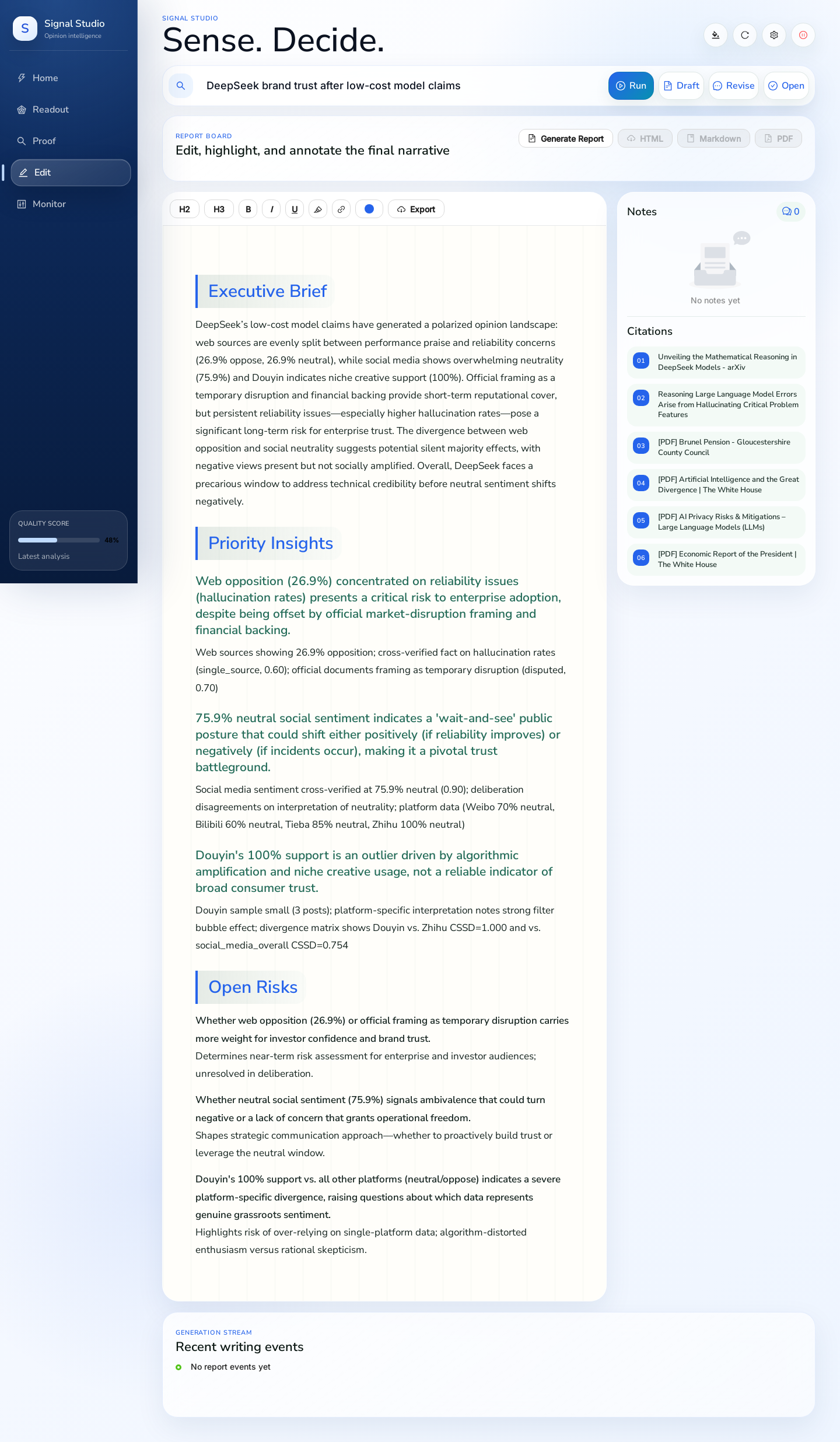 |
More screenshots: Signal Studio Screenshots.
Use Python 3.11 or newer. If python is not on PATH, use Conda or the uv commands shown in the full Setup Guide.
python -m venv .venv
.\.venv\Scripts\Activate.ps1
python -m pip install --upgrade pip
pip install -r requirements.txt
python -m playwright install chromium
Copy-Item .env.example .env
Configure provider keys in .env, then build the final UI:
cd frontend
npm install
npm run build
cd ..
Start the Flask runtime:
python app.py
uv equivalent:
uv run --with-requirements requirements.txt python app.py
Open:
http://127.0.0.1:5000
For the complete setup path, provider profile, artifact review path, and verification checklist, use the Setup Guide.
| Endpoint | Purpose |
|---|---|
GET /api/system/status | Read final runtime status. |
POST /api/system/start | Initialize runtime components. |
GET /api/config / POST /api/config | Read or persist selected runtime settings. |
POST /api/coordinator/run | Start integrated multi-agent analysis. |
GET /api/coordinator/task/{task_id} | Poll Coordinator task state. |
GET /api/coordinator/latest | Load the newest Coordinator artifact. |
POST /api/report/generate | Start report generation from current analysis. |
GET /api/report/stream/{task_id} | Stream report-generation progress with SSE. |
GET /api/report/export/pdf/{task_id} | Export generated report as PDF. |
References:
POST /api/coordinator/run keeps the public endpoint name for compatibility and executes AgentCoordinator.run(). Internally, the Coordinator uses its intelligence layer, then writes one fused coordinator_output_latest.json artifact with schema 2.1-coordinator-intelligence:
coordinator_intelligence: the internal evidence ledger with EvidenceGraph, quality_summary, freshness_summary, provider_diagnostics, audit_summary, and cited insights.synthesis, source_data, divergence_matrix, fact_opinion_separation, and coordinator_trace; these are evidence-derived views, not a separate second artifact.If optional external search or rerank providers are not configured, the engine records not_configured diagnostics and continues the Coordinator flow. Local replay is disabled by default; it is intended for demos/tests only and is used only when COORDINATOR_ALLOW_REPLAY_FALLBACK=true, with local_fixture:used recorded in the artifact.
| Start Here | Use It For |
|---|---|
| Documentation Home | Full documentation map. |
| Project Brief | Product scope and system purpose. |
| Capabilities | What the system does and where each capability lives. |
| System Architecture | Main components, decisions, and runtime structure. |
| Runtime Flow | Endpoint-level execution path. |
| Setup | Local environment and first run. |
| Artifact Review | Review cached artifacts, screenshots, and report examples. |
| Runbook | Routine operation and diagnostics. |
| Testing | Verification commands and coverage. |
| Evidence Dashboard | Provider benchmark, regression evidence, and review proof points. |
| Defense Brief | Concise technical narrative for review or defense. |
| Contribution And Novelty | Contribution map, baseline comparison, and defense talking points. |
| Roadmap | Completed scope and engineering evolution plan. |
CapstoneProject/
|-- app.py                    # Flask orchestrator and final runtime API gateway
|-- frontend/                 # Signal Studio React/Vite source
|-- AgentCoordinator/         # Coordinator entry point, internal intelligence layer, artifact cache
|   `-- intelligence/         # EvidenceGraph contracts, source gateway, quality pipeline, audit, synthesis
|-- QueryEngine/              # Search, trust, stance, social enrichment
|-- MediaEngine/              # Media-side research
|-- ReportEngine/             # Report generation graph, IR, renderers, exports
|-- ForumEngine/              # Forum-style coordination utilities
|-- SentimentAnalysisModel/   # Sentiment and topic model assets
|-- api_evaluation/           # Provider benchmark harness and results
|-- tests/                    # Regression and contract tests
`-- docs/                     # Authoritative documentation library
| Area | Document |
|---|---|
| Test coverage and commands | Testing |
| API provider benchmark | API Evaluation |
| Evidence summary | Evidence Dashboard |
| Security and sensitive input handling | Security And Safety |
| Deployment shape | Deployment |
| Troubleshooting | Troubleshooting |
| Data/model asset policy | Data And Model Assets |
| Contribution guide | CONTRIBUTING |
This repository is distributed under the GNU General Public License v2.0.
The main application path is the Flask-served Signal Studio runtime. The authoritative project documentation is in docs/, with runtime asset boundaries documented in Runtime Assets.
Documentation | Quick Start | Artifact Review | Architecture | API | Walkthrough
CapstoneProject is an end-to-end system for public-opinion analysis. It keeps separate evidence, coordination, reporting, and UI components; the current Coordinator implementation uses an EvidenceGraph-centered intelligence layer to gather observable public evidence, model quality and repeated coverage, audit claims against cited excerpts, and turn cited insights into editable, exportable reports through Signal Studio.
| Reference Point | Known For | This Project Adds |
|---|---|---|
| RAG | Retrieve, then generate. | Stance, trust, divergence, proof view. |
| Microsoft GraphRAG | Graph reasoning over corpora. | Live public-opinion workflow and exports. |
| AutoGen / CrewAI | Generic multi-agent orchestration. | Domain agents with a stable Coordinator artifact. |
| Sentiment classifiers | Labels and scores. | Investigation, synthesis, and reports. |
| BI/static dashboards | Visualization. | Run, refine, edit, monitor, export. |
Core strengths: multi-agent evidence analysis, inspectable reasoning, structured report IR, Signal Studio UI, OpenAPI contracts, and acceptance-ready docs. See Contribution And Novelty.
| Stage | User Experience | Main System Path |
|---|---|---|
| Brief | Enter a topic and start analysis. | Signal Studio -> Flask -> AgentCoordinator |
| Evidence | Inspect source mix, stance, trust, distinct evidence groups, repeated coverage, and provider diagnostics. | AgentCoordinator internal layer -> EvidenceGraph |
| Reasoning | Review audited claims, cited sources, tensions, confidence, and recommended follow-up. | Claim-driven adaptive research loop and evidence audit |
| Report | Generate, edit, annotate, and export a polished report. | ReportEngine -> Document IR -> renderers |
| Operate | Adjust providers, start runtime, inspect traces, and send feedback. | Flask runtime APIs, configurable LangSmith traces |
| Layer | Responsibility | Primary Paths |
|---|---|---|
| Interface | Signal Studio views, report editor, evidence review, runtime controls | frontend/, templates/index.html, static/signal-studio/ |
| API gateway | Flask routes, background tasks, config editing, static shell, observability | app.py |
| Coordination | Public entry point, progress reporting, and Coordinator artifact export | AgentCoordinator/ |
| Internal intelligence | Source acquisition, semantic quality routing, canonical clustering, quality features, claim mining, audit, synthesis | AgentCoordinator/intelligence/ |
| Evidence engines | QueryEngine, MediaEngine, and MindSpider evidence/search utilities used directly or through Coordinator integration points | QueryEngine/, MediaEngine/, MindSpider/ |
| Reporting | Template selection, chapter generation, Document IR, HTML/MD/PDF export | ReportEngine/ |
| Quality | Regression tests, provider evaluation, sanitization, schema validation | tests/, api_evaluation/ |
| Readout | Proof | Report Editing |
|---|---|---|
| | |
More screenshots: Signal Studio Screenshots.
Use Python 3.11 or newer. If python is not on PATH, use Conda or the uv commands shown in the full Setup Guide.
python -m venv .venv
.\.venv\Scripts\Activate.ps1
python -m pip install --upgrade pip
pip install -r requirements.txt
python -m playwright install chromium
Copy-Item .env.example .env
Configure provider keys in .env, then build the final UI:
cd frontend
npm install
npm run build
cd ..
Start the Flask runtime:
python app.py
uv equivalent:
uv run --with-requirements requirements.txt python app.py
Open:
http://127.0.0.1:5000
For the complete setup path, provider profile, artifact review path, and verification checklist, use the Setup Guide.
| Endpoint | Purpose |
|---|---|
GET /api/system/status | Read final runtime status. |
POST /api/system/start | Initialize runtime components. |
GET /api/config / POST /api/config | Read or persist selected runtime settings. |
POST /api/coordinator/run | Start integrated multi-agent analysis. |
GET /api/coordinator/task/{task_id} | Poll Coordinator task state. |
GET /api/coordinator/latest | Load the newest Coordinator artifact. |
POST /api/report/generate | Start report generation from current analysis. |
GET /api/report/stream/{task_id} | Stream report-generation progress with SSE. |
GET /api/report/export/pdf/{task_id} | Export generated report as PDF. |
References:
POST /api/coordinator/run keeps the public endpoint name for compatibility and executes AgentCoordinator.run(). Internally, the Coordinator uses its intelligence layer, then writes one fused coordinator_output_latest.json artifact with schema 2.1-coordinator-intelligence:
coordinator_intelligence: the internal evidence ledger with EvidenceGraph, quality_summary, freshness_summary, provider_diagnostics, audit_summary, and cited insights.synthesis, source_data, divergence_matrix, fact_opinion_separation, and coordinator_trace; these are evidence-derived views, not a separate second artifact.If optional external search or rerank providers are not configured, the engine records not_configured diagnostics and continues the Coordinator flow. Local replay is disabled by default; it is intended for demos/tests only and is used only when COORDINATOR_ALLOW_REPLAY_FALLBACK=true, with local_fixture:used recorded in the artifact.
| Start Here | Use It For |
|---|---|
| Documentation Home | Full documentation map. |
| Project Brief | Product scope and system purpose. |
| Capabilities | What the system does and where each capability lives. |
| System Architecture | Main components, decisions, and runtime structure. |
| Runtime Flow | Endpoint-level execution path. |
| Setup | Local environment and first run. |
| Artifact Review | Review cached artifacts, screenshots, and report examples. |
| Runbook | Routine operation and diagnostics. |
| Testing | Verification commands and coverage. |
| Evidence Dashboard | Provider benchmark, regression evidence, and review proof points. |
| Defense Brief | Concise technical narrative for review or defense. |
| Contribution And Novelty | Contribution map, baseline comparison, and defense talking points. |
| Roadmap | Completed scope and engineering evolution plan. |
CapstoneProject/
|-- app.py                    # Flask orchestrator and final runtime API gateway
|-- frontend/                 # Signal Studio React/Vite source
|-- AgentCoordinator/         # Coordinator entry point, internal intelligence layer, artifact cache
|   `-- intelligence/         # EvidenceGraph contracts, source gateway, quality pipeline, audit, synthesis
|-- QueryEngine/              # Search, trust, stance, social enrichment
|-- MediaEngine/              # Media-side research
|-- ReportEngine/             # Report generation graph, IR, renderers, exports
|-- ForumEngine/              # Forum-style coordination utilities
|-- SentimentAnalysisModel/   # Sentiment and topic model assets
|-- api_evaluation/           # Provider benchmark harness and results
|-- tests/                    # Regression and contract tests
`-- docs/                     # Authoritative documentation library
| Area | Document |
|---|---|
| Test coverage and commands | Testing |
| API provider benchmark | API Evaluation |
| Evidence summary | Evidence Dashboard |
| Security and sensitive input handling | Security And Safety |
| Deployment shape | Deployment |
| Troubleshooting | Troubleshooting |
| Data/model asset policy | Data And Model Assets |
| Contribution guide | CONTRIBUTING |
This repository is distributed under the GNU General Public License v2.0.
The main application path is the Flask-served Signal Studio runtime. The authoritative project documentation is in docs/, with runtime asset boundaries documented in Runtime Assets.



