
Programming language for the market
See the codeSee what people are saying
README

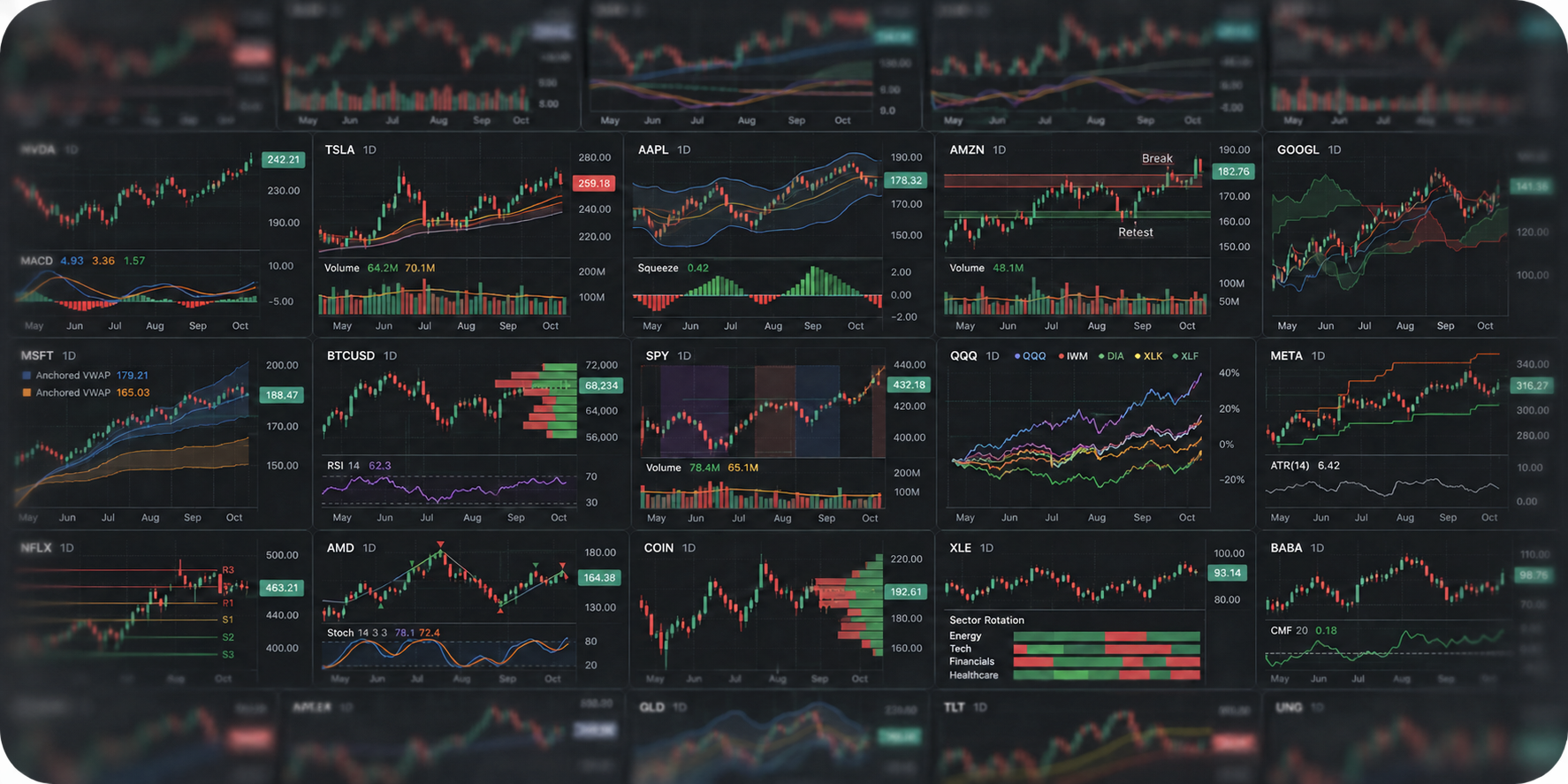
Tea is an open-source language for computation on time-series data.
Introduction
Tea is a programming language for computation over data streams. It lets you express computations whose outputs depend on the current input and previous inputs, with history and state managed by the language.
You can use Tea to build:
- Technical indicators: Combine and transform market data into signals.
- Trading strategies (coming soon): Backtesting and live trading workflows are not yet available.
- Market scanners (coming soon): Live scanning is not yet available.
- Alerts: Emit events that a host application can use to trigger external actions, such as notifying an AI agent.
- Time-series prediction: Express forecasting models and evaluate them across datasets and parameter configurations.
Why Tea
- Easy to write and read. Tea's compact syntax lets people and agents focus on the calculation. The language handles repeated evaluation, history, and retained state, while the host supplies data streams. See Program structure.
- Built for time-series performance. Tea evaluates data incrementally and retains the history each calculation needs. It uses Apache Arrow for typed data exchange.
- Explicit I/O boundaries. Tea scripts have no direct network or filesystem access. The host application controls data access and external actions.
- Extensible. Tea supports functions, structs, collections, interfaces, and generics for composing reusable calculations. Recursive function calls are not supported.
- Open source. Tea is released under the MIT License. The compiler, runtime, and standard libraries are developed in the open, so you can inspect how the language works and contribute to it. Third-party notices are retained in LICENSES/.
- Experimental GPU execution. Eligible numeric programs compile to WGSL and run through WebGPU on compatible devices. Multiple datasets or parameter configurations can share the same compiled program. See GPU support and limitations.
Similar repos


Programming language for the market
See the codeSee what people are saying
README
Tea is an open-source language for computation on time-series data.
Introduction
Tea is a programming language for computation over data streams. It lets you express computations whose outputs depend on the current input and previous inputs, with history and state managed by the language.
You can use Tea to build:
- Technical indicators: Combine and transform market data into signals.
- Trading strategies (coming soon): Backtesting and live trading workflows are not yet available.
- Market scanners (coming soon): Live scanning is not yet available.
- Alerts: Emit events that a host application can use to trigger external actions, such as notifying an AI agent.
- Time-series prediction: Express forecasting models and evaluate them across datasets and parameter configurations.
Why Tea
- Easy to write and read. Tea's compact syntax lets people and agents focus on the calculation. The language handles repeated evaluation, history, and retained state, while the host supplies data streams. See Program structure.
- Built for time-series performance. Tea evaluates data incrementally and retains the history each calculation needs. It uses Apache Arrow for typed data exchange.
- Explicit I/O boundaries. Tea scripts have no direct network or filesystem access. The host application controls data access and external actions.
- Extensible. Tea supports functions, structs, collections, interfaces, and generics for composing reusable calculations. Recursive function calls are not supported.
- Open source. Tea is released under the MIT License. The compiler, runtime, and standard libraries are developed in the open, so you can inspect how the language works and contribute to it. Third-party notices are retained in LICENSES/.
- Experimental GPU execution. Eligible numeric programs compile to WGSL and run through WebGPU on compatible devices. Multiple datasets or parameter configurations can share the same compiled program. See GPU support and limitations.