


TFMat extends CrystalFlow by introducing text-conditioned flow matching for crystal structure generation. The model maps structured material descriptions to semantic condition vectors and uses them to guide continuous flow from noise to target crystal structures.
| Dataset | CrystalFlow | TFMat | Improvement |
|---|---|---|---|
| Perov-5 | 53.69% | 91.33% | +37.64% |
| Carbon-24 | 15.02% | 46.40% | +31.38% |
| MP-20 | 67.65% | 77.80% | +10.15% |
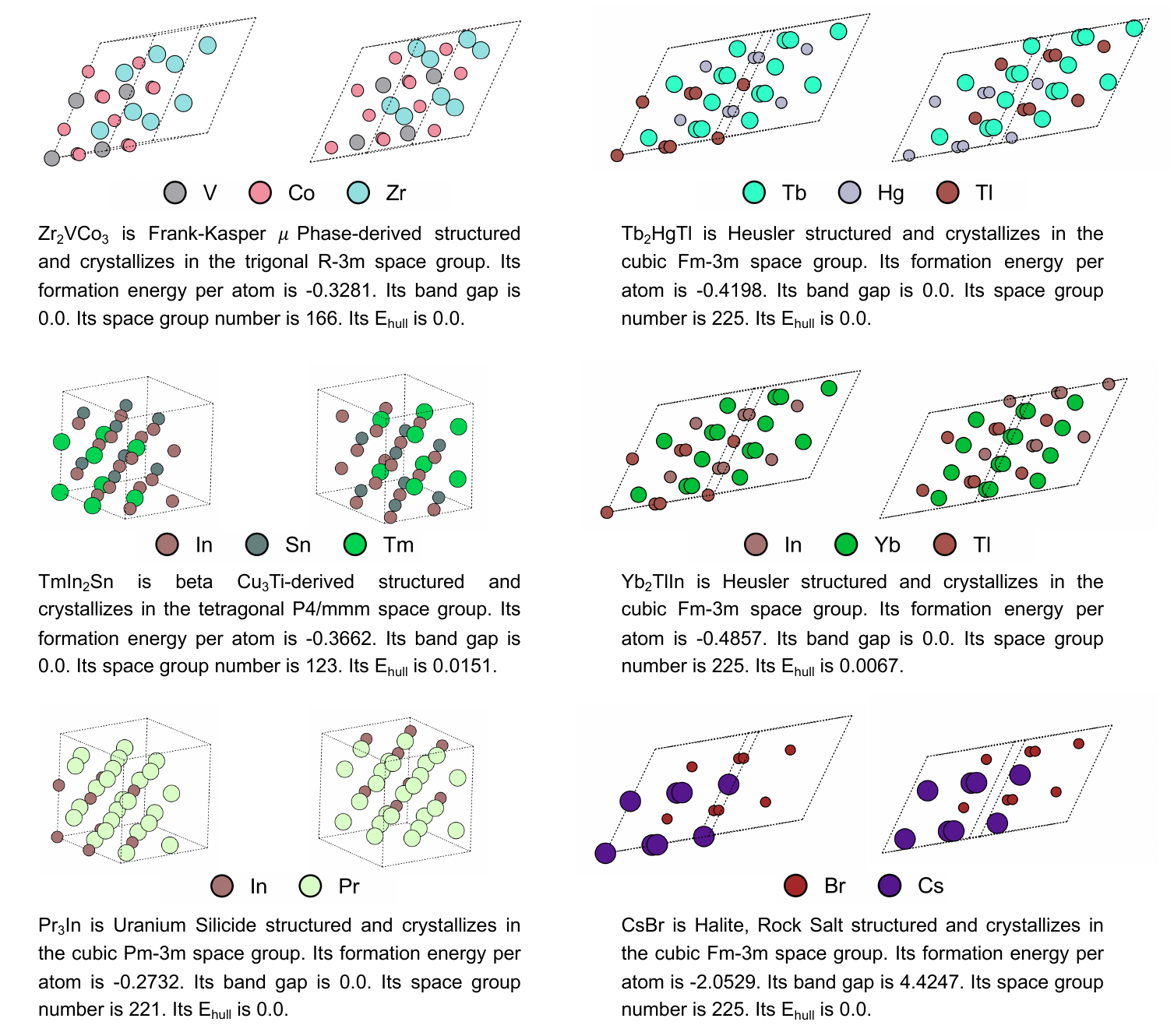
Text-conditioned de novo generation: ground-truth versus TFMat-generated crystals. Each pair shows the reference structure (left) and the crystal produced by TFMat when conditioned solely on the corresponding textual description (right). The text encodes prototype name, space group, formation energy and band gap, yet no explicit atomic coordinates are provided to the model.
# Create conda environment
conda create -n tfmat python=3.11.9
conda activate tfmat

# Install PyTorch and PyG
pip install torch==2.3.1 torchvision torchaudio --index-url https://download.pytorch.org/whl/cu121
pip install torch_geometric==2.5.3
pip install pyg_lib torch_scatter torch_sparse torch_cluster torch_spline_conv -f https://data.pyg.org/whl/torch-2.3.0+cu121.html

# Install core dependencies
pip install lightning==2.3.2 finetuning_scheduler
pip install hydra-core omegaconf python-dotenv wandb rich
pip install p_tqdm pymatgen pyxtal smact matminer einops chemparse torchdyn
pip install transformers

# Install package
pip install -e .

# Create directories
mkdir -p log hydra
Create a .env file:
cp .env.template .env
Edit .env to specify:
export PROJECT_ROOT="/path/to/CrystalFlow"
export HYDRA_JOBS="/path/to/CrystalFlow/hydra"
export WANDB_DIR="/path/to/CrystalFlow/log"
CUDA_VISIBLE_DEVICES=0 python diffcsp/run.py \
  data=mp_20_text \
  model=flow_polar_text \
  data.train_max_epochs=2000 \
  optim.optimizer.lr=1e-3 \
  +model.lattice_polar_sigma=0.1 \
  model.cost_coord=10 \
  model.cost_lattice=1 \
  logging.wandb.mode=online \
  expname=CSP-mp20-text
CUDA_VISIBLE_DEVICES=0,1,2,3 python diffcsp/run.py \
  train.pl_trainer.devices=4 \
  data=mp_20_text \
  model=flow_polar_w_type \
  data.train_max_epochs=2000 \
  +model.type_encoding=table \
  optim.optimizer.lr=1e-3 \
  +model.lattice_polar_sigma=0.1 \
  model.cost_type=10 \
  model.cost_coord=10 \
  model.cost_lattice=1 \
  logging.wandb.mode=online \
  expname=DNG-mp20-text
For DNG, text conditioning is supplied by data=mp_20_text; the corresponding
model configuration is flow_polar_w_type.
python scripts/evaluate.py \
  --model_path <checkpoint_path> \
  --dataset mp_20 \
  --ode-int-steps 100 \
  --anneal_coords \
  --anneal_slope 10 \
  --guidance_factor auto \
  --label tfmat_s100_a10

python scripts/compute_metrics.py \
  --root_path <checkpoint_dir> \
  --tasks csp \
  --gt_file data_text/mp_20/test.csv \
  --label tfmat_s100_a10
python scripts/generation.py \
  --model_path <checkpoint_path> \
  --dataset mp_20 \
  --ode-int-steps 100 \
  --anneal_coords \
  --anneal_slope 10 \
  --guidance_factor auto \
  --label tfmat_dng_s100_a10

python scripts/compute_metrics.py \
  --root_path <checkpoint_dir> \
  --tasks gen \
  --gt_file data_text/mp_20/test.csv \
  --label tfmat_dng_s100_a10
Text descriptions follow this structure:
Prototype: <prototype_name>, Space Group: <space_group_number>,
Formation Energy: <value> eV/atom, Band Gap: <value> eV
Example:
Prototype: rocksalt, Space Group: 225, Formation Energy: -2.34 eV/atom, Band Gap: 2.1 eV
data=mp_20 + model=flow_polar
Condition: formation_energy_per_atom
data=mp_20_text + model=flow_polar_text
Condition: text_embedding (768-dim MatSciBERT)
Key techniques:
  - Classifier-free guidance (gamma=auto)
  - Condition dropout (p=0.1)
  - Precomputed text embeddings
# Train CGCNN surrogate models
python scripts/compute_text_prompt_match_with_cgcnn.py \
  --generated_file <generated_structures.pt> \
  --test_file data_text/mp_20/test.csv

# Plot property distributions
python scripts/plot_property_distributions.py \
  --generated_file <generated_structures.pt> \
  --test_file data_text/mp_20/test.csv
python scripts/compute_element_composition_match.py \
  --generated_file <generated_structures.pt> \
  --test_file data_text/mp_20/test.csv \
  --top_k 2000
python scripts/plot_text_embedding_tsne.py \
  --baseline_file <crystalflow_generated.pt> \
  --text_file <tfmat_generated.pt> \
  --test_file data_text/mp_20/test.csv
CrystalFlow/
├── conf/                      # Hydra configuration files
│   ├── data/                  # Dataset configs (mp_20_text, etc.)
│   ├── model/                 # Model configs (flow_polar_text, etc.)
│   ├── optim/                 # Optimizer configs
│   └── train/                 # Training configs
├── diffcsp/                   # Core model implementation
│   ├── pl_modules/            # PyTorch Lightning modules
│   ├── pl_data/               # Data modules
│   └── run.py                 # Main training script
├── scripts/                   # Evaluation and analysis scripts
│   ├── evaluate.py            # CSP evaluation
│   ├── generation.py          # DNG evaluation
│   ├── compute_metrics.py     # Metric computation
│   └── *.py                   # Analysis scripts
├── docs/                      # Documentation
│   ├── *.png                  # Visualization figures
│   ├── main.tex               # Paper manuscript
│   ├── TRAINING_EVALUATION_GUIDE.md  # Training guide
│   └── PROJECT_STRUCTURE.md   # Project structure
└── result/                    # Evaluation results
    ├── results-1.csv          # Single-sample results
    └── results-20.csv         # Multi-sample results
Some analysis scripts require experimental results to be generated first:
plot_property_distributions.py - Requires top2000 results filecompute_element_composition_match.py - Requires generated CIF filesplot_text_embedding_tsne.py - Requires generated structuresWorkflow: Run evaluation scripts first to generate these files, then run analysis scripts.
Always specify the data configuration when running training:
# ✓ Correct
python diffcsp/run.py data=mp_20_text model=flow_polar_text

# ✗ Incorrect (will fail)
python diffcsp/run.py --help
You may see warnings about pyg-lib and torch-sparse. These do not affect core functionality but may impact performance of certain graph operations.
Due to size constraints, datasets and model checkpoints are not included in this repository.
Text-annotated datasets can be obtained by:
Model checkpoints will be made available upon paper acceptance.
If you use TFMat in your research, please cite:
@article{tfmat2024,
  title={TFMat: Text-Conditioned Flow Matching for Crystal Structure Generation},
  author={Anonymous},
  journal={arXiv preprint},
  year={2024}
}
Also cite the original CrystalFlow paper:
@article{luo2024crystalflow,
  title={CrystalFlow: A Flow-Based Generative Model for Crystalline Materials},
  author={Luo, Xiaoshan and others},
  journal={arXiv preprint arXiv:2412.11693},
  year={2024}
}
This work builds upon:
This project is licensed under the MIT License - see the LICENSE file for details.
For questions or issues, please open a GitHub issue or contact the authors.
TFMat extends CrystalFlow by introducing text-conditioned flow matching for crystal structure generation. The model maps structured material descriptions to semantic condition vectors and uses them to guide continuous flow from noise to target crystal structures.
| Dataset | CrystalFlow | TFMat | Improvement |
|---|---|---|---|
| Perov-5 | 53.69% | 91.33% | +37.64% |
| Carbon-24 | 15.02% | 46.40% | +31.38% |
| MP-20 | 67.65% | 77.80% | +10.15% |
Text-conditioned de novo generation: ground-truth versus TFMat-generated crystals. Each pair shows the reference structure (left) and the crystal produced by TFMat when conditioned solely on the corresponding textual description (right). The text encodes prototype name, space group, formation energy and band gap, yet no explicit atomic coordinates are provided to the model.
# Create conda environment
conda create -n tfmat python=3.11.9
conda activate tfmat

# Install PyTorch and PyG
pip install torch==2.3.1 torchvision torchaudio --index-url https://download.pytorch.org/whl/cu121
pip install torch_geometric==2.5.3
pip install pyg_lib torch_scatter torch_sparse torch_cluster torch_spline_conv -f https://data.pyg.org/whl/torch-2.3.0+cu121.html

# Install core dependencies
pip install lightning==2.3.2 finetuning_scheduler
pip install hydra-core omegaconf python-dotenv wandb rich
pip install p_tqdm pymatgen pyxtal smact matminer einops chemparse torchdyn
pip install transformers

# Install package
pip install -e .

# Create directories
mkdir -p log hydra
Create a .env file:
cp .env.template .env
Edit .env to specify:
export PROJECT_ROOT="/path/to/CrystalFlow"
export HYDRA_JOBS="/path/to/CrystalFlow/hydra"
export WANDB_DIR="/path/to/CrystalFlow/log"
CUDA_VISIBLE_DEVICES=0 python diffcsp/run.py \
  data=mp_20_text \
  model=flow_polar_text \
  data.train_max_epochs=2000 \
  optim.optimizer.lr=1e-3 \
  +model.lattice_polar_sigma=0.1 \
  model.cost_coord=10 \
  model.cost_lattice=1 \
  logging.wandb.mode=online \
  expname=CSP-mp20-text
CUDA_VISIBLE_DEVICES=0,1,2,3 python diffcsp/run.py \
  train.pl_trainer.devices=4 \
  data=mp_20_text \
  model=flow_polar_w_type \
  data.train_max_epochs=2000 \
  +model.type_encoding=table \
  optim.optimizer.lr=1e-3 \
  +model.lattice_polar_sigma=0.1 \
  model.cost_type=10 \
  model.cost_coord=10 \
  model.cost_lattice=1 \
  logging.wandb.mode=online \
  expname=DNG-mp20-text
For DNG, text conditioning is supplied by data=mp_20_text; the corresponding
model configuration is flow_polar_w_type.
python scripts/evaluate.py \
  --model_path <checkpoint_path> \
  --dataset mp_20 \
  --ode-int-steps 100 \
  --anneal_coords \
  --anneal_slope 10 \
  --guidance_factor auto \
  --label tfmat_s100_a10

python scripts/compute_metrics.py \
  --root_path <checkpoint_dir> \
  --tasks csp \
  --gt_file data_text/mp_20/test.csv \
  --label tfmat_s100_a10
python scripts/generation.py \
  --model_path <checkpoint_path> \
  --dataset mp_20 \
  --ode-int-steps 100 \
  --anneal_coords \
  --anneal_slope 10 \
  --guidance_factor auto \
  --label tfmat_dng_s100_a10

python scripts/compute_metrics.py \
  --root_path <checkpoint_dir> \
  --tasks gen \
  --gt_file data_text/mp_20/test.csv \
  --label tfmat_dng_s100_a10
Text descriptions follow this structure:
Prototype: <prototype_name>, Space Group: <space_group_number>,
Formation Energy: <value> eV/atom, Band Gap: <value> eV
Example:
Prototype: rocksalt, Space Group: 225, Formation Energy: -2.34 eV/atom, Band Gap: 2.1 eV
data=mp_20 + model=flow_polar
Condition: formation_energy_per_atom
data=mp_20_text + model=flow_polar_text
Condition: text_embedding (768-dim MatSciBERT)
Key techniques:
  - Classifier-free guidance (gamma=auto)
  - Condition dropout (p=0.1)
  - Precomputed text embeddings
# Train CGCNN surrogate models
python scripts/compute_text_prompt_match_with_cgcnn.py \
  --generated_file <generated_structures.pt> \
  --test_file data_text/mp_20/test.csv

# Plot property distributions
python scripts/plot_property_distributions.py \
  --generated_file <generated_structures.pt> \
  --test_file data_text/mp_20/test.csv
python scripts/compute_element_composition_match.py \
  --generated_file <generated_structures.pt> \
  --test_file data_text/mp_20/test.csv \
  --top_k 2000
python scripts/plot_text_embedding_tsne.py \
  --baseline_file <crystalflow_generated.pt> \
  --text_file <tfmat_generated.pt> \
  --test_file data_text/mp_20/test.csv
CrystalFlow/
├── conf/                      # Hydra configuration files
│   ├── data/                  # Dataset configs (mp_20_text, etc.)
│   ├── model/                 # Model configs (flow_polar_text, etc.)
│   ├── optim/                 # Optimizer configs
│   └── train/                 # Training configs
├── diffcsp/                   # Core model implementation
│   ├── pl_modules/            # PyTorch Lightning modules
│   ├── pl_data/               # Data modules
│   └── run.py                 # Main training script
├── scripts/                   # Evaluation and analysis scripts
│   ├── evaluate.py            # CSP evaluation
│   ├── generation.py          # DNG evaluation
│   ├── compute_metrics.py     # Metric computation
│   └── *.py                   # Analysis scripts
├── docs/                      # Documentation
│   ├── *.png                  # Visualization figures
│   ├── main.tex               # Paper manuscript
│   ├── TRAINING_EVALUATION_GUIDE.md  # Training guide
│   └── PROJECT_STRUCTURE.md   # Project structure
└── result/                    # Evaluation results
    ├── results-1.csv          # Single-sample results
    └── results-20.csv         # Multi-sample results
Some analysis scripts require experimental results to be generated first:
plot_property_distributions.py - Requires top2000 results filecompute_element_composition_match.py - Requires generated CIF filesplot_text_embedding_tsne.py - Requires generated structuresWorkflow: Run evaluation scripts first to generate these files, then run analysis scripts.
Always specify the data configuration when running training:
# ✓ Correct
python diffcsp/run.py data=mp_20_text model=flow_polar_text

# ✗ Incorrect (will fail)
python diffcsp/run.py --help
You may see warnings about pyg-lib and torch-sparse. These do not affect core functionality but may impact performance of certain graph operations.
Due to size constraints, datasets and model checkpoints are not included in this repository.
Text-annotated datasets can be obtained by:
Model checkpoints will be made available upon paper acceptance.
If you use TFMat in your research, please cite:
@article{tfmat2024,
  title={TFMat: Text-Conditioned Flow Matching for Crystal Structure Generation},
  author={Anonymous},
  journal={arXiv preprint},
  year={2024}
}
Also cite the original CrystalFlow paper:
@article{luo2024crystalflow,
  title={CrystalFlow: A Flow-Based Generative Model for Crystalline Materials},
  author={Luo, Xiaoshan and others},
  journal={arXiv preprint arXiv:2412.11693},
  year={2024}
}
This work builds upon:
This project is licensed under the MIT License - see the LICENSE file for details.
For questions or issues, please open a GitHub issue or contact the authors.






