The papers and code related to deep generative models for material discovery.
50
61 commits
updated Sep 2, 2026





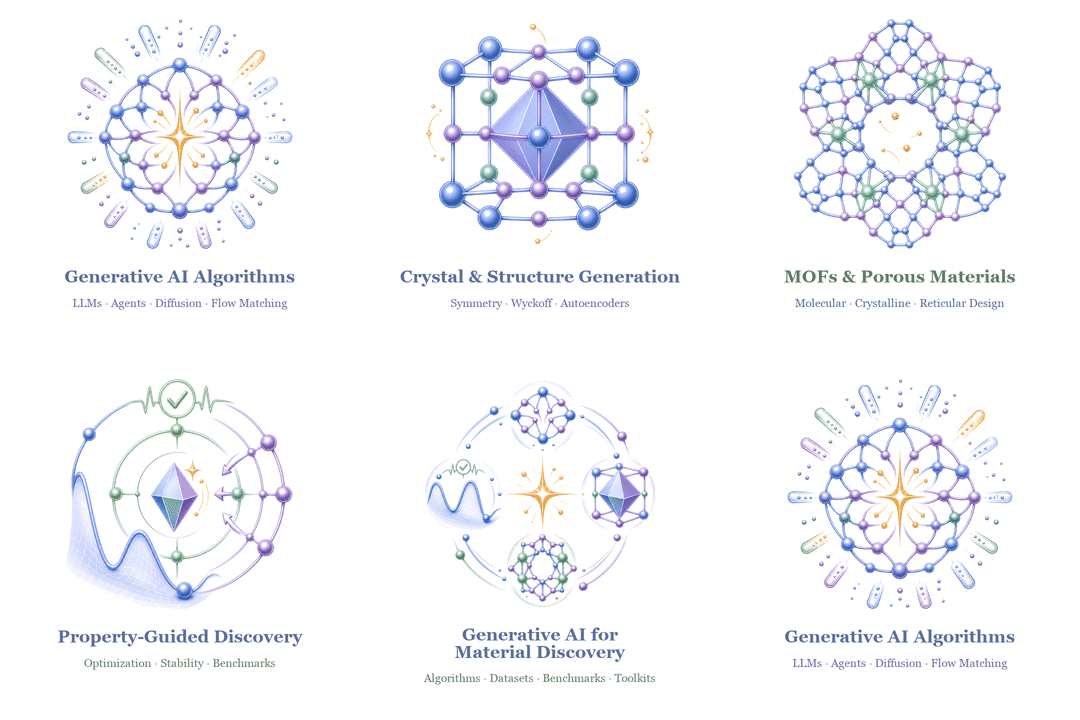
A curated collection of algorithms, surveys, datasets, benchmarks, and toolkits for generative AI in material discovery.
If this saves you even one night of paper-hunting, give us a ⭐ — it's cheaper than a GPU hour, needs no DFT convergence, and finishes in one click.

SciGenAI Slack |

WeChat Group |
Project Page | Zhihu Blog | Community | Algorithms | Surveys & Resources | Citation
Last updated: 2026-09-02
This repository tracks progress in generative AI for materials, including language-model-based crystal generation, adversarial, diffusion and flow-matching models, Bayesian and generative flow networks, VAE-style generators, multimodal materials learning, agentic discovery workflows, foundation models, and evaluation resources.
Legend: In Awesome Algorithms, Code links to implementations or official repositories and Demo links to project pages, web apps, or documentation. Resource sections use type-specific columns for companion material, data, evaluation suites, and software.
This section is limited to work whose primary contribution is a model, algorithm, representation, training method, or autonomous discovery workflow.
| Title | Venue | Date | Code | Demo |
|---|---|---|---|---|
| Generative adversarial networks (GAN) based efficient sampling of chemical composition space for inverse design of inorganic materials | npj Computational Materials 2020 | 2020.06.26 | - | - |
 Generative Adversarial Networks for Crystal Structure Prediction | ACS Central Science 2020 | 2020.07.10 | GitHub | - |
| Constrained crystals deep convolutional generative adversarial network for the inverse design of crystal structures | npj Computational Materials 2021 | 2020.07.22 | - | - |
 High-throughput discovery of novel cubic crystal materials using deep generative neural networks | Advanced Science 2021 | 2021.02.03 | GitHub | Database |
 Physics Guided Deep Learning for Generative Design of Crystal Materials with Symmetry Constraints | npj Computational Materials 2023 | 2022.03.27 | GitHub | - |
| Inverse Design of Tunable Infrared Metasurface Absorbers via a Conditional Wasserstein Generative Adversarial Network | Advanced Optical Materials 2026 | 2026.07.14 | - | - |
| Title | Venue | Date | Code | Demo |
|---|---|---|---|---|
 Crystal-GFN: sampling crystals with desirable properties and constraints | AI4Mat-NeurIPS 2023 Spotlight | 2023.10.07 | GitHub | - |
| Hierarchical GFlowNet for Crystal Structure Generation | AI4Mat-NeurIPS 2023 | 2023.10.27 | - | - |
 A Periodic Bayesian Flow for Material Generation | ICLR 2025 | 2025.02.04 | GitHub | - |
 MOF-BFN: Metal-Organic Frameworks Structure Prediction via Bayesian Flow Networks | NeurIPS 2025 | 2025.09.18 | GitHub | - |
 Efficient symmetry-aware materials generation via hierarchical generative flow networks | Digital Discovery 2026 | 2025.10.02 | GitHub | - |
 Symmetry-aware Bayesian flow networks for crystal generation | npj Computational Materials 2026 | 2026.05.19 | GitHub | - |
| Periodic Bayesian Flow Networks with Additive Accuracy | ICML 2026 | 2026.04.30 | - | - |
| A Distributional Framework for Generative Modeling of Molecular Crystals | arXiv 2026 | 2026.07.06 | - | - |
| Sample Efficient Generative Optimization for Molecular Design | arXiv 2026 | 2026.07.14 | - | - |
| Title | Venue | Date | Code | Demo |
|---|---|---|---|---|
| Atomistic Structure Generation and Neural-Network Screening of Hard Carbons to Identify High-Capacity Sodium Storage | arXiv 2026 | 2026.08.18 | - | - |
This section contains non-algorithm resources. Surveys covers reviews, perspectives, tutorial reviews, and broad capability assessments; Datasets requires reusable downloadable data; Benchmarks requires explicit evaluation tasks, protocols, metrics, or leaderboards; and Toolkits requires reusable multi-model software, data pipelines, or hosted evaluation services. Every resource backed by a paper is listed under its full paper title. A paper is cross-listed only when it releases independently reusable resources of more than one type.
This repository has benefited from close collaboration with ChatGPT in organizing, refining, and expanding the collection.
We are also grateful to contributors who have helped maintain and improve the project:
For Chinese-language project introductions and updates, visit our Zhihu Blog.
SciGenAI is a generative AI for science community where researchers, students, engineers, and practitioners can discuss ideas, share work, and find collaborators across AI4Science. The workspace hosts channels for several AI4Science projects, including a dedicated channel for Awesome Generative AI for Material Discovery.
In the materials channel, you can ask questions and get timely help, discuss papers and code, and coordinate issues, commits, and pull requests with project contributors.
Option 1 — Invitation link: Join the SciGenAI Slack community
Option 2 — QR code: Scan the code below with your phone. The QR image is also clickable.
We also have a WeChat group for Chinese-language discussions and weekly update syncs. Scan the QR code below with WeChat to join.
If you find this repository useful for your research, please consider citing it:
@misc{yan2025awesomegenerativeai,
  author       = {Yan, Liang},
  title        = {Awesome Generative {AI} for Material Discovery},
  year         = {2025},
  howpublished = {\url{https://github.com/yanliang3612/Awesome-Generative-AI-for-Material-Discovery}},
  note         = {GitHub repository, accessed 2026-07-10}
}
For any questions, feedback, or collaboration regarding this repository of papers and code, feel free to contact Liang Yan at [email protected].
The papers and code related to deep generative models for material discovery.
50
61 commits
updated Sep 2, 2026
A curated collection of algorithms, surveys, datasets, benchmarks, and toolkits for generative AI in material discovery.
If this saves you even one night of paper-hunting, give us a ⭐ — it's cheaper than a GPU hour, needs no DFT convergence, and finishes in one click.
|
SciGenAI Slack |
WeChat Group |
Project Page | Zhihu Blog | Community | Algorithms | Surveys & Resources | Citation
Last updated: 2026-09-02
This repository tracks progress in generative AI for materials, including language-model-based crystal generation, adversarial, diffusion and flow-matching models, Bayesian and generative flow networks, VAE-style generators, multimodal materials learning, agentic discovery workflows, foundation models, and evaluation resources.
Legend: In Awesome Algorithms, Code links to implementations or official repositories and Demo links to project pages, web apps, or documentation. Resource sections use type-specific columns for companion material, data, evaluation suites, and software.
This section is limited to work whose primary contribution is a model, algorithm, representation, training method, or autonomous discovery workflow.
| Title | Venue | Date | Code | Demo |
|---|---|---|---|---|
| Generative adversarial networks (GAN) based efficient sampling of chemical composition space for inverse design of inorganic materials | npj Computational Materials 2020 | 2020.06.26 | - | - |
Generative Adversarial Networks for Crystal Structure Prediction | ACS Central Science 2020 | 2020.07.10 | GitHub | - |
| Constrained crystals deep convolutional generative adversarial network for the inverse design of crystal structures | npj Computational Materials 2021 | 2020.07.22 | - | - |
High-throughput discovery of novel cubic crystal materials using deep generative neural networks | Advanced Science 2021 | 2021.02.03 | GitHub | Database |
Physics Guided Deep Learning for Generative Design of Crystal Materials with Symmetry Constraints | npj Computational Materials 2023 | 2022.03.27 | GitHub | - |
| Inverse Design of Tunable Infrared Metasurface Absorbers via a Conditional Wasserstein Generative Adversarial Network | Advanced Optical Materials 2026 | 2026.07.14 | - | - |
| Title | Venue | Date | Code | Demo |
|---|---|---|---|---|
Crystal-GFN: sampling crystals with desirable properties and constraints | AI4Mat-NeurIPS 2023 Spotlight | 2023.10.07 | GitHub | - |
| Hierarchical GFlowNet for Crystal Structure Generation | AI4Mat-NeurIPS 2023 | 2023.10.27 | - | - |
A Periodic Bayesian Flow for Material Generation | ICLR 2025 | 2025.02.04 | GitHub | - |
MOF-BFN: Metal-Organic Frameworks Structure Prediction via Bayesian Flow Networks | NeurIPS 2025 | 2025.09.18 | GitHub | - |
Efficient symmetry-aware materials generation via hierarchical generative flow networks | Digital Discovery 2026 | 2025.10.02 | GitHub | - |
Symmetry-aware Bayesian flow networks for crystal generation | npj Computational Materials 2026 | 2026.05.19 | GitHub | - |
| Periodic Bayesian Flow Networks with Additive Accuracy | ICML 2026 | 2026.04.30 | - | - |
| A Distributional Framework for Generative Modeling of Molecular Crystals | arXiv 2026 | 2026.07.06 | - | - |
| Sample Efficient Generative Optimization for Molecular Design | arXiv 2026 | 2026.07.14 | - | - |
| Title | Venue | Date | Code | Demo |
|---|---|---|---|---|
| Atomistic Structure Generation and Neural-Network Screening of Hard Carbons to Identify High-Capacity Sodium Storage | arXiv 2026 | 2026.08.18 | - | - |
This section contains non-algorithm resources. Surveys covers reviews, perspectives, tutorial reviews, and broad capability assessments; Datasets requires reusable downloadable data; Benchmarks requires explicit evaluation tasks, protocols, metrics, or leaderboards; and Toolkits requires reusable multi-model software, data pipelines, or hosted evaluation services. Every resource backed by a paper is listed under its full paper title. A paper is cross-listed only when it releases independently reusable resources of more than one type.
This repository has benefited from close collaboration with ChatGPT in organizing, refining, and expanding the collection.
We are also grateful to contributors who have helped maintain and improve the project:
For Chinese-language project introductions and updates, visit our Zhihu Blog.
SciGenAI is a generative AI for science community where researchers, students, engineers, and practitioners can discuss ideas, share work, and find collaborators across AI4Science. The workspace hosts channels for several AI4Science projects, including a dedicated channel for Awesome Generative AI for Material Discovery.
In the materials channel, you can ask questions and get timely help, discuss papers and code, and coordinate issues, commits, and pull requests with project contributors.
Option 1 — Invitation link: Join the SciGenAI Slack community
Option 2 — QR code: Scan the code below with your phone. The QR image is also clickable.
We also have a WeChat group for Chinese-language discussions and weekly update syncs. Scan the QR code below with WeChat to join.
If you find this repository useful for your research, please consider citing it:
@misc{yan2025awesomegenerativeai,
  author       = {Yan, Liang},
  title        = {Awesome Generative {AI} for Material Discovery},
  year         = {2025},
  howpublished = {\url{https://github.com/yanliang3612/Awesome-Generative-AI-for-Material-Discovery}},
  note         = {GitHub repository, accessed 2026-07-10}
}
For any questions, feedback, or collaboration regarding this repository of papers and code, feel free to contact Liang Yan at [email protected].









