The Foundational Fitness protocol as a free, offline workout app for Android and iOS: 12 weeks of lifting, cardio and rest days, prescribed sets and weights, fast logging. No account, no server, no sync, no AI, no tracking.
See the codeThe Foundational Fitness protocol as a free, offline workout app for Android and iOS.
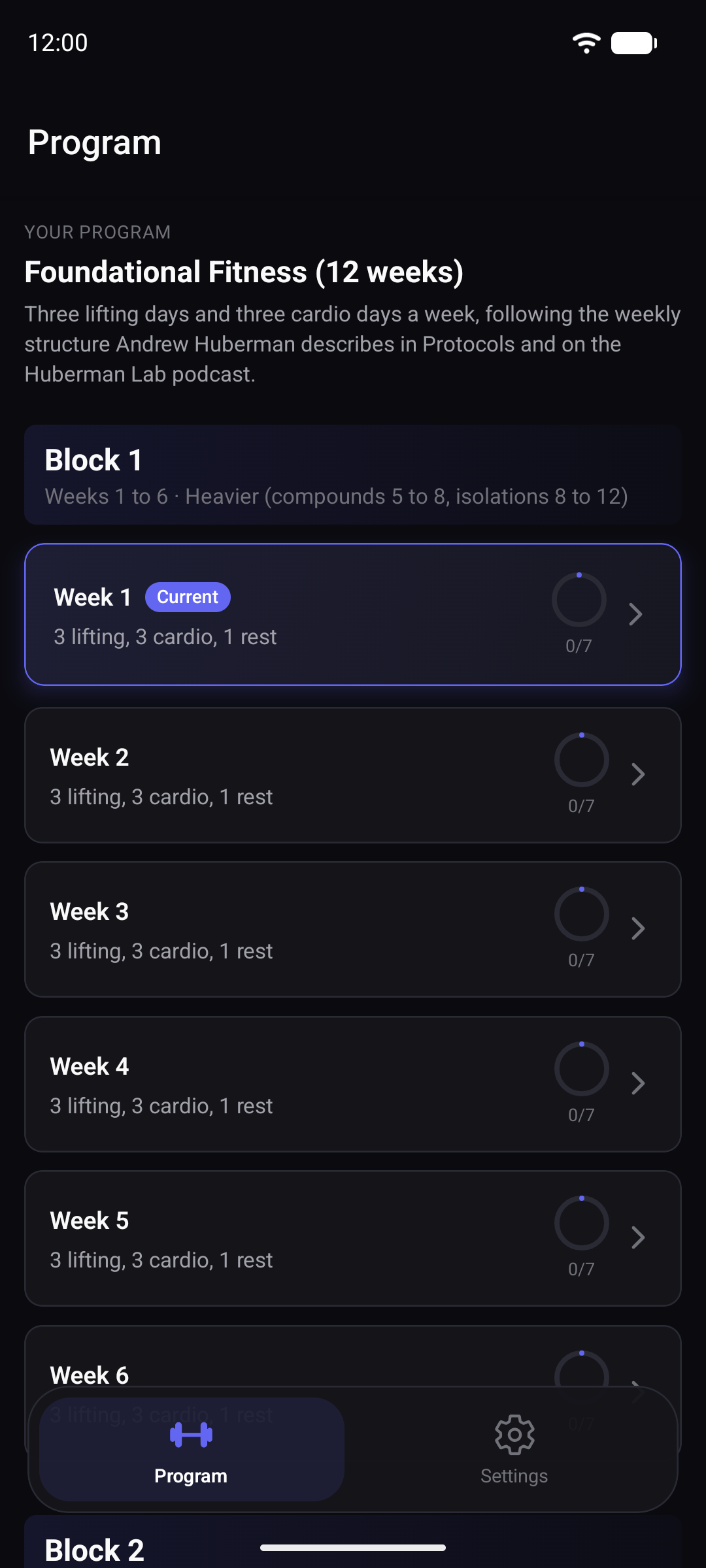
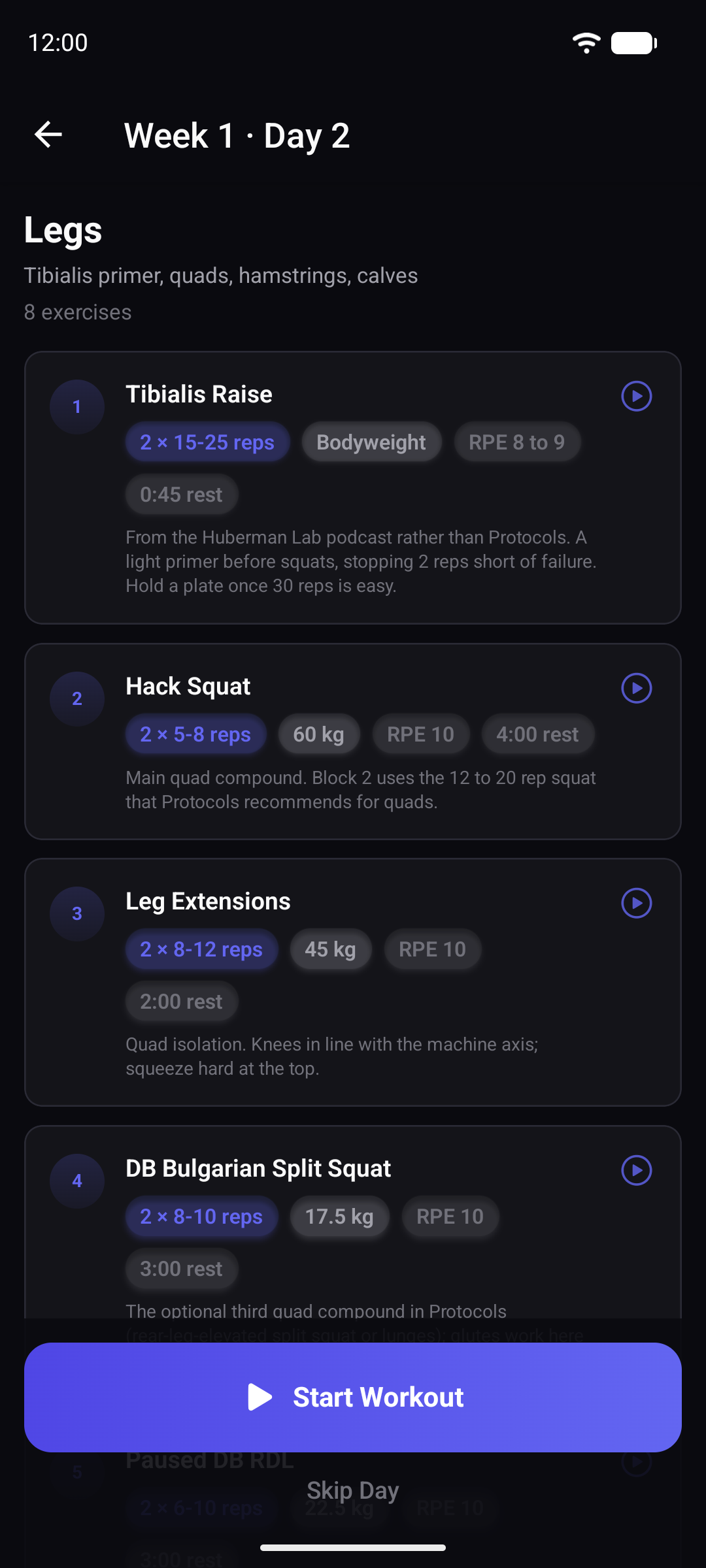
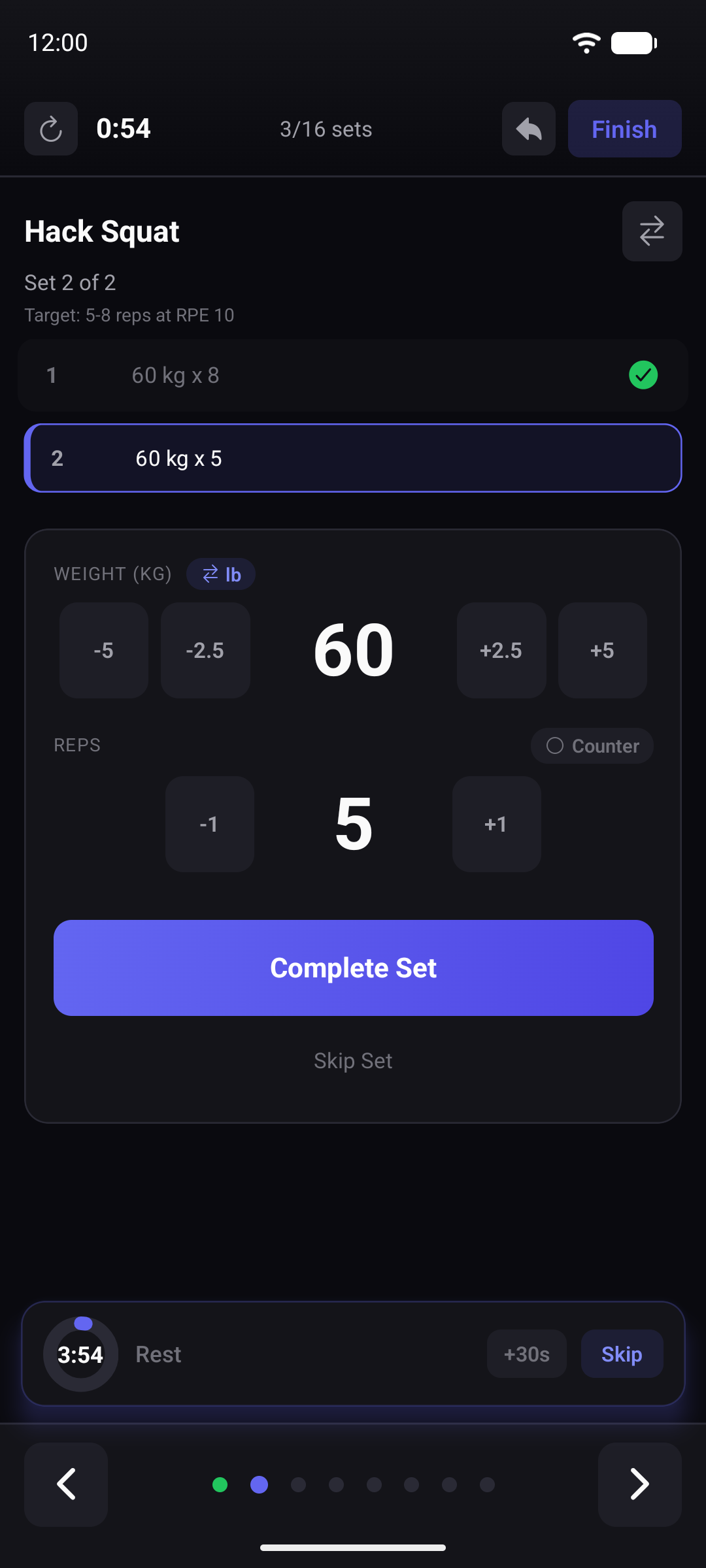
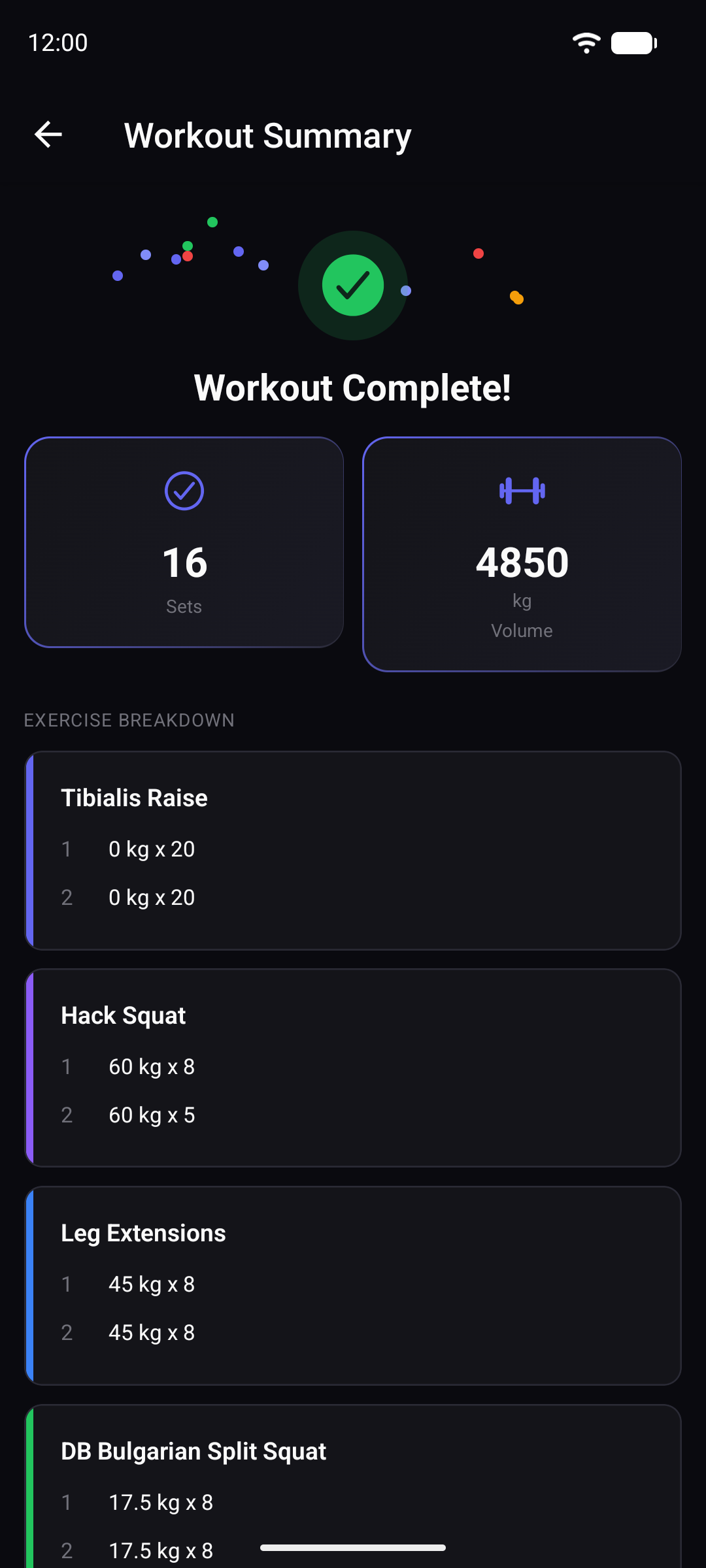
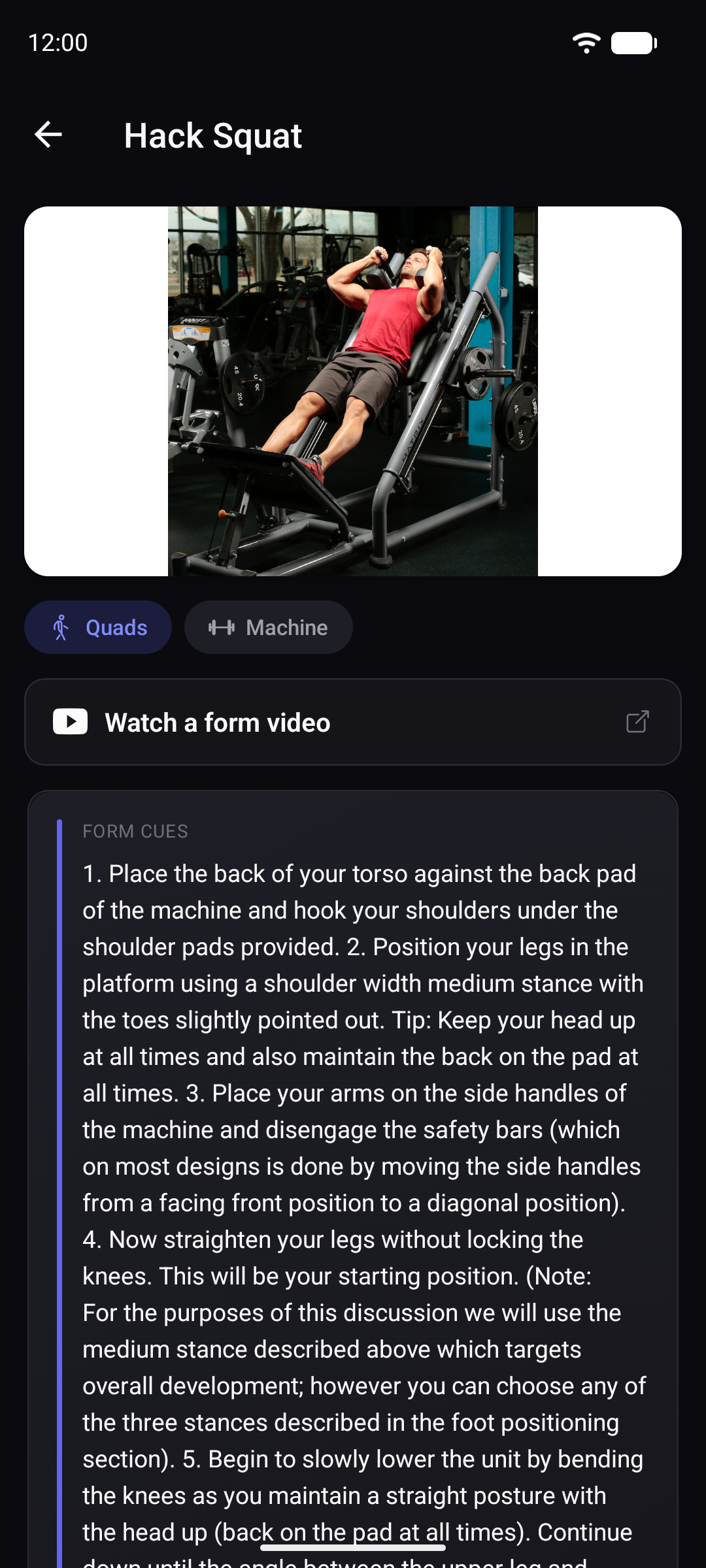
PlateClimb ships one program, Foundational Fitness (12 weeks), which follows the weekly structure Andrew Huberman describes in his book Protocols and on the Huberman Lab podcast: three lifting days, three cardio days and a rest and mobility day every week. Open the app and Week 1 is ready. It logs every set and pre-fills your weights, and everything stays on your phone. No account, no server, no sync, no backup, no AI, no subscription, no ads, no tracking.
For the cardio days, pair it with BaseMile, a free heart rate running coach from the same team that also runs entirely on your phone.
Android: download PlateClimb-<version>.apk from the
latest release and open
it on your phone. Allow installs from your browser when Android asks. It needs
Android 7.0 or newer.
An APK signed with the PlateClimb release key is the official build. The certificate SHA-256 fingerprint of that key is:
93:D4:21:35:71:EE:77:B1:B4:D7:B3:37:C9:54:FF:DD:FC:62:30:26:80:FC:08:C9:A9:E7:F9:F2:76:6C:5B:5F
Check it with apksigner verify --print-certs PlateClimb-<version>.apk.
iPhone: there is no App Store build. Build it from source with Xcode, see Quick start.
The starting weights are a reasonable example for a trained adult, not a prescription for you. Change any weight on the first session and the app remembers it from then on.
I built PlateClimb to follow this protocol myself, and I think a good training plan should not sit behind a subscription. Following a fixed weekly plan, logging sets and remembering last week's weights is simple work that a phone can do offline. So the code is open, the app needs no account or server, and anyone can read it, change it and share it under the GPL.
If it helps you train consistently, that is the whole point.
Gabriel, Likwiid
Requirements: Node 20 and npm, plus the Android SDK and a phone or emulator, or Xcode for iOS.
git clone https://github.com/likwiid/plateclimb.git
cd plateclimb
npm ci
Check that everything is in order:
npm run typecheck
npm run lint
npm test
PlateClimb uses native modules (notifications, SQLite), so it does not run in Expo Go. Build a development client once:
npm run android   # or: npm run ios
npm start         # starts Metro for the dev client on later sessions
On first launch the app sets up the exercise catalog and the program on the device and opens straight into Week 1. Settings, Reset All Data deletes your history and sets the program up fresh.
PlateClimb is fully offline. There is no account, no server, no sync, no
backup, no AI service and no analytics, and all your data stays on the phone. The only thing
the app downloads is exercise photos, loaded from the public
free-exercise-db repository on
GitHub (raw.githubusercontent.com) when you open an exercise. Nothing is sent
with that request, and offline a placeholder is shown instead. Tapping
Watch a form video hands a YouTube link to your phone, which opens it in
the YouTube app or your browser.
PlateClimb is an Expo SDK 54 / React Native app in strict TypeScript: expo-router screens, Zustand stores and SQLite through expo-sqlite. The program data, weight pre-fill and exercise photo lookup are pure modules with unit tests.
app/              screens (Program, Settings, week, day, workout, summary, exercise)
src/data/         the bundled program, the exercise catalog and photo lookup
src/features/     program, workout, exercise, settings
src/shared/       db (schema, repositories, seeding), services, stores, UI
scripts/          build-program-data.mjs, which generates the program data
See ARCHITECTURE.md for the data model and how the program is seeded.
Ideas, not promises. Issues and pull requests are welcome.
Read CONTRIBUTING.md and the Code of Conduct. Security issues go to the address in SECURITY.md, not to public issues. Changes are listed in CHANGELOG.md.
PlateClimb is free software: you can redistribute it and modify it under the
terms of the GNU General Public License as published by the Free Software
Foundation, either version 3 of the License, or (at your option) any later
version (GPL-3.0-or-later). See LICENSE for the full text.
Each source file carries the SPDX identifier GPL-3.0-or-later.
As an additional permission under GPL section 7, PlateClimb may also be distributed through app stores such as the App Store and Google Play, as long as the source stays available. See APP-STORE-EXCEPTION.md.
Copyright (C) 2026 Gabriel Ghoussoub.
PlateClimb is an independent project. It is not affiliated with or endorsed by Andrew Huberman or Huberman Lab, nor by any of the creators or projects credited above. Names are used only to describe where the weekly structure comes from.
Not medical advice. PlateClimb gives training suggestions for general fitness only. Talk to a doctor or a qualified coach before starting a new training programme, learn each lift with good form, and stop if something hurts.
PlateClimb is built and maintained by Likwiid.
The Foundational Fitness protocol as a free, offline workout app for Android and iOS: 12 weeks of lifting, cardio and rest days, prescribed sets and weights, fast logging. No account, no server, no sync, no AI, no tracking.
See the codeThe Foundational Fitness protocol as a free, offline workout app for Android and iOS.
PlateClimb ships one program, Foundational Fitness (12 weeks), which follows the weekly structure Andrew Huberman describes in his book Protocols and on the Huberman Lab podcast: three lifting days, three cardio days and a rest and mobility day every week. Open the app and Week 1 is ready. It logs every set and pre-fills your weights, and everything stays on your phone. No account, no server, no sync, no backup, no AI, no subscription, no ads, no tracking.
For the cardio days, pair it with BaseMile, a free heart rate running coach from the same team that also runs entirely on your phone.
Android: download PlateClimb-<version>.apk from the
latest release and open
it on your phone. Allow installs from your browser when Android asks. It needs
Android 7.0 or newer.
An APK signed with the PlateClimb release key is the official build. The certificate SHA-256 fingerprint of that key is:
93:D4:21:35:71:EE:77:B1:B4:D7:B3:37:C9:54:FF:DD:FC:62:30:26:80:FC:08:C9:A9:E7:F9:F2:76:6C:5B:5F
Check it with apksigner verify --print-certs PlateClimb-<version>.apk.
iPhone: there is no App Store build. Build it from source with Xcode, see Quick start.
The starting weights are a reasonable example for a trained adult, not a prescription for you. Change any weight on the first session and the app remembers it from then on.
I built PlateClimb to follow this protocol myself, and I think a good training plan should not sit behind a subscription. Following a fixed weekly plan, logging sets and remembering last week's weights is simple work that a phone can do offline. So the code is open, the app needs no account or server, and anyone can read it, change it and share it under the GPL.
If it helps you train consistently, that is the whole point.
Gabriel, Likwiid
Requirements: Node 20 and npm, plus the Android SDK and a phone or emulator, or Xcode for iOS.
git clone https://github.com/likwiid/plateclimb.git
cd plateclimb
npm ci
Check that everything is in order:
npm run typecheck
npm run lint
npm test
PlateClimb uses native modules (notifications, SQLite), so it does not run in Expo Go. Build a development client once:
npm run android   # or: npm run ios
npm start         # starts Metro for the dev client on later sessions
On first launch the app sets up the exercise catalog and the program on the device and opens straight into Week 1. Settings, Reset All Data deletes your history and sets the program up fresh.
PlateClimb is fully offline. There is no account, no server, no sync, no
backup, no AI service and no analytics, and all your data stays on the phone. The only thing
the app downloads is exercise photos, loaded from the public
free-exercise-db repository on
GitHub (raw.githubusercontent.com) when you open an exercise. Nothing is sent
with that request, and offline a placeholder is shown instead. Tapping
Watch a form video hands a YouTube link to your phone, which opens it in
the YouTube app or your browser.
PlateClimb is an Expo SDK 54 / React Native app in strict TypeScript: expo-router screens, Zustand stores and SQLite through expo-sqlite. The program data, weight pre-fill and exercise photo lookup are pure modules with unit tests.
app/              screens (Program, Settings, week, day, workout, summary, exercise)
src/data/         the bundled program, the exercise catalog and photo lookup
src/features/     program, workout, exercise, settings
src/shared/       db (schema, repositories, seeding), services, stores, UI
scripts/          build-program-data.mjs, which generates the program data
See ARCHITECTURE.md for the data model and how the program is seeded.
Ideas, not promises. Issues and pull requests are welcome.
Read CONTRIBUTING.md and the Code of Conduct. Security issues go to the address in SECURITY.md, not to public issues. Changes are listed in CHANGELOG.md.
PlateClimb is free software: you can redistribute it and modify it under the
terms of the GNU General Public License as published by the Free Software
Foundation, either version 3 of the License, or (at your option) any later
version (GPL-3.0-or-later). See LICENSE for the full text.
Each source file carries the SPDX identifier GPL-3.0-or-later.
As an additional permission under GPL section 7, PlateClimb may also be distributed through app stores such as the App Store and Google Play, as long as the source stays available. See APP-STORE-EXCEPTION.md.
Copyright (C) 2026 Gabriel Ghoussoub.
PlateClimb is an independent project. It is not affiliated with or endorsed by Andrew Huberman or Huberman Lab, nor by any of the creators or projects credited above. Names are used only to describe where the weekly structure comes from.
Not medical advice. PlateClimb gives training suggestions for general fitness only. Talk to a doctor or a qualified coach before starting a new training programme, learn each lift with good form, and stop if something hurts.
PlateClimb is built and maintained by Likwiid.



