
A curated reading list on harness engineering for recursive self-improvement of LLM agents (EN/ZH).
99
15 commits
updated Sep 8, 2026
README
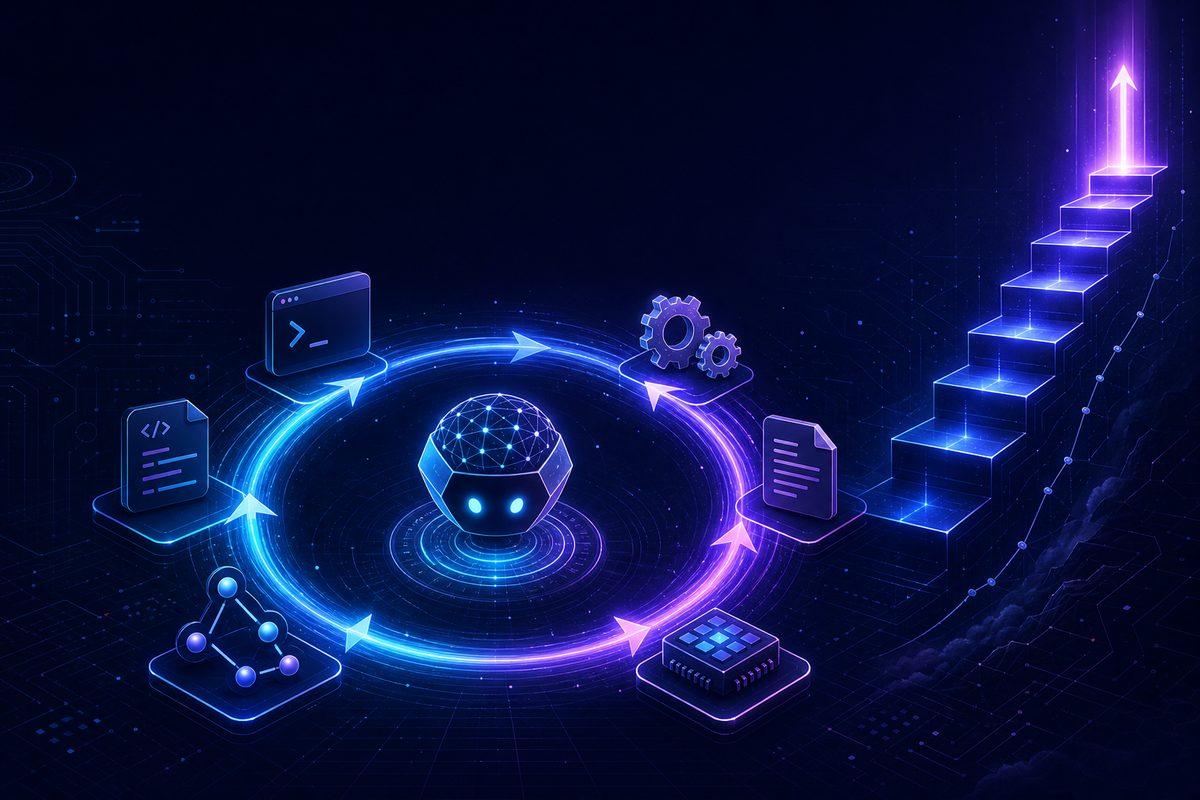
Awesome Harness Engineering for Self-Improvement
English | 中文
When the harness — the system around an LLM — learns to improve itself.



Overview · Optimization Ladder · Paper List · Scope · Contributing
A curated reading list on harness engineering as the substrate for recursive self-improvement (RSI) of LLM agents.
A harness is the system that surrounds a base model and orchestrates how it thinks and plans, calls tools and acts, perceives and manages context, stores artifacts, and evaluates its own results. This list is deliberately narrow: it collects work where the harness itself — its context, prompts, workflow, tools, or code — is the object that improves itself, i.e. where the system optimizes, searches, or evolves its own scaffolding, up to and including the loop where the harness is co-optimized with model weights.
This repository is inspired by Lilian Weng's blog post "Harness Engineering for Self-Improvement" (Jul 2026).
Scope (please read)
In focus — the harness improving itself: self-modifying agents, automated optimization/search of agentic workflows, self-evolving context and memory, prompt/workflow optimization, evolutionary program search over harness/agent code, and the joint harness+weights loop. Plus the auto-research systems that close a self-improvement loop, the evaluators that such loops optimize against, and the safety/rigor failure modes specific to self-evolving harnesses.
Out of focus — this list distinguishes self-improvement from design:
- Harness design patterns (how to hand-build a good harness — ReAct, coding-agent harnesses, multi-agent frameworks, runtimes/protocols) are the editable substrate that self-improving methods act on, but are design, not self-improvement. They are noted only as a boundary in §7 Adjacent Areas.
- Purely model-side self-improvement (self-play, synthetic data, RLVR, test-time weight training) improves the model, not the harness; also noted only in §7.
⭐ If you find this useful, please star the repo. PRs for missing papers and corrected links are welcome.
†denotes a preprint or a very recent arXiv posting whose metadata may still change.
Table of Contents
- 🧭 Overview
- 🪜 The Optimization Ladder
- 🕰️ Historical Lineage
- 📚 Paper List
- Future Directions
- Contributing
- Citation
Overview
The dominant narrative attributes agent capability to the underlying model. This reading list follows a complementary thesis: the layer between the raw model and the real-world context — the harness — is as decisive as the model's raw intelligence, and, crucially, it is a layer that can be made to improve itself.
Recursive Self-Improvement (RSI) dates back to I. J. Good (1965) and was named by Yudkowsky (2008): an AI uses its current intelligence to improve the machinery that produces its intelligence. In modern AI this loop rarely starts with a model rewriting its own weights. A more practical near-term path runs through the harness: the agent improves its own scaffolding, workflow, context management, and tools, which in turn enables a better successor.
The organizing question of this list is therefore narrow and specific: when does a harness improve itself, and how? Everything here is selected because the harness — not just the model, and not merely a human-authored design — is the thing being optimized, searched, or evolved.
flowchart LR
    A["🤖 Agent + Harness"] -->|acts| B["🌍 Environment"]
    B -->|traces & results| C["🔍 Evaluator"]
    C -->|signal| D["🛠️ Self-modify<br/>prompts · context · workflow · tools · code"]
    D -->|better scaffolding| A
    classDef node fill:#1e1b4b,stroke:#7c3aed,stroke-width:2px,color:#e0e7ff;
    class A,B,C,D node;
The Optimization Ladder
The progression of the object being self-improved inside a harness system, from most manual to most general. This ladder is the backbone of the list.
flowchart BT
    L0["<b>L0</b> · Instruction prompts<br/><i>APE · OPRO · GEPA</i>"]
    L1["<b>L1</b> · Context & memory<br/><i>ACE · ReasoningBank</i>"]
    L2["<b>L2</b> · Workflow / graph<br/><i>ADAS · AFlow · GPTSwarm</i>"]
    L3["<b>L3</b> · Harness / agent code<br/><i>DGM · SICA · Gödel Agent</i>"]
    L4["<b>L4</b> · Optimizer / meta-harness<br/><i>STOP · Meta-Harness · MCE</i>"]
    L5["<b>L5</b> · Harness + weights<br/><i>SIA · SEAL</i>"]
    L0 --> L1 --> L2 --> L3 --> L4 --> L5
    classDef rung fill:#0f172a,stroke:#22d3ee,stroke-width:2px,color:#e0f2fe;
    class L0,L1,L2,L3,L4,L5 rung;
| Level | Self-Improved Object | Representative Work | Section |
|---|---|---|---|
| L0 | Instruction prompts | APE, OPRO, Promptbreeder, GEPA | 2.2 |
| L1 | Context / memory | ACE, Dynamic Cheatsheet, ReasoningBank | 2.1 |
| L2 | Workflow / graph | ADAS, AFlow, GPTSwarm, AgentSquare | 2.3 |
| L3 | Harness / agent code | STOP, Gödel Agent, DGM, SICA, Self-Harness | 2.4 |
| L4 | Optimizer / meta-harness code | Meta-Harness, MCE, Meta Agent Search | 2.4 |
| L5 | Harness + model weights (jointly) | SIA, SEAL | 2.6 |
| — | (boundary) model weights only | self-play, RLVR, synthetic data | §7 — out of focus |
| — | (boundary) the harness design itself | ReAct, SWE-agent, AutoGen, MCP | §7 — out of focus |
As the model becomes more capable, the field moves down this table: toward more complex self-improved targets and more general mechanisms. Below L5 lies pure model-weight self-improvement; outside the ladder entirely lies human-authored harness design. Both are treated as adjacent, not core.
Historical Lineage
| Year | Milestone | Significance |
|---|---|---|
| 1965 | I. J. Good — "ultraintelligent machine" | First articulation of an intelligence explosion via self-design |
| 2008 | Yudkowsky — "Recursive Self-Improvement" | Names the RSI feedback loop |
| 2023 | Reflexion, Voyager, DSPy, Promptbreeder, STOP, FunSearch | Verbal self-improvement loops, self-growing skills, compiled pipelines, self-referential improvers |
| 2024 | ADAS, AFlow, GPTSwarm, Agent Symbolic Learning, TextGrad | Automated agent/workflow optimization; textual "backprop" over harness parts |
| 2025 | AlphaEvolve, ShinkaEvolve, DGM, SICA, ACE, GEPA, SEAL | Evolutionary coding agents; self-modifying agents; self-evolving context; self-adapting weights |
| 2026 | Meta-Harness, MCE, Self-Harness, AutoHarness, Hyperagents, SIA | Harnesses that improve harnesses; joint harness+weight loops |
Paper List
1. Foundations & Position Pieces
- Harness Engineering for Self-Improvement — Lilian Weng. Lil'Log 2026. [blog] — The essay this list is built around; frames the harness as the near-term substrate for RSI.
- Speculations Concerning the First Ultraintelligent Machine — I. J. Good. Advances in Computers 1965. — Origin of the intelligence-explosion idea via self-design.
- Recursive Self-Improvement — E. Yudkowsky. LessWrong 2008. [post] — Names and analyzes the RSI feedback loop.
- A Survey of Self-Evolving Agents: What, When, How, and Where to Evolve — Gao et al. arXiv 2025.† [paper] — Taxonomy of self-evolving agents across models, memory, tools, and architecture.
- A Comprehensive Survey of Self-Evolving AI Agents — Fang et al. arXiv 2025.† [paper] — Bridges foundation models and lifelong agentic systems; proposes "Three Laws of Self-Evolving AI Agents".
2. Harness Optimization (the core)
This is the heart of the list. Each subsection is a rung of the optimization ladder: a different part of the harness that the system learns to improve on its own.
2.1 Self-Evolving Context & Memory
L1 of the ladder: the agent curates and grows its own context/memory from experience, improving without weight updates.
- Reflexion — "Language Agents with Verbal Reinforcement Learning". Shinn et al. NeurIPS 2023. [paper] — Converts feedback into verbal self-reflections stored in episodic memory across trials — the archetypal in-harness self-improvement loop.
- ExpeL — "LLM Agents Are Experiential Learners". Zhao et al. AAAI 2024. [paper] — Gathers experiences, extracts NL insights into a growing context store, recalls at inference without fine-tuning.
- Dynamic Cheatsheet — "Test-Time Learning with Adaptive Memory". Suzgun et al. EACL 2026.† [paper] — Persistent self-curated memory of strategies/snippets at inference; a direct precursor to ACE.
- ACE — "Agentic Context Engineering: Evolving Contexts for Self-Improving Language Models". Zhang et al. ICLR 2026. [paper] — Treats context as an evolving playbook via Generator/Reflector/Curator with incremental delta updates, avoiding context collapse.
- MCE — "Meta Context Engineering via Agentic Skill Evolution". Ye et al. arXiv 2026.† [paper] — Bi-level framework co-evolving context-management skills (meta) and context artifacts (base, as files/code) — separates the mechanism from the content.
- ReasoningBank — "Scaling Agent Self-Evolving with Reasoning Memory". Ouyang et al. ICLR 2026.† [paper] — Distills generalizable reasoning strategies from successes and failures; introduces memory-aware test-time scaling.
- Agent Workflow Memory (AWM) — Wang, Mao, Fried, Neubig. ICML 2025. [paper] — Induces reusable "workflows" as durable procedural memory that the agent grows and reuses with experience.
- Memp — "Exploring Agent Procedural Memory". Fang et al. ACL Findings 2026.† [paper] — Distills trajectories into script-like procedures with build/retrieve/update strategies the agent maintains over time.
- MemAct — "Memory as Action: Autonomous Context Curation for Long-Horizon Agentic Tasks". Zhang et al. ACL Findings 2026.† [paper] — Reframes working-memory management as learnable policy actions trained end-to-end.
2.2 Prompt Optimization
L0 of the ladder: the harness's instruction layer as the object that gets optimized.
- APE — "Large Language Models Are Human-Level Prompt Engineers". Zhou et al. ICLR 2023. [paper] — Treats the instruction as a program, proposing/scoring candidates via search.
- OPRO — "Large Language Models as Optimizers". Yang et al. ICLR 2024. [paper] — "Optimization by PROmpting": generate new solutions from a meta-prompt of prior (solution, score) pairs.
- EvoPrompt — "Connecting LLMs with Evolutionary Algorithms Yields Powerful Prompt Optimizers". Guo et al. ICLR 2024. [paper] — Runs GA/DE over a population of discrete prompts with LLM mutation/crossover.
- Promptbreeder — "Self-Referential Self-Improvement via Prompt Evolution". Fernando et al. arXiv 2023.† [paper] — Evolves both task-prompts and the mutation-prompts that modify them — self-referential prompt improvement.
- ProTeGi — "Automatic Prompt Optimization with 'Gradient Descent' and Beam Search". Pryzant et al. EMNLP 2023. [paper] — Coined "textual gradients": LLM critiques as NL gradients editing prompts.
- DSPy — "Compiling Declarative Language Model Calls into Self-Improving Pipelines". Khattab et al. ICLR 2024. [paper] — Programming model treating LM pipelines as optimizable text-transformation graphs.
- MIPROv2 — "Optimizing Instructions and Demonstrations for Multi-Stage Language Model Programs". Opsahl-Ong et al. EMNLP 2024. [paper] — Jointly bootstraps few-shot examples and proposes instructions via Bayesian optimization.
- TextGrad — "Automatic 'Differentiation' via Text". Yuksekgonul et al. Nature 2025. [paper] — Backpropagates textual feedback through compound AI systems, PyTorch-style.
- GEPA — "Reflective Prompt Evolution Can Outperform Reinforcement Learning". Agrawal et al. arXiv 2025.† [paper] — Genetic-Pareto reflective optimizer reading full traces; beats RL with up to 35× fewer rollouts.
2.3 Automated Optimization of Agentic Workflows
L2 of the ladder: the agentic workflow/graph is searched and optimized automatically, rather than hand-designed.
- ADAS / Meta Agent Search — "Automated Design of Agentic Systems". Hu, Lu, Clune. ICLR 2025. [paper] — A meta-agent programs ever-better agents in code over a growing archive.
- AFlow — "Automating Agentic Workflow Generation". Zhang et al. ICLR 2025. [paper] — Workflow optimization as MCTS over code-represented graphs.
- GPTSwarm — "Language Agents as Optimizable Graphs". Zhuge et al. ICML 2024. [paper] — Agents as computational graphs; node-level prompt + edge-level REINFORCE optimization.
- AgentSquare — "Automatic LLM Agent Search in Modular Design Space". Shang et al. ICLR 2025. [paper] — Searches a modular Planning/Reasoning/Tool-use/Memory space via evolution + recombination.
- MaAS — "Multi-agent Architecture Search via Agentic Supernet". Zhang et al. ICML 2025. [paper] — Optimizes a probabilistic "agentic supernet" for cost-adaptive, query-dependent systems.
- MASS — "Multi-Agent Design: Optimizing Agents with Better Prompts and Topologies". Zhou et al. arXiv 2025.† [paper] — Interleaved multi-stage search over prompts and topologies.
- ScoreFlow — "Mastering LLM Agent Workflows via Score-based Preference Optimization". Wang et al. arXiv 2025.† [paper] — Continuous gradient-based workflow optimization via Score-DPO.
- FlowReasoner — "Reinforcing Query-Level Meta-Agents". Gao et al. arXiv 2025.† [paper] — A reasoning meta-agent (RL-tuned) that designs a bespoke multi-agent system per query.
- EvoAgent — "Towards Automatic Multi-Agent Generation via Evolutionary Algorithms". Yuan et al. NAACL 2025. [paper] — Mutation/crossover/selection to extend one agent into a multi-agent system.
- Agent Symbolic Learning — "Symbolic Learning Enables Self-Evolving Agents". Zhou et al. arXiv 2024.† [paper] — Language "loss/gradients/back-prop" to jointly optimize prompts, tools, and pipeline.
- Alita — "Generalist Agent Enabling Scalable Agentic Reasoning with Minimal Predefinition and Maximal Self-Evolution". Qiu et al. arXiv 2025.† [paper] — Self-evolves by autonomously generating and reusing its own MCP tools on the fly.
2.4 Self-Improving & Self-Modifying Harnesses
L3–L4 of the ladder: the harness/agent code — and the code that optimizes it — as the object of self-modification. The most direct realization of the theme.
- STOP — "Self-Taught Optimizer: Recursively Self-Improving Code Generation". Zelikman et al. COLM 2024. [paper] — A seed improver recursively improves its own scaffolding code (weights fixed); the improver, not the solution, is the target.
- Gödel Agent — "A Self-Referential Agent Framework for Recursive Self-Improvement". Yin et al. ACL 2025. [paper] — Uses monkey-patching to dynamically rewrite its own logic at runtime.
- Darwin Gödel Machine (DGM) — "Open-Ended Evolution of Self-Improving Agents". Zhang et al. arXiv 2025.† [paper] — A coding agent rewrites its own codebase over an open-ended archive; SWE-bench 20%→50%.
- SICA — "A Self-Improving Coding Agent". Robeyns et al. arXiv 2025.† [paper] — Removes the meta/target distinction; the agent edits its own codebase for cost/speed/accuracy.
- Meta-Harness — "End-to-End Optimization of Model Harnesses". Lee et al. arXiv 2026.† [paper] — An agentic proposer searches over harness code via the file system; returns a Pareto frontier of harnesses. "A harness for optimizing harnesses."
- Self-Harness — "Harnesses That Improve Themselves". Zhang et al. arXiv 2026.† [paper] — A propose-evaluate-accept loop: weakness mining → bounded harness proposal → regression validation on held-in/held-out splits.
- AutoHarness — "Improving LLM Agents by Automatically Synthesizing a Code Harness". Lou et al. arXiv 2026.† — Uses iterative code refinement with environment feedback to auto-synthesize a code harness.
- Hyperagents — Zhang et al. arXiv 2026.† [paper] — A meta-agent controls how to modify task agents to create new ones.
- Ouroboros — "Ouroboros: A Self-Developing Frontier Coding Agent with Reviewed Core Evolution". Razzhigaev et al. arXiv 2026.† [paper] [code] — Documents recursive and experience-driven core evolution in a coding-agent harness, with reviewed commits becoming the runtime for later work.
2.5 Evolutionary & Program Search
The engine behind self-improving coding agents: an LLM proposes edits, an evaluator scores them, and the agent's own code/algorithms evolve over a population. These are the mechanisms that DGM, Meta-Harness, and Self-Harness build on.
- AlphaEvolve — "A Coding Agent for Scientific and Algorithmic Discovery". Novikov et al. arXiv 2025.† [paper] — Evolutionary coding agent with LLM ensemble + evaluators; marked
EVOLVE-BLOCKregions; discovered a 48-mult 4×4 matrix algorithm. - FunSearch — "Mathematical Discoveries from Program Search with Large Language Models". Romera-Paredes et al. Nature 2023. [paper] — LLM + evaluator in an evolutionary loop; the template that self-improving coding agents descend from.
- ShinkaEvolve — "Towards Open-Ended and Sample-Efficient Program Evolution". Lange et al. arXiv 2025.† [paper] — Parent sampling, novelty rejection sampling, and bandit LLM selection for sample-efficient evolution.
- ThetaEvolve — "Test-time Learning on Open Problems". Wang et al. arXiv 2025.† [paper] — Combines evolutionary search with RL and in-context learning.
- ELM — "Evolution through Large Models". Lehman et al. arXiv 2022.† [paper] — LLM diff model as a mutation operator inside MAP-Elites; the earliest LLM-as-mutation program-evolution work.
2.6 Joint Optimization with Model Weights
L5 of the ladder: the boundary where harness improvement and weight updates happen in the same loop. This is the deepest in-focus rung; pure weight-only self-improvement is out of focus.
- SIA — "Self Improving AI with Harness & Weight Updates". Hebbar et al. arXiv 2026.† [paper] — A Feedback-Agent decides, per iteration, whether to update the harness or the model weights.
- SEAL — "Self-Adapting Language Models". Zweiger et al. NeurIPS 2025. [paper] — The model generates its own "self-edits" (finetuning data + directives), applied via SFT with an RL loop — the model editing its own update process.
- Voyager — "An Open-Ended Embodied Agent with Large Language Models". Wang et al. TMLR 2024. [paper] — Lifelong learning via automatic curriculum + a self-growing executable skill library (harness-side, no weight updates); the canonical skill-accumulation loop.
- SkillWeaver — "Web Agents can Self-Improve by Discovering and Honing Skills". Zheng et al. COLM 2025. [paper] — Agents synthesize reusable, debugged API skills into their harness; +31.8% on WebArena.
3. Auto-Research: A Self-Improvement Loop in Action
Auto-research is included only where the system forms a closed self-improvement loop — it reviews, critiques, and builds on its own outputs — rather than a one-shot designed pipeline. It is where evaluation, memory, and self-correction must all come together.
3.1 Closed-Loop & Self-Improving Research Agents
- The AI Scientist-v2 — "Workshop-Level Automated Scientific Discovery via Agentic Tree Search". Yamada et al. arXiv 2025.† [paper] — Template-free agentic tree search that iteratively refines its own experiments; produced the first fully-AI paper to pass workshop peer review.
- CycleResearcher — "Improving Automated Research via Automated Review". Weng et al. ICLR 2025. [paper] — Policy model + reward model trained with iterative RL so the researcher improves from its own automated reviews.
- AgentRxiv — "Towards Collaborative Autonomous Research". Schmidgall & Moor. arXiv 2025.† [paper] — A shared preprint server letting agent labs build on each other's reports — collective self-improvement.
- Dolphin — "Moving Towards Closed-loop Auto-research through Thinking, Practice, and Feedback". Yuan et al. ACL 2025. [paper] — Closed-loop idea→experiment→feedback with traceback-guided debugging.
- NovelSeek / InternAgent — "When Agent Becomes the Scientist". InternAgent Team. arXiv 2025.† [paper] — Unified closed-loop multi-agent framework across 12 scientific tasks.
- AI co-scientist — "Towards an AI co-scientist". Gottweis et al. arXiv 2025.† [paper] — Gemini multi-agent system that tournament-evolves biomedical hypotheses through a generate-debate-rank loop.
- AIDE — "AI-Driven Exploration in the Space of Code". Jiang et al. arXiv 2025.† [paper] — Casts ML engineering as iterative code optimization via agentic tree search over its own solutions.
- CORAL — "CORAL: Towards Autonomous Multi-Agent Evolution for Open-Ended Discovery". Qu et al. COLM 2026. [paper] [code] — Runs multiple coding agents in isolated worktrees around an external grader, retaining scored attempts and sharing notes and reusable skills so later experiments build on prior results.
3.2 Self-Improving Idea & Data Generation
- Autodata — "An Agentic Data Scientist to Create High Quality Synthetic Data". Kulikov et al. arXiv 2026.† [paper] — Challenger/weak-solver/strong-solver/judge roles produce "just right" difficulty data, with the challenger prompt updated iteratively from feedback.
- ResearchAgent — "Iterative Research Idea Generation over Scientific Literature". Baek et al. NAACL 2025. [paper] — Iteratively generates and refines its own problems, methods, and designs via a literature graph and reviewing agents.
3.3 Reality Checks: Are Agents Scientists Yet?
- Why LLMs Aren't Scientists Yet — "Lessons from Four Autonomous Research Attempts". Trehan & Chopra. arXiv 2026.† [paper] — Documents six recurring failure modes of self-directed research loops (training-data defaults, implementation drift, memory degradation, over-optimism, insufficient domain intelligence, weak scientific taste).
- Early Science Acceleration Experiments with GPT-5 — Bubeck et al. arXiv 2025.† [paper] — Notes "p-hacking and eureka-ing": self-improvement loops declaring victory on noise.
- Evaluating Sakana's AI Scientist — "Wishful Thinking or Emerging Reality?". arXiv 2025.† [paper] — Independent eval: high experiment failure rate, hallucinated results.
4. Evaluators That Close the Loop
A self-improvement loop is only as good as its evaluator. These benchmarks and verifiers are the signal a self-improving harness optimizes against — and their weaknesses are its blind spots.
4.1 AI Research & ML Engineering Benchmarks
- PaperBench — "Evaluating AI's Ability to Replicate AI Research". Starace et al. ICML 2025. [paper] — Replicate 20 ICML 2024 papers from scratch; 8,316 rubrics.
- MLE-bench — "Evaluating Machine Learning Agents on Machine Learning Engineering". Chan et al. ICLR 2025. [paper] — 75 Kaggle competitions with human-leaderboard baselines.
- RE-Bench — "Evaluating Frontier AI R&D Capabilities Against Human Experts". Wijk et al. ICML 2025. [paper] — 7 open-ended ML R&D environments vs 61 human experts.
- ScienceAgentBench — "Toward Rigorous Assessment of Language Agents for Data-Driven Scientific Discovery". Chen et al. ICLR 2025. [paper] — 102 tasks from 44 peer-reviewed papers.
- CORE-Bench — "Fostering the Credibility of Published Research...". Siegel et al. TMLR 2024. [paper] — 270 computational-reproducibility tasks from 90 papers.
- EXP-Bench — "Can AI Conduct AI Research Experiments?". Kon et al. arXiv 2025.† [paper] — 461 end-to-end tasks; best agents ~0.5% full success.
- KernelBench — "Can LLMs Write Efficient GPU Kernels?". Ouyang et al. ICML 2025. [paper] — 250 PyTorch workloads scored by fast_p — a fast, automatable verifier well-suited to evolutionary harnesses.
4.2 Coding & Terminal Agent Benchmarks
- SWE-bench — "Can Language Models Resolve Real-World GitHub Issues?". Jimenez et al. ICLR 2024. [paper] — 2,294 real issue→PR tasks; the standard target for coding-harness self-improvement (DGM, SICA).
- Terminal-Bench — "Benchmarking Agents on Hard, Realistic Tasks in Command Line Interfaces". Merrill et al. arXiv 2026.† — Human-verified containerized terminal tasks; the eval used by Meta-Harness / Self-Harness.
- ClawBench — "A Benchmark for Computer-Using AI Agents". Zhang et al. arXiv 2026.† [paper] [code] — Live-web benchmark for harnesses, with isolated multi-step tasks, request interception, and replayable execution traces.
- HAL — "Holistic Agent Leaderboard: The Missing Infrastructure for AI Agent Evaluation". Kapoor et al. ICLR 2026. [paper] — Standardized, cost-aware, third-party leaderboard across 9 benchmarks.
4.3 Verification & Verifiers
- Let's Verify Step by Step — Lightman et al. ICLR 2024. [paper] — Process supervision beats outcome supervision; releases PRM800K.
- Generative Verifiers (GenRM) — "Reward Modeling as Next-Token Prediction". Zhang et al. ICLR 2025. [paper] — CoT verification via next-token prediction.
- LLMs Cannot Self-Correct Reasoning Yet — Huang et al. ICLR 2024. [paper] — Intrinsic self-correction often degrades without an external signal — motivates verifiers outside the self-improvement loop.
5. Challenges: When Self-Improvement Goes Wrong
The failure modes that gate real RSI. The evaluator and permission control should sit outside the loop that evolves the harness.
- Misevolution — "Your Agent May Misevolve: Emergent Risks in Self-evolving LLM Agents". Shao et al. ICLR 2026. [paper] — First systematic study of misevolution across model/memory/tool/workflow paths — directly about self-evolving harness risk.
- Defining and Characterizing Reward Hacking — Skalse et al. NeurIPS 2022. [paper] — First formal definition; "unhackability" is a strong condition.
- Scaling Laws for Reward Model Overoptimization — Gao et al. ICML 2023. [paper] — Functional forms for gold-reward degradation vs KL — the core risk of a loop optimizing against a proxy.
- Specification Gaming: the Flip Side of AI Ingenuity — Krakovna et al. DeepMind blog 2020. [blog] — Catalog of agents exploiting objective loopholes.
- Sycophancy to Subterfuge — "Investigating Reward Tampering in Language Models". Denison et al. arXiv 2024.† [paper] — Generalization from sycophancy to reward-function tampering — a self-improvement loop editing its own reward.
- Monitoring Reasoning Models for Misbehavior — Baker et al. arXiv 2025.† [paper] — CoT monitoring detects hacking, but training against the monitor yields obfuscation.
- AI Agents That Matter — Kapoor et al. arXiv 2024.† [paper] — Agent benchmarks over-focus on accuracy vs cost with weak holdouts — a validity crisis for self-improvement signals.
- Many SWE-bench-Passing PRs Would Not Be Merged into Main — METR. Report 2026. — Benchmark-passing PRs have far lower human merge rates — an evaluation-validity warning for self-improving coding harnesses.
- Leakage and the Reproducibility Crisis in ML-based Science — Kapoor & Narayanan. Patterns 2023. [paper] — Data leakage across 17 fields / 329 papers; relevant to trusting auto-research results.
- AgentHarm — "A Benchmark for Measuring Harmfulness of LLM Agents". Andriushchenko et al. ICLR 2025. [paper] — Malicious agent tasks testing refusal + retained capability.
6. Related Surveys
- A Survey on Self-Evolution of Large Language Models — Tao et al. arXiv 2024.† [paper] — Self-evolution as cycles of experience acquisition → refinement → updating → evaluation.
- A Survey of Context Engineering for Large Language Models — Mei et al. arXiv 2025.† [paper] — 1400+ paper survey of retrieval/processing/management components that self-evolving context builds on.
- Automated Design of Agentic Systems: A Survey — Madžar & Mekterović. Preprints.org 2026.† — Surveys 33 ADAS methods along target/search/representation/feedback axes.
- Agent Harness for Large Language Model Agents: A Survey — Meng et al. Preprints.org 2026.† [repo] — Formalizes the harness as H=(E,T,C,S,L,V); a complementary systems-oriented view of the substrate self-improvement acts on.
7. Adjacent Areas (Out of Focus)
These areas are close to the theme but deliberately not its subject. They are listed only to mark the boundary; each group is intentionally short and non-exhaustive.
A. Harness design patterns — the editable substrate, not self-improvement. These works define how to build a good harness. They are the surface the §2 methods act on, but they are hand-authored design, not systems that improve themselves.
-
Execution loop: ReAct (2210.03629), Self-Refine (2303.17651), ReWOO (2305.18323).
-
Coding-agent harnesses: SWE-agent (2405.15793), OpenHands (2407.16741), CodeAct (2402.01030), Agentless (2407.01489).
-
Multi-agent frameworks: AutoGen (2308.08155), MetaGPT (2308.00352).
-
Memory/state & runtimes: MemGPT (2310.08560), AIOS (2403.16971), MCP (2503.23278).
-
Practitioner reports: Building Effective Agents (Anthropic), Effective Context Engineering (Anthropic).
-
HAT — "Training Agents to Evolve with Their Harness: TaoLive Digital Avatar Agent Technical Report". TaoLive AIGC LLM Team. arXiv 2026.† [paper] — Trains agents to use changing harnesses and evaluates developer-reviewed edits with frozen weights; a training-and-evaluation boundary reference, not an autonomous harness improver.
B. Purely model-weight self-improvement — improves the model, not the harness.
- Self-play & self-training: SPIN (2401.01335), Self-Rewarding LMs (2401.10020).
- Reinforced self-improvement from zero data: Absolute Zero / AZR (2505.03335), R-Zero (2508.05004), TTRL (2504.16084).
- RL for reasoning (RLVR): DeepSeek-R1 (2501.12948), DeepSeekMath / GRPO (2402.03300).
- Bootstrapped synthetic data: STaR (2203.14465), Self-Instruct (2212.10560), ReST^EM (2312.06585).
When these are co-optimized with the harness in one loop, the relevant work lives in §2.6 instead.
Future Directions
Open problems where current self-improving harnesses provide partial solutions but no general, production-grade infrastructure:
- Weak and fuzzy evaluators. Self-improvement loops work best with measurable, objective metrics. Research taste, novelty, and long-term value are hard to verify.
- Context and memory lifecycle. Memory grows with agent autonomy; context engineering should become a core part of intelligence rather than a software-layer afterthought.
- Negative results. Literature is biased toward successes; a self-improving harness should make failed attempts easy to preserve and learn from.
- Diversity collapse. Evolutionary and RL loops exploit known high-reward patterns; open-ended search needs mechanisms against population collapse.
- Reward hacking. A self-improvement loop optimizes whatever signal it is given; evaluators and permission control should sit outside the loop that evolves the harness.
- Broken abstraction boundaries. When a program can edit its own OS/harness, the editable surface, permission control, and security layers must live outside the self-improvement loop.
- Long-term success. Sandbox RLVR rarely captures maintainability, ownership boundaries, migration cost, or future debugging burden.
- The role of humans. Humans should move up the stack — providing oversight at the right abstraction level and the right time — not be removed from the loop.
Contributing
Pull requests are very welcome! 🎉 This list is meant to be a living, community-maintained resource. If you know of a paper we missed, spot an outdated or broken link, or have a better one-line summary, please open a pull request or start an issue. Every contribution — big or small — is appreciated.
Please respect the scope: the harness (context, prompts, workflow, tools, code) must be the object that improves itself, or a direct evaluator of such a loop. Harness design work and purely model-weight methods belong in §7 at most.
Please open a PR that:
- Adds the paper under the most relevant subsection, keeping the format:
**Name** — "Title". Authors. Venue Year. [[paper]](link) — one-line description tying it to harness self-improvement. - Uses
†for preprints or very recent postings. - Prefers the canonical venue where a paper is published; otherwise the arXiv abstract page.
Accuracy note: entries marked
†include recent (2025–2026) preprints whose arXiv IDs, authorship, or venues may still change. Please verify links before citing in formal work.
Citation
If you find this list useful, please consider citing this repository:
@misc{awesome_self_improving_harness,
  title  = {Awesome Harness Engineering for Self-Improvement},
  author = {leezythu},
  year   = {2026},
  howpublished = {\url{https://github.com/leezythu/Awesome-Harness-Self-Improvement}}
}
Contributors


Similar repos


A curated reading list on harness engineering for recursive self-improvement of LLM agents (EN/ZH).
99
15 commits
updated Sep 8, 2026
README
Awesome Harness Engineering for Self-Improvement
English | 中文
When the harness — the system around an LLM — learns to improve itself.
Overview · Optimization Ladder · Paper List · Scope · Contributing
A curated reading list on harness engineering as the substrate for recursive self-improvement (RSI) of LLM agents.
A harness is the system that surrounds a base model and orchestrates how it thinks and plans, calls tools and acts, perceives and manages context, stores artifacts, and evaluates its own results. This list is deliberately narrow: it collects work where the harness itself — its context, prompts, workflow, tools, or code — is the object that improves itself, i.e. where the system optimizes, searches, or evolves its own scaffolding, up to and including the loop where the harness is co-optimized with model weights.
This repository is inspired by Lilian Weng's blog post "Harness Engineering for Self-Improvement" (Jul 2026).
Scope (please read)
In focus — the harness improving itself: self-modifying agents, automated optimization/search of agentic workflows, self-evolving context and memory, prompt/workflow optimization, evolutionary program search over harness/agent code, and the joint harness+weights loop. Plus the auto-research systems that close a self-improvement loop, the evaluators that such loops optimize against, and the safety/rigor failure modes specific to self-evolving harnesses.
Out of focus — this list distinguishes self-improvement from design:
- Harness design patterns (how to hand-build a good harness — ReAct, coding-agent harnesses, multi-agent frameworks, runtimes/protocols) are the editable substrate that self-improving methods act on, but are design, not self-improvement. They are noted only as a boundary in §7 Adjacent Areas.
- Purely model-side self-improvement (self-play, synthetic data, RLVR, test-time weight training) improves the model, not the harness; also noted only in §7.
⭐ If you find this useful, please star the repo. PRs for missing papers and corrected links are welcome.
†denotes a preprint or a very recent arXiv posting whose metadata may still change.
Table of Contents
- 🧭 Overview
- 🪜 The Optimization Ladder
- 🕰️ Historical Lineage
- 📚 Paper List
- Future Directions
- Contributing
- Citation
Overview
The dominant narrative attributes agent capability to the underlying model. This reading list follows a complementary thesis: the layer between the raw model and the real-world context — the harness — is as decisive as the model's raw intelligence, and, crucially, it is a layer that can be made to improve itself.
Recursive Self-Improvement (RSI) dates back to I. J. Good (1965) and was named by Yudkowsky (2008): an AI uses its current intelligence to improve the machinery that produces its intelligence. In modern AI this loop rarely starts with a model rewriting its own weights. A more practical near-term path runs through the harness: the agent improves its own scaffolding, workflow, context management, and tools, which in turn enables a better successor.
The organizing question of this list is therefore narrow and specific: when does a harness improve itself, and how? Everything here is selected because the harness — not just the model, and not merely a human-authored design — is the thing being optimized, searched, or evolved.
flowchart LR
    A["🤖 Agent + Harness"] -->|acts| B["🌍 Environment"]
    B -->|traces & results| C["🔍 Evaluator"]
    C -->|signal| D["🛠️ Self-modify<br/>prompts · context · workflow · tools · code"]
    D -->|better scaffolding| A
    classDef node fill:#1e1b4b,stroke:#7c3aed,stroke-width:2px,color:#e0e7ff;
    class A,B,C,D node;
The Optimization Ladder
The progression of the object being self-improved inside a harness system, from most manual to most general. This ladder is the backbone of the list.
flowchart BT
    L0["<b>L0</b> · Instruction prompts<br/><i>APE · OPRO · GEPA</i>"]
    L1["<b>L1</b> · Context & memory<br/><i>ACE · ReasoningBank</i>"]
    L2["<b>L2</b> · Workflow / graph<br/><i>ADAS · AFlow · GPTSwarm</i>"]
    L3["<b>L3</b> · Harness / agent code<br/><i>DGM · SICA · Gödel Agent</i>"]
    L4["<b>L4</b> · Optimizer / meta-harness<br/><i>STOP · Meta-Harness · MCE</i>"]
    L5["<b>L5</b> · Harness + weights<br/><i>SIA · SEAL</i>"]
    L0 --> L1 --> L2 --> L3 --> L4 --> L5
    classDef rung fill:#0f172a,stroke:#22d3ee,stroke-width:2px,color:#e0f2fe;
    class L0,L1,L2,L3,L4,L5 rung;
| Level | Self-Improved Object | Representative Work | Section |
|---|---|---|---|
| L0 | Instruction prompts | APE, OPRO, Promptbreeder, GEPA | 2.2 |
| L1 | Context / memory | ACE, Dynamic Cheatsheet, ReasoningBank | 2.1 |
| L2 | Workflow / graph | ADAS, AFlow, GPTSwarm, AgentSquare | 2.3 |
| L3 | Harness / agent code | STOP, Gödel Agent, DGM, SICA, Self-Harness | 2.4 |
| L4 | Optimizer / meta-harness code | Meta-Harness, MCE, Meta Agent Search | 2.4 |
| L5 | Harness + model weights (jointly) | SIA, SEAL | 2.6 |
| — | (boundary) model weights only | self-play, RLVR, synthetic data | §7 — out of focus |
| — | (boundary) the harness design itself | ReAct, SWE-agent, AutoGen, MCP | §7 — out of focus |
As the model becomes more capable, the field moves down this table: toward more complex self-improved targets and more general mechanisms. Below L5 lies pure model-weight self-improvement; outside the ladder entirely lies human-authored harness design. Both are treated as adjacent, not core.
Historical Lineage
| Year | Milestone | Significance |
|---|---|---|
| 1965 | I. J. Good — "ultraintelligent machine" | First articulation of an intelligence explosion via self-design |
| 2008 | Yudkowsky — "Recursive Self-Improvement" | Names the RSI feedback loop |
| 2023 | Reflexion, Voyager, DSPy, Promptbreeder, STOP, FunSearch | Verbal self-improvement loops, self-growing skills, compiled pipelines, self-referential improvers |
| 2024 | ADAS, AFlow, GPTSwarm, Agent Symbolic Learning, TextGrad | Automated agent/workflow optimization; textual "backprop" over harness parts |
| 2025 | AlphaEvolve, ShinkaEvolve, DGM, SICA, ACE, GEPA, SEAL | Evolutionary coding agents; self-modifying agents; self-evolving context; self-adapting weights |
| 2026 | Meta-Harness, MCE, Self-Harness, AutoHarness, Hyperagents, SIA | Harnesses that improve harnesses; joint harness+weight loops |
Paper List
1. Foundations & Position Pieces
- Harness Engineering for Self-Improvement — Lilian Weng. Lil'Log 2026. [blog] — The essay this list is built around; frames the harness as the near-term substrate for RSI.
- Speculations Concerning the First Ultraintelligent Machine — I. J. Good. Advances in Computers 1965. — Origin of the intelligence-explosion idea via self-design.
- Recursive Self-Improvement — E. Yudkowsky. LessWrong 2008. [post] — Names and analyzes the RSI feedback loop.
- A Survey of Self-Evolving Agents: What, When, How, and Where to Evolve — Gao et al. arXiv 2025.† [paper] — Taxonomy of self-evolving agents across models, memory, tools, and architecture.
- A Comprehensive Survey of Self-Evolving AI Agents — Fang et al. arXiv 2025.† [paper] — Bridges foundation models and lifelong agentic systems; proposes "Three Laws of Self-Evolving AI Agents".
2. Harness Optimization (the core)
This is the heart of the list. Each subsection is a rung of the optimization ladder: a different part of the harness that the system learns to improve on its own.
2.1 Self-Evolving Context & Memory
L1 of the ladder: the agent curates and grows its own context/memory from experience, improving without weight updates.
- Reflexion — "Language Agents with Verbal Reinforcement Learning". Shinn et al. NeurIPS 2023. [paper] — Converts feedback into verbal self-reflections stored in episodic memory across trials — the archetypal in-harness self-improvement loop.
- ExpeL — "LLM Agents Are Experiential Learners". Zhao et al. AAAI 2024. [paper] — Gathers experiences, extracts NL insights into a growing context store, recalls at inference without fine-tuning.
- Dynamic Cheatsheet — "Test-Time Learning with Adaptive Memory". Suzgun et al. EACL 2026.† [paper] — Persistent self-curated memory of strategies/snippets at inference; a direct precursor to ACE.
- ACE — "Agentic Context Engineering: Evolving Contexts for Self-Improving Language Models". Zhang et al. ICLR 2026. [paper] — Treats context as an evolving playbook via Generator/Reflector/Curator with incremental delta updates, avoiding context collapse.
- MCE — "Meta Context Engineering via Agentic Skill Evolution". Ye et al. arXiv 2026.† [paper] — Bi-level framework co-evolving context-management skills (meta) and context artifacts (base, as files/code) — separates the mechanism from the content.
- ReasoningBank — "Scaling Agent Self-Evolving with Reasoning Memory". Ouyang et al. ICLR 2026.† [paper] — Distills generalizable reasoning strategies from successes and failures; introduces memory-aware test-time scaling.
- Agent Workflow Memory (AWM) — Wang, Mao, Fried, Neubig. ICML 2025. [paper] — Induces reusable "workflows" as durable procedural memory that the agent grows and reuses with experience.
- Memp — "Exploring Agent Procedural Memory". Fang et al. ACL Findings 2026.† [paper] — Distills trajectories into script-like procedures with build/retrieve/update strategies the agent maintains over time.
- MemAct — "Memory as Action: Autonomous Context Curation for Long-Horizon Agentic Tasks". Zhang et al. ACL Findings 2026.† [paper] — Reframes working-memory management as learnable policy actions trained end-to-end.
2.2 Prompt Optimization
L0 of the ladder: the harness's instruction layer as the object that gets optimized.
- APE — "Large Language Models Are Human-Level Prompt Engineers". Zhou et al. ICLR 2023. [paper] — Treats the instruction as a program, proposing/scoring candidates via search.
- OPRO — "Large Language Models as Optimizers". Yang et al. ICLR 2024. [paper] — "Optimization by PROmpting": generate new solutions from a meta-prompt of prior (solution, score) pairs.
- EvoPrompt — "Connecting LLMs with Evolutionary Algorithms Yields Powerful Prompt Optimizers". Guo et al. ICLR 2024. [paper] — Runs GA/DE over a population of discrete prompts with LLM mutation/crossover.
- Promptbreeder — "Self-Referential Self-Improvement via Prompt Evolution". Fernando et al. arXiv 2023.† [paper] — Evolves both task-prompts and the mutation-prompts that modify them — self-referential prompt improvement.
- ProTeGi — "Automatic Prompt Optimization with 'Gradient Descent' and Beam Search". Pryzant et al. EMNLP 2023. [paper] — Coined "textual gradients": LLM critiques as NL gradients editing prompts.
- DSPy — "Compiling Declarative Language Model Calls into Self-Improving Pipelines". Khattab et al. ICLR 2024. [paper] — Programming model treating LM pipelines as optimizable text-transformation graphs.
- MIPROv2 — "Optimizing Instructions and Demonstrations for Multi-Stage Language Model Programs". Opsahl-Ong et al. EMNLP 2024. [paper] — Jointly bootstraps few-shot examples and proposes instructions via Bayesian optimization.
- TextGrad — "Automatic 'Differentiation' via Text". Yuksekgonul et al. Nature 2025. [paper] — Backpropagates textual feedback through compound AI systems, PyTorch-style.
- GEPA — "Reflective Prompt Evolution Can Outperform Reinforcement Learning". Agrawal et al. arXiv 2025.† [paper] — Genetic-Pareto reflective optimizer reading full traces; beats RL with up to 35× fewer rollouts.
2.3 Automated Optimization of Agentic Workflows
L2 of the ladder: the agentic workflow/graph is searched and optimized automatically, rather than hand-designed.
- ADAS / Meta Agent Search — "Automated Design of Agentic Systems". Hu, Lu, Clune. ICLR 2025. [paper] — A meta-agent programs ever-better agents in code over a growing archive.
- AFlow — "Automating Agentic Workflow Generation". Zhang et al. ICLR 2025. [paper] — Workflow optimization as MCTS over code-represented graphs.
- GPTSwarm — "Language Agents as Optimizable Graphs". Zhuge et al. ICML 2024. [paper] — Agents as computational graphs; node-level prompt + edge-level REINFORCE optimization.
- AgentSquare — "Automatic LLM Agent Search in Modular Design Space". Shang et al. ICLR 2025. [paper] — Searches a modular Planning/Reasoning/Tool-use/Memory space via evolution + recombination.
- MaAS — "Multi-agent Architecture Search via Agentic Supernet". Zhang et al. ICML 2025. [paper] — Optimizes a probabilistic "agentic supernet" for cost-adaptive, query-dependent systems.
- MASS — "Multi-Agent Design: Optimizing Agents with Better Prompts and Topologies". Zhou et al. arXiv 2025.† [paper] — Interleaved multi-stage search over prompts and topologies.
- ScoreFlow — "Mastering LLM Agent Workflows via Score-based Preference Optimization". Wang et al. arXiv 2025.† [paper] — Continuous gradient-based workflow optimization via Score-DPO.
- FlowReasoner — "Reinforcing Query-Level Meta-Agents". Gao et al. arXiv 2025.† [paper] — A reasoning meta-agent (RL-tuned) that designs a bespoke multi-agent system per query.
- EvoAgent — "Towards Automatic Multi-Agent Generation via Evolutionary Algorithms". Yuan et al. NAACL 2025. [paper] — Mutation/crossover/selection to extend one agent into a multi-agent system.
- Agent Symbolic Learning — "Symbolic Learning Enables Self-Evolving Agents". Zhou et al. arXiv 2024.† [paper] — Language "loss/gradients/back-prop" to jointly optimize prompts, tools, and pipeline.
- Alita — "Generalist Agent Enabling Scalable Agentic Reasoning with Minimal Predefinition and Maximal Self-Evolution". Qiu et al. arXiv 2025.† [paper] — Self-evolves by autonomously generating and reusing its own MCP tools on the fly.
2.4 Self-Improving & Self-Modifying Harnesses
L3–L4 of the ladder: the harness/agent code — and the code that optimizes it — as the object of self-modification. The most direct realization of the theme.
- STOP — "Self-Taught Optimizer: Recursively Self-Improving Code Generation". Zelikman et al. COLM 2024. [paper] — A seed improver recursively improves its own scaffolding code (weights fixed); the improver, not the solution, is the target.
- Gödel Agent — "A Self-Referential Agent Framework for Recursive Self-Improvement". Yin et al. ACL 2025. [paper] — Uses monkey-patching to dynamically rewrite its own logic at runtime.
- Darwin Gödel Machine (DGM) — "Open-Ended Evolution of Self-Improving Agents". Zhang et al. arXiv 2025.† [paper] — A coding agent rewrites its own codebase over an open-ended archive; SWE-bench 20%→50%.
- SICA — "A Self-Improving Coding Agent". Robeyns et al. arXiv 2025.† [paper] — Removes the meta/target distinction; the agent edits its own codebase for cost/speed/accuracy.
- Meta-Harness — "End-to-End Optimization of Model Harnesses". Lee et al. arXiv 2026.† [paper] — An agentic proposer searches over harness code via the file system; returns a Pareto frontier of harnesses. "A harness for optimizing harnesses."
- Self-Harness — "Harnesses That Improve Themselves". Zhang et al. arXiv 2026.† [paper] — A propose-evaluate-accept loop: weakness mining → bounded harness proposal → regression validation on held-in/held-out splits.
- AutoHarness — "Improving LLM Agents by Automatically Synthesizing a Code Harness". Lou et al. arXiv 2026.† — Uses iterative code refinement with environment feedback to auto-synthesize a code harness.
- Hyperagents — Zhang et al. arXiv 2026.† [paper] — A meta-agent controls how to modify task agents to create new ones.
- Ouroboros — "Ouroboros: A Self-Developing Frontier Coding Agent with Reviewed Core Evolution". Razzhigaev et al. arXiv 2026.† [paper] [code] — Documents recursive and experience-driven core evolution in a coding-agent harness, with reviewed commits becoming the runtime for later work.
2.5 Evolutionary & Program Search
The engine behind self-improving coding agents: an LLM proposes edits, an evaluator scores them, and the agent's own code/algorithms evolve over a population. These are the mechanisms that DGM, Meta-Harness, and Self-Harness build on.
- AlphaEvolve — "A Coding Agent for Scientific and Algorithmic Discovery". Novikov et al. arXiv 2025.† [paper] — Evolutionary coding agent with LLM ensemble + evaluators; marked
EVOLVE-BLOCKregions; discovered a 48-mult 4×4 matrix algorithm. - FunSearch — "Mathematical Discoveries from Program Search with Large Language Models". Romera-Paredes et al. Nature 2023. [paper] — LLM + evaluator in an evolutionary loop; the template that self-improving coding agents descend from.
- ShinkaEvolve — "Towards Open-Ended and Sample-Efficient Program Evolution". Lange et al. arXiv 2025.† [paper] — Parent sampling, novelty rejection sampling, and bandit LLM selection for sample-efficient evolution.
- ThetaEvolve — "Test-time Learning on Open Problems". Wang et al. arXiv 2025.† [paper] — Combines evolutionary search with RL and in-context learning.
- ELM — "Evolution through Large Models". Lehman et al. arXiv 2022.† [paper] — LLM diff model as a mutation operator inside MAP-Elites; the earliest LLM-as-mutation program-evolution work.
2.6 Joint Optimization with Model Weights
L5 of the ladder: the boundary where harness improvement and weight updates happen in the same loop. This is the deepest in-focus rung; pure weight-only self-improvement is out of focus.
- SIA — "Self Improving AI with Harness & Weight Updates". Hebbar et al. arXiv 2026.† [paper] — A Feedback-Agent decides, per iteration, whether to update the harness or the model weights.
- SEAL — "Self-Adapting Language Models". Zweiger et al. NeurIPS 2025. [paper] — The model generates its own "self-edits" (finetuning data + directives), applied via SFT with an RL loop — the model editing its own update process.
- Voyager — "An Open-Ended Embodied Agent with Large Language Models". Wang et al. TMLR 2024. [paper] — Lifelong learning via automatic curriculum + a self-growing executable skill library (harness-side, no weight updates); the canonical skill-accumulation loop.
- SkillWeaver — "Web Agents can Self-Improve by Discovering and Honing Skills". Zheng et al. COLM 2025. [paper] — Agents synthesize reusable, debugged API skills into their harness; +31.8% on WebArena.
3. Auto-Research: A Self-Improvement Loop in Action
Auto-research is included only where the system forms a closed self-improvement loop — it reviews, critiques, and builds on its own outputs — rather than a one-shot designed pipeline. It is where evaluation, memory, and self-correction must all come together.
3.1 Closed-Loop & Self-Improving Research Agents
- The AI Scientist-v2 — "Workshop-Level Automated Scientific Discovery via Agentic Tree Search". Yamada et al. arXiv 2025.† [paper] — Template-free agentic tree search that iteratively refines its own experiments; produced the first fully-AI paper to pass workshop peer review.
- CycleResearcher — "Improving Automated Research via Automated Review". Weng et al. ICLR 2025. [paper] — Policy model + reward model trained with iterative RL so the researcher improves from its own automated reviews.
- AgentRxiv — "Towards Collaborative Autonomous Research". Schmidgall & Moor. arXiv 2025.† [paper] — A shared preprint server letting agent labs build on each other's reports — collective self-improvement.
- Dolphin — "Moving Towards Closed-loop Auto-research through Thinking, Practice, and Feedback". Yuan et al. ACL 2025. [paper] — Closed-loop idea→experiment→feedback with traceback-guided debugging.
- NovelSeek / InternAgent — "When Agent Becomes the Scientist". InternAgent Team. arXiv 2025.† [paper] — Unified closed-loop multi-agent framework across 12 scientific tasks.
- AI co-scientist — "Towards an AI co-scientist". Gottweis et al. arXiv 2025.† [paper] — Gemini multi-agent system that tournament-evolves biomedical hypotheses through a generate-debate-rank loop.
- AIDE — "AI-Driven Exploration in the Space of Code". Jiang et al. arXiv 2025.† [paper] — Casts ML engineering as iterative code optimization via agentic tree search over its own solutions.
- CORAL — "CORAL: Towards Autonomous Multi-Agent Evolution for Open-Ended Discovery". Qu et al. COLM 2026. [paper] [code] — Runs multiple coding agents in isolated worktrees around an external grader, retaining scored attempts and sharing notes and reusable skills so later experiments build on prior results.
3.2 Self-Improving Idea & Data Generation
- Autodata — "An Agentic Data Scientist to Create High Quality Synthetic Data". Kulikov et al. arXiv 2026.† [paper] — Challenger/weak-solver/strong-solver/judge roles produce "just right" difficulty data, with the challenger prompt updated iteratively from feedback.
- ResearchAgent — "Iterative Research Idea Generation over Scientific Literature". Baek et al. NAACL 2025. [paper] — Iteratively generates and refines its own problems, methods, and designs via a literature graph and reviewing agents.
3.3 Reality Checks: Are Agents Scientists Yet?
- Why LLMs Aren't Scientists Yet — "Lessons from Four Autonomous Research Attempts". Trehan & Chopra. arXiv 2026.† [paper] — Documents six recurring failure modes of self-directed research loops (training-data defaults, implementation drift, memory degradation, over-optimism, insufficient domain intelligence, weak scientific taste).
- Early Science Acceleration Experiments with GPT-5 — Bubeck et al. arXiv 2025.† [paper] — Notes "p-hacking and eureka-ing": self-improvement loops declaring victory on noise.
- Evaluating Sakana's AI Scientist — "Wishful Thinking or Emerging Reality?". arXiv 2025.† [paper] — Independent eval: high experiment failure rate, hallucinated results.
4. Evaluators That Close the Loop
A self-improvement loop is only as good as its evaluator. These benchmarks and verifiers are the signal a self-improving harness optimizes against — and their weaknesses are its blind spots.
4.1 AI Research & ML Engineering Benchmarks
- PaperBench — "Evaluating AI's Ability to Replicate AI Research". Starace et al. ICML 2025. [paper] — Replicate 20 ICML 2024 papers from scratch; 8,316 rubrics.
- MLE-bench — "Evaluating Machine Learning Agents on Machine Learning Engineering". Chan et al. ICLR 2025. [paper] — 75 Kaggle competitions with human-leaderboard baselines.
- RE-Bench — "Evaluating Frontier AI R&D Capabilities Against Human Experts". Wijk et al. ICML 2025. [paper] — 7 open-ended ML R&D environments vs 61 human experts.
- ScienceAgentBench — "Toward Rigorous Assessment of Language Agents for Data-Driven Scientific Discovery". Chen et al. ICLR 2025. [paper] — 102 tasks from 44 peer-reviewed papers.
- CORE-Bench — "Fostering the Credibility of Published Research...". Siegel et al. TMLR 2024. [paper] — 270 computational-reproducibility tasks from 90 papers.
- EXP-Bench — "Can AI Conduct AI Research Experiments?". Kon et al. arXiv 2025.† [paper] — 461 end-to-end tasks; best agents ~0.5% full success.
- KernelBench — "Can LLMs Write Efficient GPU Kernels?". Ouyang et al. ICML 2025. [paper] — 250 PyTorch workloads scored by fast_p — a fast, automatable verifier well-suited to evolutionary harnesses.
4.2 Coding & Terminal Agent Benchmarks
- SWE-bench — "Can Language Models Resolve Real-World GitHub Issues?". Jimenez et al. ICLR 2024. [paper] — 2,294 real issue→PR tasks; the standard target for coding-harness self-improvement (DGM, SICA).
- Terminal-Bench — "Benchmarking Agents on Hard, Realistic Tasks in Command Line Interfaces". Merrill et al. arXiv 2026.† — Human-verified containerized terminal tasks; the eval used by Meta-Harness / Self-Harness.
- ClawBench — "A Benchmark for Computer-Using AI Agents". Zhang et al. arXiv 2026.† [paper] [code] — Live-web benchmark for harnesses, with isolated multi-step tasks, request interception, and replayable execution traces.
- HAL — "Holistic Agent Leaderboard: The Missing Infrastructure for AI Agent Evaluation". Kapoor et al. ICLR 2026. [paper] — Standardized, cost-aware, third-party leaderboard across 9 benchmarks.
4.3 Verification & Verifiers
- Let's Verify Step by Step — Lightman et al. ICLR 2024. [paper] — Process supervision beats outcome supervision; releases PRM800K.
- Generative Verifiers (GenRM) — "Reward Modeling as Next-Token Prediction". Zhang et al. ICLR 2025. [paper] — CoT verification via next-token prediction.
- LLMs Cannot Self-Correct Reasoning Yet — Huang et al. ICLR 2024. [paper] — Intrinsic self-correction often degrades without an external signal — motivates verifiers outside the self-improvement loop.
5. Challenges: When Self-Improvement Goes Wrong
The failure modes that gate real RSI. The evaluator and permission control should sit outside the loop that evolves the harness.
- Misevolution — "Your Agent May Misevolve: Emergent Risks in Self-evolving LLM Agents". Shao et al. ICLR 2026. [paper] — First systematic study of misevolution across model/memory/tool/workflow paths — directly about self-evolving harness risk.
- Defining and Characterizing Reward Hacking — Skalse et al. NeurIPS 2022. [paper] — First formal definition; "unhackability" is a strong condition.
- Scaling Laws for Reward Model Overoptimization — Gao et al. ICML 2023. [paper] — Functional forms for gold-reward degradation vs KL — the core risk of a loop optimizing against a proxy.
- Specification Gaming: the Flip Side of AI Ingenuity — Krakovna et al. DeepMind blog 2020. [blog] — Catalog of agents exploiting objective loopholes.
- Sycophancy to Subterfuge — "Investigating Reward Tampering in Language Models". Denison et al. arXiv 2024.† [paper] — Generalization from sycophancy to reward-function tampering — a self-improvement loop editing its own reward.
- Monitoring Reasoning Models for Misbehavior — Baker et al. arXiv 2025.† [paper] — CoT monitoring detects hacking, but training against the monitor yields obfuscation.
- AI Agents That Matter — Kapoor et al. arXiv 2024.† [paper] — Agent benchmarks over-focus on accuracy vs cost with weak holdouts — a validity crisis for self-improvement signals.
- Many SWE-bench-Passing PRs Would Not Be Merged into Main — METR. Report 2026. — Benchmark-passing PRs have far lower human merge rates — an evaluation-validity warning for self-improving coding harnesses.
- Leakage and the Reproducibility Crisis in ML-based Science — Kapoor & Narayanan. Patterns 2023. [paper] — Data leakage across 17 fields / 329 papers; relevant to trusting auto-research results.
- AgentHarm — "A Benchmark for Measuring Harmfulness of LLM Agents". Andriushchenko et al. ICLR 2025. [paper] — Malicious agent tasks testing refusal + retained capability.
6. Related Surveys
- A Survey on Self-Evolution of Large Language Models — Tao et al. arXiv 2024.† [paper] — Self-evolution as cycles of experience acquisition → refinement → updating → evaluation.
- A Survey of Context Engineering for Large Language Models — Mei et al. arXiv 2025.† [paper] — 1400+ paper survey of retrieval/processing/management components that self-evolving context builds on.
- Automated Design of Agentic Systems: A Survey — Madžar & Mekterović. Preprints.org 2026.† — Surveys 33 ADAS methods along target/search/representation/feedback axes.
- Agent Harness for Large Language Model Agents: A Survey — Meng et al. Preprints.org 2026.† [repo] — Formalizes the harness as H=(E,T,C,S,L,V); a complementary systems-oriented view of the substrate self-improvement acts on.
7. Adjacent Areas (Out of Focus)
These areas are close to the theme but deliberately not its subject. They are listed only to mark the boundary; each group is intentionally short and non-exhaustive.
A. Harness design patterns — the editable substrate, not self-improvement. These works define how to build a good harness. They are the surface the §2 methods act on, but they are hand-authored design, not systems that improve themselves.
-
Execution loop: ReAct (2210.03629), Self-Refine (2303.17651), ReWOO (2305.18323).
-
Coding-agent harnesses: SWE-agent (2405.15793), OpenHands (2407.16741), CodeAct (2402.01030), Agentless (2407.01489).
-
Multi-agent frameworks: AutoGen (2308.08155), MetaGPT (2308.00352).
-
Memory/state & runtimes: MemGPT (2310.08560), AIOS (2403.16971), MCP (2503.23278).
-
Practitioner reports: Building Effective Agents (Anthropic), Effective Context Engineering (Anthropic).
-
HAT — "Training Agents to Evolve with Their Harness: TaoLive Digital Avatar Agent Technical Report". TaoLive AIGC LLM Team. arXiv 2026.† [paper] — Trains agents to use changing harnesses and evaluates developer-reviewed edits with frozen weights; a training-and-evaluation boundary reference, not an autonomous harness improver.
B. Purely model-weight self-improvement — improves the model, not the harness.
- Self-play & self-training: SPIN (2401.01335), Self-Rewarding LMs (2401.10020).
- Reinforced self-improvement from zero data: Absolute Zero / AZR (2505.03335), R-Zero (2508.05004), TTRL (2504.16084).
- RL for reasoning (RLVR): DeepSeek-R1 (2501.12948), DeepSeekMath / GRPO (2402.03300).
- Bootstrapped synthetic data: STaR (2203.14465), Self-Instruct (2212.10560), ReST^EM (2312.06585).
When these are co-optimized with the harness in one loop, the relevant work lives in §2.6 instead.
Future Directions
Open problems where current self-improving harnesses provide partial solutions but no general, production-grade infrastructure:
- Weak and fuzzy evaluators. Self-improvement loops work best with measurable, objective metrics. Research taste, novelty, and long-term value are hard to verify.
- Context and memory lifecycle. Memory grows with agent autonomy; context engineering should become a core part of intelligence rather than a software-layer afterthought.
- Negative results. Literature is biased toward successes; a self-improving harness should make failed attempts easy to preserve and learn from.
- Diversity collapse. Evolutionary and RL loops exploit known high-reward patterns; open-ended search needs mechanisms against population collapse.
- Reward hacking. A self-improvement loop optimizes whatever signal it is given; evaluators and permission control should sit outside the loop that evolves the harness.
- Broken abstraction boundaries. When a program can edit its own OS/harness, the editable surface, permission control, and security layers must live outside the self-improvement loop.
- Long-term success. Sandbox RLVR rarely captures maintainability, ownership boundaries, migration cost, or future debugging burden.
- The role of humans. Humans should move up the stack — providing oversight at the right abstraction level and the right time — not be removed from the loop.
Contributing
Pull requests are very welcome! 🎉 This list is meant to be a living, community-maintained resource. If you know of a paper we missed, spot an outdated or broken link, or have a better one-line summary, please open a pull request or start an issue. Every contribution — big or small — is appreciated.
Please respect the scope: the harness (context, prompts, workflow, tools, code) must be the object that improves itself, or a direct evaluator of such a loop. Harness design work and purely model-weight methods belong in §7 at most.
Please open a PR that:
- Adds the paper under the most relevant subsection, keeping the format:
**Name** — "Title". Authors. Venue Year. [[paper]](link) — one-line description tying it to harness self-improvement. - Uses
†for preprints or very recent postings. - Prefers the canonical venue where a paper is published; otherwise the arXiv abstract page.
Accuracy note: entries marked
†include recent (2025–2026) preprints whose arXiv IDs, authorship, or venues may still change. Please verify links before citing in formal work.
Citation
If you find this list useful, please consider citing this repository:
@misc{awesome_self_improving_harness,
  title  = {Awesome Harness Engineering for Self-Improvement},
  author = {leezythu},
  year   = {2026},
  howpublished = {\url{https://github.com/leezythu/Awesome-Harness-Self-Improvement}}
}