
Local-first AI orchestration with a host-authoritative Rust runtime, extension-driven capabilities, and first-party support for local LLM, audio, and video workflows. The hub where everything connects and extends.
Rust
1
1,478 commits
updated Sep 1, 2026
README
nexus-dnn
Local-first AI orchestration with a host-authoritative Rust runtime, extension-driven capabilities, and first-party support for local LLM, audio, and video workflows.







-ba9eff.svg)
-a78bfa.svg)
-f59e0b.svg)
📋 Table of Contents
- 🚀 Run It Locally First
- 🧩 Supported Capabilities
- 🎬 Video Generation — SVI2-Pro · LongCat · LTX-2.3, RIFE frame-gen, RTX ×2/×4 upscale
- 🧠 LLM Inference — llama.cpp + speculative decoding (MTP)
- 🎤 Voice Generation (EmotionTTS) — IndexTTS-2 emotion vectors + storyboard
- 🧊 Image-to-3D — Microsoft TRELLIS.2, single image → watertight GLB mesh
- 🧑 Photo-to-Identity-Head — Arc2Avatar, single photo → identity 3D head, graft onto a TRELLIS body
- 🎨 Image Generation — Stable Diffusion · FLUX (coming soon)
- ✨ What nexus-dnn Is For
- 🧭 System At A Glance
- 🖼️ UI Screenshots
- 🔌 Built-in Extensions
- 📚 Documentation Map
- 🛣️ Future Roadmap
- 📄 License
🚀 Run It Locally First
1. Install prerequisites
| What | Minimum |
|---|---|
| Rust | stable |
| Node.js | 20+ |
| pnpm | 8+ |
uv | latest recommended |
uv matters because several built-in extensions use host-managed Python environments.
GPU / production install? See docs/deployment/container-and-cuda-dependencies.md → "Installation by platform". On linux-aarch64 (DGX Spark) run the container (
just dgx-deploy); on Windows use the native build scriptdockerfiles/win64.build.ps1(no Windows container — CUDA is Linux-container-only).
2. Clone and start
git clone <your-fork-or-origin-url> nexus-dnn
cd nexus-dnn

# Host only: browser UI served from the embedded frontend bundle
cargo host

# or

cargo run -p nexus-core --bin nexus-dnn
Open http://127.0.0.1:3000.
3. Verify the host is healthy
curl http://127.0.0.1:3000/api/v1/health
Expected shape:
{
  "data": {
    "status": "ok",
    "details": {
      "...": "additional live health fields may appear here"
    }
  },
  "meta": {
    "timestamp": "2026-06-12T00:00:00Z"
  },
  "error": null
}
nexus-dnncurrently listens on0.0.0.0:$NEXUS_PORT, but local usage should still prefer127.0.0.1.
4. Useful local launch modes
| Goal | Command |
|---|---|
| Host only | cargo host |
| Host + TUI | cargo dev |
| TUI drives host | cargo dev-tui |
| Desktop shell | cd apps/web && pnpm install && pnpm tauri dev |
| Rebuild embedded web app | cd apps/web && pnpm install && pnpm build |
The host serves the already-built web bundle from apps/web/dist, so frontend install/build is mainly for frontend or desktop-shell development.
✨ What nexus-dnn Is For
nexus-dnn is a local-first platform for running AI features as structured host-managed systems instead of ad-hoc scripts. The host owns process lifecycle, storage, installs, API routing, workflows, model/runtime leasing, and extension boundaries. Extensions add domain capability without taking control away from the host.
Today that means the repo can host:
- Local chat and RAG workflows
- Host-managed backend runtime leasing
- Emotional TTS pipelines
- Image-to-video and long-video generation flows
- Image-to-3D mesh generation (single image → watertight GLB)
- Single-photo identity 3D heads (Arc2Avatar), optionally grafted onto a generated body
- Extension-owned UI surfaces mounted inside the host app
🧩 Supported Capabilities
Everything below runs locally, on a single consumer GPU, behind the same host-managed runtime-lease + model-store foundation.
| Capability | Engines | Highlights | Status |
|---|---|---|---|
| 🎬 Video Generation | SVI2-Pro · LongCat · LTX-2.3 | Text→Video, Image→Video, infinite length, RIFE frame-gen, RTX ×2/×4 upscale | 🟢 Stable |
| 🧠 LLM Inference | llama.cpp | Speculative decoding via MTP, GGUF, host-managed runtime leases | 🟢 Stable |
| 🎤 Voice Generation | IndexTTS-2 (EmotionTTS) | 8-axis emotion vectors, storyboard, custom-voice upload | 🟢 Stable |
| 🧊 Image-to-3D | Microsoft TRELLIS.2 | Single image → watertight GLB, mesh-only or textured, triangle-budget decimation, in-browser 3D preview | 🟢 Stable |
| 🧑 Photo-to-Identity-Head | Arc2Avatar (FLAME + ArcFace) | Single photo → identity-faithful 3D head, graft onto a TRELLIS base mesh, GLB | 🟡 Experimental |
| 🎨 Image Generation | Stable Diffusion · FLUX | Text→Image | 🟠 Coming soon |
🎬 Video Generation
nexus.video.svi2-pro·nexus.video.longcat·nexus.video.ltx23
Generate video from a text prompt or a still image — then push it past what a single diffusion pass yields: higher frame-rate and higher resolution, all on a local GPU.
Engines
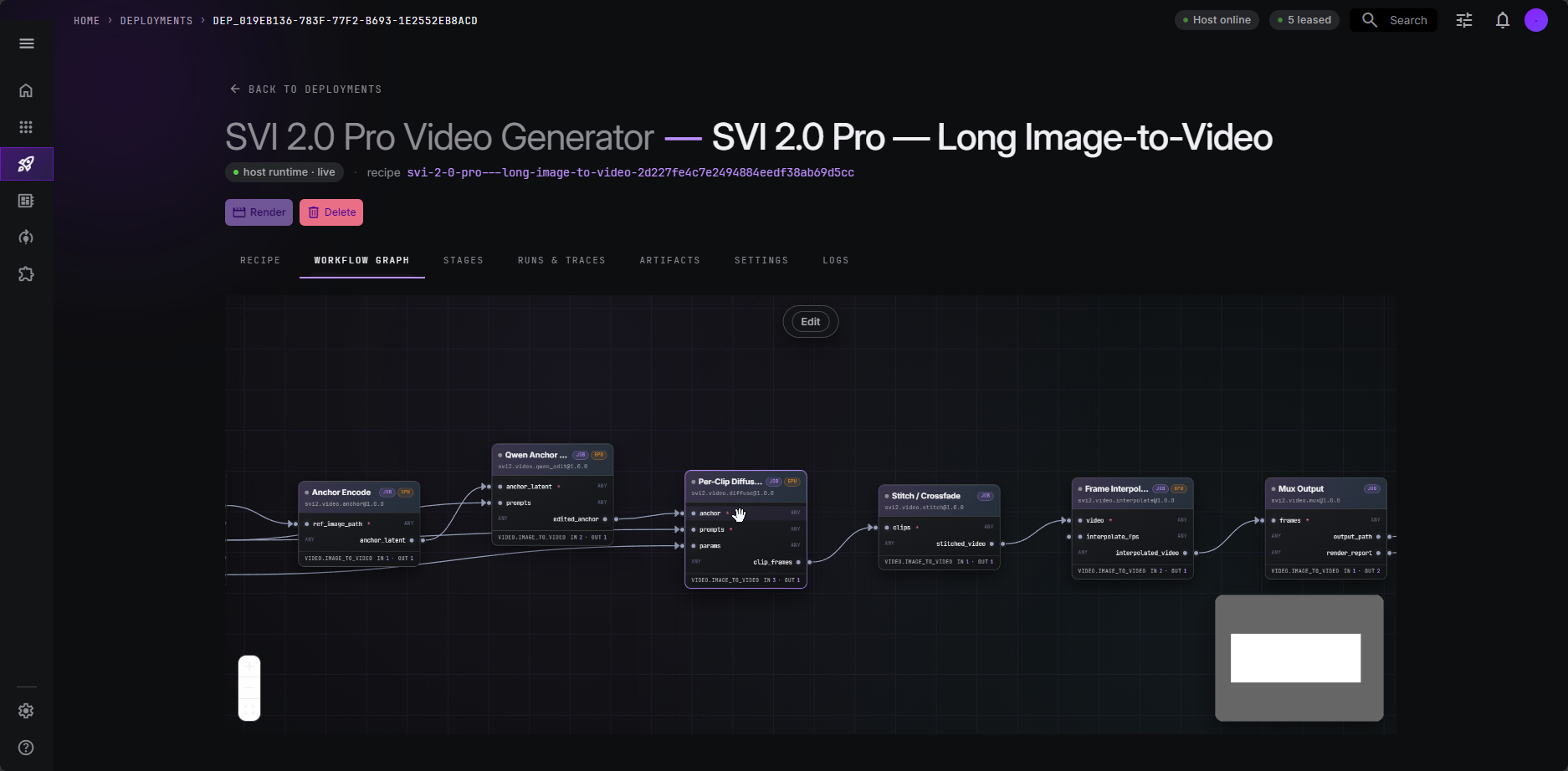
- SVI2-Pro — Stable Video Infinity 2.0 Pro (two SVI LoRAs over the Wan2.2-I2V-A14B dual-expert MoE). Does both Image→Video and Text→Video, with infinite, cross-clip-consistent length: clips are chained with rolling cross-fade + reference anchoring so the subject stays coherent across arbitrarily many segments. The fp8 e4m3fn base fits in 16 GB of VRAM — or less.
- LTX-2.3 — fast image-to-video with host-managed runtime profiles. RTX 40 FP8, RTX 50 Blackwell FP8 (production) + RTX 50 NVFP4 (experimental). 16 GB-safe by default via external-segment rendering.
- LongCat — 13.6B DiT (UMT5-XXL text encoder, Wan 2.1 VAE) for text→video, image→video, and long-video continuations. FP8 e4m3fn path for 12–16 GB; BF16 path for 24 GB+.
Post-processing stack — applies on top of any engine
- 🌀 RIFE frame interpolation (frame-gen) — torch-RIFE (vendored IFNet HDv3) synthesizes in-between frames to multiply FPS (e.g. 16 → 48 fps) for fluid motion, with no extra diffusion cost.
- 🔍 RTX ×2 / ×4 upscaling — NVIDIA Maxine RTX super-resolution on RTX GPUs upscales the output in a hardware-accelerated pass (e.g. 1216×768 → 2432×1536).
- ⚙️ Attention backends (SDPA / FlashAttention-2/3 / SageAttention) are auto-selected per GPU architecture + dtype.
16 GB-friendly by design — staged CPU offload, fp8 compute, and external-segment rendering keep peak VRAM under consumer-card budgets.
🧠 LLM Inference
nexus.local-llm
Local large-language-model inference and chat, served through host-managed backend runtimes.
- ⚡ Latest llama.cpp backend with speculative decoding via MTP (Multi-Token Prediction) — a draft head proposes several tokens per step and the main model verifies them in one pass, for materially higher tokens/sec at identical output quality.
- 📦 GGUF models with quantization-aware install and an on-disk model store.
- 🛡️ Host-managed runtime leases — the host owns process lifecycle, VRAM budgeting, and idle reaping; the extension simply acquires a lease.
- 💬 Interactive chat threads with per-thread generation settings, model picker, and RAG workflows.
- 🎚️ Throughput knobs: KV-cache reuse, MoE offload, min-p / DRY sampling, context cram.
🎤 Voice Generation (EmotionTTS)
nexus.audio.emotiontts
State-of-the-art emotional text-to-speech via IndexTTS-2, running in a host-managed Python subprocess.
- 🎚️ 8-axis emotion vectors — dial the emotional tone (joy, anger, sadness, surprise, …) per line. Optional Qwen text-emotion inference reads the intended emotion straight from the text, and audio-reference transfer copies the feeling from a sample clip.
- 🎬 Storyboard — author a multi-line script/dialogue, assign a voice and an emotion vector to every line, and batch-synthesize the whole scene in a single run. The lines render as one coherent, ordered sequence with independent per-line control — think a screenplay that compiles to audio, with each character speaking in their own voice and mood.
- 🎙️ Custom voice upload — drop in your own reference audio to mint a custom voice ("voice asset"). Automatic reference-audio preprocessing, alignment-score observability, and speaker-prefix caching keep quality high and re-synthesis fast.
- 🗂️ Deployment-scoped character→voice mappings, a global content-hash synthesis cache (10 GB LRU), and partial-ZIP install with auto-resume.
🧊 Image-to-3D
nexus.3d.trellis2· operatortrellis2.generate_3d
Turn a single image into a watertight 3D mesh with Microsoft TRELLIS.2 (a 4B flow-matching model over an O-Voxel sparse structure), then orbit and download the result as a GLB — all on a local GPU.
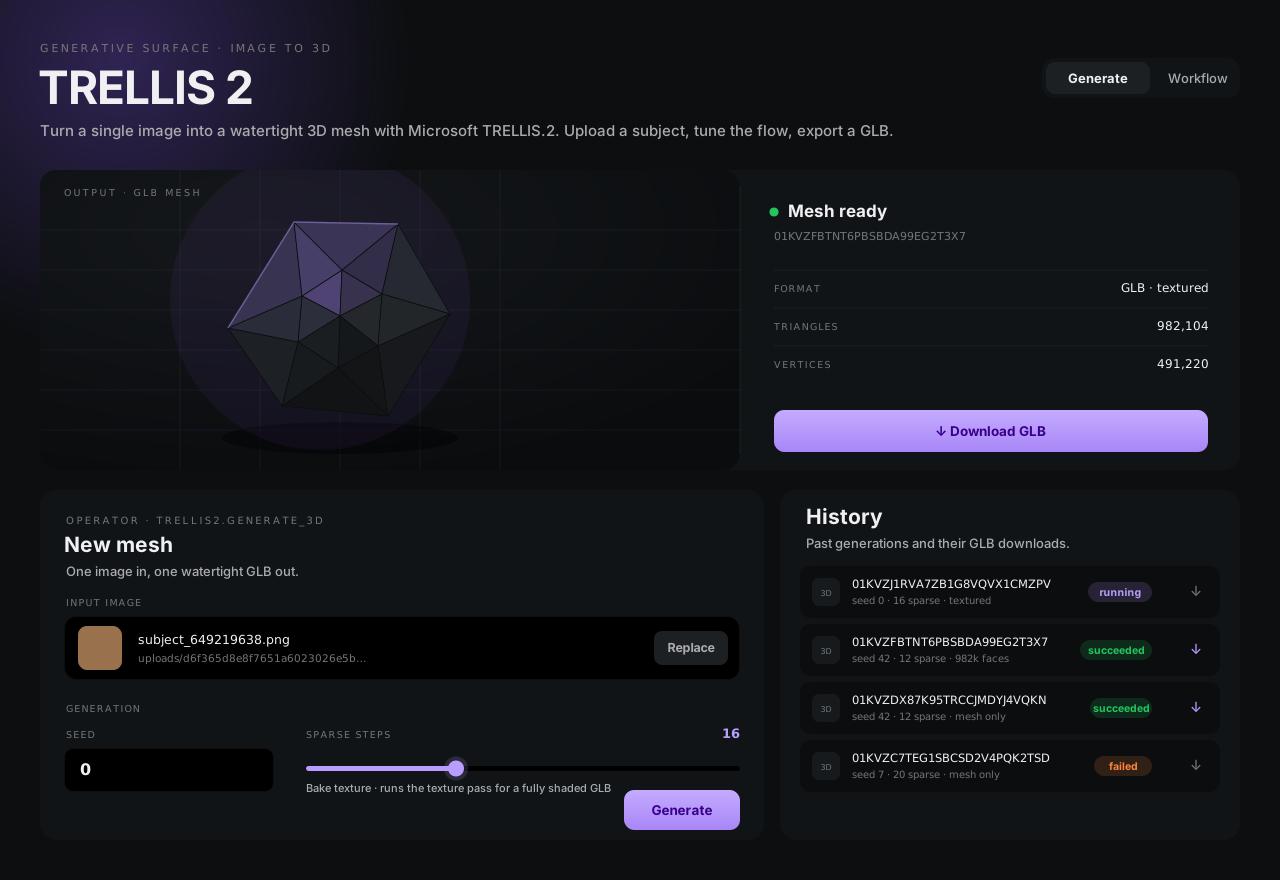
- 🧊 Single image → watertight GLB — upload a subject on a clean background; the pipeline runs image → sparse structure → shape → mesh decode → GLB export and returns a downloadable artifact.
- 🎚️ Tunable flow — sparse-structure and shape flow steps, deterministic seed, and a triangle-budget decimation target for light, game-ready meshes.
- 🎨 Mesh-only or textured — skip the texture pass for a fast
MeshOnlyGLB, or bake a full PBR texture for a shaded result. - 🧭 In-browser 3D preview — every result renders in an interactive
<model-viewer>(orbit, auto-rotate, neutral/ACES tone-mapping, exposure) with a live FORMAT / TRIANGLES / VERTICES readout and one-click GLB download. - 🛡️ Host-managed — install, runtime lease, storage, and
/mediaartifact serving all flow through the same host foundation as the video and LLM stacks.
Validated end-to-end on the DGX Spark (GB10, aarch64 Blackwell sm_121) with vendored native
kernels. See extensions/builtin/trellis2/README.md, or
open the standalone showcase: docs/showcase/trellis2-image-to-3d.html.
🧑 Photo-to-Identity-Head
nexus.3d.faceavatar· operatorsfaceavatar.generate_head·faceavatar.graft_head
Turn a single photo of a real person into an identity-faithful 3D head with Arc2Avatar — a FLAME-topology Gaussian avatar optimized toward the person's ArcFace recognition embedding — exported as a GLB for the same in-browser 3D viewer.
- 🧑 Photo → identity head — insightface ArcFace embedding → Arc2Face SDS optimization → Gaussian splat → FLAME-template mesh + color bake → GLB.
- 🧬 Head refinement (graft) — feed a TRELLIS body/character GLB as an opaque base mesh and refine its head with the person's identity: the body and hair come from TRELLIS, the face carries the likeness. Two deploy-time recipes — standalone head, or head-refine.
- 🎚️ Identity-fit iterations knob (quality vs latency) — the fit is optimization-based (minutes per photo).
- 🛡️ Host-managed — install, runtime lease, storage, and
/mediaserving through the same foundation as the 3D, video, and LLM stacks; results render in the in-app<model-viewer>.
Non-commercial + honest ceiling: Arc2Avatar builds on FLAME (Max Planck), which is research/non-commercial only. Single-photo output is a recognizable frontal-to-three-quarter head on a FLAME-shaped base — not scan-grade 360° (unseen sides/hair are approximated). Validated end-to-end on the DGX Spark (GB10, aarch64 Blackwell
sm_121).
🎨 Image Generation
🟠 Coming soon
Text-to-image generation via Stable Diffusion and FLUX, packaged as host-managed extensions on the same runtime-lease + model-store foundation as the video and LLM stacks — so installs, VRAM budgeting, and UI mounting work exactly the same way.

🧭 System At A Glance
flowchart LR
    UI["🖥️ Web UI / Tauri / TUI"] --> HOST["🛡️ nexus-dnn host"]
    HOST --> API["HTTP + SSE + WS"]
    HOST --> REG["Extension registry"]
    HOST --> DEPS["Dependency installer"]
    HOST --> STORE["SQLite + artifact store"]
    HOST --> RUNTIMES["Backend runtime leases"]
    REG --> EXT["Built-in + external extensions"]
    EXT --> WORKERS["Native / Python workers"]
    WORKERS --> RUNTIMES
    WORKERS --> STORE
Host authority is the core design rule
| Area | Authority |
|---|---|
| HTTP listener, health, API envelopes | Host |
| Extension discovery, validation, enable/disable | Host |
| Dependency install plans | Host |
| Runtime processes and leases | Host |
| Workflow storage, runs, artifacts | Host |
| Extension-specific logic and UX | Extension, but only through host-owned surfaces |
🖼️ UI Screenshots
|
Image-to-3D — TRELLIS 2 generative surface
| |
|
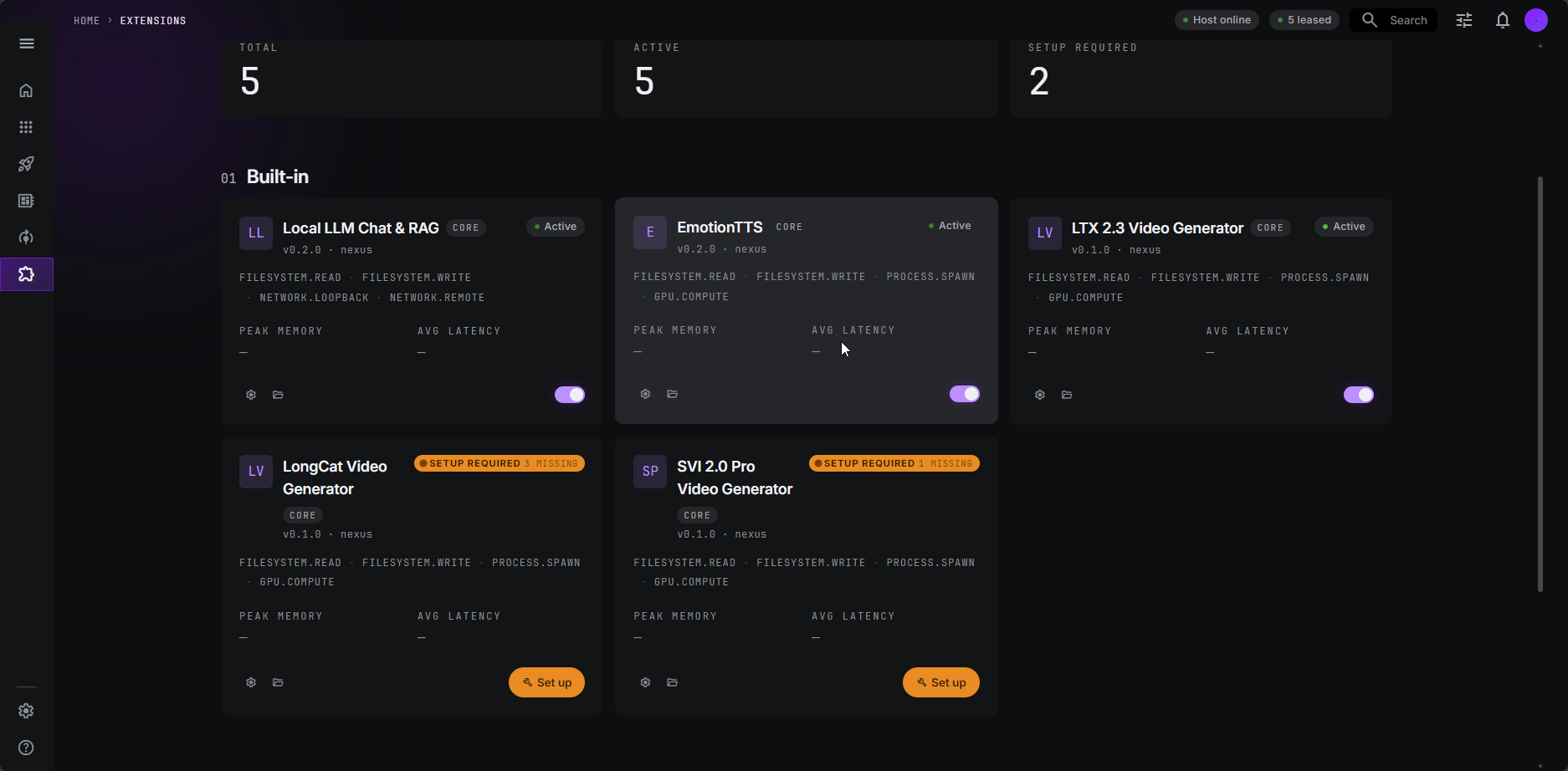
Extensions gallery
|
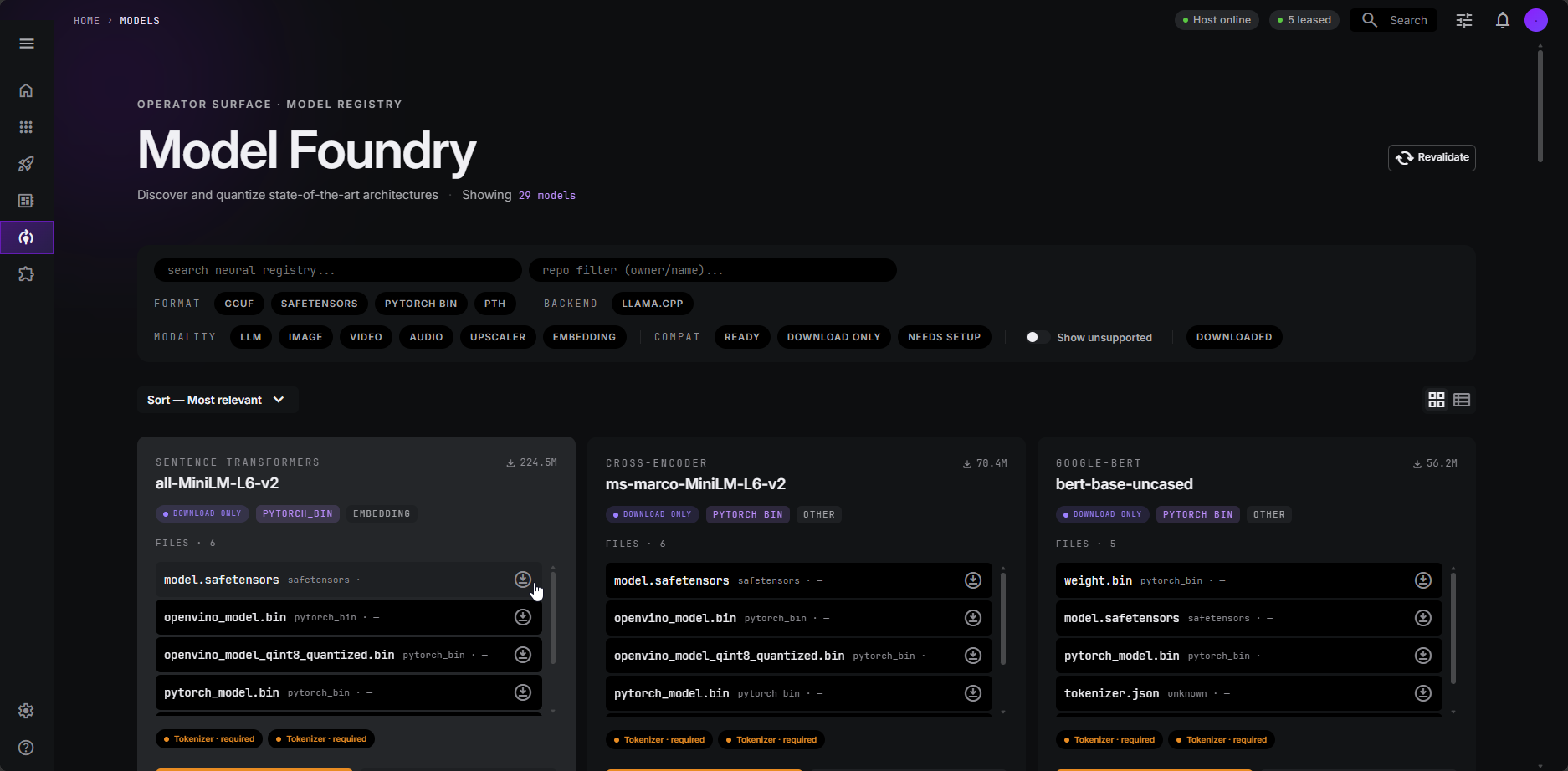
Models browser
|
|
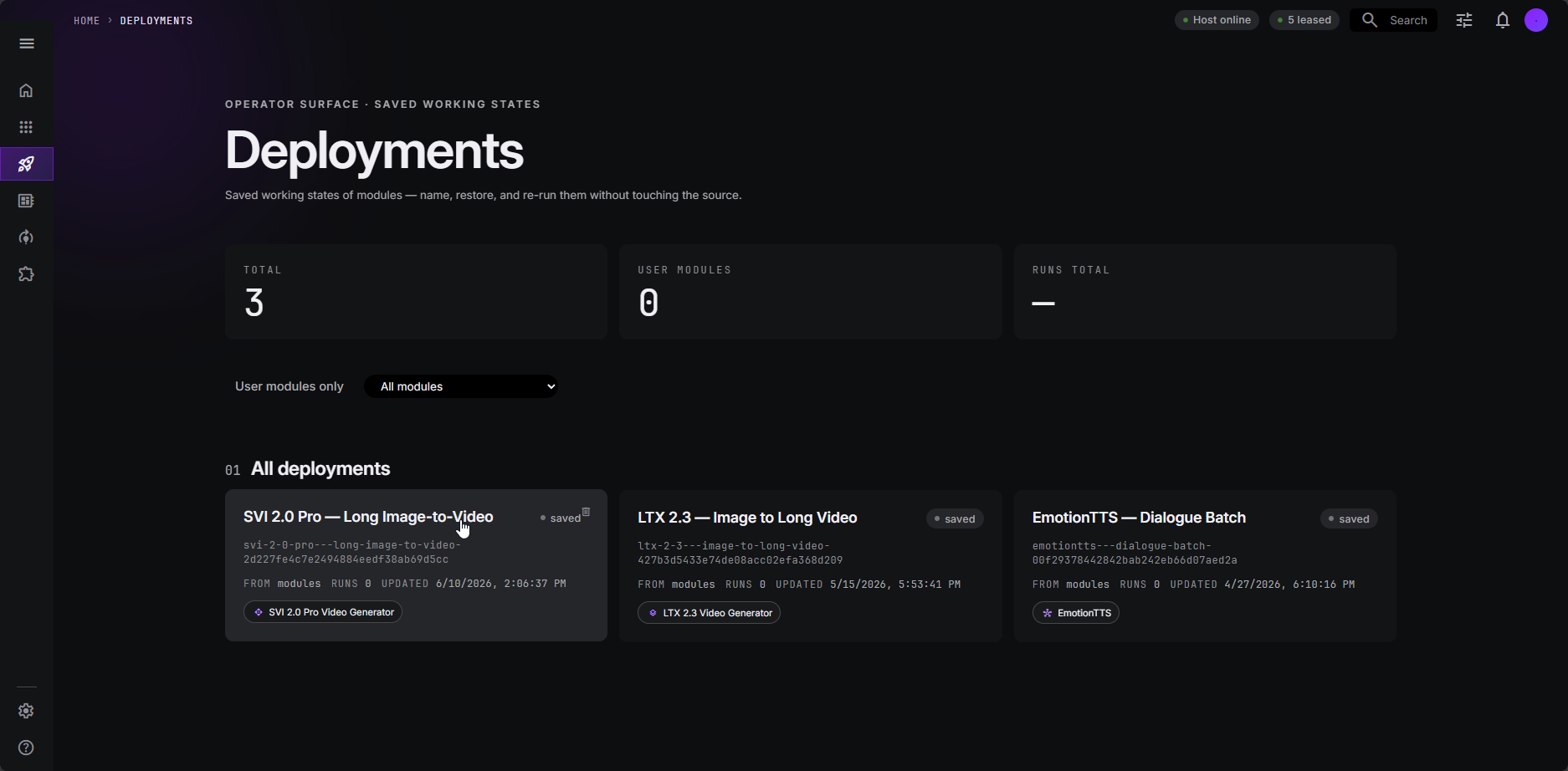
Deployments
|
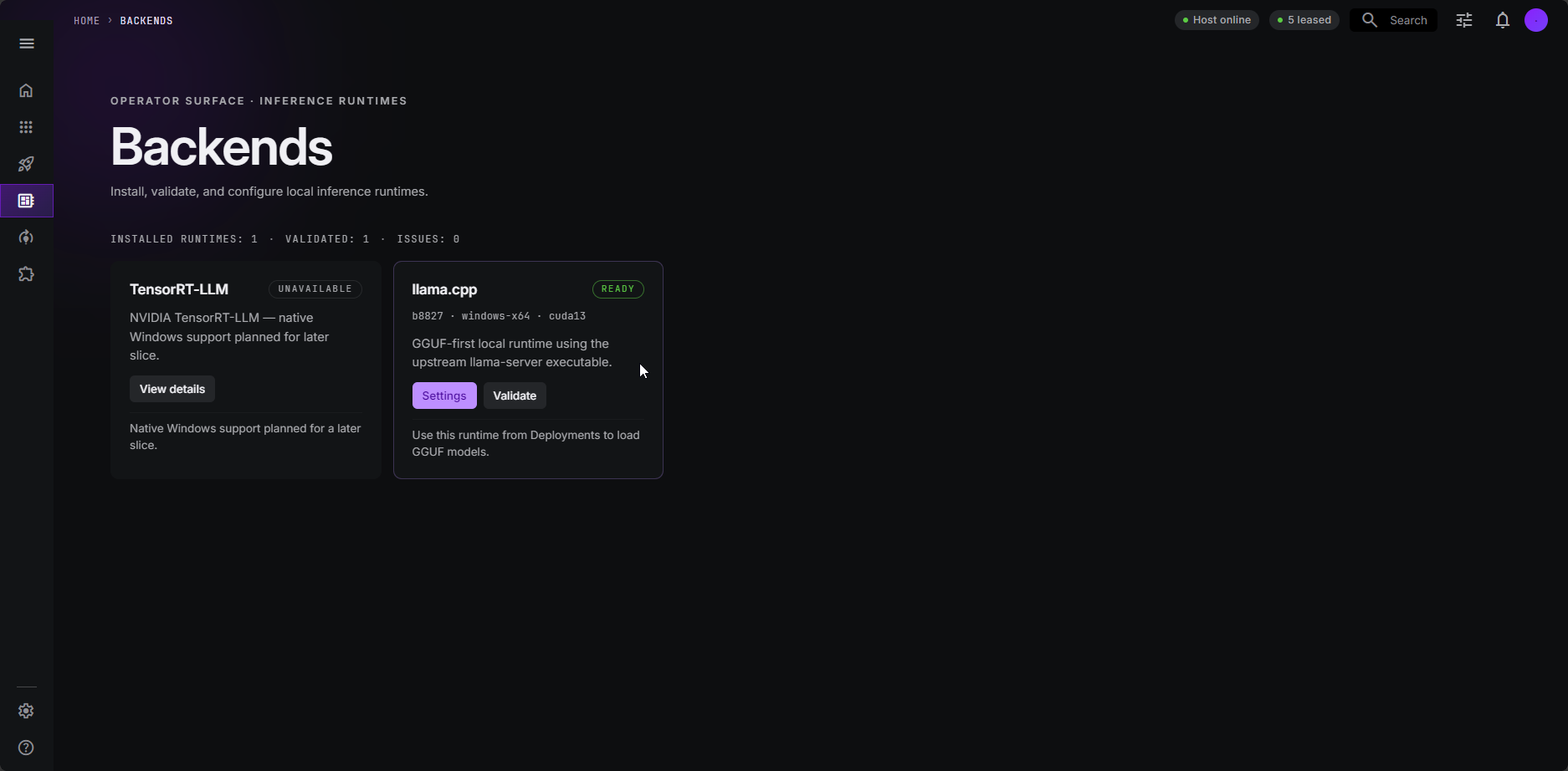
Backend runtimes
|
|
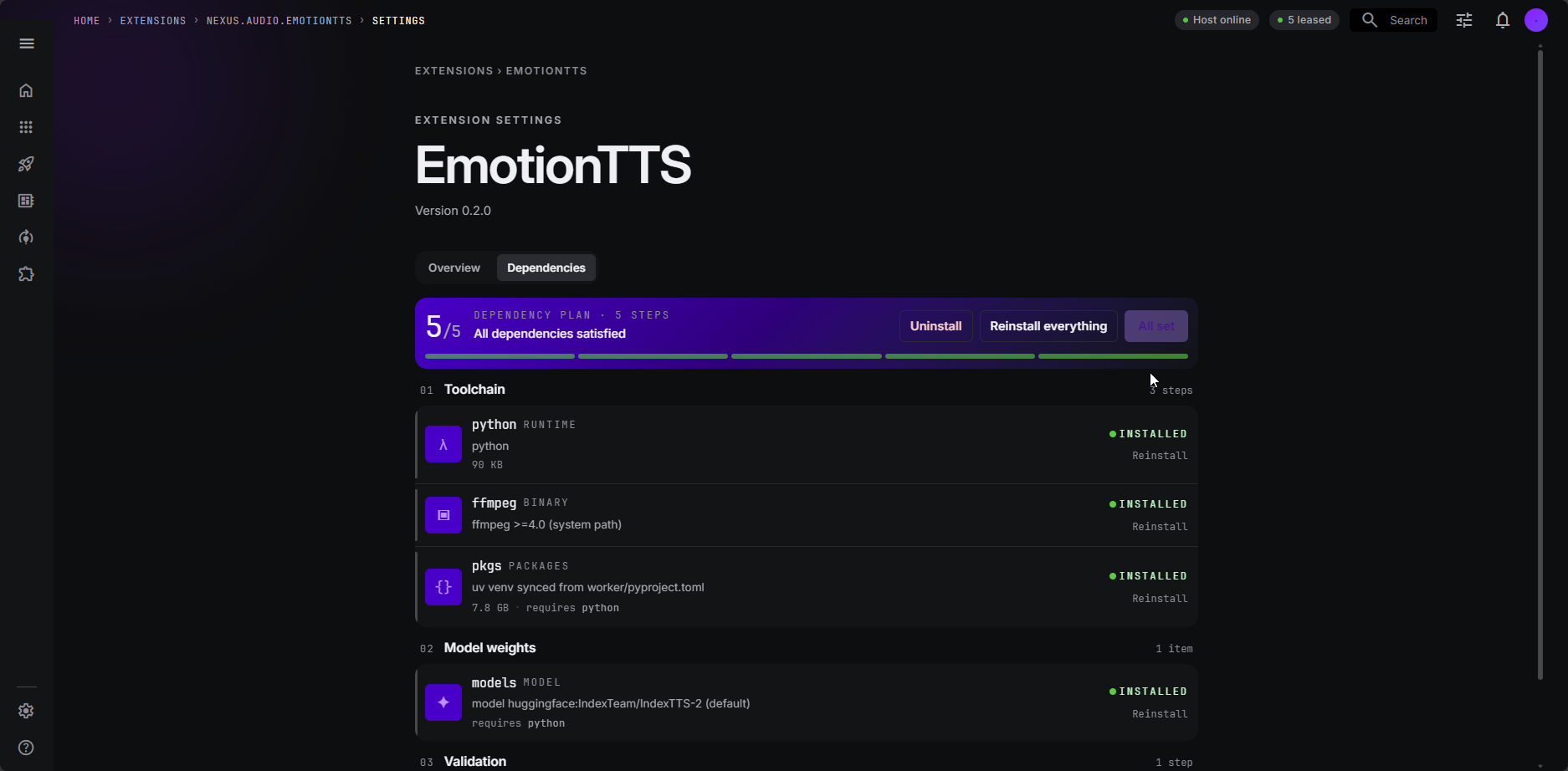
Dependency installer
|
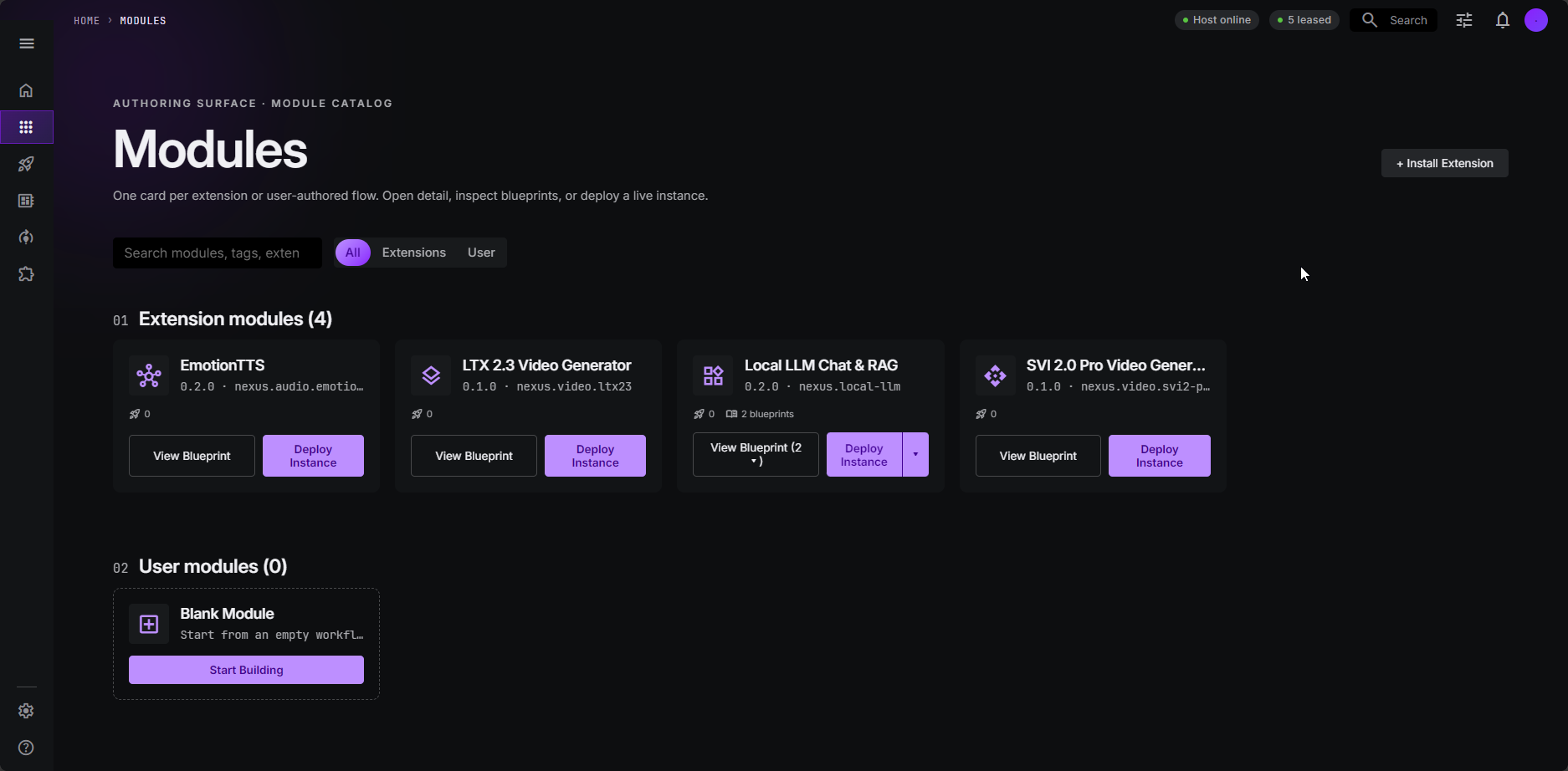
Modules
|
|
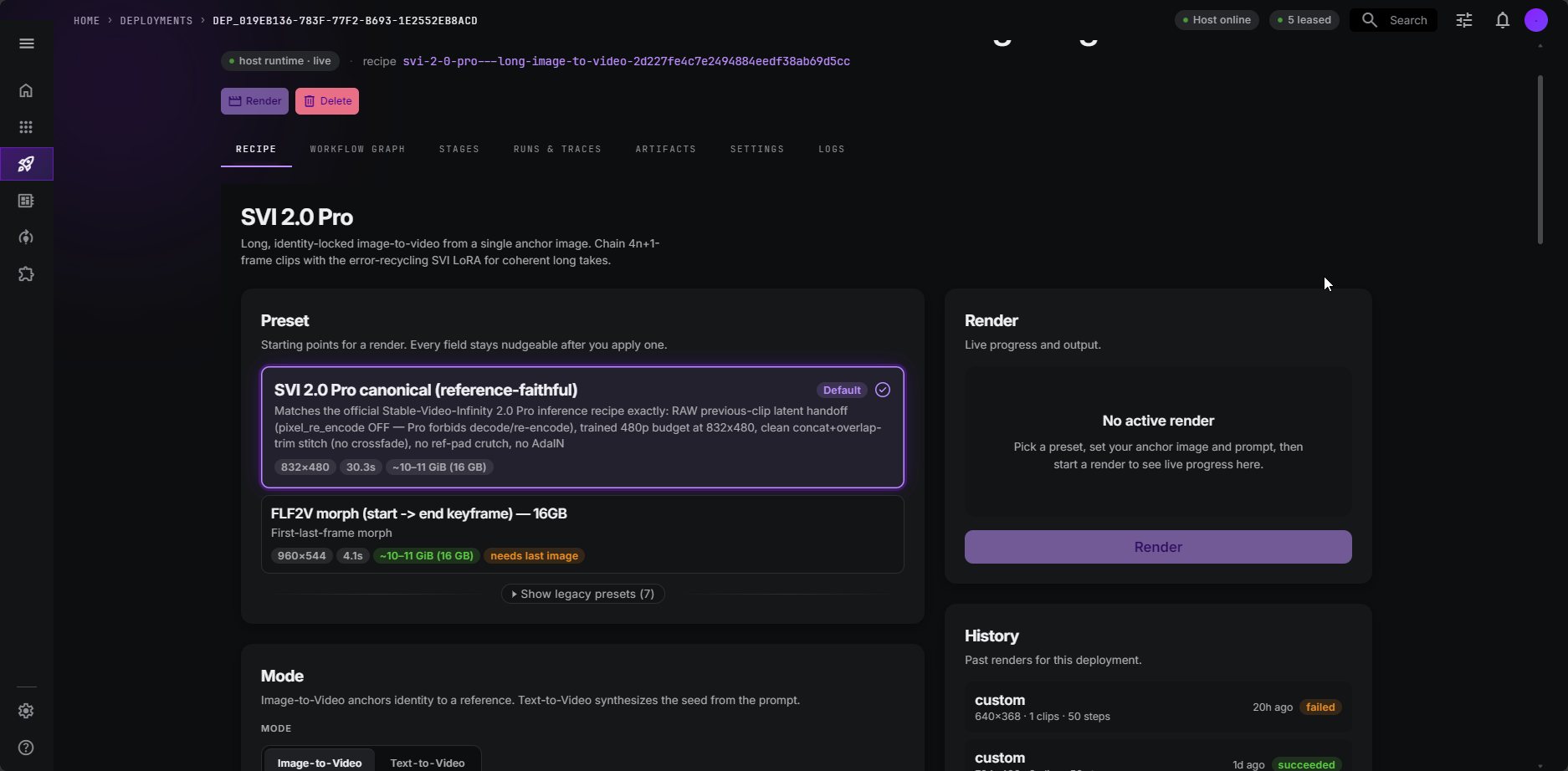
SVI2 recipe
|
SVI2 recipe graph
|
🔌 Built-in Extensions
| Extension | Status | What it adds |
|---|---|---|
nexus.local-llm | 🟢 active product surface | Local chat, RAG, backend-runtime integration, model/browser layouts |
nexus.audio.emotiontts | 🟢 active product surface | Emotional dialogue TTS, voice assets, batch runs, audio editing |
nexus.video.ltx23 | 🟢 active product surface | LTX 2.3 image-to-video with host-managed runtime profiles |
nexus.video.longcat | 🟡 active extension, still evolving | LongCat-based long-video generation paths |
nexus.video.svi2-pro | 🟡 advanced / high-requirement path | SVI 2.0 Pro image-to-video for Blackwell-focused setups |
nexus.3d.trellis2 | 🟢 active product surface | Image→3D mesh generation (Microsoft TRELLIS.2), GLB export, in-app 3D viewer |
nexus.3d.faceavatar | 🟡 experimental | Single photo → identity 3D head (Arc2Avatar), head-graft onto a TRELLIS base, GLB export |
Several of these extensions ship more than operators:
- Dependency graphs
- Backend runtime manifests
- Storage migrations
- YAML layouts
- Static web assets and custom elements
- Extension routers mounted under
/api/v1/extensions/{ext_id}/...
🔄 How The Host And Extensions Communicate
sequenceDiagram
    participant User as User Surface
    participant Host as Host App
    participant Ext as Extension Registry/Router
    participant Worker as Native or Python Worker
    participant Runtime as Backend Runtime Lease
    participant Store as Storage + Artifacts

    User->>Host: UI action / API request
    Host->>Ext: Resolve extension metadata or route
    Ext->>Host: Manifest, layouts, storage, router, runtime declarations
    Host->>Worker: JSON-RPC / typed host service calls
    Worker->>Runtime: Acquire or use host-managed lease
    Worker->>Store: Read/write artifacts through host-owned paths
    Worker-->>Host: Results, progress, errors
    Host-->>User: REST/SSE/WS updates + rendered UI
The important boundary is that extensions do not become mini-hosts. They can contribute routes, UIs, and workers, but the host still owns mounting, serving, validation, and lifecycle.
🧪 Tested Machine Snapshot
The strongest recent validation evidence in the repo is centered on a Windows workstation rather than a broad cross-platform certification matrix.
| Area | Evidence in repo |
|---|---|
| OS | Windows |
| GPU | NVIDIA GeForce RTX 5070 Ti |
| VRAM | ~15.9 GiB |
| Driver family | 570.65+ |
| Python evidence | 3.12.11 |
| Torch evidence | 2.12.0 + CUDA 13.2 |
Architectures: the host targets amd64 Windows, amd64 Linux, and aarch64 Linux (e.g. DGX Spark / GB10). The host, embedded Python, ffmpeg, and the LLM install pipeline are arch-aware across all three; on aarch64, managed llama.cpp is CPU-only (GPU via external llama-server) and GPU video paths are experimental. See the Architecture Support matrix.
For the detailed support notes and caveats, read docs/platform-support.md and docs/requirements.md.
📚 Documentation Map
Start here:
- docs/getting-started.md — install, run, verify, and choose the right local launch mode
- docs/platform-support.md — what is validated today, what is experimental, and hardware expectations
- docs/architecture.md — host authority, crate map, runtime model, and data flow
- docs/extension-internals.md — how extensions are discovered, mounted, and constrained
- docs/configuration.md — CLI flags, env vars, config file, and data directories
Reference and deeper dives:
- docs/api-reference.md
- docs/extension-guide.md
- docs/data-model.md
- docs/database-schema.md
- docs/README.md
🛣️ Future Roadmap
The next platform-level milestones should reinforce host authority instead of weakening it.
- MCP control The host should expose and govern tool/runtime control surfaces in a first-class way, instead of scattering capability across ad-hoc extension UX.
- Remote workers Worker execution should be able to move off-box while still preserving host-owned leases, auditability, and policy checks.
- Extensions SDK Extension authoring should become a clearer supported product surface, with stable contracts, better scaffolding, and thinner accidental complexity.
See docs/roadmap.md for the expanded roadmap.
🧱 Repo Shape
apps/web/                  React web frontend + desktop shell frontend
crates/                    Rust workspace crates
extensions/builtin/        First-party extensions
docs/                      User and architecture documentation
specs/                     Detailed feature specs and verification artifacts
graphify-out/              Generated codebase graph and reports
🔍 Verification Commands
cargo test
cargo clippy
cd apps/web && pnpm test
📄 License
GPL-3.0. See LICENSE.


Similar repos


Languages
Rust
46.2%
TypeScript
28.9%
Python
22.9%
Local-first AI orchestration with a host-authoritative Rust runtime, extension-driven capabilities, and first-party support for local LLM, audio, and video workflows. The hub where everything connects and extends.
Rust
1
1,478 commits
updated Sep 1, 2026
README
nexus-dnn
Local-first AI orchestration with a host-authoritative Rust runtime, extension-driven capabilities, and first-party support for local LLM, audio, and video workflows.
📋 Table of Contents
- 🚀 Run It Locally First
- 🧩 Supported Capabilities
- 🎬 Video Generation — SVI2-Pro · LongCat · LTX-2.3, RIFE frame-gen, RTX ×2/×4 upscale
- 🧠 LLM Inference — llama.cpp + speculative decoding (MTP)
- 🎤 Voice Generation (EmotionTTS) — IndexTTS-2 emotion vectors + storyboard
- 🧊 Image-to-3D — Microsoft TRELLIS.2, single image → watertight GLB mesh
- 🧑 Photo-to-Identity-Head — Arc2Avatar, single photo → identity 3D head, graft onto a TRELLIS body
- 🎨 Image Generation — Stable Diffusion · FLUX (coming soon)
- ✨ What nexus-dnn Is For
- 🧭 System At A Glance
- 🖼️ UI Screenshots
- 🔌 Built-in Extensions
- 📚 Documentation Map
- 🛣️ Future Roadmap
- 📄 License
🚀 Run It Locally First
1. Install prerequisites
| What | Minimum |
|---|---|
| Rust | stable |
| Node.js | 20+ |
| pnpm | 8+ |
uv | latest recommended |
uv matters because several built-in extensions use host-managed Python environments.
GPU / production install? See docs/deployment/container-and-cuda-dependencies.md → "Installation by platform". On linux-aarch64 (DGX Spark) run the container (
just dgx-deploy); on Windows use the native build scriptdockerfiles/win64.build.ps1(no Windows container — CUDA is Linux-container-only).
2. Clone and start
git clone <your-fork-or-origin-url> nexus-dnn
cd nexus-dnn

# Host only: browser UI served from the embedded frontend bundle
cargo host

# or

cargo run -p nexus-core --bin nexus-dnn
Open http://127.0.0.1:3000.
3. Verify the host is healthy
curl http://127.0.0.1:3000/api/v1/health
Expected shape:
{
  "data": {
    "status": "ok",
    "details": {
      "...": "additional live health fields may appear here"
    }
  },
  "meta": {
    "timestamp": "2026-06-12T00:00:00Z"
  },
  "error": null
}
nexus-dnncurrently listens on0.0.0.0:$NEXUS_PORT, but local usage should still prefer127.0.0.1.
4. Useful local launch modes
| Goal | Command |
|---|---|
| Host only | cargo host |
| Host + TUI | cargo dev |
| TUI drives host | cargo dev-tui |
| Desktop shell | cd apps/web && pnpm install && pnpm tauri dev |
| Rebuild embedded web app | cd apps/web && pnpm install && pnpm build |
The host serves the already-built web bundle from apps/web/dist, so frontend install/build is mainly for frontend or desktop-shell development.
✨ What nexus-dnn Is For
nexus-dnn is a local-first platform for running AI features as structured host-managed systems instead of ad-hoc scripts. The host owns process lifecycle, storage, installs, API routing, workflows, model/runtime leasing, and extension boundaries. Extensions add domain capability without taking control away from the host.
Today that means the repo can host:
- Local chat and RAG workflows
- Host-managed backend runtime leasing
- Emotional TTS pipelines
- Image-to-video and long-video generation flows
- Image-to-3D mesh generation (single image → watertight GLB)
- Single-photo identity 3D heads (Arc2Avatar), optionally grafted onto a generated body
- Extension-owned UI surfaces mounted inside the host app
🧩 Supported Capabilities
Everything below runs locally, on a single consumer GPU, behind the same host-managed runtime-lease + model-store foundation.
| Capability | Engines | Highlights | Status |
|---|---|---|---|
| 🎬 Video Generation | SVI2-Pro · LongCat · LTX-2.3 | Text→Video, Image→Video, infinite length, RIFE frame-gen, RTX ×2/×4 upscale | 🟢 Stable |
| 🧠 LLM Inference | llama.cpp | Speculative decoding via MTP, GGUF, host-managed runtime leases | 🟢 Stable |
| 🎤 Voice Generation | IndexTTS-2 (EmotionTTS) | 8-axis emotion vectors, storyboard, custom-voice upload | 🟢 Stable |
| 🧊 Image-to-3D | Microsoft TRELLIS.2 | Single image → watertight GLB, mesh-only or textured, triangle-budget decimation, in-browser 3D preview | 🟢 Stable |
| 🧑 Photo-to-Identity-Head | Arc2Avatar (FLAME + ArcFace) | Single photo → identity-faithful 3D head, graft onto a TRELLIS base mesh, GLB | 🟡 Experimental |
| 🎨 Image Generation | Stable Diffusion · FLUX | Text→Image | 🟠 Coming soon |
🎬 Video Generation
nexus.video.svi2-pro·nexus.video.longcat·nexus.video.ltx23
Generate video from a text prompt or a still image — then push it past what a single diffusion pass yields: higher frame-rate and higher resolution, all on a local GPU.
Engines
- SVI2-Pro — Stable Video Infinity 2.0 Pro (two SVI LoRAs over the Wan2.2-I2V-A14B dual-expert MoE). Does both Image→Video and Text→Video, with infinite, cross-clip-consistent length: clips are chained with rolling cross-fade + reference anchoring so the subject stays coherent across arbitrarily many segments. The fp8 e4m3fn base fits in 16 GB of VRAM — or less.
- LTX-2.3 — fast image-to-video with host-managed runtime profiles. RTX 40 FP8, RTX 50 Blackwell FP8 (production) + RTX 50 NVFP4 (experimental). 16 GB-safe by default via external-segment rendering.
- LongCat — 13.6B DiT (UMT5-XXL text encoder, Wan 2.1 VAE) for text→video, image→video, and long-video continuations. FP8 e4m3fn path for 12–16 GB; BF16 path for 24 GB+.
Post-processing stack — applies on top of any engine
- 🌀 RIFE frame interpolation (frame-gen) — torch-RIFE (vendored IFNet HDv3) synthesizes in-between frames to multiply FPS (e.g. 16 → 48 fps) for fluid motion, with no extra diffusion cost.
- 🔍 RTX ×2 / ×4 upscaling — NVIDIA Maxine RTX super-resolution on RTX GPUs upscales the output in a hardware-accelerated pass (e.g. 1216×768 → 2432×1536).
- ⚙️ Attention backends (SDPA / FlashAttention-2/3 / SageAttention) are auto-selected per GPU architecture + dtype.
16 GB-friendly by design — staged CPU offload, fp8 compute, and external-segment rendering keep peak VRAM under consumer-card budgets.
🧠 LLM Inference
nexus.local-llm
Local large-language-model inference and chat, served through host-managed backend runtimes.
- ⚡ Latest llama.cpp backend with speculative decoding via MTP (Multi-Token Prediction) — a draft head proposes several tokens per step and the main model verifies them in one pass, for materially higher tokens/sec at identical output quality.
- 📦 GGUF models with quantization-aware install and an on-disk model store.
- 🛡️ Host-managed runtime leases — the host owns process lifecycle, VRAM budgeting, and idle reaping; the extension simply acquires a lease.
- 💬 Interactive chat threads with per-thread generation settings, model picker, and RAG workflows.
- 🎚️ Throughput knobs: KV-cache reuse, MoE offload, min-p / DRY sampling, context cram.
🎤 Voice Generation (EmotionTTS)
nexus.audio.emotiontts
State-of-the-art emotional text-to-speech via IndexTTS-2, running in a host-managed Python subprocess.
- 🎚️ 8-axis emotion vectors — dial the emotional tone (joy, anger, sadness, surprise, …) per line. Optional Qwen text-emotion inference reads the intended emotion straight from the text, and audio-reference transfer copies the feeling from a sample clip.
- 🎬 Storyboard — author a multi-line script/dialogue, assign a voice and an emotion vector to every line, and batch-synthesize the whole scene in a single run. The lines render as one coherent, ordered sequence with independent per-line control — think a screenplay that compiles to audio, with each character speaking in their own voice and mood.
- 🎙️ Custom voice upload — drop in your own reference audio to mint a custom voice ("voice asset"). Automatic reference-audio preprocessing, alignment-score observability, and speaker-prefix caching keep quality high and re-synthesis fast.
- 🗂️ Deployment-scoped character→voice mappings, a global content-hash synthesis cache (10 GB LRU), and partial-ZIP install with auto-resume.
🧊 Image-to-3D
nexus.3d.trellis2· operatortrellis2.generate_3d
Turn a single image into a watertight 3D mesh with Microsoft TRELLIS.2 (a 4B flow-matching model over an O-Voxel sparse structure), then orbit and download the result as a GLB — all on a local GPU.
- 🧊 Single image → watertight GLB — upload a subject on a clean background; the pipeline runs image → sparse structure → shape → mesh decode → GLB export and returns a downloadable artifact.
- 🎚️ Tunable flow — sparse-structure and shape flow steps, deterministic seed, and a triangle-budget decimation target for light, game-ready meshes.
- 🎨 Mesh-only or textured — skip the texture pass for a fast
MeshOnlyGLB, or bake a full PBR texture for a shaded result. - 🧭 In-browser 3D preview — every result renders in an interactive
<model-viewer>(orbit, auto-rotate, neutral/ACES tone-mapping, exposure) with a live FORMAT / TRIANGLES / VERTICES readout and one-click GLB download. - 🛡️ Host-managed — install, runtime lease, storage, and
/mediaartifact serving all flow through the same host foundation as the video and LLM stacks.
Validated end-to-end on the DGX Spark (GB10, aarch64 Blackwell sm_121) with vendored native
kernels. See extensions/builtin/trellis2/README.md, or
open the standalone showcase: docs/showcase/trellis2-image-to-3d.html.
🧑 Photo-to-Identity-Head
nexus.3d.faceavatar· operatorsfaceavatar.generate_head·faceavatar.graft_head
Turn a single photo of a real person into an identity-faithful 3D head with Arc2Avatar — a FLAME-topology Gaussian avatar optimized toward the person's ArcFace recognition embedding — exported as a GLB for the same in-browser 3D viewer.
- 🧑 Photo → identity head — insightface ArcFace embedding → Arc2Face SDS optimization → Gaussian splat → FLAME-template mesh + color bake → GLB.
- 🧬 Head refinement (graft) — feed a TRELLIS body/character GLB as an opaque base mesh and refine its head with the person's identity: the body and hair come from TRELLIS, the face carries the likeness. Two deploy-time recipes — standalone head, or head-refine.
- 🎚️ Identity-fit iterations knob (quality vs latency) — the fit is optimization-based (minutes per photo).
- 🛡️ Host-managed — install, runtime lease, storage, and
/mediaserving through the same foundation as the 3D, video, and LLM stacks; results render in the in-app<model-viewer>.
Non-commercial + honest ceiling: Arc2Avatar builds on FLAME (Max Planck), which is research/non-commercial only. Single-photo output is a recognizable frontal-to-three-quarter head on a FLAME-shaped base — not scan-grade 360° (unseen sides/hair are approximated). Validated end-to-end on the DGX Spark (GB10, aarch64 Blackwell
sm_121).
🎨 Image Generation
🟠 Coming soon
Text-to-image generation via Stable Diffusion and FLUX, packaged as host-managed extensions on the same runtime-lease + model-store foundation as the video and LLM stacks — so installs, VRAM budgeting, and UI mounting work exactly the same way.
🧭 System At A Glance
flowchart LR
    UI["🖥️ Web UI / Tauri / TUI"] --> HOST["🛡️ nexus-dnn host"]
    HOST --> API["HTTP + SSE + WS"]
    HOST --> REG["Extension registry"]
    HOST --> DEPS["Dependency installer"]
    HOST --> STORE["SQLite + artifact store"]
    HOST --> RUNTIMES["Backend runtime leases"]
    REG --> EXT["Built-in + external extensions"]
    EXT --> WORKERS["Native / Python workers"]
    WORKERS --> RUNTIMES
    WORKERS --> STORE
Host authority is the core design rule
| Area | Authority |
|---|---|
| HTTP listener, health, API envelopes | Host |
| Extension discovery, validation, enable/disable | Host |
| Dependency install plans | Host |
| Runtime processes and leases | Host |
| Workflow storage, runs, artifacts | Host |
| Extension-specific logic and UX | Extension, but only through host-owned surfaces |
🖼️ UI Screenshots
|
Image-to-3D — TRELLIS 2 generative surface
| |
|
Extensions gallery
|
Models browser
|
|
Deployments
|
Backend runtimes
|
|
Dependency installer
|
Modules
|
|
SVI2 recipe
|
SVI2 recipe graph
|
🔌 Built-in Extensions
| Extension | Status | What it adds |
|---|---|---|
nexus.local-llm | 🟢 active product surface | Local chat, RAG, backend-runtime integration, model/browser layouts |
nexus.audio.emotiontts | 🟢 active product surface | Emotional dialogue TTS, voice assets, batch runs, audio editing |
nexus.video.ltx23 | 🟢 active product surface | LTX 2.3 image-to-video with host-managed runtime profiles |
nexus.video.longcat | 🟡 active extension, still evolving | LongCat-based long-video generation paths |
nexus.video.svi2-pro | 🟡 advanced / high-requirement path | SVI 2.0 Pro image-to-video for Blackwell-focused setups |
nexus.3d.trellis2 | 🟢 active product surface | Image→3D mesh generation (Microsoft TRELLIS.2), GLB export, in-app 3D viewer |
nexus.3d.faceavatar | 🟡 experimental | Single photo → identity 3D head (Arc2Avatar), head-graft onto a TRELLIS base, GLB export |
Several of these extensions ship more than operators:
- Dependency graphs
- Backend runtime manifests
- Storage migrations
- YAML layouts
- Static web assets and custom elements
- Extension routers mounted under
/api/v1/extensions/{ext_id}/...
🔄 How The Host And Extensions Communicate
sequenceDiagram
    participant User as User Surface
    participant Host as Host App
    participant Ext as Extension Registry/Router
    participant Worker as Native or Python Worker
    participant Runtime as Backend Runtime Lease
    participant Store as Storage + Artifacts

    User->>Host: UI action / API request
    Host->>Ext: Resolve extension metadata or route
    Ext->>Host: Manifest, layouts, storage, router, runtime declarations
    Host->>Worker: JSON-RPC / typed host service calls
    Worker->>Runtime: Acquire or use host-managed lease
    Worker->>Store: Read/write artifacts through host-owned paths
    Worker-->>Host: Results, progress, errors
    Host-->>User: REST/SSE/WS updates + rendered UI
The important boundary is that extensions do not become mini-hosts. They can contribute routes, UIs, and workers, but the host still owns mounting, serving, validation, and lifecycle.
🧪 Tested Machine Snapshot
The strongest recent validation evidence in the repo is centered on a Windows workstation rather than a broad cross-platform certification matrix.
| Area | Evidence in repo |
|---|---|
| OS | Windows |
| GPU | NVIDIA GeForce RTX 5070 Ti |
| VRAM | ~15.9 GiB |
| Driver family | 570.65+ |
| Python evidence | 3.12.11 |
| Torch evidence | 2.12.0 + CUDA 13.2 |
Architectures: the host targets amd64 Windows, amd64 Linux, and aarch64 Linux (e.g. DGX Spark / GB10). The host, embedded Python, ffmpeg, and the LLM install pipeline are arch-aware across all three; on aarch64, managed llama.cpp is CPU-only (GPU via external llama-server) and GPU video paths are experimental. See the Architecture Support matrix.
For the detailed support notes and caveats, read docs/platform-support.md and docs/requirements.md.
📚 Documentation Map
Start here:
- docs/getting-started.md — install, run, verify, and choose the right local launch mode
- docs/platform-support.md — what is validated today, what is experimental, and hardware expectations
- docs/architecture.md — host authority, crate map, runtime model, and data flow
- docs/extension-internals.md — how extensions are discovered, mounted, and constrained
- docs/configuration.md — CLI flags, env vars, config file, and data directories
Reference and deeper dives:
- docs/api-reference.md
- docs/extension-guide.md
- docs/data-model.md
- docs/database-schema.md
- docs/README.md
🛣️ Future Roadmap
The next platform-level milestones should reinforce host authority instead of weakening it.
- MCP control The host should expose and govern tool/runtime control surfaces in a first-class way, instead of scattering capability across ad-hoc extension UX.
- Remote workers Worker execution should be able to move off-box while still preserving host-owned leases, auditability, and policy checks.
- Extensions SDK Extension authoring should become a clearer supported product surface, with stable contracts, better scaffolding, and thinner accidental complexity.
See docs/roadmap.md for the expanded roadmap.
🧱 Repo Shape
apps/web/                  React web frontend + desktop shell frontend
crates/                    Rust workspace crates
extensions/builtin/        First-party extensions
docs/                      User and architecture documentation
specs/                     Detailed feature specs and verification artifacts
graphify-out/              Generated codebase graph and reports
🔍 Verification Commands
cargo test
cargo clippy
cd apps/web && pnpm test
📄 License
GPL-3.0. See LICENSE.
Similar repos
Languages
Rust
46.2%
TypeScript
28.9%
Python
22.9%