Ultra-lightweight, bindless-first cross-platform GPU abstraction
Rust
8
23 commits
updated Oct 18, 2026

Ultra-lightweight, bindless-first, modern Vulkan 1.3 GPU abstraction for Rust & C99.






lgpu (Lean GPU) departs from the compile-time bloat and restrictive legacy models of WebGPU/W3C by embracing the native hardware reality of modern GPUs:
VkRenderPass and VkFramebuffer state object boilerplate.VK_EXT_descriptor_indexing / update_after_bind) for uniform & storage buffers, sampled textures, storage images, and samplers.ash, bitflags, thiserror, raw-window-handle) compiling in ~1.5s from clean cache.include/lgpu.h.
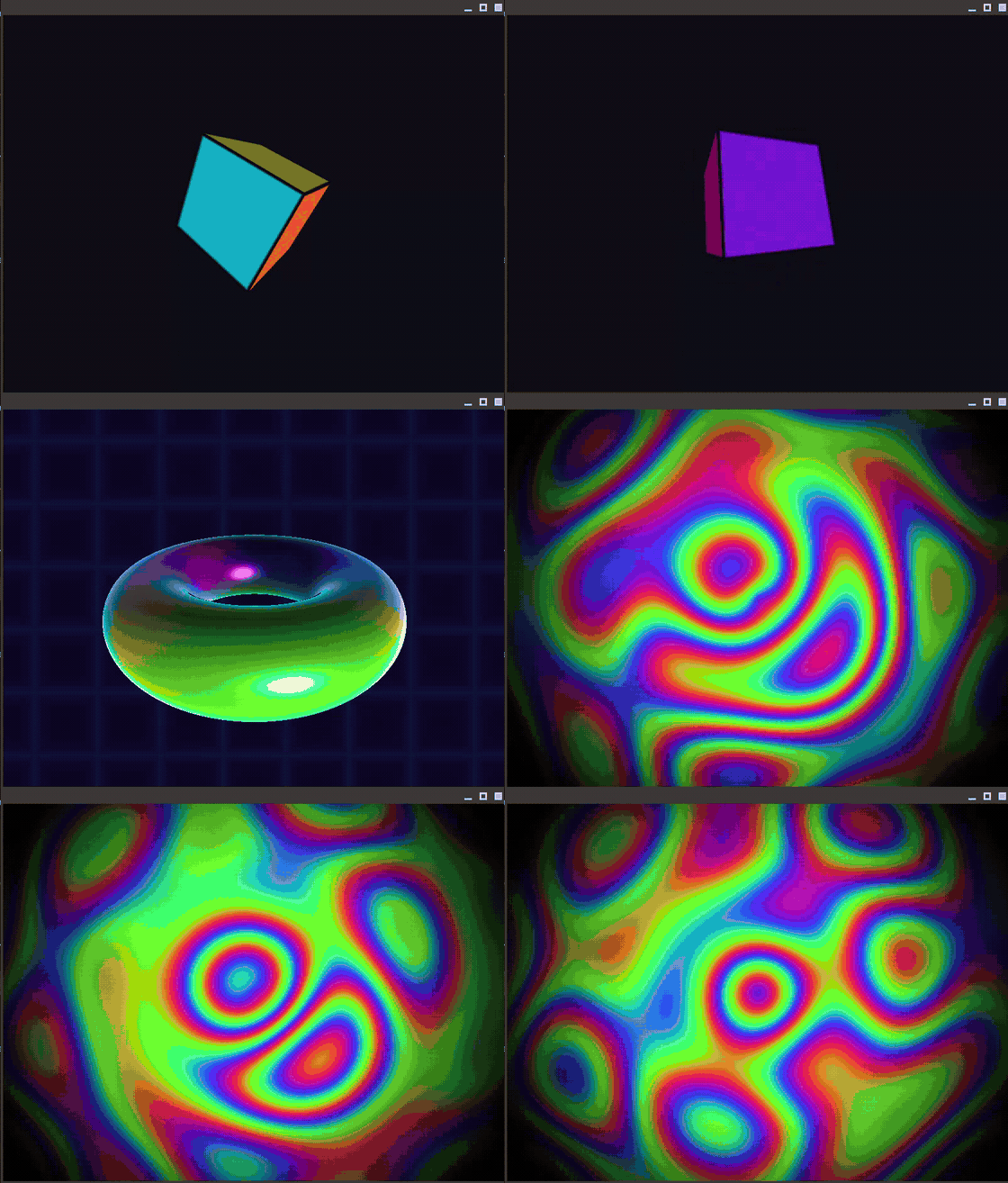
Live 3D rotating polygon geometries, volumetric raymarched Torus SDF, and dynamic procedural shaders rendered via lgpu native swapchain (cargo run -p example-window-shader).
| Dimension | wgpu | Raw Vulkan (ash) | lgpu (Lean GPU) |
|---|---|---|---|
| Clean Compile Time | 25 – 45s | 1 – 3s | ~1.5s |
| Binary Overhead | 15 – 35 MB | Minimal | < 1.8 MB |
| API Paradigm | WebGPU (Pre-2018 Model) | Explicit Driver C-API | Modern Vulkan 1.3+ Native |
| Descriptor Indexing | Restricted / Emulated | Manual Vulkan Bookkeeping | First-Class Bindless Heaps |
| Dynamic Rendering | No (RenderPass Objects) | Raw Vulkan Structs | Built-in Dynamic Rendering |
| C / C++ Bindings | Separate C Wrapper | Native C | Header-Driven C99 (lgpu.h) |
| Dynamic Loading | Yes | Manual / Entry | Automatic Dynamic Loading |
The repository is modularized into three focused crates:
lgpu/
├── crates/
│   ├── lgpu-hal/   # Micro Hardware Abstraction Layer (Dynamic Vulkan 1.3 loading, heaps, suballocator)
│   ├── lgpu/       # High-level, ergonomic, safe Rust API with RAII resource lifecycles
│   └── lgpu-c/     # Universal C99 / Zig / Odin FFI bindings and shared library exports
├── examples/       # 5 Real-world hardware examples (Compute, Clear, Triangle, 100k Particles, Window)
└── assets/         # Project banners, media, and interactive demo assets
RADV, ANV, NVK) and NVIDIA proprietary drivers.HWND / HINSTANCE) with standard NVIDIA, AMD, and Intel GPU drivers dynamically loading vulkan-1.dll.VK_EXT_metal_surface for AppKit (NSView / CAMetalLayer) and UIKit with automatic VK_KHR_portability_enumeration and VK_KHR_portability_subset negotiation.Add lgpu to your Cargo.toml:
[dependencies]
lgpu = "0.1.1"
bytemuck = { version = "1.19", features = ["derive"] }
use lgpu::{BufferDesc, BufferUsage, Instance, MemoryLocation};

fn main() -> Result<(), Box<dyn std::error::Error>> {
    // 1. Initialize instance and acquire hardware device
    let instance = Instance::new()?;
    let adapter = &instance.enumerate_adapters()?[0];
    let (device, queue) = adapter.request_device(&instance)?;
    println!("GPU: {}", adapter.info().name);

    // 2. Allocate GPU buffers (with automatic bindless IDs)
    let desc = BufferDesc {
        label: Some("ComputeBuffer"),
        size: 256,
        usage: BufferUsage::STORAGE | BufferUsage::TRANSFER_SRC | BufferUsage::TRANSFER_DST,
        memory_location: MemoryLocation::CpuToGpu,
    };
    let buf_a = device.create_buffer_init_slice(&desc, &[1.0f32, 2.0, 3.0, 4.0])?;
    let buf_b = device.create_buffer_init_slice(&desc, &[10.0f32, 20.0, 30.0, 40.0])?;
    let buf_out = device.create_buffer(&desc)?;

    // 3. Compile SPIR-V and create compute pipeline
    let shader = device.create_shader_spirv(VECTOR_ADD_SPV)?;
    let pipeline = device.create_compute_pipeline(&shader, 3)?;

    // 4. Record and submit compute dispatch
    let mut encoder = device.create_command_encoder()?;
    encoder.dispatch_compute(&pipeline, &[&buf_a, &buf_b, &buf_out], 1, 1, 1);
    queue.submit(encoder.finish())?;

    // 5. Read back results
    let mut results = [0.0f32; 4];
    buf_out.read(bytemuck::cast_slice_mut(&mut results))?;
    println!("GPU Results: {:?}", results);

    Ok(())
}
Include lgpu.h in your C application:
#include <stdio.h>
#include <lgpu.h>

int main(void) {
    lgpu_instance_t instance = NULL;
    lgpu_create_instance(&instance);

    uint32_t count = lgpu_get_adapter_count(instance);
    printf("Found %u physical GPU(s)\n", count);

    lgpu_adapter_info_t info;
    lgpu_get_adapter_info(instance, 0, &info);
    printf("Primary GPU: %s\n", info.name);

    lgpu_device_t device = NULL;
    lgpu_queue_t queue = NULL;
    lgpu_create_device(instance, 0, &device, &queue);

    // Clean up
    lgpu_destroy_device(device);
    lgpu_destroy_queue(queue);
    lgpu_destroy_instance(instance);
    return 0;
}
Compile and link against lgpu_c:
cargo build --release -p lgpu-c
gcc -std=c99 main.c -Icrates/lgpu-c/include -Ltarget/release -llgpu_c -Wl,-rpath,target/release -o app
./app
The workspace includes 5 runnable hardware demonstrations:
# 1. Headless Compute (Vector addition verified on GPU)
cargo run -p example-headless-compute

# 2. Modern Dynamic Rendering Clear Screen (Verification of 4,096 pixels)
cargo run -p example-clear-screen

# 3. Procedural Bindless Triangle (Zero vertex buffer; ASCII rasterized terminal view)
cargo run -p example-bindless-triangle

# 4. 100,000 Particle Physics Simulation (49 Million particles/sec on GPU)
cargo run -p example-bindless-100k

# 5. Interactive 3D Windowed Demo (Rotating Polygons, Raymarched Torus, Plasma)
cargo run --release -p example-window-shader
Run the integration and documentation test suites across the workspace:
# Run all 41 integration tests against live GPU hardware
cargo test --workspace

# Run all 17 documentation tests
cargo test --doc

# Verify strict zero-warning compiler and clippy standards
cargo clippy --workspace --all-targets --all-features -- -D warnings
lgpu is dual-licensed under:
You may choose either license at your option.
Ultra-lightweight, bindless-first cross-platform GPU abstraction
Rust
8
23 commits
updated Oct 18, 2026
Ultra-lightweight, bindless-first, modern Vulkan 1.3 GPU abstraction for Rust & C99.
lgpu (Lean GPU) departs from the compile-time bloat and restrictive legacy models of WebGPU/W3C by embracing the native hardware reality of modern GPUs:
VkRenderPass and VkFramebuffer state object boilerplate.VK_EXT_descriptor_indexing / update_after_bind) for uniform & storage buffers, sampled textures, storage images, and samplers.ash, bitflags, thiserror, raw-window-handle) compiling in ~1.5s from clean cache.include/lgpu.h.
Live 3D rotating polygon geometries, volumetric raymarched Torus SDF, and dynamic procedural shaders rendered via lgpu native swapchain (cargo run -p example-window-shader).
| Dimension | wgpu | Raw Vulkan (ash) | lgpu (Lean GPU) |
|---|---|---|---|
| Clean Compile Time | 25 – 45s | 1 – 3s | ~1.5s |
| Binary Overhead | 15 – 35 MB | Minimal | < 1.8 MB |
| API Paradigm | WebGPU (Pre-2018 Model) | Explicit Driver C-API | Modern Vulkan 1.3+ Native |
| Descriptor Indexing | Restricted / Emulated | Manual Vulkan Bookkeeping | First-Class Bindless Heaps |
| Dynamic Rendering | No (RenderPass Objects) | Raw Vulkan Structs | Built-in Dynamic Rendering |
| C / C++ Bindings | Separate C Wrapper | Native C | Header-Driven C99 (lgpu.h) |
| Dynamic Loading | Yes | Manual / Entry | Automatic Dynamic Loading |
The repository is modularized into three focused crates:
lgpu/
├── crates/
│   ├── lgpu-hal/   # Micro Hardware Abstraction Layer (Dynamic Vulkan 1.3 loading, heaps, suballocator)
│   ├── lgpu/       # High-level, ergonomic, safe Rust API with RAII resource lifecycles
│   └── lgpu-c/     # Universal C99 / Zig / Odin FFI bindings and shared library exports
├── examples/       # 5 Real-world hardware examples (Compute, Clear, Triangle, 100k Particles, Window)
└── assets/         # Project banners, media, and interactive demo assets
RADV, ANV, NVK) and NVIDIA proprietary drivers.HWND / HINSTANCE) with standard NVIDIA, AMD, and Intel GPU drivers dynamically loading vulkan-1.dll.VK_EXT_metal_surface for AppKit (NSView / CAMetalLayer) and UIKit with automatic VK_KHR_portability_enumeration and VK_KHR_portability_subset negotiation.Add lgpu to your Cargo.toml:
[dependencies]
lgpu = "0.1.1"
bytemuck = { version = "1.19", features = ["derive"] }
use lgpu::{BufferDesc, BufferUsage, Instance, MemoryLocation};

fn main() -> Result<(), Box<dyn std::error::Error>> {
    // 1. Initialize instance and acquire hardware device
    let instance = Instance::new()?;
    let adapter = &instance.enumerate_adapters()?[0];
    let (device, queue) = adapter.request_device(&instance)?;
    println!("GPU: {}", adapter.info().name);

    // 2. Allocate GPU buffers (with automatic bindless IDs)
    let desc = BufferDesc {
        label: Some("ComputeBuffer"),
        size: 256,
        usage: BufferUsage::STORAGE | BufferUsage::TRANSFER_SRC | BufferUsage::TRANSFER_DST,
        memory_location: MemoryLocation::CpuToGpu,
    };
    let buf_a = device.create_buffer_init_slice(&desc, &[1.0f32, 2.0, 3.0, 4.0])?;
    let buf_b = device.create_buffer_init_slice(&desc, &[10.0f32, 20.0, 30.0, 40.0])?;
    let buf_out = device.create_buffer(&desc)?;

    // 3. Compile SPIR-V and create compute pipeline
    let shader = device.create_shader_spirv(VECTOR_ADD_SPV)?;
    let pipeline = device.create_compute_pipeline(&shader, 3)?;

    // 4. Record and submit compute dispatch
    let mut encoder = device.create_command_encoder()?;
    encoder.dispatch_compute(&pipeline, &[&buf_a, &buf_b, &buf_out], 1, 1, 1);
    queue.submit(encoder.finish())?;

    // 5. Read back results
    let mut results = [0.0f32; 4];
    buf_out.read(bytemuck::cast_slice_mut(&mut results))?;
    println!("GPU Results: {:?}", results);

    Ok(())
}
Include lgpu.h in your C application:
#include <stdio.h>
#include <lgpu.h>

int main(void) {
    lgpu_instance_t instance = NULL;
    lgpu_create_instance(&instance);

    uint32_t count = lgpu_get_adapter_count(instance);
    printf("Found %u physical GPU(s)\n", count);

    lgpu_adapter_info_t info;
    lgpu_get_adapter_info(instance, 0, &info);
    printf("Primary GPU: %s\n", info.name);

    lgpu_device_t device = NULL;
    lgpu_queue_t queue = NULL;
    lgpu_create_device(instance, 0, &device, &queue);

    // Clean up
    lgpu_destroy_device(device);
    lgpu_destroy_queue(queue);
    lgpu_destroy_instance(instance);
    return 0;
}
Compile and link against lgpu_c:
cargo build --release -p lgpu-c
gcc -std=c99 main.c -Icrates/lgpu-c/include -Ltarget/release -llgpu_c -Wl,-rpath,target/release -o app
./app
The workspace includes 5 runnable hardware demonstrations:
# 1. Headless Compute (Vector addition verified on GPU)
cargo run -p example-headless-compute

# 2. Modern Dynamic Rendering Clear Screen (Verification of 4,096 pixels)
cargo run -p example-clear-screen

# 3. Procedural Bindless Triangle (Zero vertex buffer; ASCII rasterized terminal view)
cargo run -p example-bindless-triangle

# 4. 100,000 Particle Physics Simulation (49 Million particles/sec on GPU)
cargo run -p example-bindless-100k

# 5. Interactive 3D Windowed Demo (Rotating Polygons, Raymarched Torus, Plasma)
cargo run --release -p example-window-shader
Run the integration and documentation test suites across the workspace:
# Run all 41 integration tests against live GPU hardware
cargo test --workspace

# Run all 17 documentation tests
cargo test --doc

# Verify strict zero-warning compiler and clippy standards
cargo clippy --workspace --all-targets --all-features -- -D warnings
lgpu is dual-licensed under:
You may choose either license at your option.



