This repository contains the source files and supplementary information for the implementations and use cases presented in the work:
David Medina-Ortiz1,2, Diego Alvares-Saravia2,3, Nicole Soto-García2, Diego Sandoval-Vargas1,4, Jacqueline Aldridge2, Sebastián Rodríguez1,4, Bárbara Andrews1,4, Juan A. Asenjo1,4 Anamaría Daza1,4∗
Discovering potential plastic degrading enzymes using machine learning strategies.
https://doi.org/10.1101/2025.02.09.637306
1Centre for Biotechnology and Bioengineering, CeBiB, Universidad de Chile, Beauchef 851, Santiago, Chile
2Departamento de Ingeniería En Computación, Universidad de Magallanes, Avenida Bulnes 01855, Punta Arenas, Chile.
2Centro Asistencial de Docencia e Investigación, CADI, Universidad de Magallanes. Av. Los Flamencos 01364, Punta Arenas, Chile.
4Departamento de Ingeniería Química, Biotecnología y Materiales, Universidad de Chile, Beauchef 851, Santiago, Chile
*Corresponding author
Plastic pollution presents a critical environmental challenge, necessitating innovative and sustainable solutions. In this context, biodegradation using microorganisms and enzymes offers an environmentally friendly alternative. This work introduces an AI-driven framework that integrates machine learning (ML) and generative models to accelerate the discovery and design of plastic-degrading enzymes. By leveraging pre-trained protein language models and curated datasets, we developed seven ML-based binary classification models to identify enzymes targeting specific plastic substrates, achieving an average accuracy of 89%. The framework was applied to over 6,000 enzyme sequences from the RemeDB to classify enzymes targeting diverse plastics, including PET, PLA, and Nylon. Besides, generative learning strategies combined with trained classification models in this work were applied for \textit{de novo} generation of PET-degrading enzymes. Structural bioinformatics validated potential candidates through \textit{in-silico} analysis, highlighting differences in physicochemical properties between generated and experimentally validated enzymes. Moreover, generated sequences exhibited lower molecular weights and higher aliphatic indices, features that may enhance interactions with hydrophobic plastic substrates. These findings highlight the utility of AI-based approaches in enzyme discovery, providing a scalable and efficient tool for addressing plastic pollution. Future work will focus on experimental validation of promising candidates and further refinement of generative strategies to optimize enzymatic performance.
This work was implemented on Python v3.12. To facilitate the deployment and the replication of the work, an environment file was constructed
To create the environment, please run the following command:
conda create -f environment.yml
Moreover, if you want to check all generated embedding and numerical representation strategies, you can find it as a tar.gz files in the shared Google Drive folder.
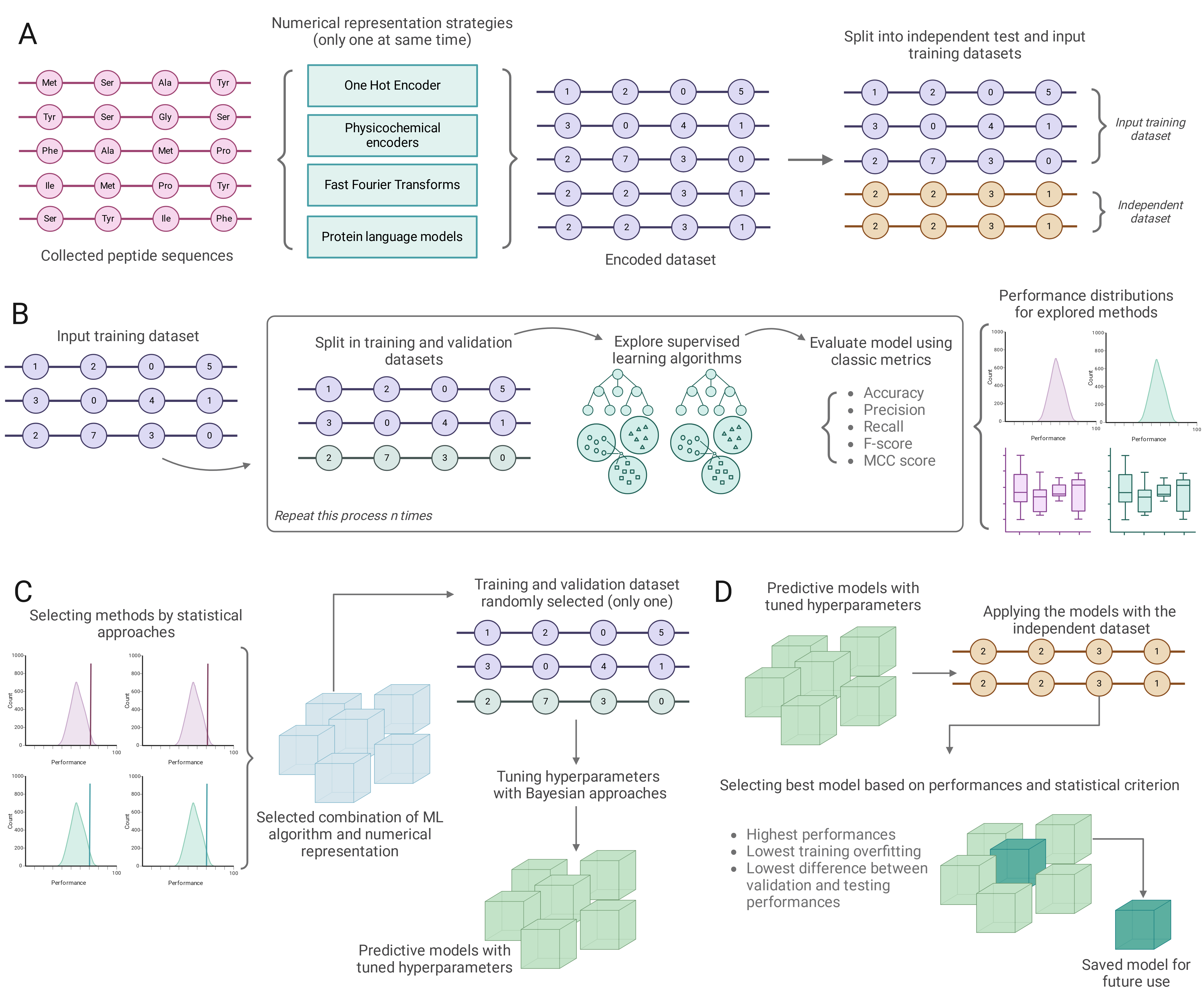
The implemented pipeline to train the classification models is based on our previous work [2]
The folder raw_data contains:
This work explores different numerical representation strategies to process the input enzyme sequences. See the notebooks in folder encoding_approaches for details about the execution.
The encoding strategies including:
In the case of physicochemical-based and FFT-based the physicochemical properties encoders used were extracted from [4].
In the case of embedding, the bioembedding library was employed [5].
The numerical representation strategies take the input data input_data, apply the encoder strategy, and generate the outputs with the encoder sequences. The folder processed_dataset contains the results of all encoder strategies explored in this work.
This work explores different supervised learning strategies to train binary classification models. The folder train_models has the script implemented for the development of classification models, including:
The script training_model.py facilitate the training during exploration step for all type of plastic explored in this work.
Besides, in the folder selecting_models you will find scripts for analyzing the results of the exploration performances and for selecting the best combinations of supervised learning algorithms and numerical representation strategies.
Finally, the folder checking_and_characterizing_models facilitates the processing, voting, and genering the trained models to use to classify new sequences.
These models were used for analyzing:
See folder exploring_generated_sequences for more details. These scripts facilitate:
This repository contains the source files and supplementary information for the implementations and use cases presented in the work:
David Medina-Ortiz1,2, Diego Alvares-Saravia2,3, Nicole Soto-García2, Diego Sandoval-Vargas1,4, Jacqueline Aldridge2, Sebastián Rodríguez1,4, Bárbara Andrews1,4, Juan A. Asenjo1,4 Anamaría Daza1,4∗
Discovering potential plastic degrading enzymes using machine learning strategies.
https://doi.org/10.1101/2025.02.09.637306
1Centre for Biotechnology and Bioengineering, CeBiB, Universidad de Chile, Beauchef 851, Santiago, Chile
2Departamento de Ingeniería En Computación, Universidad de Magallanes, Avenida Bulnes 01855, Punta Arenas, Chile.
2Centro Asistencial de Docencia e Investigación, CADI, Universidad de Magallanes. Av. Los Flamencos 01364, Punta Arenas, Chile.
4Departamento de Ingeniería Química, Biotecnología y Materiales, Universidad de Chile, Beauchef 851, Santiago, Chile
*Corresponding author
Plastic pollution presents a critical environmental challenge, necessitating innovative and sustainable solutions. In this context, biodegradation using microorganisms and enzymes offers an environmentally friendly alternative. This work introduces an AI-driven framework that integrates machine learning (ML) and generative models to accelerate the discovery and design of plastic-degrading enzymes. By leveraging pre-trained protein language models and curated datasets, we developed seven ML-based binary classification models to identify enzymes targeting specific plastic substrates, achieving an average accuracy of 89%. The framework was applied to over 6,000 enzyme sequences from the RemeDB to classify enzymes targeting diverse plastics, including PET, PLA, and Nylon. Besides, generative learning strategies combined with trained classification models in this work were applied for \textit{de novo} generation of PET-degrading enzymes. Structural bioinformatics validated potential candidates through \textit{in-silico} analysis, highlighting differences in physicochemical properties between generated and experimentally validated enzymes. Moreover, generated sequences exhibited lower molecular weights and higher aliphatic indices, features that may enhance interactions with hydrophobic plastic substrates. These findings highlight the utility of AI-based approaches in enzyme discovery, providing a scalable and efficient tool for addressing plastic pollution. Future work will focus on experimental validation of promising candidates and further refinement of generative strategies to optimize enzymatic performance.
This work was implemented on Python v3.12. To facilitate the deployment and the replication of the work, an environment file was constructed
To create the environment, please run the following command:
conda create -f environment.yml
Moreover, if you want to check all generated embedding and numerical representation strategies, you can find it as a tar.gz files in the shared Google Drive folder.
The implemented pipeline to train the classification models is based on our previous work [2]
The folder raw_data contains:
This work explores different numerical representation strategies to process the input enzyme sequences. See the notebooks in folder encoding_approaches for details about the execution.
The encoding strategies including:
In the case of physicochemical-based and FFT-based the physicochemical properties encoders used were extracted from [4].
In the case of embedding, the bioembedding library was employed [5].
The numerical representation strategies take the input data input_data, apply the encoder strategy, and generate the outputs with the encoder sequences. The folder processed_dataset contains the results of all encoder strategies explored in this work.
This work explores different supervised learning strategies to train binary classification models. The folder train_models has the script implemented for the development of classification models, including:
The script training_model.py facilitate the training during exploration step for all type of plastic explored in this work.
Besides, in the folder selecting_models you will find scripts for analyzing the results of the exploration performances and for selecting the best combinations of supervised learning algorithms and numerical representation strategies.
Finally, the folder checking_and_characterizing_models facilitates the processing, voting, and genering the trained models to use to classify new sequences.
These models were used for analyzing:
See folder exploring_generated_sequences for more details. These scripts facilitate: