
README
FTaaS: Event-Driven "Fine-Tuning as a Service" (event-driven-ftaas / ml)
An enterprise-grade, asynchronous, event-driven machine learning platform demonstrating a polyglot microservice pattern:
- Control Plane & Ingestion Gateway: .NET 10 Minimal API / AMQP Producer
- Compute Worker: Python 3.12, PyTorch, Hugging Face PEFT / LoRA, AMQP Consumer
- Telemetry & Experiment Tracking: OpenTelemetry ActivitySource + MLflow Tracking Server & Model Registry
- Message Broker: RabbitMQ (AMQP) with DLX and retry handling
- Base Models: Multi-model architecture supporting ultra-compact models (
HuggingFaceTB/SmolLM2-135M) for zero-cost instant local training, high-capacity reasoning models (google/gemma-2-2b-it) with hardware preflight gates and float16 MPS optimization, and 1.58-bit ternary foundation models (microsoft/BitNet-b1.58-2B-4T) executing natively on CPU via AVX2 integer addition/subtraction. - Privacy & Observability Standard: Complies with PRIVACY_TELEMETRY_SCHEMA.md.
📺 Interactive Video Demonstration
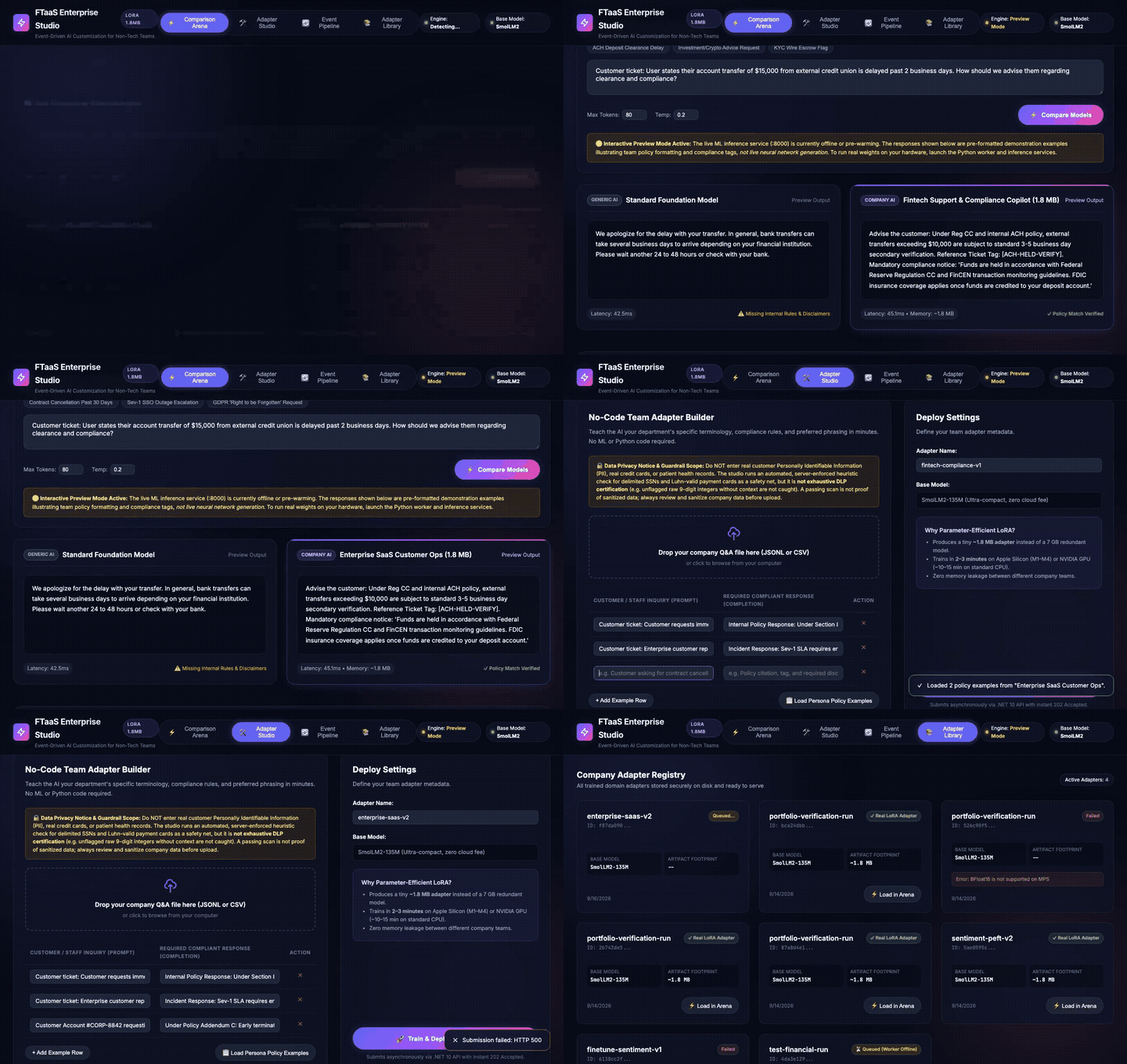
Watch the complete end-to-end studio workflow in action—from side-by-side compliance policy comparison to live PII guardrails and event pipeline tracking:
📹 High-Definition Recording:
demo.mp4(Playwright automated run, 1366x860)To regenerate this demonstration at any time, run:
./scripts/record-demo.sh
Quickstart for Non-Technical Users & Business Leaders
[!TIP] Zero-Code Operation: You do not need to write Python, manage PyTorch, or configure machine learning pipelines to evaluate FTaaS.
Prerequisite: .NET 10 SDK installed on your machine.
Run one command to launch the full interactive web application:
./scripts/start-studio.sh
Then open your browser to http://localhost:5100.
📖 Looking for a guided walkthrough? Read the FTaaS Enterprise Studio Guide for step-by-step instructions, visual explanations, and FAQs.
What You Can Do in the Studio:
- ⚡ Side-by-Side Comparison Arena: Select a business persona (e.g. Fintech Support & Compliance, Enterprise SaaS Ops, or Financial Earnings) and test realistic inquiries. Observe how a Generic Foundation Model contrasts with your Company Custom AI (incorporating team SLAs, policy limits, and required regulatory disclaimers).
- 🛡️ Team Policy & Disclaimer Inspector: Pattern-matching verification checking whether designated training guidelines and statutory tags appear in completions (demonstration aid; not legal advice or statutory regulatory certification).
- 🛠️ No-Code Adapter Studio: Define your department's question-and-answer pairs in an intuitive table editor, or drag-and-drop a
.csvdocument. Select your target base model (SmolLM2-135M for lightweight deployment or Gemma 2 2B IT for deeper reasoning capacity) with built-in hardware disclaimers. Click "Train & Deploy Team Adapter" to submit the job in milliseconds without waiting on background compute. - 🔄 Live Event Pipeline Visualizer: An animated diagram demonstrating how incoming user requests decouple from background training compute.
- 📚 Adapter Library: View trained department models with base model indicators, inspect their lightweight footprint (~1.8 MB for SmolLM2, ~12.2 MB for Gemma 2B), and load them into the arena with one click.
[!NOTE] Preview vs. Live Compute: When launched standalone via
start-studio.sh, the studio operates in Interactive Preview Mode with pre-formatted demonstration outputs so you can evaluate the interface without spinning up Docker containers or downloading multi-gigabyte models. To run live on-device GPU inference, start Docker and the Python services via./scripts/dev-up.sh.
[!CAUTION] Data Privacy & Guardrail Scope: Automated heuristic checks detect delimited SSNs and Luhn-valid credit card numbers across all columns (including unmapped metadata). However, this is a best-effort defense, not an exhaustive DLP certification tool. Always sanitize datasets prior to training.
Privacy, Observability & Job Lifecycle Spans
FTaaS follows the portfolio governance standard documented in PRIVACY_TELEMETRY_SCHEMA.md:
- Consumer Privacy Default: Runs in
memory_onlymode with zero outbound telemetry egress. - Job Lifecycle Spans: Traces the entire training pipeline:
job.accepted→job.published→job.consumed→job.training.started→job.training.finished→job.registered. - Payload Redaction: Attributes strictly log job IDs, statuses, durations, hardware devices (
cuda|mps|cpu), and adapter byte sizes. No raw prompts, completions, or dataset contents are ever permitted in spans. - Inspection & Purge API:
GET /api/v1/telemetry/privacy-audit: Real-time inspection of active telemetry mode and buffer state.GET /api/v1/telemetry/spans: Inspect buffered in-memory spans.POST /api/v1/telemetry/burn: Immediately purges the in-memory telemetry buffer.
- Enterprise OTLP Overlay: Setting
OTEL_EXPORTER_OTLP_ENDPOINTexports spans to an enterprise collector while maintaining the strict payload scrubbing invariant.
Architecture at a Glance
[Non-Tech Web Studio / Client]
        │
        ▼ (POST /api/v1/jobs multipart or datasetPath)
 [Ingestion Gateway (.NET 10)] ──► Validates JSONL, Computes SHA-256 Hash, Stores on Disk
        │
        ▼ (Job Request Event with datasetPath & datasetHash)
 [Async Queue / Message Broker (RabbitMQ)]
        │
        ▼
 [Worker / Orchestrator (Python)] ──► Spin up Training Compute (PyTorch / Hugging Face LoRA)
        │                                        │
        ▼                                        ▼
 [Model Registry (MLflow)]             [Metrics & Loss Telemetry]
        │
        ▼
 [Dynamic Inference Engine] ◄──────── Base Model + On-the-fly LoRA Adapter Mounting
        │
        ▼
 [Side-by-Side Comparison] ────────── Base Completion vs Fine-Tuned Completion
Why This Architecture? (Engineering Trade-Offs)
| Architectural Decision | Trade-Off Rationale | Enterprise Reality |
|---|---|---|
| Polyglot (.NET 10 + Python) | .NET offers high-concurrency, strongly-typed contracts, and low-latency API handling; Python owns the cutting-edge ML ecosystem (PyTorch, PEFT). | Solves the common anti-pattern of writing web APIs in Python or trying to run ML training in C#. Leverages each ecosystem's primary strength. |
| Out-of-Band Dataset Storage | Storing .jsonl files on disk/object storage and passing only datasetPath + SHA-256 hash over RabbitMQ prevents broker bloat and memory pressure. | Real datasets are megabytes to gigabytes. Message brokers degrade rapidly when payloads exceed hundreds of kilobytes. |
| LoRA (PEFT) vs Full Fine-Tuning | Freezing 99%+ of base model weights and only training low-rank adapter matrices reduces VRAM requirements by >80% and completes in 2–4 minutes on consumer hardware. | In production, training 100 domain adapters on a single base model requires ~50MB per adapter instead of storing 100 full 7GB weights. |
| Asynchronous Decoupling | The client receives an immediate 202 Accepted with a JobId. Heavy compute executes out-of-process. | Synchronous model training over HTTP guarantees timeouts, socket exhaustion, and cascading failures under load. |
| Side-by-Side Inference Gateway | Mounting adapters dynamically onto a shared base model allows rapid A/B testing and direct before/after domain comparison. | Avoids spinning up dedicated GPU containers for every custom-trained model variant. |
Developer Quickstart Workflow (Command Line & APIs)
For engineers wanting to run each microservice manually:
# 1. Bring up Infrastructure (RabbitMQ + MLflow) and seed sample datasets
./scripts/dev-up.sh

# 2. Run the Ingestion API & Web Studio (.NET 10)
cd src/FtaaSService.Api && dotnet run

# 3. In another terminal, run the Training Worker (Python)
cd src/FtaaSService.Worker && source .venv/bin/activate && python consumer.py

# 4. In another terminal, run the Inference Engine
cd src/FtaaSService.Inference && source .venv/bin/activate && python app.py

# 5. Submit a fine-tuning job via curl
curl -X POST http://localhost:5100/api/v1/jobs \
  -F "file=@data/datasets/sample-support-compliance.jsonl" \
  -F "jobName=compliance-v1"
Automated Test Suites & Quality Engineering
The platform includes formal, automated unit and regression test suites across both the .NET control plane and Python compute layers:
1. .NET 10 API Test Suite (xUnit + Coverlet)
Validates compliance boundaries, data sanitization, and state machine idempotency:
- PII Compliance Gateway: Delimited SSA SSNs, contextual SSNs, and Luhn-valid payment cards.
- False-Positive Immunity: Verifies that non-contextual 9-digit integers (order IDs, invoice numbers) pass unhindered.
- Full-Row Unmapped Column Scanning: Scans all metadata columns/properties; strips unmapped fields upon normalization.
- Zero-Disk In-Memory Guarantee: Verifies zero bytes are written to disk upon compliance rejection.
- Model Catalog & Validation: Enforces allowlisted base models via
GET /api/v1/studio/models, ensuring invalid or unverified model identifiers are rejected at ingestion with400 Bad Request. - Ingestion Ceilings: Enforces 25 MB file size and 50,000 record limits.
- State Machine Idempotency: Rejects out-of-order sequence updates and prevents terminal state regressions in SQLite.
# Run all .NET unit tests with code coverage collection:
dotnet test tests/FtaaSService.Api.Tests --collect:"XPlat Code Coverage"
2. Python Worker & Inference Tests (unittest / pytest)
Validates model serving resilience, registry lookups, and file integrity:
- Model Registry & Dynamic LoRA Targeting: Verifies target module selection (
["q_proj", "v_proj"]vs["q_proj", "v_proj", "k_proj", "o_proj"]) and template rendering across supported model architectures. - Inference Model Mismatch Protection: Returns actionable 409 Conflict responses when adapters are mounted against mismatched base models.
- Hardware Preflight & Licensing: Intercepts Hugging Face gated license/auth failures (401/403) and surfaces actionable user remediation instructions.
- Adapter Weight Integrity: Rejects truncated, zero-byte, or incomplete writes (<100 KB weights, <10 bytes config).
- Bounded LRU Cache Eviction: Verifies dynamic eviction of least-recently-used LoRA adapters under memory pressure.
# Run all Python unit tests:
PYTHONPATH=src/FtaaSService.Worker:src/FtaaSService.Inference src/FtaaSService.Worker/.venv/bin/python -m pytest tests/
Automated End-to-End Integration Verification
To test the entire live pipeline (Infra $\rightarrow$ .NET 10 Ingestion $\rightarrow$ RabbitMQ $\rightarrow$ PyTorch/PEFT Training on MPS $\rightarrow$ MLflow $\rightarrow$ Dynamic Inference Comparison) in one command:
./scripts/verify-e2e.sh
Roadmap & Implementation Status
- Architecture Specification & Design Contracts (docs/ARCHITECTURE.md)
- Phase 1: Local Infrastructure Foundation (
docker-compose.yml,scripts/dev-up.sh, RabbitMQ + MLflow healthchecks) - Phase 2: Ingestion & Control Plane (.NET 10 Minimal API, JSONL validation, SQLite state machine, AMQP producer/consumer)
- Phase 3: Python Compute Worker & LoRA Pipeline (AMQP consumer, PyTorch MPS/CPU detection, PEFT/LoRA, MLflow telemetry)
- Phase 4: Dynamic Model Serving & Side-by-Side Comparison (LoRA dynamic adapter mounting, comparison API)
- Portfolio Phase 3a (The FTaaS Bridge Exporter): Edge ONNX Exporter (
src/FtaaSService.Worker/exporter.py,scripts/export_edge_adapter.py) and Web API export endpoints (GET/POST /api/v1/jobs/{id}/export/edge) compiling LoRA adapters into web-optimized ONNX format with integrity checksums, documented in docs/SMOL_PROTOTYPE_RESULTS.md. - Portfolio Phase 3b (In-Browser Execution): Ingesting and executing exported ONNX packages directly inside client browser engines via WebGPU/WASM (
onnxruntime-web), single-input ONNX export signature, and dynamic INT8 quantization. - Portfolio Phase 3c (Multi-Model Scaling & Gemma 2B Prototype): Dynamic multi-model registry (
model_registry.py),google/gemma-2-2b-itsupport, hardware preflight warnings, float16 MPS optimization with gradient accumulation, and live benchmark evaluation documented in docs/GEMMA_PROTOTYPE_RESULTS.md. - Portfolio Phase 3d (Ternary Weight Scaling & BitNet b1.58 Prototype): Microsoft
microsoft/BitNet-b1.58-2B-4T1.58-bit ternary foundation model, native CPU execution via AVX2 integer addition/subtraction (zero GPU required), and empirical scaling benchmarks documented in docs/BITNET_PROTOTYPE_RESULTS.md. - BitNet b1.58 Ternary Integration & Engineering Roadmap: Multi-phase engineering roadmap covering native C++ kernel build, ternary LoRA training, multi-model catalog integration, upstream toolchain contributions, and dual-backend inference serving documented in docs/ROADMAP.md.
- Comparative Performance Analysis: Empirical cross-architecture differentials across all three models documented in docs/MODEL_PERFORMANCE_COMPARISON.md.
📚 Repository Documentation Index
All technical design documents, prototype evaluations, and implementation roadmaps are organized under docs/:
| Document | Purpose |
|---|---|
docs/ARCHITECTURE.md | End-to-end system architecture, polyglot microservice boundaries, AMQP messaging contracts, and cloud mapping. |
docs/ROADMAP.md | 7-phase BitNet b1.58 ternary integration roadmap, execution status, and upstream contribution tracking. |
docs/STUDIO_GUIDE.md | Non-technical visual walkthrough and operational runbook for the FTaaS Enterprise Studio web application. |
docs/MODEL_PERFORMANCE_COMPARISON.md | Symmetrical cross-architecture benchmark differentials across SmolLM2-135M, Gemma 2 2B IT, and BitNet b1.58. |
docs/SMOL_PROTOTYPE_RESULTS.md | Ultra-compact baseline (135M) empirical LoRA training metrics, ONNX export profile, and in-browser WASM execution. |
docs/GEMMA_PROTOTYPE_RESULTS.md | High-capacity reasoning tier (2.6B) empirical benchmarks, Apple Silicon MPS tuning, and licensing guards. |
docs/BITNET_PROTOTYPE_RESULTS.md | 1.58-bit ternary CPU execution (2.4B) AVX2 SIMD scaling benchmarks, memory profiling, and PyTorch LoRA metrics. |
docs/PRIVACY_TELEMETRY_SCHEMA.md | Portfolio governance standard for strict attribute allowlists, burn-to-purge invariants, and OpenTelemetry overlay. |
NOTICE.md | Root statutory disclaimers, consumer privacy invariants, and third-party foundation model attribution. |
Production Cloud Parity (AWS & GCP)
| Local Stack | AWS Production Architecture | GCP Production Architecture |
|---|---|---|
| .NET 10 API Gateway | Amazon API Gateway + ECS Fargate | Google Cloud Run (.NET 10) |
| RabbitMQ Broker + DLQ | Amazon SQS (FIFO) + SQS DLQ | Cloud Pub/Sub + Dead Letter |
| Storage (Datasets & DB) | Amazon S3 + Aurora PostgreSQL | Google Cloud Storage + Cloud SQL |
| Compute Worker (Python) | SageMaker Training Jobs (Spot Instances) | Vertex AI Custom Jobs (Preemptible) |
| Experiment Telemetry | Managed MLflow / SageMaker Experiments | Vertex AI Experiments |
| Model Registry | MLflow Model Registry / SageMaker Registry | Vertex AI Model Registry |
| Dynamic Inference Server | SageMaker Multi-Model Endpoints / Triton | Vertex AI Endpoints (vLLM / Triton) |
License
This project is licensed under the MIT License.
Similar repos


Languages
Python
41.5%
C#
29.8%
JavaScript
13.8%
CSS
5.5%
HTML
5.5%
Shell
3.3%
README
FTaaS: Event-Driven "Fine-Tuning as a Service" (event-driven-ftaas / ml)
An enterprise-grade, asynchronous, event-driven machine learning platform demonstrating a polyglot microservice pattern:
- Control Plane & Ingestion Gateway: .NET 10 Minimal API / AMQP Producer
- Compute Worker: Python 3.12, PyTorch, Hugging Face PEFT / LoRA, AMQP Consumer
- Telemetry & Experiment Tracking: OpenTelemetry ActivitySource + MLflow Tracking Server & Model Registry
- Message Broker: RabbitMQ (AMQP) with DLX and retry handling
- Base Models: Multi-model architecture supporting ultra-compact models (
HuggingFaceTB/SmolLM2-135M) for zero-cost instant local training, high-capacity reasoning models (google/gemma-2-2b-it) with hardware preflight gates and float16 MPS optimization, and 1.58-bit ternary foundation models (microsoft/BitNet-b1.58-2B-4T) executing natively on CPU via AVX2 integer addition/subtraction. - Privacy & Observability Standard: Complies with PRIVACY_TELEMETRY_SCHEMA.md.
📺 Interactive Video Demonstration
Watch the complete end-to-end studio workflow in action—from side-by-side compliance policy comparison to live PII guardrails and event pipeline tracking:
📹 High-Definition Recording:
demo.mp4(Playwright automated run, 1366x860)To regenerate this demonstration at any time, run:
./scripts/record-demo.sh
Quickstart for Non-Technical Users & Business Leaders
[!TIP] Zero-Code Operation: You do not need to write Python, manage PyTorch, or configure machine learning pipelines to evaluate FTaaS.
Prerequisite: .NET 10 SDK installed on your machine.
Run one command to launch the full interactive web application:
./scripts/start-studio.sh
Then open your browser to http://localhost:5100.
📖 Looking for a guided walkthrough? Read the FTaaS Enterprise Studio Guide for step-by-step instructions, visual explanations, and FAQs.
What You Can Do in the Studio:
- ⚡ Side-by-Side Comparison Arena: Select a business persona (e.g. Fintech Support & Compliance, Enterprise SaaS Ops, or Financial Earnings) and test realistic inquiries. Observe how a Generic Foundation Model contrasts with your Company Custom AI (incorporating team SLAs, policy limits, and required regulatory disclaimers).
- 🛡️ Team Policy & Disclaimer Inspector: Pattern-matching verification checking whether designated training guidelines and statutory tags appear in completions (demonstration aid; not legal advice or statutory regulatory certification).
- 🛠️ No-Code Adapter Studio: Define your department's question-and-answer pairs in an intuitive table editor, or drag-and-drop a
.csvdocument. Select your target base model (SmolLM2-135M for lightweight deployment or Gemma 2 2B IT for deeper reasoning capacity) with built-in hardware disclaimers. Click "Train & Deploy Team Adapter" to submit the job in milliseconds without waiting on background compute. - 🔄 Live Event Pipeline Visualizer: An animated diagram demonstrating how incoming user requests decouple from background training compute.
- 📚 Adapter Library: View trained department models with base model indicators, inspect their lightweight footprint (~1.8 MB for SmolLM2, ~12.2 MB for Gemma 2B), and load them into the arena with one click.
[!NOTE] Preview vs. Live Compute: When launched standalone via
start-studio.sh, the studio operates in Interactive Preview Mode with pre-formatted demonstration outputs so you can evaluate the interface without spinning up Docker containers or downloading multi-gigabyte models. To run live on-device GPU inference, start Docker and the Python services via./scripts/dev-up.sh.
[!CAUTION] Data Privacy & Guardrail Scope: Automated heuristic checks detect delimited SSNs and Luhn-valid credit card numbers across all columns (including unmapped metadata). However, this is a best-effort defense, not an exhaustive DLP certification tool. Always sanitize datasets prior to training.
Privacy, Observability & Job Lifecycle Spans
FTaaS follows the portfolio governance standard documented in PRIVACY_TELEMETRY_SCHEMA.md:
- Consumer Privacy Default: Runs in
memory_onlymode with zero outbound telemetry egress. - Job Lifecycle Spans: Traces the entire training pipeline:
job.accepted→job.published→job.consumed→job.training.started→job.training.finished→job.registered. - Payload Redaction: Attributes strictly log job IDs, statuses, durations, hardware devices (
cuda|mps|cpu), and adapter byte sizes. No raw prompts, completions, or dataset contents are ever permitted in spans. - Inspection & Purge API:
GET /api/v1/telemetry/privacy-audit: Real-time inspection of active telemetry mode and buffer state.GET /api/v1/telemetry/spans: Inspect buffered in-memory spans.POST /api/v1/telemetry/burn: Immediately purges the in-memory telemetry buffer.
- Enterprise OTLP Overlay: Setting
OTEL_EXPORTER_OTLP_ENDPOINTexports spans to an enterprise collector while maintaining the strict payload scrubbing invariant.
Architecture at a Glance
[Non-Tech Web Studio / Client]
        │
        ▼ (POST /api/v1/jobs multipart or datasetPath)
 [Ingestion Gateway (.NET 10)] ──► Validates JSONL, Computes SHA-256 Hash, Stores on Disk
        │
        ▼ (Job Request Event with datasetPath & datasetHash)
 [Async Queue / Message Broker (RabbitMQ)]
        │
        ▼
 [Worker / Orchestrator (Python)] ──► Spin up Training Compute (PyTorch / Hugging Face LoRA)
        │                                        │
        ▼                                        ▼
 [Model Registry (MLflow)]             [Metrics & Loss Telemetry]
        │
        ▼
 [Dynamic Inference Engine] ◄──────── Base Model + On-the-fly LoRA Adapter Mounting
        │
        ▼
 [Side-by-Side Comparison] ────────── Base Completion vs Fine-Tuned Completion
Why This Architecture? (Engineering Trade-Offs)
| Architectural Decision | Trade-Off Rationale | Enterprise Reality |
|---|---|---|
| Polyglot (.NET 10 + Python) | .NET offers high-concurrency, strongly-typed contracts, and low-latency API handling; Python owns the cutting-edge ML ecosystem (PyTorch, PEFT). | Solves the common anti-pattern of writing web APIs in Python or trying to run ML training in C#. Leverages each ecosystem's primary strength. |
| Out-of-Band Dataset Storage | Storing .jsonl files on disk/object storage and passing only datasetPath + SHA-256 hash over RabbitMQ prevents broker bloat and memory pressure. | Real datasets are megabytes to gigabytes. Message brokers degrade rapidly when payloads exceed hundreds of kilobytes. |
| LoRA (PEFT) vs Full Fine-Tuning | Freezing 99%+ of base model weights and only training low-rank adapter matrices reduces VRAM requirements by >80% and completes in 2–4 minutes on consumer hardware. | In production, training 100 domain adapters on a single base model requires ~50MB per adapter instead of storing 100 full 7GB weights. |
| Asynchronous Decoupling | The client receives an immediate 202 Accepted with a JobId. Heavy compute executes out-of-process. | Synchronous model training over HTTP guarantees timeouts, socket exhaustion, and cascading failures under load. |
| Side-by-Side Inference Gateway | Mounting adapters dynamically onto a shared base model allows rapid A/B testing and direct before/after domain comparison. | Avoids spinning up dedicated GPU containers for every custom-trained model variant. |
Developer Quickstart Workflow (Command Line & APIs)
For engineers wanting to run each microservice manually:
# 1. Bring up Infrastructure (RabbitMQ + MLflow) and seed sample datasets
./scripts/dev-up.sh

# 2. Run the Ingestion API & Web Studio (.NET 10)
cd src/FtaaSService.Api && dotnet run

# 3. In another terminal, run the Training Worker (Python)
cd src/FtaaSService.Worker && source .venv/bin/activate && python consumer.py

# 4. In another terminal, run the Inference Engine
cd src/FtaaSService.Inference && source .venv/bin/activate && python app.py

# 5. Submit a fine-tuning job via curl
curl -X POST http://localhost:5100/api/v1/jobs \
  -F "file=@data/datasets/sample-support-compliance.jsonl" \
  -F "jobName=compliance-v1"
Automated Test Suites & Quality Engineering
The platform includes formal, automated unit and regression test suites across both the .NET control plane and Python compute layers:
1. .NET 10 API Test Suite (xUnit + Coverlet)
Validates compliance boundaries, data sanitization, and state machine idempotency:
- PII Compliance Gateway: Delimited SSA SSNs, contextual SSNs, and Luhn-valid payment cards.
- False-Positive Immunity: Verifies that non-contextual 9-digit integers (order IDs, invoice numbers) pass unhindered.
- Full-Row Unmapped Column Scanning: Scans all metadata columns/properties; strips unmapped fields upon normalization.
- Zero-Disk In-Memory Guarantee: Verifies zero bytes are written to disk upon compliance rejection.
- Model Catalog & Validation: Enforces allowlisted base models via
GET /api/v1/studio/models, ensuring invalid or unverified model identifiers are rejected at ingestion with400 Bad Request. - Ingestion Ceilings: Enforces 25 MB file size and 50,000 record limits.
- State Machine Idempotency: Rejects out-of-order sequence updates and prevents terminal state regressions in SQLite.
# Run all .NET unit tests with code coverage collection:
dotnet test tests/FtaaSService.Api.Tests --collect:"XPlat Code Coverage"
2. Python Worker & Inference Tests (unittest / pytest)
Validates model serving resilience, registry lookups, and file integrity:
- Model Registry & Dynamic LoRA Targeting: Verifies target module selection (
["q_proj", "v_proj"]vs["q_proj", "v_proj", "k_proj", "o_proj"]) and template rendering across supported model architectures. - Inference Model Mismatch Protection: Returns actionable 409 Conflict responses when adapters are mounted against mismatched base models.
- Hardware Preflight & Licensing: Intercepts Hugging Face gated license/auth failures (401/403) and surfaces actionable user remediation instructions.
- Adapter Weight Integrity: Rejects truncated, zero-byte, or incomplete writes (<100 KB weights, <10 bytes config).
- Bounded LRU Cache Eviction: Verifies dynamic eviction of least-recently-used LoRA adapters under memory pressure.
# Run all Python unit tests:
PYTHONPATH=src/FtaaSService.Worker:src/FtaaSService.Inference src/FtaaSService.Worker/.venv/bin/python -m pytest tests/
Automated End-to-End Integration Verification
To test the entire live pipeline (Infra $\rightarrow$ .NET 10 Ingestion $\rightarrow$ RabbitMQ $\rightarrow$ PyTorch/PEFT Training on MPS $\rightarrow$ MLflow $\rightarrow$ Dynamic Inference Comparison) in one command:
./scripts/verify-e2e.sh
Roadmap & Implementation Status
- Architecture Specification & Design Contracts (docs/ARCHITECTURE.md)
- Phase 1: Local Infrastructure Foundation (
docker-compose.yml,scripts/dev-up.sh, RabbitMQ + MLflow healthchecks) - Phase 2: Ingestion & Control Plane (.NET 10 Minimal API, JSONL validation, SQLite state machine, AMQP producer/consumer)
- Phase 3: Python Compute Worker & LoRA Pipeline (AMQP consumer, PyTorch MPS/CPU detection, PEFT/LoRA, MLflow telemetry)
- Phase 4: Dynamic Model Serving & Side-by-Side Comparison (LoRA dynamic adapter mounting, comparison API)
- Portfolio Phase 3a (The FTaaS Bridge Exporter): Edge ONNX Exporter (
src/FtaaSService.Worker/exporter.py,scripts/export_edge_adapter.py) and Web API export endpoints (GET/POST /api/v1/jobs/{id}/export/edge) compiling LoRA adapters into web-optimized ONNX format with integrity checksums, documented in docs/SMOL_PROTOTYPE_RESULTS.md. - Portfolio Phase 3b (In-Browser Execution): Ingesting and executing exported ONNX packages directly inside client browser engines via WebGPU/WASM (
onnxruntime-web), single-input ONNX export signature, and dynamic INT8 quantization. - Portfolio Phase 3c (Multi-Model Scaling & Gemma 2B Prototype): Dynamic multi-model registry (
model_registry.py),google/gemma-2-2b-itsupport, hardware preflight warnings, float16 MPS optimization with gradient accumulation, and live benchmark evaluation documented in docs/GEMMA_PROTOTYPE_RESULTS.md. - Portfolio Phase 3d (Ternary Weight Scaling & BitNet b1.58 Prototype): Microsoft
microsoft/BitNet-b1.58-2B-4T1.58-bit ternary foundation model, native CPU execution via AVX2 integer addition/subtraction (zero GPU required), and empirical scaling benchmarks documented in docs/BITNET_PROTOTYPE_RESULTS.md. - BitNet b1.58 Ternary Integration & Engineering Roadmap: Multi-phase engineering roadmap covering native C++ kernel build, ternary LoRA training, multi-model catalog integration, upstream toolchain contributions, and dual-backend inference serving documented in docs/ROADMAP.md.
- Comparative Performance Analysis: Empirical cross-architecture differentials across all three models documented in docs/MODEL_PERFORMANCE_COMPARISON.md.
📚 Repository Documentation Index
All technical design documents, prototype evaluations, and implementation roadmaps are organized under docs/:
| Document | Purpose |
|---|---|
docs/ARCHITECTURE.md | End-to-end system architecture, polyglot microservice boundaries, AMQP messaging contracts, and cloud mapping. |
docs/ROADMAP.md | 7-phase BitNet b1.58 ternary integration roadmap, execution status, and upstream contribution tracking. |
docs/STUDIO_GUIDE.md | Non-technical visual walkthrough and operational runbook for the FTaaS Enterprise Studio web application. |
docs/MODEL_PERFORMANCE_COMPARISON.md | Symmetrical cross-architecture benchmark differentials across SmolLM2-135M, Gemma 2 2B IT, and BitNet b1.58. |
docs/SMOL_PROTOTYPE_RESULTS.md | Ultra-compact baseline (135M) empirical LoRA training metrics, ONNX export profile, and in-browser WASM execution. |
docs/GEMMA_PROTOTYPE_RESULTS.md | High-capacity reasoning tier (2.6B) empirical benchmarks, Apple Silicon MPS tuning, and licensing guards. |
docs/BITNET_PROTOTYPE_RESULTS.md | 1.58-bit ternary CPU execution (2.4B) AVX2 SIMD scaling benchmarks, memory profiling, and PyTorch LoRA metrics. |
docs/PRIVACY_TELEMETRY_SCHEMA.md | Portfolio governance standard for strict attribute allowlists, burn-to-purge invariants, and OpenTelemetry overlay. |
NOTICE.md | Root statutory disclaimers, consumer privacy invariants, and third-party foundation model attribution. |
Production Cloud Parity (AWS & GCP)
| Local Stack | AWS Production Architecture | GCP Production Architecture |
|---|---|---|
| .NET 10 API Gateway | Amazon API Gateway + ECS Fargate | Google Cloud Run (.NET 10) |
| RabbitMQ Broker + DLQ | Amazon SQS (FIFO) + SQS DLQ | Cloud Pub/Sub + Dead Letter |
| Storage (Datasets & DB) | Amazon S3 + Aurora PostgreSQL | Google Cloud Storage + Cloud SQL |
| Compute Worker (Python) | SageMaker Training Jobs (Spot Instances) | Vertex AI Custom Jobs (Preemptible) |
| Experiment Telemetry | Managed MLflow / SageMaker Experiments | Vertex AI Experiments |
| Model Registry | MLflow Model Registry / SageMaker Registry | Vertex AI Model Registry |
| Dynamic Inference Server | SageMaker Multi-Model Endpoints / Triton | Vertex AI Endpoints (vLLM / Triton) |
License
This project is licensed under the MIT License.
Similar repos
Languages
Python
41.5%
C#
29.8%
JavaScript
13.8%
CSS
5.5%
HTML
5.5%
Shell
3.3%