Feature rich WhatsApp Client for Desktop Linux
See the code
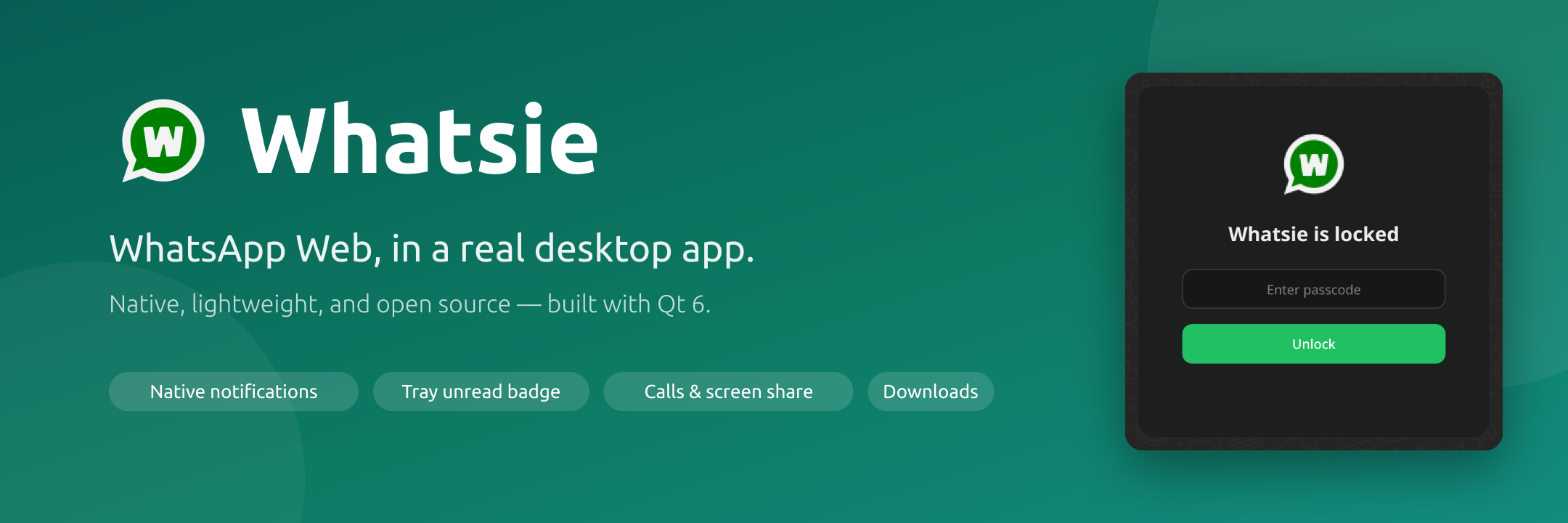
WhatsApp Web, in a real desktop app.
Native notifications, a tray unread badge, calls and screen share, a real downloads
manager, themes that follow the page, spell check, a proxy, and an optional app lock —
lightweight and open source, built with Qt 6.


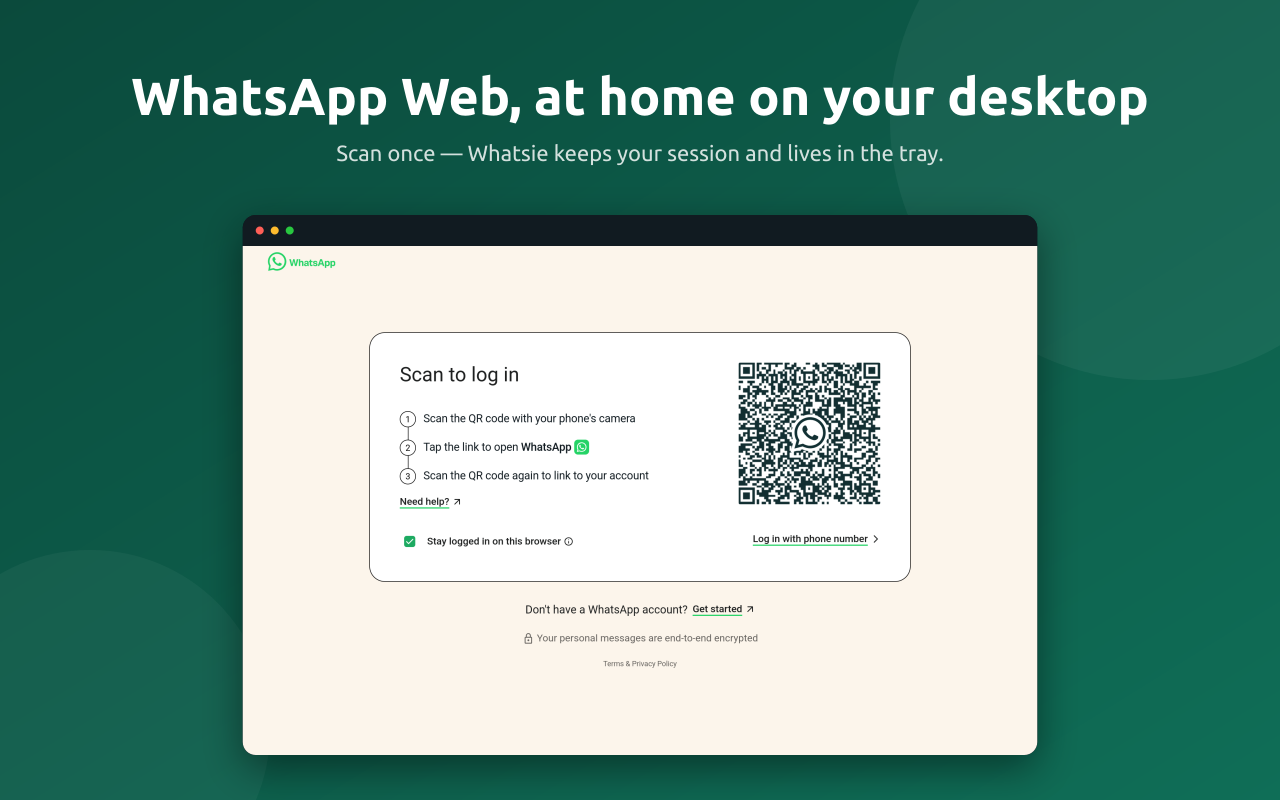
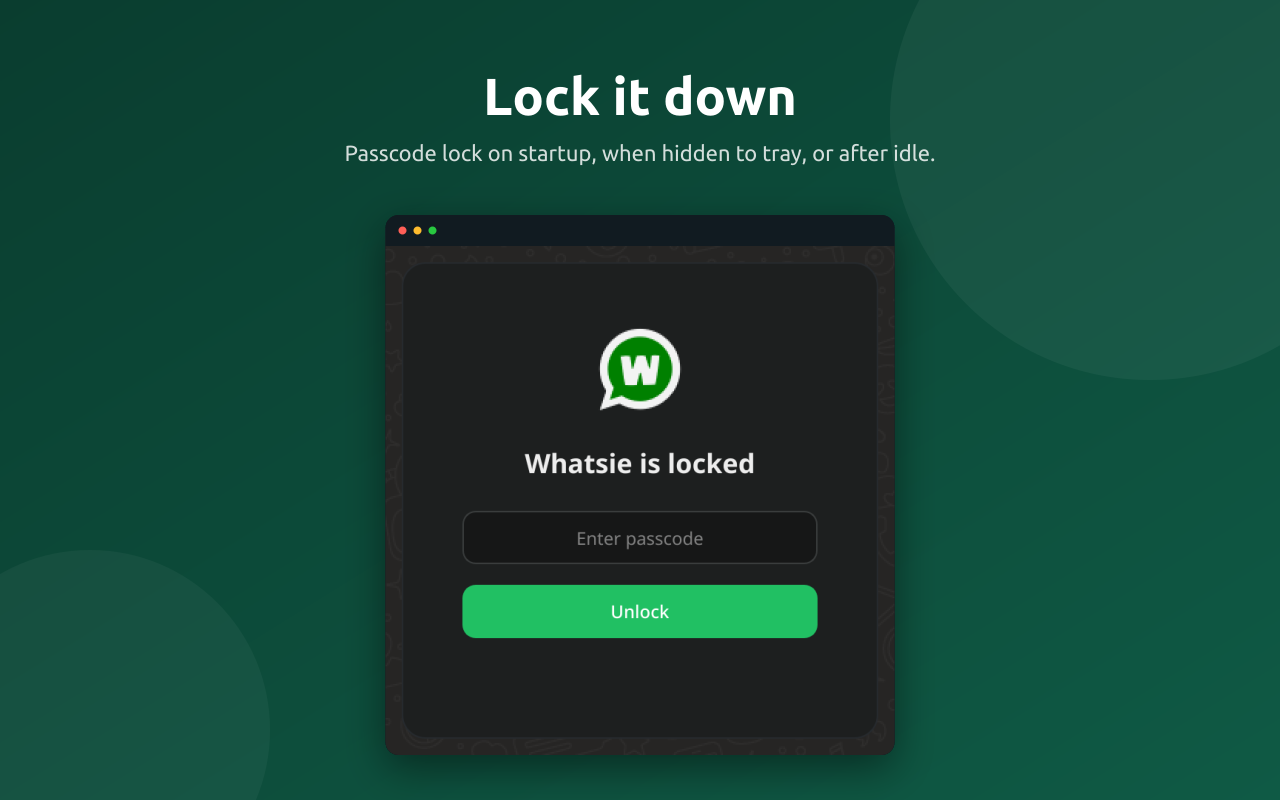
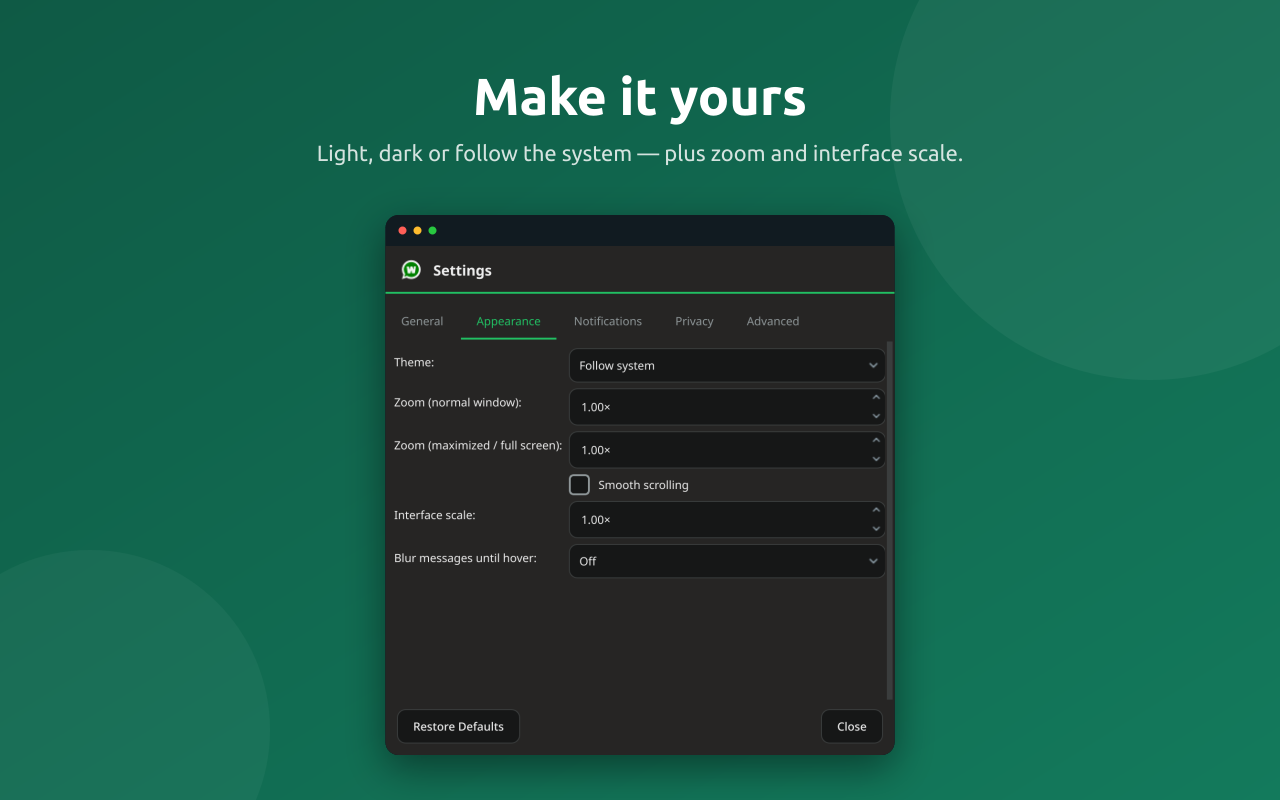
WhatsApp Web is great, but a browser tab is a poor home for it. Whatsie gives it a real window: it stays in your tray, tells you when a message arrives, opens your downloads where you expect them, and gets out of the way. It’s a thin, native shell — no Electron — so it starts fast and stays light.
 |  |
 |  |
 |
Desktop integration
--profile for multiple accounts; autostart at login.whatsapp: / wa.me links and a --new-chat command open straight into a chat.The web experience, done right
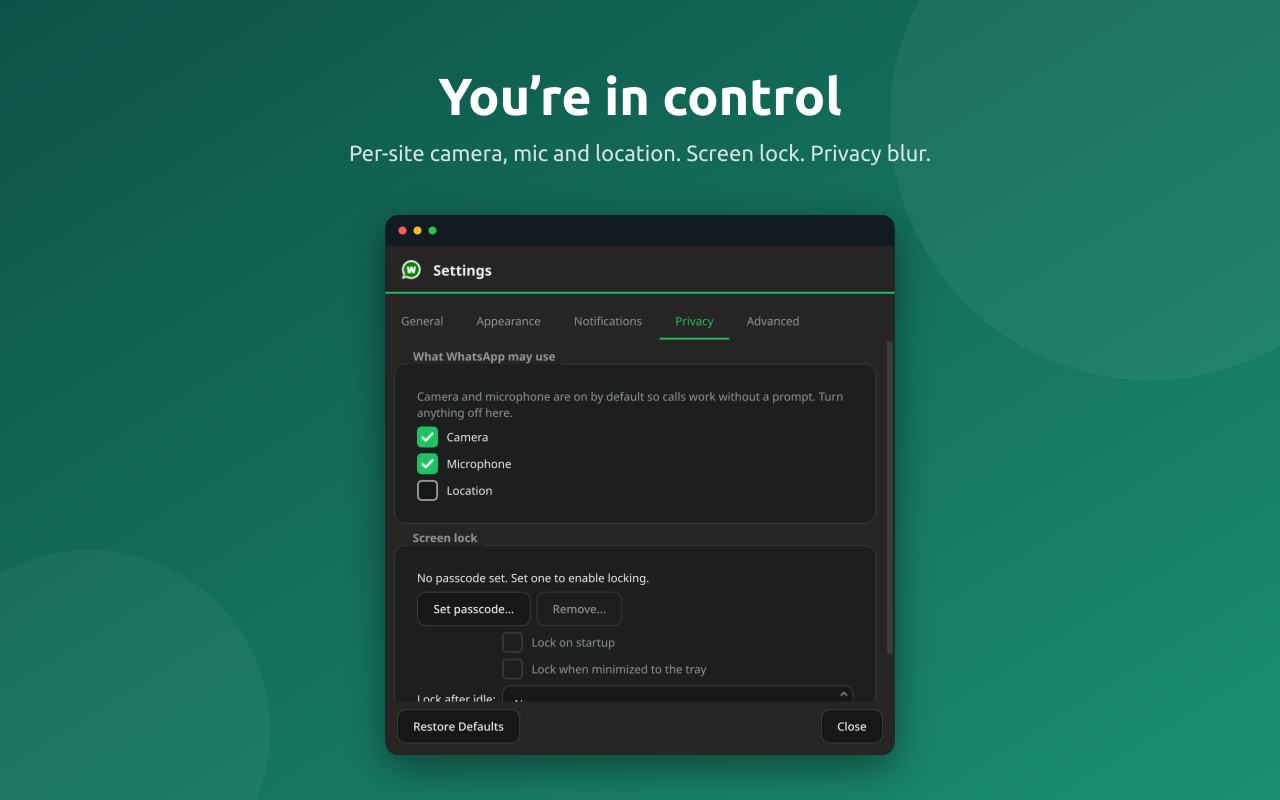
Privacy & control
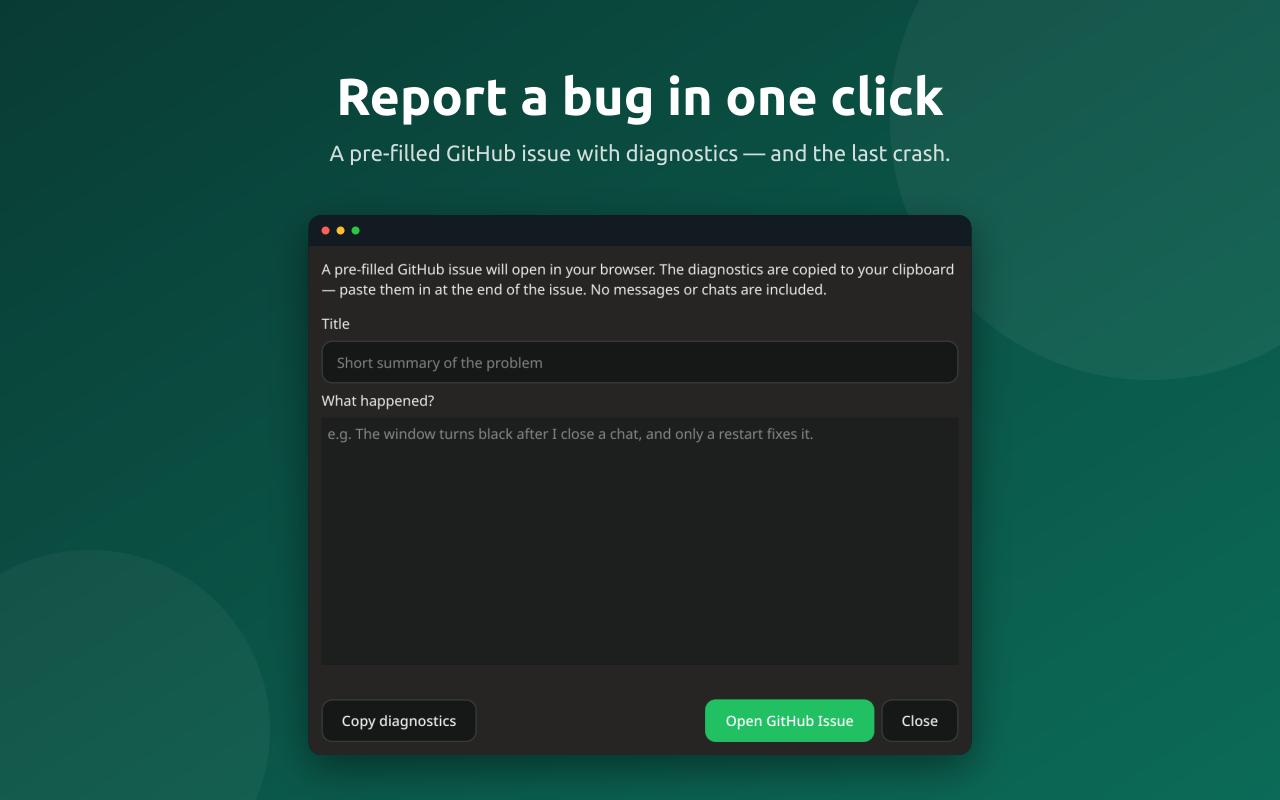
Honest about problems


# Snap — any distro with snapd
sudo snap install whatsie

# Flatpak — from Flathub
flatpak install flathub com.ktechpit.whatsie

# Arch Linux (AUR) — builds from source
yay -S whatsie      # or: paru -S whatsie
AppImage and a self-contained .deb (Qt bundled, installs on any modern
Debian/Ubuntu) are attached to the latest release.
Make the AppImage executable and run it (chmod +x whatsie-*.AppImage); install the deb with
sudo apt install ./whatsie_*_amd64.deb.
Download the installer or portable build from the latest release:
whatsie-<version>-x64.msi — installer (Start Menu + Desktop shortcuts, in-place upgrades)whatsie-<version>-windows-x64.zip — portable, no install requiredWindows 10/11, 64-bit; it bundles its own Qt runtime.
Whatsie bundles dictionaries for several languages (English, German, Spanish, French, Italian, Russian). Turn it on and pick a language in Settings → Advanced → Spell check.
To add a language that isn't bundled, drop its Chromium <code>.bdic file into
the dictionaries folder — the Open folder… button in that same settings
section takes you straight there (then reopen the dialog to pick the language):
~/snap/whatsie/current/.local/share/ktechpit/whatsie/qtwebengine_dictionaries/~/.var/app/com.ktechpit.whatsie/data/ktechpit/whatsie/qtwebengine_dictionaries/~/.local/share/ktechpit/whatsie/qtwebengine_dictionaries/.bdic is Chromium's compiled dictionary format. Convert a Hunspell .dic/.aff
pair with the qwebengine_convert_dict tool that ships with Qt WebEngine, e.g.
qwebengine_convert_dict fr_FR.dic fr-FR.bdic.
Requires Qt 6.11 (the version shipped by the snap kf6-core24 runtime and the Flathub
KDE runtime), CMake ≥ 3.21, and a C++20 compiler.
# Development build against the KDE Qt 6.11 snap SDK (works on any distro)
sudo snap install kde-qt6-core24-sdk kf6-core24
scripts/dev-build.sh --tests    # configure + build + run the test suite
scripts/dev-run.sh              # launch

# …or with a system Qt >= 6.11
cmake -B build -DCMAKE_BUILD_TYPE=RelWithDebInfo
cmake --build build -j
ctest --test-dir build --output-on-failure
Packagers can bundle only selected spell-check dictionaries with, e.g.,
-DWHATSIE_DICTIONARIES="en-US;de-DE" (empty — the default — bundles every
Hunspell dictionary found in -DWHATSIE_HUNSPELL_DIR, /usr/share/hunspell).
src/core      pure logic (settings, services) — Qt Core only, unit-tested
src/web       WebEngine profile/page/view, injected scripts, the JS↔C++ bridge
src/platform  OS backends behind interfaces (notifications, autostart, files, …)
src/ui        QtWidgets: main window, dialogs, tray, lock screen
src/app       Application object, CLI, single instance
tests/        Qt Test suites (unit + offscreen smoke)
snap/         snap packaging (built in CI)
Found a bug? The fastest path is Menu → About → Report a bug…, which opens a pre-filled
issue with the diagnostics already attached. Otherwise, open an issue or a pull request —
the test suite runs with scripts/dev-build.sh --tests.
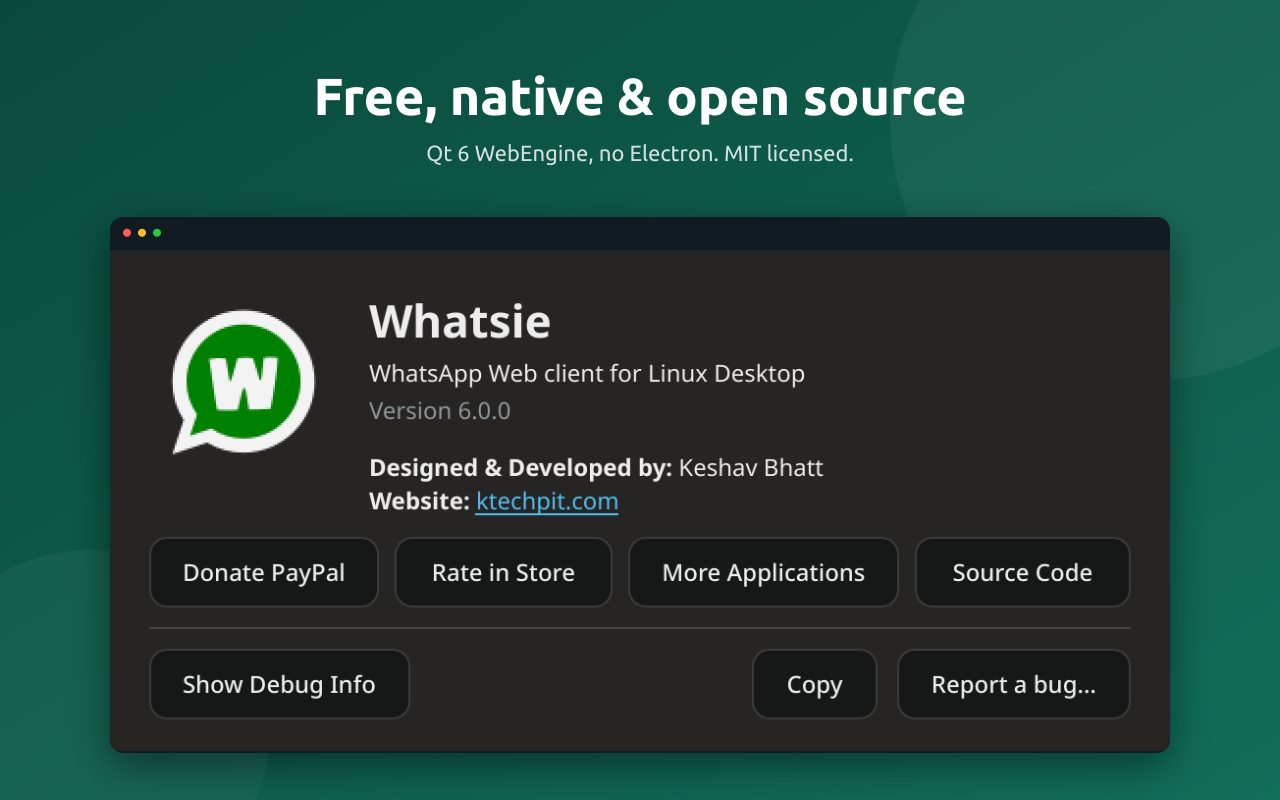
MIT © Keshav Bhatt
WhatsApp is a trademark of WhatsApp LLC. Whatsie is an independent client and is not affiliated with, endorsed by, or sponsored by WhatsApp or Meta.
269 followers · starred Jun 2026
69 followers · starred Aug 2022
386 followers · starred Jun 2025
45 followers · starred Mar 2025
Feature rich WhatsApp Client for Desktop Linux
See the code
WhatsApp Web, in a real desktop app.
Native notifications, a tray unread badge, calls and screen share, a real downloads
manager, themes that follow the page, spell check, a proxy, and an optional app lock —
lightweight and open source, built with Qt 6.
WhatsApp Web is great, but a browser tab is a poor home for it. Whatsie gives it a real window: it stays in your tray, tells you when a message arrives, opens your downloads where you expect them, and gets out of the way. It’s a thin, native shell — no Electron — so it starts fast and stays light.
| |
| |
|
Desktop integration
--profile for multiple accounts; autostart at login.whatsapp: / wa.me links and a --new-chat command open straight into a chat.The web experience, done right
Privacy & control
Honest about problems
# Snap — any distro with snapd
sudo snap install whatsie

# Flatpak — from Flathub
flatpak install flathub com.ktechpit.whatsie

# Arch Linux (AUR) — builds from source
yay -S whatsie      # or: paru -S whatsie
AppImage and a self-contained .deb (Qt bundled, installs on any modern
Debian/Ubuntu) are attached to the latest release.
Make the AppImage executable and run it (chmod +x whatsie-*.AppImage); install the deb with
sudo apt install ./whatsie_*_amd64.deb.
Download the installer or portable build from the latest release:
whatsie-<version>-x64.msi — installer (Start Menu + Desktop shortcuts, in-place upgrades)whatsie-<version>-windows-x64.zip — portable, no install requiredWindows 10/11, 64-bit; it bundles its own Qt runtime.
Whatsie bundles dictionaries for several languages (English, German, Spanish, French, Italian, Russian). Turn it on and pick a language in Settings → Advanced → Spell check.
To add a language that isn't bundled, drop its Chromium <code>.bdic file into
the dictionaries folder — the Open folder… button in that same settings
section takes you straight there (then reopen the dialog to pick the language):
~/snap/whatsie/current/.local/share/ktechpit/whatsie/qtwebengine_dictionaries/~/.var/app/com.ktechpit.whatsie/data/ktechpit/whatsie/qtwebengine_dictionaries/~/.local/share/ktechpit/whatsie/qtwebengine_dictionaries/.bdic is Chromium's compiled dictionary format. Convert a Hunspell .dic/.aff
pair with the qwebengine_convert_dict tool that ships with Qt WebEngine, e.g.
qwebengine_convert_dict fr_FR.dic fr-FR.bdic.
Requires Qt 6.11 (the version shipped by the snap kf6-core24 runtime and the Flathub
KDE runtime), CMake ≥ 3.21, and a C++20 compiler.
# Development build against the KDE Qt 6.11 snap SDK (works on any distro)
sudo snap install kde-qt6-core24-sdk kf6-core24
scripts/dev-build.sh --tests    # configure + build + run the test suite
scripts/dev-run.sh              # launch

# …or with a system Qt >= 6.11
cmake -B build -DCMAKE_BUILD_TYPE=RelWithDebInfo
cmake --build build -j
ctest --test-dir build --output-on-failure
Packagers can bundle only selected spell-check dictionaries with, e.g.,
-DWHATSIE_DICTIONARIES="en-US;de-DE" (empty — the default — bundles every
Hunspell dictionary found in -DWHATSIE_HUNSPELL_DIR, /usr/share/hunspell).
src/core      pure logic (settings, services) — Qt Core only, unit-tested
src/web       WebEngine profile/page/view, injected scripts, the JS↔C++ bridge
src/platform  OS backends behind interfaces (notifications, autostart, files, …)
src/ui        QtWidgets: main window, dialogs, tray, lock screen
src/app       Application object, CLI, single instance
tests/        Qt Test suites (unit + offscreen smoke)
snap/         snap packaging (built in CI)
Found a bug? The fastest path is Menu → About → Report a bug…, which opens a pre-filled
issue with the diagnostics already attached. Otherwise, open an issue or a pull request —
the test suite runs with scripts/dev-build.sh --tests.
MIT © Keshav Bhatt
WhatsApp is a trademark of WhatsApp LLC. Whatsie is an independent client and is not affiliated with, endorsed by, or sponsored by WhatsApp or Meta.
269 followers · starred Jun 2026
69 followers · starred Aug 2022
386 followers · starred Jun 2025
45 followers · starred Mar 2025