
Local-first CLI, Docker, and Tauri workspace for hardware-aware Kimi K3 inference on consumer systems.
C
0
5 commits
updated Aug 21, 2026
README
Xcaliber



Xcaliber is a public, local-first control plane and inference workspace for running very large sparse language models—currently focused on Moonshot AI's Kimi K3—across imperfect consumer hardware. It includes a Rust CLI, an exact streamed CPU engine, an adaptive Docker/Colibri runtime, and an original Tauri desktop controller.
Xcaliber uses model files on your own storage. It does not call Moonshot's hosted inference API, does not require a Kimi API key, and does not upload prompts. Model weights are not included in this repository.
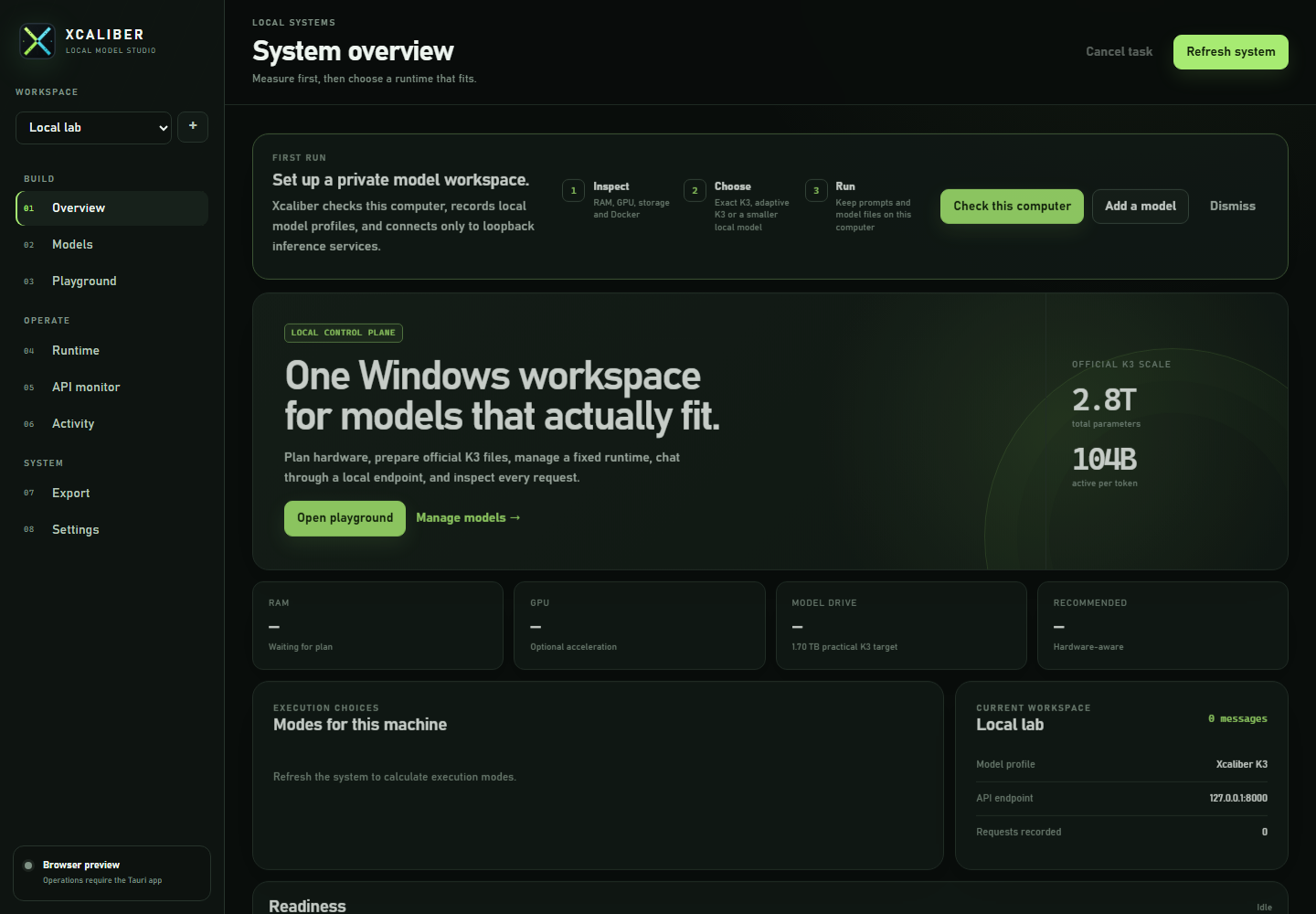
The screenshot uses deterministic preview hardware data; it is an interface view, not a full-model benchmark or certification result.
Read this before downloading Kimi K3
Kimi K3 is not a normal laptop-sized model. The official architecture has roughly 2.8 trillion total parameters, about 104 billion active parameters per token, 93 layers, and 896 routed experts. The published 96-shard checkpoint represented by Xcaliber's pinned manifest totals exactly 1,560,936,091,448 bytes. Exact low-memory execution also needs roughly 109 GB for a packed dense trunk.
Sparse activation lowers arithmetic; it does not make the checkpoint small. Xcaliber's 8 GiB reference evidence completed all 93 layers but measured 72.4722 seconds per token. A 32 GB laptop with a 6 GB GPU cannot turn that storage traffic into fast, interactive full-K3 chat. Xcaliber reports this before beginning a download instead of hiding it behind a progress screen.
Run the planner first:
xcaliber.exe plan --model-dir E:\Models\Kimi-K3 --measure-io
The planner detects CPU threads, available RAM, NVIDIA VRAM, free model-drive space, Docker availability, and optional measured sequential-read performance. Its nonzero "not ready" exit status is intentional when requirements are missing.
Project status
| Component | Status | What that means |
|---|---|---|
| Rust CLI | Implemented and tested | Plans hardware, verifies requirements, pulls pinned shards, packs the trunk, and launches exact inference |
| Exact streamed engine | Implemented and weightless-tested | Preserves the official tensor path but is storage-bandwidth bound |
| Adaptive Docker engine | Source and configuration complete | Quantized dense path plus RAM/SSD/Vulkan expert tiers; not numerically identical to the exact path |
| Tauri desktop app | Implemented and Windows smoke-tested | Fixed allowlisted CLI/Docker operations and localhost chat; no arbitrary shell bridge |
| CPU-only operation | Supported | Exact Rust and C engines build without a GPU |
| Optional GPU tier | Wired through Colibri Vulkan settings | Not certified with real K3 weights in this release |
| Multi-computer K3 pool | Research/design only | K3-specific workers, parity, recovery, and failover are not implemented |
| Official checkpoint run | Not claimed | The validation host did not contain the 1.56 TB checkpoint |
See VALIDATION.md for executed evidence and RELEASE_GATES.md for gates that remain hardware- or checkpoint-dependent.
Download and verify
The latest release is the only supported download page. Release automation produces:
| File | Purpose |
|---|---|
| Xcaliber-1.3.0-windows-x64-studio.zip | Portable Windows Studio, CLI, exact engine, release Compose file, licenses, and evidence |
| Xcaliber-1.3.0-windows-x64-cli.zip | Portable Windows CLI, exact engine, trunk tool, release Compose file, licenses, and evidence |
| Xcaliber_*_x64-setup.exe | Windows desktop and bundled CLI resources, produced by the NSIS release job |
| SHA256SUMS.txt | SHA-256 values for every attached artifact |
Xcaliber release executables are not code-signed until the project has a protected signing certificate. Verify the SHA-256 file and the GitHub build provenance before running a download. Do not obtain binaries from reposting sites.
The source tree remains usable if a hosted release runner has not produced an artifact.
Execution modes
Xcaliber keeps four fundamentally different outcomes explicit:
- Exact streamed K3 preserves the official model semantics and operates with low RAM by reading tensors and experts from storage. It is usable for correctness and experimentation, not expected to be interactive on an ordinary SSD.
- Adaptive local K3 keeps a quantized dense path resident and tiers routed experts across RAM, SSD, and optional Vulkan memory. It can reduce traffic substantially, but quantization means it is not bit-identical to the exact official path.
- Smaller surrogate model is the practical interactive choice for many 16–32 GB systems. Xcaliber never labels a distilled or smaller model as official Kimi K3.
- Heterogeneous cluster could aggregate several ordinary systems, but the exact K3 worker protocol and distributed correctness tests remain future work.
The research and bandwidth calculations behind these choices are in docs/RESEARCH-AND-PERFORMANCE.md.
Get the source
git clone https://github.com/karvifi/xcaliber.git
cd xcaliber
Do not clone model weights into this Git repository. Put them on a dedicated fast drive and pass that location to Xcaliber.
First run on a normal computer
Check the machine before downloading anything:
xcaliber.exe requirements
xcaliber.exe plan
If the planner recommends smaller-surrogate, start a separately licensed local OpenAI-compatible model server and chat with it through loopback:
xcaliber.exe chat `
  --api-url http://127.0.0.1:8000 `
  --model local-model `
  --prompt "Explain sparse mixture-of-experts routing."
This is the storage-conscious interactive route. Xcaliber does not download a model behind your back and does not call a hosted Kimi API. A smaller model is never labeled as official Kimi K3.
Windows CLI
Build
Install stable Rust. On Windows, install the MSVC Rust target and Microsoft C++ Build Tools, then run:
.\scripts\build-windows.ps1
The portable CLI folder is produced under dist/windows-cli and contains
xcaliber.exe, xcaliber-engine.exe, the trunk-packing tool, notices, and validation
information.
A normal developer build is:
cargo build --workspace --release --locked
Inspect the machine and model
xcaliber.exe --version
xcaliber.exe requirements
xcaliber.exe plan --model-dir E:\Models\Kimi-K3 --measure-io
xcaliber.exe doctor --model-dir E:\Models\Kimi-K3 --json
Pull the official checkpoint
xcaliber.exe pull --destination E:\Models\Kimi-K3
Pulls are resumable, pinned to an immutable Hugging Face revision, size-checked, and
SHA-256 verified by default. Xcaliber refuses the pull when the selected destination
does not have at least 1.70 TB free. --skip-checksum exists for recovery work but is
not recommended.
Moonshot's model repository and model license remain authoritative for access to and use of the weights. Xcaliber's AGPL license does not relicense the model.
Pack and run the exact engine
xcaliber.exe pack `
  --model-dir E:\Models\Kimi-K3 `
  --destination E:\Models\Kimi-K3-trunk

xcaliber.exe run `
  --model-dir E:\Models\Kimi-K3 `
  --trunk E:\Models\Kimi-K3-trunk `
  --prompt "Explain sparse mixture-of-experts routing." `
  --gen 32
Native decode uses incremental state and lossless n-gram draft proposals. Every
accepted draft token is verified by the exact engine. Pass --spec 0 to disable
drafting. Environment overrides are XCALIBER_ENGINE and XCALIBER_PACK_TOOL.
Docker adaptive service
Docker provides the persistent Colibri engine and a local OpenAI-compatible endpoint. It still requires the complete K3 checkpoint.
The versioned public image is:
ghcr.io/karvifi/xcaliber:1.3.0
Use docker/compose.release.yaml to pull the public image, or docker/compose.yaml to build it from the pinned source in this repository.
$env:MODEL_DIR = 'E:\Models\Kimi-K3'
$env:K3_LOCAL_API_KEY = 'replace-this-local-password'
docker compose -f docker\compose.yaml up --build
The API is published only on loopback by default:
http://127.0.0.1:8000/v1/chat/completions
Example request:
curl http://127.0.0.1:8000/v1/chat/completions \
  -H "Authorization: Bearer replace-this-local-password" \
  -H "Content-Type: application/json" \
  -d '{"model":"kimi-k3-local","messages":[{"role":"user","content":"Hello"}]}'
Important settings:
| Variable | Default | Purpose |
|---|---|---|
K3_PORT | 8000 | Host loopback port |
K3_LOCAL_API_KEY | xcaliber-local | Local gateway password; change it |
K3_BITS | 4 | Adaptive dense-path quantization |
K3_MLA_BITS | 8 | MLA-path quantization |
K3_DIRECT | 1 | Direct storage I/O where supported |
K3_PIPE | 1 | Pipeline loading and execution |
K3_LOAD_THREADS | 4 | Storage-loading workers |
K3_VK | 0 | Enable optional Vulkan tier with 1 |
K3_VK_GB | 0 | Vulkan memory budget; 0 lets the planner decide |
K3_TOPP | 0 | Keep all officially selected routed experts |
K3_POLICY | quality | Adaptive resource policy |
Do not change the Compose port binding to 0.0.0.0 unless you understand the
authentication, firewall, and AGPL source-offer implications of providing a network
service.
Desktop app
The app directory contains an original Tauri 2 desktop controller. It has no npm
dependency tree or downloaded web frontend. Its content security policy permits only
the application itself, Tauri IPC, and localhost API connections. The Tauri capability
file grants no shell plugin.
The interface includes separate local workspaces, reusable model profiles, persistent conversations, generation controls, runtime operations, request monitoring, job history, safe exports, and privacy/appearance settings. See the clean-room desktop studio map for the product concepts studied and the capabilities deliberately not represented as complete.
Build on Windows with Rust's MSVC target, Microsoft C++ Build Tools, and WebView2:
.\scripts\build-app.ps1
Build the NSIS installer after installing Tauri CLI 2:
.\scripts\build-installer.ps1
Keep the generated Xcaliber.exe, xcaliber.exe, xcaliber-engine.exe, and bundled
docker and runtime directories together. The app can:
- display the hardware plan and blockers;
- verify, pull, and pack the official checkpoint;
- run an exact one-shot prompt;
- start, stop, inspect, and read logs from the fixed Docker Compose service;
- chat with the localhost OpenAI-compatible endpoint;
- cancel only the process it started.
It cannot execute arbitrary commands. XCALIBER_CLI may point it to a developer CLI
build.
Repository layout
app/                 Tauri desktop controller and static UI
assets/              Original Xcaliber logo, icons, banner, and artwork
cli/                 Rust planner, doctor, model puller, packer, and launcher
docker/              Local adaptive service image and Compose definition
docs/                Architecture, research, ADRs, and release gates
runtime/rust/         Exact streamed Kimi K3 Rust engine
runtime/colibri/      Adaptive C/Python/optional Vulkan runtime
scripts/              Audits, checksums, and Windows release builders
tools/                Model preparation tools shipped with the CLI
Development and validation
Core checks:
cargo fmt --all -- --check
cargo check --workspace --all-targets --locked
cargo clippy --workspace --all-targets --locked -- -D warnings
cargo test --workspace --release --locked
pwsh -File scripts\audit.ps1
node --check app\ui\app.js
node --test app\tests\core.test.mjs
Desktop tests use their own locked Cargo workspace:
cargo check --manifest-path app\src-tauri\Cargo.toml --locked
cargo test --manifest-path app\src-tauri\Cargo.toml --locked
scripts/audit.ps1 verifies the 96-shard byte total, Docker safety defaults, release
container shape, version alignment, brand assets, installer resources, absence
of hosted-Kimi credentials, desktop command boundaries, Cargo target shape, Win32 FFI
shape, licensing metadata, public-repository files, unfinished Rust macros, and
accidental large files.
Tests that need the official checkpoint are deliberately ignored unless their model path guard is satisfied. A green weightless test suite is not a full-model certification.
Security and privacy
- No Moonshot or Kimi API credential is requested.
- Docker binds to
127.0.0.1and requires a local password. - The desktop app exposes typed operations, not a general shell.
- Pulls use a pinned model revision and published checksums.
- Model weights, prompts, caches, and environment files are excluded from Git.
See SECURITY.md for vulnerability reporting and SUPPORT.md for the diagnostic checklist.
Contributing
Issues and pull requests are welcome, especially for reproducible hardware evidence, storage scheduling, exactness tests, Vulkan parity, safer model management, and the future heterogeneous-worker protocol. Read CONTRIBUTING.md before submitting changes.
Public release state is tracked in CHANGELOG.md, PRODUCT-READINESS.md, and CODE_OF_CONDUCT.md.
Do not remove evidence gates or describe an adaptive/surrogate result as official K3. Performance contributions should include the model revision, prompt/token counts, hardware, storage, driver versions, and complete commands.
License
Xcaliber-specific source code is released under the GNU Affero General Public License version 3 only. If you modify Xcaliber and provide it as a network service, the AGPL requires offering the corresponding source to users of that service.
Bundled and modified upstream inference components retain compatible Apache-2.0 notices; see NOTICE and LICENSES/Apache-2.0.txt. Kimi K3 weights are separate and remain governed by Moonshot AI's model license.
Acknowledgements
Xcaliber incorporates or adapts work from pinned versions of kimi-k3-in-rust,
kimi-k3-in-c, and colibri, recorded in NOTICE. Research references and
the reasoning behind the execution modes are collected in
docs/RESEARCH-AND-PERFORMANCE.md.
Unsloth Studio was studied as a workflow reference only. No Unsloth source, assets, branding, or interface code is included.
Contributors

5 commits
Similar repos


Languages
C
47.2%
Python
25.8%
Rust
9.6%
Cuda
8.2%
Objective-C++
2.5%
TypeScript
1.4%
Makefile
1.1%
Local-first CLI, Docker, and Tauri workspace for hardware-aware Kimi K3 inference on consumer systems.
C
0
5 commits
updated Aug 21, 2026
README
Xcaliber
Xcaliber is a public, local-first control plane and inference workspace for running very large sparse language models—currently focused on Moonshot AI's Kimi K3—across imperfect consumer hardware. It includes a Rust CLI, an exact streamed CPU engine, an adaptive Docker/Colibri runtime, and an original Tauri desktop controller.
Xcaliber uses model files on your own storage. It does not call Moonshot's hosted inference API, does not require a Kimi API key, and does not upload prompts. Model weights are not included in this repository.
The screenshot uses deterministic preview hardware data; it is an interface view, not a full-model benchmark or certification result.
Read this before downloading Kimi K3
Kimi K3 is not a normal laptop-sized model. The official architecture has roughly 2.8 trillion total parameters, about 104 billion active parameters per token, 93 layers, and 896 routed experts. The published 96-shard checkpoint represented by Xcaliber's pinned manifest totals exactly 1,560,936,091,448 bytes. Exact low-memory execution also needs roughly 109 GB for a packed dense trunk.
Sparse activation lowers arithmetic; it does not make the checkpoint small. Xcaliber's 8 GiB reference evidence completed all 93 layers but measured 72.4722 seconds per token. A 32 GB laptop with a 6 GB GPU cannot turn that storage traffic into fast, interactive full-K3 chat. Xcaliber reports this before beginning a download instead of hiding it behind a progress screen.
Run the planner first:
xcaliber.exe plan --model-dir E:\Models\Kimi-K3 --measure-io
The planner detects CPU threads, available RAM, NVIDIA VRAM, free model-drive space, Docker availability, and optional measured sequential-read performance. Its nonzero "not ready" exit status is intentional when requirements are missing.
Project status
| Component | Status | What that means |
|---|---|---|
| Rust CLI | Implemented and tested | Plans hardware, verifies requirements, pulls pinned shards, packs the trunk, and launches exact inference |
| Exact streamed engine | Implemented and weightless-tested | Preserves the official tensor path but is storage-bandwidth bound |
| Adaptive Docker engine | Source and configuration complete | Quantized dense path plus RAM/SSD/Vulkan expert tiers; not numerically identical to the exact path |
| Tauri desktop app | Implemented and Windows smoke-tested | Fixed allowlisted CLI/Docker operations and localhost chat; no arbitrary shell bridge |
| CPU-only operation | Supported | Exact Rust and C engines build without a GPU |
| Optional GPU tier | Wired through Colibri Vulkan settings | Not certified with real K3 weights in this release |
| Multi-computer K3 pool | Research/design only | K3-specific workers, parity, recovery, and failover are not implemented |
| Official checkpoint run | Not claimed | The validation host did not contain the 1.56 TB checkpoint |
See VALIDATION.md for executed evidence and RELEASE_GATES.md for gates that remain hardware- or checkpoint-dependent.
Download and verify
The latest release is the only supported download page. Release automation produces:
| File | Purpose |
|---|---|
| Xcaliber-1.3.0-windows-x64-studio.zip | Portable Windows Studio, CLI, exact engine, release Compose file, licenses, and evidence |
| Xcaliber-1.3.0-windows-x64-cli.zip | Portable Windows CLI, exact engine, trunk tool, release Compose file, licenses, and evidence |
| Xcaliber_*_x64-setup.exe | Windows desktop and bundled CLI resources, produced by the NSIS release job |
| SHA256SUMS.txt | SHA-256 values for every attached artifact |
Xcaliber release executables are not code-signed until the project has a protected signing certificate. Verify the SHA-256 file and the GitHub build provenance before running a download. Do not obtain binaries from reposting sites.
The source tree remains usable if a hosted release runner has not produced an artifact.
Execution modes
Xcaliber keeps four fundamentally different outcomes explicit:
- Exact streamed K3 preserves the official model semantics and operates with low RAM by reading tensors and experts from storage. It is usable for correctness and experimentation, not expected to be interactive on an ordinary SSD.
- Adaptive local K3 keeps a quantized dense path resident and tiers routed experts across RAM, SSD, and optional Vulkan memory. It can reduce traffic substantially, but quantization means it is not bit-identical to the exact official path.
- Smaller surrogate model is the practical interactive choice for many 16–32 GB systems. Xcaliber never labels a distilled or smaller model as official Kimi K3.
- Heterogeneous cluster could aggregate several ordinary systems, but the exact K3 worker protocol and distributed correctness tests remain future work.
The research and bandwidth calculations behind these choices are in docs/RESEARCH-AND-PERFORMANCE.md.
Get the source
git clone https://github.com/karvifi/xcaliber.git
cd xcaliber
Do not clone model weights into this Git repository. Put them on a dedicated fast drive and pass that location to Xcaliber.
First run on a normal computer
Check the machine before downloading anything:
xcaliber.exe requirements
xcaliber.exe plan
If the planner recommends smaller-surrogate, start a separately licensed local OpenAI-compatible model server and chat with it through loopback:
xcaliber.exe chat `
  --api-url http://127.0.0.1:8000 `
  --model local-model `
  --prompt "Explain sparse mixture-of-experts routing."
This is the storage-conscious interactive route. Xcaliber does not download a model behind your back and does not call a hosted Kimi API. A smaller model is never labeled as official Kimi K3.
Windows CLI
Build
Install stable Rust. On Windows, install the MSVC Rust target and Microsoft C++ Build Tools, then run:
.\scripts\build-windows.ps1
The portable CLI folder is produced under dist/windows-cli and contains
xcaliber.exe, xcaliber-engine.exe, the trunk-packing tool, notices, and validation
information.
A normal developer build is:
cargo build --workspace --release --locked
Inspect the machine and model
xcaliber.exe --version
xcaliber.exe requirements
xcaliber.exe plan --model-dir E:\Models\Kimi-K3 --measure-io
xcaliber.exe doctor --model-dir E:\Models\Kimi-K3 --json
Pull the official checkpoint
xcaliber.exe pull --destination E:\Models\Kimi-K3
Pulls are resumable, pinned to an immutable Hugging Face revision, size-checked, and
SHA-256 verified by default. Xcaliber refuses the pull when the selected destination
does not have at least 1.70 TB free. --skip-checksum exists for recovery work but is
not recommended.
Moonshot's model repository and model license remain authoritative for access to and use of the weights. Xcaliber's AGPL license does not relicense the model.
Pack and run the exact engine
xcaliber.exe pack `
  --model-dir E:\Models\Kimi-K3 `
  --destination E:\Models\Kimi-K3-trunk

xcaliber.exe run `
  --model-dir E:\Models\Kimi-K3 `
  --trunk E:\Models\Kimi-K3-trunk `
  --prompt "Explain sparse mixture-of-experts routing." `
  --gen 32
Native decode uses incremental state and lossless n-gram draft proposals. Every
accepted draft token is verified by the exact engine. Pass --spec 0 to disable
drafting. Environment overrides are XCALIBER_ENGINE and XCALIBER_PACK_TOOL.
Docker adaptive service
Docker provides the persistent Colibri engine and a local OpenAI-compatible endpoint. It still requires the complete K3 checkpoint.
The versioned public image is:
ghcr.io/karvifi/xcaliber:1.3.0
Use docker/compose.release.yaml to pull the public image, or docker/compose.yaml to build it from the pinned source in this repository.
$env:MODEL_DIR = 'E:\Models\Kimi-K3'
$env:K3_LOCAL_API_KEY = 'replace-this-local-password'
docker compose -f docker\compose.yaml up --build
The API is published only on loopback by default:
http://127.0.0.1:8000/v1/chat/completions
Example request:
curl http://127.0.0.1:8000/v1/chat/completions \
  -H "Authorization: Bearer replace-this-local-password" \
  -H "Content-Type: application/json" \
  -d '{"model":"kimi-k3-local","messages":[{"role":"user","content":"Hello"}]}'
Important settings:
| Variable | Default | Purpose |
|---|---|---|
K3_PORT | 8000 | Host loopback port |
K3_LOCAL_API_KEY | xcaliber-local | Local gateway password; change it |
K3_BITS | 4 | Adaptive dense-path quantization |
K3_MLA_BITS | 8 | MLA-path quantization |
K3_DIRECT | 1 | Direct storage I/O where supported |
K3_PIPE | 1 | Pipeline loading and execution |
K3_LOAD_THREADS | 4 | Storage-loading workers |
K3_VK | 0 | Enable optional Vulkan tier with 1 |
K3_VK_GB | 0 | Vulkan memory budget; 0 lets the planner decide |
K3_TOPP | 0 | Keep all officially selected routed experts |
K3_POLICY | quality | Adaptive resource policy |
Do not change the Compose port binding to 0.0.0.0 unless you understand the
authentication, firewall, and AGPL source-offer implications of providing a network
service.
Desktop app
The app directory contains an original Tauri 2 desktop controller. It has no npm
dependency tree or downloaded web frontend. Its content security policy permits only
the application itself, Tauri IPC, and localhost API connections. The Tauri capability
file grants no shell plugin.
The interface includes separate local workspaces, reusable model profiles, persistent conversations, generation controls, runtime operations, request monitoring, job history, safe exports, and privacy/appearance settings. See the clean-room desktop studio map for the product concepts studied and the capabilities deliberately not represented as complete.
Build on Windows with Rust's MSVC target, Microsoft C++ Build Tools, and WebView2:
.\scripts\build-app.ps1
Build the NSIS installer after installing Tauri CLI 2:
.\scripts\build-installer.ps1
Keep the generated Xcaliber.exe, xcaliber.exe, xcaliber-engine.exe, and bundled
docker and runtime directories together. The app can:
- display the hardware plan and blockers;
- verify, pull, and pack the official checkpoint;
- run an exact one-shot prompt;
- start, stop, inspect, and read logs from the fixed Docker Compose service;
- chat with the localhost OpenAI-compatible endpoint;
- cancel only the process it started.
It cannot execute arbitrary commands. XCALIBER_CLI may point it to a developer CLI
build.
Repository layout
app/                 Tauri desktop controller and static UI
assets/              Original Xcaliber logo, icons, banner, and artwork
cli/                 Rust planner, doctor, model puller, packer, and launcher
docker/              Local adaptive service image and Compose definition
docs/                Architecture, research, ADRs, and release gates
runtime/rust/         Exact streamed Kimi K3 Rust engine
runtime/colibri/      Adaptive C/Python/optional Vulkan runtime
scripts/              Audits, checksums, and Windows release builders
tools/                Model preparation tools shipped with the CLI
Development and validation
Core checks:
cargo fmt --all -- --check
cargo check --workspace --all-targets --locked
cargo clippy --workspace --all-targets --locked -- -D warnings
cargo test --workspace --release --locked
pwsh -File scripts\audit.ps1
node --check app\ui\app.js
node --test app\tests\core.test.mjs
Desktop tests use their own locked Cargo workspace:
cargo check --manifest-path app\src-tauri\Cargo.toml --locked
cargo test --manifest-path app\src-tauri\Cargo.toml --locked
scripts/audit.ps1 verifies the 96-shard byte total, Docker safety defaults, release
container shape, version alignment, brand assets, installer resources, absence
of hosted-Kimi credentials, desktop command boundaries, Cargo target shape, Win32 FFI
shape, licensing metadata, public-repository files, unfinished Rust macros, and
accidental large files.
Tests that need the official checkpoint are deliberately ignored unless their model path guard is satisfied. A green weightless test suite is not a full-model certification.
Security and privacy
- No Moonshot or Kimi API credential is requested.
- Docker binds to
127.0.0.1and requires a local password. - The desktop app exposes typed operations, not a general shell.
- Pulls use a pinned model revision and published checksums.
- Model weights, prompts, caches, and environment files are excluded from Git.
See SECURITY.md for vulnerability reporting and SUPPORT.md for the diagnostic checklist.
Contributing
Issues and pull requests are welcome, especially for reproducible hardware evidence, storage scheduling, exactness tests, Vulkan parity, safer model management, and the future heterogeneous-worker protocol. Read CONTRIBUTING.md before submitting changes.
Public release state is tracked in CHANGELOG.md, PRODUCT-READINESS.md, and CODE_OF_CONDUCT.md.
Do not remove evidence gates or describe an adaptive/surrogate result as official K3. Performance contributions should include the model revision, prompt/token counts, hardware, storage, driver versions, and complete commands.
License
Xcaliber-specific source code is released under the GNU Affero General Public License version 3 only. If you modify Xcaliber and provide it as a network service, the AGPL requires offering the corresponding source to users of that service.
Bundled and modified upstream inference components retain compatible Apache-2.0 notices; see NOTICE and LICENSES/Apache-2.0.txt. Kimi K3 weights are separate and remain governed by Moonshot AI's model license.
Acknowledgements
Xcaliber incorporates or adapts work from pinned versions of kimi-k3-in-rust,
kimi-k3-in-c, and colibri, recorded in NOTICE. Research references and
the reasoning behind the execution modes are collected in
docs/RESEARCH-AND-PERFORMANCE.md.
Unsloth Studio was studied as a workflow reference only. No Unsloth source, assets, branding, or interface code is included.
Similar repos
Contributors
5 commits
Languages
C
47.2%
Python
25.8%
Rust
9.6%
Cuda
8.2%
Objective-C++
2.5%
TypeScript
1.4%
Makefile
1.1%