KVAE-Audio: a continuous full-band audio waveform autoencoder
Python
123
31 commits
updated Aug 10, 2026
KVAE-Audio is a continuous, full-band (48 kHz) audio autoencoder. It compresses raw waveforms into compact continuous latents and reconstructs them with high fidelity across speech, music, and general sound. The model is designed not only for faithful reconstruction, but as a latent space for generative models — in our internal text-to-audio pipeline, swapping the autoencoder for KVAE-Audio improves generation quality under a fixed generator.
First install PyTorch (adjust for your CUDA setup):
pip install torch==2.11.0 torchvision==0.26.0 torchaudio==2.11.0 --index-url https://download.pytorch.org/whl/cu128
Then clone the repository and install KVAE-Audio from the local package:
git clone https://github.com/kandinskylab/kvae-audio.git
pip install -e ./kvae-audio
Tested with Python 3.14.
Checkpoint kvae-audio.pt is hosted on Hugging Face: kandinskylab/KVAE-Audio.
pip install huggingface_hub
hf download kandinskylab/KVAE-Audio kvae-audio.pt --local-dir .
Or from Python:
from huggingface_hub import hf_hub_download

weights_path = hf_hub_download("kandinskylab/KVAE-Audio", "kvae-audio.pt")
Place input wavs in input_samples. Reconstructions are written to output_samples.
python scripts/infer.py \
  --weights_path kvae-audio.pt \
  --input_path input_samples \
  --output_path output_samples
Compare reference wavs in input_samples against reconstructions in output_samples (same filenames). Writes metrics.csv to output_samples.
python scripts/eval.py \
  --input_path input_samples \
  --output_path output_samples
By default encode returns the mean latent (mu); pass sample=True for stochastic sampling. For end-to-end reconstruction, model(waveform, sample_rate)["audio"] is equivalent.
import torch
import soundfile as sf
from kvae_audio import KVAEAudio

model = KVAEAudio.load("kvae-audio.pt", map_location="cpu")
model.eval()

data, sr = sf.read("audio.wav")
waveform = torch.from_numpy(data).float().unsqueeze(0).unsqueeze(0)
length = waveform.shape[-1]

with torch.no_grad():
    latents, _, _, _ = model.encode(waveform, sample_rate=sr)
    audio = model.decode(latents)[..., :length]

sf.write("output.wav", audio.squeeze(0).T.numpy(), sr)
Generative quality is established under a fixed generator — same DiT architecture, training data, and number of steps — varying only the autoencoder. We report objective generation metrics and blind human side-by-side below.
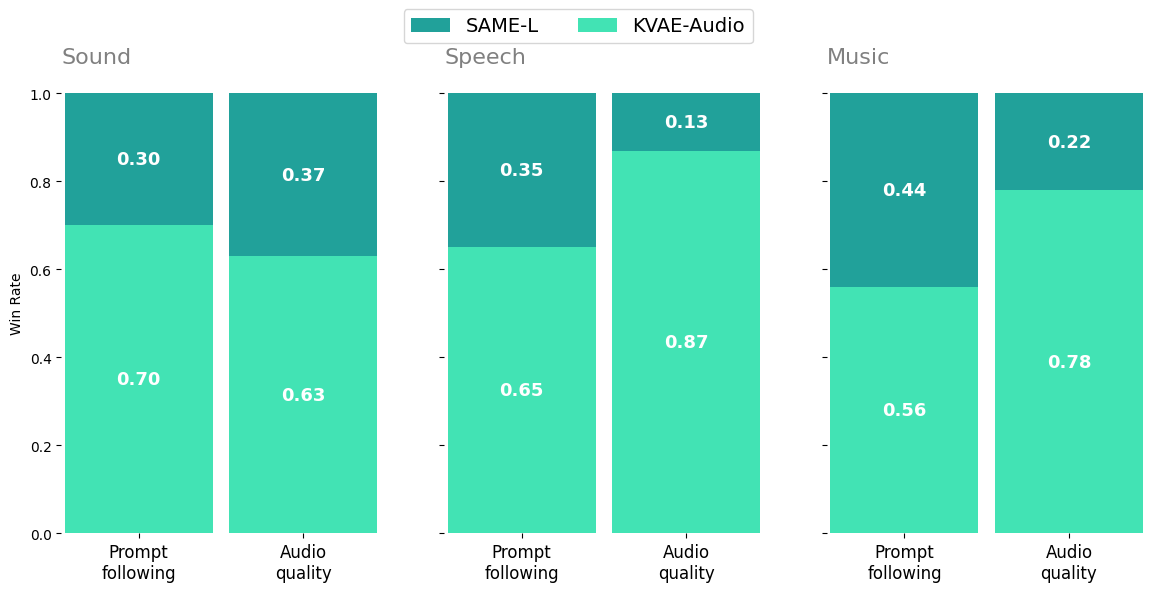
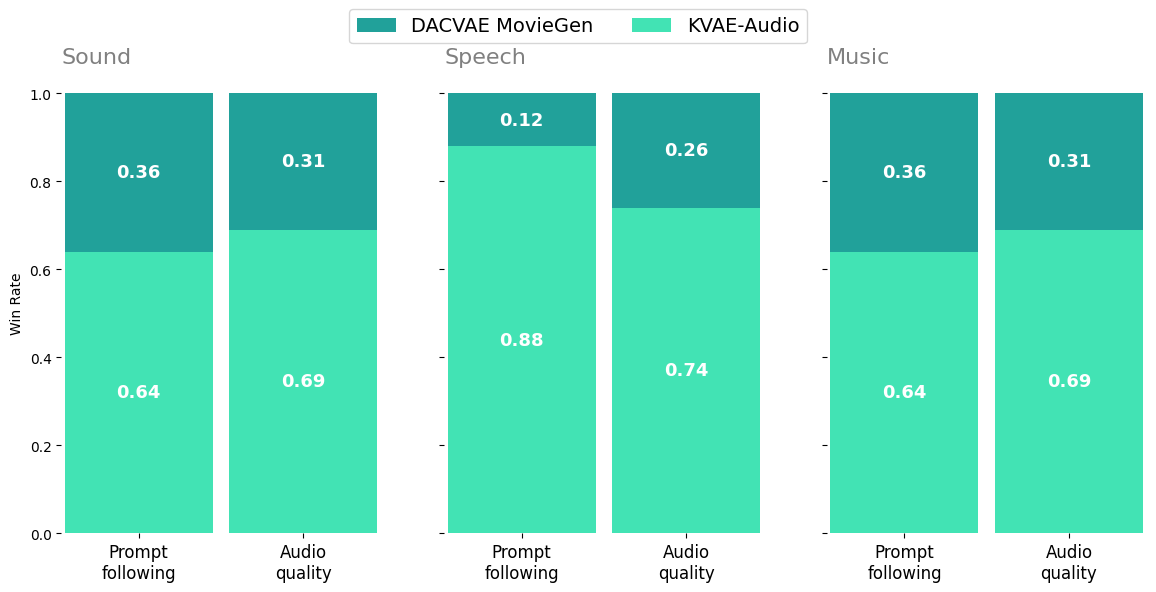
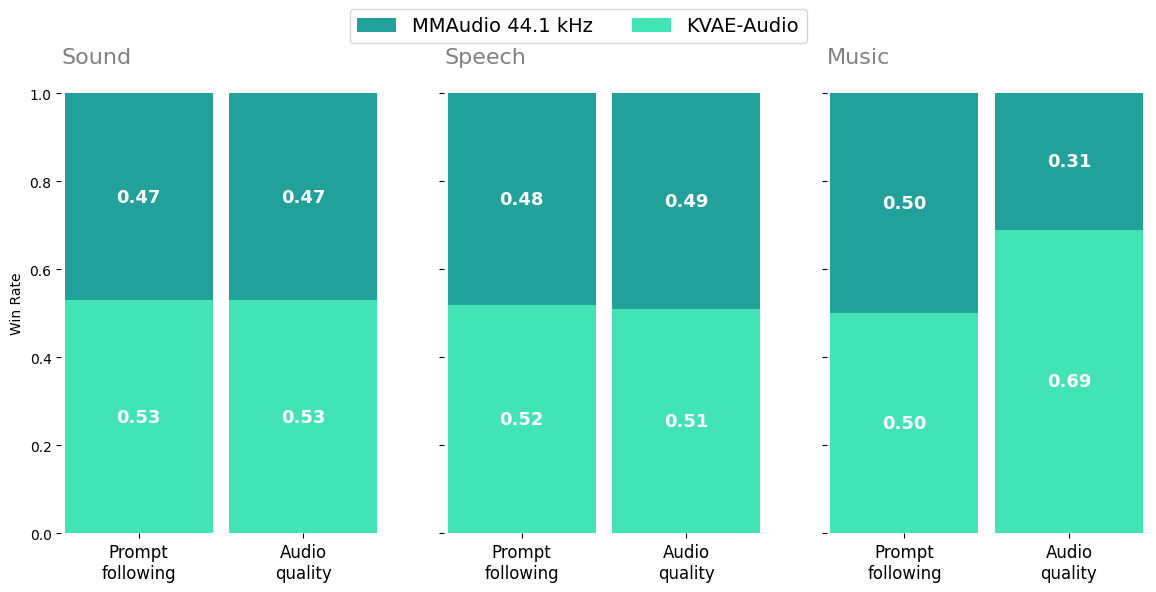
Below are qualitative examples generated from the same text prompts using four different models.
Prompt:
Low and gravelly, with a southern Russian accent, a man says slowly, <S>Я говорил тебе, что так и будет<E>. A sharp inhale precedes the line. The space is acoustically dry, with minimal room tone and a slight hiss.
Prompt:
In a home kitchen, oil sizzles in a pan, a knife chops on a board, and a woman hums softly in Russian, a refrigerator humming beneath it all. Small kitchen, light reverberation. High-fidelity.
Prompt:
In a large reverberant hall, a brass band launches into a lively march. Trumpets and cornets carry the melody while trombones drive the harmony, brisk and precise. Clean recording, natural reverb, faint equipment hiss.
| Model | # Params | Latent dim | CLAP↑ | CE↑ | PQ↑ | FAD (PANNs)↓ | FAD (PASST)↓ | FAD (VGGIsh)↓ |
|---|---|---|---|---|---|---|---|---|
| MMAudio 44.1kHz | 427.6M | 40 | 0,336 | 3,909 | 6,192 | 17,873 | 195,910 | 1,364 |
| DACVAE MovieGen | 107.7M | 128 | 0,313 | 3,772 | 6,167 | 20,558 | 234,312 | 1,700 |
| SAME-L | 852.1M | 256 | 0,322 | 3,588 | 5,756 | 18,446 | 240,635 | 1,325 |
| KVAE-Audio | 166.9M | 64 | 0,344 | 3,982 | 6,242 | 15,381 | 193,760 | 1,210 |
| Model | # Params | Latent dim | CLAP↑ | CE↑ | PQ↑ | FAD (PANNs)↓ | FAD (PASST)↓ | FAD (VGGIsh)↓ |
|---|---|---|---|---|---|---|---|---|
| MMAudio 44.1kHz | 427.6M | 40 | 0,356 | 7,136 | 7,707 | 5,412 | 158,599 | 0,356 |
| DACVAE MovieGen | 107.7M | 128 | 0,312 | 6,953 | 7,538 | 10,194 | 214,009 | 1,046 |
| SAME-L | 852.1M | 256 | 0,345 | 7,076 | 7,465 | 8,442 | 250,668 | 0,987 |
| KVAE-Audio | 166.9M | 64 | 0,339 | 7,216 | 7,929 | 7,971 | 189,427 | 0,599 |
| Model | # Params | Latent dim | CLAP↑ | CE↑ | PQ↑ | FAD (PANNs)↓ | FAD (PASST)↓ | FAD (VGGIsh)↓ | WER↓ | CER↓ |
|---|---|---|---|---|---|---|---|---|---|---|
| MMAudio 44.1kHz | 427.6M | 40 | 0,368 | 5,704 | 6,629 | 8,305 | 105,931 | 2,001 | 0,257 | 0,593 |
| DACVAE MovieGen | 107.7M | 128 | 0,413 | 5,482 | 7,052 | 5,008 | 210,478 | 1,501 | 0,911 | 1,048 |
| SAME-L | 852.1M | 256 | 0,379 | 4,617 | 5,024 | 10,257 | 301,508 | 2,721 | 0,349 | 0,629 |
| KVAE-Audio | 166.9M | 64 | 0,389 | 5,906 | 6,940 | 4,677 | 185,609 | 2,138 | 0,244 | 0,576 |
Reconstruction is evaluated on open datasets across domains (the released weights directly substantiate these numbers). Baselines: MMAudio 44.1 kHz VAE, DACVAE from MovieGen Audio, SAME-L (Stable Audio 3 VAE).
| Model | # Params | Latent dim | MEL↓ | STFT↓ | Waveform↓ | SI-SDR↑ | SDR↑ | SNR↑ |
|---|---|---|---|---|---|---|---|---|
| MMAudio 44.1kHz | 427.6M | 40 | 0,636 | 1,938 | 0,106 | -32,080 | -2,682 | -2,686 |
| DACVAE MovieGen | 107.7M | 128 | 0,669 | 2,275 | 0,029 | 8,384 | 9,421 | 9,416 |
| SAME-L | 852.1M | 256 | 0,986 | 2,726 | 0,027 | 9,586 | 10,347 | 10,339 |
| KVAE-Audio | 166.9M | 64 | 0,537 | 1,770 | 0,027 | 9,065 | 9,920 | 9,933 |
| Model | # Params | Latent dim | MEL↓ | STFT↓ | Waveform↓ | SI-SDR↑ | SDR↑ | SNR↑ |
|---|---|---|---|---|---|---|---|---|
| MMAudio 44.1kHz | 427.6M | 40 | 0,681 | 1,865 | 0,114 | -40,204 | -3,274 | -3,273 |
| DACVAE MovieGen | 107.7M | 128 | 0,519 | 1,762 | 0,024 | 9,688 | 10,046 | 10,047 |
| SAME-L | 852.1M | 256 | 0,668 | 1,786 | 0,023 | 10,278 | 10,648 | 10,648 |
| KVAE-Audio | 166.9M | 64 | 0,516 | 1,725 | 0,022 | 10,390 | 10,675 | 10,677 |
| Model | # Params | Latent dim | MEL↓ | STFT↓ | Waveform↓ | SI-SDR↑ | SDR↑ | SNR↑ | PESQ↑ |
|---|---|---|---|---|---|---|---|---|---|
| MMAudio 44.1kHz | 427.6M | 40 | 0,616 | 1,395 | 0,030 | -29,947 | -2,728 | -2,697 | 2,424 |
| DACVAE MovieGen | 107.7M | 128 | 0,453 | 1,310 | 0,006 | 10,264 | 10,680 | 10,681 | 4,246 |
| SAME-L | 852.1M | 256 | 0,774 | 1,575 | 0,007 | 9,939 | 10,374 | 10,376 | 2,982 |
| KVAE-Audio | 166.9M | 64 | 0,463 | 1,314 | 0,006 | 9,952 | 10,377 | 10,384 | 4,266 |
@misc{kvae_audio_2026,
    author = {Ivan Kirillov, Denis Parkhomenko, Alexander Ivanov, Azat Saginbaev, Egor Silvestrov, Denis Dimitrov},
    title = {KVAE-Audio: a full-band continuous audio tokenizer for generative models},
    howpublished = {\url{https://github.com/kandinskylab/kvae-audio}},
    year = 2026
}
kvae-audio/
├── kvae_audio/
│   ├── model/
│   │   ├── kvae_audio.py
│   │   └── base.py
│   ├── metrics/loss.py
│   └── nn/layers.py
└── scripts/
    ├── infer.py
    └── eval.py
427 followers · starred Jun 2026
1,111 followers · starred Jul 2026
970 followers · starred Jul 2026
340 followers · starred Jul 2026
KVAE-Audio: a continuous full-band audio waveform autoencoder
Python
123
31 commits
updated Aug 10, 2026
KVAE-Audio is a continuous, full-band (48 kHz) audio autoencoder. It compresses raw waveforms into compact continuous latents and reconstructs them with high fidelity across speech, music, and general sound. The model is designed not only for faithful reconstruction, but as a latent space for generative models — in our internal text-to-audio pipeline, swapping the autoencoder for KVAE-Audio improves generation quality under a fixed generator.
First install PyTorch (adjust for your CUDA setup):
pip install torch==2.11.0 torchvision==0.26.0 torchaudio==2.11.0 --index-url https://download.pytorch.org/whl/cu128
Then clone the repository and install KVAE-Audio from the local package:
git clone https://github.com/kandinskylab/kvae-audio.git
pip install -e ./kvae-audio
Tested with Python 3.14.
Checkpoint kvae-audio.pt is hosted on Hugging Face: kandinskylab/KVAE-Audio.
pip install huggingface_hub
hf download kandinskylab/KVAE-Audio kvae-audio.pt --local-dir .
Or from Python:
from huggingface_hub import hf_hub_download

weights_path = hf_hub_download("kandinskylab/KVAE-Audio", "kvae-audio.pt")
Place input wavs in input_samples. Reconstructions are written to output_samples.
python scripts/infer.py \
  --weights_path kvae-audio.pt \
  --input_path input_samples \
  --output_path output_samples
Compare reference wavs in input_samples against reconstructions in output_samples (same filenames). Writes metrics.csv to output_samples.
python scripts/eval.py \
  --input_path input_samples \
  --output_path output_samples
By default encode returns the mean latent (mu); pass sample=True for stochastic sampling. For end-to-end reconstruction, model(waveform, sample_rate)["audio"] is equivalent.
import torch
import soundfile as sf
from kvae_audio import KVAEAudio

model = KVAEAudio.load("kvae-audio.pt", map_location="cpu")
model.eval()

data, sr = sf.read("audio.wav")
waveform = torch.from_numpy(data).float().unsqueeze(0).unsqueeze(0)
length = waveform.shape[-1]

with torch.no_grad():
    latents, _, _, _ = model.encode(waveform, sample_rate=sr)
    audio = model.decode(latents)[..., :length]

sf.write("output.wav", audio.squeeze(0).T.numpy(), sr)
Generative quality is established under a fixed generator — same DiT architecture, training data, and number of steps — varying only the autoencoder. We report objective generation metrics and blind human side-by-side below.
Below are qualitative examples generated from the same text prompts using four different models.
Prompt:
Low and gravelly, with a southern Russian accent, a man says slowly, <S>Я говорил тебе, что так и будет<E>. A sharp inhale precedes the line. The space is acoustically dry, with minimal room tone and a slight hiss.
Prompt:
In a home kitchen, oil sizzles in a pan, a knife chops on a board, and a woman hums softly in Russian, a refrigerator humming beneath it all. Small kitchen, light reverberation. High-fidelity.
Prompt:
In a large reverberant hall, a brass band launches into a lively march. Trumpets and cornets carry the melody while trombones drive the harmony, brisk and precise. Clean recording, natural reverb, faint equipment hiss.
| Model | # Params | Latent dim | CLAP↑ | CE↑ | PQ↑ | FAD (PANNs)↓ | FAD (PASST)↓ | FAD (VGGIsh)↓ |
|---|---|---|---|---|---|---|---|---|
| MMAudio 44.1kHz | 427.6M | 40 | 0,336 | 3,909 | 6,192 | 17,873 | 195,910 | 1,364 |
| DACVAE MovieGen | 107.7M | 128 | 0,313 | 3,772 | 6,167 | 20,558 | 234,312 | 1,700 |
| SAME-L | 852.1M | 256 | 0,322 | 3,588 | 5,756 | 18,446 | 240,635 | 1,325 |
| KVAE-Audio | 166.9M | 64 | 0,344 | 3,982 | 6,242 | 15,381 | 193,760 | 1,210 |
| Model | # Params | Latent dim | CLAP↑ | CE↑ | PQ↑ | FAD (PANNs)↓ | FAD (PASST)↓ | FAD (VGGIsh)↓ |
|---|---|---|---|---|---|---|---|---|
| MMAudio 44.1kHz | 427.6M | 40 | 0,356 | 7,136 | 7,707 | 5,412 | 158,599 | 0,356 |
| DACVAE MovieGen | 107.7M | 128 | 0,312 | 6,953 | 7,538 | 10,194 | 214,009 | 1,046 |
| SAME-L | 852.1M | 256 | 0,345 | 7,076 | 7,465 | 8,442 | 250,668 | 0,987 |
| KVAE-Audio | 166.9M | 64 | 0,339 | 7,216 | 7,929 | 7,971 | 189,427 | 0,599 |
| Model | # Params | Latent dim | CLAP↑ | CE↑ | PQ↑ | FAD (PANNs)↓ | FAD (PASST)↓ | FAD (VGGIsh)↓ | WER↓ | CER↓ |
|---|---|---|---|---|---|---|---|---|---|---|
| MMAudio 44.1kHz | 427.6M | 40 | 0,368 | 5,704 | 6,629 | 8,305 | 105,931 | 2,001 | 0,257 | 0,593 |
| DACVAE MovieGen | 107.7M | 128 | 0,413 | 5,482 | 7,052 | 5,008 | 210,478 | 1,501 | 0,911 | 1,048 |
| SAME-L | 852.1M | 256 | 0,379 | 4,617 | 5,024 | 10,257 | 301,508 | 2,721 | 0,349 | 0,629 |
| KVAE-Audio | 166.9M | 64 | 0,389 | 5,906 | 6,940 | 4,677 | 185,609 | 2,138 | 0,244 | 0,576 |
Reconstruction is evaluated on open datasets across domains (the released weights directly substantiate these numbers). Baselines: MMAudio 44.1 kHz VAE, DACVAE from MovieGen Audio, SAME-L (Stable Audio 3 VAE).
| Model | # Params | Latent dim | MEL↓ | STFT↓ | Waveform↓ | SI-SDR↑ | SDR↑ | SNR↑ |
|---|---|---|---|---|---|---|---|---|
| MMAudio 44.1kHz | 427.6M | 40 | 0,636 | 1,938 | 0,106 | -32,080 | -2,682 | -2,686 |
| DACVAE MovieGen | 107.7M | 128 | 0,669 | 2,275 | 0,029 | 8,384 | 9,421 | 9,416 |
| SAME-L | 852.1M | 256 | 0,986 | 2,726 | 0,027 | 9,586 | 10,347 | 10,339 |
| KVAE-Audio | 166.9M | 64 | 0,537 | 1,770 | 0,027 | 9,065 | 9,920 | 9,933 |
| Model | # Params | Latent dim | MEL↓ | STFT↓ | Waveform↓ | SI-SDR↑ | SDR↑ | SNR↑ |
|---|---|---|---|---|---|---|---|---|
| MMAudio 44.1kHz | 427.6M | 40 | 0,681 | 1,865 | 0,114 | -40,204 | -3,274 | -3,273 |
| DACVAE MovieGen | 107.7M | 128 | 0,519 | 1,762 | 0,024 | 9,688 | 10,046 | 10,047 |
| SAME-L | 852.1M | 256 | 0,668 | 1,786 | 0,023 | 10,278 | 10,648 | 10,648 |
| KVAE-Audio | 166.9M | 64 | 0,516 | 1,725 | 0,022 | 10,390 | 10,675 | 10,677 |
| Model | # Params | Latent dim | MEL↓ | STFT↓ | Waveform↓ | SI-SDR↑ | SDR↑ | SNR↑ | PESQ↑ |
|---|---|---|---|---|---|---|---|---|---|
| MMAudio 44.1kHz | 427.6M | 40 | 0,616 | 1,395 | 0,030 | -29,947 | -2,728 | -2,697 | 2,424 |
| DACVAE MovieGen | 107.7M | 128 | 0,453 | 1,310 | 0,006 | 10,264 | 10,680 | 10,681 | 4,246 |
| SAME-L | 852.1M | 256 | 0,774 | 1,575 | 0,007 | 9,939 | 10,374 | 10,376 | 2,982 |
| KVAE-Audio | 166.9M | 64 | 0,463 | 1,314 | 0,006 | 9,952 | 10,377 | 10,384 | 4,266 |
@misc{kvae_audio_2026,
    author = {Ivan Kirillov, Denis Parkhomenko, Alexander Ivanov, Azat Saginbaev, Egor Silvestrov, Denis Dimitrov},
    title = {KVAE-Audio: a full-band continuous audio tokenizer for generative models},
    howpublished = {\url{https://github.com/kandinskylab/kvae-audio}},
    year = 2026
}
kvae-audio/
├── kvae_audio/
│   ├── model/
│   │   ├── kvae_audio.py
│   │   └── base.py
│   ├── metrics/loss.py
│   └── nn/layers.py
└── scripts/
    ├── infer.py
    └── eval.py
427 followers · starred Jun 2026
1,111 followers · starred Jul 2026
970 followers · starred Jul 2026
340 followers · starred Jul 2026



