Humanoid locomotion, navigation, and language-guided manipulation in simulation: Isaac Lab/MuJoCo studies, sensor tests, and reproducible evaluation gates.
Python
0
656 commits
updated Oct 15, 2026
Train humanoid policies in Isaac Lab, then measure how they walk, turn, and navigate in MuJoCo. Humanoid Robustness Ladder combines learned control with reproducible evaluations and sensor studies.
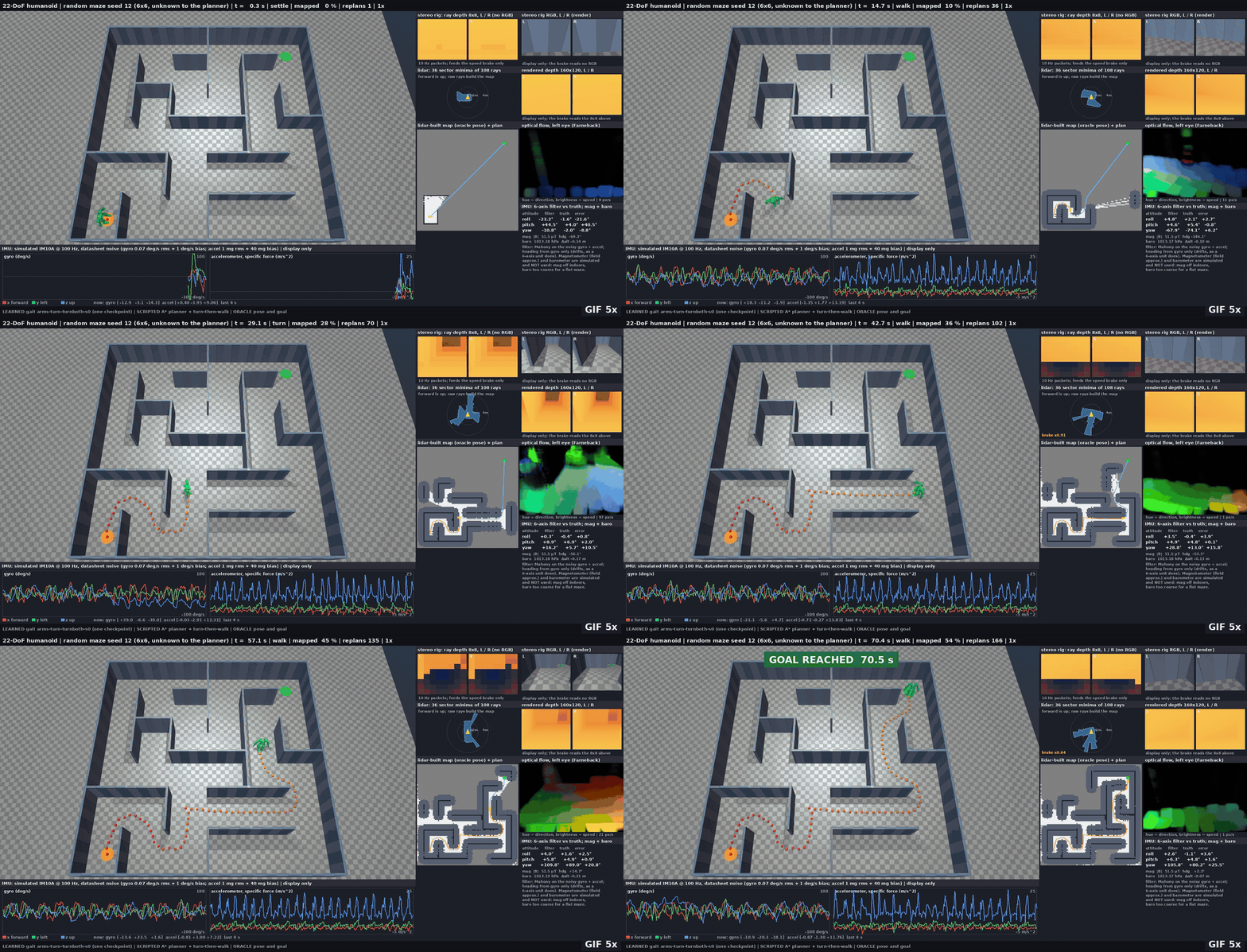
Selected MuJoCo rollout: learned gait, scripted A planner, lidar-built map, and oracle pose/goal. Other sensor panels are display only. Playback is accelerated. This is simulation-to-simulation; physical locomotion transfer remains unvalidated.*
Case study · Results · Setup · Demo gallery · Research overview
A policy can earn more training reward and still fall in another simulator. I built task overlays, checkpoint qualification, sensor checks, and experiment drivers to measure that gap before promoting a policy.
The robot design and deployment controller come from Berkeley Humanoid Lite. My work adds locomotion and navigation experiments, MuJoCo scoring, portable regression replay, and published controls and failures.
These are saved study results, not new measurements from this documentation refresh.
| Study | Measured result | Scope and evidence |
|---|---|---|
| Domain randomization | Default: 0/360 flat falls; no randomization: 77/360. | 12-DoF biped, three training seeds per setting, part of a 3,600-episode simulation confirmation. Verdict. |
| Navigation command filter | 259/288 goals versus 247/288 baseline; 0 versus 9 observed falls. | 576 matched episodes across three actors; oracle pose/goal. Shared layouts are clustered observations; wall contacts remain. Protocol and results. |
| Portable replay | 5/5 seeded trajectories reproduced on a second HPC host. | Frozen CPU bundle and runtime; no claim of general cross-platform determinism. Comparison. |
Negative findings remain part of the project: the matched IMU-history ablation did not qualify, and stereo-pose navigation remained limited. H3/H4 report · Native sensor report.
October 12 follow-ups: 48 native scheduling simulations completed, with LiDAR–IMU clean goals 0/12 → 11/12 and stereo 0/12 in both schedules. EuRoC replay completed on 1,200 stereo pairs per native mode. Both reports retain timing, order and validation limits.
flowchart LR
  A[Isaac Lab tasks] --> B[PPO checkpoints]
  B --> C[ONNX export]
  C --> D[MuJoCo controller replay]
  D --> E[Task scores and recordings]
  E --> F[Checkpoint gate]
| Code | Responsibility |
|---|---|
| Task overlays | Observations, rewards, and curricula. |
| Evaluation | MuJoCo replay, sensing, and scoring. |
| Benchmark scripts | Matched comparisons and checkpoint gates. |
| Slurm launchers | Training and evaluation jobs on the research cluster. |
| Results | Saved scores, provenance, and recordings. |
The CPU suite uses Python 3.11. Training additionally needs the documented Isaac environment, GPU resources, and cluster configuration. Some historical results reference external assets that are not public downloads; see reproducibility requirements.
git -c url.https://github.com/.insteadOf=git@github.com: clone \
  --recurse-submodules https://github.com/joses2017smjh/bhl-robustness-ladder.git
cd bhl-robustness-ladder
python3.11 -m venv .venv-cpu
source .venv-cpu/bin/activate
python -m pip install torch==2.7.0 torchvision==0.22.0 \
  --index-url https://download.pytorch.org/whl/cpu
python -m pip install -r requirements-test.txt
python -m pip check
OMP_NUM_THREADS=1 OPENBLAS_NUM_THREADS=1 MKL_NUM_THREADS=1 \
  PYTHONPATH=src:external/Berkeley-Humanoid-Lite/source/berkeley_humanoid_lite_lowlevel \
  python -m pytest -q tests
These commands match the CPU workflow. Tests cover logic and artifact contracts; simulator and asset prerequisites cause documented optional skips. The saved October 8 validation receipt records 1,998 tests plus six subtests passing, with 123 skips. That receipt is historical, not a new full-suite run.
For a frozen trained-policy replay, start with the included portable bundle and its USAGE.txt. Bundle provenance, timing scope, and detailed instructions.
Slurm launchers describe the original Isaac Sim 5.1 / Isaac Lab 2.3.2 stack; newer campaigns use a separate 6.0 / 3.0 environment. Adapt account, partition, dependencies, and paths before submitting jobs. The research overview retains the full setup and campaign history.
Physical Quest arm teleoperation is a separate project. The sensor rig plan describes pending calibration and hardware validation. Repository boundaries and transfer milestones explain the proposed next step.
Python · PyTorch · Isaac Lab / Isaac Sim · MuJoCo · ONNX Runtime · Warp · rsl-rl · Slurm · Apptainer.
Upstream robot code, models, and assets retain their respective licenses. This repository currently has no repository-level license.
Humanoid locomotion, navigation, and language-guided manipulation in simulation: Isaac Lab/MuJoCo studies, sensor tests, and reproducible evaluation gates.
Python
0
656 commits
updated Oct 15, 2026
Train humanoid policies in Isaac Lab, then measure how they walk, turn, and navigate in MuJoCo. Humanoid Robustness Ladder combines learned control with reproducible evaluations and sensor studies.
Selected MuJoCo rollout: learned gait, scripted A planner, lidar-built map, and oracle pose/goal. Other sensor panels are display only. Playback is accelerated. This is simulation-to-simulation; physical locomotion transfer remains unvalidated.*
Case study · Results · Setup · Demo gallery · Research overview
A policy can earn more training reward and still fall in another simulator. I built task overlays, checkpoint qualification, sensor checks, and experiment drivers to measure that gap before promoting a policy.
The robot design and deployment controller come from Berkeley Humanoid Lite. My work adds locomotion and navigation experiments, MuJoCo scoring, portable regression replay, and published controls and failures.
These are saved study results, not new measurements from this documentation refresh.
| Study | Measured result | Scope and evidence |
|---|---|---|
| Domain randomization | Default: 0/360 flat falls; no randomization: 77/360. | 12-DoF biped, three training seeds per setting, part of a 3,600-episode simulation confirmation. Verdict. |
| Navigation command filter | 259/288 goals versus 247/288 baseline; 0 versus 9 observed falls. | 576 matched episodes across three actors; oracle pose/goal. Shared layouts are clustered observations; wall contacts remain. Protocol and results. |
| Portable replay | 5/5 seeded trajectories reproduced on a second HPC host. | Frozen CPU bundle and runtime; no claim of general cross-platform determinism. Comparison. |
Negative findings remain part of the project: the matched IMU-history ablation did not qualify, and stereo-pose navigation remained limited. H3/H4 report · Native sensor report.
October 12 follow-ups: 48 native scheduling simulations completed, with LiDAR–IMU clean goals 0/12 → 11/12 and stereo 0/12 in both schedules. EuRoC replay completed on 1,200 stereo pairs per native mode. Both reports retain timing, order and validation limits.
flowchart LR
  A[Isaac Lab tasks] --> B[PPO checkpoints]
  B --> C[ONNX export]
  C --> D[MuJoCo controller replay]
  D --> E[Task scores and recordings]
  E --> F[Checkpoint gate]
| Code | Responsibility |
|---|---|
| Task overlays | Observations, rewards, and curricula. |
| Evaluation | MuJoCo replay, sensing, and scoring. |
| Benchmark scripts | Matched comparisons and checkpoint gates. |
| Slurm launchers | Training and evaluation jobs on the research cluster. |
| Results | Saved scores, provenance, and recordings. |
The CPU suite uses Python 3.11. Training additionally needs the documented Isaac environment, GPU resources, and cluster configuration. Some historical results reference external assets that are not public downloads; see reproducibility requirements.
git -c url.https://github.com/.insteadOf=git@github.com: clone \
  --recurse-submodules https://github.com/joses2017smjh/bhl-robustness-ladder.git
cd bhl-robustness-ladder
python3.11 -m venv .venv-cpu
source .venv-cpu/bin/activate
python -m pip install torch==2.7.0 torchvision==0.22.0 \
  --index-url https://download.pytorch.org/whl/cpu
python -m pip install -r requirements-test.txt
python -m pip check
OMP_NUM_THREADS=1 OPENBLAS_NUM_THREADS=1 MKL_NUM_THREADS=1 \
  PYTHONPATH=src:external/Berkeley-Humanoid-Lite/source/berkeley_humanoid_lite_lowlevel \
  python -m pytest -q tests
These commands match the CPU workflow. Tests cover logic and artifact contracts; simulator and asset prerequisites cause documented optional skips. The saved October 8 validation receipt records 1,998 tests plus six subtests passing, with 123 skips. That receipt is historical, not a new full-suite run.
For a frozen trained-policy replay, start with the included portable bundle and its USAGE.txt. Bundle provenance, timing scope, and detailed instructions.
Slurm launchers describe the original Isaac Sim 5.1 / Isaac Lab 2.3.2 stack; newer campaigns use a separate 6.0 / 3.0 environment. Adapt account, partition, dependencies, and paths before submitting jobs. The research overview retains the full setup and campaign history.
Physical Quest arm teleoperation is a separate project. The sensor rig plan describes pending calibration and hardware validation. Repository boundaries and transfer milestones explain the proposed next step.
Python · PyTorch · Isaac Lab / Isaac Sim · MuJoCo · ONNX Runtime · Warp · rsl-rl · Slurm · Apptainer.
Upstream robot code, models, and assets retain their respective licenses. This repository currently has no repository-level license.