Medical dialogue summarization with BioBART-large LoRA and Flask EHR workflow
Jupyter Notebook
0
56 commits
updated Sep 2, 2026


A local Flask application that helps clinicians turn a post-visit doctor-patient transcript into copy-ready EHR sections. The clinician pastes the full transcript, selects only the sections needed for that encounter, reviews each generated block, and copies it into the EHR.
This is a continuation of a Deep Learning course project for the University of Surrey. The original BART fine-tuning approach is preserved; the default backbone is now GanjinZero/biobart-large, a biomedical BART model released in 2022.
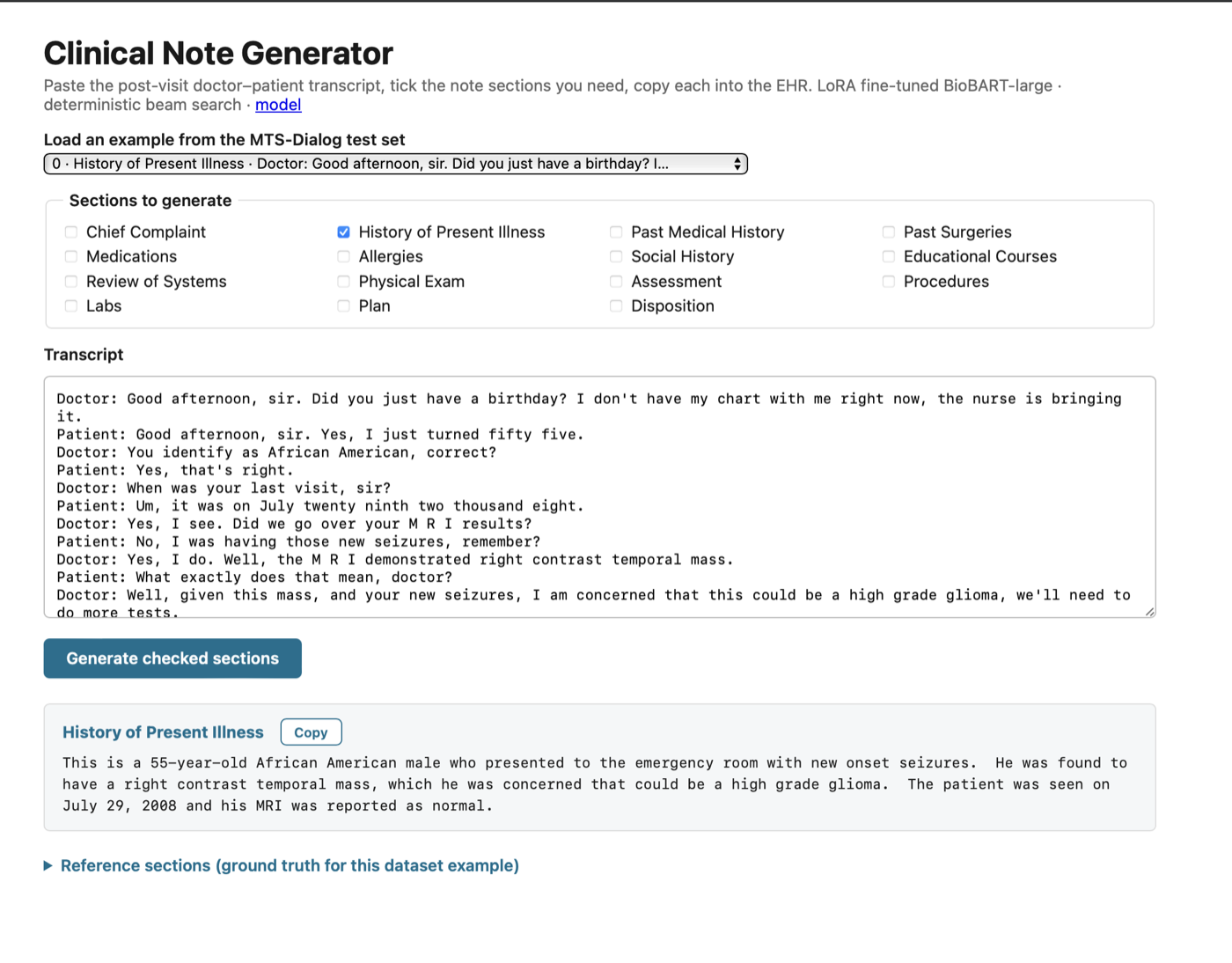
Run the doctor-facing application:
python app.py
Open http://127.0.0.1:5002.
The workflow is deliberately section-based because the MTS-Dialog training data pairs each dialogue with a documented EHR section. It does not force irrelevant sections into every note.
None. and Noncontributory. are visibly flagged.The older dataset-table explorer remains available:
python eval.py
Open http://127.0.0.1:5001.
The committed adapter is biobart-large-lora/. It contains only the LoRA adapter and tokenizer; the 407M-parameter BioBART-large base downloads from Hugging Face on first use.
GanjinZero/biobart-largejonleed/clinical-note-biobart-large-loraq_proj and v_projEvaluation uses the same prompt and section-target construction as the original notebook. Scores use ROUGE with stemming on 100 validation dialogues, seed 42.
| BioBART-large LoRA evaluation | ROUGE-1 | ROUGE-2 | ROUGE-L | ROUGE-Lsum |
|---|---|---|---|---|
| 100 validation dialogues, seed 42 | 0.553 | 0.325 | 0.472 | 0.474 |
The evaluation output is checked in at results/eval-biobart-large-2026-08.json.
Using the same validation split, seed, prompt construction, token limits, deterministic decoding, and ROUGE scorer:
| Model | ROUGE-1 | ROUGE-2 | ROUGE-L | ROUGE-Lsum |
|---|---|---|---|---|
| BART-base, no adapter | 0.2195 | 0.0746 | 0.1673 | 0.1671 |
| BART-base with LoRA | 0.4987 | 0.2858 | 0.4342 | 0.4336 |
| BioBART-large with LoRA | 0.5589 | 0.3334 | 0.4803 | 0.4803 |
The complete study record is results/model-study-2026-08.json. The results show the value of the original LoRA fine-tuning approach and support BioBART-large as the project's selected backbone.
Run the original notebook-style evaluation:
python eval_notebook_protocol.py --split val
Run the Flask integration evaluation through the actual test client:
python eval_app_integration.py --app note --n 100
python eval_app_integration.py --app section --n 100
The BioBART-large adapter produced ROUGE-L 0.4719 through the Flask integration path. This confirms that the served application and evaluation use the same adapter, prompt, input length, and deterministic decode.
git clone --recurse-submodules https://github.com/jonleed/Medical-Dialogue-Summary.git
cd Medical-Dialogue-Summary
python3 -m venv .venv
source .venv/bin/activate
pip install -r requirements.txt
python app.py
| Environment variable | Default | Purpose |
|---|---|---|
BASE_MODEL_ID | GanjinZero/biobart-large | Base seq2seq model |
ADAPTER_MODEL_ID | ./biobart-large-lora | Local or Hugging Face LoRA adapter |
HF_TOKEN | unset | Optional Hugging Face authentication |
train_lora.py mirrors the original notebook while using BioBART-large by default:
python train_lora.py \
  --base_model GanjinZero/biobart-large \
  --output_dir ./biobart-large-lora \
  --per_device_batch 2 \
  --grad_accum 4 \
  --epochs 20
The original notebook recipe is retained in Medical_Dialogue_Generation.ipynb. Training uses the MTS-Dialog training split, the original prompt and target construction, 512-token inputs, 256-token targets, learning rate 2e-4, weight decay 0.01, and per-epoch validation ROUGE. The effective batch size is 8 in the recommended command.
graph LR
    A["Full doctor-patient transcript"] --> B["Clinician selects EHR sections"]
    B --> C["Original section prompt"]
    C --> D["BioBART-large"]
    D --> E["LoRA adapter"]
    E --> F["Deterministic beam search"]
    F --> G["Reviewable EHR section"]
The original project used BART-base with LoRA. The restoration preserves that approach and improves the deployable artifact by:
This project is educational and is not a medical device.
Medical dialogue summarization with BioBART-large LoRA and Flask EHR workflow
Jupyter Notebook
0
56 commits
updated Sep 2, 2026
A local Flask application that helps clinicians turn a post-visit doctor-patient transcript into copy-ready EHR sections. The clinician pastes the full transcript, selects only the sections needed for that encounter, reviews each generated block, and copies it into the EHR.
This is a continuation of a Deep Learning course project for the University of Surrey. The original BART fine-tuning approach is preserved; the default backbone is now GanjinZero/biobart-large, a biomedical BART model released in 2022.
Run the doctor-facing application:
python app.py
Open http://127.0.0.1:5002.
The workflow is deliberately section-based because the MTS-Dialog training data pairs each dialogue with a documented EHR section. It does not force irrelevant sections into every note.
None. and Noncontributory. are visibly flagged.The older dataset-table explorer remains available:
python eval.py
Open http://127.0.0.1:5001.
The committed adapter is biobart-large-lora/. It contains only the LoRA adapter and tokenizer; the 407M-parameter BioBART-large base downloads from Hugging Face on first use.
GanjinZero/biobart-largejonleed/clinical-note-biobart-large-loraq_proj and v_projEvaluation uses the same prompt and section-target construction as the original notebook. Scores use ROUGE with stemming on 100 validation dialogues, seed 42.
| BioBART-large LoRA evaluation | ROUGE-1 | ROUGE-2 | ROUGE-L | ROUGE-Lsum |
|---|---|---|---|---|
| 100 validation dialogues, seed 42 | 0.553 | 0.325 | 0.472 | 0.474 |
The evaluation output is checked in at results/eval-biobart-large-2026-08.json.
Using the same validation split, seed, prompt construction, token limits, deterministic decoding, and ROUGE scorer:
| Model | ROUGE-1 | ROUGE-2 | ROUGE-L | ROUGE-Lsum |
|---|---|---|---|---|
| BART-base, no adapter | 0.2195 | 0.0746 | 0.1673 | 0.1671 |
| BART-base with LoRA | 0.4987 | 0.2858 | 0.4342 | 0.4336 |
| BioBART-large with LoRA | 0.5589 | 0.3334 | 0.4803 | 0.4803 |
The complete study record is results/model-study-2026-08.json. The results show the value of the original LoRA fine-tuning approach and support BioBART-large as the project's selected backbone.
Run the original notebook-style evaluation:
python eval_notebook_protocol.py --split val
Run the Flask integration evaluation through the actual test client:
python eval_app_integration.py --app note --n 100
python eval_app_integration.py --app section --n 100
The BioBART-large adapter produced ROUGE-L 0.4719 through the Flask integration path. This confirms that the served application and evaluation use the same adapter, prompt, input length, and deterministic decode.
git clone --recurse-submodules https://github.com/jonleed/Medical-Dialogue-Summary.git
cd Medical-Dialogue-Summary
python3 -m venv .venv
source .venv/bin/activate
pip install -r requirements.txt
python app.py
| Environment variable | Default | Purpose |
|---|---|---|
BASE_MODEL_ID | GanjinZero/biobart-large | Base seq2seq model |
ADAPTER_MODEL_ID | ./biobart-large-lora | Local or Hugging Face LoRA adapter |
HF_TOKEN | unset | Optional Hugging Face authentication |
train_lora.py mirrors the original notebook while using BioBART-large by default:
python train_lora.py \
  --base_model GanjinZero/biobart-large \
  --output_dir ./biobart-large-lora \
  --per_device_batch 2 \
  --grad_accum 4 \
  --epochs 20
The original notebook recipe is retained in Medical_Dialogue_Generation.ipynb. Training uses the MTS-Dialog training split, the original prompt and target construction, 512-token inputs, 256-token targets, learning rate 2e-4, weight decay 0.01, and per-epoch validation ROUGE. The effective batch size is 8 in the recommended command.
graph LR
    A["Full doctor-patient transcript"] --> B["Clinician selects EHR sections"]
    B --> C["Original section prompt"]
    C --> D["BioBART-large"]
    D --> E["LoRA adapter"]
    E --> F["Deterministic beam search"]
    F --> G["Reviewable EHR section"]
The original project used BART-base with LoRA. The restoration preserves that approach and improves the deployable artifact by:
This project is educational and is not a medical device.





