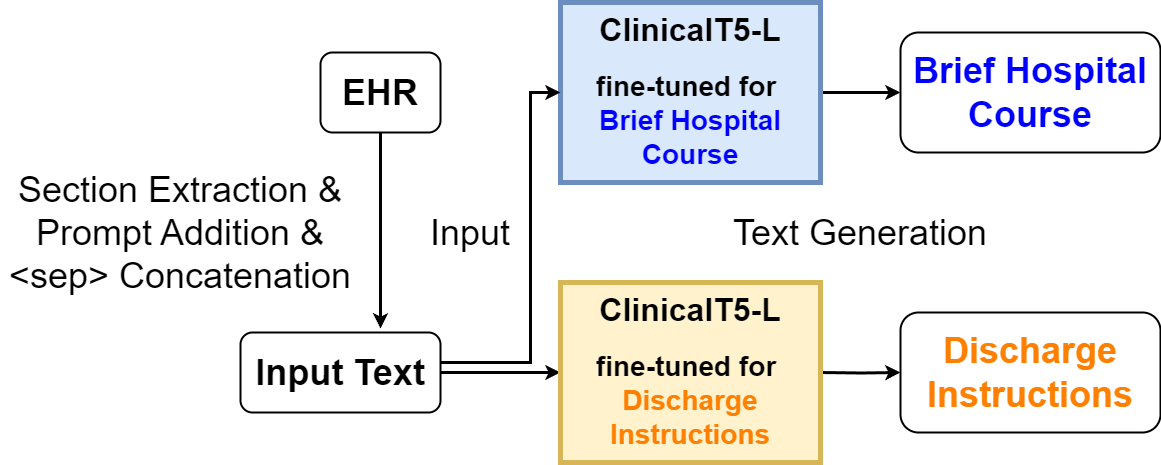
 Overview of our pipeline. To create input text, we extract sections from the EHR, add explanatory prompts, and then concatenate them with <sep> tokens. We then generate discharge summaries using ClnicalT5-large, which has been fine-tuned for each target.
pip install transformers==4.39.3
pip install torch==2.2.1
We employ the ClinicalT5-Large[1] model for our tasks. To fine-tune this model, utilize the provided train.py script as demonstrated below:
python train.py --fold=1 --batch_size=2 --target="brief_hospital_course" --model_name="luqh/ClinicalT5-large"
After fine-tuned model, you can use generate text like:
import pandas as pd
from generation import generate_summary

# Please provide the path for the input file.
df_input = ""

# Generate summary for "brief hospital course"
# Please provide the path of the fine-tuned model for brief hospital course.
model_name = ""
summary1 = generate_summary(df_input=df_input, model_name=model_name, target="brief_hospital_course")

# Generate summary for "discharge instructions"
# Please provide the path of the fine-tuned model for discharge instructions.
model_name = ""
summary2 = generate_summary(df_input=df_input, model_name=model_name, target="discharge_instructions")
The over-all score is calculated by first averaging the eight scores for each target, then averaging the values for the two targets.
You can use this to calculate you score:
from metrics import compute_overall_score

# Please provide the data of the generated summaries
# Please provide the data of the reference text
score = compute_overall_score(rows_ref=, rows_gen=):
print(score)
If you didn't implement the official scoring metrics, please take a look at https://github.com/Stanford-AIMI/discharge-me/blob/main/scoring.
[1] Qiuhao Lu, Dejing Dou, Thien Huu Nguyen: ClinicalT5: A Generative Language Model for Clinical Text. EMNL(Findings) 2022: 5436-5443
Please cite our paper if it's help for your work! @
Overview of our pipeline. To create input text, we extract sections from the EHR, add explanatory prompts, and then concatenate them with <sep> tokens. We then generate discharge summaries using ClnicalT5-large, which has been fine-tuned for each target.
pip install transformers==4.39.3
pip install torch==2.2.1
We employ the ClinicalT5-Large[1] model for our tasks. To fine-tune this model, utilize the provided train.py script as demonstrated below:
python train.py --fold=1 --batch_size=2 --target="brief_hospital_course" --model_name="luqh/ClinicalT5-large"
After fine-tuned model, you can use generate text like:
import pandas as pd
from generation import generate_summary

# Please provide the path for the input file.
df_input = ""

# Generate summary for "brief hospital course"
# Please provide the path of the fine-tuned model for brief hospital course.
model_name = ""
summary1 = generate_summary(df_input=df_input, model_name=model_name, target="brief_hospital_course")

# Generate summary for "discharge instructions"
# Please provide the path of the fine-tuned model for discharge instructions.
model_name = ""
summary2 = generate_summary(df_input=df_input, model_name=model_name, target="discharge_instructions")
The over-all score is calculated by first averaging the eight scores for each target, then averaging the values for the two targets.
You can use this to calculate you score:
from metrics import compute_overall_score

# Please provide the data of the generated summaries
# Please provide the data of the reference text
score = compute_overall_score(rows_ref=, rows_gen=):
print(score)
If you didn't implement the official scoring metrics, please take a look at https://github.com/Stanford-AIMI/discharge-me/blob/main/scoring.
[1] Qiuhao Lu, Dejing Dou, Thien Huu Nguyen: ClinicalT5: A Generative Language Model for Clinical Text. EMNL(Findings) 2022: 5436-5443
Please cite our paper if it's help for your work! @



