
Small decision models that return a probability for every option of typed questions in one forward pass
Python
1
2 commits
updated Oct 5, 2026
See what people are saying
README
jiwo
jiwo models read a state and typed questions, and return a probability for every option in one forward pass. They do not generate text. On one H100, the median request takes about 50 ms.
The request and response format is the format of TypeSafe's Jev API (POST /v1/systemone). jiwo is an independent
project. TypeSafe does not endorse it.
Models
On the Decision Index, jiwo-0.8b has the highest score of all models under 1B parameters. jiwo-4b is first in the 3–6B class of the live board, and second when open submissions are included.
| Model | Base | Parameters | Decision Index 0.2.1 | Live board | Board and open submissions¹ | Licence |
|---|---|---|---|---|---|---|
| jiwo-0.8b | Qwen3.5-0.8B | 0.75B | 28.00 | 1st of 23 (under 1B) | 1st of 33 (under 1B) | Apache-2.0 |
| jiwo-4b | Qwen3.5-4B | 4.2B | 44.97 | 1st of 18 (3–6B) | 2nd of 27 (3–6B) | Apache-2.0 |
Against the untrained base model and the best other fine-tune of the same base model:
| Model | Untrained base² | Best other on the live board | Best other including open submissions¹ |
|---|---|---|---|
| jiwo-0.8b (28.00) | Qwen3.5-0.8B, 6.99: +21.0 points | JPT-0.8B, 19.22: +45.7% | Sifr 0.8B v3.1, 26.88: +4.2% |
| jiwo-4b (44.97) | Qwen3.5-4B, 29.20: +15.8 points | JPT-4B, 43.04: +4.5% | ezjev-4b-s2, 51.15: −12.1% |
¹ Complete runs in open pull requests (as of 2026-10-04) with a readable scores.json and a median latency under
1,000 ms, the limit of the board. The board's smallest class is 1.3B parameters or less. In that class, one open
submission scores higher than jiwo-0.8b: EXAONE-4.0-1.2B-JEV v0.3 (1.28B parameters, 30.29). One slower Qwen3.5-4B
submission also scores higher than jiwo-4b: Wald-Q4B v1.1 (54.59, median 2,360 ms).
² The untrained base model, run through the same server on the full suite, with its answer temperatures fitted on the same calibration data as jiwo.
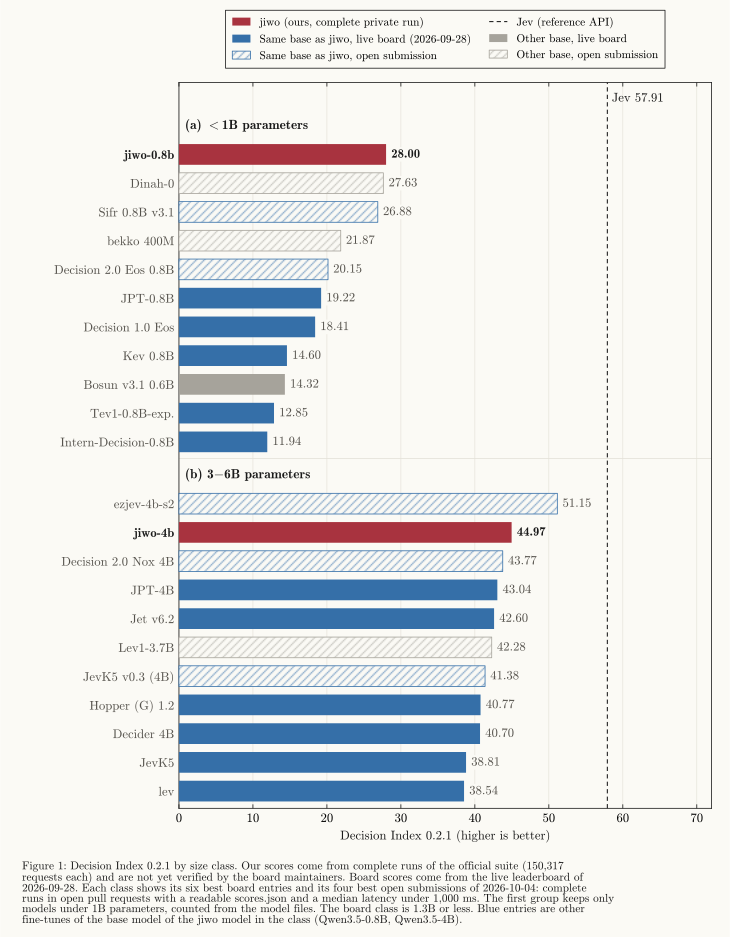
The scores come from complete runs of the suite (150,317 requests per model), served by jiwo serve. The board
maintainers did not verify them yet. The board ranks use the live board of 2026-09-28. The training data is mostly
English. Other languages are not evaluated.
Install
jiwo needs Python 3.12.
pip install "jiwo @ git+https://github.com/jiwidi/jiwo"
Or work in a checkout with uv:
git clone https://github.com/jiwidi/jiwo
cd jiwo
uv sync                  # on NVIDIA GPUs, add --extra cuda for the fast linear-attention kernels
On a CPU, use float32 (the default). Torch has no fast bfloat16 matrix product on many CPUs. On Apple silicon, bfloat16 is several times slower than float32.
Quickstart
from jiwo.model import DecisionModel

model = DecisionModel.from_pretrained("eljiwo/jiwo-0.8b")
question = {"type": "noul", "instructions": "The customer is angry."}
response = model.decide("Refund please, the parcel arrived crushed.", {"angry": question})
print(response["answers"]["angry"]["noul"])  # the probability that the statement is true
from_pretrained also accepts a local checkpoint directory. Use eljiwo/jiwo-4b for the larger model. The first
call downloads the model into the Hugging Face cache.
Serve
JIWO_CHECKPOINT=eljiwo/jiwo-0.8b jiwo serve
The server listens on 127.0.0.1:8765. It answers POST /v1/systemone. GET /health and GET /v1/models give the
status and the model name.
Send one request:
curl -s localhost:8765/v1/systemone -H 'content-type: application/json' -d '{
  "state": "Refund please, the parcel arrived crushed.",
  "questions": {
    "team":  {"type": "choice", "instructions": "Which team handles this?",
              "criteria": {"billing": "Payments and refunds", "shipping": "Damaged or lost parcels", "account": null}},
    "angry": {"type": "noul", "instructions": "The customer is angry."},
    "urgency": {"type": "score", "instructions": "How urgent is it?", "criteria": ["Not urgent", "Soon", "Now"]}}}'
The response has one answer for each question. The numbers below are synthetic. They show the format only.
{
  "model": "jiwo-0.8b",
  "answers": {
    "team": {"type": "choice", "choice": "shipping", "confidence": 0.895,
             "probabilities": {"billing": 0.05, "shipping": 0.93, "account": 0.02}},
    "angry": {"type": "noul", "noul": 0.71},
    "urgency": {"type": "score", "score": 1.1, "confidence": 0.55,
                "legend": {"0": "Not urgent", "1": "Soon", "2": "Now"},
                "probabilities": {"0": 0.1, "1": 0.7, "2": 0.2}}
  },
  "usage": {"input_tokens": 312, "output_tokens": 0}
}
choice:choiceis the most probable option.confidenceis(p_best - 1/n) / (1 - 1/n).score:scoreis the expected level, from 0 to n - 1.confidenceis 1 minus the expected distance to the most probable level, divided by the mean distance of the levels to the middle of the scale.noul:noulis the probability that the statement is true.usage.input_tokensis the number of prompt tokens. The model does not generate tokens.
To answer one request without a server, put the request in a file and run
jiwo decide eljiwo/jiwo-0.8b request.json. The command prints the response.
Request format
A request has a state and named questions. The state is a string, a JSON object or a JSON array. A request can
have at most 64 questions. Each question has one of three types:
| Type | Meaning | criteria |
|---|---|---|
choice | Pick one of the named options (at most 255) | An object that maps option keys to descriptions or null |
score | Rate the state on 2 to 10 ordered levels | A list of level descriptions, lowest level first |
noul | Decide whether a statement is true | Optional. Descriptions for the keys true and false |
instructions is optional. It is the question text, or the statement of a noul question.
The server gives these errors. The body is {"error": {"message": "...", "type": "..."}}.
| Status | Cause |
|---|---|
| 400 | The request is not valid. Or a prompt is longer than JIWO_MAX_LENGTH. Or a choice has more options than the model saw in training. Or the request does not fit in GPU memory. |
| 401 | JIWO_API_KEY is set and the request has no valid Authorization: Bearer <key> header. |
| 413 | The body is larger than JIWO_MAX_BODY_BYTES. |
| 503 | The model is not loaded. |
Settings
The server reads its settings from the environment.
| Variable | Meaning | Default |
|---|---|---|
JIWO_CHECKPOINT | A checkpoint directory or a Hugging Face repository id | required |
JIWO_DEVICE | cuda, mps or cpu | the best available device |
JIWO_API_KEY | If set, requests need Authorization: Bearer <key> | not set |
JIWO_MODEL_NAME | The model name in responses | the name in the checkpoint, else the repository name, else jiwo |
JIWO_MAX_LENGTH | The longest prompt in tokens. A longer prompt gets a 400 error. Nothing is truncated. | 8192 |
JIWO_BATCH_TOKENS | The most padded tokens in one forward pass. It does not change the answers. | 262144 on CUDA, 16384 on CPU and MPS |
JIWO_MAX_BODY_BYTES | The largest request body in bytes | 2000000 |
JIWO_CUDNN_ATTENTION | 0 switches off the cuDNN attention kernel. Some Gemma 4 models need this. | on |
JIWO_HOST, PORT | The address of the server | 127.0.0.1, 8765 |
The server answers one request at a time. After a GPU out-of-memory error, it tries again with smaller batches. A CPU
gives no out-of-memory error before the system swaps. On a CPU, keep JIWO_BATCH_TOKENS small.
A checkpoint that holds a LoRA adapter needs the lora extra: pip install "jiwo[lora] @ git+https://github.com/jiwidi/jiwo".
Decision Index
jiwo has an engine for the Decision Index kit. The engine runs the
model in the kit's process. It uses the request code of the server, so it gives the same answers as the kit's
http engine against jiwo serve with the same settings.
The kit is not on PyPI. Install it from its repository, then install jiwo in the same environment:
git clone https://github.com/apolinario/decision-index
cd decision-index
git checkout 87d4650b42b377c0291a89c1f1a879f9b31082bf    # edition 0.2.1
pip install -e ".[rebuild]"
pip install "jiwo @ git+https://github.com/jiwidi/jiwo"
python -m decision_index pipeline --engine jiwo.index_engine:JiwoEngine --model eljiwo/jiwo-0.8b \
    --option max_length=65536 --out runs/jiwo-0.8b
The kit's README tells how to get the suite. Engine options use --option key=value: revision, device,
max_length (default 8192), batch_tokens (default 262144 on CUDA, 16384 on CPU and MPS), cudnn_attention
(default true) and model_name (the model name in responses). A prompt that is too long and a choice with too many
options become unsupported, as in the http engine. About 340 suite requests have a prompt longer than 8192
tokens, most of them in ToolRet. For a complete run, add --option max_length=65536.
Development
uv sync
uv run hf download trl-internal-testing/tiny-Qwen3_5ForConditionalGeneration    # a tiny random test model
HF_HUB_OFFLINE=1 uv run pytest -q
uv run ruff check . && uv run ruff format --check . && uv run mypy
License
The code is under the MIT license (see LICENSE). Each model has the license of its base model. Both models above are Apache-2.0.
Similar repos





Small decision models that return a probability for every option of typed questions in one forward pass
Python
1
2 commits
updated Oct 5, 2026
See what people are saying
README
jiwo
jiwo models read a state and typed questions, and return a probability for every option in one forward pass. They do not generate text. On one H100, the median request takes about 50 ms.
The request and response format is the format of TypeSafe's Jev API (POST /v1/systemone). jiwo is an independent
project. TypeSafe does not endorse it.
Models
On the Decision Index, jiwo-0.8b has the highest score of all models under 1B parameters. jiwo-4b is first in the 3–6B class of the live board, and second when open submissions are included.
| Model | Base | Parameters | Decision Index 0.2.1 | Live board | Board and open submissions¹ | Licence |
|---|---|---|---|---|---|---|
| jiwo-0.8b | Qwen3.5-0.8B | 0.75B | 28.00 | 1st of 23 (under 1B) | 1st of 33 (under 1B) | Apache-2.0 |
| jiwo-4b | Qwen3.5-4B | 4.2B | 44.97 | 1st of 18 (3–6B) | 2nd of 27 (3–6B) | Apache-2.0 |
Against the untrained base model and the best other fine-tune of the same base model:
| Model | Untrained base² | Best other on the live board | Best other including open submissions¹ |
|---|---|---|---|
| jiwo-0.8b (28.00) | Qwen3.5-0.8B, 6.99: +21.0 points | JPT-0.8B, 19.22: +45.7% | Sifr 0.8B v3.1, 26.88: +4.2% |
| jiwo-4b (44.97) | Qwen3.5-4B, 29.20: +15.8 points | JPT-4B, 43.04: +4.5% | ezjev-4b-s2, 51.15: −12.1% |
¹ Complete runs in open pull requests (as of 2026-10-04) with a readable scores.json and a median latency under
1,000 ms, the limit of the board. The board's smallest class is 1.3B parameters or less. In that class, one open
submission scores higher than jiwo-0.8b: EXAONE-4.0-1.2B-JEV v0.3 (1.28B parameters, 30.29). One slower Qwen3.5-4B
submission also scores higher than jiwo-4b: Wald-Q4B v1.1 (54.59, median 2,360 ms).
² The untrained base model, run through the same server on the full suite, with its answer temperatures fitted on the same calibration data as jiwo.
The scores come from complete runs of the suite (150,317 requests per model), served by jiwo serve. The board
maintainers did not verify them yet. The board ranks use the live board of 2026-09-28. The training data is mostly
English. Other languages are not evaluated.
Install
jiwo needs Python 3.12.
pip install "jiwo @ git+https://github.com/jiwidi/jiwo"
Or work in a checkout with uv:
git clone https://github.com/jiwidi/jiwo
cd jiwo
uv sync                  # on NVIDIA GPUs, add --extra cuda for the fast linear-attention kernels
On a CPU, use float32 (the default). Torch has no fast bfloat16 matrix product on many CPUs. On Apple silicon, bfloat16 is several times slower than float32.
Quickstart
from jiwo.model import DecisionModel

model = DecisionModel.from_pretrained("eljiwo/jiwo-0.8b")
question = {"type": "noul", "instructions": "The customer is angry."}
response = model.decide("Refund please, the parcel arrived crushed.", {"angry": question})
print(response["answers"]["angry"]["noul"])  # the probability that the statement is true
from_pretrained also accepts a local checkpoint directory. Use eljiwo/jiwo-4b for the larger model. The first
call downloads the model into the Hugging Face cache.
Serve
JIWO_CHECKPOINT=eljiwo/jiwo-0.8b jiwo serve
The server listens on 127.0.0.1:8765. It answers POST /v1/systemone. GET /health and GET /v1/models give the
status and the model name.
Send one request:
curl -s localhost:8765/v1/systemone -H 'content-type: application/json' -d '{
  "state": "Refund please, the parcel arrived crushed.",
  "questions": {
    "team":  {"type": "choice", "instructions": "Which team handles this?",
              "criteria": {"billing": "Payments and refunds", "shipping": "Damaged or lost parcels", "account": null}},
    "angry": {"type": "noul", "instructions": "The customer is angry."},
    "urgency": {"type": "score", "instructions": "How urgent is it?", "criteria": ["Not urgent", "Soon", "Now"]}}}'
The response has one answer for each question. The numbers below are synthetic. They show the format only.
{
  "model": "jiwo-0.8b",
  "answers": {
    "team": {"type": "choice", "choice": "shipping", "confidence": 0.895,
             "probabilities": {"billing": 0.05, "shipping": 0.93, "account": 0.02}},
    "angry": {"type": "noul", "noul": 0.71},
    "urgency": {"type": "score", "score": 1.1, "confidence": 0.55,
                "legend": {"0": "Not urgent", "1": "Soon", "2": "Now"},
                "probabilities": {"0": 0.1, "1": 0.7, "2": 0.2}}
  },
  "usage": {"input_tokens": 312, "output_tokens": 0}
}
choice:choiceis the most probable option.confidenceis(p_best - 1/n) / (1 - 1/n).score:scoreis the expected level, from 0 to n - 1.confidenceis 1 minus the expected distance to the most probable level, divided by the mean distance of the levels to the middle of the scale.noul:noulis the probability that the statement is true.usage.input_tokensis the number of prompt tokens. The model does not generate tokens.
To answer one request without a server, put the request in a file and run
jiwo decide eljiwo/jiwo-0.8b request.json. The command prints the response.
Request format
A request has a state and named questions. The state is a string, a JSON object or a JSON array. A request can
have at most 64 questions. Each question has one of three types:
| Type | Meaning | criteria |
|---|---|---|
choice | Pick one of the named options (at most 255) | An object that maps option keys to descriptions or null |
score | Rate the state on 2 to 10 ordered levels | A list of level descriptions, lowest level first |
noul | Decide whether a statement is true | Optional. Descriptions for the keys true and false |
instructions is optional. It is the question text, or the statement of a noul question.
The server gives these errors. The body is {"error": {"message": "...", "type": "..."}}.
| Status | Cause |
|---|---|
| 400 | The request is not valid. Or a prompt is longer than JIWO_MAX_LENGTH. Or a choice has more options than the model saw in training. Or the request does not fit in GPU memory. |
| 401 | JIWO_API_KEY is set and the request has no valid Authorization: Bearer <key> header. |
| 413 | The body is larger than JIWO_MAX_BODY_BYTES. |
| 503 | The model is not loaded. |
Settings
The server reads its settings from the environment.
| Variable | Meaning | Default |
|---|---|---|
JIWO_CHECKPOINT | A checkpoint directory or a Hugging Face repository id | required |
JIWO_DEVICE | cuda, mps or cpu | the best available device |
JIWO_API_KEY | If set, requests need Authorization: Bearer <key> | not set |
JIWO_MODEL_NAME | The model name in responses | the name in the checkpoint, else the repository name, else jiwo |
JIWO_MAX_LENGTH | The longest prompt in tokens. A longer prompt gets a 400 error. Nothing is truncated. | 8192 |
JIWO_BATCH_TOKENS | The most padded tokens in one forward pass. It does not change the answers. | 262144 on CUDA, 16384 on CPU and MPS |
JIWO_MAX_BODY_BYTES | The largest request body in bytes | 2000000 |
JIWO_CUDNN_ATTENTION | 0 switches off the cuDNN attention kernel. Some Gemma 4 models need this. | on |
JIWO_HOST, PORT | The address of the server | 127.0.0.1, 8765 |
The server answers one request at a time. After a GPU out-of-memory error, it tries again with smaller batches. A CPU
gives no out-of-memory error before the system swaps. On a CPU, keep JIWO_BATCH_TOKENS small.
A checkpoint that holds a LoRA adapter needs the lora extra: pip install "jiwo[lora] @ git+https://github.com/jiwidi/jiwo".
Decision Index
jiwo has an engine for the Decision Index kit. The engine runs the
model in the kit's process. It uses the request code of the server, so it gives the same answers as the kit's
http engine against jiwo serve with the same settings.
The kit is not on PyPI. Install it from its repository, then install jiwo in the same environment:
git clone https://github.com/apolinario/decision-index
cd decision-index
git checkout 87d4650b42b377c0291a89c1f1a879f9b31082bf    # edition 0.2.1
pip install -e ".[rebuild]"
pip install "jiwo @ git+https://github.com/jiwidi/jiwo"
python -m decision_index pipeline --engine jiwo.index_engine:JiwoEngine --model eljiwo/jiwo-0.8b \
    --option max_length=65536 --out runs/jiwo-0.8b
The kit's README tells how to get the suite. Engine options use --option key=value: revision, device,
max_length (default 8192), batch_tokens (default 262144 on CUDA, 16384 on CPU and MPS), cudnn_attention
(default true) and model_name (the model name in responses). A prompt that is too long and a choice with too many
options become unsupported, as in the http engine. About 340 suite requests have a prompt longer than 8192
tokens, most of them in ToolRet. For a complete run, add --option max_length=65536.
Development
uv sync
uv run hf download trl-internal-testing/tiny-Qwen3_5ForConditionalGeneration    # a tiny random test model
HF_HUB_OFFLINE=1 uv run pytest -q
uv run ruff check . && uv run ruff format --check . && uv run mypy
License
The code is under the MIT license (see LICENSE). Each model has the license of its base model. Both models above are Apache-2.0.