
The code for paper: PeFoMed: Parameter Efficient Fine-tuning on Multi-modal Large Language Models for Medical Visual Question Answering
Python
65
49 commits
updated Dec 21, 2025
README
PeFoMed
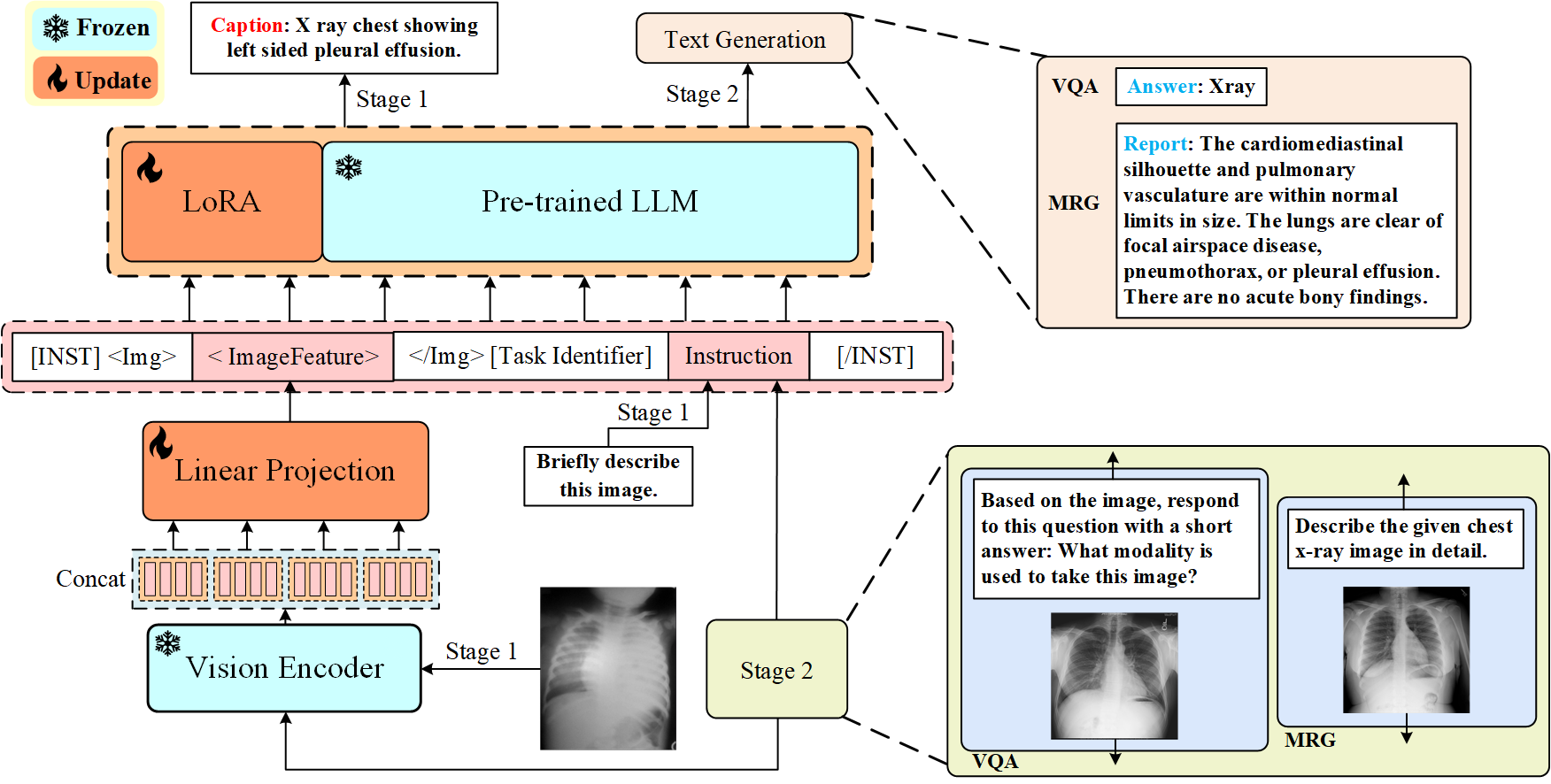
This is the official implementation of PeFoMed: Parameter Efficient Fine-tuning of Multimodal Large Language Models for Medical Imaging.
Datasets
The configuration of all datasets needs to be set in the corresponding dataset configuration file in the pefomed/configs/datasets/medical
Stage 1 finetune datasets: ROCO, CLEF2022, MEDICAT, and MIMIC-CXR
Stage 2 finetune medical VQA datasets: VQA-RAD, PathVQA and Slake.
Stage 2 finetune MRG dataset: IU-Xray
Checkpoints
You can download the checkpoints in HuggingFace
Parameter Efficient Fine-tuning (PEFT) Methods
Updated: December 14, 2025 - Added support for Prompt Tuning and Prefix Tuning methods in addition to the existing LoRA method.
PeFoMed supports three PEFT methods for efficient model adaptation:
LoRA (Low-Rank Adaptation)
LoRA is the default PEFT method that adds trainable low-rank matrices to the model's attention layers. It provides a good balance between parameter efficiency and performance.
Configuration:
peft_method: "lora"lora_r: Rank of the low-rank matrices (default: 64)lora_alpha: Scaling factor (default: 16)lora_target_modules: Target modules to apply LoRA (default: ["q_proj", "v_proj"])
Prompt Tuning
Prompt Tuning adds trainable virtual tokens (soft prompts) at the beginning of the input sequence. This method is memory-efficient and works well with simplified instruction formats.
Configuration:
peft_method: "prompt_tuning"prompt_tuning_num_virtual_tokens: Number of virtual tokens (default: 20)prompt_tuning_init_text: Optional initialization text for the prompts (e.g., "Answer the medical question:")- Recommended: Set
use_instruction_pool: falsein dataset configuration to allow soft prompts to handle instruction roles
Example configuration:
model:
  peft_method: "prompt_tuning"
  prompt_tuning_num_virtual_tokens: 20
  prompt_tuning_init_text: "Answer the medical question:"

datasets:
  vqarad:
    dataset_kwargs:
      use_instruction_pool: false  # Recommended for Prompt Tuning
Prefix Tuning
Prefix Tuning prepends trainable prefix embeddings to the input, which can be optionally projected through an encoder network. This method is flexible and can work with full instruction formats.
Configuration:
peft_method: "prefix_tuning"prefix_tuning_num_virtual_tokens: Number of prefix tokens (default: 20)prefix_tuning_encoder_hidden_size: Optional encoder hidden size for prefix projection (e.g., 512). If not set, uses the model's hidden size without projection.- Recommended: Set
use_instruction_pool: truein dataset configuration to leverage full instruction formats
Example configuration:
model:
  peft_method: "prefix_tuning"
  prefix_tuning_num_virtual_tokens: 20
  prefix_tuning_encoder_hidden_size: 512  # Optional: enables projection layer

datasets:
  vqarad:
    dataset_kwargs:
      use_instruction_pool: true  # Recommended for Prefix Tuning
Usage
You can switch between PEFT methods by setting the peft_method parameter in your training configuration file. Example training scripts are available in run_scripts/minigpt4/:
train_prompt_experiments.sh- Prompt Tuning experimentstrain_prefix_experiments.sh- Prefix Tuning experiments
Acknowledgement
If you're using PeFoMed in your research or applications, please cite using this BibTeX:
@misc{liu2024pefomedparameterefficientfinetuning,
      title={PeFoMed: Parameter Efficient Fine-tuning of Multimodal Large Language Models for Medical Imaging},
      author={Jinlong He and Gang Liu and Pengfei Li and Genrong He and Zhaolin Chen and Shenjun Zhong},
      year={2024},
      eprint={2401.02797},
      archivePrefix={arXiv},
      primaryClass={cs.CL},
      url={https://arxiv.org/abs/2401.02797},
}
License
This repository is under BSD 3-Clause License.
Many codes are based on Lavis and MiniGPT-v2
Similar repos


Languages
Python
99.7%
The code for paper: PeFoMed: Parameter Efficient Fine-tuning on Multi-modal Large Language Models for Medical Visual Question Answering
Python
65
49 commits
updated Dec 21, 2025
README
PeFoMed
This is the official implementation of PeFoMed: Parameter Efficient Fine-tuning of Multimodal Large Language Models for Medical Imaging.
Datasets
The configuration of all datasets needs to be set in the corresponding dataset configuration file in the pefomed/configs/datasets/medical
Stage 1 finetune datasets: ROCO, CLEF2022, MEDICAT, and MIMIC-CXR
Stage 2 finetune medical VQA datasets: VQA-RAD, PathVQA and Slake.
Stage 2 finetune MRG dataset: IU-Xray
Checkpoints
You can download the checkpoints in HuggingFace
Parameter Efficient Fine-tuning (PEFT) Methods
Updated: December 14, 2025 - Added support for Prompt Tuning and Prefix Tuning methods in addition to the existing LoRA method.
PeFoMed supports three PEFT methods for efficient model adaptation:
LoRA (Low-Rank Adaptation)
LoRA is the default PEFT method that adds trainable low-rank matrices to the model's attention layers. It provides a good balance between parameter efficiency and performance.
Configuration:
peft_method: "lora"lora_r: Rank of the low-rank matrices (default: 64)lora_alpha: Scaling factor (default: 16)lora_target_modules: Target modules to apply LoRA (default: ["q_proj", "v_proj"])
Prompt Tuning
Prompt Tuning adds trainable virtual tokens (soft prompts) at the beginning of the input sequence. This method is memory-efficient and works well with simplified instruction formats.
Configuration:
peft_method: "prompt_tuning"prompt_tuning_num_virtual_tokens: Number of virtual tokens (default: 20)prompt_tuning_init_text: Optional initialization text for the prompts (e.g., "Answer the medical question:")- Recommended: Set
use_instruction_pool: falsein dataset configuration to allow soft prompts to handle instruction roles
Example configuration:
model:
  peft_method: "prompt_tuning"
  prompt_tuning_num_virtual_tokens: 20
  prompt_tuning_init_text: "Answer the medical question:"

datasets:
  vqarad:
    dataset_kwargs:
      use_instruction_pool: false  # Recommended for Prompt Tuning
Prefix Tuning
Prefix Tuning prepends trainable prefix embeddings to the input, which can be optionally projected through an encoder network. This method is flexible and can work with full instruction formats.
Configuration:
peft_method: "prefix_tuning"prefix_tuning_num_virtual_tokens: Number of prefix tokens (default: 20)prefix_tuning_encoder_hidden_size: Optional encoder hidden size for prefix projection (e.g., 512). If not set, uses the model's hidden size without projection.- Recommended: Set
use_instruction_pool: truein dataset configuration to leverage full instruction formats
Example configuration:
model:
  peft_method: "prefix_tuning"
  prefix_tuning_num_virtual_tokens: 20
  prefix_tuning_encoder_hidden_size: 512  # Optional: enables projection layer

datasets:
  vqarad:
    dataset_kwargs:
      use_instruction_pool: true  # Recommended for Prefix Tuning
Usage
You can switch between PEFT methods by setting the peft_method parameter in your training configuration file. Example training scripts are available in run_scripts/minigpt4/:
train_prompt_experiments.sh- Prompt Tuning experimentstrain_prefix_experiments.sh- Prefix Tuning experiments
Acknowledgement
If you're using PeFoMed in your research or applications, please cite using this BibTeX:
@misc{liu2024pefomedparameterefficientfinetuning,
      title={PeFoMed: Parameter Efficient Fine-tuning of Multimodal Large Language Models for Medical Imaging},
      author={Jinlong He and Gang Liu and Pengfei Li and Genrong He and Zhaolin Chen and Shenjun Zhong},
      year={2024},
      eprint={2401.02797},
      archivePrefix={arXiv},
      primaryClass={cs.CL},
      url={https://arxiv.org/abs/2401.02797},
}
License
This repository is under BSD 3-Clause License.
Many codes are based on Lavis and MiniGPT-v2
Similar repos
Languages
Python
99.7%