An open benchmark for a specific way voice agents fail: deciding the caller has finished talking when they were only pausing between chunks of a number.
Plus four baseline endpointing strategies, a trained semantic classifier, and a fused endpointer that beats pure silence detection on the failure that matters.
Everything runs offline on CPU. No API keys, no accounts, no GPU.
Voice agents decide when to reply using endpointing: notice the user has gone quiet for N milliseconds, assume the turn is over, respond. Tune N to ordinary conversation and you land somewhere around 500–700 ms.
Then someone reads out a member ID:
"My member ID is four seven two ... [700ms] ... nine one ... [600ms] ... six three"
                                    ^^^^^^^^
                                    the agent interrupts here
People chunk numbers when they read them. A 700 ms threshold fires inside the first pause and the agent talks over the caller — who now has to start the whole number again. Raise the threshold to survive that, and every ordinary "yes, that's right" gains a second of dead air.
That is the tradeoff this repo measures.
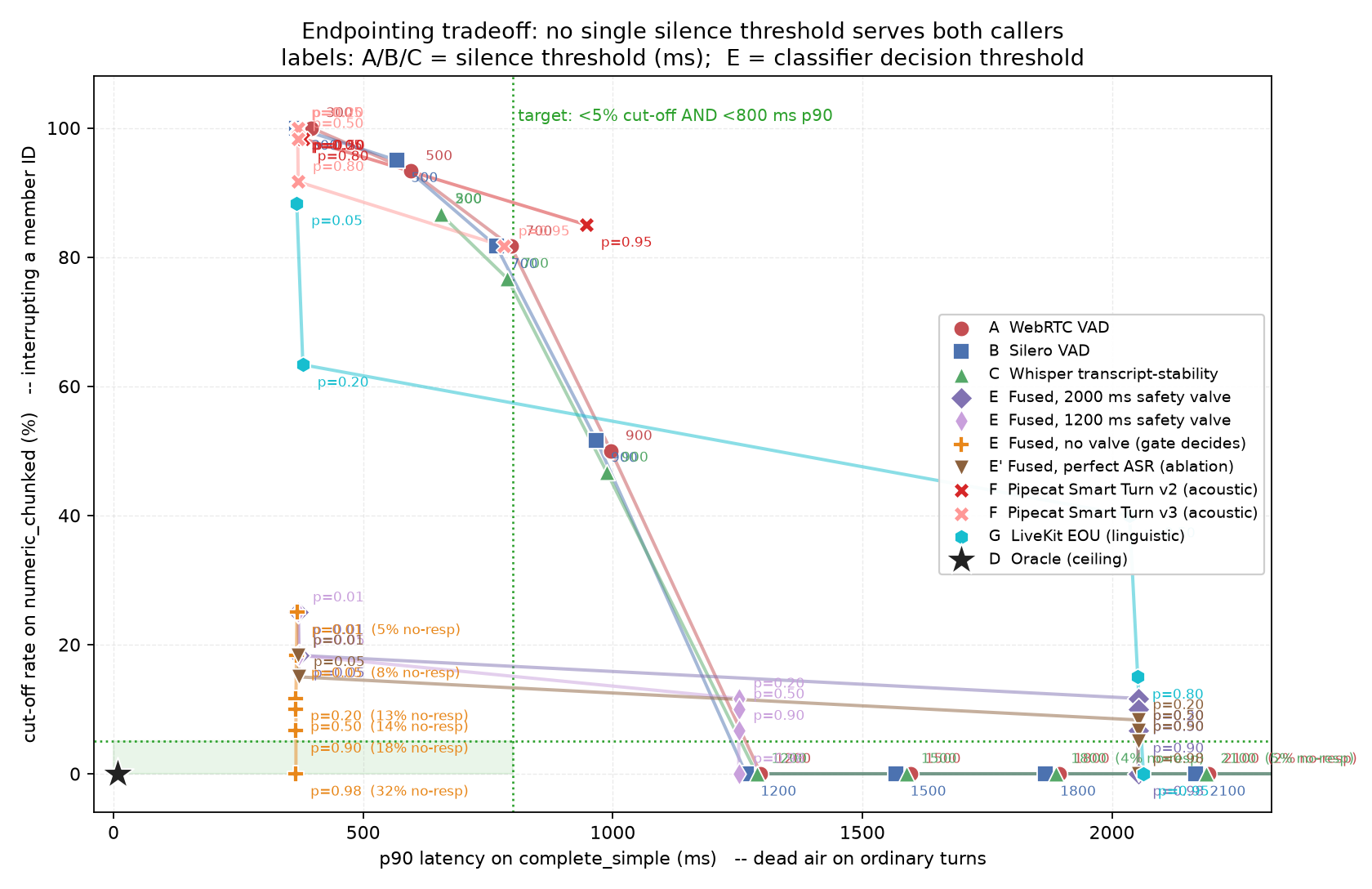
Read the chart as: down is fewer interruptions on chunked numbers, left is less dead air on ordinary turns, and the green box is where a shippable system would have to live. The red, blue and green curves are the same three silence-based strategies swept across their thresholds. None of them enters the box. They cannot: moving down the curve is moving right.
| strategy | cut-off % on numbers | p90 ms on ordinary turns | backchannel false-ends % | no-response % on numbers |
|---|---|---|---|---|
A_webrtc@300ms — fast VAD | 100.0 | 396 | 100.0 | 0.0 |
A_webrtc@1200ms — safe VAD | 0.0 | 1296 | 100.0 | 0.0 |
C_whisper@300ms — transcript stability | 86.7 | 655 | 100.0 | 0.0 |
[email protected] — + semantic gate | 18.3 | 366 | 0.0 | 15.0 |
D_oracle — ceiling | 0.0 | 8 | 0.0 | 0.0 |
At the same latency as the fastest VAD, adding a "is this thought finished?" classifier drops mid-number interruptions from 100% to 18% and backchannel false-ends from 100% to zero.
It is not free, and the last column is why: the gate converts a loud failure (talking over the caller) into a quiet one (never answering). That is probably the right trade for a voice agent, but it is a trade, not a fix. A variant with a safety valve removes the no-response failure entirely and instead pays a latency tail — 6.7% cut-off, 350 ms median, 1252 ms p90. Neither configuration reaches the green box in the chart.
Full numbers, caveats, and the things that went wrong: FINDINGS.md.
Phase 1 — a synthetic corpus with exact pause structure. Real call recordings
are not available, so the dataset is generated: 600 clips, 16 kHz, ~71 minutes,
three Piper TTS voices. Each clip is built by synthesising speech chunks
separately, trimming them, and splicing silences of exact duration between
them — so the ground-truth endpoint and all 660 internal pause boundaries are
known to the sample rather than annotated. validate_dataset.py re-measures
every clip off the waveform and confirms the labels agree to within 20 ms.
Five categories, 120 clips each:
| category | what it tests |
|---|---|
complete_simple | a finished statement, no internal pause. The easy case. |
numeric_chunked | a number in 2–4 groups, 400/600/800/1000 ms pauses between them |
self_correction | "seven four ... no sorry ... seven five ..." |
trailing_thought | pause at a syntactically incomplete point, then continue |
backchannel | "mm-hmm", "right" — must not count as a turn end |
Phase 2 — four strategies behind one streaming interface. Every endpointer
consumes 10 ms frames in order and returns True on the frame where it declares
the turn over. Nothing looks ahead.
faster-whisper base) transcript stability + a short silence
threshold — what most production stacks shipPhase 3 — metrics that admit two failure modes. Cut-off rate and latency move in opposite directions, so neither is reported alone, and latency is p50/p90/p95 rather than a mean — a mean launders exactly the long waits that make an agent feel broken.
Phase 4 — the semantic gate. A DistilBERT binary classifier trained on Phase 1 transcripts truncated at word boundaries: full transcript → complete, truncation → incomplete, backchannel token → not a turn end.
Two deliberate choices there. Negatives are all chunk-boundary prefixes plus
three sampled word-boundary truncations per clip, rather than every possible
truncation — taking all of them pushes the class ratio past 13:1 on numeric clips
and fills the training set with prefixes no endpointer is ever queried on, while
the chunk boundaries are precisely the states a real pause lands in. And
backchannel tokens are labelled not a turn end even though "okay" is a
grammatically complete utterance; the question being asked is "should the agent
reply", not "is this a sentence".
Strategy E fires only when Silero reports silence and the classifier says the thought is finished:
acoustic (Silero)     -> "the user has gone quiet"
semantic (DistilBERT) -> "what they said is a finished turn"
                         both must agree, or keep waiting
Splits are by clip, so a clip's own truncations cannot leak across the boundary, and all five strategies are scored on the same 300 held-out clips.
python3 -m venv .venv && .venv/bin/pip install -r requirements.txt
./run_all.sh
Everything is seeded (--seed 1234) and regenerates identically. The full run
takes roughly an hour on an 8-core CPU with no GPU, most of it precomputing
Whisper prefix transcripts. First run also downloads Piper voices (~190 MB),
silero-vad, faster-whisper base, and distilbert-base-uncased; after that
nothing touches the network.
For a smoke test, --quick uses 30 clips per category and one training epoch,
and finishes in about 15 minutes:
./run_all.sh --quick
--quick checks that the pipeline runs, not that the findings hold. One epoch on
a fifth of the data leaves the classifier undertrained — strategy E scores far
worse there than in the full run, which is a property of the smoke test and not a
result. Only the full run reproduces the numbers in FINDINGS.md, and step 6
checks that it did.
DATA_DIR, RESULTS_DIR and MODEL_DIR can be pointed at a scratch tree so a
smoke run does not overwrite a completed one:
DATA_DIR=data_quick RESULTS_DIR=results_quick MODEL_DIR=models/quick ./run_all.sh --quick
Note that run_all.sh regenerates the dataset from scratch, which clears the
transcript cache with it. If a run is interrupted during the Whisper step,
re-running precompute_transcripts.py on its own resumes from what is already
cached; re-running run_all.sh starts that step over.
generate_dataset.py        Phase 1  synthesise + splice the corpus
validate_dataset.py        Phase 1  re-measure every clip against its label
precompute_transcripts.py  Phase 2  cache Whisper prefix transcripts for C and E
run_baselines.py           Phase 2  score every strategy -> results/raw_detections.csv
metrics.py                 Phase 3  rates, latencies, tradeoff chart
train_classifier.py        Phase 4  DistilBERT (+ TF-IDF control) completion classifier
check_findings.py          re-checks every number quoted in the docs against the CSVs
run_all.sh                 end to end

endpointing/
  audio.py         resample, trim, splice, noise floor
  corpus.py        the text material for all five categories
  tts.py           Piper wrapper with an on-disk chunk cache
  endpointers.py   Endpointer interface + strategies A, B, C, D
  fused.py         the classifier wrapper and strategy E
  textprep.py      normalisation and training-example construction

results/
  tradeoff.png              the headline chart
  curves.png                per-category cut-off and latency vs threshold
  confusion_*.png           classifier confusion matrices
  summary_table.md          full results table, markdown
  results_by_category.csv   every strategy x category
  results_overall.csv       every strategy, pooled
  classifier_metrics.csv    classifier metrics incl. numeric/non-numeric split
If you want the ideas in the order that makes them land:
results/tradeoff.png — the whole problem in one image. Understand why the
curve has that shape and you understand endpointing.generate_dataset.py — the pause structures encode what actually goes
wrong on real calls.metrics.py — why cut-off rate and latency have to be reported together,
and why p90 matters more than the mean.endpointing/fused.py — the architectural idea worth carrying: acoustic
signal answers is there sound, semantic signal answers is the thought
finished. Two questions, two models, one fused decision.A silence threshold is a single number being asked to encode a judgement about language. It works when the caller says "yes" and fails when the caller says a member ID, because the acoustic evidence in both cases is identical — a person who stopped making noise — and the difference between them is not acoustic at all. You cannot fix that by tuning the number, only by moving along a tradeoff curve, which is why the chart above has the shape it does. What you do about it is ask a second question the audio cannot answer: given the words so far, is this a finished thought? Then require both answers before you speak.
setuptools is pinned <81 because webrtcvad imports pkg_resources, which
setuptools 84 removed.requirements.txt.An open benchmark for a specific way voice agents fail: deciding the caller has finished talking when they were only pausing between chunks of a number.
Plus four baseline endpointing strategies, a trained semantic classifier, and a fused endpointer that beats pure silence detection on the failure that matters.
Everything runs offline on CPU. No API keys, no accounts, no GPU.
Voice agents decide when to reply using endpointing: notice the user has gone quiet for N milliseconds, assume the turn is over, respond. Tune N to ordinary conversation and you land somewhere around 500–700 ms.
Then someone reads out a member ID:
"My member ID is four seven two ... [700ms] ... nine one ... [600ms] ... six three"
                                    ^^^^^^^^
                                    the agent interrupts here
People chunk numbers when they read them. A 700 ms threshold fires inside the first pause and the agent talks over the caller — who now has to start the whole number again. Raise the threshold to survive that, and every ordinary "yes, that's right" gains a second of dead air.
That is the tradeoff this repo measures.
Read the chart as: down is fewer interruptions on chunked numbers, left is less dead air on ordinary turns, and the green box is where a shippable system would have to live. The red, blue and green curves are the same three silence-based strategies swept across their thresholds. None of them enters the box. They cannot: moving down the curve is moving right.
| strategy | cut-off % on numbers | p90 ms on ordinary turns | backchannel false-ends % | no-response % on numbers |
|---|---|---|---|---|
A_webrtc@300ms — fast VAD | 100.0 | 396 | 100.0 | 0.0 |
A_webrtc@1200ms — safe VAD | 0.0 | 1296 | 100.0 | 0.0 |
C_whisper@300ms — transcript stability | 86.7 | 655 | 100.0 | 0.0 |
[email protected] — + semantic gate | 18.3 | 366 | 0.0 | 15.0 |
D_oracle — ceiling | 0.0 | 8 | 0.0 | 0.0 |
At the same latency as the fastest VAD, adding a "is this thought finished?" classifier drops mid-number interruptions from 100% to 18% and backchannel false-ends from 100% to zero.
It is not free, and the last column is why: the gate converts a loud failure (talking over the caller) into a quiet one (never answering). That is probably the right trade for a voice agent, but it is a trade, not a fix. A variant with a safety valve removes the no-response failure entirely and instead pays a latency tail — 6.7% cut-off, 350 ms median, 1252 ms p90. Neither configuration reaches the green box in the chart.
Full numbers, caveats, and the things that went wrong: FINDINGS.md.
Phase 1 — a synthetic corpus with exact pause structure. Real call recordings
are not available, so the dataset is generated: 600 clips, 16 kHz, ~71 minutes,
three Piper TTS voices. Each clip is built by synthesising speech chunks
separately, trimming them, and splicing silences of exact duration between
them — so the ground-truth endpoint and all 660 internal pause boundaries are
known to the sample rather than annotated. validate_dataset.py re-measures
every clip off the waveform and confirms the labels agree to within 20 ms.
Five categories, 120 clips each:
| category | what it tests |
|---|---|
complete_simple | a finished statement, no internal pause. The easy case. |
numeric_chunked | a number in 2–4 groups, 400/600/800/1000 ms pauses between them |
self_correction | "seven four ... no sorry ... seven five ..." |
trailing_thought | pause at a syntactically incomplete point, then continue |
backchannel | "mm-hmm", "right" — must not count as a turn end |
Phase 2 — four strategies behind one streaming interface. Every endpointer
consumes 10 ms frames in order and returns True on the frame where it declares
the turn over. Nothing looks ahead.
faster-whisper base) transcript stability + a short silence
threshold — what most production stacks shipPhase 3 — metrics that admit two failure modes. Cut-off rate and latency move in opposite directions, so neither is reported alone, and latency is p50/p90/p95 rather than a mean — a mean launders exactly the long waits that make an agent feel broken.
Phase 4 — the semantic gate. A DistilBERT binary classifier trained on Phase 1 transcripts truncated at word boundaries: full transcript → complete, truncation → incomplete, backchannel token → not a turn end.
Two deliberate choices there. Negatives are all chunk-boundary prefixes plus
three sampled word-boundary truncations per clip, rather than every possible
truncation — taking all of them pushes the class ratio past 13:1 on numeric clips
and fills the training set with prefixes no endpointer is ever queried on, while
the chunk boundaries are precisely the states a real pause lands in. And
backchannel tokens are labelled not a turn end even though "okay" is a
grammatically complete utterance; the question being asked is "should the agent
reply", not "is this a sentence".
Strategy E fires only when Silero reports silence and the classifier says the thought is finished:
acoustic (Silero)     -> "the user has gone quiet"
semantic (DistilBERT) -> "what they said is a finished turn"
                         both must agree, or keep waiting
Splits are by clip, so a clip's own truncations cannot leak across the boundary, and all five strategies are scored on the same 300 held-out clips.
python3 -m venv .venv && .venv/bin/pip install -r requirements.txt
./run_all.sh
Everything is seeded (--seed 1234) and regenerates identically. The full run
takes roughly an hour on an 8-core CPU with no GPU, most of it precomputing
Whisper prefix transcripts. First run also downloads Piper voices (~190 MB),
silero-vad, faster-whisper base, and distilbert-base-uncased; after that
nothing touches the network.
For a smoke test, --quick uses 30 clips per category and one training epoch,
and finishes in about 15 minutes:
./run_all.sh --quick
--quick checks that the pipeline runs, not that the findings hold. One epoch on
a fifth of the data leaves the classifier undertrained — strategy E scores far
worse there than in the full run, which is a property of the smoke test and not a
result. Only the full run reproduces the numbers in FINDINGS.md, and step 6
checks that it did.
DATA_DIR, RESULTS_DIR and MODEL_DIR can be pointed at a scratch tree so a
smoke run does not overwrite a completed one:
DATA_DIR=data_quick RESULTS_DIR=results_quick MODEL_DIR=models/quick ./run_all.sh --quick
Note that run_all.sh regenerates the dataset from scratch, which clears the
transcript cache with it. If a run is interrupted during the Whisper step,
re-running precompute_transcripts.py on its own resumes from what is already
cached; re-running run_all.sh starts that step over.
generate_dataset.py        Phase 1  synthesise + splice the corpus
validate_dataset.py        Phase 1  re-measure every clip against its label
precompute_transcripts.py  Phase 2  cache Whisper prefix transcripts for C and E
run_baselines.py           Phase 2  score every strategy -> results/raw_detections.csv
metrics.py                 Phase 3  rates, latencies, tradeoff chart
train_classifier.py        Phase 4  DistilBERT (+ TF-IDF control) completion classifier
check_findings.py          re-checks every number quoted in the docs against the CSVs
run_all.sh                 end to end

endpointing/
  audio.py         resample, trim, splice, noise floor
  corpus.py        the text material for all five categories
  tts.py           Piper wrapper with an on-disk chunk cache
  endpointers.py   Endpointer interface + strategies A, B, C, D
  fused.py         the classifier wrapper and strategy E
  textprep.py      normalisation and training-example construction

results/
  tradeoff.png              the headline chart
  curves.png                per-category cut-off and latency vs threshold
  confusion_*.png           classifier confusion matrices
  summary_table.md          full results table, markdown
  results_by_category.csv   every strategy x category
  results_overall.csv       every strategy, pooled
  classifier_metrics.csv    classifier metrics incl. numeric/non-numeric split
If you want the ideas in the order that makes them land:
results/tradeoff.png — the whole problem in one image. Understand why the
curve has that shape and you understand endpointing.generate_dataset.py — the pause structures encode what actually goes
wrong on real calls.metrics.py — why cut-off rate and latency have to be reported together,
and why p90 matters more than the mean.endpointing/fused.py — the architectural idea worth carrying: acoustic
signal answers is there sound, semantic signal answers is the thought
finished. Two questions, two models, one fused decision.A silence threshold is a single number being asked to encode a judgement about language. It works when the caller says "yes" and fails when the caller says a member ID, because the acoustic evidence in both cases is identical — a person who stopped making noise — and the difference between them is not acoustic at all. You cannot fix that by tuning the number, only by moving along a tradeoff curve, which is why the chart above has the shape it does. What you do about it is ask a second question the audio cannot answer: given the words so far, is this a finished thought? Then require both answers before you speak.
setuptools is pinned <81 because webrtcvad imports pkg_resources, which
setuptools 84 removed.requirements.txt.


