A low-latency full-duplex voice agent with streaming ASR, tool-using LLM responses, neural TTS, learned turn-taking, and scale-to-zero Modal deployment.
Python
7
764 commits
updated Oct 17, 2026
Voice Light is an end-to-end research project for building a natural, low-latency streaming voice agent: generate and label conversational data, train language and turn-taking adapters, evaluate their behavior, integrate the useful pieces into a full-duplex cascade, and deploy the result on scale-to-zero GPU compute.
Try the live demo · Read the paper · Read the deployment record · Explore the models and datasets
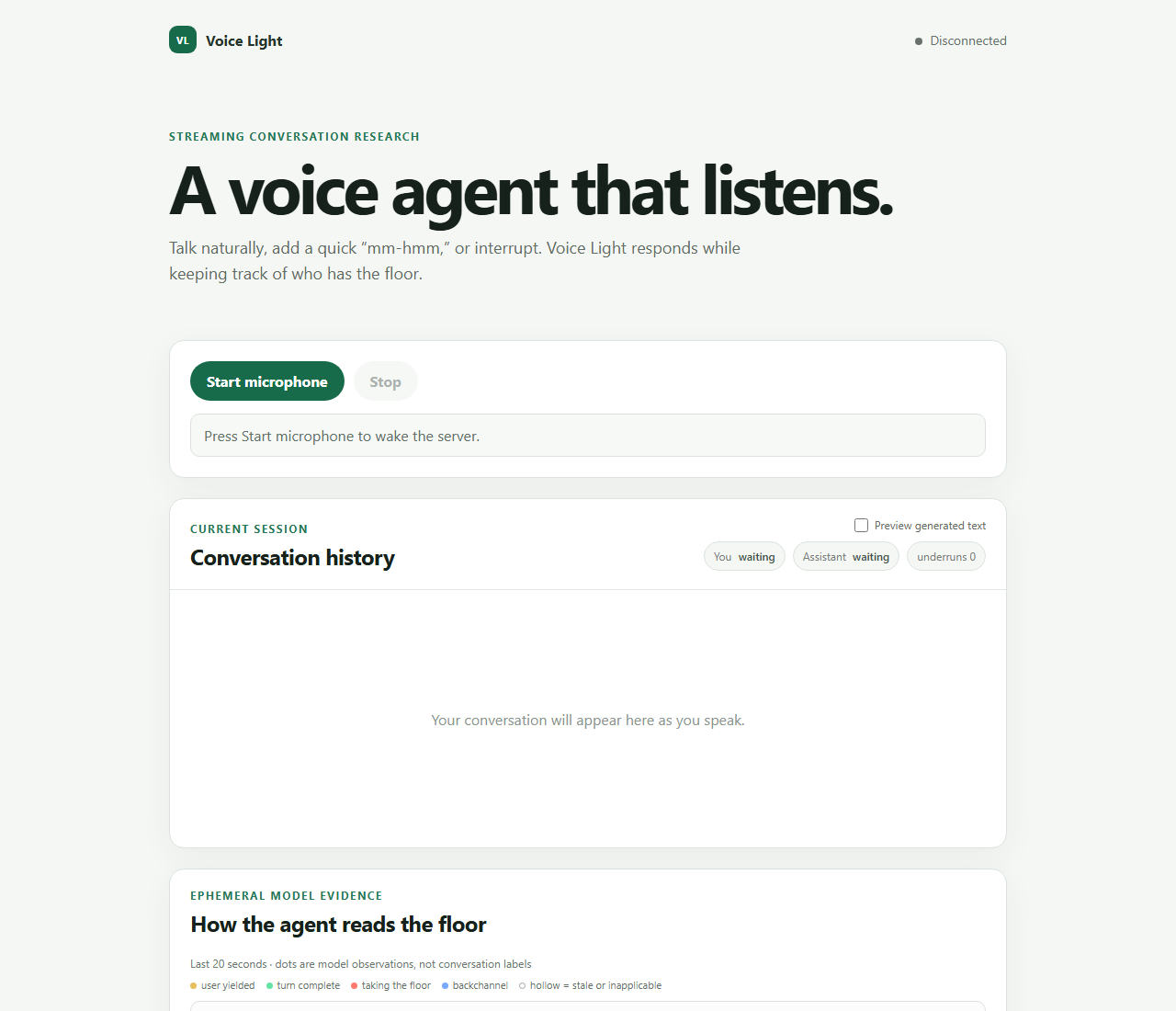
The browser streams microphone audio directly to a provider-neutral compute service on Modal. Nemotron performs streaming ASR and supplies the encoder features used by a small causal turn-taking adapter. Qwen produces conversational responses and structured tool calls, Kyutai streams speech, and browser playback acknowledgements ensure that only audio the user actually heard enters durable conversation history.
Voice Light treats the deployed agent as the last stage of a reproducible research pipeline rather than an isolated demo.
The detailed records are in synthetic tool-use generation, LoRA training, tool-use evaluation, synthetic turn-taking construction, human corpus preparation, turn-taking training, and the locked turn-detection benchmark.
Browser microphone
    │ 16 kHz PCM + playback acknowledgements
    ▼
Modal WebSocket (/v1/voice)
    ├── GPU 0: streaming Nemotron ASR ── shared encoder taps ── turn adapter
    │          Qwen3 4B conversation model + Qwen3 0.6B search summarizer
    ├── GPU 1: Kyutai streaming TTS
    └── typed orchestration: prediction, tools, cancellation, playback barriers
                         │
                         ▼
Browser audio queue + live interaction diagnostics
The production endpoint admits one session at a time and scales to zero after two idle minutes. Model caches live in a persistent Modal volume; model processes are persistent inside a warm container, but an idle deployment still pays the CUDA and model-initialization cost on its next cold start. The static frontend is hosted separately on GitHub Pages.
The deployed conversation model is the stronger pinned Qwen/Qwen3-4B-Instruct-2507, not the
1.7B experimental LoRA. This preserves general conversational quality while keeping the LoRA as a
reproducible result and comparison point. The same principle applies to endpointing: the learned
adapter contributes interaction evidence, but current production latency still relies heavily on
Silero and speculative generation because the locked learned completion policy did not beat the
stronger timing baselines.
On the original balanced 80-record holdout, the final 1.7B proof-of-concept adapter improved:
| Behavior | Base Qwen3-1.7B | Fine-tuned adapter |
|---|---|---|
| Correct tool decision | 80.0% | 95.2% |
| Exact tool name | 78.6% | 94.3% |
| Concise spoken bridge | 7.6% | 94.3% |
| Correctly avoided a tool | 70.0% | 100.0% |
These are held-out results from a synthetic experiment, not evidence of general factual accuracy. A later 240-state checkpoint comparison selected an earlier epoch and also exposed remaining tool selection errors; the complete lineage and both evaluations are documented in the results report and published model card.
The locked real-conversation test contained 1,673 candidates. At its selected policy, the Voice Light checkpoint produced one false cutoff among 37 HOLD cases, but crossed its learned threshold for only 205 of 1,636 EOT cases. Most endpoints therefore used the timeout, and the adapter did not outperform the Silero or LiveKit timing policies on this protocol. The small HOLD denominator and known benchmark provenance constraints are reported with the results; no superiority claim is made from synthetic interaction validation.
Across three unscripted operator-run microphone sessions, 36 response turns were measured. The first server audio packet arrived within 800 ms of the final VAD endpoint for 21 turns. One session exported complete component telemetry for 13 turns.
| Metric | Observed value |
|---|---|
| Sessions / measured turns | 3 / 36 |
| Final VAD endpoint → first server audio, median | 758 ms |
| Final VAD endpoint → first server audio, mean | 932 ms |
| Final VAD endpoint → first server audio, range | 528–1,652 ms |
| Turns below 800 ms | 21 / 36 |
| Fully traced turns | 13 |
| Endpoint decision, median | 502 ms |
| LLM first word, median | 336 ms |
| TTS first PCM, median | 444 ms |
| First server audio → browser render, median | 95 ms |
| Final VAD endpoint → browser render, median | 836 ms |
This is an instrumented case study run by one operator, not a controlled user evaluation or a population latency distribution. The paper and final deployment record contain the measurement definitions, limitations, and development smoke-test history.
| Artifact | Purpose | Access |
|---|---|---|
| Tool-use synthetic dataset | 3,999 canonical tool-rich and no-tool conversations plus reproducibility material | Public |
| Qwen3-1.7B tool-use LoRA | PEFT adapter, configuration, metrics, and evaluation | Public |
| Merged Qwen3-1.7B checkpoint | Standalone BF16 merge of the base model and tool-use adapter | Public |
| Synthetic turn-taking audio | Trimmed user speech units and deterministic conversation reconstruction metadata | Public |
| Human conversation corpus | Licensed source audio, annotations, and materialized turn-taking windows | Restricted |
| Mundo TurnBench dev | Public source with independent human turn annotations | External source |
Other human sources retain their original access, license, privacy, and redistribution constraints. Raw source mappings, credentials, private annotations, and local training artifacts are excluded from Git. See corpus preparation before using any human data.
For the local data and analysis application, start Postgres, apply migrations, and run the FastAPI
server as described in the compute and local-app guide. Open
http://127.0.0.1:8000 for the dataset tools or /voice-agent for the local voice client.
For the production voice stack, follow the Modal runbook. It covers the pinned models, persistent cache volume, adapter checkpoint packaging, GPU topology, secrets, deployment command, scale-from-zero smoke test, and browser verification. Credentials are supplied through Modal secrets and are never committed.
Voice-Light: A Full-Duplex Cascaded Voice Agent with Causal Turn-Taking and Speculative
Generation connects the data, training, evaluation, integration,
deployment, and microphone case study in one narrative. The corresponding GitHub
release contains the PDF and exact
arXiv source package; the maintained LaTeX source and build instructions are in
docs/technical-report.
@article{braun2026voicelight,
  title = {Voice-Light: A Full-Duplex Cascaded Voice Agent with Causal Turn-Taking and Speculative Generation},
  author = {Braun, Bertil},
  journal = {arXiv preprint arXiv:2609.20995},
  year = {2026},
  doi = {10.48550/arXiv.2609.20995},
  url = {https://arxiv.org/abs/2609.20995},
}
A low-latency full-duplex voice agent with streaming ASR, tool-using LLM responses, neural TTS, learned turn-taking, and scale-to-zero Modal deployment.
Python
7
764 commits
updated Oct 17, 2026
Voice Light is an end-to-end research project for building a natural, low-latency streaming voice agent: generate and label conversational data, train language and turn-taking adapters, evaluate their behavior, integrate the useful pieces into a full-duplex cascade, and deploy the result on scale-to-zero GPU compute.
Try the live demo · Read the paper · Read the deployment record · Explore the models and datasets
The browser streams microphone audio directly to a provider-neutral compute service on Modal. Nemotron performs streaming ASR and supplies the encoder features used by a small causal turn-taking adapter. Qwen produces conversational responses and structured tool calls, Kyutai streams speech, and browser playback acknowledgements ensure that only audio the user actually heard enters durable conversation history.
Voice Light treats the deployed agent as the last stage of a reproducible research pipeline rather than an isolated demo.
The detailed records are in synthetic tool-use generation, LoRA training, tool-use evaluation, synthetic turn-taking construction, human corpus preparation, turn-taking training, and the locked turn-detection benchmark.
Browser microphone
    │ 16 kHz PCM + playback acknowledgements
    ▼
Modal WebSocket (/v1/voice)
    ├── GPU 0: streaming Nemotron ASR ── shared encoder taps ── turn adapter
    │          Qwen3 4B conversation model + Qwen3 0.6B search summarizer
    ├── GPU 1: Kyutai streaming TTS
    └── typed orchestration: prediction, tools, cancellation, playback barriers
                         │
                         ▼
Browser audio queue + live interaction diagnostics
The production endpoint admits one session at a time and scales to zero after two idle minutes. Model caches live in a persistent Modal volume; model processes are persistent inside a warm container, but an idle deployment still pays the CUDA and model-initialization cost on its next cold start. The static frontend is hosted separately on GitHub Pages.
The deployed conversation model is the stronger pinned Qwen/Qwen3-4B-Instruct-2507, not the
1.7B experimental LoRA. This preserves general conversational quality while keeping the LoRA as a
reproducible result and comparison point. The same principle applies to endpointing: the learned
adapter contributes interaction evidence, but current production latency still relies heavily on
Silero and speculative generation because the locked learned completion policy did not beat the
stronger timing baselines.
On the original balanced 80-record holdout, the final 1.7B proof-of-concept adapter improved:
| Behavior | Base Qwen3-1.7B | Fine-tuned adapter |
|---|---|---|
| Correct tool decision | 80.0% | 95.2% |
| Exact tool name | 78.6% | 94.3% |
| Concise spoken bridge | 7.6% | 94.3% |
| Correctly avoided a tool | 70.0% | 100.0% |
These are held-out results from a synthetic experiment, not evidence of general factual accuracy. A later 240-state checkpoint comparison selected an earlier epoch and also exposed remaining tool selection errors; the complete lineage and both evaluations are documented in the results report and published model card.
The locked real-conversation test contained 1,673 candidates. At its selected policy, the Voice Light checkpoint produced one false cutoff among 37 HOLD cases, but crossed its learned threshold for only 205 of 1,636 EOT cases. Most endpoints therefore used the timeout, and the adapter did not outperform the Silero or LiveKit timing policies on this protocol. The small HOLD denominator and known benchmark provenance constraints are reported with the results; no superiority claim is made from synthetic interaction validation.
Across three unscripted operator-run microphone sessions, 36 response turns were measured. The first server audio packet arrived within 800 ms of the final VAD endpoint for 21 turns. One session exported complete component telemetry for 13 turns.
| Metric | Observed value |
|---|---|
| Sessions / measured turns | 3 / 36 |
| Final VAD endpoint → first server audio, median | 758 ms |
| Final VAD endpoint → first server audio, mean | 932 ms |
| Final VAD endpoint → first server audio, range | 528–1,652 ms |
| Turns below 800 ms | 21 / 36 |
| Fully traced turns | 13 |
| Endpoint decision, median | 502 ms |
| LLM first word, median | 336 ms |
| TTS first PCM, median | 444 ms |
| First server audio → browser render, median | 95 ms |
| Final VAD endpoint → browser render, median | 836 ms |
This is an instrumented case study run by one operator, not a controlled user evaluation or a population latency distribution. The paper and final deployment record contain the measurement definitions, limitations, and development smoke-test history.
| Artifact | Purpose | Access |
|---|---|---|
| Tool-use synthetic dataset | 3,999 canonical tool-rich and no-tool conversations plus reproducibility material | Public |
| Qwen3-1.7B tool-use LoRA | PEFT adapter, configuration, metrics, and evaluation | Public |
| Merged Qwen3-1.7B checkpoint | Standalone BF16 merge of the base model and tool-use adapter | Public |
| Synthetic turn-taking audio | Trimmed user speech units and deterministic conversation reconstruction metadata | Public |
| Human conversation corpus | Licensed source audio, annotations, and materialized turn-taking windows | Restricted |
| Mundo TurnBench dev | Public source with independent human turn annotations | External source |
Other human sources retain their original access, license, privacy, and redistribution constraints. Raw source mappings, credentials, private annotations, and local training artifacts are excluded from Git. See corpus preparation before using any human data.
For the local data and analysis application, start Postgres, apply migrations, and run the FastAPI
server as described in the compute and local-app guide. Open
http://127.0.0.1:8000 for the dataset tools or /voice-agent for the local voice client.
For the production voice stack, follow the Modal runbook. It covers the pinned models, persistent cache volume, adapter checkpoint packaging, GPU topology, secrets, deployment command, scale-from-zero smoke test, and browser verification. Credentials are supplied through Modal secrets and are never committed.
Voice-Light: A Full-Duplex Cascaded Voice Agent with Causal Turn-Taking and Speculative
Generation connects the data, training, evaluation, integration,
deployment, and microphone case study in one narrative. The corresponding GitHub
release contains the PDF and exact
arXiv source package; the maintained LaTeX source and build instructions are in
docs/technical-report.
@article{braun2026voicelight,
  title = {Voice-Light: A Full-Duplex Cascaded Voice Agent with Causal Turn-Taking and Speculative Generation},
  author = {Braun, Bertil},
  journal = {arXiv preprint arXiv:2609.20995},
  year = {2026},
  doi = {10.48550/arXiv.2609.20995},
  url = {https://arxiv.org/abs/2609.20995},
}



