Daily word game where you guess by meaning, not spelling. iOS app, web client, and the scoring server.
See the code

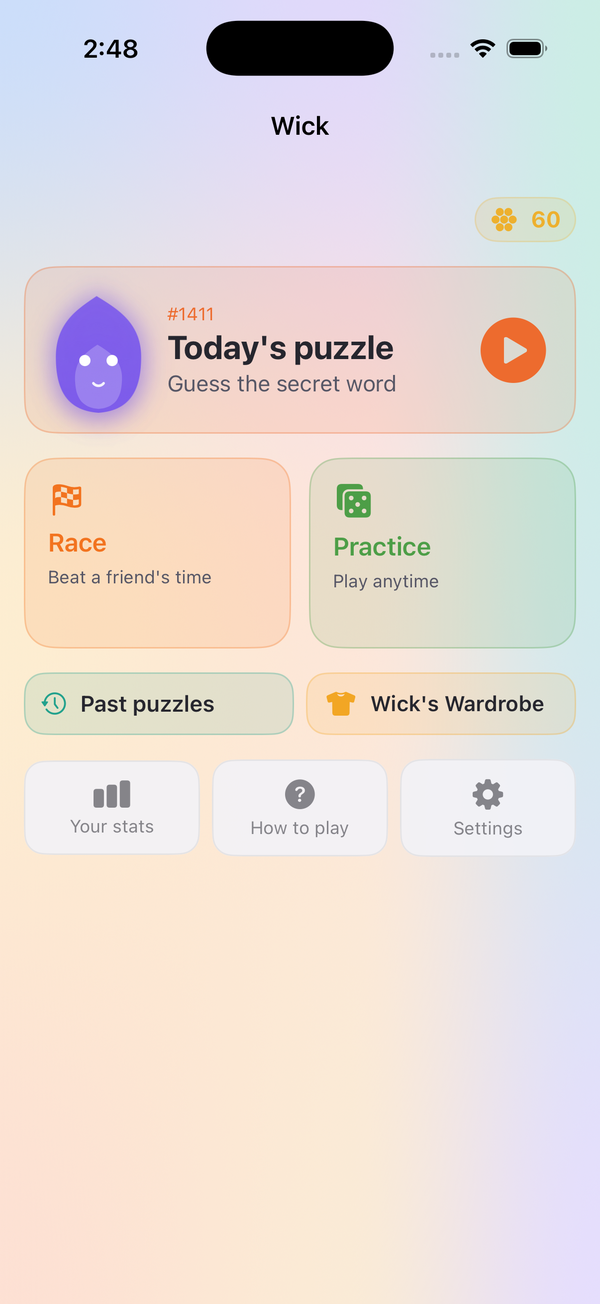
A daily word game where you guess by meaning, not spelling.






Play in your browser · App Store · Website · Privacy · Report a bug
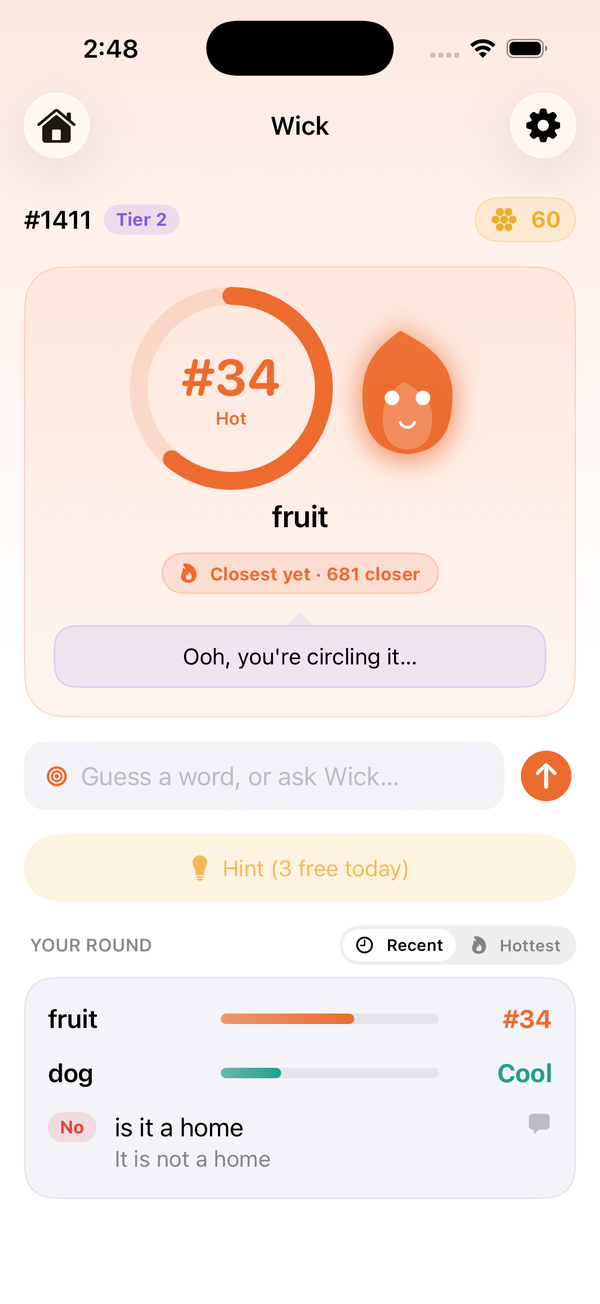
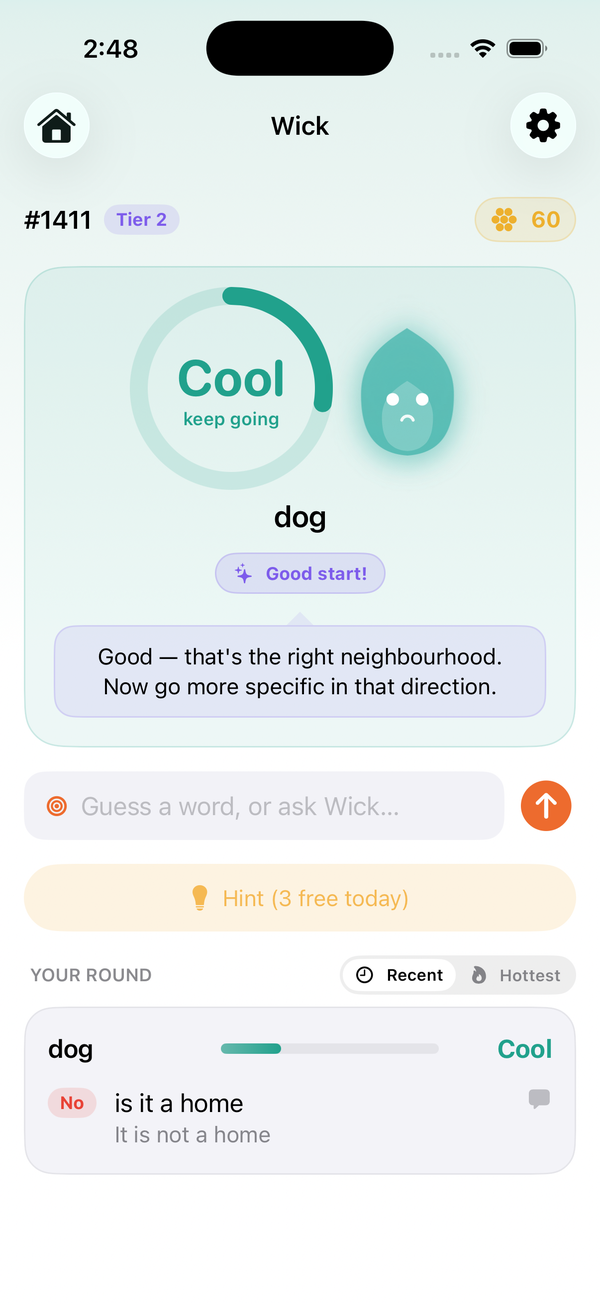
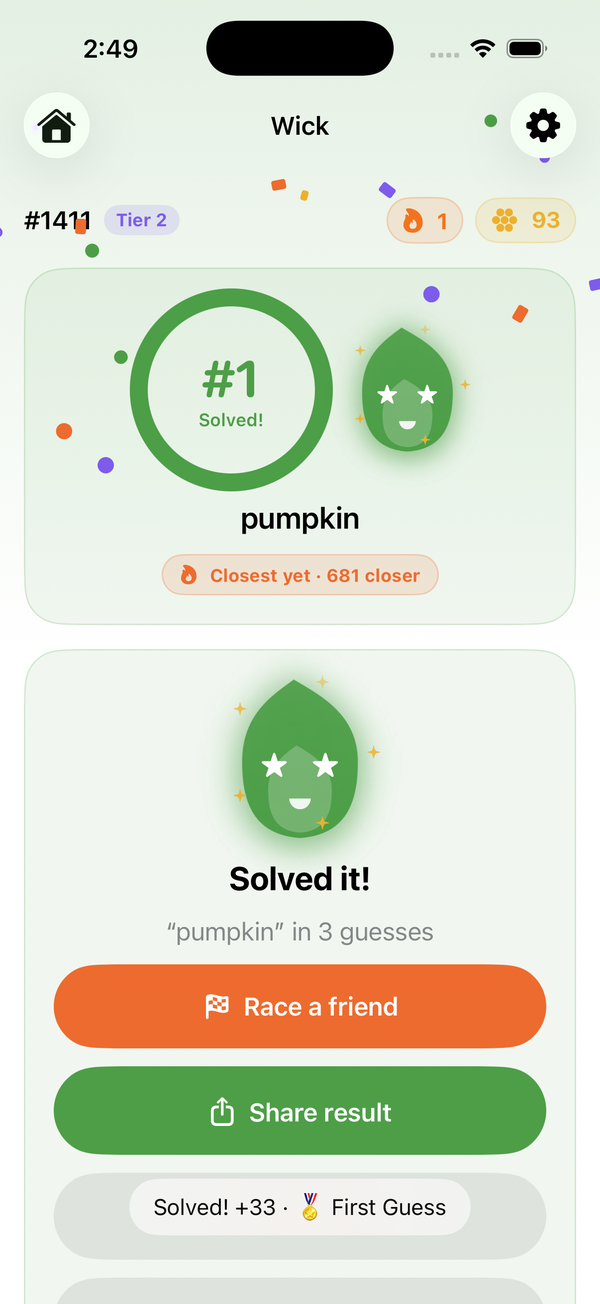
There is one secret word a day. Type any word and Wick tells you how close you are in meaning: freezing, cold, cool, warm, hot, boiling. "Tomato" is hot when the answer is "red". "Tomb" is freezing, even though the letters look close. No letter clues, no colored tiles. You can also ask Wick, the little flame who guards the word, yes or no questions, and it answers without ever giving the word away.
The iOS app and the web game play the same daily puzzle, in English, Spanish, French, Italian and German. Single player on iOS runs entirely on the phone. Live races and the web game are scored by a small server, and that server is the only place a secret lives: one Google Gemini API key, read from its environment. This repository is all three parts.

| Stage | Live. Version 3.3 on the App Store and at guesswick.com. |
| Team | One developer. No company, no funding. |
| Platforms | iPhone, iOS 17 and later. Any modern browser. No Android app; the web game is the Android answer. |
| Server | One Node process on Render, in memory, no database. Self-hostable with your own Gemini key. |
| Accounts | None. No logins, no tracking, no ads. Single-player stats live on your device. |
| Price | Free. Optional coin packs on iOS for extra hints. |
| Dependencies | Server: Hono, ws, word-list. Web: Vite, qrcode. iOS: Apple frameworks only. |
HunchTheme.swift), so a live race and a solo round feel the same.DailyWords.swift on iOS and
dailyPool.json on the web hold the same pool, and the day number picks
the word, so every device agrees on the puzzle without asking anyone.WordAttributes.swift). Questions those facts can answer
are answered by rule, never by a model, so the Keeper cannot contradict
them. Everything else goes to Apple's on-device Foundation Models on iOS
26, or to Gemini on the web, and the secret is scrubbed from the reply.

Everything below is in wick-api/src/server.ts. The scoring, Keeper and
match routes are rate limited per IP address. There is no state between
requests except the in-memory match rooms and the embedding cache.
| Route | Body | Returns | What it is for |
|---|---|---|---|
POST /warmth | { secret, guess } | { score, rank, source } | Score one guess. source is rank, embeddings, exact or fallback (no key). |
POST /keeper | { secret, question } | { verdict, reply, source } | Ask the Keeper. The reply is scrubbed of the secret before it leaves. |
POST /validate-word | { word } | { ok, verdict } | May this word be a Race secret? Checks the dictionary and that it embeds cleanly. |
POST /reveal | { guesses: [{ word, score }] } | { points } | The reveal map: a 2D layout of your guesses around the answer. Only words you sent come back. |
POST /event | { name, ... } | { ok } | A short allowlist of product events. Ids are hashed on arrival. |
WS /match?kid= | frames in protocol.ts | frames | Live Race. Up: queue, guess, question, heartbeat. Down: paired, state, scored, result. |
GET /p/:code, /r/:run, /d/:code | HTML | Share links. An installed app opens them via Universal Links; a browser gets a preview page that bounces into the web game. No link ever carries a word. | |
GET /healthz | JSON | Readiness, including whether the rank vocabulary has finished embedding. |
The web client imports its wire types straight from wick-api/src/protocol.ts
through a TypeScript path alias, so the two cannot drift.
The next big change is to split what the server decides from what the
player sees, the way a rhythm game separates its judgement from its skins.
The server stays the one judge: the secret, the score, the bands, the clock and
the dictionary are the same for every player on every client. Everything
cosmetic becomes a pack: a folder with a manifest.json and assets that
a player can swap. Colors, the sounds for each heat step, the Keeper's name
and face and lines, the heat words themselves, the share card. A pack cannot
change a score, because the scoring engine never reads from one.

None of this is built. Today those pieces live in code: HunchTheme.swift,
Sounds/, OfflineKeeper.swift and Loc.swift on iOS; style.css,
sound.ts and i18n.ts on the web. The first step is one interface per
platform that the engine talks to, so a pack can replace the defaults without
touching anything that scores. If you want to help, that is the place.
| Path | What |
|---|---|
Hunch/Engine/ | Scoring (SemanticEngine.swift), the daily word pool, the Keeper (QuestionService.swift, OfflineKeeper.swift, WordAttributes.swift), word lists per language |
Hunch/Live/ | The live Race client: LiveConfig.swift, MatchClient.swift, the wire protocol |
Hunch/Game/, Hunch/Views/, Hunch/Theme/ | SwiftUI. GameViewModel.swift is the round |
Config/ | Wick.xcconfig (committed defaults), Local.xcconfig.example, the merged Info.plist |
ODRResources/ | Core ML embedding models for Spanish, French, Italian and German, loaded on demand |
wick-api/src/ | server.ts routes, warmthservice.ts scoring, embeddings.ts Gemini, hub.ts and room.ts matches, bot.ts the practice opponent |
wick-web/src/ | main.ts the app, game/daily.ts the seeded daily, net/ the client |
debug/ | The embedding build pipeline (embeddings/), a load tester, a Python port of the Keeper's rule table |
docs/ | The GitHub Pages site, diagrams, screenshots, and wick/CROSS_PLATFORM.md |
Node 22.9 or newer and a Gemini API key. The web client has no key of its
own; it talks to wick-api, and the key lives only there.
cd wick-api
npm ci
cp .env.example .env        # put your key in GEMINI_API_KEY
npm run dev                 # http://localhost:8080

cd ../wick-web              # second terminal
npm ci
npm run dev                 # http://localhost:5173, talks to localhost:8080
To serve the game from one process the way guesswick.com does:
cd wick-api && npm run build:all && npm start
render.yaml is an optional Render Blueprint for that layout. Every server
variable is documented in wick-api/.env.example. WICK_ALLOWED_ORIGINS
must include your own domain for the browser's live socket to connect, and
WICK_DEBUG_TOKEN should stay unset in production: the debug routes reveal
the secret word.
Xcode 26 or newer. The app targets iOS 17; the Keeper's on-device model needs iOS 26 and an Apple Intelligence capable device, and falls back to rule based answers below that.
cp Config/Local.xcconfig.example Config/Local.xcconfig
open Hunch.xcodeproj
Set DEVELOPMENT_TEAM and a PRODUCT_BUNDLE_IDENTIFIER you own in
Local.xcconfig (it is gitignored), and WICK_SERVER_BASE if you want live
Race against your own server. Write URLs as wss:/$()/host, because //
starts a comment in an xcconfig file. Single player works with no server and
no key. iCloud sync and Game Center need their capabilities on your App ID;
without them those calls fail quietly and the game still plays.
wick-api/.env. On a host, set GEMINI_API_KEY in the
environment settings instead of a file.source: "fallback", and the Keeper is off.The key is sent to Google as a query parameter on each call, which is Google's documented pattern for this API.
Pull requests are welcome for bugs, tests, languages and documentation.
npm test in wick-api runs 196 tests and should stay green. Keep new
Swift and TypeScript files under the MPL notice, and do not add a server
dependency without a reason: there are four, and that is on purpose.
A bug that lets someone learn the secret word without guessing it is worth
an issue marked security before anything else.
Mozilla Public License 2.0. File level copyleft: you may read, run and fork this, and build something larger around it under whatever terms you like, but changes to Wick's own files have to be published under the same license.
MPL rather than GPL on purpose: GPL family licenses conflict with the App Store's terms, and a game that cannot ship on the App Store is not a game.
The four bundled embedding models are derived from fastText vectors and keep their own license; see THIRD_PARTY_NOTICES.md. The Wick name, the flame character and the App Store listing are not covered by the code license.
Daily word game where you guess by meaning, not spelling. iOS app, web client, and the scoring server.
See the code
A daily word game where you guess by meaning, not spelling.
Play in your browser · App Store · Website · Privacy · Report a bug
There is one secret word a day. Type any word and Wick tells you how close you are in meaning: freezing, cold, cool, warm, hot, boiling. "Tomato" is hot when the answer is "red". "Tomb" is freezing, even though the letters look close. No letter clues, no colored tiles. You can also ask Wick, the little flame who guards the word, yes or no questions, and it answers without ever giving the word away.
The iOS app and the web game play the same daily puzzle, in English, Spanish, French, Italian and German. Single player on iOS runs entirely on the phone. Live races and the web game are scored by a small server, and that server is the only place a secret lives: one Google Gemini API key, read from its environment. This repository is all three parts.
| Stage | Live. Version 3.3 on the App Store and at guesswick.com. |
| Team | One developer. No company, no funding. |
| Platforms | iPhone, iOS 17 and later. Any modern browser. No Android app; the web game is the Android answer. |
| Server | One Node process on Render, in memory, no database. Self-hostable with your own Gemini key. |
| Accounts | None. No logins, no tracking, no ads. Single-player stats live on your device. |
| Price | Free. Optional coin packs on iOS for extra hints. |
| Dependencies | Server: Hono, ws, word-list. Web: Vite, qrcode. iOS: Apple frameworks only. |
HunchTheme.swift), so a live race and a solo round feel the same.DailyWords.swift on iOS and
dailyPool.json on the web hold the same pool, and the day number picks
the word, so every device agrees on the puzzle without asking anyone.WordAttributes.swift). Questions those facts can answer
are answered by rule, never by a model, so the Keeper cannot contradict
them. Everything else goes to Apple's on-device Foundation Models on iOS
26, or to Gemini on the web, and the secret is scrubbed from the reply.
Everything below is in wick-api/src/server.ts. The scoring, Keeper and
match routes are rate limited per IP address. There is no state between
requests except the in-memory match rooms and the embedding cache.
| Route | Body | Returns | What it is for |
|---|---|---|---|
POST /warmth | { secret, guess } | { score, rank, source } | Score one guess. source is rank, embeddings, exact or fallback (no key). |
POST /keeper | { secret, question } | { verdict, reply, source } | Ask the Keeper. The reply is scrubbed of the secret before it leaves. |
POST /validate-word | { word } | { ok, verdict } | May this word be a Race secret? Checks the dictionary and that it embeds cleanly. |
POST /reveal | { guesses: [{ word, score }] } | { points } | The reveal map: a 2D layout of your guesses around the answer. Only words you sent come back. |
POST /event | { name, ... } | { ok } | A short allowlist of product events. Ids are hashed on arrival. |
WS /match?kid= | frames in protocol.ts | frames | Live Race. Up: queue, guess, question, heartbeat. Down: paired, state, scored, result. |
GET /p/:code, /r/:run, /d/:code | HTML | Share links. An installed app opens them via Universal Links; a browser gets a preview page that bounces into the web game. No link ever carries a word. | |
GET /healthz | JSON | Readiness, including whether the rank vocabulary has finished embedding. |
The web client imports its wire types straight from wick-api/src/protocol.ts
through a TypeScript path alias, so the two cannot drift.
The next big change is to split what the server decides from what the
player sees, the way a rhythm game separates its judgement from its skins.
The server stays the one judge: the secret, the score, the bands, the clock and
the dictionary are the same for every player on every client. Everything
cosmetic becomes a pack: a folder with a manifest.json and assets that
a player can swap. Colors, the sounds for each heat step, the Keeper's name
and face and lines, the heat words themselves, the share card. A pack cannot
change a score, because the scoring engine never reads from one.
None of this is built. Today those pieces live in code: HunchTheme.swift,
Sounds/, OfflineKeeper.swift and Loc.swift on iOS; style.css,
sound.ts and i18n.ts on the web. The first step is one interface per
platform that the engine talks to, so a pack can replace the defaults without
touching anything that scores. If you want to help, that is the place.
| Path | What |
|---|---|
Hunch/Engine/ | Scoring (SemanticEngine.swift), the daily word pool, the Keeper (QuestionService.swift, OfflineKeeper.swift, WordAttributes.swift), word lists per language |
Hunch/Live/ | The live Race client: LiveConfig.swift, MatchClient.swift, the wire protocol |
Hunch/Game/, Hunch/Views/, Hunch/Theme/ | SwiftUI. GameViewModel.swift is the round |
Config/ | Wick.xcconfig (committed defaults), Local.xcconfig.example, the merged Info.plist |
ODRResources/ | Core ML embedding models for Spanish, French, Italian and German, loaded on demand |
wick-api/src/ | server.ts routes, warmthservice.ts scoring, embeddings.ts Gemini, hub.ts and room.ts matches, bot.ts the practice opponent |
wick-web/src/ | main.ts the app, game/daily.ts the seeded daily, net/ the client |
debug/ | The embedding build pipeline (embeddings/), a load tester, a Python port of the Keeper's rule table |
docs/ | The GitHub Pages site, diagrams, screenshots, and wick/CROSS_PLATFORM.md |
Node 22.9 or newer and a Gemini API key. The web client has no key of its
own; it talks to wick-api, and the key lives only there.
cd wick-api
npm ci
cp .env.example .env        # put your key in GEMINI_API_KEY
npm run dev                 # http://localhost:8080

cd ../wick-web              # second terminal
npm ci
npm run dev                 # http://localhost:5173, talks to localhost:8080
To serve the game from one process the way guesswick.com does:
cd wick-api && npm run build:all && npm start
render.yaml is an optional Render Blueprint for that layout. Every server
variable is documented in wick-api/.env.example. WICK_ALLOWED_ORIGINS
must include your own domain for the browser's live socket to connect, and
WICK_DEBUG_TOKEN should stay unset in production: the debug routes reveal
the secret word.
Xcode 26 or newer. The app targets iOS 17; the Keeper's on-device model needs iOS 26 and an Apple Intelligence capable device, and falls back to rule based answers below that.
cp Config/Local.xcconfig.example Config/Local.xcconfig
open Hunch.xcodeproj
Set DEVELOPMENT_TEAM and a PRODUCT_BUNDLE_IDENTIFIER you own in
Local.xcconfig (it is gitignored), and WICK_SERVER_BASE if you want live
Race against your own server. Write URLs as wss:/$()/host, because //
starts a comment in an xcconfig file. Single player works with no server and
no key. iCloud sync and Game Center need their capabilities on your App ID;
without them those calls fail quietly and the game still plays.
wick-api/.env. On a host, set GEMINI_API_KEY in the
environment settings instead of a file.source: "fallback", and the Keeper is off.The key is sent to Google as a query parameter on each call, which is Google's documented pattern for this API.
Pull requests are welcome for bugs, tests, languages and documentation.
npm test in wick-api runs 196 tests and should stay green. Keep new
Swift and TypeScript files under the MPL notice, and do not add a server
dependency without a reason: there are four, and that is on purpose.
A bug that lets someone learn the secret word without guessing it is worth
an issue marked security before anything else.
Mozilla Public License 2.0. File level copyleft: you may read, run and fork this, and build something larger around it under whatever terms you like, but changes to Wick's own files have to be published under the same license.
MPL rather than GPL on purpose: GPL family licenses conflict with the App Store's terms, and a game that cannot ship on the App Store is not a game.
The four bundled embedding models are derived from fastText vectors and keep their own license; see THIRD_PARTY_NOTICES.md. The Wick name, the flame character and the App Store listing are not covered by the code license.



