Open platform for running Managed Agents at scale
See the codeThe open runtime for managed AI agents.
Durable sessions. Isolated execution. Governance on every tool call. Agents that survive a crash, a restart, and a bad decision.



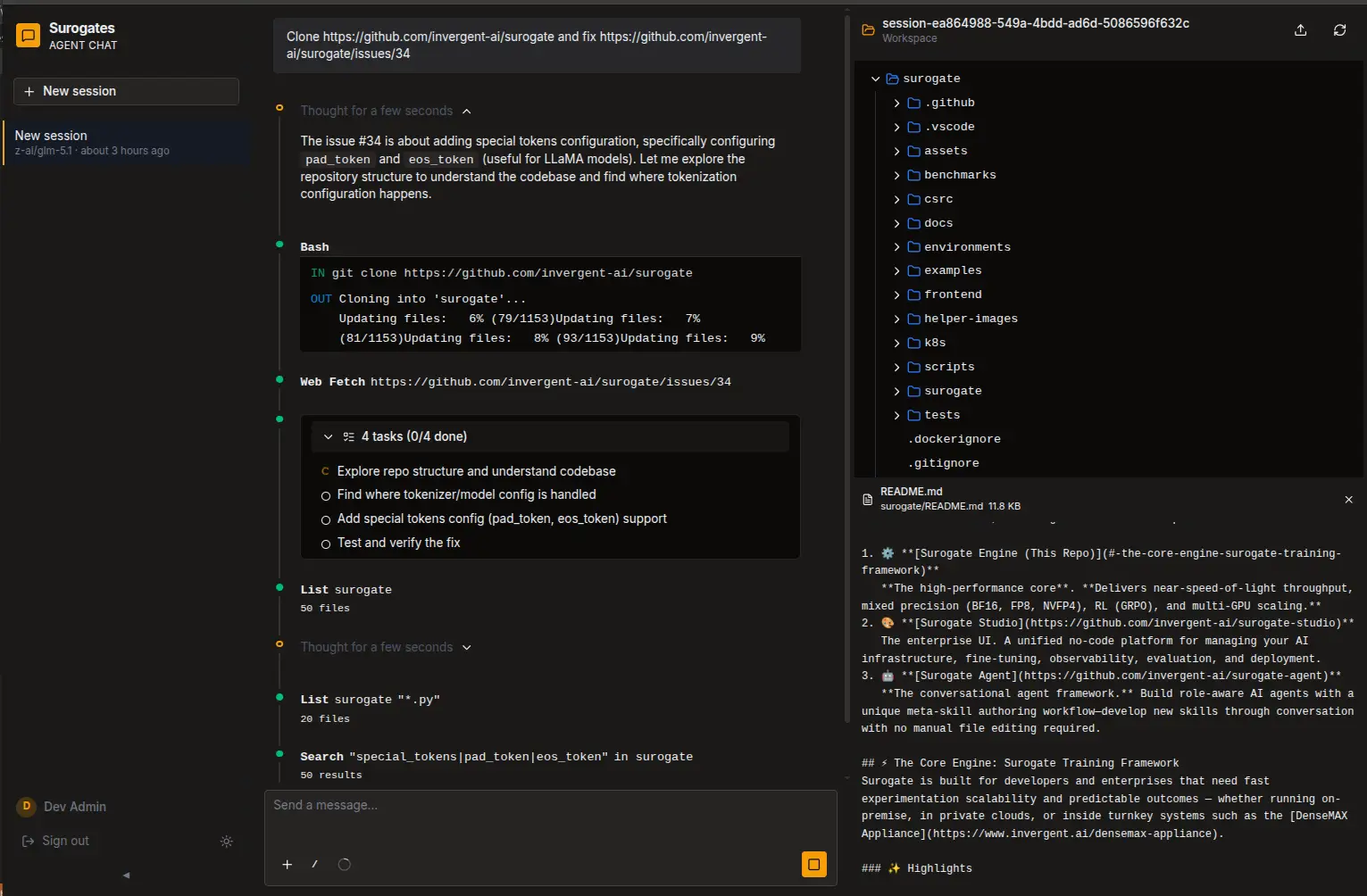
Most agent frameworks are a loop around an LLM call. That is the easy part. It falls over the moment an agent has to run for an hour, touch a real system, or be trusted by someone other than the person who wrote it.
Surogates is the part that comes after the loop:
| It survives | Every session is an append-only event log in PostgreSQL. Kill the worker mid-tool-call and the next one replays the log and carries on. Workers are stateless; any of them can serve any session. |
| It is contained | A hard brain/hands split. Workers run the reasoning loop. Sandboxes — Kubernetes pods in production — run the untrusted code, with a session-scoped workspace and a network policy around them. |
| It is governed | Every tool call passes a policy engine before it executes: allow-lists, deny-lists, ABAC rules, file-path containment. Policy is frozen per session, so a prompt injection mid-conversation cannot widen it. |
| It is multi-tenant | Storage, credentials, skills, memory, MCP config, policy and rate limits are all tenant-scoped. Sandboxes never see tenant secrets — the MCP proxy injects credentials on the way out. |
| It goes where users are | Web, Slack, Telegram, WhatsApp, an embeddable website widget, and an OpenAI-compatible API — the same agent, the same session store, six front doors. |
One command builds a local Kubernetes cluster with everything Surogates needs — PostgreSQL, Redis, S3-compatible storage, ingress and TLS:
git clone https://github.com/invergent-ai/surogates
cd surogates/k8s && ./setup-cluster.sh
It installs kubectl, helm, k3d and mkcert into ~/.surogates/bin/ if
they are missing, then writes a filled-in ~/.surogates/config.yaml.
Point it at any OpenAI-compatible model:
llm:
  model: "claude-sonnet-4-20250514"
  base_url: "https://api.anthropic.com/v1"
  api_key: "sk-ant-..."
Then run the control plane and a worker:
export SUROGATES_CONFIG=~/.surogates/config.yaml
surogates api      # REST API + web chat UI
surogates worker   # pulls sessions off Redis, runs the harness
Full walkthrough: Getting Started.
Sessions are REST. Create one, send it work, stream the result back:
# Create a session
curl -X POST https://your-host/v1/sessions \
  -H "Authorization: Bearer $TOKEN" \
  -H "Content-Type: application/json" \
  -d '{"system": "Answer only in SQL. Never write prose."}'
# → {"session_id": "…", "status": "active"}

# Give it something to do
curl -X POST https://your-host/v1/sessions/$SID/messages \
  -H "Authorization: Bearer $TOKEN" \
  -H "Content-Type: application/json" \
  -d '{"content": "Which customers churned last quarter?"}'
# → {"event_id": 42, "status": "processing"}

# Watch it think, over SSE
curl -N https://your-host/v1/sessions/$SID/events \
  -H "Authorization: Bearer $TOKEN"
The same endpoint replays from any point in the log, so a dropped connection costs nothing. Full surface: REST API Reference.
Tasks are database rows, not in-memory promises. Each wraps zero or more attempt
sessions with a goal, optional parents=[...] for fan-in, structured results,
and a todo → ready → running → done/blocked/failed/cancelled state machine. A
5-second dispatcher promotes ready tasks, finalises attempts and retries crashes
up to max_attempts — with the prior attempts injected into the retry's context
so it does not repeat itself.
Missions sit on top: /mission <description> plus a written rubric. A
coordinator decomposes the goal into work tasks and a verifier task, and an LLM
judge grades the workstream whenever a task terminates — satisfied,
needs_revision, blocked or failed. Pause, resume and cancel without losing
in-flight workers.
Turns "improve this benchmark" into a cumulative search. A coordinator grows a durable Idea Tree of hypotheses; ephemeral executors implement and evaluate each one in an isolated git worktree; a verified gain merges into a protected trunk only after an independently re-run held-out evaluation. Executors cannot merge their own claims, so progress cannot be faked.
A two-agent pipeline that turns an open-ended question into a long-form, citation-grounded report. Opt-in per agent, with guards against runaway iteration and dangling citations.
When a session fans out, the whole tree shares one board of compact, typed
notes. Workers post what they learn and every member — siblings, retries and the
coordinator — reads it directly, instead of results dribbling upward one parent
at a time. A dead end hit by worker 1 becomes a FAIL note that worker 2 reads
before repeating it.
/goal <description> defines an outcome with a rubric; Surogates works the
conversation, grades each response and appends continuations until the evaluator
returns satisfied, blocked or failed. /loop [interval] <prompt> schedules
recurring work — a fixed 5m/1h/2d, or dynamic self-pacing.
Agents drive a real session-scoped Chromium: navigate, click, type, scroll, read the accessibility tree, screenshot. When it hits a login, MFA or CAPTCHA it hands the browser to the user, waits, and continues in the same session.
Built-in tools for shell, files, patching, code execution, web search, extraction, crawling, vision, memory, skills, delegation and scheduling. MCP servers over stdio and HTTP with OAuth 2.1 PKCE.
The proxy injects credentials on the way out, so sandboxes never see tenant secrets. Tool definitions are scanned for prompt injection, invisible unicode and schema abuse, and SHA-256 fingerprinted to catch rug-pulls.
→ Tools · MCP Integration
Skills are reusable prompt-based behaviours layered platform → org → user. Sub-agents are declarative child presets with their own prompt, tool envelope, model override, iteration cap and policy profile. Experts are task-specialised models or scoped mini-loops, retrainable from the event log the runtime already collects.
→ Skills · Sub-Agents · Experts
MEMORY.md for durable project knowledge, USER.md for user preferences.
Frozen snapshots are injected at session start; updates are security-scanned and
deduplicated before storage.
→ Memory
A policy engine on every tool call — allow-lists, deny-lists, ABAC rules and file-path containment — immutable once a session is frozen. Policy profiles narrow what child sessions may do. Sandboxes are network-isolated by Kubernetes NetworkPolicy. Credentials live in a vault encrypted at rest, scoped per org and per user. Saga tracking compensates a multi-step tool chain when a later step fails. Sliding-window rate limits per org and per user.
Everything lands in the session event log and a tenant audit log, with SQL views for compliance, debugging, dashboards and training data.
| Channel | What it is |
|---|---|
| Web | Streaming chat UI with session management and workspace browsing |
| Slack | Socket Mode — DMs, @mentions, threads, files, multi-workspace |
| Telegram | DMs, groups, forum topics, media, fallback transport for restricted networks |
| Official Business Cloud API, per-tenant Meta app. Reactive by design, so the 24-hour window never applies | |
| Website widget | Embeddable widget for anonymous visitors — publishable-key auth, CORS allow-list, CSRF-protected sessions |
| API | OpenAI-compatible chat completions plus fire-and-forget submission for batch pipelines |
→ Channels · Agent Inbox
Three tiers, decoupled so each can fail, scale and be governed on its own.
flowchart TD
    C["Web · Slack · Telegram · WhatsApp · Widget · API"]
    C --> API["<b>API server</b><br/>auth · tenant routing · REST · agent web app<br/><i>the trusted control plane</i>"]
    API --> R[("Redis<br/>orchestrator")]
    R --> W["<b>Workers</b> — stateless<br/>harness loop · tool routing · governance<br/>memory · skills · MCP proxy"]
    W --> S["<b>Sandboxes</b> — isolated<br/>shell · files · patches · code<br/><i>session workspace only</i>"]
    W --> DB[("PostgreSQL<br/>append-only event log<br/>sessions · leases · inbox · outbox")]
    API --> DB
    DB -. "replay after any crash" .-> W
Workers hold no state, so any worker can serve any session. Sandboxes get a session-scoped workspace and nothing else. If either dies, the next run resumes from the log.
→ Architecture · Multi-Tenancy
| Path | Purpose |
|---|---|
surogates/ | Python backend — API server, worker harness, tools, storage, governance, jobs |
web/ | React web application for the hosted chat UI |
sdk/agent-chat-react/ | Shared React chat and inbox components |
sdk/website-widget/ | Embeddable website widget SDK |
docs/ | User, operator and architecture documentation |
k8s/ | Cluster setup script and manifests |
tests/ | Backend unit and integration tests |
uv sync                                  # Python deps
uv run pytest                            # backend tests
cd web && npm run typecheck && npm run build
cd sdk/agent-chat-react && npm test
Some integration tests need PostgreSQL, Redis, Docker, browser images or Kubernetes, depending on the marker.
Start here — Introduction · Getting Started · Architecture · Glossary
Build with it — Tools · Skills · Sub-Agents · Experts · MCP · Memory · Commands
Long-horizon work — Tasks and Missions · Goals · Research Missions · Deep Research · Coordination Board
Reach users — Channels · Agent Inbox · Browser Use
Run it — Multi-Tenancy · Governance and Security · Audit · Storage · Background Jobs · Operations · Configuration · REST API
Contributions that improve reliability, security, documentation and interoperability are welcome. Surogates builds on ideas from:
Anthropic — Building Effective Agents · Anthropic Sandbox Runtime · Microsoft Agent Governance Toolkit · Hermes Agent · OpenClaw · NVIDIA OpenShell
Built by Invergent · surogate.ai · Discord · X
If Surogates is useful to you, a ⭐ helps other people find it.
Open platform for running Managed Agents at scale
See the codeThe open runtime for managed AI agents.
Durable sessions. Isolated execution. Governance on every tool call. Agents that survive a crash, a restart, and a bad decision.
Most agent frameworks are a loop around an LLM call. That is the easy part. It falls over the moment an agent has to run for an hour, touch a real system, or be trusted by someone other than the person who wrote it.
Surogates is the part that comes after the loop:
| It survives | Every session is an append-only event log in PostgreSQL. Kill the worker mid-tool-call and the next one replays the log and carries on. Workers are stateless; any of them can serve any session. |
| It is contained | A hard brain/hands split. Workers run the reasoning loop. Sandboxes — Kubernetes pods in production — run the untrusted code, with a session-scoped workspace and a network policy around them. |
| It is governed | Every tool call passes a policy engine before it executes: allow-lists, deny-lists, ABAC rules, file-path containment. Policy is frozen per session, so a prompt injection mid-conversation cannot widen it. |
| It is multi-tenant | Storage, credentials, skills, memory, MCP config, policy and rate limits are all tenant-scoped. Sandboxes never see tenant secrets — the MCP proxy injects credentials on the way out. |
| It goes where users are | Web, Slack, Telegram, WhatsApp, an embeddable website widget, and an OpenAI-compatible API — the same agent, the same session store, six front doors. |
One command builds a local Kubernetes cluster with everything Surogates needs — PostgreSQL, Redis, S3-compatible storage, ingress and TLS:
git clone https://github.com/invergent-ai/surogates
cd surogates/k8s && ./setup-cluster.sh
It installs kubectl, helm, k3d and mkcert into ~/.surogates/bin/ if
they are missing, then writes a filled-in ~/.surogates/config.yaml.
Point it at any OpenAI-compatible model:
llm:
  model: "claude-sonnet-4-20250514"
  base_url: "https://api.anthropic.com/v1"
  api_key: "sk-ant-..."
Then run the control plane and a worker:
export SUROGATES_CONFIG=~/.surogates/config.yaml
surogates api      # REST API + web chat UI
surogates worker   # pulls sessions off Redis, runs the harness
Full walkthrough: Getting Started.
Sessions are REST. Create one, send it work, stream the result back:
# Create a session
curl -X POST https://your-host/v1/sessions \
  -H "Authorization: Bearer $TOKEN" \
  -H "Content-Type: application/json" \
  -d '{"system": "Answer only in SQL. Never write prose."}'
# → {"session_id": "…", "status": "active"}

# Give it something to do
curl -X POST https://your-host/v1/sessions/$SID/messages \
  -H "Authorization: Bearer $TOKEN" \
  -H "Content-Type: application/json" \
  -d '{"content": "Which customers churned last quarter?"}'
# → {"event_id": 42, "status": "processing"}

# Watch it think, over SSE
curl -N https://your-host/v1/sessions/$SID/events \
  -H "Authorization: Bearer $TOKEN"
The same endpoint replays from any point in the log, so a dropped connection costs nothing. Full surface: REST API Reference.
Tasks are database rows, not in-memory promises. Each wraps zero or more attempt
sessions with a goal, optional parents=[...] for fan-in, structured results,
and a todo → ready → running → done/blocked/failed/cancelled state machine. A
5-second dispatcher promotes ready tasks, finalises attempts and retries crashes
up to max_attempts — with the prior attempts injected into the retry's context
so it does not repeat itself.
Missions sit on top: /mission <description> plus a written rubric. A
coordinator decomposes the goal into work tasks and a verifier task, and an LLM
judge grades the workstream whenever a task terminates — satisfied,
needs_revision, blocked or failed. Pause, resume and cancel without losing
in-flight workers.
Turns "improve this benchmark" into a cumulative search. A coordinator grows a durable Idea Tree of hypotheses; ephemeral executors implement and evaluate each one in an isolated git worktree; a verified gain merges into a protected trunk only after an independently re-run held-out evaluation. Executors cannot merge their own claims, so progress cannot be faked.
A two-agent pipeline that turns an open-ended question into a long-form, citation-grounded report. Opt-in per agent, with guards against runaway iteration and dangling citations.
When a session fans out, the whole tree shares one board of compact, typed
notes. Workers post what they learn and every member — siblings, retries and the
coordinator — reads it directly, instead of results dribbling upward one parent
at a time. A dead end hit by worker 1 becomes a FAIL note that worker 2 reads
before repeating it.
/goal <description> defines an outcome with a rubric; Surogates works the
conversation, grades each response and appends continuations until the evaluator
returns satisfied, blocked or failed. /loop [interval] <prompt> schedules
recurring work — a fixed 5m/1h/2d, or dynamic self-pacing.
Agents drive a real session-scoped Chromium: navigate, click, type, scroll, read the accessibility tree, screenshot. When it hits a login, MFA or CAPTCHA it hands the browser to the user, waits, and continues in the same session.
Built-in tools for shell, files, patching, code execution, web search, extraction, crawling, vision, memory, skills, delegation and scheduling. MCP servers over stdio and HTTP with OAuth 2.1 PKCE.
The proxy injects credentials on the way out, so sandboxes never see tenant secrets. Tool definitions are scanned for prompt injection, invisible unicode and schema abuse, and SHA-256 fingerprinted to catch rug-pulls.
→ Tools · MCP Integration
Skills are reusable prompt-based behaviours layered platform → org → user. Sub-agents are declarative child presets with their own prompt, tool envelope, model override, iteration cap and policy profile. Experts are task-specialised models or scoped mini-loops, retrainable from the event log the runtime already collects.
→ Skills · Sub-Agents · Experts
MEMORY.md for durable project knowledge, USER.md for user preferences.
Frozen snapshots are injected at session start; updates are security-scanned and
deduplicated before storage.
→ Memory
A policy engine on every tool call — allow-lists, deny-lists, ABAC rules and file-path containment — immutable once a session is frozen. Policy profiles narrow what child sessions may do. Sandboxes are network-isolated by Kubernetes NetworkPolicy. Credentials live in a vault encrypted at rest, scoped per org and per user. Saga tracking compensates a multi-step tool chain when a later step fails. Sliding-window rate limits per org and per user.
Everything lands in the session event log and a tenant audit log, with SQL views for compliance, debugging, dashboards and training data.
| Channel | What it is |
|---|---|
| Web | Streaming chat UI with session management and workspace browsing |
| Slack | Socket Mode — DMs, @mentions, threads, files, multi-workspace |
| Telegram | DMs, groups, forum topics, media, fallback transport for restricted networks |
| Official Business Cloud API, per-tenant Meta app. Reactive by design, so the 24-hour window never applies | |
| Website widget | Embeddable widget for anonymous visitors — publishable-key auth, CORS allow-list, CSRF-protected sessions |
| API | OpenAI-compatible chat completions plus fire-and-forget submission for batch pipelines |
→ Channels · Agent Inbox
Three tiers, decoupled so each can fail, scale and be governed on its own.
flowchart TD
    C["Web · Slack · Telegram · WhatsApp · Widget · API"]
    C --> API["<b>API server</b><br/>auth · tenant routing · REST · agent web app<br/><i>the trusted control plane</i>"]
    API --> R[("Redis<br/>orchestrator")]
    R --> W["<b>Workers</b> — stateless<br/>harness loop · tool routing · governance<br/>memory · skills · MCP proxy"]
    W --> S["<b>Sandboxes</b> — isolated<br/>shell · files · patches · code<br/><i>session workspace only</i>"]
    W --> DB[("PostgreSQL<br/>append-only event log<br/>sessions · leases · inbox · outbox")]
    API --> DB
    DB -. "replay after any crash" .-> W
Workers hold no state, so any worker can serve any session. Sandboxes get a session-scoped workspace and nothing else. If either dies, the next run resumes from the log.
→ Architecture · Multi-Tenancy
| Path | Purpose |
|---|---|
surogates/ | Python backend — API server, worker harness, tools, storage, governance, jobs |
web/ | React web application for the hosted chat UI |
sdk/agent-chat-react/ | Shared React chat and inbox components |
sdk/website-widget/ | Embeddable website widget SDK |
docs/ | User, operator and architecture documentation |
k8s/ | Cluster setup script and manifests |
tests/ | Backend unit and integration tests |
uv sync                                  # Python deps
uv run pytest                            # backend tests
cd web && npm run typecheck && npm run build
cd sdk/agent-chat-react && npm test
Some integration tests need PostgreSQL, Redis, Docker, browser images or Kubernetes, depending on the marker.
Start here — Introduction · Getting Started · Architecture · Glossary
Build with it — Tools · Skills · Sub-Agents · Experts · MCP · Memory · Commands
Long-horizon work — Tasks and Missions · Goals · Research Missions · Deep Research · Coordination Board
Reach users — Channels · Agent Inbox · Browser Use
Run it — Multi-Tenancy · Governance and Security · Audit · Storage · Background Jobs · Operations · Configuration · REST API
Contributions that improve reliability, security, documentation and interoperability are welcome. Surogates builds on ideas from:
Anthropic — Building Effective Agents · Anthropic Sandbox Runtime · Microsoft Agent Governance Toolkit · Hermes Agent · OpenClaw · NVIDIA OpenShell
Built by Invergent · surogate.ai · Discord · X
If Surogates is useful to you, a ⭐ helps other people find it.



