
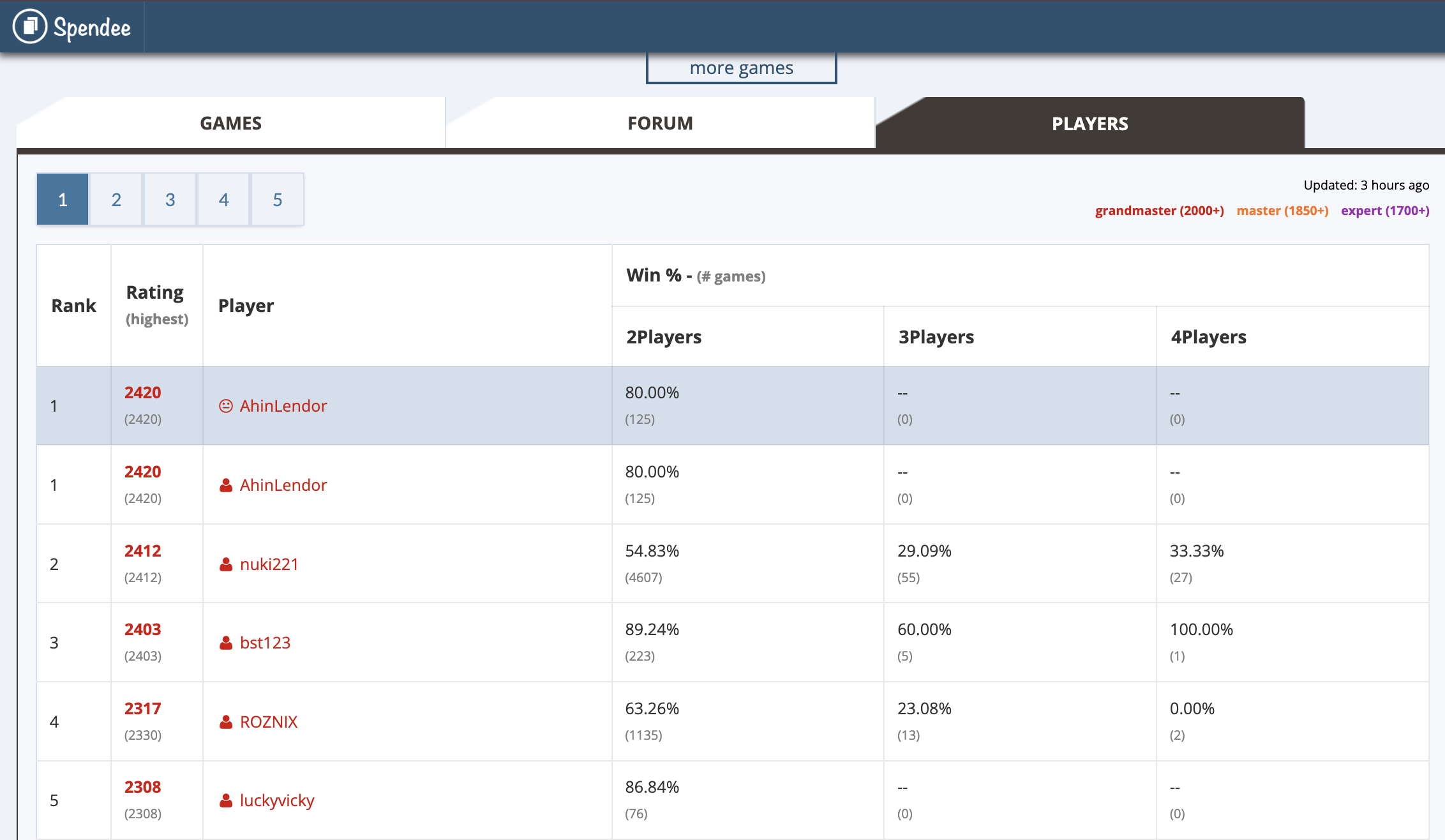
AhinLendor is an AlphaZero-style AI for Splendor, trained entirely through self-play using a policy-value neural network and Monte Carlo Tree Search (MCTS). It reached Rank 1 on the Spendee leaderboard and has defeated top-ranked human players in exhibition matches on Board Game Arena.
See the codeSee what people are saying
README
AhinLendor
An AlphaZero-style AI for Splendor, trained entirely through self-play.
AhinLendor combines a native C++ game engine, a PyTorch policy-value network, and Monte Carlo Tree Search (MCTS) to learn the game without human data. It reached Rank 1 on Spendee and serves as the research engine behind the AhinLendor web application.
AlphaZero Architecture
AhinLendor follows the standard AlphaZero training loop:
Self Play
      ↓
 Monte Carlo Tree Search
      ↓
Policy-Value Network
      ↓
 Training
      ↓
Stronger Model
      ↺
The neural network predicts both:
- Policy — probability distribution over legal moves
- Value — estimated probability of winning
During play, these predictions guide MCTS to produce stronger search than the network alone.
Engine Specifications
When AhinLendor first reached Rank 1 on Spendee, it competed under a 5 minutes + 10 seconds per action time control, performing approximately 70,000 MCTS simulations per move.
Later versions significantly improved search by combining:
- 250,000 MCTS simulations
- 20,000 Bootstrap iterations
- Batch inference of 64 leaf evaluations
Running on a MacBook M2, this version typically spent around 20 seconds per move.
Key Design Decisions
1. Reduced Action Space
One of the first design challenges was defining the policy action space.
Splendor naturally contains many combinations of gem collections, token returns, and card interactions. Treating every possibility as a separate action quickly becomes impractical. For comparison, Jonatan Simonsson's master's thesis Creating an AI Opponent with Super-Human Performance for Splendor uses 371 actions.
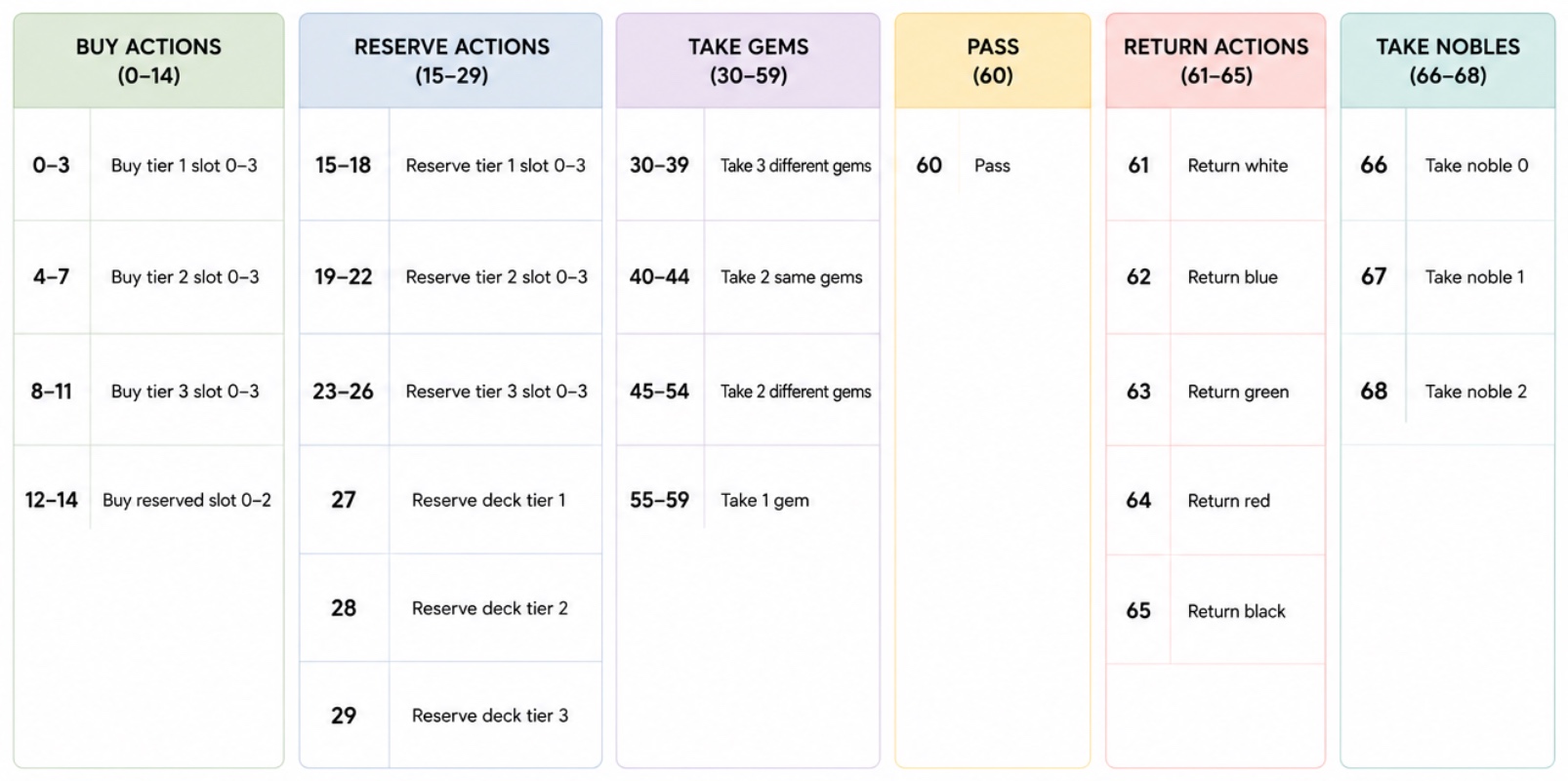
AhinLendor reduces the action space to only 69 actions by:
- returning gems one token at a time in a dedicated return phase;
- limiting buy and reserve actions to cards currently visible on the board;
- sharing fixed action slots across equivalent board positions.
This preserves the complete game rules while making policy learning substantially easier.
2. Bootstrap MCTS
While analyzing games against former Board Game Arena Rank 1 player seed seed, an interesting weakness emerged.
In one position, AhinLendor chose to collect gems. However, the strongest move was to reserve an inexpensive green development card, unlocking an efficient path toward several powerful Tier 3 purchases.
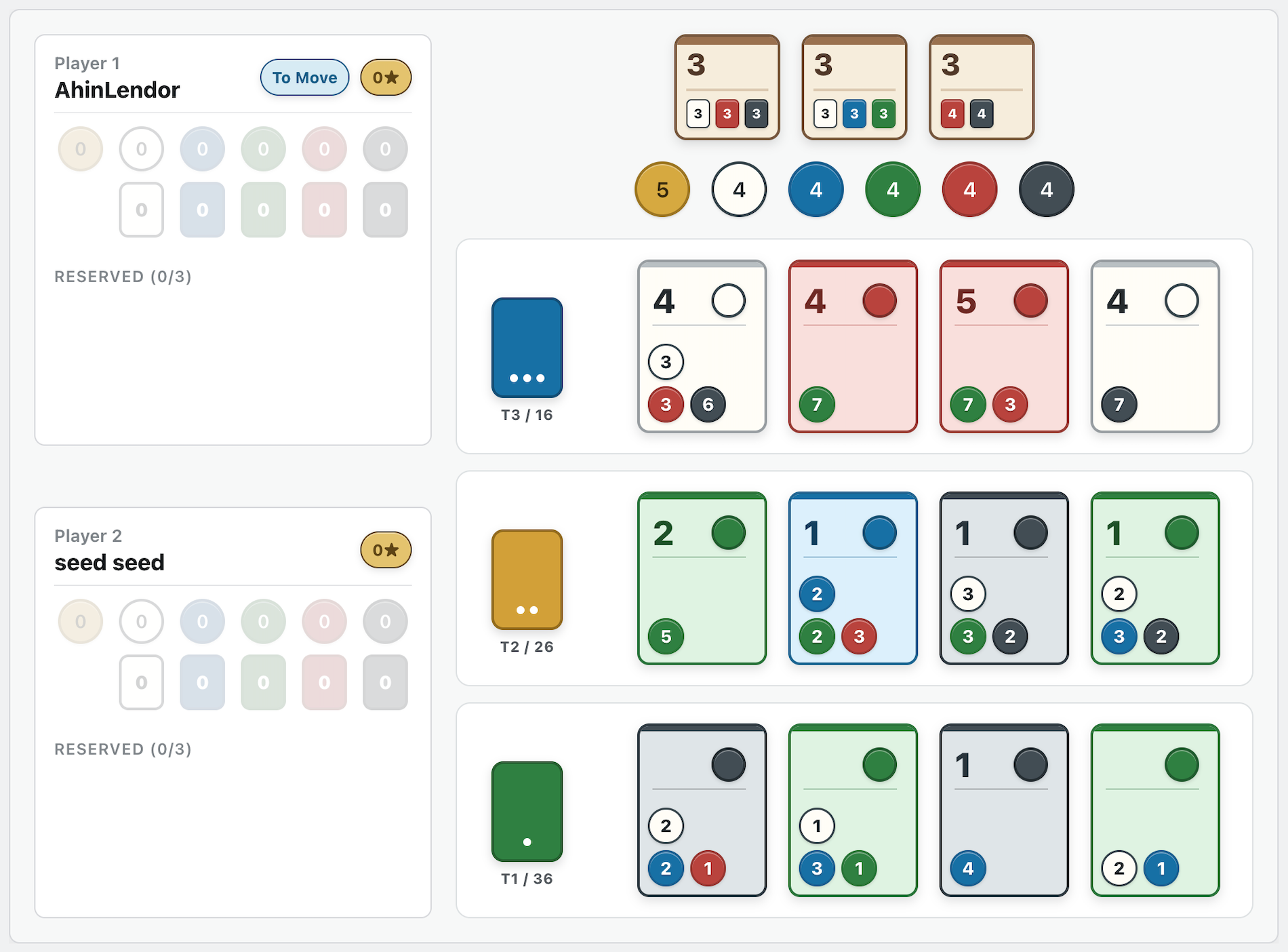
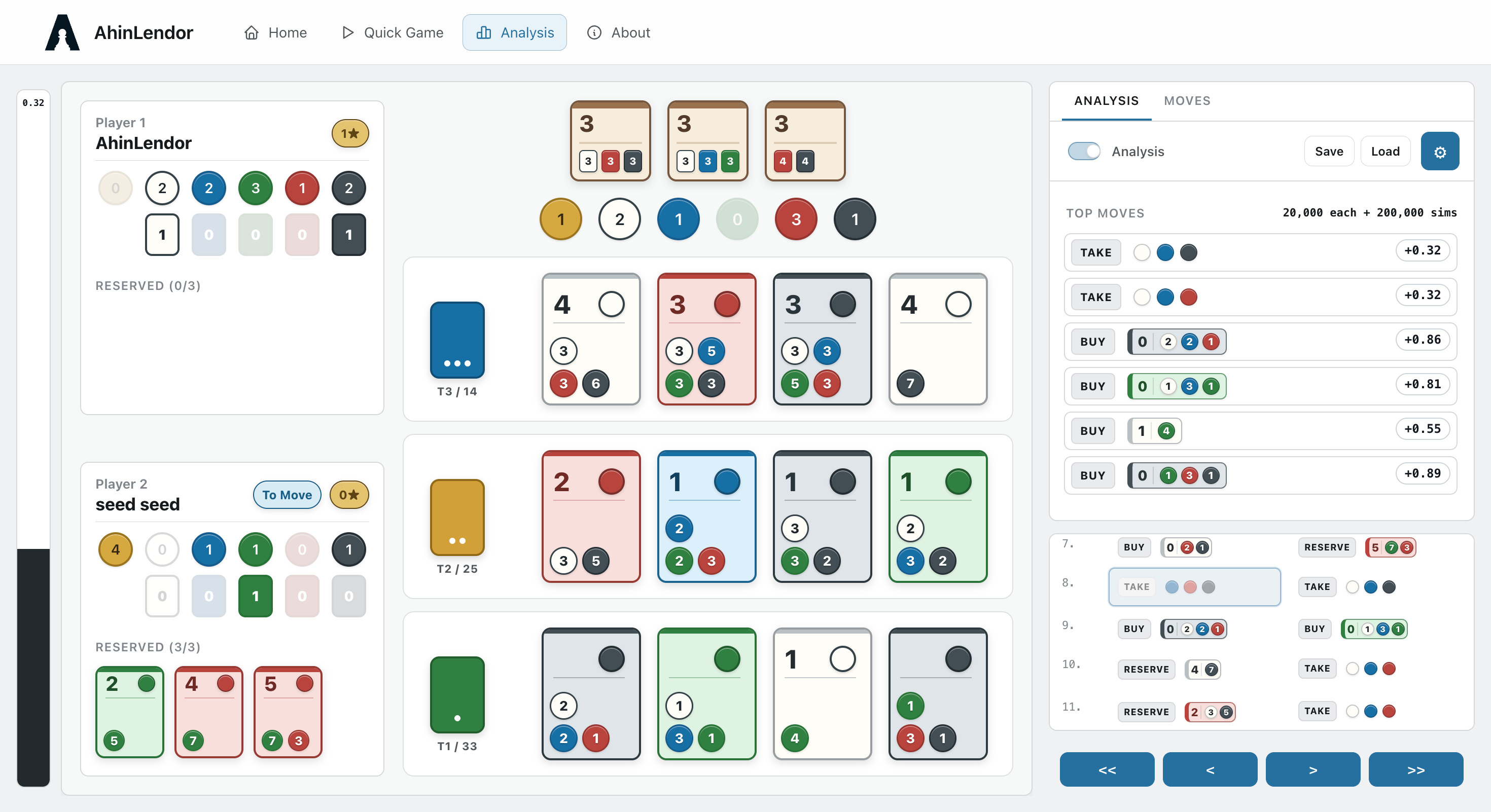
AhinLendor vs seed seed, AhinLendor to move.
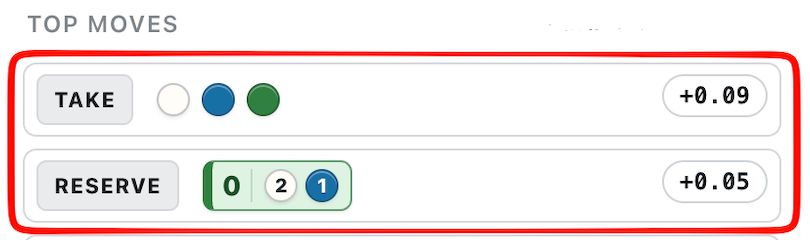
AhinLendor thinks taking gems is better than reserving the crucial tier-1 card.
The problem was not the search algorithm itself, but the interaction between the neural network and MCTS.
Because MCTS naturally spends most of its simulations on moves that already appear promising, actions receiving poor initial evaluations from the neural network may receive very little exploration—even when deeper search would reveal them to be the strongest moves.
To address this, I developed Bootstrap MCTS.
Before standard MCTS begins, the search first performs a fixed number of simulations from every legal move one ply ahead. Only after this initial exploration does normal MCTS allocate simulations according to its search policy.
This allows underestimated moves to demonstrate their strength before search becomes selective.
After introducing Bootstrap MCTS, the engine correctly identified reserving the green card as the best move.
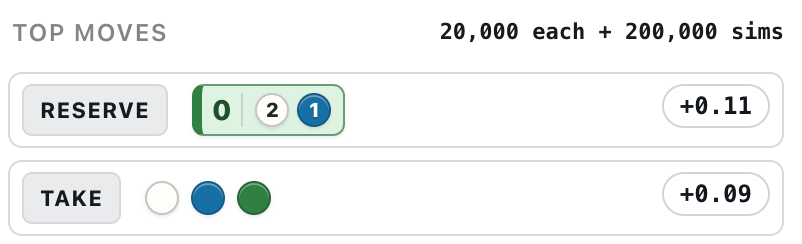
With bootstrap search (20K each), AhinLendor now correctly evaluates that reserving the tier-1 card is the best move.
Tech Stack
| Component | Technology |
|---|---|
| Engine | C++17 + pybind11 |
| Search | MCTS |
| Neural Network | PyTorch |
| Backend | FastAPI |
| Frontend | React + TypeScript + Vite |
| Build | CMake |
| Live Play | Playwright |
License
MIT License
Similar repos


AhinLendor is an AlphaZero-style AI for Splendor, trained entirely through self-play using a policy-value neural network and Monte Carlo Tree Search (MCTS). It reached Rank 1 on the Spendee leaderboard and has defeated top-ranked human players in exhibition matches on Board Game Arena.
See the codeSee what people are saying
README
AhinLendor
An AlphaZero-style AI for Splendor, trained entirely through self-play.
AhinLendor combines a native C++ game engine, a PyTorch policy-value network, and Monte Carlo Tree Search (MCTS) to learn the game without human data. It reached Rank 1 on Spendee and serves as the research engine behind the AhinLendor web application.
AlphaZero Architecture
AhinLendor follows the standard AlphaZero training loop:
Self Play
      ↓
 Monte Carlo Tree Search
      ↓
Policy-Value Network
      ↓
 Training
      ↓
Stronger Model
      ↺
The neural network predicts both:
- Policy — probability distribution over legal moves
- Value — estimated probability of winning
During play, these predictions guide MCTS to produce stronger search than the network alone.
Engine Specifications
When AhinLendor first reached Rank 1 on Spendee, it competed under a 5 minutes + 10 seconds per action time control, performing approximately 70,000 MCTS simulations per move.
Later versions significantly improved search by combining:
- 250,000 MCTS simulations
- 20,000 Bootstrap iterations
- Batch inference of 64 leaf evaluations
Running on a MacBook M2, this version typically spent around 20 seconds per move.
Key Design Decisions
1. Reduced Action Space
One of the first design challenges was defining the policy action space.
Splendor naturally contains many combinations of gem collections, token returns, and card interactions. Treating every possibility as a separate action quickly becomes impractical. For comparison, Jonatan Simonsson's master's thesis Creating an AI Opponent with Super-Human Performance for Splendor uses 371 actions.
AhinLendor reduces the action space to only 69 actions by:
- returning gems one token at a time in a dedicated return phase;
- limiting buy and reserve actions to cards currently visible on the board;
- sharing fixed action slots across equivalent board positions.
This preserves the complete game rules while making policy learning substantially easier.
2. Bootstrap MCTS
While analyzing games against former Board Game Arena Rank 1 player seed seed, an interesting weakness emerged.
In one position, AhinLendor chose to collect gems. However, the strongest move was to reserve an inexpensive green development card, unlocking an efficient path toward several powerful Tier 3 purchases.
AhinLendor vs seed seed, AhinLendor to move.
AhinLendor thinks taking gems is better than reserving the crucial tier-1 card.
The problem was not the search algorithm itself, but the interaction between the neural network and MCTS.
Because MCTS naturally spends most of its simulations on moves that already appear promising, actions receiving poor initial evaluations from the neural network may receive very little exploration—even when deeper search would reveal them to be the strongest moves.
To address this, I developed Bootstrap MCTS.
Before standard MCTS begins, the search first performs a fixed number of simulations from every legal move one ply ahead. Only after this initial exploration does normal MCTS allocate simulations according to its search policy.
This allows underestimated moves to demonstrate their strength before search becomes selective.
After introducing Bootstrap MCTS, the engine correctly identified reserving the green card as the best move.
With bootstrap search (20K each), AhinLendor now correctly evaluates that reserving the tier-1 card is the best move.
Tech Stack
| Component | Technology |
|---|---|
| Engine | C++17 + pybind11 |
| Search | MCTS |
| Neural Network | PyTorch |
| Backend | FastAPI |
| Frontend | React + TypeScript + Vite |
| Build | CMake |
| Live Play | Playwright |
License
MIT License