
[NeurIPS 2023 Spotlight] LightZero: A Unified Benchmark for Monte Carlo Tree Search in General Sequential Decision Scenarios (awesome MCTS)
See the codeREADME
LightZero















Updated on 2026.03.11 LightZero-v0.2.0
LightZero is a lightweight, efficient, and easy-to-understand open-source algorithm toolkit that combines Monte Carlo Tree Search (MCTS) and Deep Reinforcement Learning (RL).
English | 简体中文(Simplified Chinese) | Documentation | LightZero Paper | UniZero Paper | ReZero Paper | 🔥ScaleZero Paper
News
- [2026.02] 🔥 The ScaleZero paper has been accepted as a conference paper at ICLR 2026: One Model for All Tasks: Leveraging Efficient World Models in Multi-Task Planning.
- [2025.08] The ReZero paper has been accepted by the CoRL 2025 RemembeRL workshop.
- [2025.06] The UniZero paper has been accepted by Transactions on Machine Learning Research (TMLR 2025).
- [2023.09] The LightZero paper has been accepted as a Spotlight Presentation at the NeurIPS 2023 Datasets and Benchmarks Track.
- [2023.04] LightZero v0.0.1 was officially released.
🔍 Background
The integration of Monte Carlo Tree Search and Deep Reinforcement Learning,
exemplified by AlphaZero and MuZero,
has achieved unprecedented performance levels in various games, including Go and Atari.
This advanced methodology has also made significant strides in scientific domains like protein structure prediction and the search for matrix multiplication algorithms.
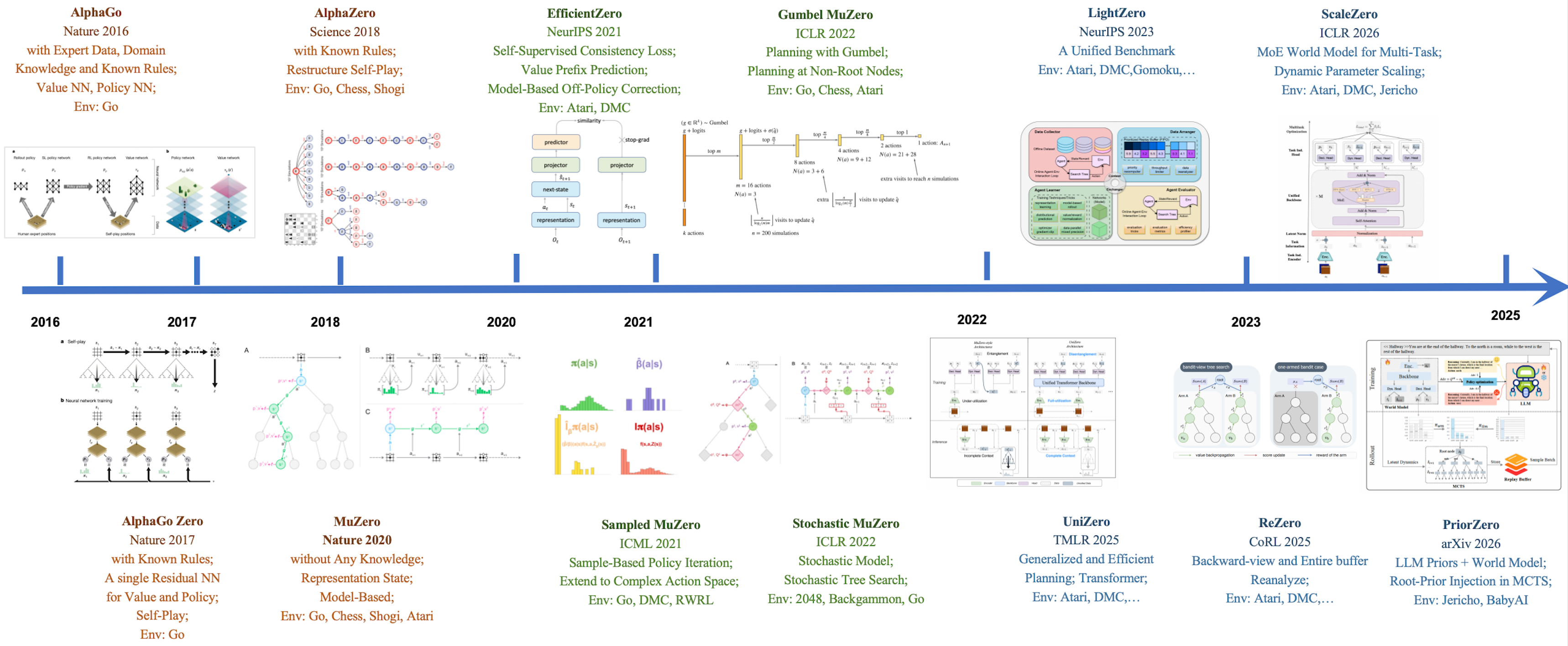
The following is an overview of the historical evolution of the Monte Carlo Tree Search algorithm series:
🎨 Overview
LightZero is an open-source algorithm toolkit that combines Monte Carlo Tree Search (MCTS) and Reinforcement Learning (RL) for PyTorch. It supports a range of MCTS-based RL algorithms and applications, offering several key advantages:
- Lightweight.
- Efficient.
- Easy-to-understand.
For further details, please refer to Features, Framework Structure and Integrated Algorithms.
LightZero aims to promote the standardization of the MCTS+RL algorithm family to accelerate related research and applications. A performance comparison of all implemented algorithms under a unified framework is presented in the Benchmark.
Outline
- LightZero
💥 Features
Lightweight: LightZero integrates multiple MCTS algorithm families and can solve decision-making problems with various attributes in a lightweight framework. The algorithms and environments LightZero implemented can be found here.
Efficient: LightZero uses mixed heterogeneous computing programming to improve computational efficiency for the most time-consuming part of MCTS algorithms.
Easy-to-understand: LightZero provides detailed documentation and algorithm framework diagrams for all integrated algorithms to help users understand the algorithm's core and compare the differences and similarities between algorithms under the same paradigm. LightZero also provides function call graphs and network structure diagrams for algorithm code implementation, making it easier for users to locate critical code. All the documentation can be found here.
🧩 Framework Structure

The above picture is the framework pipeline of LightZero. We briefly introduce the three core modules below:
Model:
Model is used to define the network structure, including the __init__ function for initializing the network structure and the forward function for computing the network's forward propagation.
Policy:
Policy defines the way the network is updated and interacts with the environment, including three processes: the learning process, the collecting process, and the evaluation process.
MCTS:
MCTS defines the structure of the Monte Carlo search tree and the way it interacts with the Policy. The implementation of MCTS includes two languages: Python and C++, implemented in ptree and ctree, respectively.
For the file structure of LightZero, please refer to lightzero_file_structure.
🎁 Integrated Algorithms
LightZero is a library with a PyTorch implementation of MCTS algorithms (sometimes combined with cython and cpp), including:
The environments and algorithms currently supported by LightZero are shown in the table below:
| Env./Algo. | AlphaZero | MuZero | Sampled MuZero | EfficientZero | Sampled EfficientZero | Gumbel MuZero | Stochastic MuZero | UniZero | Sampled UniZero | ReZero |
|---|---|---|---|---|---|---|---|---|---|---|
| TicTacToe | ✔ | ✔ | 🔒 | 🔒 | 🔒 | ✔ | 🔒 | ✔ | 🔒 | 🔒 |
| Gomoku | ✔ | ✔ | 🔒 | 🔒 | 🔒 | ✔ | 🔒 | ✔ | 🔒 | ✔ |
| Connect4 | ✔ | ✔ | 🔒 | 🔒 | 🔒 | 🔒 | 🔒 | ✔ | 🔒 | ✔ |
| 2048 | --- | ✔ | 🔒 | 🔒 | 🔒 | 🔒 | ✔ | ✔ | 🔒 | 🔒 |
| Chess | 🔒 | 🔒 | 🔒 | 🔒 | 🔒 | 🔒 | 🔒 | 🔒 | 🔒 | 🔒 |
| Go | 🔒 | 🔒 | 🔒 | 🔒 | 🔒 | 🔒 | 🔒 | 🔒 | 🔒 | 🔒 |
| CartPole | --- | ✔ | 🔒 | ✔ | ✔ | ✔ | ✔ | ✔ | 🔒 | ✔ |
| Pendulum | --- | ✔ | ✔ | ✔ | ✔ | ✔ | ✔ | 🔒 | ✔ | 🔒 |
| LunarLander | --- | ✔ | ✔ | ✔ | ✔ | ✔ | ✔ | ✔ | ✔ | 🔒 |
| BipedalWalker | --- | ✔ | ✔ | ✔ | ✔ | ✔ | 🔒 | 🔒 | ✔ | 🔒 |
| Atari | --- | ✔ | 🔒 | ✔ | ✔ | ✔ | ✔ | ✔ | 🔒 | ✔ |
| DeepMind Control | --- | --- | ✔ | --- | ✔ | 🔒 | 🔒 | 🔒 | ✔ | 🔒 |
| MuJoCo | --- | ✔ | 🔒 | ✔ | ✔ | 🔒 | 🔒 | 🔒 | 🔒 | 🔒 |
| MiniGrid | --- | ✔ | 🔒 | ✔ | ✔ | 🔒 | 🔒 | ✔ | 🔒 | 🔒 |
| Bsuite | --- | ✔ | 🔒 | ✔ | ✔ | 🔒 | 🔒 | ✔ | 🔒 | 🔒 |
| Memory | --- | ✔ | 🔒 | ✔ | ✔ | 🔒 | 🔒 | ✔ | 🔒 | 🔒 |
| SumToThree (billiards) | --- | 🔒 | 🔒 | 🔒 | ✔ | 🔒 | 🔒 | 🔒 | 🔒 | 🔒 |
| MetaDrive | --- | 🔒 | 🔒 | 🔒 | ✔ | 🔒 | 🔒 | 🔒 | 🔒 | 🔒 |
(1): "✔" means that the corresponding item is finished and well-tested.
(2): "🔒" means that the corresponding item is in the waiting-list (Work In Progress).
(3): "---" means that this algorithm doesn't support this environment.
⚙️ Installation
You can install the latest LightZero in development from the GitHub source codes with the following command:
git clone https://github.com/opendilab/LightZero.git
cd LightZero
pip3 install -e .
Kindly note that LightZero currently supports compilation only on Linux and macOS platforms.
We are actively working towards extending this support to the Windows platform.
Your patience during this transition is greatly appreciated.
Installation with Docker
We also provide a Dockerfile that sets up an environment with all dependencies needed to run the LightZero library. This Docker image is based on Ubuntu 20.04 and installs Python 3.8, along with other necessary tools and libraries. Here's how to use our Dockerfile to build a Docker image, run a container from this image, and execute LightZero code inside the container.
- Download the Dockerfile: The Dockerfile is located in the root directory of the LightZero repository. Download this file to your local machine.
- Prepare the build context: Create a new empty directory on your local machine, move the Dockerfile into this directory, and navigate into this directory. This step helps to avoid sending unnecessary files to the Docker daemon during the build process.
mkdir lightzero-docker mv Dockerfile lightzero-docker/ cd lightzero-docker/ - Build the Docker image: Use the following command to build the Docker image. This command should be run from inside the directory that contains the Dockerfile.
docker build -t ubuntu-py38-lz:latest -f ./Dockerfile . - Run a container from the image: Use the following command to start a container from the image in interactive mode with a Bash shell.
docker run -dit --rm ubuntu-py38-lz:latest /bin/bash - Execute LightZero code inside the container: Once you're inside the container, you can run the example Python script with the following command:
python ./LightZero/zoo/classic_control/cartpole/config/cartpole_muzero_config.py
🚀 Quick Start
Train a MuZero agent to play CartPole:
cd LightZero
python3 -u zoo/classic_control/cartpole/config/cartpole_muzero_config.py
Train a MuZero agent to play Pong:
cd LightZero
python3 -u zoo/atari/config/atari_muzero_segment_config.py
Train an experimental Ray async MuZero agent to play Pong:
cd LightZero
python3 -u zoo/atari/config/atari_muzero_segment_async_config.py
Train a MuZero agent to play TicTacToe:
cd LightZero
python3 -u zoo/board_games/tictactoe/config/tictactoe_muzero_bot_mode_config.py
Train a UniZero agent to play Pong:
cd LightZero
python3 -u zoo/atari/config/atari_unizero_segment_config.py
Experimental Async Segment Training
The Atari segment async pipeline uses Ray collector/evaluator actors while keeping the learner and replay buffer in the driver process. It supports MuZero-family segment policies and UniZero segment policies through the explicit --async-pipeline config flag. In a same-window Pong MuZero rjob comparison (2026-07-02, 2 collector actors, ~6.2 h wall-clock), async collected 809.5k env steps (≈36.3 env steps/s) versus 499.8k env steps (≈22.4 env steps/s) for the synchronous baseline — about 1.6× end-to-end throughput, with eval rewards statistically comparable at this early training stage. For design details and UniZero differences, see Async Pipeline and 中文说明.
📚 Documentation
The LightZero documentation can be found here. It contains tutorials and the API reference.
For those interested in customizing environments and algorithms, we provide relevant guides:
- Customize Environments
- Customize Algorithms
- How to Set Configuration Files?
- Logging and Monitoring System
- Loss Landscape Visualization
- MuZero / UniZero Async Segment Pipeline
Should you have any questions, feel free to contact us for support.
📊 Benchmark
Click to expand
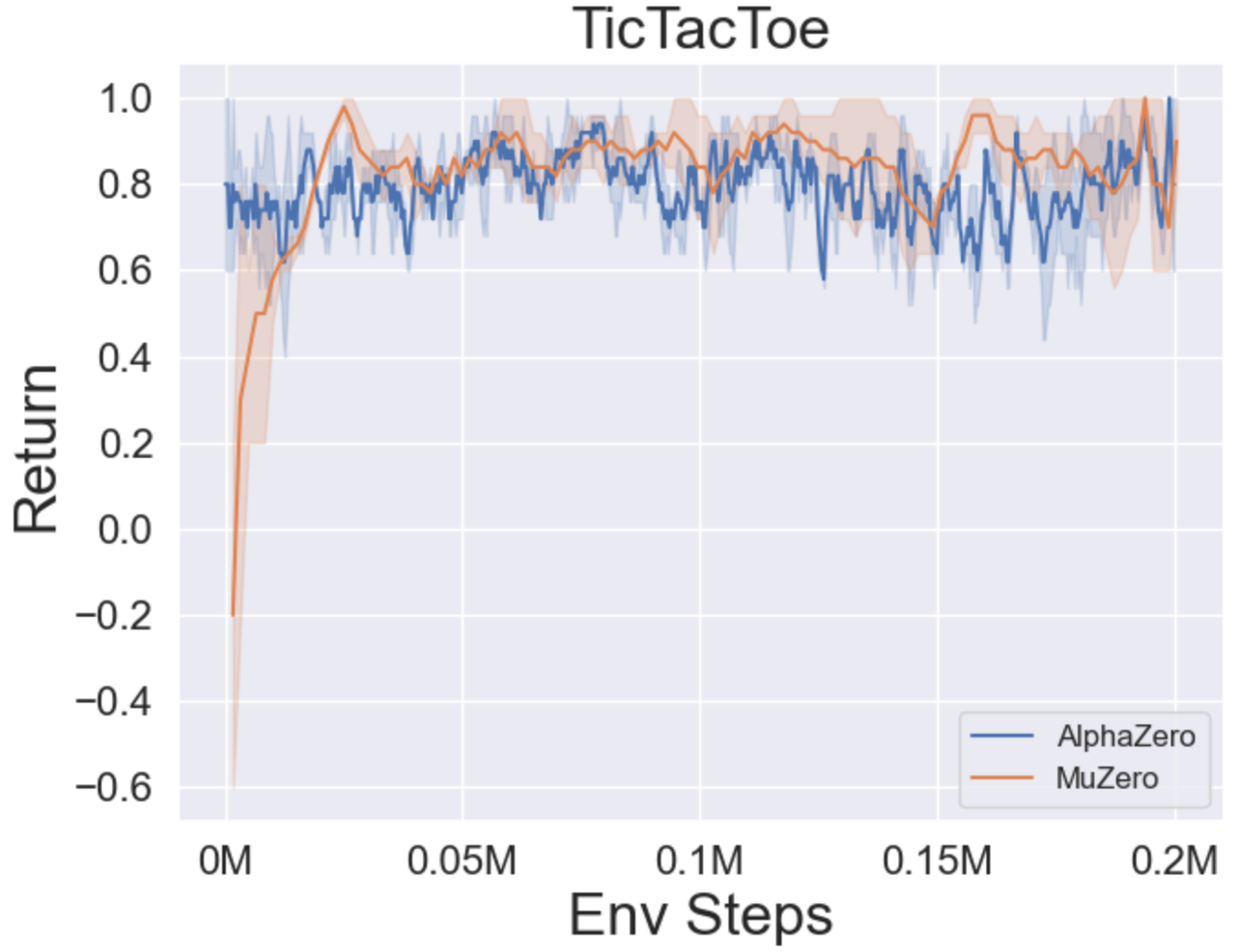
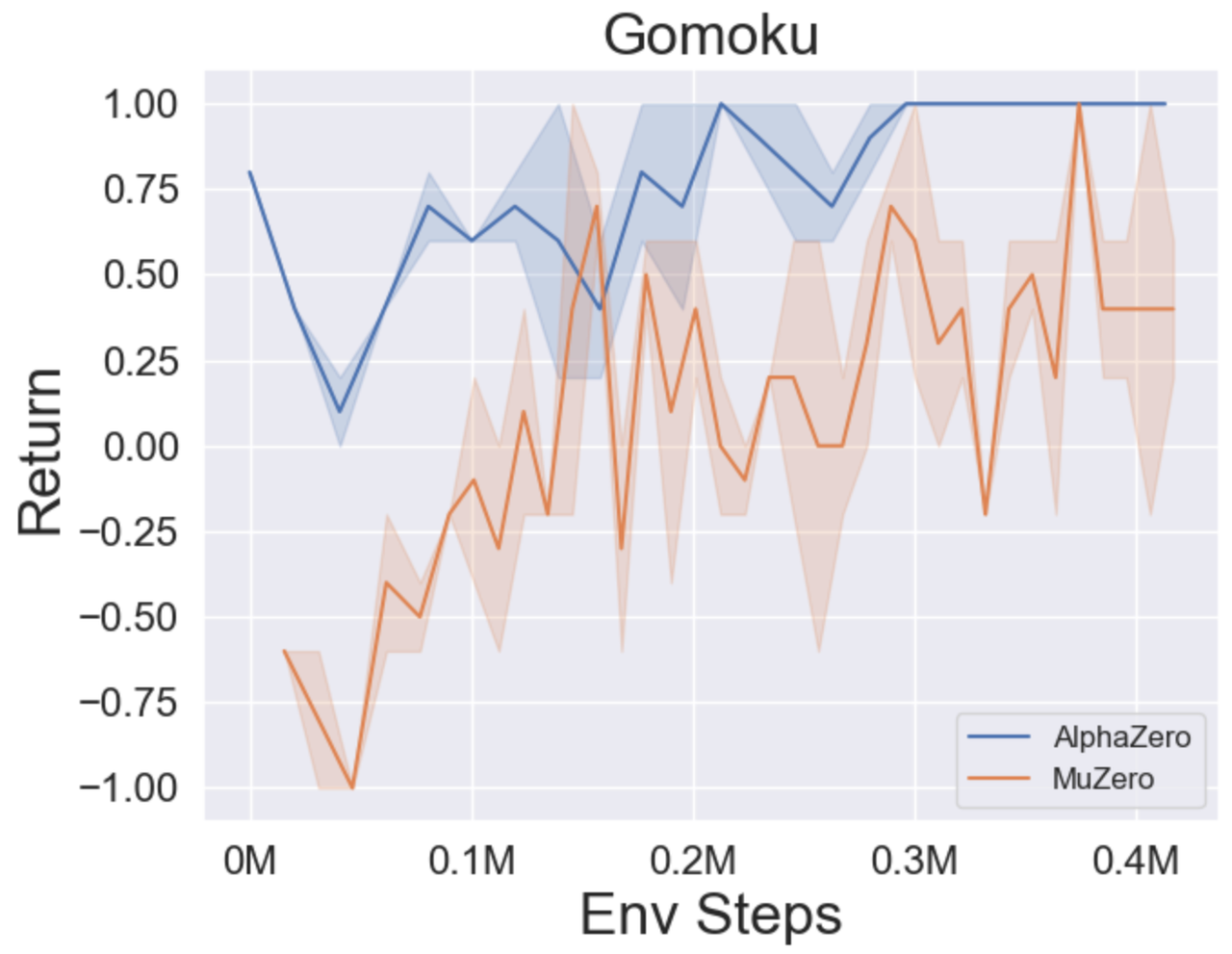
- Below are the benchmark results of AlphaZero and MuZero on three board games: TicTacToe, Connect4, Gomoku.
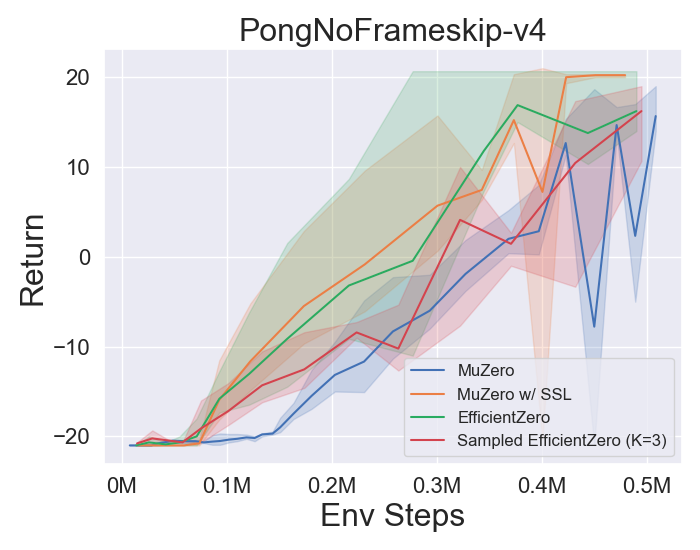
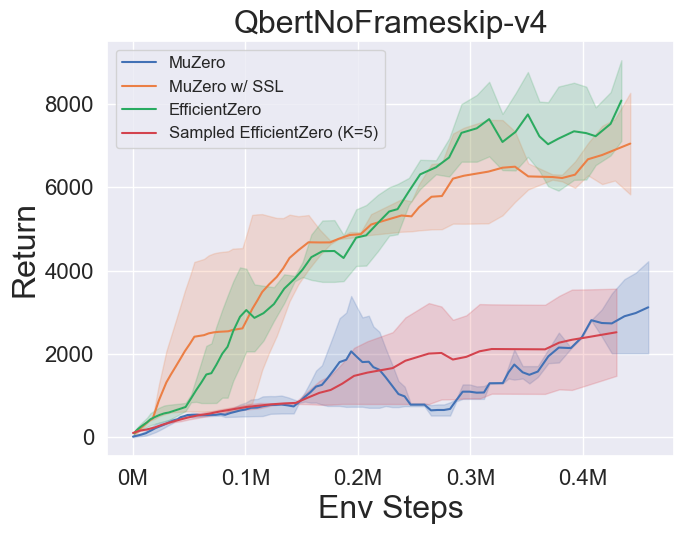
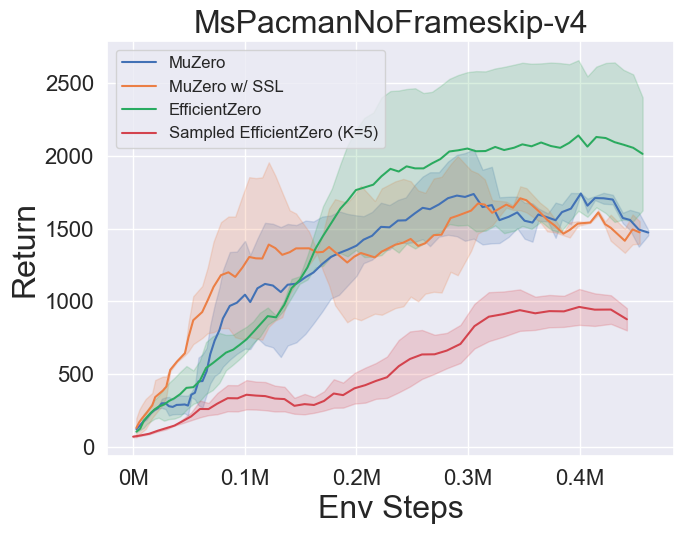
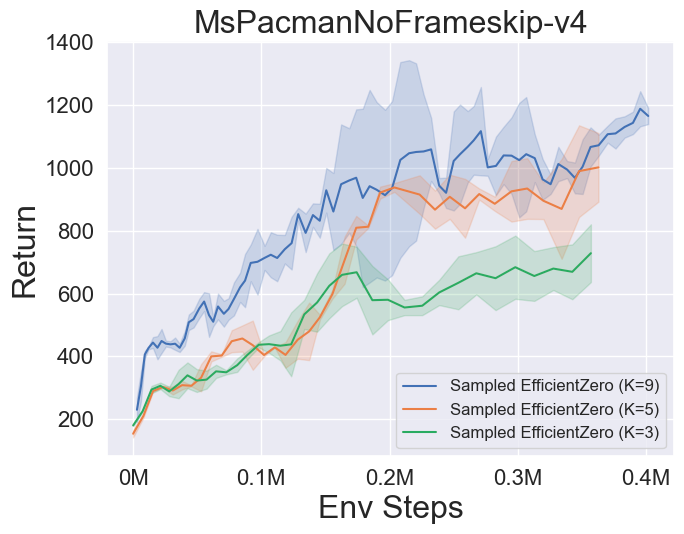
- Below are the benchmark results of MuZero, MuZero w/ SSL , EfficientZero and Sampled EfficientZero on three discrete action space games in Atari.
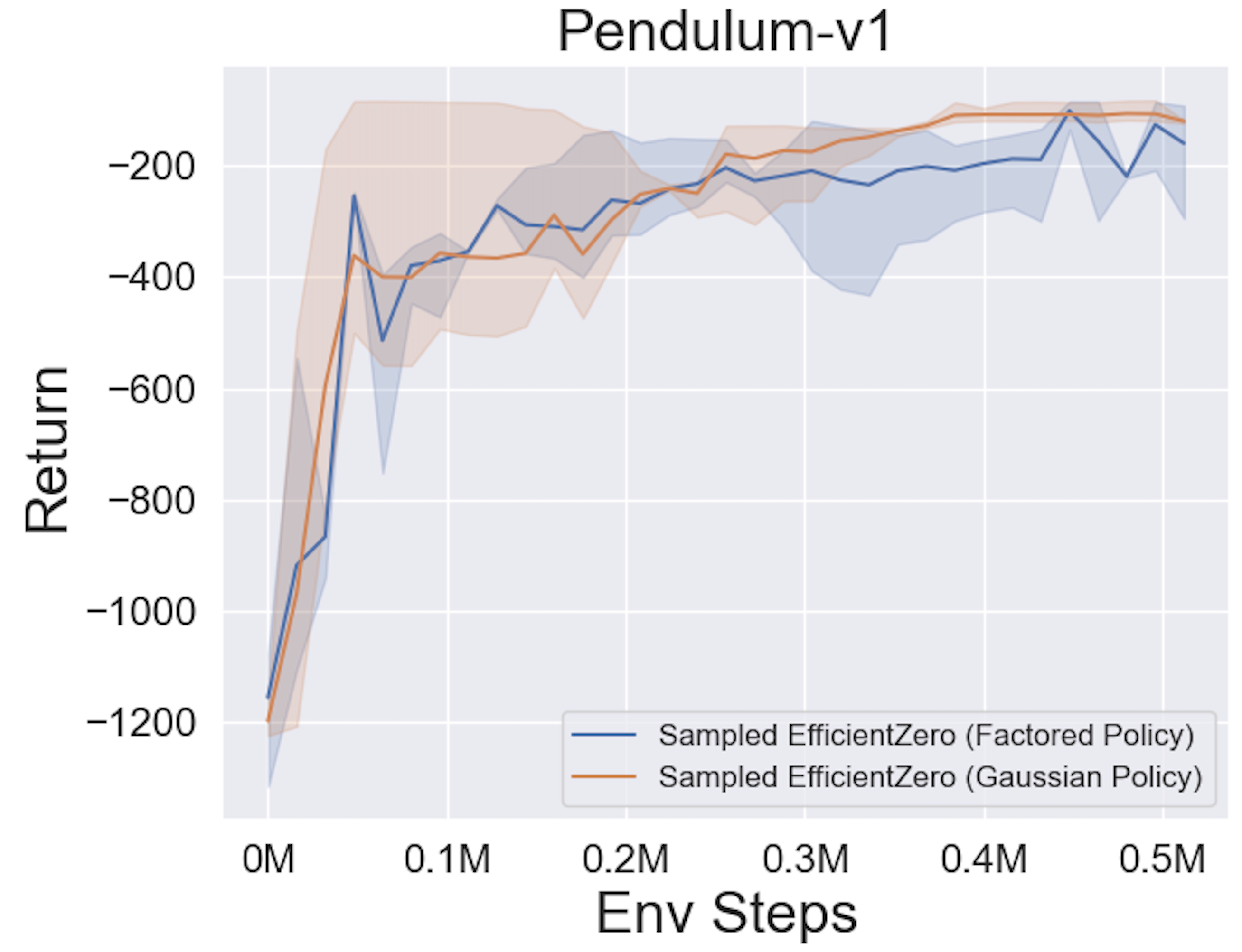
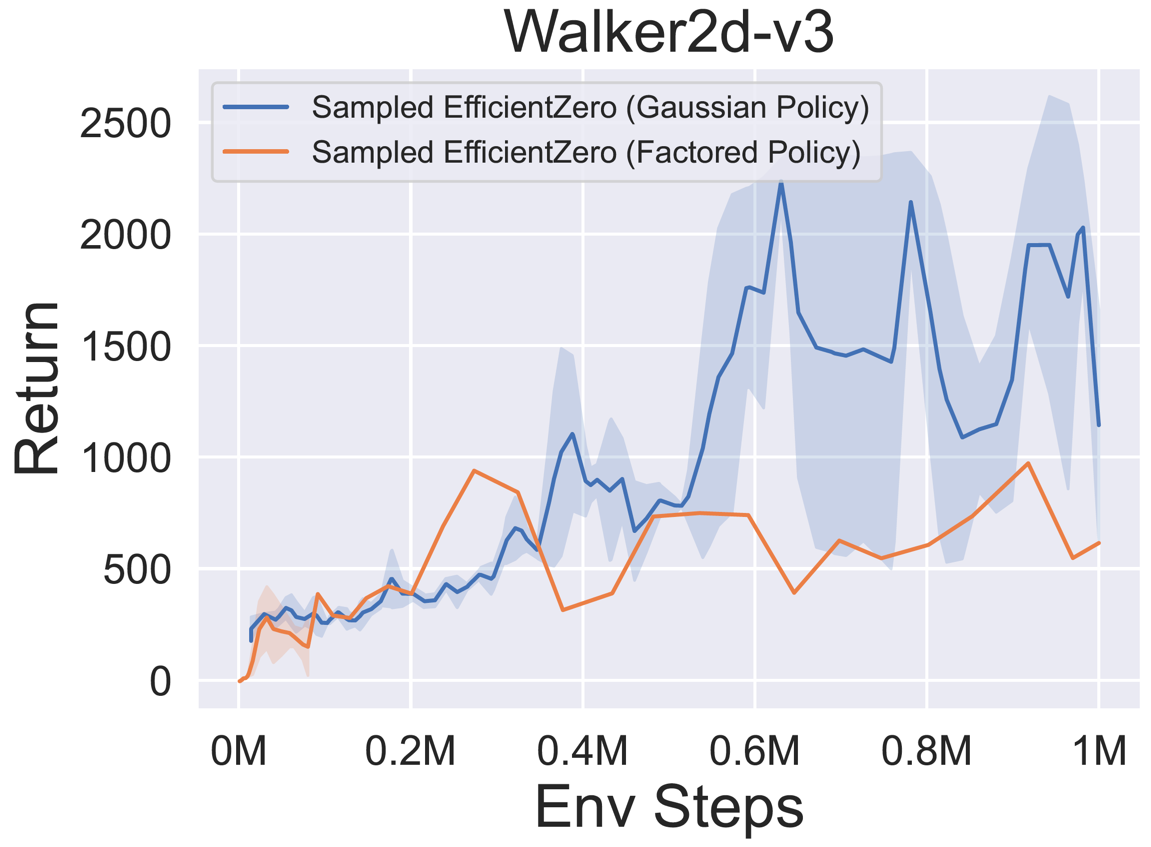
- Below are the benchmark results of Sampled EfficientZero with
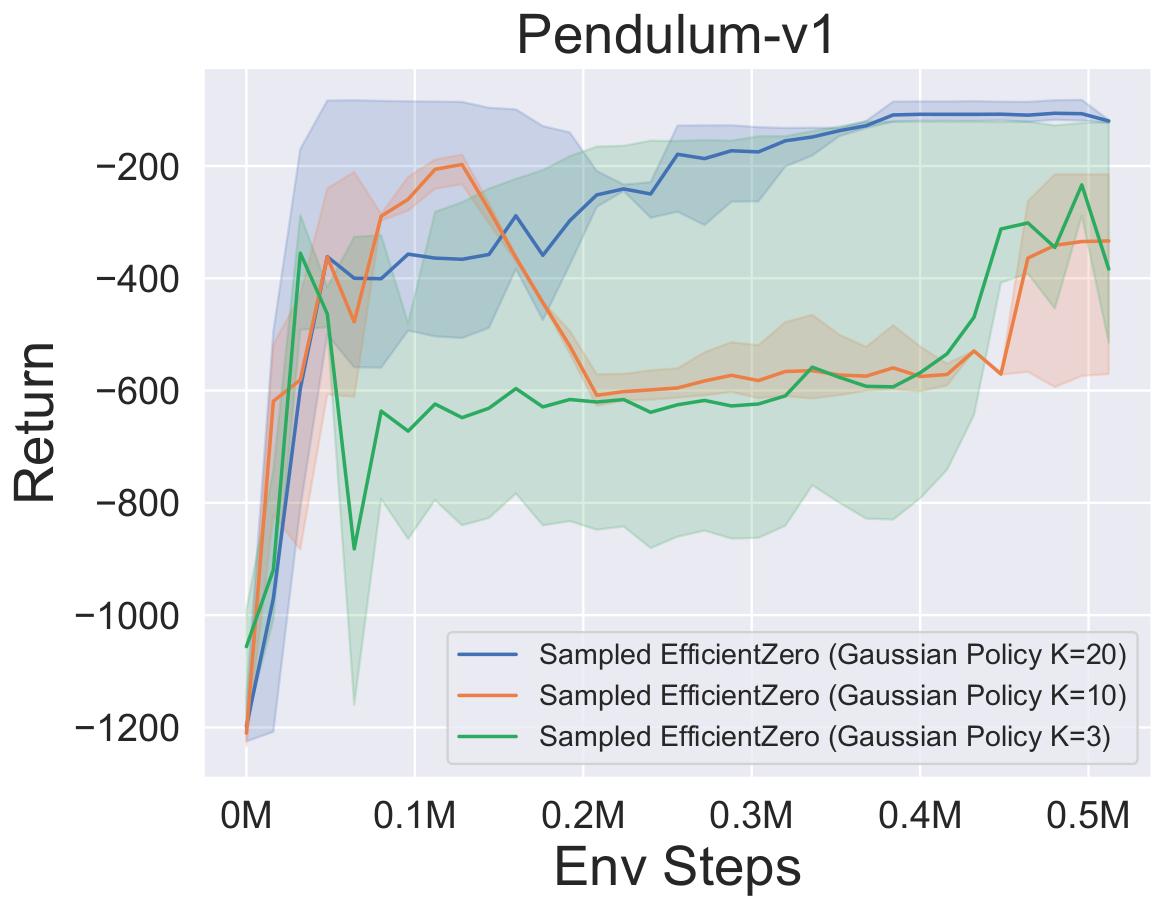
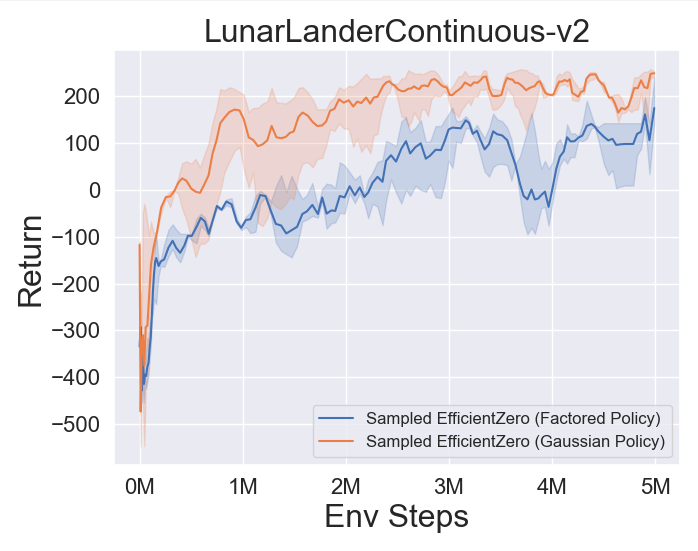
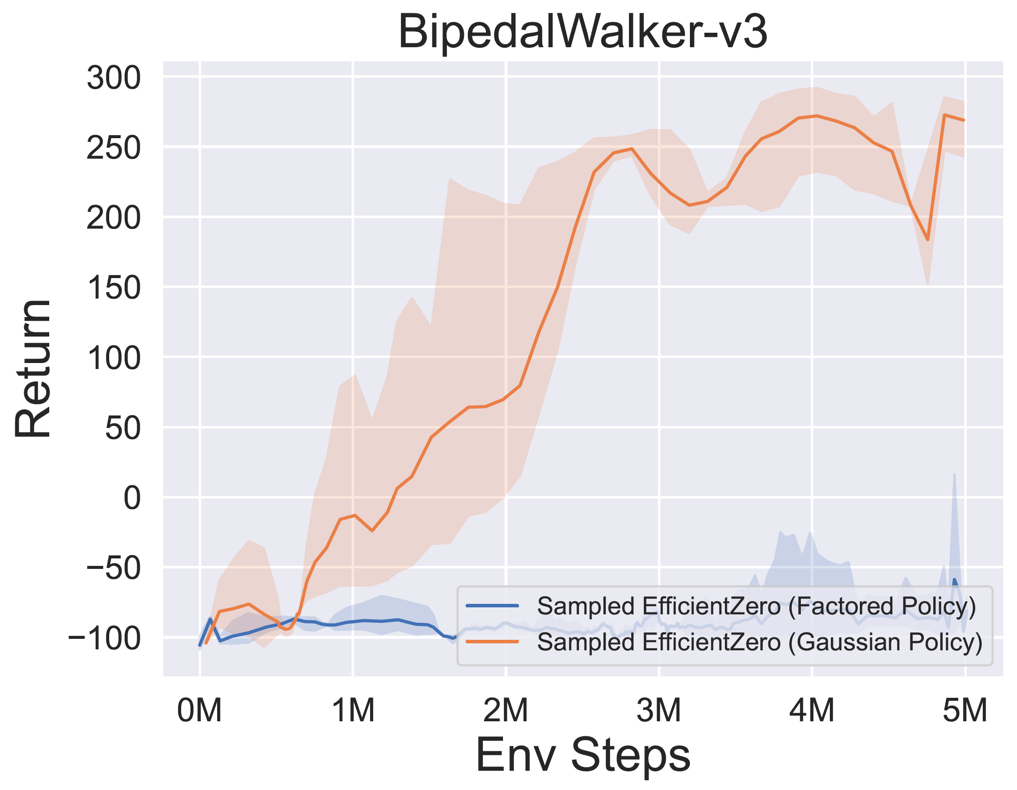
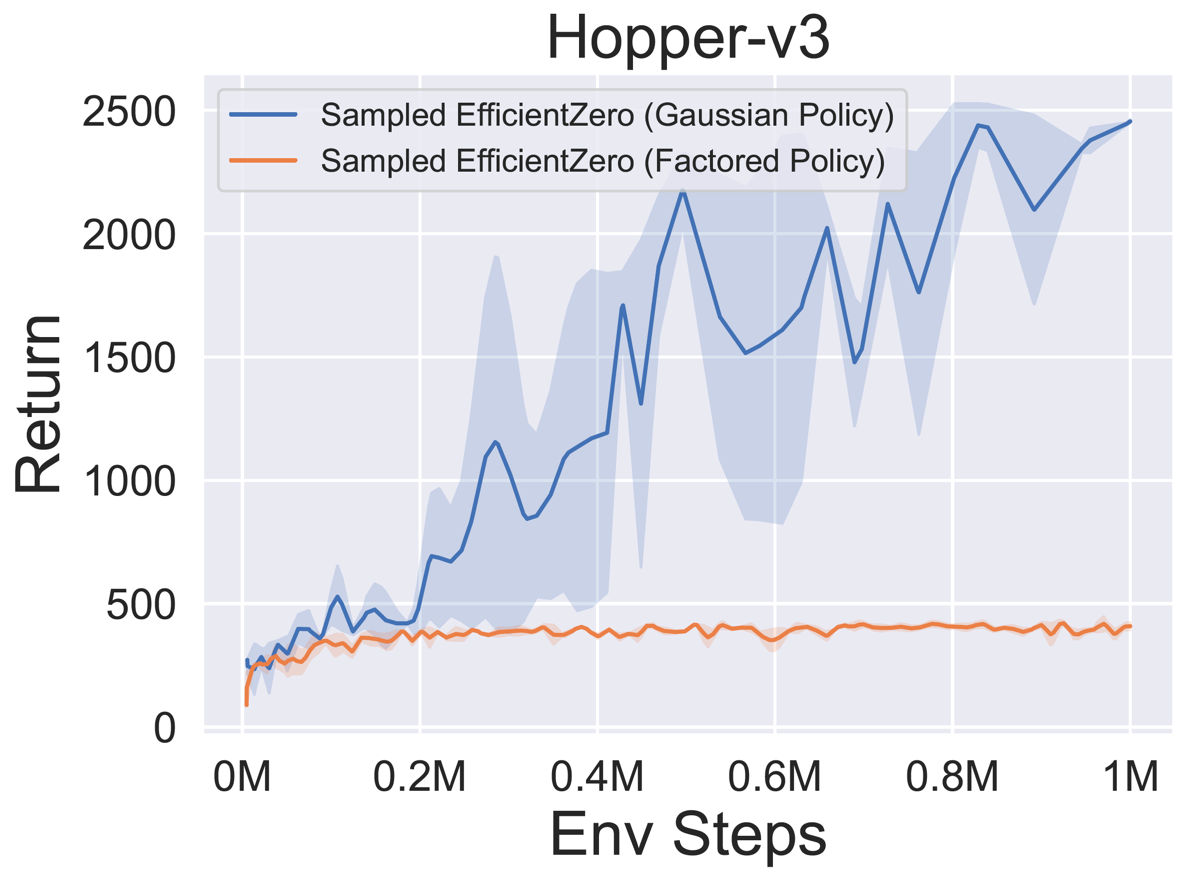
Factored/Gaussianpolicy representation on three classic continuous action space games: Pendulum-v1, LunarLanderContinuous-v2, BipedalWalker-v3 and two MuJoCo continuous action space games: Hopper-v3, Walker2d-v3.
"Factored Policy" indicates that the agent learns a policy network that outputs a categorical distribution. After manual discretization, the dimensions of the action space for the five environments are 11, 49 (7^2), 256 (4^4), 64 (4^3), and 4096 (4^6), respectively. On the other hand, "Gaussian Policy" refers to the agent learning a policy network that directly outputs parameters (mu and sigma) for a Gaussian distribution.
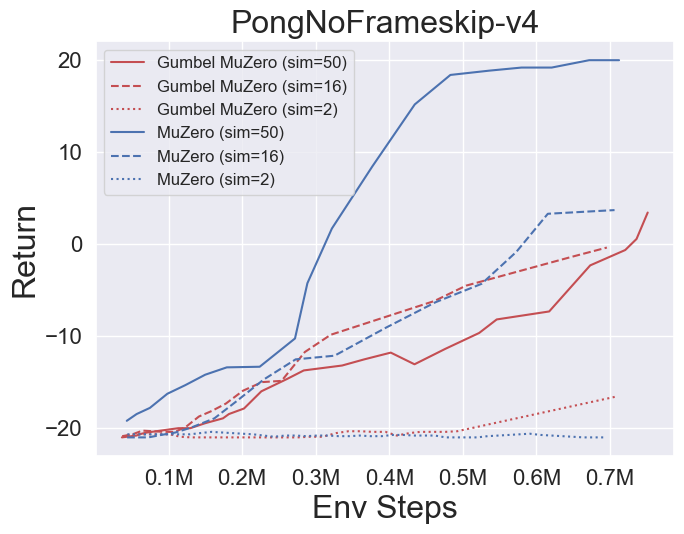
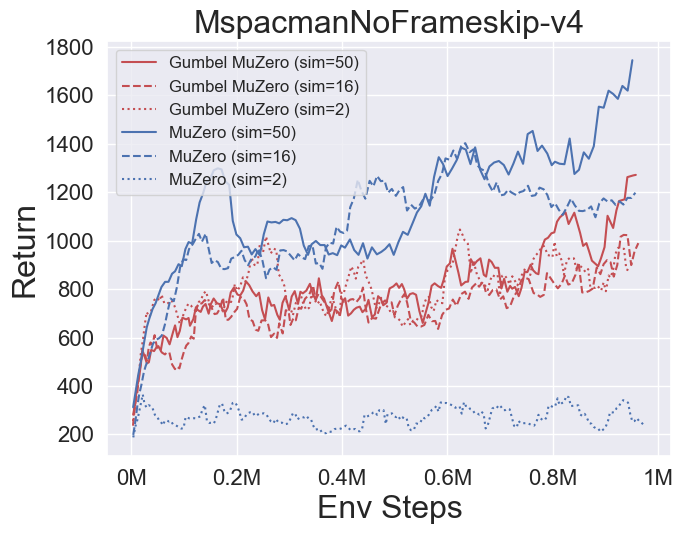
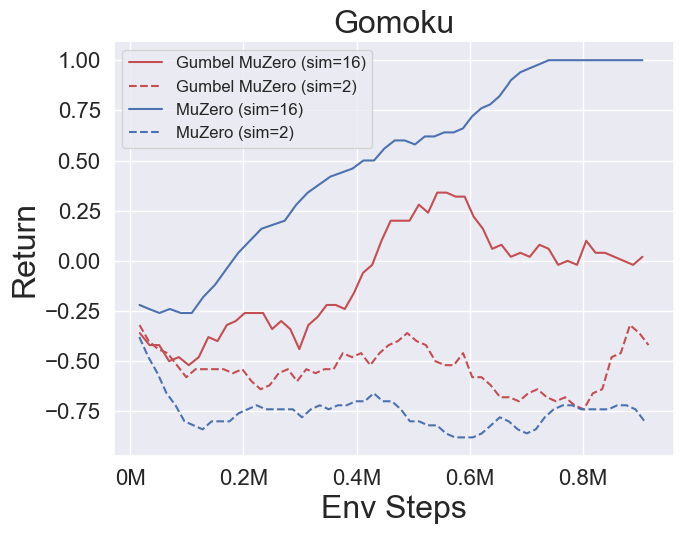
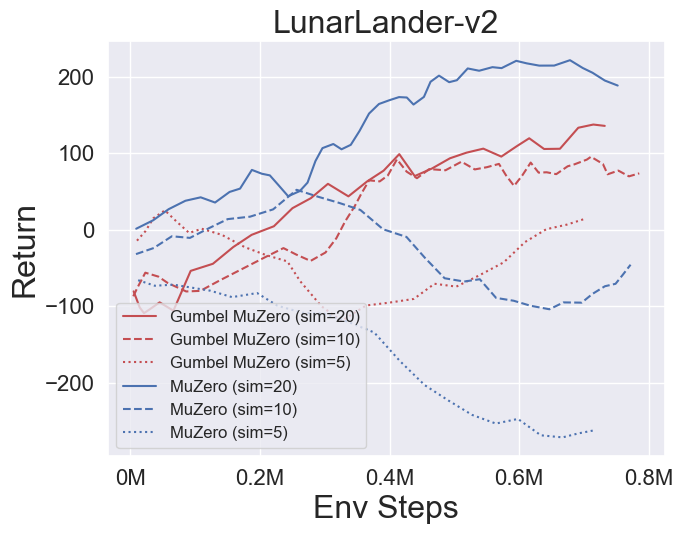
- Below are the benchmark results of GumbelMuZero and MuZero (under different simulation cost) on four environments: PongNoFrameskip-v4, MsPacmanNoFrameskip-v4, Gomoku, and LunarLanderContinuous-v2.
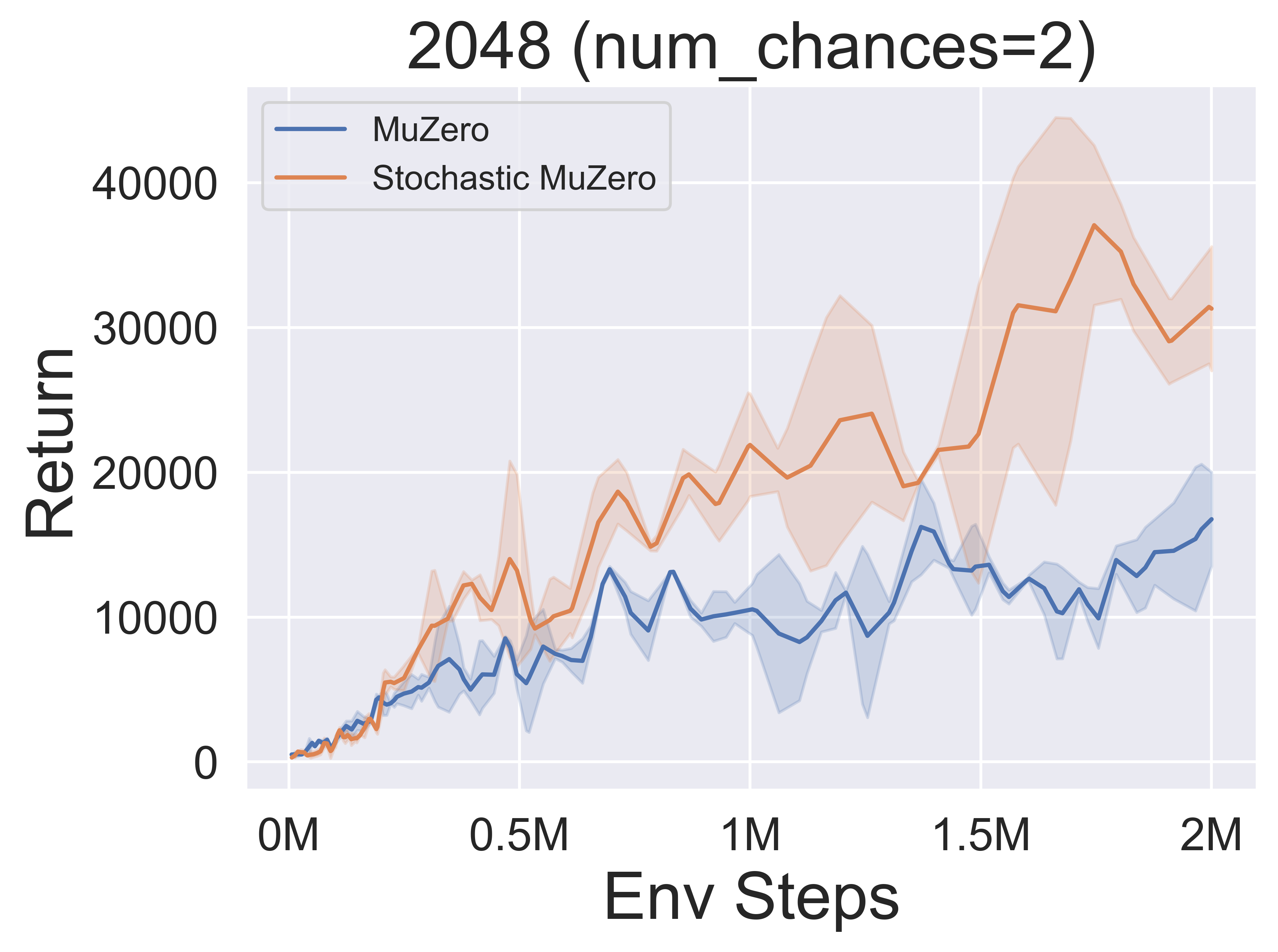
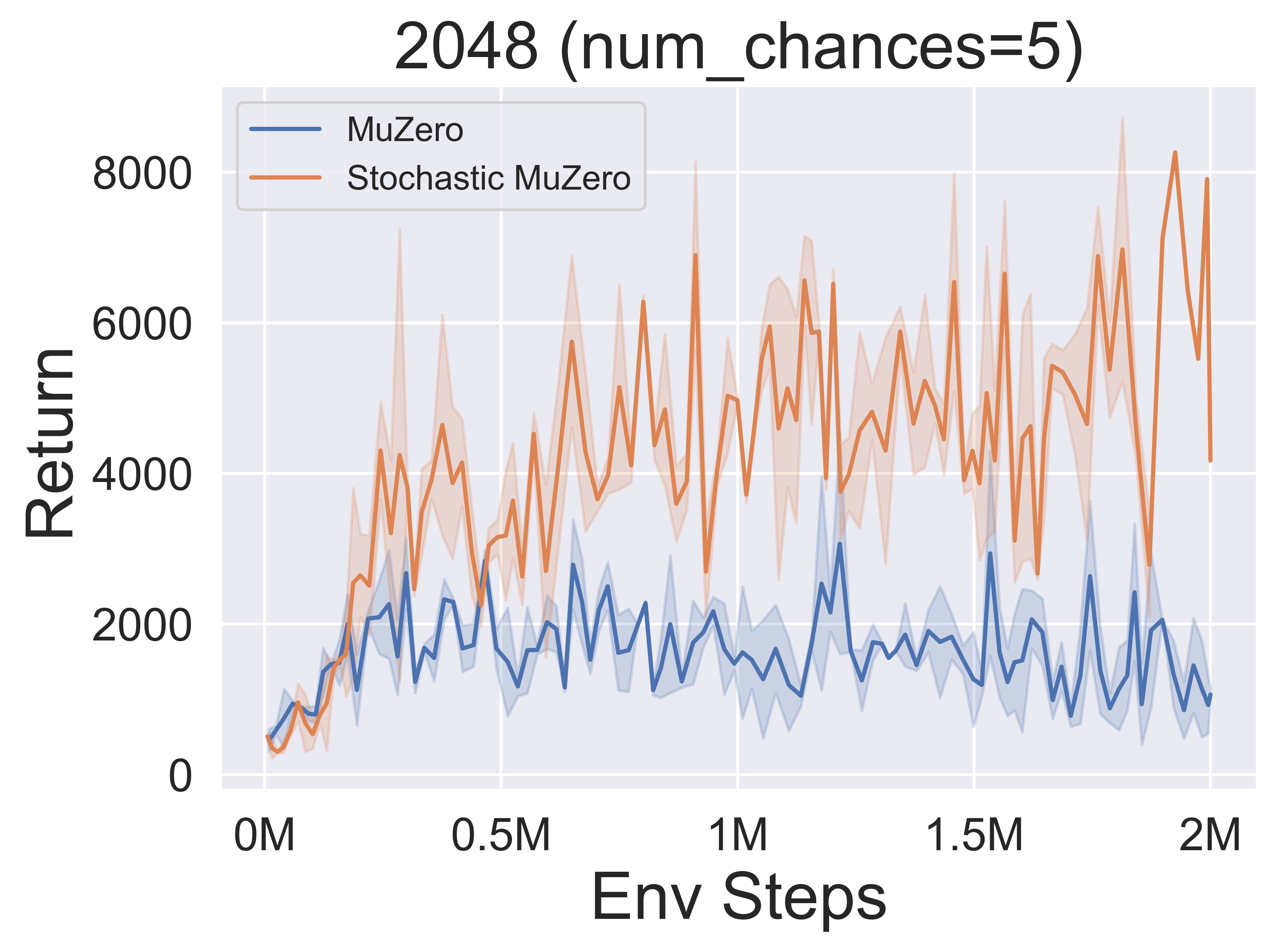
- Below are the benchmark results of StochasticMuZero and MuZero on 2048 environment with varying levels of chance (num_chances=2 and 5).
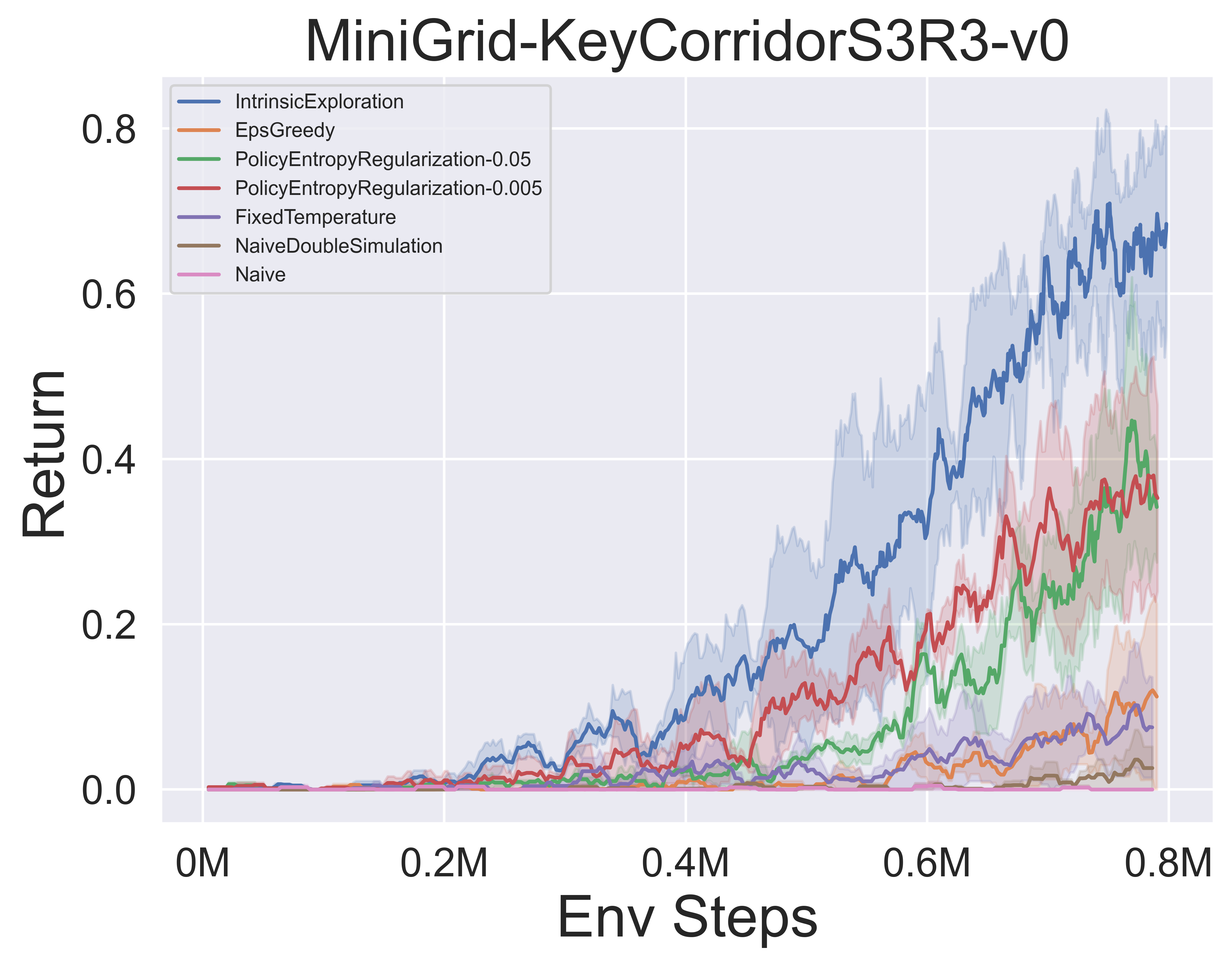
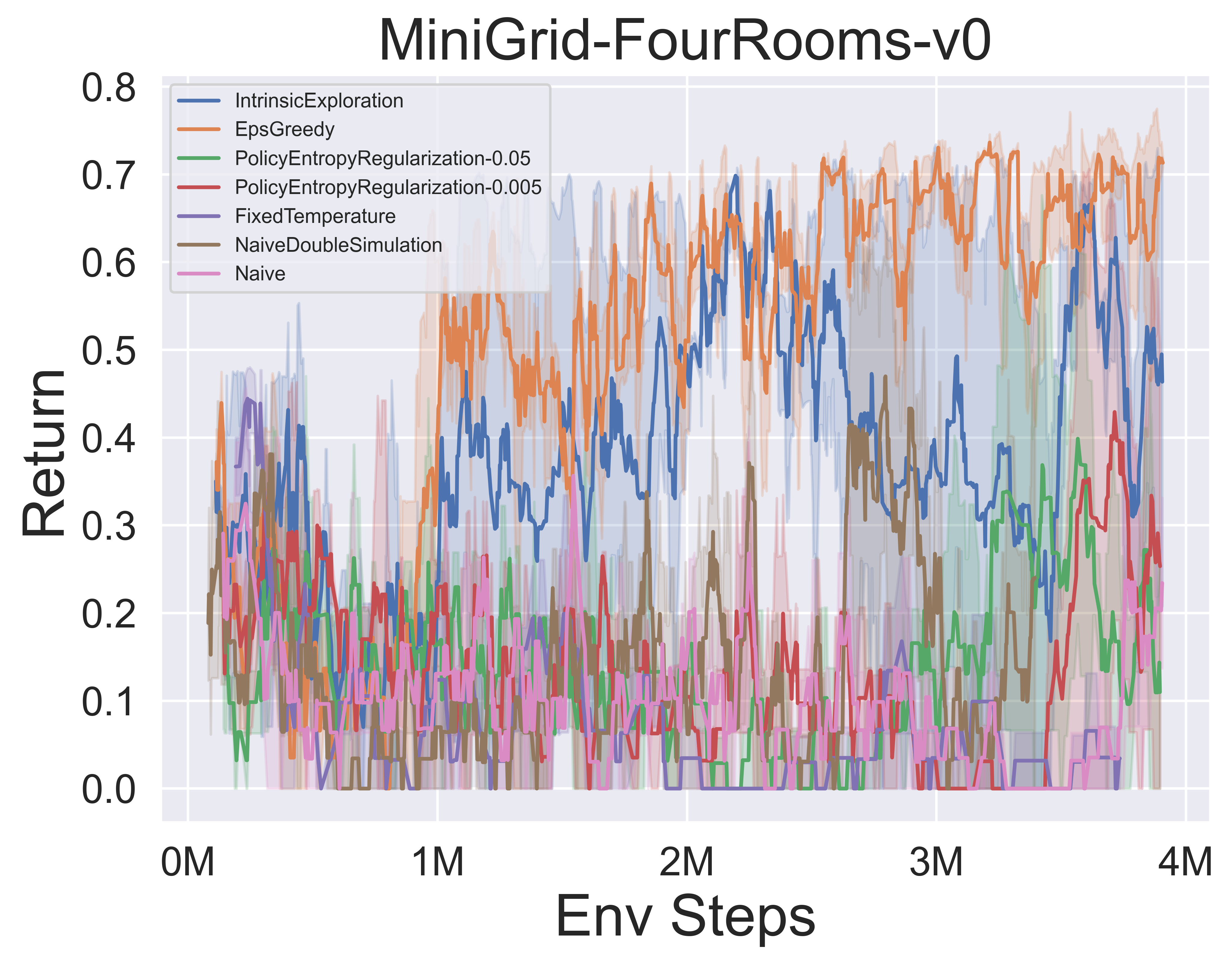
- Below are the benchmark results of various MCTS exploration mechanisms of MuZero w/ SSL in the MiniGrid environment.
📝 Awesome-MCTS Notes
Paper Notes
The following are the detailed paper notes (in Chinese) of the above algorithms:
Click to collapse
You can also refer to the relevant Zhihu column (in Chinese): In-depth Analysis of MCTS+RL Frontier Theories and Applications.
Algo. Overview
The following are the overview MCTS principle diagrams of the above algorithms:
Click to expand
Awesome-MCTS Papers
Here is a collection of research papers about Monte Carlo Tree Search. This Section will be continuously updated to track the frontier of MCTS.
Classic & Foundational Papers
Click to expand
LightZero Implemented series
- 2018 Science AlphaZero: A general reinforcement learning algorithm that masters chess, shogi, and Go through self-play
- 2019 MuZero: Mastering Atari, Go, Chess and Shogi by Planning with a Learned Model
- 2021 EfficientZero: Mastering Atari Games with Limited Data
- 2021 Sampled MuZero: Learning and Planning in Complex Action Spaces
- 2022 Stochastic MuZero: Planning in Stochastic Environments with A Learned Model
- 2022 Gumbel MuZero: Policy Improvement by Planning with Gumbel
- 2024 UniZero: Generalized and Efficient Planning with Scalable Latent World Models
AlphaGo series
- 2015 Nature AlphaGo Mastering the game of Go with deep neural networks and tree search
- 2017 Nature AlphaGo Zero Mastering the game of Go without human knowledge
- 2019 ELF OpenGo: An Analysis and Open Reimplementation of AlphaZero
- 2023 Student of Games: A unified learning algorithm for both perfect and imperfect information games
MuZero series
- 2022 Online and Offline Reinforcement Learning by Planning with a Learned Model
- 2021 Vector Quantized Models for Planning
- 2021 Muesli: Combining Improvements in Policy Optimization.
MCTS Analysis
- 2020 Monte-Carlo Tree Search as Regularized Policy Optimization
- 2021 Self-Consistent Models and Values
- 2022 Adversarial Policies Beat Professional-Level Go AIs
- 2022 PNAS Acquisition of Chess Knowledge in AlphaZero.
MCTS Application
- 2023 Symbolic Physics Learner: Discovering governing equations via Monte Carlo tree search
- 2022 Nature Discovering faster matrix multiplication algorithms with reinforcement learning
- 2022 MuZero with Self-competition for Rate Control in VP9 Video Compression
- 2021 DouZero: Mastering DouDizhu with Self-Play Deep Reinforcement Learning
- 2019 Combining Planning and Deep Reinforcement Learning in Tactical Decision Making for Autonomous Driving
Recent Research & Emerging Applications
Click to expand
ICML
- STAIR: Improving Safety Alignment with Introspective Reasoning 2025
- Yichi Zhang, Siyuan Zhang, Yao Huang, Zeyu Xia, Zhengwei Fang, Xiao Yang, Ranjie Duan, Dong Yan, Yinpeng Dong, Jun Zhu
- Key: LLM, Safety Alignment, Reasoning
- ExpEnv: StrongReject, XsTest, WildChat, Do-Not-Answer, GSM8k, AlpacaEval 2.0, BIG-bench HHH, SimpleQA, InfoFlow, AdvGLUE
- rStar-Math: Small LLMs Can Master Math Reasoning with Self-Evolved Deep Thinking 2025
- Xinyu Guan, Li Lyna Zhang, Yifei Liu, Ning Shang, Youran Sun, Yi Zhu, Fan Yang, Mao Yang
- Key: LLM, Reasoning, Self-evolution
- ExpEnv: GSM8K, MATH, AIME 2024, AMC 2023, Olympiad Bench, College Math, Gaokao (Chinese College Entrance Exam 2023)
- Monte-Carlo Tree Search with Uncertainty Propagation via Optimal Transport 2025
- Tuan Quang Dam, Pascal Stenger, Lukas Schneider, Joni Pajarinen, Carlo D'Eramo, Odalric-Ambrym Maillard
- Key: Monte-Carlo Tree Search, Planning under Uncertainty
- ExpEnv: FrozenLake, NChain, RiverSwim, SixArms, Taxi, Rocksample, Pocman, Tag, LaserTag
- Re-ranking Reasoning Context with Tree Search Makes Large Vision-Language Models Stronger 2025
- Qi Yang, Chenghao Zhang, Lubin Fan, Kun Ding, Jieping Ye, Shiming Xiang
- Key: Large Vision Language Model, Multimodal Retrieval-Augmented Generation, In-context Learning, Monte Carlo Tree Search
- ExpEnv: ScienceQA, MMMU, MathV, VizWiz, VSR-MC
- Mastering Board Games by External and Internal Planning with Language Models 2025
- John Schultz, Jakub Adamek, Matej Jusup, Marc Lanctot, Michael Kaisers, Sarah Perrin, Daniel Hennes, Jeremy Shar, Cannada A. Lewis, Anian Ruoss, Tom Zahavy, Petar Veličković, Laurel Prince, Satinder Singh, Eric Malmi, Nenad Tomasev
- Key: search, planning, language models, games, chess
- ExpEnv: Chess, Chess960, Connect Four, Hex
- Language Models as Implicit Tree Search 2025
- Ziliang Chen, Zhao-Rong Lai, Yufeng Yang, Liangda Fang, ZHANFU YANG, Liang Lin
- Key: RL-free preference optimization; LLM based MCTS; LLM alignment;LLM reasoning
- ExpEnv: Anthropic HH, GSM8K, MATH, Game24
- Free Process Rewards without Process Labels 2025
- Lifan Yuan, Wendi Li, Huayu Chen, Ganqu Cui, Ning Ding, Kaiyan Zhang, Bowen Zhou, Zhiyuan Liu, Hao Peng
- Key: Process Reward Model
- ExpEnv: MATH
- Monte Carlo Tree Search for Comprehensive Exploration in LLM-Based Automatic Heuristic Design 2025
- Zhi Zheng, Zhuoliang Xie, Zhenkun Wang, Bryan Hooi
- Key: Automatic Heuristic Design, Combinatorial Optimization, Large Language Model, Neural Combinatorial Optimization, Monte Carlo Tree Search
- ExpEnv: TSP, Knapsack, CVRP, Multiple Knapsack, Bin Packing, Admissible Set Problem, Bayesian Optimization
- Boosting Virtual Agent Learning and Reasoning: A Step-Wise, Multi-Dimensional, and Generalist Reward Model with Benchmark 2025
- Bingchen Miao, Yang Wu, Minghe Gao, Qifan Yu, Wendong Bu, Wenqiao Zhang, Yunfei Li, Siliang Tang, Tat-Seng Chua, Juncheng Li
- Key: Virtual Agent; Digital Agent; Reward Model
- ExpEnv: WebArena, VisualWebArena, Android World, OSWorld
- Online Robust Reinforcement Learning Through Monte-Carlo Planning 2025
- Tuan Quang Dam, Kishan Panaganti, Brahim Driss, Adam Wierman
- Key: Monte-carlo tree search, distributionally robust reinforcement learning, online reinforcement learning
- ExpEnv: Gambler’s Problem, Frozen Lake, American Option Pricing
- Trust-Region Twisted Policy Improvement 2025
- Joery A. de Vries, Jinke He, Yaniv Oren, Matthijs T. J. Spaan
- Key: Reinforcement Learning; Sequential Monte-Carlo; Monte-Carlo Tree Search; planning; model-based; policy improvement
- ExpEnv: Brax, Jumanji
- KBQA-o1: Agentic Knowledge Base Question Answering with Monte Carlo Tree Search 2025
- Haoran Luo, Haihong E, Yikai Guo, Qika Lin, Xiaobao Wu, Xinyu Mu, Wenhao Liu, Meina Song, Yifan Zhu, Anh Tuan Luu
- Key: Knowledge Base Question Answering, Large Language Model, LLM Agents, Monte Carlo Tree Search
- ExpEnv: GrailQA, WebQSP, GraphQ
- Monte Carlo Tree Diffusion for System 2 Planning 2025
- Jaesik Yoon, Hyeonseo Cho, Doojin Baek, Yoshua Bengio, Sungjin Ahn
- Key: Diffusion Models, MCTS, System 2 Planning, Trajectory Optimization
- ExpEnv: Maze2D, Kitchen, Block stacking
- Code
- Monte-Carlo Tree Search with Uncertainty Propagation via Optimal Transport 2025
- Tuan Quang Dam, Pascal Stenger, Lukas Schneider, Joni Pajarinen, Carlo D’Eramo, Odalric-Ambrym Maillard
- Key: Optimal Transport, Wasserstein Distance, Uncertainty Propagation, MCTS
- ExpEnv: FrozenLake, NChain, RiverSwim, SixArms, Taxi, Rocksample
- Online Robust Reinforcement Learning Through Monte-Carlo Planning 2025
- Tuan Quang Dam, Kishan Panaganti, Brahim Driss, Adam Wierman
- Key: Robust RL, MCTS, Distributionally Robust Optimization, Sim-to-Real
- ExpEnv: Gambler’s Problem, Frozen Lake, American Option Pricing
- Code
- Power Mean Estimation in Stochastic Continuous Monte-Carlo Tree Search 2025
- Tuan Quang Dam
- Key: Continuous MCTS, Polynomial Exploration, Stochastic Environments, Power Mean
- ExpEnv: Continuous Cartpole, Inverted Pendulum
- Language Agent Tree Search Unifies Reasoning, Acting, and Planning in Language Models 2024
- Andy Zhou, Kai Yan, Michal Shlapentokh-Rothman, Haohan Wang, Yu-Xiong Wang
- Key: language models, decision-making, Monte Carlo Tree Search, reasoning, acting, planning
- ExpEnv: HumanEval, WebShop, interactive QA, programming, math
- Efficient Adaptation in Mixed-Motive Environments via Hierarchical Opponent Modeling and Planning 2024
- Yizhe Huang, Anji Liu, Fanqi Kong, Yaodong Yang, Song-Chun Zhu, Xue Feng
- Key: multi-agent reinforcement learning, hierarchical opponent modeling, Monte Carlo Tree Search, few-shot adaptation, mixed-motive environments
- ExpEnv: multi-agent decision-making scenarios, self-play, mixed-motive interactions
- Accelerating Look-ahead in Bayesian Optimization: Multilevel Monte Carlo is All you Need 2024
- Shangda Yang, Vitaly Zankin, Maximilian Balandat, Stefan Scherer, Kevin Thomas Carlberg, Neil Walton, Kody J. H. Law
- Key: Bayesian optimization, multilevel Monte Carlo, nested expectations, acquisition functions
- ExpEnv: Benchmark examples
- Accelerated Speculative Sampling Based on Tree Monte Carlo 2024
- Zhengmian Hu, Heng Huang
- Key: speculative sampling, large language models, tree Monte Carlo, inference acceleration
- ExpEnv: Not specified
- Provably Efficient Long-Horizon Exploration in Monte Carlo Tree Search through State Occupancy Regularization 2024
- Liam Schramm, Abdeslam Boularias
- Key: Exploration, State Occupancy, Long-horizon planning, Volume-MCTS
- ExpEnv: Robot Navigation, 2D Maze
- Code
- Scalable Safe Policy Improvement via Monte Carlo Tree Search 2023
- Alberto Castellini, Federico Bianchi, Edoardo Zorzi, Thiago D. Simão, Alessandro Farinelli, Matthijs T. J. Spaan
- Key: safe policy improvement online using a MCTS based strategy, Safe Policy Improvement with Baseline Bootstrapping
- ExpEnv: Gridworld and SysAdmin
- Efficient Learning for AlphaZero via Path Consistency 2022
- Dengwei Zhao, Shikui Tu, Lei Xu
- Key: limited amount of self-plays, path consistency (PC) optimality
- ExpEnv: Go, Othello, Gomoku
- Visualizing MuZero Models 2021
- Joery A. de Vries, Ken S. Voskuil, Thomas M. Moerland, Aske Plaat
- Key: visualizing the value equivalent dynamics model, action trajectories diverge, two regularization techniques
- ExpEnv: CartPole and MountainCar.
- Convex Regularization in Monte-Carlo Tree Search 2021
- Tuan Dam, Carlo D'Eramo, Jan Peters, Joni Pajarinen
- Key: entropy-regularization backup operators, regret analysis, Tsallis entropy
- ExpEnv: synthetic tree, Atari
- Information Particle Filter Tree: An Online Algorithm for POMDPs with Belief-Based Rewards on Continuous Domains 2020
- Johannes Fischer, Ömer Sahin Tas
- Key: Continuous POMDP, Particle Filter Tree, information-based reward shaping, Information Gathering.
- ExpEnv: POMDPs.jl framework
- Code
- Retro*: Learning Retrosynthetic Planning with Neural Guided A* Search 2020
- Binghong Chen, Chengtao Li, Hanjun Dai, Le Song
- Key: chemical retrosynthetic planning, neural-based A*-like algorithm, ANDOR tree
- ExpEnv: USPTO datasets
- Code
ICLR
- OptionZero: Planning with Learned Options 2025
- Po-Wei Huang, Pei-Chiun Peng, Hung Guei, Ti-Rong Wu
- Key: Option, Semi-MDP, MuZero, MCTS, Planning, Reinforcement Learning
- ExpEnv: 26 Atari games
- Monte Carlo Planning with Large Language Model for Text-Based Games 2025
- Zijing Shi, Meng Fang, Ling Chen
- Key: Large language model, Monte Carlo tree search, Text-based games
- ExpEnv: Jericho benchmark
- Epistemic Monte Carlo Tree Search 2025
- Yaniv Oren, Viliam Vadocz, Matthijs T. J. Spaan, Wendelin Boehmer
- Key: model based, epistemic uncertainty, exploration, planning, alphazero, muzero
- ExpEnv: SUBLEQ (Assembly language), Deep Sea
- Enhancing Software Agents with Monte Carlo Tree Search and Hindsight Feedback 2025
- Antonis Antoniades, Albert Örwall, Kexun Zhang, Yuxi Xie, Anirudh Goyal, William Yang Wang
- Key: agents, LLM, SWE-agents, SWE-bench, search, planning, reasoning, self-improvement, open-ended
- ExpEnv: SWE-bench
- Epistemic Monte Carlo Tree Search 2025
- Wendelin Boehmer, Zheng Shen, Haoran Duan, Chengzhi Mao, Rosario Scalise
- Key: MCTS, Epistemic Uncertainty, Exploration, Sparse Reward, Model-based RL
- ExpEnv: Deep Sea, SUBLEQ (Assembly language)
- DeepSeek-Prover-V1.5: Harnessing Proof Assistant Feedback for Reinforcement Learning and Monte-Carlo Tree Search 2025
- DeepSeek Prover Team
- Key: Automated Theorem Proving, LLM, MCTS, RL from Proof Assistant Feedback (RLPAF), RMaxTS
- ExpEnv: Lean 4, miniF2F, ProofNet
- Code
- Bayes Adaptive Monte Carlo Tree Search for Offline Model-based Reinforcement Learning 2025
- Lucas Niu Janson, et al.
- Key: Offline RL, Model-based RL, Bayes-Adaptive MDP, Uncertainty Propagation
- ExpEnv: D4RL
- The Update Equivalence Framework for Decision-Time Planning 2024
- Samuel Sokota, Gabriele Farina, David J Wu, Hengyuan Hu, Kevin A. Wang, J Zico Kolter, Noam Brown
- Key: imperfect-information games, search, decision-time planning, update equivalence
- ExpEnv: Hanabi, 3x3 Abrupt Dark Hex and Phantom Tic-Tac-Toe
- Efficient Multi-agent Reinforcement Learning by Planning 2024
- Qihan Liu, Jianing Ye, Xiaoteng Ma, Jun Yang, Bin Liang, Chongjie Zhang
- Key: multi-agent reinforcement learning, planning, multi-agent MCTS
- ExpEnv: SMAC, LunarLander, MuJoCo, and Google Research Football
- PromptAgent: Strategic Planning with Large Language Models Enables Expert-Level Prompt Optimization 2024
- Zhutian Yang, et al.
- Key: Prompt Optimization, Strategic Planning, MCTS, LLM Agent
- ExpEnv: BIG-Bench Hard (BBH), MMLU, HellaSwag
- Code
- Become a Proficient Player with Limited Data through Watching Pure Videos 2023
- Weirui Ye, Yunsheng Zhang, Pieter Abbeel, Yang Gao
- Key: pre-training from action-free videos, forward-inverse cycle consistency (FICC) objective based on vector quantization, pre-training phase, fine-tuning phase.
- ExpEnv: Atari
- Policy-Based Self-Competition for Planning Problems 2023
- Jonathan Pirnay, Quirin Göttl, Jakob Burger, Dominik Gerhard Grimm
- Key: self-competition, find strong trajectories by planning against possible strategies of its past self.
- ExpEnv: Traveling Salesman Problem and the Job-Shop Scheduling Problem.
- Explaining Temporal Graph Models through an Explorer-Navigator Framework 2023
- Wenwen Xia, Mincai Lai, Caihua Shan, Yao Zhang, Xinnan Dai, Xiang Li, Dongsheng Li
- Key: Temporal GNN Explainer, an explorer to find the event subsets with MCTS, a navigator that learns the correlations between events and helps reduce the search space.
- ExpEnv: Wikipedia and Reddit, Synthetic datasets
- SpeedyZero: Mastering Atari with Limited Data and Time 2023
- Yixuan Mei, Jiaxuan Gao, Weirui Ye, Shaohuai Liu, Yang Gao, Yi Wu
- Key: distributed RL system, Priority Refresh, Clipped LARS
- ExpEnv: Atari
- Efficient Offline Policy Optimization with a Learned Model 2023
- Zichen Liu, Siyi Li, Wee Sun Lee, Shuicheng YAN, Zhongwen Xu
- Key: Regularized One-Step Model-based algorithm for Offline-RL
- ExpEnv: Atari,BSuite
- Code
- Enabling Arbitrary Translation Objectives with Adaptive Tree Search 2022
- Wang Ling, Wojciech Stokowiec, Domenic Donato, Chris Dyer, Lei Yu, Laurent Sartran, Austin Matthews
- Key: adaptive tree search, translation models, autoregressive models
- ExpEnv: Chinese–English and Pashto–English tasks from WMT2020, German–English from WMT2014
- What's Wrong with Deep Learning in Tree Search for Combinatorial Optimization 2022
- Maximili1an Böther, Otto Kißig, Martin Taraz, Sarel Cohen, Karen Seidel, Tobias Friedrich
- Key: combinatorial optimization, open-source benchmark suite for the NP-hard maximum independent set problem, an in-depth analysis of the popular guided tree search algorithm, compare the tree search implementations to other solvers
- ExpEnv: NP-hard MAXIMUM INDEPENDENT SET.
- Code
- Monte-Carlo Planning and Learning with Language Action Value Estimates 2021
- Youngsoo Jang, Seokin Seo, Jongmin Lee, Kee-Eung Kim
- Key: Monte-Carlo tree search with language-driven exploration, locally optimistic language value estimates.
- ExpEnv: Interactive Fiction (IF) games
- Practical Massively Parallel Monte-Carlo Tree Search Applied to Molecular Design 2021
- Xiufeng Yang, Tanuj Kr Aasawat, Kazuki Yoshizoe
- Key: massively parallel Monte-Carlo Tree Search, molecular design, Hash-driven parallel search
- ExpEnv: octanol-water partition coefficient (logP) penalized by the synthetic accessibility (SA) and large Ring Penalty score.
- Watch the Unobserved: A Simple Approach to Parallelizing Monte Carlo Tree Search 2020
- Anji Liu, Jianshu Chen, Mingze Yu, Yu Zhai, Xuewen Zhou, Ji Liu
- Key: parallel Monte-Carlo Tree Search, partition the tree into sub-trees efficiently, compare the observation ratio of each processor.
- ExpEnv: speedup and performance comparison on JOY-CITY game, average episode return on atari game
- Code
- Learning to Plan in High Dimensions via Neural Exploration-Exploitation Trees 2020
- Binghong Chen, Bo Dai, Qinjie Lin, Guo Ye, Han Liu, Le Song
- Key: meta path planning algorithm, exploits a novel neural architecture which can learn promising search directions from problem structures.
- ExpEnv: a 2d workspace with a 2 DoF (degrees of freedom) point robot, a 3 DoF stick robot and a 5 DoF snake robot
NeurIPS
- Feedback-Aware MCTS for Goal-Oriented Information Seeking 2025
- Harmanpreet Chopra, Chirag Shah
- Key: Conversational AI, Goal-Oriented Information Seeking, MCTS, LLM
- ExpEnv: 20 Questions, GuessWhat?, MutualFriends
- MCTS-Transfer: Monte Carlo Tree Search based Space Transfer for Black-box Optimization 2024
- Shukuan Wang, Ke Xue, Lei Song, Xiaobin Huang, Chao Qian
- Key: Black-box Optimization, Transfer Learning, MCTS, Search Space Transfer
- ExpEnv: Synthetic functions (Ackley, etc.), Design-Bench, Hyper-parameter optimization
- Code
- Speculative Monte-Carlo Tree Search 2024
- Jungwoo Park, David Wu, Kellin Pelrine, Jimmy Wei, Thomas Anthony, Julian Schrittwieser, Junwhan Ahn
- Key: Efficiency, Speculative Execution, Parallelism, AlphaZero
- ExpEnv: Go (9x9, 19x19)
- Generating Code World Models with Large Language Models Guided by Monte Carlo Tree Search 2024
- Nicola Dainese, Matteo Merler, Minttu Alakuijala, Pekka Marttinen
- Key: Code Generation, World Models, MCTS, Model-based Planning
- ExpEnv: CWMB (Code World Models Benchmark), Crafter
- ReST-MCTS*: LLM Self-Training via Process Reward Guided Tree Search 2024
- Dan Zhang, Sining Zhoubian, Ziniu Hu, Yisong Yue, Yuxiao Dong, Jie Tang
- Key: LLM Self-training, Process Reward, Reasoning, CoT
- ExpEnv: GSM8K, MATH
- Code
- LightZero: A Unified Benchmark for Monte Carlo Tree Search in General Sequential Decision Scenarios 2023
- Yazhe Niu, Yuan Pu, Zhenjie Yang, Xueyan Li, Tong Zhou, Jiyuan Ren, Shuai Hu, Hongsheng Li, Yu Liu
- Key: the first unified benchmark for deploying MCTS/MuZero in general sequential decision scenarios.
- ExpEnv: ClassicControl, Box2D, Atari, MuJoCo, GoBigger, MiniGrid, TicTacToe, ConnectFour, Gomoku, 2048, etc.
- Large Language Models as Commonsense Knowledge for Large-Scale Task Planning 2023
- Zirui Zhao, Wee Sun Lee, David Hsu
- Key: world model (LLM) and the LLM-induced policy can be combined in MCTS, to scale up task planning.
- ExpEnv: multiplication, travel planning, object rearrangement
- Monte Carlo Tree Search with Boltzmann Exploration 2023
- Michael Painter, Mohamed Baioumy, Nick Hawes, Bruno Lacerda
- Key: Boltzmann exploration with MCTS, optimal actions for the maximum entropy objective do not necessarily correspond to optimal actions for the original objective, two improved algorithms.
- ExpEnv: the Frozen Lake environment, the Sailing Problem, Go
- Generalized Weighted Path Consistency for Mastering Atari Games 2023
- Dengwei Zhao, Shikui Tu, Lei Xu
- Key: Generalized Weighted Path Consistency, A weighting mechanism.
- ExpEnv: Atari
- Accelerating Monte Carlo Tree Search with Probability Tree State Abstraction 2023
- Yangqing Fu, Ming Sun, Buqing Nie, Yue Gao
- Key: probability tree state abstraction, transitivity and aggregation error bound
- ExpEnv: Atari, CartPole, LunarLander, Gomoku
- Spending Thinking Time Wisely: Accelerating MCTS with Virtual Expansions 2022
- Weirui Ye, Pieter Abbeel, Yang Gao
- Key: trade off computation versus performancem, virtual expansions, spend thinking time adaptively.
- ExpEnv: Atari, 9x9 Go
- Planning for Sample Efficient Imitation Learning 2022
- Zhao-Heng Yin, Weirui Ye, Qifeng Chen, Yang Gao
- Key: Behavioral Cloning,Adversarial Imitation Learning (AIL),MCTS-based RL.
- ExpEnv: DeepMind Control Suite
- Code
- Evaluation Beyond Task Performance: Analyzing Concepts in AlphaZero in Hex 2022
- Charles Lovering, Jessica Zosa Forde, George Konidaris, Ellie Pavlick, Michael L. Littman
- Key: AlphaZero’s internal representations, model probing and behavioral tests, how these concepts are captured in the network.
- ExpEnv: Hex
- Are AlphaZero-like Agents Robust to Adversarial Perturbations? 2022
- Li-Cheng Lan, Huan Zhang, Ti-Rong Wu, Meng-Yu Tsai, I-Chen Wu, 4 Cho-Jui Hsieh
- Key: adversarial states, first adversarial attack on Go AIs.
- ExpEnv: Go
- Monte Carlo Tree Descent for Black-Box Optimization 2022
- Yaoguang Zhai, Sicun Gao
- Key: Black-Box Optimization, how to further integrate samplebased descent for faster optimization.
- ExpEnv: synthetic functions for nonlinear optimization, reinforcement learning problems in MuJoCo locomotion environments, and optimization problems in Neural Architecture Search (NAS).
- Monte Carlo Tree Search based Variable Selection for High Dimensional Bayesian Optimization 2022
- Lei Song∗ , Ke Xue∗ , Xiaobin Huang, Chao Qian
- Key: a low-dimensional subspace via MCTS, optimizes in the subspace with any Bayesian optimization algorithm.
- ExpEnv: NAS-bench problems and MuJoCo locomotion
- Monte Carlo Tree Search With Iteratively Refining State Abstractions 2021
- Samuel Sokota, Caleb Ho, Zaheen Ahmad, J. Zico Kolter
- Key: stochastic environments, Progressive widening, abstraction refining
- ExpEnv: Blackjack, Trap, five by five Go.
- Deep Synoptic Monte Carlo Planning in Reconnaissance Blind Chess 2021
- Gregory Clark
- Key: imperfect information, belief state with an unweighted particle filter, a novel stochastic abstraction of information states.
- ExpEnv: reconnaissance blind chess
- POLY-HOOT: Monte-Carlo Planning in Continuous Space MDPs with Non-Asymptotic Analysis 2020
- Weichao Mao, Kaiqing Zhang, Qiaomin Xie, Tamer Ba¸sar
- Key: continuous state-action spaces, Hierarchical Optimistic Optimization.
- ExpEnv: CartPole, Inverted Pendulum, Swing-up, and LunarLander.
- Learning Search Space Partition for Black-box Optimization using Monte Carlo Tree Search 2020
- Linnan Wang, Rodrigo Fonseca, Yuandong Tian
- Key: learns the partition of the search space using a few samples, a nonlinear decision boundary and learns a local model to pick good candidates.
- ExpEnv: MuJoCo locomotion tasks, Small-scale Benchmarks
- Mix and Match: An Optimistic Tree-Search Approach for Learning Models from Mixture Distributions 2020
- Matthew Faw, Rajat Sen, Karthikeyan Shanmugam, Constantine Caramanis, Sanjay Shakkottai
- Key: covariate shift problem, Mix&Match combines stochastic gradient descent (SGD) with optimistic tree search and model re-use (evolving partially trained models with samples from different mixture distributions)
- Code
Other Conference or Journal
- Learning to Stop: Dynamic Simulation Monte-Carlo Tree Search AAAI 2021.
- On Monte Carlo Tree Search and Reinforcement Learning Journal of Artificial Intelligence Research 2017.
- Sample-Efficient Neural Architecture Search by Learning Actions for Monte Carlo Tree Search IEEE Transactions on Pattern Analysis and Machine Intelligence 2022.
💬 Feedback and Contribution
-
File an issue on Github
-
Open or participate in our discussion forum
-
Discuss on LightZero discord server
-
Contact our email (opendilab@pjlab.org.cn)
-
We appreciate all the feedback and contributions to improve LightZero, both algorithms and system designs.
🌏 Citation
@article{niu2024lightzero,
  title={LightZero: A Unified Benchmark for Monte Carlo Tree Search in General Sequential Decision Scenarios},
  author={Niu, Yazhe and Pu, Yuan and Yang, Zhenjie and Li, Xueyan and Zhou, Tong and Ren, Jiyuan and Hu, Shuai and Li, Hongsheng and Liu, Yu},
  journal={Advances in Neural Information Processing Systems},
  volume={36},
  year={2024}
}

@article{puunizero,
  title={UniZero: Generalized and Efficient Planning with Scalable Latent World Models},
  author={Pu, Yuan and Niu, Yazhe and Yang, Zhenjie and Ren, Jiyuan and Li, Hongsheng and Liu, Yu},
  journal={Transactions on Machine Learning Research}
}

@article{xuan2024rezero,
  title={ReZero: Boosting MCTS-based Algorithms by Backward-view and Entire-buffer Reanalyze},
  author={Xuan, Chunyu and Niu, Yazhe and Pu, Yuan and Hu, Shuai and Liu, Yu and Yang, Jing},
  journal={arXiv preprint arXiv:2404.16364},
  year={2024}
}

@article{pu2025one,
  title={One Model for All Tasks: Leveraging Efficient World Models in Multi-Task Planning},
  author={Pu, Yuan and Niu, Yazhe and Tang, Jia and Xiong, Junyu and Hu, Shuai and Li, Hongsheng},
  journal={arXiv preprint arXiv:2509.07945},
  year={2025}
}
💓 Acknowledgments
This project has been developed partially based on the following pioneering works on GitHub repositories. We express our profound gratitude for these foundational resources:
- https://github.com/opendilab/DI-engine
- https://github.com/deepmind/mctx
- https://github.com/YeWR/EfficientZero
- https://github.com/werner-duvaud/muzero-general
We would like to extend our special thanks to the following contributors @PaParaZz1, @karroyan, @nighood, @jayyoung0802, @timothijoe, @TuTuHuss, @HarryXuancy, @puyuan1996, @HansBug for their valuable contributions and support to this algorithm library.
Thanks to all who contributed to this project:
🏷️ License
All code within this repository is under Apache License 2.0.
Contributors


Similar repos


Languages
Python
93.3%
C++
4.9%
[NeurIPS 2023 Spotlight] LightZero: A Unified Benchmark for Monte Carlo Tree Search in General Sequential Decision Scenarios (awesome MCTS)
See the codeREADME
LightZero
Updated on 2026.03.11 LightZero-v0.2.0
LightZero is a lightweight, efficient, and easy-to-understand open-source algorithm toolkit that combines Monte Carlo Tree Search (MCTS) and Deep Reinforcement Learning (RL).
English | 简体中文(Simplified Chinese) | Documentation | LightZero Paper | UniZero Paper | ReZero Paper | 🔥ScaleZero Paper
News
- [2026.02] 🔥 The ScaleZero paper has been accepted as a conference paper at ICLR 2026: One Model for All Tasks: Leveraging Efficient World Models in Multi-Task Planning.
- [2025.08] The ReZero paper has been accepted by the CoRL 2025 RemembeRL workshop.
- [2025.06] The UniZero paper has been accepted by Transactions on Machine Learning Research (TMLR 2025).
- [2023.09] The LightZero paper has been accepted as a Spotlight Presentation at the NeurIPS 2023 Datasets and Benchmarks Track.
- [2023.04] LightZero v0.0.1 was officially released.
🔍 Background
The integration of Monte Carlo Tree Search and Deep Reinforcement Learning,
exemplified by AlphaZero and MuZero,
has achieved unprecedented performance levels in various games, including Go and Atari.
This advanced methodology has also made significant strides in scientific domains like protein structure prediction and the search for matrix multiplication algorithms.
The following is an overview of the historical evolution of the Monte Carlo Tree Search algorithm series:
🎨 Overview
LightZero is an open-source algorithm toolkit that combines Monte Carlo Tree Search (MCTS) and Reinforcement Learning (RL) for PyTorch. It supports a range of MCTS-based RL algorithms and applications, offering several key advantages:
- Lightweight.
- Efficient.
- Easy-to-understand.
For further details, please refer to Features, Framework Structure and Integrated Algorithms.
LightZero aims to promote the standardization of the MCTS+RL algorithm family to accelerate related research and applications. A performance comparison of all implemented algorithms under a unified framework is presented in the Benchmark.
Outline
- LightZero
💥 Features
Lightweight: LightZero integrates multiple MCTS algorithm families and can solve decision-making problems with various attributes in a lightweight framework. The algorithms and environments LightZero implemented can be found here.
Efficient: LightZero uses mixed heterogeneous computing programming to improve computational efficiency for the most time-consuming part of MCTS algorithms.
Easy-to-understand: LightZero provides detailed documentation and algorithm framework diagrams for all integrated algorithms to help users understand the algorithm's core and compare the differences and similarities between algorithms under the same paradigm. LightZero also provides function call graphs and network structure diagrams for algorithm code implementation, making it easier for users to locate critical code. All the documentation can be found here.
🧩 Framework Structure
The above picture is the framework pipeline of LightZero. We briefly introduce the three core modules below:
Model:
Model is used to define the network structure, including the __init__ function for initializing the network structure and the forward function for computing the network's forward propagation.
Policy:
Policy defines the way the network is updated and interacts with the environment, including three processes: the learning process, the collecting process, and the evaluation process.
MCTS:
MCTS defines the structure of the Monte Carlo search tree and the way it interacts with the Policy. The implementation of MCTS includes two languages: Python and C++, implemented in ptree and ctree, respectively.
For the file structure of LightZero, please refer to lightzero_file_structure.
🎁 Integrated Algorithms
LightZero is a library with a PyTorch implementation of MCTS algorithms (sometimes combined with cython and cpp), including:
The environments and algorithms currently supported by LightZero are shown in the table below:
| Env./Algo. | AlphaZero | MuZero | Sampled MuZero | EfficientZero | Sampled EfficientZero | Gumbel MuZero | Stochastic MuZero | UniZero | Sampled UniZero | ReZero |
|---|---|---|---|---|---|---|---|---|---|---|
| TicTacToe | ✔ | ✔ | 🔒 | 🔒 | 🔒 | ✔ | 🔒 | ✔ | 🔒 | 🔒 |
| Gomoku | ✔ | ✔ | 🔒 | 🔒 | 🔒 | ✔ | 🔒 | ✔ | 🔒 | ✔ |
| Connect4 | ✔ | ✔ | 🔒 | 🔒 | 🔒 | 🔒 | 🔒 | ✔ | 🔒 | ✔ |
| 2048 | --- | ✔ | 🔒 | 🔒 | 🔒 | 🔒 | ✔ | ✔ | 🔒 | 🔒 |
| Chess | 🔒 | 🔒 | 🔒 | 🔒 | 🔒 | 🔒 | 🔒 | 🔒 | 🔒 | 🔒 |
| Go | 🔒 | 🔒 | 🔒 | 🔒 | 🔒 | 🔒 | 🔒 | 🔒 | 🔒 | 🔒 |
| CartPole | --- | ✔ | 🔒 | ✔ | ✔ | ✔ | ✔ | ✔ | 🔒 | ✔ |
| Pendulum | --- | ✔ | ✔ | ✔ | ✔ | ✔ | ✔ | 🔒 | ✔ | 🔒 |
| LunarLander | --- | ✔ | ✔ | ✔ | ✔ | ✔ | ✔ | ✔ | ✔ | 🔒 |
| BipedalWalker | --- | ✔ | ✔ | ✔ | ✔ | ✔ | 🔒 | 🔒 | ✔ | 🔒 |
| Atari | --- | ✔ | 🔒 | ✔ | ✔ | ✔ | ✔ | ✔ | 🔒 | ✔ |
| DeepMind Control | --- | --- | ✔ | --- | ✔ | 🔒 | 🔒 | 🔒 | ✔ | 🔒 |
| MuJoCo | --- | ✔ | 🔒 | ✔ | ✔ | 🔒 | 🔒 | 🔒 | 🔒 | 🔒 |
| MiniGrid | --- | ✔ | 🔒 | ✔ | ✔ | 🔒 | 🔒 | ✔ | 🔒 | 🔒 |
| Bsuite | --- | ✔ | 🔒 | ✔ | ✔ | 🔒 | 🔒 | ✔ | 🔒 | 🔒 |
| Memory | --- | ✔ | 🔒 | ✔ | ✔ | 🔒 | 🔒 | ✔ | 🔒 | 🔒 |
| SumToThree (billiards) | --- | 🔒 | 🔒 | 🔒 | ✔ | 🔒 | 🔒 | 🔒 | 🔒 | 🔒 |
| MetaDrive | --- | 🔒 | 🔒 | 🔒 | ✔ | 🔒 | 🔒 | 🔒 | 🔒 | 🔒 |
(1): "✔" means that the corresponding item is finished and well-tested.
(2): "🔒" means that the corresponding item is in the waiting-list (Work In Progress).
(3): "---" means that this algorithm doesn't support this environment.
⚙️ Installation
You can install the latest LightZero in development from the GitHub source codes with the following command:
git clone https://github.com/opendilab/LightZero.git
cd LightZero
pip3 install -e .
Kindly note that LightZero currently supports compilation only on Linux and macOS platforms.
We are actively working towards extending this support to the Windows platform.
Your patience during this transition is greatly appreciated.
Installation with Docker
We also provide a Dockerfile that sets up an environment with all dependencies needed to run the LightZero library. This Docker image is based on Ubuntu 20.04 and installs Python 3.8, along with other necessary tools and libraries. Here's how to use our Dockerfile to build a Docker image, run a container from this image, and execute LightZero code inside the container.
- Download the Dockerfile: The Dockerfile is located in the root directory of the LightZero repository. Download this file to your local machine.
- Prepare the build context: Create a new empty directory on your local machine, move the Dockerfile into this directory, and navigate into this directory. This step helps to avoid sending unnecessary files to the Docker daemon during the build process.
mkdir lightzero-docker mv Dockerfile lightzero-docker/ cd lightzero-docker/ - Build the Docker image: Use the following command to build the Docker image. This command should be run from inside the directory that contains the Dockerfile.
docker build -t ubuntu-py38-lz:latest -f ./Dockerfile . - Run a container from the image: Use the following command to start a container from the image in interactive mode with a Bash shell.
docker run -dit --rm ubuntu-py38-lz:latest /bin/bash - Execute LightZero code inside the container: Once you're inside the container, you can run the example Python script with the following command:
python ./LightZero/zoo/classic_control/cartpole/config/cartpole_muzero_config.py
🚀 Quick Start
Train a MuZero agent to play CartPole:
cd LightZero
python3 -u zoo/classic_control/cartpole/config/cartpole_muzero_config.py
Train a MuZero agent to play Pong:
cd LightZero
python3 -u zoo/atari/config/atari_muzero_segment_config.py
Train an experimental Ray async MuZero agent to play Pong:
cd LightZero
python3 -u zoo/atari/config/atari_muzero_segment_async_config.py
Train a MuZero agent to play TicTacToe:
cd LightZero
python3 -u zoo/board_games/tictactoe/config/tictactoe_muzero_bot_mode_config.py
Train a UniZero agent to play Pong:
cd LightZero
python3 -u zoo/atari/config/atari_unizero_segment_config.py
Experimental Async Segment Training
The Atari segment async pipeline uses Ray collector/evaluator actors while keeping the learner and replay buffer in the driver process. It supports MuZero-family segment policies and UniZero segment policies through the explicit --async-pipeline config flag. In a same-window Pong MuZero rjob comparison (2026-07-02, 2 collector actors, ~6.2 h wall-clock), async collected 809.5k env steps (≈36.3 env steps/s) versus 499.8k env steps (≈22.4 env steps/s) for the synchronous baseline — about 1.6× end-to-end throughput, with eval rewards statistically comparable at this early training stage. For design details and UniZero differences, see Async Pipeline and 中文说明.
📚 Documentation
The LightZero documentation can be found here. It contains tutorials and the API reference.
For those interested in customizing environments and algorithms, we provide relevant guides:
- Customize Environments
- Customize Algorithms
- How to Set Configuration Files?
- Logging and Monitoring System
- Loss Landscape Visualization
- MuZero / UniZero Async Segment Pipeline
Should you have any questions, feel free to contact us for support.
📊 Benchmark
Click to expand
- Below are the benchmark results of AlphaZero and MuZero on three board games: TicTacToe, Connect4, Gomoku.
- Below are the benchmark results of MuZero, MuZero w/ SSL , EfficientZero and Sampled EfficientZero on three discrete action space games in Atari.
- Below are the benchmark results of Sampled EfficientZero with
Factored/Gaussianpolicy representation on three classic continuous action space games: Pendulum-v1, LunarLanderContinuous-v2, BipedalWalker-v3 and two MuJoCo continuous action space games: Hopper-v3, Walker2d-v3.
"Factored Policy" indicates that the agent learns a policy network that outputs a categorical distribution. After manual discretization, the dimensions of the action space for the five environments are 11, 49 (7^2), 256 (4^4), 64 (4^3), and 4096 (4^6), respectively. On the other hand, "Gaussian Policy" refers to the agent learning a policy network that directly outputs parameters (mu and sigma) for a Gaussian distribution.
- Below are the benchmark results of GumbelMuZero and MuZero (under different simulation cost) on four environments: PongNoFrameskip-v4, MsPacmanNoFrameskip-v4, Gomoku, and LunarLanderContinuous-v2.
- Below are the benchmark results of StochasticMuZero and MuZero on 2048 environment with varying levels of chance (num_chances=2 and 5).
- Below are the benchmark results of various MCTS exploration mechanisms of MuZero w/ SSL in the MiniGrid environment.
📝 Awesome-MCTS Notes
Paper Notes
The following are the detailed paper notes (in Chinese) of the above algorithms:
Click to collapse
You can also refer to the relevant Zhihu column (in Chinese): In-depth Analysis of MCTS+RL Frontier Theories and Applications.
Algo. Overview
The following are the overview MCTS principle diagrams of the above algorithms:
Click to expand
Awesome-MCTS Papers
Here is a collection of research papers about Monte Carlo Tree Search. This Section will be continuously updated to track the frontier of MCTS.
Classic & Foundational Papers
Click to expand
LightZero Implemented series
- 2018 Science AlphaZero: A general reinforcement learning algorithm that masters chess, shogi, and Go through self-play
- 2019 MuZero: Mastering Atari, Go, Chess and Shogi by Planning with a Learned Model
- 2021 EfficientZero: Mastering Atari Games with Limited Data
- 2021 Sampled MuZero: Learning and Planning in Complex Action Spaces
- 2022 Stochastic MuZero: Planning in Stochastic Environments with A Learned Model
- 2022 Gumbel MuZero: Policy Improvement by Planning with Gumbel
- 2024 UniZero: Generalized and Efficient Planning with Scalable Latent World Models
AlphaGo series
- 2015 Nature AlphaGo Mastering the game of Go with deep neural networks and tree search
- 2017 Nature AlphaGo Zero Mastering the game of Go without human knowledge
- 2019 ELF OpenGo: An Analysis and Open Reimplementation of AlphaZero
- 2023 Student of Games: A unified learning algorithm for both perfect and imperfect information games
MuZero series
- 2022 Online and Offline Reinforcement Learning by Planning with a Learned Model
- 2021 Vector Quantized Models for Planning
- 2021 Muesli: Combining Improvements in Policy Optimization.
MCTS Analysis
- 2020 Monte-Carlo Tree Search as Regularized Policy Optimization
- 2021 Self-Consistent Models and Values
- 2022 Adversarial Policies Beat Professional-Level Go AIs
- 2022 PNAS Acquisition of Chess Knowledge in AlphaZero.
MCTS Application
- 2023 Symbolic Physics Learner: Discovering governing equations via Monte Carlo tree search
- 2022 Nature Discovering faster matrix multiplication algorithms with reinforcement learning
- 2022 MuZero with Self-competition for Rate Control in VP9 Video Compression
- 2021 DouZero: Mastering DouDizhu with Self-Play Deep Reinforcement Learning
- 2019 Combining Planning and Deep Reinforcement Learning in Tactical Decision Making for Autonomous Driving
Recent Research & Emerging Applications
Click to expand
ICML
- STAIR: Improving Safety Alignment with Introspective Reasoning 2025
- Yichi Zhang, Siyuan Zhang, Yao Huang, Zeyu Xia, Zhengwei Fang, Xiao Yang, Ranjie Duan, Dong Yan, Yinpeng Dong, Jun Zhu
- Key: LLM, Safety Alignment, Reasoning
- ExpEnv: StrongReject, XsTest, WildChat, Do-Not-Answer, GSM8k, AlpacaEval 2.0, BIG-bench HHH, SimpleQA, InfoFlow, AdvGLUE
- rStar-Math: Small LLMs Can Master Math Reasoning with Self-Evolved Deep Thinking 2025
- Xinyu Guan, Li Lyna Zhang, Yifei Liu, Ning Shang, Youran Sun, Yi Zhu, Fan Yang, Mao Yang
- Key: LLM, Reasoning, Self-evolution
- ExpEnv: GSM8K, MATH, AIME 2024, AMC 2023, Olympiad Bench, College Math, Gaokao (Chinese College Entrance Exam 2023)
- Monte-Carlo Tree Search with Uncertainty Propagation via Optimal Transport 2025
- Tuan Quang Dam, Pascal Stenger, Lukas Schneider, Joni Pajarinen, Carlo D'Eramo, Odalric-Ambrym Maillard
- Key: Monte-Carlo Tree Search, Planning under Uncertainty
- ExpEnv: FrozenLake, NChain, RiverSwim, SixArms, Taxi, Rocksample, Pocman, Tag, LaserTag
- Re-ranking Reasoning Context with Tree Search Makes Large Vision-Language Models Stronger 2025
- Qi Yang, Chenghao Zhang, Lubin Fan, Kun Ding, Jieping Ye, Shiming Xiang
- Key: Large Vision Language Model, Multimodal Retrieval-Augmented Generation, In-context Learning, Monte Carlo Tree Search
- ExpEnv: ScienceQA, MMMU, MathV, VizWiz, VSR-MC
- Mastering Board Games by External and Internal Planning with Language Models 2025
- John Schultz, Jakub Adamek, Matej Jusup, Marc Lanctot, Michael Kaisers, Sarah Perrin, Daniel Hennes, Jeremy Shar, Cannada A. Lewis, Anian Ruoss, Tom Zahavy, Petar Veličković, Laurel Prince, Satinder Singh, Eric Malmi, Nenad Tomasev
- Key: search, planning, language models, games, chess
- ExpEnv: Chess, Chess960, Connect Four, Hex
- Language Models as Implicit Tree Search 2025
- Ziliang Chen, Zhao-Rong Lai, Yufeng Yang, Liangda Fang, ZHANFU YANG, Liang Lin
- Key: RL-free preference optimization; LLM based MCTS; LLM alignment;LLM reasoning
- ExpEnv: Anthropic HH, GSM8K, MATH, Game24
- Free Process Rewards without Process Labels 2025
- Lifan Yuan, Wendi Li, Huayu Chen, Ganqu Cui, Ning Ding, Kaiyan Zhang, Bowen Zhou, Zhiyuan Liu, Hao Peng
- Key: Process Reward Model
- ExpEnv: MATH
- Monte Carlo Tree Search for Comprehensive Exploration in LLM-Based Automatic Heuristic Design 2025
- Zhi Zheng, Zhuoliang Xie, Zhenkun Wang, Bryan Hooi
- Key: Automatic Heuristic Design, Combinatorial Optimization, Large Language Model, Neural Combinatorial Optimization, Monte Carlo Tree Search
- ExpEnv: TSP, Knapsack, CVRP, Multiple Knapsack, Bin Packing, Admissible Set Problem, Bayesian Optimization
- Boosting Virtual Agent Learning and Reasoning: A Step-Wise, Multi-Dimensional, and Generalist Reward Model with Benchmark 2025
- Bingchen Miao, Yang Wu, Minghe Gao, Qifan Yu, Wendong Bu, Wenqiao Zhang, Yunfei Li, Siliang Tang, Tat-Seng Chua, Juncheng Li
- Key: Virtual Agent; Digital Agent; Reward Model
- ExpEnv: WebArena, VisualWebArena, Android World, OSWorld
- Online Robust Reinforcement Learning Through Monte-Carlo Planning 2025
- Tuan Quang Dam, Kishan Panaganti, Brahim Driss, Adam Wierman
- Key: Monte-carlo tree search, distributionally robust reinforcement learning, online reinforcement learning
- ExpEnv: Gambler’s Problem, Frozen Lake, American Option Pricing
- Trust-Region Twisted Policy Improvement 2025
- Joery A. de Vries, Jinke He, Yaniv Oren, Matthijs T. J. Spaan
- Key: Reinforcement Learning; Sequential Monte-Carlo; Monte-Carlo Tree Search; planning; model-based; policy improvement
- ExpEnv: Brax, Jumanji
- KBQA-o1: Agentic Knowledge Base Question Answering with Monte Carlo Tree Search 2025
- Haoran Luo, Haihong E, Yikai Guo, Qika Lin, Xiaobao Wu, Xinyu Mu, Wenhao Liu, Meina Song, Yifan Zhu, Anh Tuan Luu
- Key: Knowledge Base Question Answering, Large Language Model, LLM Agents, Monte Carlo Tree Search
- ExpEnv: GrailQA, WebQSP, GraphQ
- Monte Carlo Tree Diffusion for System 2 Planning 2025
- Jaesik Yoon, Hyeonseo Cho, Doojin Baek, Yoshua Bengio, Sungjin Ahn
- Key: Diffusion Models, MCTS, System 2 Planning, Trajectory Optimization
- ExpEnv: Maze2D, Kitchen, Block stacking
- Code
- Monte-Carlo Tree Search with Uncertainty Propagation via Optimal Transport 2025
- Tuan Quang Dam, Pascal Stenger, Lukas Schneider, Joni Pajarinen, Carlo D’Eramo, Odalric-Ambrym Maillard
- Key: Optimal Transport, Wasserstein Distance, Uncertainty Propagation, MCTS
- ExpEnv: FrozenLake, NChain, RiverSwim, SixArms, Taxi, Rocksample
- Online Robust Reinforcement Learning Through Monte-Carlo Planning 2025
- Tuan Quang Dam, Kishan Panaganti, Brahim Driss, Adam Wierman
- Key: Robust RL, MCTS, Distributionally Robust Optimization, Sim-to-Real
- ExpEnv: Gambler’s Problem, Frozen Lake, American Option Pricing
- Code
- Power Mean Estimation in Stochastic Continuous Monte-Carlo Tree Search 2025
- Tuan Quang Dam
- Key: Continuous MCTS, Polynomial Exploration, Stochastic Environments, Power Mean
- ExpEnv: Continuous Cartpole, Inverted Pendulum
- Language Agent Tree Search Unifies Reasoning, Acting, and Planning in Language Models 2024
- Andy Zhou, Kai Yan, Michal Shlapentokh-Rothman, Haohan Wang, Yu-Xiong Wang
- Key: language models, decision-making, Monte Carlo Tree Search, reasoning, acting, planning
- ExpEnv: HumanEval, WebShop, interactive QA, programming, math
- Efficient Adaptation in Mixed-Motive Environments via Hierarchical Opponent Modeling and Planning 2024
- Yizhe Huang, Anji Liu, Fanqi Kong, Yaodong Yang, Song-Chun Zhu, Xue Feng
- Key: multi-agent reinforcement learning, hierarchical opponent modeling, Monte Carlo Tree Search, few-shot adaptation, mixed-motive environments
- ExpEnv: multi-agent decision-making scenarios, self-play, mixed-motive interactions
- Accelerating Look-ahead in Bayesian Optimization: Multilevel Monte Carlo is All you Need 2024
- Shangda Yang, Vitaly Zankin, Maximilian Balandat, Stefan Scherer, Kevin Thomas Carlberg, Neil Walton, Kody J. H. Law
- Key: Bayesian optimization, multilevel Monte Carlo, nested expectations, acquisition functions
- ExpEnv: Benchmark examples
- Accelerated Speculative Sampling Based on Tree Monte Carlo 2024
- Zhengmian Hu, Heng Huang
- Key: speculative sampling, large language models, tree Monte Carlo, inference acceleration
- ExpEnv: Not specified
- Provably Efficient Long-Horizon Exploration in Monte Carlo Tree Search through State Occupancy Regularization 2024
- Liam Schramm, Abdeslam Boularias
- Key: Exploration, State Occupancy, Long-horizon planning, Volume-MCTS
- ExpEnv: Robot Navigation, 2D Maze
- Code
- Scalable Safe Policy Improvement via Monte Carlo Tree Search 2023
- Alberto Castellini, Federico Bianchi, Edoardo Zorzi, Thiago D. Simão, Alessandro Farinelli, Matthijs T. J. Spaan
- Key: safe policy improvement online using a MCTS based strategy, Safe Policy Improvement with Baseline Bootstrapping
- ExpEnv: Gridworld and SysAdmin
- Efficient Learning for AlphaZero via Path Consistency 2022
- Dengwei Zhao, Shikui Tu, Lei Xu
- Key: limited amount of self-plays, path consistency (PC) optimality
- ExpEnv: Go, Othello, Gomoku
- Visualizing MuZero Models 2021
- Joery A. de Vries, Ken S. Voskuil, Thomas M. Moerland, Aske Plaat
- Key: visualizing the value equivalent dynamics model, action trajectories diverge, two regularization techniques
- ExpEnv: CartPole and MountainCar.
- Convex Regularization in Monte-Carlo Tree Search 2021
- Tuan Dam, Carlo D'Eramo, Jan Peters, Joni Pajarinen
- Key: entropy-regularization backup operators, regret analysis, Tsallis entropy
- ExpEnv: synthetic tree, Atari
- Information Particle Filter Tree: An Online Algorithm for POMDPs with Belief-Based Rewards on Continuous Domains 2020
- Johannes Fischer, Ömer Sahin Tas
- Key: Continuous POMDP, Particle Filter Tree, information-based reward shaping, Information Gathering.
- ExpEnv: POMDPs.jl framework
- Code
- Retro*: Learning Retrosynthetic Planning with Neural Guided A* Search 2020
- Binghong Chen, Chengtao Li, Hanjun Dai, Le Song
- Key: chemical retrosynthetic planning, neural-based A*-like algorithm, ANDOR tree
- ExpEnv: USPTO datasets
- Code
ICLR
- OptionZero: Planning with Learned Options 2025
- Po-Wei Huang, Pei-Chiun Peng, Hung Guei, Ti-Rong Wu
- Key: Option, Semi-MDP, MuZero, MCTS, Planning, Reinforcement Learning
- ExpEnv: 26 Atari games
- Monte Carlo Planning with Large Language Model for Text-Based Games 2025
- Zijing Shi, Meng Fang, Ling Chen
- Key: Large language model, Monte Carlo tree search, Text-based games
- ExpEnv: Jericho benchmark
- Epistemic Monte Carlo Tree Search 2025
- Yaniv Oren, Viliam Vadocz, Matthijs T. J. Spaan, Wendelin Boehmer
- Key: model based, epistemic uncertainty, exploration, planning, alphazero, muzero
- ExpEnv: SUBLEQ (Assembly language), Deep Sea
- Enhancing Software Agents with Monte Carlo Tree Search and Hindsight Feedback 2025
- Antonis Antoniades, Albert Örwall, Kexun Zhang, Yuxi Xie, Anirudh Goyal, William Yang Wang
- Key: agents, LLM, SWE-agents, SWE-bench, search, planning, reasoning, self-improvement, open-ended
- ExpEnv: SWE-bench
- Epistemic Monte Carlo Tree Search 2025
- Wendelin Boehmer, Zheng Shen, Haoran Duan, Chengzhi Mao, Rosario Scalise
- Key: MCTS, Epistemic Uncertainty, Exploration, Sparse Reward, Model-based RL
- ExpEnv: Deep Sea, SUBLEQ (Assembly language)
- DeepSeek-Prover-V1.5: Harnessing Proof Assistant Feedback for Reinforcement Learning and Monte-Carlo Tree Search 2025
- DeepSeek Prover Team
- Key: Automated Theorem Proving, LLM, MCTS, RL from Proof Assistant Feedback (RLPAF), RMaxTS
- ExpEnv: Lean 4, miniF2F, ProofNet
- Code
- Bayes Adaptive Monte Carlo Tree Search for Offline Model-based Reinforcement Learning 2025
- Lucas Niu Janson, et al.
- Key: Offline RL, Model-based RL, Bayes-Adaptive MDP, Uncertainty Propagation
- ExpEnv: D4RL
- The Update Equivalence Framework for Decision-Time Planning 2024
- Samuel Sokota, Gabriele Farina, David J Wu, Hengyuan Hu, Kevin A. Wang, J Zico Kolter, Noam Brown
- Key: imperfect-information games, search, decision-time planning, update equivalence
- ExpEnv: Hanabi, 3x3 Abrupt Dark Hex and Phantom Tic-Tac-Toe
- Efficient Multi-agent Reinforcement Learning by Planning 2024
- Qihan Liu, Jianing Ye, Xiaoteng Ma, Jun Yang, Bin Liang, Chongjie Zhang
- Key: multi-agent reinforcement learning, planning, multi-agent MCTS
- ExpEnv: SMAC, LunarLander, MuJoCo, and Google Research Football
- PromptAgent: Strategic Planning with Large Language Models Enables Expert-Level Prompt Optimization 2024
- Zhutian Yang, et al.
- Key: Prompt Optimization, Strategic Planning, MCTS, LLM Agent
- ExpEnv: BIG-Bench Hard (BBH), MMLU, HellaSwag
- Code
- Become a Proficient Player with Limited Data through Watching Pure Videos 2023
- Weirui Ye, Yunsheng Zhang, Pieter Abbeel, Yang Gao
- Key: pre-training from action-free videos, forward-inverse cycle consistency (FICC) objective based on vector quantization, pre-training phase, fine-tuning phase.
- ExpEnv: Atari
- Policy-Based Self-Competition for Planning Problems 2023
- Jonathan Pirnay, Quirin Göttl, Jakob Burger, Dominik Gerhard Grimm
- Key: self-competition, find strong trajectories by planning against possible strategies of its past self.
- ExpEnv: Traveling Salesman Problem and the Job-Shop Scheduling Problem.
- Explaining Temporal Graph Models through an Explorer-Navigator Framework 2023
- Wenwen Xia, Mincai Lai, Caihua Shan, Yao Zhang, Xinnan Dai, Xiang Li, Dongsheng Li
- Key: Temporal GNN Explainer, an explorer to find the event subsets with MCTS, a navigator that learns the correlations between events and helps reduce the search space.
- ExpEnv: Wikipedia and Reddit, Synthetic datasets
- SpeedyZero: Mastering Atari with Limited Data and Time 2023
- Yixuan Mei, Jiaxuan Gao, Weirui Ye, Shaohuai Liu, Yang Gao, Yi Wu
- Key: distributed RL system, Priority Refresh, Clipped LARS
- ExpEnv: Atari
- Efficient Offline Policy Optimization with a Learned Model 2023
- Zichen Liu, Siyi Li, Wee Sun Lee, Shuicheng YAN, Zhongwen Xu
- Key: Regularized One-Step Model-based algorithm for Offline-RL
- ExpEnv: Atari,BSuite
- Code
- Enabling Arbitrary Translation Objectives with Adaptive Tree Search 2022
- Wang Ling, Wojciech Stokowiec, Domenic Donato, Chris Dyer, Lei Yu, Laurent Sartran, Austin Matthews
- Key: adaptive tree search, translation models, autoregressive models
- ExpEnv: Chinese–English and Pashto–English tasks from WMT2020, German–English from WMT2014
- What's Wrong with Deep Learning in Tree Search for Combinatorial Optimization 2022
- Maximili1an Böther, Otto Kißig, Martin Taraz, Sarel Cohen, Karen Seidel, Tobias Friedrich
- Key: combinatorial optimization, open-source benchmark suite for the NP-hard maximum independent set problem, an in-depth analysis of the popular guided tree search algorithm, compare the tree search implementations to other solvers
- ExpEnv: NP-hard MAXIMUM INDEPENDENT SET.
- Code
- Monte-Carlo Planning and Learning with Language Action Value Estimates 2021
- Youngsoo Jang, Seokin Seo, Jongmin Lee, Kee-Eung Kim
- Key: Monte-Carlo tree search with language-driven exploration, locally optimistic language value estimates.
- ExpEnv: Interactive Fiction (IF) games
- Practical Massively Parallel Monte-Carlo Tree Search Applied to Molecular Design 2021
- Xiufeng Yang, Tanuj Kr Aasawat, Kazuki Yoshizoe
- Key: massively parallel Monte-Carlo Tree Search, molecular design, Hash-driven parallel search
- ExpEnv: octanol-water partition coefficient (logP) penalized by the synthetic accessibility (SA) and large Ring Penalty score.
- Watch the Unobserved: A Simple Approach to Parallelizing Monte Carlo Tree Search 2020
- Anji Liu, Jianshu Chen, Mingze Yu, Yu Zhai, Xuewen Zhou, Ji Liu
- Key: parallel Monte-Carlo Tree Search, partition the tree into sub-trees efficiently, compare the observation ratio of each processor.
- ExpEnv: speedup and performance comparison on JOY-CITY game, average episode return on atari game
- Code
- Learning to Plan in High Dimensions via Neural Exploration-Exploitation Trees 2020
- Binghong Chen, Bo Dai, Qinjie Lin, Guo Ye, Han Liu, Le Song
- Key: meta path planning algorithm, exploits a novel neural architecture which can learn promising search directions from problem structures.
- ExpEnv: a 2d workspace with a 2 DoF (degrees of freedom) point robot, a 3 DoF stick robot and a 5 DoF snake robot
NeurIPS
- Feedback-Aware MCTS for Goal-Oriented Information Seeking 2025
- Harmanpreet Chopra, Chirag Shah
- Key: Conversational AI, Goal-Oriented Information Seeking, MCTS, LLM
- ExpEnv: 20 Questions, GuessWhat?, MutualFriends
- MCTS-Transfer: Monte Carlo Tree Search based Space Transfer for Black-box Optimization 2024
- Shukuan Wang, Ke Xue, Lei Song, Xiaobin Huang, Chao Qian
- Key: Black-box Optimization, Transfer Learning, MCTS, Search Space Transfer
- ExpEnv: Synthetic functions (Ackley, etc.), Design-Bench, Hyper-parameter optimization
- Code
- Speculative Monte-Carlo Tree Search 2024
- Jungwoo Park, David Wu, Kellin Pelrine, Jimmy Wei, Thomas Anthony, Julian Schrittwieser, Junwhan Ahn
- Key: Efficiency, Speculative Execution, Parallelism, AlphaZero
- ExpEnv: Go (9x9, 19x19)
- Generating Code World Models with Large Language Models Guided by Monte Carlo Tree Search 2024
- Nicola Dainese, Matteo Merler, Minttu Alakuijala, Pekka Marttinen
- Key: Code Generation, World Models, MCTS, Model-based Planning
- ExpEnv: CWMB (Code World Models Benchmark), Crafter
- ReST-MCTS*: LLM Self-Training via Process Reward Guided Tree Search 2024
- Dan Zhang, Sining Zhoubian, Ziniu Hu, Yisong Yue, Yuxiao Dong, Jie Tang
- Key: LLM Self-training, Process Reward, Reasoning, CoT
- ExpEnv: GSM8K, MATH
- Code
- LightZero: A Unified Benchmark for Monte Carlo Tree Search in General Sequential Decision Scenarios 2023
- Yazhe Niu, Yuan Pu, Zhenjie Yang, Xueyan Li, Tong Zhou, Jiyuan Ren, Shuai Hu, Hongsheng Li, Yu Liu
- Key: the first unified benchmark for deploying MCTS/MuZero in general sequential decision scenarios.
- ExpEnv: ClassicControl, Box2D, Atari, MuJoCo, GoBigger, MiniGrid, TicTacToe, ConnectFour, Gomoku, 2048, etc.
- Large Language Models as Commonsense Knowledge for Large-Scale Task Planning 2023
- Zirui Zhao, Wee Sun Lee, David Hsu
- Key: world model (LLM) and the LLM-induced policy can be combined in MCTS, to scale up task planning.
- ExpEnv: multiplication, travel planning, object rearrangement
- Monte Carlo Tree Search with Boltzmann Exploration 2023
- Michael Painter, Mohamed Baioumy, Nick Hawes, Bruno Lacerda
- Key: Boltzmann exploration with MCTS, optimal actions for the maximum entropy objective do not necessarily correspond to optimal actions for the original objective, two improved algorithms.
- ExpEnv: the Frozen Lake environment, the Sailing Problem, Go
- Generalized Weighted Path Consistency for Mastering Atari Games 2023
- Dengwei Zhao, Shikui Tu, Lei Xu
- Key: Generalized Weighted Path Consistency, A weighting mechanism.
- ExpEnv: Atari
- Accelerating Monte Carlo Tree Search with Probability Tree State Abstraction 2023
- Yangqing Fu, Ming Sun, Buqing Nie, Yue Gao
- Key: probability tree state abstraction, transitivity and aggregation error bound
- ExpEnv: Atari, CartPole, LunarLander, Gomoku
- Spending Thinking Time Wisely: Accelerating MCTS with Virtual Expansions 2022
- Weirui Ye, Pieter Abbeel, Yang Gao
- Key: trade off computation versus performancem, virtual expansions, spend thinking time adaptively.
- ExpEnv: Atari, 9x9 Go
- Planning for Sample Efficient Imitation Learning 2022
- Zhao-Heng Yin, Weirui Ye, Qifeng Chen, Yang Gao
- Key: Behavioral Cloning,Adversarial Imitation Learning (AIL),MCTS-based RL.
- ExpEnv: DeepMind Control Suite
- Code
- Evaluation Beyond Task Performance: Analyzing Concepts in AlphaZero in Hex 2022
- Charles Lovering, Jessica Zosa Forde, George Konidaris, Ellie Pavlick, Michael L. Littman
- Key: AlphaZero’s internal representations, model probing and behavioral tests, how these concepts are captured in the network.
- ExpEnv: Hex
- Are AlphaZero-like Agents Robust to Adversarial Perturbations? 2022
- Li-Cheng Lan, Huan Zhang, Ti-Rong Wu, Meng-Yu Tsai, I-Chen Wu, 4 Cho-Jui Hsieh
- Key: adversarial states, first adversarial attack on Go AIs.
- ExpEnv: Go
- Monte Carlo Tree Descent for Black-Box Optimization 2022
- Yaoguang Zhai, Sicun Gao
- Key: Black-Box Optimization, how to further integrate samplebased descent for faster optimization.
- ExpEnv: synthetic functions for nonlinear optimization, reinforcement learning problems in MuJoCo locomotion environments, and optimization problems in Neural Architecture Search (NAS).
- Monte Carlo Tree Search based Variable Selection for High Dimensional Bayesian Optimization 2022
- Lei Song∗ , Ke Xue∗ , Xiaobin Huang, Chao Qian
- Key: a low-dimensional subspace via MCTS, optimizes in the subspace with any Bayesian optimization algorithm.
- ExpEnv: NAS-bench problems and MuJoCo locomotion
- Monte Carlo Tree Search With Iteratively Refining State Abstractions 2021
- Samuel Sokota, Caleb Ho, Zaheen Ahmad, J. Zico Kolter
- Key: stochastic environments, Progressive widening, abstraction refining
- ExpEnv: Blackjack, Trap, five by five Go.
- Deep Synoptic Monte Carlo Planning in Reconnaissance Blind Chess 2021
- Gregory Clark
- Key: imperfect information, belief state with an unweighted particle filter, a novel stochastic abstraction of information states.
- ExpEnv: reconnaissance blind chess
- POLY-HOOT: Monte-Carlo Planning in Continuous Space MDPs with Non-Asymptotic Analysis 2020
- Weichao Mao, Kaiqing Zhang, Qiaomin Xie, Tamer Ba¸sar
- Key: continuous state-action spaces, Hierarchical Optimistic Optimization.
- ExpEnv: CartPole, Inverted Pendulum, Swing-up, and LunarLander.
- Learning Search Space Partition for Black-box Optimization using Monte Carlo Tree Search 2020
- Linnan Wang, Rodrigo Fonseca, Yuandong Tian
- Key: learns the partition of the search space using a few samples, a nonlinear decision boundary and learns a local model to pick good candidates.
- ExpEnv: MuJoCo locomotion tasks, Small-scale Benchmarks
- Mix and Match: An Optimistic Tree-Search Approach for Learning Models from Mixture Distributions 2020
- Matthew Faw, Rajat Sen, Karthikeyan Shanmugam, Constantine Caramanis, Sanjay Shakkottai
- Key: covariate shift problem, Mix&Match combines stochastic gradient descent (SGD) with optimistic tree search and model re-use (evolving partially trained models with samples from different mixture distributions)
- Code
Other Conference or Journal
- Learning to Stop: Dynamic Simulation Monte-Carlo Tree Search AAAI 2021.
- On Monte Carlo Tree Search and Reinforcement Learning Journal of Artificial Intelligence Research 2017.
- Sample-Efficient Neural Architecture Search by Learning Actions for Monte Carlo Tree Search IEEE Transactions on Pattern Analysis and Machine Intelligence 2022.
💬 Feedback and Contribution
-
File an issue on Github
-
Open or participate in our discussion forum
-
Discuss on LightZero discord server
-
Contact our email (opendilab@pjlab.org.cn)
-
We appreciate all the feedback and contributions to improve LightZero, both algorithms and system designs.
🌏 Citation
@article{niu2024lightzero,
  title={LightZero: A Unified Benchmark for Monte Carlo Tree Search in General Sequential Decision Scenarios},
  author={Niu, Yazhe and Pu, Yuan and Yang, Zhenjie and Li, Xueyan and Zhou, Tong and Ren, Jiyuan and Hu, Shuai and Li, Hongsheng and Liu, Yu},
  journal={Advances in Neural Information Processing Systems},
  volume={36},
  year={2024}
}

@article{puunizero,
  title={UniZero: Generalized and Efficient Planning with Scalable Latent World Models},
  author={Pu, Yuan and Niu, Yazhe and Yang, Zhenjie and Ren, Jiyuan and Li, Hongsheng and Liu, Yu},
  journal={Transactions on Machine Learning Research}
}

@article{xuan2024rezero,
  title={ReZero: Boosting MCTS-based Algorithms by Backward-view and Entire-buffer Reanalyze},
  author={Xuan, Chunyu and Niu, Yazhe and Pu, Yuan and Hu, Shuai and Liu, Yu and Yang, Jing},
  journal={arXiv preprint arXiv:2404.16364},
  year={2024}
}

@article{pu2025one,
  title={One Model for All Tasks: Leveraging Efficient World Models in Multi-Task Planning},
  author={Pu, Yuan and Niu, Yazhe and Tang, Jia and Xiong, Junyu and Hu, Shuai and Li, Hongsheng},
  journal={arXiv preprint arXiv:2509.07945},
  year={2025}
}
💓 Acknowledgments
This project has been developed partially based on the following pioneering works on GitHub repositories. We express our profound gratitude for these foundational resources:
- https://github.com/opendilab/DI-engine
- https://github.com/deepmind/mctx
- https://github.com/YeWR/EfficientZero
- https://github.com/werner-duvaud/muzero-general
We would like to extend our special thanks to the following contributors @PaParaZz1, @karroyan, @nighood, @jayyoung0802, @timothijoe, @TuTuHuss, @HarryXuancy, @puyuan1996, @HansBug for their valuable contributions and support to this algorithm library.
Thanks to all who contributed to this project:
🏷️ License
All code within this repository is under Apache License 2.0.
Similar repos
Contributors
Languages
Python
93.3%
C++
4.9%