Benchmark Repository for Automatic Prompt Optimization (APO) with Chess
Python
3
3 commits
updated Oct 6, 2026





Overview · Results · Installation · Quick Start · Data · Architecture · Scope · Citation
1,118 Lichess puzzles · 6 APO algorithms · 8 frozen target models
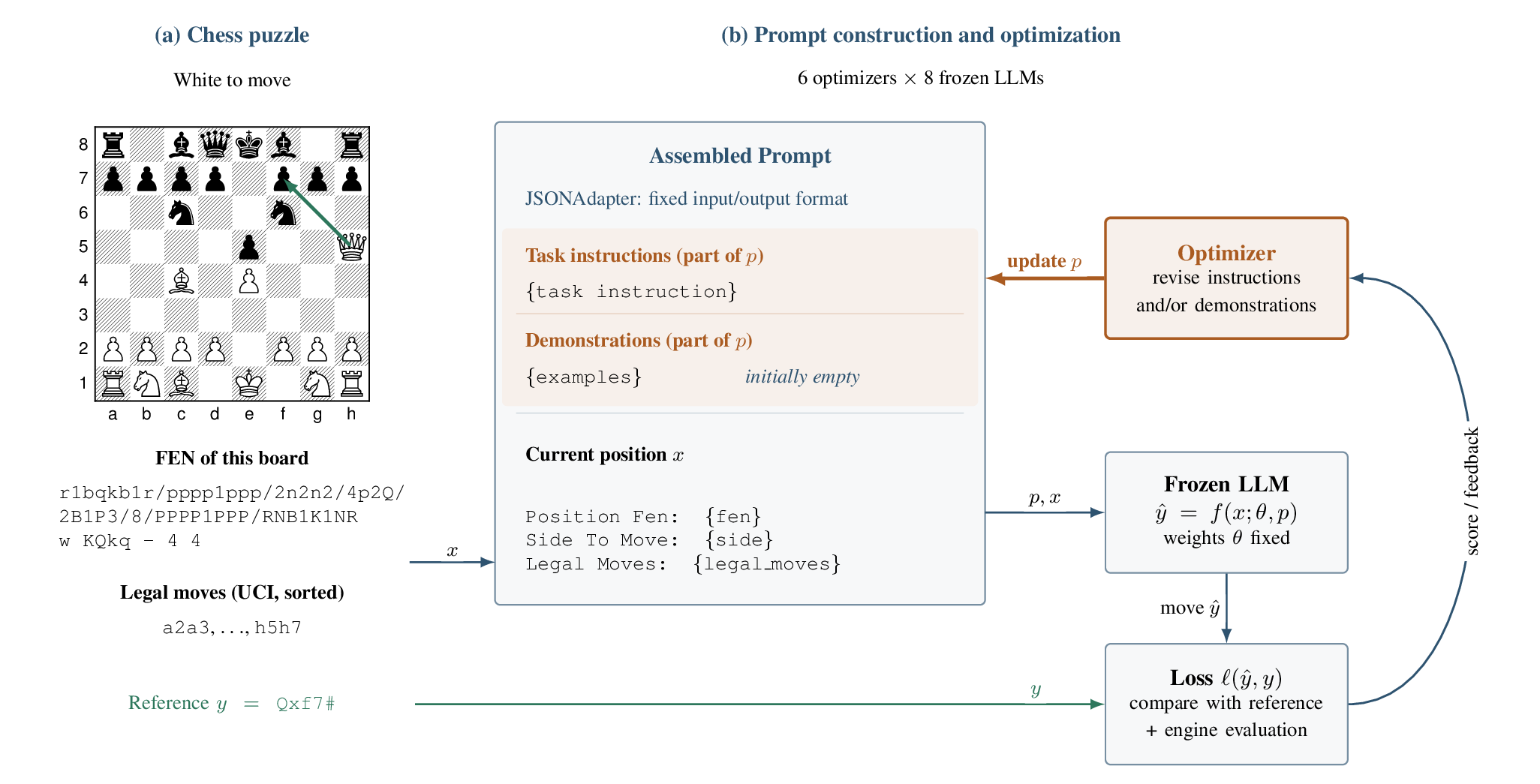
This repository contains code and data for the paper Benchmarking Prompt Optimization of Large Language Models With Chess. A frozen LLM is given a chess position (FEN, side to move, legal moves) and must return the reference move. An optimizer improves the prompt's instructions and/or demonstrations; the model weights never change.
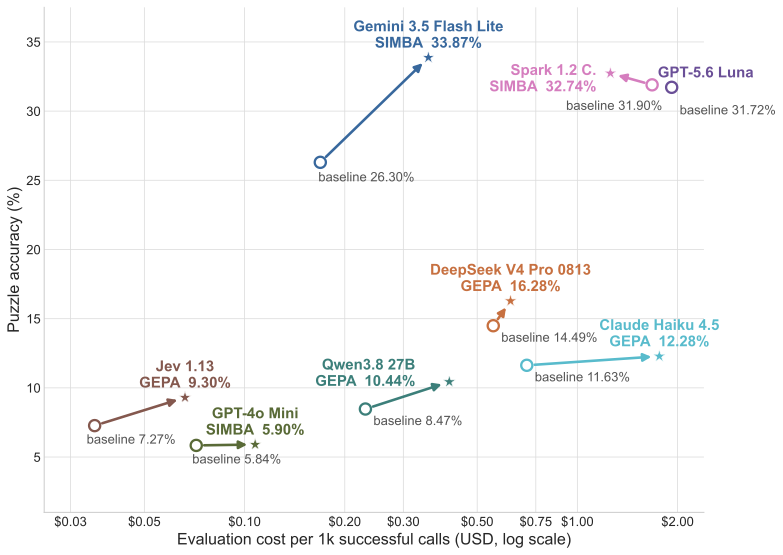
Right: cost vs. accuracy, baseline prompt (circle) → best optimizer (star). Paper, Figure 2a.
Interactive explorer:
plots inference cost against puzzle accuracy for every model × optimizer, with
the Pareto frontier and the compiled prompt of every run one click away. The
page is built from site/; see docs/results-site.md
for local preview and deployment.
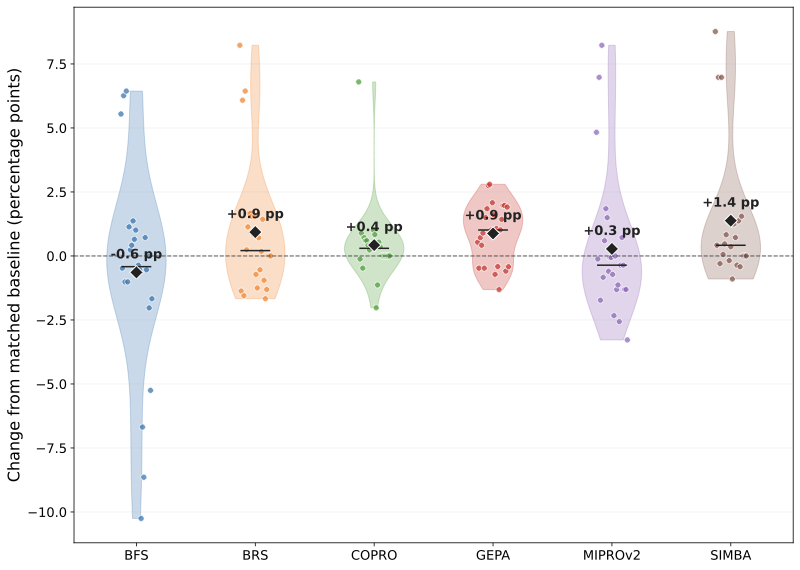
Four of eight models improve over their baseline (one-sided Welch test, p < 0.05, unadjusted). The largest gain is Gemini 3.5 Flash Lite, +7.57 points with SIMBA. No optimizer wins on every model.
Puzzle accuracy (%, N = 559, mean ± SD over three seeds)
| Model | Baseline | BFS | BRS | COPRO | GEPA | MIPROv2 | SIMBA |
|---|---|---|---|---|---|---|---|
| GPT-4o Mini | 5.84 ±0.37 | 5.01 ±0.31 | 4.95 ±0.99 | 5.84 ±0.55 | 5.66 ±0.52 | 4.95 ±0.81 | 5.90 ±0.36 |
| Jev 1.13 † | 7.27 ±0.10 | 7.87 ±0.47 | 8.77 ±0.31* | 7.69 ±0.18* | 9.30 ±0.47* | 8.59 ±0.65* | N.A. |
| Qwen3.8 27B † | 8.47 ±0.37 | 9.48 ±0.36* | 9.78 ±0.41* | 9.12 ±0.31* | 10.44 ±0.90* | 8.23 ±0.31 | 9.36 ±0.45* |
| Claude Haiku 4.5 | 11.63 ±0.00 | 11.09 ±0.18 | 11.21 ±1.02 | N.U. | 12.28 ±1.22 | 10.61 ±1.19 | 11.39 ±0.63 |
| DeepSeek V4 Pro 0813 † | 14.49 ±0.18 | 14.55 ±0.63 | 14.85 ±1.00 | 14.79 ±0.27 | 16.28 ±0.31* | 14.49 ±0.62 | 15.03 ±0.82 |
| Gemini 3.5 Flash Lite † | 26.30 ±0.62 | 32.38 ±0.47* | 33.21 ±1.15* | 29.10 ±3.46 | 27.01 ±0.18 | 32.98 ±1.72* | 33.87 ±1.03* |
| GPT-5.6 Luna | 31.72 ±0.37 | 23.20 ±1.79 | N.U. | 30.95 ±1.46 | 31.48 ±1.17 | 30.05 ±0.78 | N.U. |
| Muse Spark 1.2 Contributor | 31.90 ±1.49 | 28.92 ±1.97 | 30.59 ±0.36 | N.U. | 32.20 ±1.40 | 29.93 ±1.14 | 32.74 ±1.09 |
Bold: highest mean per model. * Improvement over the baseline (one-sided Welch test, p < 0.05, unadjusted). † At least one starred optimizer. N.U.: no seed changed the original prompt. N.A.: not applicable (SIMBA needs temperature sampling, which Jev does not support).
Raw observations behind every plot and table are in
results/paper/: per-position responses with
tokens, cost, latency and engine regret (independent_positions.csv.gz), the
compiled prompts (prompts.csv), game-play rollouts (rollouts.csv.gz), and a
manifest with the schema, coverage, settings, and file hashes. The data
dictionary describes every column and how the tables join.
Requires Python 3.11+ and uv.
git clone https://github.com/imec-ailabs/Automatic-Prompt-Optimization-with-Chess.git
cd Automatic-Prompt-Optimization-with-Chess
uv sync --dev
export OPENROUTER_API_KEY=...
All models, including the meta-model, run through OpenRouter. Jev uses OpenRouter's alpha decisions endpoint, so your key needs access to it.
# Zero-training baseline (20 positions, Gemini 3.5 Flash Lite)
uv run chess-bench evaluate configs/independent_positions_baseline.yaml

# Small GEPA optimization, then held-out evaluation
uv run chess-bench evaluate configs/independent_positions_gepa.yaml

# Same for Jev (decision endpoint)
uv run chess-bench evaluate configs/independent_positions_jev_baseline.yaml
uv run chess-bench evaluate configs/independent_positions_jev_gepa.yaml
configs/ has one baseline per paper model; the unsuffixed one uses
Gemini 3.5 Flash Lite. Each example evaluates at most 20 positions so it runs
in minutes; docs/paper-configs.md explains how to run
the paper's full protocol.
Each run writes:
runs/<name>/
├── compiled.json       # optimized DSPy program; omitted for baselines
├── results.json        # one record per held-out position (source_id, rating,
│                       #   move_index/solver_length, prediction, correct)
├── run_config.json     # resolved configuration and dataset hashes
└── summary.json        # metrics, timing, and token/cost usage per phase
summary.json reports position-level accuracy and the paper's per-puzzle
source_record_accuracy (every solver position of a puzzle must be correct),
plus compile_usage (task and prompt model) and evaluation_usage with call
counts, tokens, and cost as reported by the provider; usage_complete: false
means some calls returned no usage metadata.
Supported method values: baseline, gepa, mipro_v2, simba, copro,
bootstrap_few_shot, bootstrap_random_search. Omitting the optimizer block
runs the paper's settings (Appendix B.6, Table 11; auto: heavy for GEPA and
MIPROv2), so the example configs override them to stay small. See
docs/paper-configs.md for per-model settings, full-data
runs, and the three seeds (42, 43, 44).
Runs stop at the first provider or configuration error. Set
continue_on_error: true to record failed calls as incorrect instead.
Note: A 20-position run can stop mid-puzzle.
source_record_accuracyis computed only over puzzles whose positions were all evaluated (source_records_complete), so comparing with the paper needs the full test set.
data/puzzle_train.csv and data/puzzle_test.csv hold the paper's 559 + 559
puzzles from the Lichess puzzle database (CC0).
The same files are published on Hugging Face as
imecai/chess-apo-bench
(load_dataset("imecai/chess-apo-bench")).
The two files do not overlap in puzzle IDs or (FEN, Moves) lines and share
the same composition, stratified by rating and solver length: 20 puzzles per
100-point rating bin from 400 to 2000, 30 per bin from 2000 to 2800, half of
them mate puzzles, with 1 to 5 solver moves. The NumMoves, RatingBin,
Mate, GameId, and GameSAN columns record that construction. Every
run_config.json stores the SHA-256 of the data files a run used.
To draw a fresh set from the latest Lichess snapshot:
uv run python scripts/generate_puzzle_datasets.py --refresh-source --overwrite
Warning:
--overwritereplaces the paper'sdata/puzzle_train.csvanddata/puzzle_test.csv. Use--train-output/--test-outputto write elsewhere.
The snapshot is cached at data/lichess_db_puzzle.csv.zst; reusing it with the
same seed gives the same datasets, and the command prints the snapshot's
SHA-256 to record with your results. Puzzles are drawn uniformly at random from
the snapshot; --min-rating, --max-rating, --solver-moves, and --theme
narrow the pool. Run with --help for all options.
├── configs/                     # one YAML per run (model, method, budgets, seed)
├── data/                        # paper train/test puzzles (559 + 559)
├── results/paper/               # observations behind the paper's plots and tables
├── scripts/
│   ├── generate_puzzle_datasets.py   # draw fresh puzzle sets from Lichess
│   └── build_results_site.py    # build the interactive results page in site/
├── src/chess_self_improvement/
│   ├── cli.py                   # `chess-bench evaluate <config.yaml>`
│   ├── runner.py                # config → splits → optimize → evaluate → runs/<name>/
│   ├── datasets.py              # load Lichess CSVs
│   ├── benchmarks/
│   │   └── independent_positions.py  # puzzle → positions, exact-move metrics, feedback
│   ├── dspy_program.py          # DSPy signature with the baseline instruction
│   ├── moves.py                 # parse model output into a legal move
│   ├── jev.py                   # Jev decision-endpoint adapter
│   ├── dspy_usage.py            # token and cost accounting
│   └── optimization/            # optimizer factory and strict per-optimizer parameters
├── docs/paper-configs.md        # per-model settings and how to run the full paper setup
└── tests/                       # offline tests, no live API calls
Included: puzzle data, the six optimizers plus baseline, per-model configs,
the dataset-renewal script, and the paper's raw observations under
results/paper/: per-position results including
engine-based regret (Appendix B.2) and cross-model transfer (Section 5.4),
compiled prompts, and Stockfish game-play rollouts (Section 5.5).
Not included: the code that ran the regret, transfer, and rollout
experiments, the scripts that exported results/paper/, and the
plotting scripts. To score regret or run game-play rollouts yourself, use
Stockfish 18 at depth 20 for both, as in the paper.
uv run pytest
uv run ruff check .
uv run mypy src tests
The test suite never calls live model APIs.
If you use this benchmark, please cite the paper (GitHub's "Cite this repository"
uses CITATION.cff):
@article{lesort2026chessapo,
  title   = {Benchmarking Prompt Optimization of Large Language Models With Chess},
  author  = {Lesort, Timoth{\'e}e and L{\'o}pez de Aberasturi G{\'o}mez, Alejandra and Karch, Tristan and Veniat, Tom and Modard, Philippe and Tuyls, Karl and Denoyer, Ludovic},
  journal = {arXiv preprint arXiv:2610.00416},
  year    = {2026}
}
Code is released under the Apache License 2.0 (see also NOTICE).
It depends on python-chess (GPL-3.0+),
which is installed separately and not bundled.
Puzzle data in data/ comes from Lichess under CC0 1.0. The result data in
results/paper/ is released under
CC BY 4.0; see its
README for details.
133 followers · starred Oct 2026
Benchmark Repository for Automatic Prompt Optimization (APO) with Chess
Python
3
3 commits
updated Oct 6, 2026
Overview · Results · Installation · Quick Start · Data · Architecture · Scope · Citation
1,118 Lichess puzzles · 6 APO algorithms · 8 frozen target models
This repository contains code and data for the paper Benchmarking Prompt Optimization of Large Language Models With Chess. A frozen LLM is given a chess position (FEN, side to move, legal moves) and must return the reference move. An optimizer improves the prompt's instructions and/or demonstrations; the model weights never change.
Right: cost vs. accuracy, baseline prompt (circle) → best optimizer (star). Paper, Figure 2a.
Interactive explorer:
plots inference cost against puzzle accuracy for every model × optimizer, with
the Pareto frontier and the compiled prompt of every run one click away. The
page is built from site/; see docs/results-site.md
for local preview and deployment.
Four of eight models improve over their baseline (one-sided Welch test, p < 0.05, unadjusted). The largest gain is Gemini 3.5 Flash Lite, +7.57 points with SIMBA. No optimizer wins on every model.
Puzzle accuracy (%, N = 559, mean ± SD over three seeds)
| Model | Baseline | BFS | BRS | COPRO | GEPA | MIPROv2 | SIMBA |
|---|---|---|---|---|---|---|---|
| GPT-4o Mini | 5.84 ±0.37 | 5.01 ±0.31 | 4.95 ±0.99 | 5.84 ±0.55 | 5.66 ±0.52 | 4.95 ±0.81 | 5.90 ±0.36 |
| Jev 1.13 † | 7.27 ±0.10 | 7.87 ±0.47 | 8.77 ±0.31* | 7.69 ±0.18* | 9.30 ±0.47* | 8.59 ±0.65* | N.A. |
| Qwen3.8 27B † | 8.47 ±0.37 | 9.48 ±0.36* | 9.78 ±0.41* | 9.12 ±0.31* | 10.44 ±0.90* | 8.23 ±0.31 | 9.36 ±0.45* |
| Claude Haiku 4.5 | 11.63 ±0.00 | 11.09 ±0.18 | 11.21 ±1.02 | N.U. | 12.28 ±1.22 | 10.61 ±1.19 | 11.39 ±0.63 |
| DeepSeek V4 Pro 0813 † | 14.49 ±0.18 | 14.55 ±0.63 | 14.85 ±1.00 | 14.79 ±0.27 | 16.28 ±0.31* | 14.49 ±0.62 | 15.03 ±0.82 |
| Gemini 3.5 Flash Lite † | 26.30 ±0.62 | 32.38 ±0.47* | 33.21 ±1.15* | 29.10 ±3.46 | 27.01 ±0.18 | 32.98 ±1.72* | 33.87 ±1.03* |
| GPT-5.6 Luna | 31.72 ±0.37 | 23.20 ±1.79 | N.U. | 30.95 ±1.46 | 31.48 ±1.17 | 30.05 ±0.78 | N.U. |
| Muse Spark 1.2 Contributor | 31.90 ±1.49 | 28.92 ±1.97 | 30.59 ±0.36 | N.U. | 32.20 ±1.40 | 29.93 ±1.14 | 32.74 ±1.09 |
Bold: highest mean per model. * Improvement over the baseline (one-sided Welch test, p < 0.05, unadjusted). † At least one starred optimizer. N.U.: no seed changed the original prompt. N.A.: not applicable (SIMBA needs temperature sampling, which Jev does not support).
Raw observations behind every plot and table are in
results/paper/: per-position responses with
tokens, cost, latency and engine regret (independent_positions.csv.gz), the
compiled prompts (prompts.csv), game-play rollouts (rollouts.csv.gz), and a
manifest with the schema, coverage, settings, and file hashes. The data
dictionary describes every column and how the tables join.
Requires Python 3.11+ and uv.
git clone https://github.com/imec-ailabs/Automatic-Prompt-Optimization-with-Chess.git
cd Automatic-Prompt-Optimization-with-Chess
uv sync --dev
export OPENROUTER_API_KEY=...
All models, including the meta-model, run through OpenRouter. Jev uses OpenRouter's alpha decisions endpoint, so your key needs access to it.
# Zero-training baseline (20 positions, Gemini 3.5 Flash Lite)
uv run chess-bench evaluate configs/independent_positions_baseline.yaml

# Small GEPA optimization, then held-out evaluation
uv run chess-bench evaluate configs/independent_positions_gepa.yaml

# Same for Jev (decision endpoint)
uv run chess-bench evaluate configs/independent_positions_jev_baseline.yaml
uv run chess-bench evaluate configs/independent_positions_jev_gepa.yaml
configs/ has one baseline per paper model; the unsuffixed one uses
Gemini 3.5 Flash Lite. Each example evaluates at most 20 positions so it runs
in minutes; docs/paper-configs.md explains how to run
the paper's full protocol.
Each run writes:
runs/<name>/
├── compiled.json       # optimized DSPy program; omitted for baselines
├── results.json        # one record per held-out position (source_id, rating,
│                       #   move_index/solver_length, prediction, correct)
├── run_config.json     # resolved configuration and dataset hashes
└── summary.json        # metrics, timing, and token/cost usage per phase
summary.json reports position-level accuracy and the paper's per-puzzle
source_record_accuracy (every solver position of a puzzle must be correct),
plus compile_usage (task and prompt model) and evaluation_usage with call
counts, tokens, and cost as reported by the provider; usage_complete: false
means some calls returned no usage metadata.
Supported method values: baseline, gepa, mipro_v2, simba, copro,
bootstrap_few_shot, bootstrap_random_search. Omitting the optimizer block
runs the paper's settings (Appendix B.6, Table 11; auto: heavy for GEPA and
MIPROv2), so the example configs override them to stay small. See
docs/paper-configs.md for per-model settings, full-data
runs, and the three seeds (42, 43, 44).
Runs stop at the first provider or configuration error. Set
continue_on_error: true to record failed calls as incorrect instead.
Note: A 20-position run can stop mid-puzzle.
source_record_accuracyis computed only over puzzles whose positions were all evaluated (source_records_complete), so comparing with the paper needs the full test set.
data/puzzle_train.csv and data/puzzle_test.csv hold the paper's 559 + 559
puzzles from the Lichess puzzle database (CC0).
The same files are published on Hugging Face as
imecai/chess-apo-bench
(load_dataset("imecai/chess-apo-bench")).
The two files do not overlap in puzzle IDs or (FEN, Moves) lines and share
the same composition, stratified by rating and solver length: 20 puzzles per
100-point rating bin from 400 to 2000, 30 per bin from 2000 to 2800, half of
them mate puzzles, with 1 to 5 solver moves. The NumMoves, RatingBin,
Mate, GameId, and GameSAN columns record that construction. Every
run_config.json stores the SHA-256 of the data files a run used.
To draw a fresh set from the latest Lichess snapshot:
uv run python scripts/generate_puzzle_datasets.py --refresh-source --overwrite
Warning:
--overwritereplaces the paper'sdata/puzzle_train.csvanddata/puzzle_test.csv. Use--train-output/--test-outputto write elsewhere.
The snapshot is cached at data/lichess_db_puzzle.csv.zst; reusing it with the
same seed gives the same datasets, and the command prints the snapshot's
SHA-256 to record with your results. Puzzles are drawn uniformly at random from
the snapshot; --min-rating, --max-rating, --solver-moves, and --theme
narrow the pool. Run with --help for all options.
├── configs/                     # one YAML per run (model, method, budgets, seed)
├── data/                        # paper train/test puzzles (559 + 559)
├── results/paper/               # observations behind the paper's plots and tables
├── scripts/
│   ├── generate_puzzle_datasets.py   # draw fresh puzzle sets from Lichess
│   └── build_results_site.py    # build the interactive results page in site/
├── src/chess_self_improvement/
│   ├── cli.py                   # `chess-bench evaluate <config.yaml>`
│   ├── runner.py                # config → splits → optimize → evaluate → runs/<name>/
│   ├── datasets.py              # load Lichess CSVs
│   ├── benchmarks/
│   │   └── independent_positions.py  # puzzle → positions, exact-move metrics, feedback
│   ├── dspy_program.py          # DSPy signature with the baseline instruction
│   ├── moves.py                 # parse model output into a legal move
│   ├── jev.py                   # Jev decision-endpoint adapter
│   ├── dspy_usage.py            # token and cost accounting
│   └── optimization/            # optimizer factory and strict per-optimizer parameters
├── docs/paper-configs.md        # per-model settings and how to run the full paper setup
└── tests/                       # offline tests, no live API calls
Included: puzzle data, the six optimizers plus baseline, per-model configs,
the dataset-renewal script, and the paper's raw observations under
results/paper/: per-position results including
engine-based regret (Appendix B.2) and cross-model transfer (Section 5.4),
compiled prompts, and Stockfish game-play rollouts (Section 5.5).
Not included: the code that ran the regret, transfer, and rollout
experiments, the scripts that exported results/paper/, and the
plotting scripts. To score regret or run game-play rollouts yourself, use
Stockfish 18 at depth 20 for both, as in the paper.
uv run pytest
uv run ruff check .
uv run mypy src tests
The test suite never calls live model APIs.
If you use this benchmark, please cite the paper (GitHub's "Cite this repository"
uses CITATION.cff):
@article{lesort2026chessapo,
  title   = {Benchmarking Prompt Optimization of Large Language Models With Chess},
  author  = {Lesort, Timoth{\'e}e and L{\'o}pez de Aberasturi G{\'o}mez, Alejandra and Karch, Tristan and Veniat, Tom and Modard, Philippe and Tuyls, Karl and Denoyer, Ludovic},
  journal = {arXiv preprint arXiv:2610.00416},
  year    = {2026}
}
Code is released under the Apache License 2.0 (see also NOTICE).
It depends on python-chess (GPL-3.0+),
which is installed separately and not bundled.
Puzzle data in data/ comes from Lichess under CC0 1.0. The result data in
results/paper/ is released under
CC BY 4.0; see its
README for details.
133 followers · starred Oct 2026






