Knowledge graph-guided multi-task pre-training for legal reasoning: the German StVO is parsed into a knowledge graph whose TransE paragraph embeddings become soft targets for NSP, KG-clustering, and KG-aware classification objectives. NLLP 2026.
Python
1
15 commits
updated Sep 20, 2026
Legal language models treat statutory text as flat token sequences. It isn't flat. This repository injects the structure of German road traffic law directly into model weights — and shows it could be transfered across languages, jurisdictions, and legal domains.


| Problem | Legal PLMs rely on masked language modeling alone. They ignore the hierarchical and cross-referential constraints that make statutory text legal text. |
| Approach | Parse the German Straßenverkehrs-Ordnung (StVO) into a knowledge graph, embed it with TransE, and use those embeddings as soft targets across three complementary pre-training objectives. |
| Result | +10.3 % to +155.0 % relative gain over baselines on StVO QA · new SOTA on 4 LexGLUE metrics · +3.4 % to +15.8 % zero-shot on Austrian driving regulations. |
| Key insight | Structural knowledge learned in German surfaces through an English classification head — cross-lingual transfer without ever showing the model English legal structure. |
Two pipelines converge: one distills the law into geometry, the other teaches a language model to read that geometry.
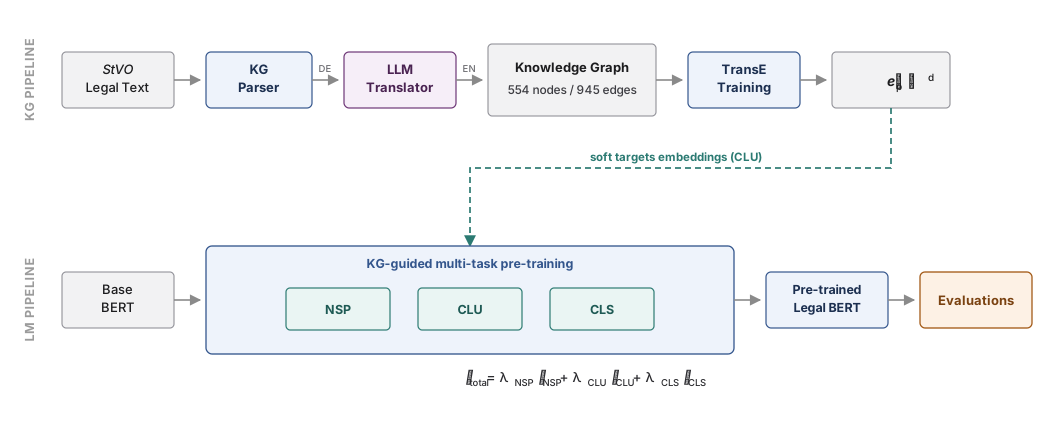
German StVO legal text is parsed, translated via an LLM translator, and structurally aligned with a corresponding English-based knowledge graph, injecting explicit relational constraints into model reasoning. The TransE paragraph embeddings enter the LM pipeline as soft targets for the CLU objective — the only coupling between the two pipelines, and the mechanism by which legal structure reaches the model weights.
The total objective is a weighted sum over the unit simplex:
$$\mathcal{L}{total} = \lambda{NSP}\mathcal{L}{NSP} + \lambda{CLU}\mathcal{L}{CLU} + \lambda{CLS}\mathcal{L}_{CLS}, \qquad \sum\lambda = 1.0$$
| Task | Signal | What it teaches |
|---|---|---|
| NSP — Next Sentence Prediction | Positive pairs from consecutive sentences within a paragraph; negatives sampled cross-paragraph | Document coherence and paragraph boundaries |
| CLU — KG-Guided Clustering | Margin-based contrastive loss pulling a segment toward its source paragraph's TransE embedding, pushing it from a random negative | Relational geometry — structurally related paragraphs (§ 8 and § 9 on right-of-way) already cluster together in TransE space |
| CLS — KG-Aware Classification | Binary correctness of a (question, answer) pair, decided through gated attention over the full paragraph-embedding set | Task-aligned reasoning grounded in the actual statute |
CLU is the conceptual core. Because the target e⁺ is a 500-dimensional continuous vector rather than a discrete label, the gradient carries relational geometry — the model learns a continuous range of legal concepts instead of hard class boundaries.
The CLS head does not rely on the self-contained encoder representation. It queries the whole paragraph-embedding library at decision time:
$$\alpha_j = \text{softmax}\left(\frac{\mathbf{z}_s^\top \mathbf{e}j}{\sqrt{d_h}}\right), \quad \mathbf{c}{KG} = \sum_j \alpha_j \mathbf{e}_j$$
$$\tilde{\mathbf{z}}s = g \odot \mathbf{c}{KG} + (1-g) \odot \mathbf{z}_s, \quad g = \sigma([\mathbf{z}s; \mathbf{c}{KG}]W_g)$$
Unlike retrieval-augmented generation, there is no discrete database lookup at inference — retrieval happens in latent space and is fully differentiable. The gate g can drive the KG contribution to zero when the retrieved context is uninformative, so the mechanism degrades gracefully rather than injecting noise. Implementation: multi_task_classes_STvO_mlm_clm_clu_cls.py.
Multi-task pre-training (PT) is zero-shot; FT adds a few downstream samples. Gains are largely decoupled from base performance, which is the evidence that the objectives — not a strong starting point — are doing the work.
| Model | Base m-F1 | PT m-F1 | PT Gain | Bal. Acc. | FT m-F1 |
|---|---|---|---|---|---|
| Top performers (m-F1 > 0.8) | |||||
bert-base-echr | 0.566 | 0.864 | +0.298 | 0.864 | 0.912 |
bert-base-eurlex | 0.338 | 0.862 | +0.524 | 0.864 | 0.909 |
bert-base-contracts | 0.475 | 0.845 | +0.370 | 0.848 | 0.905 |
custom-legalbert | 0.467 | 0.820 | +0.353 | 0.820 | 0.900 |
Italian-Legal-BERT | 0.514 | 0.813 | +0.299 | 0.815 | 0.893 |
| Moderate | |||||
google-bert-base | 0.425 | 0.630 | +0.205 | 0.666 | 0.919 |
legal-bert-base | 0.456 | 0.569 | +0.114 | 0.617 | 0.888 |
| Limited | |||||
legal-bert-small | 0.486 | 0.537 | +0.050 | 0.545 | 0.892 |
Legal-heBERT | 0.336 | 0.435 | +0.099 | 0.548 | 0.870 |
bert-base-eurlex climbs from the weakest base (0.338) to 0.862. Counterintuitively, general-purpose google-bert-base gains more (+0.205) than the broad multi-field legal-bert-base (+0.114) — we attribute this to domain-specific interference, where many legal-English tasks conflict with the StVO domain, while single-subfield specialists (echr, eurlex) align cleanly.
NSP and CLU are trained on non-translated German StVO; only the CLS head sees English. Any zero-shot gain is therefore German-learned structure surfacing in English.
| Model | Base | PT (zero-shot) | Gain |
|---|---|---|---|
bert-base-eurlex | 0.338 | 0.837 | +0.499 |
google-bert-base | 0.425 | 0.773 | +0.347 |
bert-base-contracts | 0.475 | 0.694 | +0.219 |
legal-bert-base | 0.456 | 0.599 | +0.144 |
Italian-Legal-BERT | 0.514 | 0.608 | +0.094 |
bert-base-eurlex barely improves with further fine-tuning (+0.032) — the German NSP+CLU signal was already sufficient. Models that fail zero-shot recover fully once fine-tuned, all converging to a narrow 0.862–0.878 band.
Trained exclusively on German traffic law, the models set new SOTA on four metrics across four English legal tasks:
| Model | ECtHR-A µ-F1 | ECtHR-B µ-F1 | UNFAIR-ToS m-F1 | CaseHOLD F1 |
|---|---|---|---|---|
| Legal-BERT (published) | 70.0 | 80.4 | 83.0 | 75.3 |
| CaseLaw-BERT (published) | 69.8 | 78.8 | 82.3 | 75.4 |
| BERT-ECHR + StVO | 72.7 † | 81.0 † | 82.5 | 71.9 |
| Custom-LegalBERT + StVO | 71.2 | 78.6 | 86.0 † | 77.0 † |
† new SOTA over the published baselines of Chalkidis et al. (2021). The models show negative transfer on SCOTUS, EUR-LEX, and LEDGAR — reported in full rather than omitted.
Average m-F1 drop when each objective is removed, across all nine models:
| Removed | Mean drop | Significance |
|---|---|---|
| CLS | 0.277 | t(8) = 4.35, p < 0.01 |
| NSP | 0.105 | t(8) = 2.52, p < 0.05 |
| CLU | 0.056 | t(8) = 1.76, p = 0.11 (n.s.) |
The full NSP+CLU+CLS configuration wins for 7 of 9 models. CLS dominates because it aligns directly with the downstream task. CLU's aggregate effect is not statistically significant — it helps top performers (bert-base-echr: 0.587 → 0.864) but interferes in bert-base-contracts and google-bert-base, where random negative sampling can pair semantically related paragraphs as negatives. Task synergy is architecture-dependent, and we report that honestly.
| Dataset | Size | Role |
|---|---|---|
| StVO knowledge graph | 554 nodes · 945 edges · 5 relations | HAS_PARAGRAPH, HAS_SENTENCE, HAS_SECTION, HAS_SIGN, HAS_TABLE |
| Synthetic StVO QA | 12,554 pairs → 10,245 train / 2,309 test | Paragraph-level split (49 train / 10 test §, zero overlap) |
| Irish theory test | 890 questions → 625 textual → 2,500 samples | Zero-shot in-domain transfer |
| Austrian ÖAMTC | 1,954 questions → 963 textual → 3,852 samples | Zero-shot in-domain transfer |
| LexGLUE | 7 English legal tasks | Out-of-domain legal transfer |
Synthetic StVO QA is published separately — the corpus, the 11 individual generation runs with their manifests, and the full generation/validation/evaluation pipeline live at stvo-legal-qa, together with a dataset card documenting the record schema, the paragraph-disjoint split, and known label noise.
legal_qa_generation_multi_lingual.py prompts Llama-2-7b-chat, Mistral-7B-Instruct-v0.2 and Chocolatine-14B to produce, for each StVO sentence, a source-grounded correct answer and a plausible but contradictory incorrect one.
A six-stage validation pipeline then filters them — structural and field constraints, rejection of non-reasoning yes/no questions, domain-terminology verification (Vorfahrt, right of way), lexical-overlap removal of trivial paraphrases, and placeholder detection. Only pairs scoring Q ≥ 0.6 on a composite metric survive. Validation and analysis tooling lives in data/synthetic-data-eval/.
Critically, 17 % of paragraph identifiers are reserved exclusively for testing, so the model cannot exploit content memorisation — the split is by paragraph, not by pair.
Example — § 8 Right of way Source: "At intersections without traffic signs or lights, vehicles coming from the right have right-of-way." ✅ Correct: Q: "Which vehicle has priority at an unmarked intersection?" → A: "…vehicles approaching from the right have right-of-way." ❌ Incorrect: Q: "Who must yield at an intersection without signals?" → A: "The vehicle traveling at lower speed must always yield to faster-moving traffic." (contradicts the right-hand priority rule)
Everything the pipeline consumes, and where it comes from. Nothing here is
redistributed by this repository except the KG embeddings under legal-KGE/.
| Resource | Link |
|---|---|
| Straßenverkehrs-Ordnung (StVO 2013) — the statute itself, in German | gesetze-im-internet.de |
The parser scrapes this URL directly, pulling the ~500 referenced Zeichen images alongside the text. As an amtliches Werk under § 5 UrhG the statute carries no copyright, but it is amended over time — a re-scrape today yields a slightly different graph than the 554-node/945-edge snapshot reported here.
| Resource | Provides | Used for |
|---|---|---|
| stvo-legal-knowledge-graph-parser | Parsed statute, tagged tree, integrated knowledge graph, NSP/CLU datasets, triples | Stage 1 — every input below the QA corpus |
| stvo-legal-qa | 12,554 synthetic QA pairs (10,245 train / 2,309 test), 11 generation runs with manifests, and the generation + validation + evaluation pipeline | The CLS objective, and the main results table |
stvo-legal-qa carries the corpus this project trains and evaluates its
classification head on, so the numbers in Results are reproducible
without rerunning generation: clone it and point --dataset_path at
data/stvo/qa_train.jsonl / qa_test.jsonl. Its paragraph-disjoint split is the
same one used here — 49 training §§, 10 held-out §§, zero overlap.
| Role | Model | Notes |
|---|---|---|
| Translation DE→EN | facebook/m2m100_418M | Default; source of the m2m100_418M_translated_* artifacts |
Helsinki-NLP/opus-mt-de-en | Alternative, for the translation ablation | |
| QA generation | mistralai/Mistral-7B-Instruct-v0.2 | Fast runs and the quality-threshold sweep |
meta-llama/Llama-2-7b-chat-hf | Largest share of the corpus, and the domain variants | |
jpacifico/Chocolatine-14B-Instruct-DPO-v1.2 | Balanced run | |
| Base encoders (9) | nlpaueb/bert-base-uncased-{echr,eurlex,contracts}, nlpaueb/legal-bert-{base,small}-uncased, casehold/custom-legalbert, dlicari/Italian-Legal-BERT, avichr/Legal-heBERT, google-bert/bert-base-uncased | The models multi-task pre-training is applied to |
Gated checkpoints (Llama, Mistral) need a Hugging Face token, read from HF_TOKEN.
| Benchmark | Source |
|---|---|
| LexGLUE — 7 English legal tasks | coastalcph/lex-glue |
| Irish theory test · Austrian ÖAMTC | Driving-theory question sets, under data/test-sets/ |
├── legal-parser/                 Stage 1 — legal text → knowledge graph (published standalone)
│   ├── main_content_extractor.py     Structured content extraction
│   ├── table_content_extractor.py    Tables and traffic-sign figures
│   ├── citator.py                    Cross-reference / citation resolution
│   ├── knowledge_graph_constructor.py
│   └── kg_class.py
│
├── legal-KGE/                    Stage 2 — knowledge graph embeddings
│   ├── train_legal_kge.py            TransE · DistMult · RotatE · ComplEx
│   ├── train_transE.py               Standalone TransE trainer
│   ├── extract_paragraph_embeddings.py
│   ├── compare_kge_models.py
│   └── embeddings/                   Pretrained checkpoints (committed)
│
├── legal_qa_generation_multi_lingual.py    Stage 3 — synthetic QA generation
├── data/synthetic-data-eval/               QA validation & analysis suite
│   ├── evaluation_suite.py · llm_evaluator.py · report.py
│   ├── validate_qa_dataset.py            Six-stage quality filter
│   └── paper_visualize.py · tables.py    Paper figures and tables
│
├── finetune_multi_task_STvO_mlm_clm_clu.py      Stage 4 — training loop
├── multi_task_classes_STvO_mlm_clm_clu_cls.py   Model, datasets, KG attention
├── segmenter.py                                 Structure-aware segmentation
│
├── eval.py                       Stage 5 — evaluation entry point
├── driving_examiner.py               Prompting, retrieval, scoring
├── driving_license_data_loader.py    DE / IE / AT exam loaders
├── plotter.py                        Figures
├── results/stats_table.py            Result aggregation
│
├── benchmark-lexglue/            LexGLUE modifications (see below)
├── slurms/                       SLURM job scripts (HPC)
└── tmux/                         tmux runners (single-node multi-GPU)
Data and results —
data/,results/,plots/, andstats/hold large artifacts and are excluded from version control; the scripts inside them are tracked. Pretrained KG embeddings underlegal-KGE/embeddings/are committed, so evaluation reproduces without re-running stages 1–2.
LexGLUE — the RQ3 experiments run on coastalcph/lex-glue, which is a separate upstream repository. Rather than vendoring it,
benchmark-lexglue/carries our modifications as a patch. Clone upstream, thengit apply ../benchmark-lexglue/stvo-lexglue-modifications.patch.
git clone https://github.com/ibrahimssd/stvo-llm-driver.git
cd stvo-llm-driver

python3 -m venv envs/driving-env
source envs/driving-env/bin/activate
bash tmux/install.sh
install.sh pins PyTorch 2.6.0 / CUDA 12.4 and installs transformers, datasets, accelerate, peft, evaluate, scikit-learn, wandb, and the plotting stack. All experiments ran on a single NVIDIA H100 80 GB, seed 42.
1 · Parse the statute into a knowledge graph — prerequisite. This step is not performed in this repository. The pattern-based parser is published standalone as stvo-legal-knowledge-graph-parser (ESSV 2025), and everything below consumes its output. It exploits the semi-structured hierarchy of the StVO — categories, paragraphs, Absätze, Sätze, tables, sections, Zeichen — and resolves the statute's own cross-references into typed edges, using a predefined ontology rather than an LLM-inferred one.
git clone https://github.com/ibrahimssd/stvo-legal-knowledge-graph-parser.git
cd stvo-legal-knowledge-graph-parser
pip install -r requirements.txt

bash scripts/1_extract_entities.sh     # scrape gesetze-im-internet.de, tag the tree
bash scripts/2_translate.sh            # DE → EN, m2m100_418M (optional)
bash scripts/3_construct_kg.sh         # build the integrated graph
Step 2 is the DE → EN hop in Figure 1; --model_name Helsinki-NLP/opus-mt-de-en
produces the opus-mt-de-en_* variants used in the translation ablation. Step 3 needs
neither the scrape nor the translation — it builds from the parser repo's examples/
in seconds. Output: 554 nodes, 945 edges, 5 relations.
Copy the resulting files into data/stvo/. Four of them feed this project directly,
one per downstream consumer:
| Parser output | Consumed here by | Purpose |
|---|---|---|
*_graph_triples.txt | legal-KGE/train_legal_kge.py | TransE training → the 500-d paragraph embeddings eₚ |
*_graph_nsp_dataset.json | finetune_multi_task_STvO_mlm_clm_clu.py | NSP objective — sentence pairs within/across paragraphs |
*_graph_sentence_clu_dataset.json | finetune_multi_task_STvO_mlm_clm_clu.py | CLU objective — sentence → parent paragraph |
*_translated_main_content_*.json | legal_qa_generation_multi_lingual.py | Source statute for synthetic QA generation (CLS) |
The _graph_raw.txt node dump is additionally available for plain MLM pre-training.
Filenames in data/stvo/ carry the translation model as a prefix
(m2m100_418M_translated_…, opus-mt-de-en_translated_…), which is how the
translation ablation selects between them.
2 · Train the KG embeddings — TransE, producing the 500-d paragraph embeddings eₚ used as CLU soft targets.
python legal-KGE/train_legal_kge.py \
    --model_type transe \
    --data_path data/stvo/stvo_triples.txt \
    --embedding_dim 500 \
    --epochs 50 \
    --batch_size 256 \
    --learning_rate 1e-3 \
    --margin 1.0 \
    --save_paragraph_embeddings \
    --output_dir legal-KGE/embeddings/transe/STvO_de
Swap --model_type for distmult, rotate, or complex to reproduce the preliminary KGE comparison (legal-KGE/compare_kge_models.py); TransE was the most robust on downstream tasks.
3 · Generate and validate the QA corpus.
python legal_qa_generation_multi_lingual.py \
    --input_file data/stvo/structured_stvo.json \
    --output_file data/synthetic-data/stvo_qa_de.json \
    --language de --domain_type traffic \
    --pairs_per_sentence 2 --min_quality_score 0.6

python data/synthetic-data/stvo/validate_qa_dataset.py   # six-stage quality filter
bash data/synthetic-data-eval/run_eval_pipline.sh        # corpus analysis + report
4 · KG-guided multi-task pre-training — the base encoder internalises legal structure via NSP + CLU + CLS.
python finetune_multi_task_STvO_mlm_clm_clu.py \
    --base_model_name nlpaueb/bert-base-uncased-echr \
    --modeling_type masked \
    --legal_text STVO \
    --clm_data_path data/stvo/clm.json \
    --nsp_data_path data/stvo/nsp.json \
    --clu_data_path data/stvo/clu.json \
    --cls_data_path data/stvo/cls.json \
    --paragraph_embeddings_file legal-KGE/embeddings/transe/m2m100_418M_STvO/transe_paragraph_embeddings_best.json \
    --clm_nsp_lambdas 0.0 0.1 0.2 0.3 0.4 0.5 0.6 0.7 0.8 0.9 \
    --cls_lambdas 0.1 \
    --num_epochs 20 --batch_size_nsp 16 --max_segments 10 \
    --learning_rate 5e-5 --gradient_accumulation_steps 2
λ_CLU is derived as 1 − (λ_NSP + λ_CLS), giving 36 valid configurations per model.
5 · Evaluate — zero-shot on the StVO QA test split, the Irish and Austrian exams, and (via benchmark-lexglue/) LexGLUE.
python eval.py \
    --data_path data/test-sets/irish-driving-license.json \
    --data_name irish \
    --baseline_model nlpaueb/bert-base-uncased-echr \
    --model_checkpoint_dir  <checkpoint-dir> \
    --model_checkpoint      m2m100_418M_clm_nsp_0.4_clu_0.5_cls_0.1.pt \
    --paragraph_embeddings_file legal-KGE/embeddings/transe/m2m100_418M_STvO/transe_paragraph_embeddings_best.json \
    --modeling_type masked --task_type cls --num_cls_labels 2 \
    --decoding combine --similarity_threshold 0.6 \
    --skip_images --skip_category direct_answer \
    --results_file results/irish-echr.csv
Add --eval_base for the untuned baseline. Full sweeps: cd tmux && bash stvo_train_multi_task.sh or cd slurms && sbatch stvo_train_multi_task_ultimate.sm.
|
TransE (KG embedding)
|
Multi-task pre-training
|
bert-base-contracts. Hard-negative sampling is future work.legal-bert-small plateaus (capacity bottleneck) and Legal-heBERT degrades monotonically (Hebrew↔English incompatibility), showing severe precision-recall imbalance (P = 1.000, R = 0.096).These are research prototypes, not legal advice. Outputs must not substitute for a qualified legal professional, and deployment in safety-critical settings such as automated driver assessment without human oversight is strongly discouraged. The corpora are LLM-generated and quality-filtered; filtering does not guarantee correctness, and no held-out subset was validated by human legal experts. Base encoders pre-trained on corpora such as EUR-LEX may encode biases that continued StVO pre-training does not remove.
@inproceedings{siddig2026stvo,
  title     = {Enhancing Legal Reasoning in Pre-trained Language Models via
               Knowledge Graph-Guided Multi-Task Pre-training},
  author    = {Siddig, Ibrahim and Georges, Munir},
  booktitle = {Proceedings of the Natural Legal Language Processing Workshop 2026 (NLLP)},
  year      = {2026}
}
The pattern-based parser behind the knowledge graph is published separately as stvo-legal-knowledge-graph-parser:
@inproceedings{siddig2025parsing,
  title     = {Pattern-based Parsing of German Traffic Regulations (StVO)
               for Legal Knowledge Graph Construction (KGC)},
  author    = {Siddig, Ibrahim and Tugeev, Sviatoslav and Georges, Munir},
  booktitle = {ESSV},
  year      = {2025}
}
Research code — interfaces may change between experiment iterations.
Knowledge graph-guided multi-task pre-training for legal reasoning: the German StVO is parsed into a knowledge graph whose TransE paragraph embeddings become soft targets for NSP, KG-clustering, and KG-aware classification objectives. NLLP 2026.
Python
1
15 commits
updated Sep 20, 2026
Legal language models treat statutory text as flat token sequences. It isn't flat. This repository injects the structure of German road traffic law directly into model weights — and shows it could be transfered across languages, jurisdictions, and legal domains.
| Problem | Legal PLMs rely on masked language modeling alone. They ignore the hierarchical and cross-referential constraints that make statutory text legal text. |
| Approach | Parse the German Straßenverkehrs-Ordnung (StVO) into a knowledge graph, embed it with TransE, and use those embeddings as soft targets across three complementary pre-training objectives. |
| Result | +10.3 % to +155.0 % relative gain over baselines on StVO QA · new SOTA on 4 LexGLUE metrics · +3.4 % to +15.8 % zero-shot on Austrian driving regulations. |
| Key insight | Structural knowledge learned in German surfaces through an English classification head — cross-lingual transfer without ever showing the model English legal structure. |
Two pipelines converge: one distills the law into geometry, the other teaches a language model to read that geometry.
German StVO legal text is parsed, translated via an LLM translator, and structurally aligned with a corresponding English-based knowledge graph, injecting explicit relational constraints into model reasoning. The TransE paragraph embeddings enter the LM pipeline as soft targets for the CLU objective — the only coupling between the two pipelines, and the mechanism by which legal structure reaches the model weights.
The total objective is a weighted sum over the unit simplex:
$$\mathcal{L}{total} = \lambda{NSP}\mathcal{L}{NSP} + \lambda{CLU}\mathcal{L}{CLU} + \lambda{CLS}\mathcal{L}_{CLS}, \qquad \sum\lambda = 1.0$$
| Task | Signal | What it teaches |
|---|---|---|
| NSP — Next Sentence Prediction | Positive pairs from consecutive sentences within a paragraph; negatives sampled cross-paragraph | Document coherence and paragraph boundaries |
| CLU — KG-Guided Clustering | Margin-based contrastive loss pulling a segment toward its source paragraph's TransE embedding, pushing it from a random negative | Relational geometry — structurally related paragraphs (§ 8 and § 9 on right-of-way) already cluster together in TransE space |
| CLS — KG-Aware Classification | Binary correctness of a (question, answer) pair, decided through gated attention over the full paragraph-embedding set | Task-aligned reasoning grounded in the actual statute |
CLU is the conceptual core. Because the target e⁺ is a 500-dimensional continuous vector rather than a discrete label, the gradient carries relational geometry — the model learns a continuous range of legal concepts instead of hard class boundaries.
The CLS head does not rely on the self-contained encoder representation. It queries the whole paragraph-embedding library at decision time:
$$\alpha_j = \text{softmax}\left(\frac{\mathbf{z}_s^\top \mathbf{e}j}{\sqrt{d_h}}\right), \quad \mathbf{c}{KG} = \sum_j \alpha_j \mathbf{e}_j$$
$$\tilde{\mathbf{z}}s = g \odot \mathbf{c}{KG} + (1-g) \odot \mathbf{z}_s, \quad g = \sigma([\mathbf{z}s; \mathbf{c}{KG}]W_g)$$
Unlike retrieval-augmented generation, there is no discrete database lookup at inference — retrieval happens in latent space and is fully differentiable. The gate g can drive the KG contribution to zero when the retrieved context is uninformative, so the mechanism degrades gracefully rather than injecting noise. Implementation: multi_task_classes_STvO_mlm_clm_clu_cls.py.
Multi-task pre-training (PT) is zero-shot; FT adds a few downstream samples. Gains are largely decoupled from base performance, which is the evidence that the objectives — not a strong starting point — are doing the work.
| Model | Base m-F1 | PT m-F1 | PT Gain | Bal. Acc. | FT m-F1 |
|---|---|---|---|---|---|
| Top performers (m-F1 > 0.8) | |||||
bert-base-echr | 0.566 | 0.864 | +0.298 | 0.864 | 0.912 |
bert-base-eurlex | 0.338 | 0.862 | +0.524 | 0.864 | 0.909 |
bert-base-contracts | 0.475 | 0.845 | +0.370 | 0.848 | 0.905 |
custom-legalbert | 0.467 | 0.820 | +0.353 | 0.820 | 0.900 |
Italian-Legal-BERT | 0.514 | 0.813 | +0.299 | 0.815 | 0.893 |
| Moderate | |||||
google-bert-base | 0.425 | 0.630 | +0.205 | 0.666 | 0.919 |
legal-bert-base | 0.456 | 0.569 | +0.114 | 0.617 | 0.888 |
| Limited | |||||
legal-bert-small | 0.486 | 0.537 | +0.050 | 0.545 | 0.892 |
Legal-heBERT | 0.336 | 0.435 | +0.099 | 0.548 | 0.870 |
bert-base-eurlex climbs from the weakest base (0.338) to 0.862. Counterintuitively, general-purpose google-bert-base gains more (+0.205) than the broad multi-field legal-bert-base (+0.114) — we attribute this to domain-specific interference, where many legal-English tasks conflict with the StVO domain, while single-subfield specialists (echr, eurlex) align cleanly.
NSP and CLU are trained on non-translated German StVO; only the CLS head sees English. Any zero-shot gain is therefore German-learned structure surfacing in English.
| Model | Base | PT (zero-shot) | Gain |
|---|---|---|---|
bert-base-eurlex | 0.338 | 0.837 | +0.499 |
google-bert-base | 0.425 | 0.773 | +0.347 |
bert-base-contracts | 0.475 | 0.694 | +0.219 |
legal-bert-base | 0.456 | 0.599 | +0.144 |
Italian-Legal-BERT | 0.514 | 0.608 | +0.094 |
bert-base-eurlex barely improves with further fine-tuning (+0.032) — the German NSP+CLU signal was already sufficient. Models that fail zero-shot recover fully once fine-tuned, all converging to a narrow 0.862–0.878 band.
Trained exclusively on German traffic law, the models set new SOTA on four metrics across four English legal tasks:
| Model | ECtHR-A µ-F1 | ECtHR-B µ-F1 | UNFAIR-ToS m-F1 | CaseHOLD F1 |
|---|---|---|---|---|
| Legal-BERT (published) | 70.0 | 80.4 | 83.0 | 75.3 |
| CaseLaw-BERT (published) | 69.8 | 78.8 | 82.3 | 75.4 |
| BERT-ECHR + StVO | 72.7 † | 81.0 † | 82.5 | 71.9 |
| Custom-LegalBERT + StVO | 71.2 | 78.6 | 86.0 † | 77.0 † |
† new SOTA over the published baselines of Chalkidis et al. (2021). The models show negative transfer on SCOTUS, EUR-LEX, and LEDGAR — reported in full rather than omitted.
Average m-F1 drop when each objective is removed, across all nine models:
| Removed | Mean drop | Significance |
|---|---|---|
| CLS | 0.277 | t(8) = 4.35, p < 0.01 |
| NSP | 0.105 | t(8) = 2.52, p < 0.05 |
| CLU | 0.056 | t(8) = 1.76, p = 0.11 (n.s.) |
The full NSP+CLU+CLS configuration wins for 7 of 9 models. CLS dominates because it aligns directly with the downstream task. CLU's aggregate effect is not statistically significant — it helps top performers (bert-base-echr: 0.587 → 0.864) but interferes in bert-base-contracts and google-bert-base, where random negative sampling can pair semantically related paragraphs as negatives. Task synergy is architecture-dependent, and we report that honestly.
| Dataset | Size | Role |
|---|---|---|
| StVO knowledge graph | 554 nodes · 945 edges · 5 relations | HAS_PARAGRAPH, HAS_SENTENCE, HAS_SECTION, HAS_SIGN, HAS_TABLE |
| Synthetic StVO QA | 12,554 pairs → 10,245 train / 2,309 test | Paragraph-level split (49 train / 10 test §, zero overlap) |
| Irish theory test | 890 questions → 625 textual → 2,500 samples | Zero-shot in-domain transfer |
| Austrian ÖAMTC | 1,954 questions → 963 textual → 3,852 samples | Zero-shot in-domain transfer |
| LexGLUE | 7 English legal tasks | Out-of-domain legal transfer |
Synthetic StVO QA is published separately — the corpus, the 11 individual generation runs with their manifests, and the full generation/validation/evaluation pipeline live at stvo-legal-qa, together with a dataset card documenting the record schema, the paragraph-disjoint split, and known label noise.
legal_qa_generation_multi_lingual.py prompts Llama-2-7b-chat, Mistral-7B-Instruct-v0.2 and Chocolatine-14B to produce, for each StVO sentence, a source-grounded correct answer and a plausible but contradictory incorrect one.
A six-stage validation pipeline then filters them — structural and field constraints, rejection of non-reasoning yes/no questions, domain-terminology verification (Vorfahrt, right of way), lexical-overlap removal of trivial paraphrases, and placeholder detection. Only pairs scoring Q ≥ 0.6 on a composite metric survive. Validation and analysis tooling lives in data/synthetic-data-eval/.
Critically, 17 % of paragraph identifiers are reserved exclusively for testing, so the model cannot exploit content memorisation — the split is by paragraph, not by pair.
Example — § 8 Right of way Source: "At intersections without traffic signs or lights, vehicles coming from the right have right-of-way." ✅ Correct: Q: "Which vehicle has priority at an unmarked intersection?" → A: "…vehicles approaching from the right have right-of-way." ❌ Incorrect: Q: "Who must yield at an intersection without signals?" → A: "The vehicle traveling at lower speed must always yield to faster-moving traffic." (contradicts the right-hand priority rule)
Everything the pipeline consumes, and where it comes from. Nothing here is
redistributed by this repository except the KG embeddings under legal-KGE/.
| Resource | Link |
|---|---|
| Straßenverkehrs-Ordnung (StVO 2013) — the statute itself, in German | gesetze-im-internet.de |
The parser scrapes this URL directly, pulling the ~500 referenced Zeichen images alongside the text. As an amtliches Werk under § 5 UrhG the statute carries no copyright, but it is amended over time — a re-scrape today yields a slightly different graph than the 554-node/945-edge snapshot reported here.
| Resource | Provides | Used for |
|---|---|---|
| stvo-legal-knowledge-graph-parser | Parsed statute, tagged tree, integrated knowledge graph, NSP/CLU datasets, triples | Stage 1 — every input below the QA corpus |
| stvo-legal-qa | 12,554 synthetic QA pairs (10,245 train / 2,309 test), 11 generation runs with manifests, and the generation + validation + evaluation pipeline | The CLS objective, and the main results table |
stvo-legal-qa carries the corpus this project trains and evaluates its
classification head on, so the numbers in Results are reproducible
without rerunning generation: clone it and point --dataset_path at
data/stvo/qa_train.jsonl / qa_test.jsonl. Its paragraph-disjoint split is the
same one used here — 49 training §§, 10 held-out §§, zero overlap.
| Role | Model | Notes |
|---|---|---|
| Translation DE→EN | facebook/m2m100_418M | Default; source of the m2m100_418M_translated_* artifacts |
Helsinki-NLP/opus-mt-de-en | Alternative, for the translation ablation | |
| QA generation | mistralai/Mistral-7B-Instruct-v0.2 | Fast runs and the quality-threshold sweep |
meta-llama/Llama-2-7b-chat-hf | Largest share of the corpus, and the domain variants | |
jpacifico/Chocolatine-14B-Instruct-DPO-v1.2 | Balanced run | |
| Base encoders (9) | nlpaueb/bert-base-uncased-{echr,eurlex,contracts}, nlpaueb/legal-bert-{base,small}-uncased, casehold/custom-legalbert, dlicari/Italian-Legal-BERT, avichr/Legal-heBERT, google-bert/bert-base-uncased | The models multi-task pre-training is applied to |
Gated checkpoints (Llama, Mistral) need a Hugging Face token, read from HF_TOKEN.
| Benchmark | Source |
|---|---|
| LexGLUE — 7 English legal tasks | coastalcph/lex-glue |
| Irish theory test · Austrian ÖAMTC | Driving-theory question sets, under data/test-sets/ |
├── legal-parser/                 Stage 1 — legal text → knowledge graph (published standalone)
│   ├── main_content_extractor.py     Structured content extraction
│   ├── table_content_extractor.py    Tables and traffic-sign figures
│   ├── citator.py                    Cross-reference / citation resolution
│   ├── knowledge_graph_constructor.py
│   └── kg_class.py
│
├── legal-KGE/                    Stage 2 — knowledge graph embeddings
│   ├── train_legal_kge.py            TransE · DistMult · RotatE · ComplEx
│   ├── train_transE.py               Standalone TransE trainer
│   ├── extract_paragraph_embeddings.py
│   ├── compare_kge_models.py
│   └── embeddings/                   Pretrained checkpoints (committed)
│
├── legal_qa_generation_multi_lingual.py    Stage 3 — synthetic QA generation
├── data/synthetic-data-eval/               QA validation & analysis suite
│   ├── evaluation_suite.py · llm_evaluator.py · report.py
│   ├── validate_qa_dataset.py            Six-stage quality filter
│   └── paper_visualize.py · tables.py    Paper figures and tables
│
├── finetune_multi_task_STvO_mlm_clm_clu.py      Stage 4 — training loop
├── multi_task_classes_STvO_mlm_clm_clu_cls.py   Model, datasets, KG attention
├── segmenter.py                                 Structure-aware segmentation
│
├── eval.py                       Stage 5 — evaluation entry point
├── driving_examiner.py               Prompting, retrieval, scoring
├── driving_license_data_loader.py    DE / IE / AT exam loaders
├── plotter.py                        Figures
├── results/stats_table.py            Result aggregation
│
├── benchmark-lexglue/            LexGLUE modifications (see below)
├── slurms/                       SLURM job scripts (HPC)
└── tmux/                         tmux runners (single-node multi-GPU)
Data and results —
data/,results/,plots/, andstats/hold large artifacts and are excluded from version control; the scripts inside them are tracked. Pretrained KG embeddings underlegal-KGE/embeddings/are committed, so evaluation reproduces without re-running stages 1–2.
LexGLUE — the RQ3 experiments run on coastalcph/lex-glue, which is a separate upstream repository. Rather than vendoring it,
benchmark-lexglue/carries our modifications as a patch. Clone upstream, thengit apply ../benchmark-lexglue/stvo-lexglue-modifications.patch.
git clone https://github.com/ibrahimssd/stvo-llm-driver.git
cd stvo-llm-driver

python3 -m venv envs/driving-env
source envs/driving-env/bin/activate
bash tmux/install.sh
install.sh pins PyTorch 2.6.0 / CUDA 12.4 and installs transformers, datasets, accelerate, peft, evaluate, scikit-learn, wandb, and the plotting stack. All experiments ran on a single NVIDIA H100 80 GB, seed 42.
1 · Parse the statute into a knowledge graph — prerequisite. This step is not performed in this repository. The pattern-based parser is published standalone as stvo-legal-knowledge-graph-parser (ESSV 2025), and everything below consumes its output. It exploits the semi-structured hierarchy of the StVO — categories, paragraphs, Absätze, Sätze, tables, sections, Zeichen — and resolves the statute's own cross-references into typed edges, using a predefined ontology rather than an LLM-inferred one.
git clone https://github.com/ibrahimssd/stvo-legal-knowledge-graph-parser.git
cd stvo-legal-knowledge-graph-parser
pip install -r requirements.txt

bash scripts/1_extract_entities.sh     # scrape gesetze-im-internet.de, tag the tree
bash scripts/2_translate.sh            # DE → EN, m2m100_418M (optional)
bash scripts/3_construct_kg.sh         # build the integrated graph
Step 2 is the DE → EN hop in Figure 1; --model_name Helsinki-NLP/opus-mt-de-en
produces the opus-mt-de-en_* variants used in the translation ablation. Step 3 needs
neither the scrape nor the translation — it builds from the parser repo's examples/
in seconds. Output: 554 nodes, 945 edges, 5 relations.
Copy the resulting files into data/stvo/. Four of them feed this project directly,
one per downstream consumer:
| Parser output | Consumed here by | Purpose |
|---|---|---|
*_graph_triples.txt | legal-KGE/train_legal_kge.py | TransE training → the 500-d paragraph embeddings eₚ |
*_graph_nsp_dataset.json | finetune_multi_task_STvO_mlm_clm_clu.py | NSP objective — sentence pairs within/across paragraphs |
*_graph_sentence_clu_dataset.json | finetune_multi_task_STvO_mlm_clm_clu.py | CLU objective — sentence → parent paragraph |
*_translated_main_content_*.json | legal_qa_generation_multi_lingual.py | Source statute for synthetic QA generation (CLS) |
The _graph_raw.txt node dump is additionally available for plain MLM pre-training.
Filenames in data/stvo/ carry the translation model as a prefix
(m2m100_418M_translated_…, opus-mt-de-en_translated_…), which is how the
translation ablation selects between them.
2 · Train the KG embeddings — TransE, producing the 500-d paragraph embeddings eₚ used as CLU soft targets.
python legal-KGE/train_legal_kge.py \
    --model_type transe \
    --data_path data/stvo/stvo_triples.txt \
    --embedding_dim 500 \
    --epochs 50 \
    --batch_size 256 \
    --learning_rate 1e-3 \
    --margin 1.0 \
    --save_paragraph_embeddings \
    --output_dir legal-KGE/embeddings/transe/STvO_de
Swap --model_type for distmult, rotate, or complex to reproduce the preliminary KGE comparison (legal-KGE/compare_kge_models.py); TransE was the most robust on downstream tasks.
3 · Generate and validate the QA corpus.
python legal_qa_generation_multi_lingual.py \
    --input_file data/stvo/structured_stvo.json \
    --output_file data/synthetic-data/stvo_qa_de.json \
    --language de --domain_type traffic \
    --pairs_per_sentence 2 --min_quality_score 0.6

python data/synthetic-data/stvo/validate_qa_dataset.py   # six-stage quality filter
bash data/synthetic-data-eval/run_eval_pipline.sh        # corpus analysis + report
4 · KG-guided multi-task pre-training — the base encoder internalises legal structure via NSP + CLU + CLS.
python finetune_multi_task_STvO_mlm_clm_clu.py \
    --base_model_name nlpaueb/bert-base-uncased-echr \
    --modeling_type masked \
    --legal_text STVO \
    --clm_data_path data/stvo/clm.json \
    --nsp_data_path data/stvo/nsp.json \
    --clu_data_path data/stvo/clu.json \
    --cls_data_path data/stvo/cls.json \
    --paragraph_embeddings_file legal-KGE/embeddings/transe/m2m100_418M_STvO/transe_paragraph_embeddings_best.json \
    --clm_nsp_lambdas 0.0 0.1 0.2 0.3 0.4 0.5 0.6 0.7 0.8 0.9 \
    --cls_lambdas 0.1 \
    --num_epochs 20 --batch_size_nsp 16 --max_segments 10 \
    --learning_rate 5e-5 --gradient_accumulation_steps 2
λ_CLU is derived as 1 − (λ_NSP + λ_CLS), giving 36 valid configurations per model.
5 · Evaluate — zero-shot on the StVO QA test split, the Irish and Austrian exams, and (via benchmark-lexglue/) LexGLUE.
python eval.py \
    --data_path data/test-sets/irish-driving-license.json \
    --data_name irish \
    --baseline_model nlpaueb/bert-base-uncased-echr \
    --model_checkpoint_dir  <checkpoint-dir> \
    --model_checkpoint      m2m100_418M_clm_nsp_0.4_clu_0.5_cls_0.1.pt \
    --paragraph_embeddings_file legal-KGE/embeddings/transe/m2m100_418M_STvO/transe_paragraph_embeddings_best.json \
    --modeling_type masked --task_type cls --num_cls_labels 2 \
    --decoding combine --similarity_threshold 0.6 \
    --skip_images --skip_category direct_answer \
    --results_file results/irish-echr.csv
Add --eval_base for the untuned baseline. Full sweeps: cd tmux && bash stvo_train_multi_task.sh or cd slurms && sbatch stvo_train_multi_task_ultimate.sm.
|
TransE (KG embedding)
|
Multi-task pre-training
|
bert-base-contracts. Hard-negative sampling is future work.legal-bert-small plateaus (capacity bottleneck) and Legal-heBERT degrades monotonically (Hebrew↔English incompatibility), showing severe precision-recall imbalance (P = 1.000, R = 0.096).These are research prototypes, not legal advice. Outputs must not substitute for a qualified legal professional, and deployment in safety-critical settings such as automated driver assessment without human oversight is strongly discouraged. The corpora are LLM-generated and quality-filtered; filtering does not guarantee correctness, and no held-out subset was validated by human legal experts. Base encoders pre-trained on corpora such as EUR-LEX may encode biases that continued StVO pre-training does not remove.
@inproceedings{siddig2026stvo,
  title     = {Enhancing Legal Reasoning in Pre-trained Language Models via
               Knowledge Graph-Guided Multi-Task Pre-training},
  author    = {Siddig, Ibrahim and Georges, Munir},
  booktitle = {Proceedings of the Natural Legal Language Processing Workshop 2026 (NLLP)},
  year      = {2026}
}
The pattern-based parser behind the knowledge graph is published separately as stvo-legal-knowledge-graph-parser:
@inproceedings{siddig2025parsing,
  title     = {Pattern-based Parsing of German Traffic Regulations (StVO)
               for Legal Knowledge Graph Construction (KGC)},
  author    = {Siddig, Ibrahim and Tugeev, Sviatoslav and Georges, Munir},
  booktitle = {ESSV},
  year      = {2025}
}
Research code — interfaces may change between experiment iterations.





