LexiSignVQA: A Unified Training-free Multi-stage Approach to Multimodal Legal Question Answering on Traffic Sign Rules
Jupyter Notebook
24
9 commits
updated Nov 18, 2025
The task of multimodal legal question answering on traffic sign rules (MLQA-TSR) presents unique challenges due to the need for jointly interpreting visual and textual information in regulatory contexts. In this work, we propose LexiSignVQA, a unified, training-free, multi-stage approach developed for the VLSP 2025 MLQA-TSR shared task. Our approach integrates traffic sign detection, image embedding, and vision–language modeling with a structured preprocessing procedure that aligns traffic sign images with their corresponding legal provisions.
By combining simple yet effective image processing for clean legal databases with traffic sign detection models for real-world scenarios, our method achieves both efficiency and robustness. Experimental results on the MLQA-TSR dataset demonstrate that LexiSignVQA ranked 1st in multimodal retrieval (Subtask 1) and 7th in legal question answering (Subtask 2). Furthermore, our analysis reveals the complementary strengths of conventional segmentation versus learning-based detection and highlights the role of embeddings in addressing directional reasoning in traffic signs. These findings underscore the potential of hybrid, training-free frameworks for advancing multimodal legal reasoning and practical applications in traffic law compliance.
The VLSP 2025 Multimodal Legal Question Answering on Traffic Sign Rules challenge consists of two interconnected subtasks:
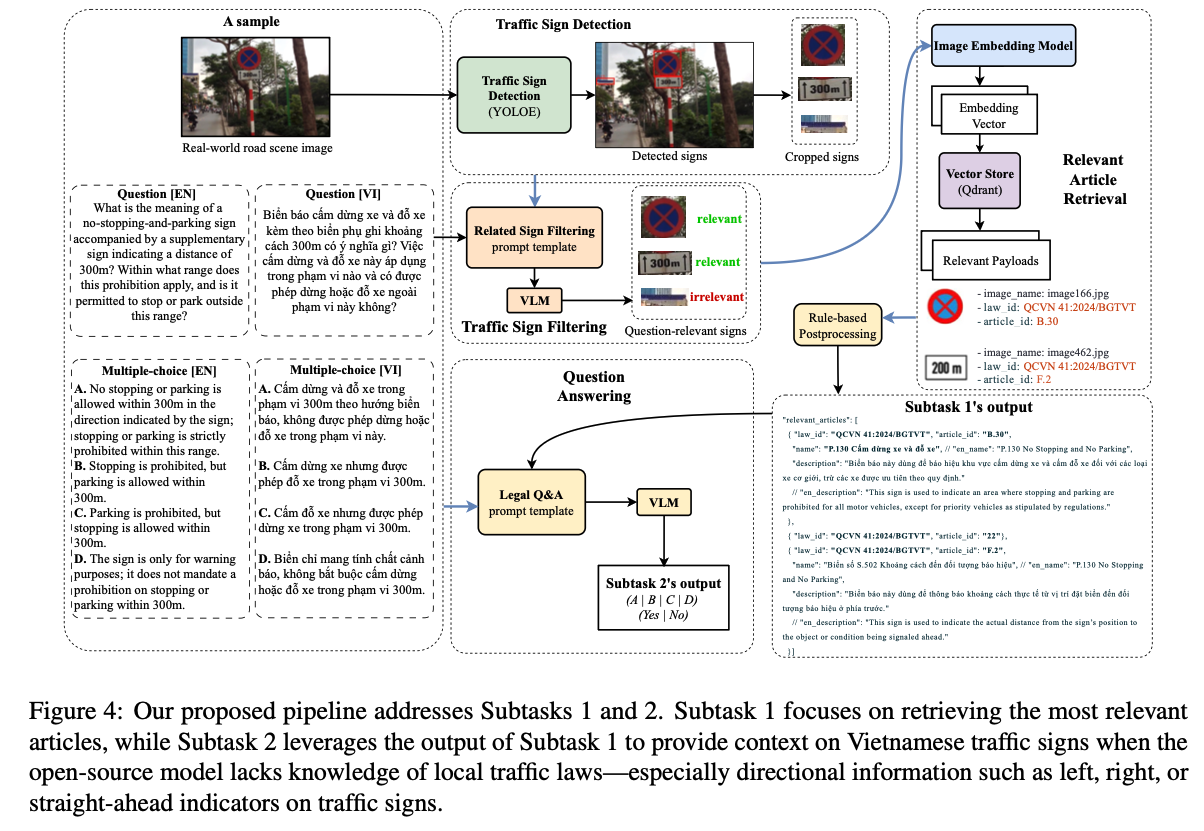
Identify relevant legal articles from Vietnamese traffic law documents given a query image and question.
Answer multiple-choice and yes/no questions about traffic signs and regulations.
The system processes two primary Vietnamese legal documents:
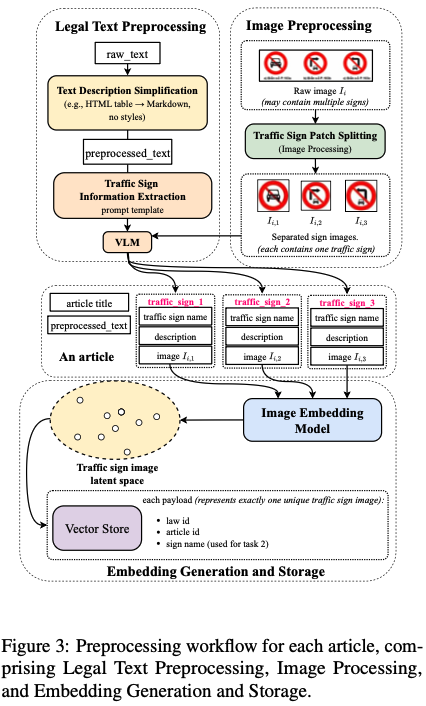
LexiSignVQA is a unified, training-free, multi-stage framework that combines:
YOLOE and GroundingDINO for detecting signs in real-world scenesSigLIP2 and CLIP models for semantic representationGemma-3-12B for sign filtering and question answeringQdrant for efficient retrieval of legal articlesThe system processes both clean legal database images and real-world road scenes through distinct pipelines optimized for each context.
Clone the repository
git clone [email protected]:phungpx/LexiSignVQA.git
cd LexiSignVQA
Create virtual environment
# Using uv (recommended)
uv venv
source .venv/bin/activate  # On Windows: .venv\Scripts\activate

# Or using standard Python
python -m venv .venv
source .venv/bin/activate
Install dependencies
uv pip install -e .
# Or: pip install -e .
Start Qdrant vector database
docker-compose up -d
Qdrant dashboard will be available at http://localhost:6333/dashboard
Configure environment variables
Create a .env file in the project root:
# LLM Configuration
LLM_API_KEYS=your_api_key_here
LLM_BASE_URL=https://generativelanguage.googleapis.com/v1beta/openai/
LLM_MODEL=gemma-3-12b-it

# Embedding Model
EMBEDDING_NAME=CLIP-GmP-ViT-L-14

# Detection Models
IMAGE_LAWDB_DETECTION_MODEL=ImageProcessing
IMAGE_QUERY_DETECTION_MODEL=YoloE

# Qdrant
QDRANT_URI=http://localhost:6333

# HuggingFace (optional, for gated models)
HUGGINGFACE_TOKEN=your_hf_token_here
For running Gemma-3-12B locally with llama.cpp:
Build llama.cpp with CUDA support
git clone https://github.com/ggerganov/llama.cpp
cd llama.cpp
cmake -B build -DGGML_CUDA=ON -DLLAMA_CURL=OFF
cmake --build build --config Release -j -t llama-server
Download model weights
# Download from HuggingFace
mkdir -p weights
cd weights
wget https://huggingface.co/google/gemma-3-12b-it-qat-q4_0-gguf/resolve/main/gemma-3-12b-it-Q4_K_M.gguf
wget https://huggingface.co/google/gemma-3-12b-it-qat-q4_0-gguf/resolve/main/mmproj-BF16.gguf
Start the server
CUDA_VISIBLE_DEVICES=0 ./build/bin/llama-server \
  --model weights/gemma-3-12b-it-Q4_K_M.gguf \
  --mmproj weights/mmproj-BF16.gguf \
  --gpu-layers 99 \
  --seed 3407 \
  --ctx-size 5000 \
  --port 18989 \
  --flash-attn \
  --threads 16
Update .env to use local server
LLM_BASE_URL=http://localhost:18989/v1
Run the entire pipeline using the Makefile:
# Setup (first time only)
make setup

# Process legal database
make lawdb

# Run both subtasks on training data
make task1-train
make task2-train

# Or run complete pipeline at once
make pipeline-train
Process the legal document corpus and build the vector database:
# Step 1: Extract article information
python -m src.core.lawdb.preprocess_lawdb_infos

# Step 2: Extract traffic sign images
python -m src.core.lawdb.extract_lawdb_sign_images

# Step 3: Parse sign metadata
python -m src.core.lawdb.parse_lawdb_sign_infos

# Step 4: Ingest into vector database
python -m src.core.lawdb.ingest_lawdb_signs
Or run all steps together:
bash src/core/lawdb/run_lawdb.sh
Run article retrieval on different datasets:
# Training set
python -m src.core.sub_task_1 --set_name train --batch_size 10

# Public test set
python -m src.core.sub_task_1 --set_name public_test --batch_size 10

# Private test set
python -m src.core.sub_task_1 --set_name private_test --batch_size 10
Arguments:
--set_name: Dataset split (train, public_test, private_test)--batch_size: Number of signs to process per LLM call (default: 10)--begin_idx: Starting sample index for resuming (default: 0)--log_level: Logging verbosity (DEBUG, INFO, WARNING, ERROR)Generate answers for the questions:
# Training set
python -m src.core.sub_task_2 --set_name train

# Public test set
python -m src.core.sub_task_2 --set_name public_test

# Private test set
python -m src.core.sub_task_2 --set_name private_test
Output will be saved to:
data/train_data/vlsp_2025_train_preprocessed_*.jsondata/public_test/vlsp_2025_public_test_task1_preprocessed_*.jsondata/private_test/submission_task2.jsonEvaluate performance on the training set:
# Evaluate Subtask 1 (Article Retrieval)
python -m src.eval.sub_task_1

# Evaluate Subtask 2 (Answer Generation)
python -m src.eval.sub_task_2
Explore and debug the system using Streamlit interfaces:
# Inspect legal database
make ui-inspect
# Or: streamlit run src/ui/inspect_lawdb.py

# Review Subtask 1 predictions
make ui-inspect-task1
# Or: streamlit run src/ui/inspect_subtask1.py

# Annotation interface
make ui-label
# Or: streamlit run src/ui/label_app.py
We conducted ablation studies on detection method and embedding model combinations. All experiments use Gemma-3-12B-IT for sign filtering.
| Exp | LawDB Detection | Query Detection | Embedding Model | Precision | Recall | F2-Score |
|---|---|---|---|---|---|---|
| 1 | GroundingDINO | GroundingDINO | SigLIP2-SO400M | 0.5430 | 0.5463 | 0.5310 |
| 2 | GroundingDINO | YOLOE | SigLIP2-SO400M | 0.5235 | 0.5733 | 0.5445 |
| 3 | ImageProcessing | YOLOE | SigLIP2-SO400M | 0.5049 | 0.5543 | 0.5259 |
| 4 | ImageProcessing | YOLOE | CLIP-GmP-ViT-L | 0.5416 | 0.5959 | 0.5655 |
Key Findings:
Performance on the training set (530 samples) using the best Subtask 1 configuration:
| Metric | Value |
|---|---|
| Overall Accuracy | 73.02% (387/530) |
| Multiple Choice Accuracy | 73.14% (275/376) |
| Yes/No Accuracy | 72.73% (112/154) |
Per-Choice Breakdown:
| Choice | Count | Correct | Accuracy |
|---|---|---|---|
| A | 115 | 87 | 75.65% |
| B | 103 | 81 | 78.64% |
| C | 84 | 60 | 71.43% |
| D | 74 | 47 | 63.51% |
| Đúng | 75 | 58 | 77.33% |
| Sai | 79 | 54 | 68.35% |
Observations:
LexiSignVQA/
│
├── data/                                   # Datasets and processed outputs
│   ├── law_db/                             # Legal document database
│   │   ├── vlsp2025_law_new.json           # Original legal corpus
│   │   ├── images.fld/                     # Article images
│   │   ├── signs_imageprocessing/          # Extracted signs (image processing)
│   │   ├── signs_groundingdino/            # Extracted signs (GroundingDINO)
│   │   └── *_preprocessed*.json            # Processed database files
│   │
│   ├── train_data/                         # Training dataset
│   │   ├── vlsp_2025_train.json            # Original training data
│   │   ├── train_images/                   # Training images
│   │   ├── train_signs_yoloe/              # Detected signs (YOLOE)
│   │   └── *_preprocessed*.json            # Preprocessed training outputs
│   │
│   ├── public_test/                        # Public test dataset
│   │   ├── vlsp_2025_public_test_task1.json
│   │   └── public_test_images/
│   │
│   └── private_test/                       # Private test dataset (for submission)
│       ├── vlsp2025_submission_task1.json
│       └── private_test_images/
│
├── src/                                    # Source code
│   ├── core/                               # Core pipeline modules
│   │   ├── lawdb/                          # Legal database processing
│   │   │   ├── preprocess_lawdb_infos.py   # Extract article information
│   │   │   ├── extract_lawdb_sign_images.py# Extract sign images
│   │   │   ├── parse_lawdb_sign_infos.py   # Parse sign metadata
│   │   │   ├── ingest_lawdb_signs.py       # Ingest into vector DB
│   │   │   └── run_lawdb.sh                # Complete pipeline script
│   │   │
│   │   ├── sub_task_1.py                   # Article retrieval pipeline
│   │   ├── sub_task_2.py                   # Answer generation pipeline
│   │   ├── extract_signs.py                # Traffic sign extraction
│   │   ├── filter_signs.py                 # LLM-based sign filtering
│   │   ├── query_signs.py                  # Vector similarity search
│   │   └── utils.py                        # Utility functions
│   │
│   ├── deps/                               # External dependencies
│   │   ├── detection/                      # Detection model wrappers
│   │   │   ├── base.py                     # Base detector interface
│   │   │   ├── groundingdino.py            # GroundingDINO wrapper
│   │   │   ├── yoloe.py                    # YOLOE wrapper
│   │   │   └── image_processing.py         # Classical CV methods
│   │   │
│   │   ├── embeddings.py                   # Vision encoder wrappers
│   │   ├── llm_client.py                   # LLM API client
│   │   └── qdrant.py                       # Vector database client
│   │
│   ├── prompts/                            # Prompt templates
│   │   ├── answer_prompt.py                # Answer generation prompts
│   │   ├── parse_signs_prompt.py           # Sign parsing prompts
│   │   └── sign_filter_prompt.py           # Sign filtering prompts
│   │
│   ├── eval/                               # Evaluation scripts
│   │   ├── sub_task_1.py                   # Subtask 1 evaluation
│   │   └── sub_task_2.py                   # Subtask 2 evaluation
│   │
│   ├── ui/                                 # Interactive interfaces
│   │   ├── inspect_lawdb.py                # Legal DB inspector
│   │   ├── inspect_subtask1.py             # Subtask 1 inspector
│   │   └── label_app.py                    # Annotation tool
│   │
│   ├── settings.py                         # Configuration management
│   └── constants.py                        # Global constants
│
├── models/                                 # Pre-trained model weights
│   └── yoloe-v8l-seg.pt                    # YOLOE-Large segmentation
│
├── notebook/                               # Jupyter notebooks
│   ├── explore.ipynb                       # Data exploration
│   ├── preprocess.ipynb                    # Preprocessing experiments
│   ├── embed.ipynb                         # Embedding analysis
│   └── yoloe.ipynb                         # Detection experiments
│
├── docs/                                   # Documentation
│   ├── papers/
│   │   ├── LexiSignVQA.pdf                 # Main paper
│   │   └── LexiSignVQA_Supplemental_materials.pdf
│   ├── subtask1.png                        # Task illustrations
│   ├── subtask2.png
│   └── lawdb.png
│
├── .env.example                            # Environment template
├── .gitignore                              # Git ignore patterns
├── docker-compose.yaml                     # Docker services definition
├── Makefile                                # Build automation
├── pyproject.toml                          # Python project metadata
└── README.md                               # This file
System configuration is managed through src/settings.py and environment variables.
See .env.example for a complete template. Key variables:
# LLM Configuration
LLM_API_KEYS=key1,key2,key3              # Comma-separated API keys (for rotation)
LLM_BASE_URL=https://api.provider.com/   # API endpoint
LLM_MODEL=gemma-3-12b-it                 # Model identifier
LLM_TEMPERATURE=0.0                      # Sampling temperature (0 = deterministic)
LLM_MAX_NEW_TOKENS=5000                  # Maximum output length

# Embedding Configuration
EMBEDDING_NAME=CLIP-GmP-ViT-L-14         # Vision encoder
# Options: CLIP-GmP-ViT-L-14, siglip2-so400m-patch14-384,
#          siglip2-base-patch16-384, dinov2-with-registers-large

# Detection Configuration
IMAGE_LAWDB_DETECTION_MODEL=ImageProcessing  # For clean legal images
IMAGE_QUERY_DETECTION_MODEL=YoloE            # For real-world query images
# Options: ImageProcessing, GroundingDINO, YoloE

# Vector Database
QDRANT_URI=http://localhost:6333
COLLECTION_NAME=auto                     # Auto-generated from other settings

# Retrieval Configuration
LIMIT=1                                  # Top-K articles to retrieve

# Optional: HuggingFace Token (for gated models)
HUGGINGFACE_TOKEN=your_token_here
Detection Models:
ImageProcessing: Classical CV (color/shape filtering) - best for clean imagesGroundingDINO: Zero-shot object detection - balanced performanceYoloE: YOLOE-Large Segmentation - best for real-world imagesEmbedding Models:
CLIP-GmP-ViT-L-14: 768-dim, 427M params - recommendedsiglip2-so400m-patch14-384: 1152-dim, 1.1B paramssiglip2-base-patch16-384: 768-dim, 375M paramssiglip2-large-patch16-384: 1024-dim, 882M paramsdinov2-with-registers-large: 1024-dim - self-supervisedLLM Models:
gemma-3-12b-it: Google's instruction-tuned multimodal model - recommendedAll models were deployed on dual NVIDIA RTX 3060 GPUs, each with 12GB of memory, ensuring efficient inference and reliable reproducibility
See pyproject.toml for complete dependency list.
To exactly reproduce our VLSP 2025 submission results:
Use the same configuration (Experiment 4 from results table):
export LLM_MODEL=gemma-3-12b-it
export IMAGE_LAWDB_DETECTION_MODEL=ImageProcessing
export IMAGE_QUERY_DETECTION_MODEL=YoloE
export EMBEDDING_NAME=CLIP-GmP-ViT-L-14
Set deterministic seeds:
The codebase uses fixed random seeds (e.g., seed=3407 for LLM server)
Run the complete pipeline:
make pipeline-train
Evaluate:
python -m src.eval.sub_task_1
python -m src.eval.sub_task_2
Input Sample (data/train_data/vlsp_2025_train.json):
{
  "id": "train_001",
  "image_id": "IMG_001",
  "relevant_articles": [
    {
      "law_id": "QCVN 41:2024/BGTVT",
      "article_id": "22"
    }
  ],
  "question_type": "Multiple choice",
  "question": "Biển báo này có ý nghĩa gì?",
  "choices": [
    "A. Cấm rẽ trái",
    "B. Cấm rẽ phải",
    "C. Cấm quay đầu xe",
    "D. Cấm dừng và đỗ xe"
  ],
  "answer": "A"
}
Preprocessed Output (includes detection and retrieval results):
{
  "id": "train_001",
  "image_id": "IMG_001",
  "detected_signs": [
    {
      "image_name": "IMG_001_sign_0.png",
      "bbox": [100, 200, 300, 400],
      "confidence": 0.95,
      "is_chosen": true
    }
  ],
  "retrieved_articles": [
    {
      "law_id": "QCVN 41:2024/BGTVT",
      "article_id": "22",
      "score": 0.89
    }
  ],
  "predict": "A",
  "answer_explanation": "Based on the retrieved article...",
  "time_second": 2.34
}
If you use LexiSignVQA in your research, please cite:
@inproceedings{lexisignvqa2025,
  title={LexiSignVQA: A Unified Training-free Multi-stage Approach to Multimodal Legal Question Answering on Traffic Sign Rules},
  author={Phung Xuan Pham, Duc Quang Le, Tuan Hau Tran, Thinh Nguyen-Truong Huynh},
  booktitle={Proceedings of INLG},
  year={2025},
}
Dataset License: The VLSP 2025 MLQA-TSR dataset is provided by the VLSP organizers. Please refer to the official challenge website for dataset usage terms.
LexiSignVQA: A Unified Training-free Multi-stage Approach to Multimodal Legal Question Answering on Traffic Sign Rules
Jupyter Notebook
24
9 commits
updated Nov 18, 2025
The task of multimodal legal question answering on traffic sign rules (MLQA-TSR) presents unique challenges due to the need for jointly interpreting visual and textual information in regulatory contexts. In this work, we propose LexiSignVQA, a unified, training-free, multi-stage approach developed for the VLSP 2025 MLQA-TSR shared task. Our approach integrates traffic sign detection, image embedding, and vision–language modeling with a structured preprocessing procedure that aligns traffic sign images with their corresponding legal provisions.
By combining simple yet effective image processing for clean legal databases with traffic sign detection models for real-world scenarios, our method achieves both efficiency and robustness. Experimental results on the MLQA-TSR dataset demonstrate that LexiSignVQA ranked 1st in multimodal retrieval (Subtask 1) and 7th in legal question answering (Subtask 2). Furthermore, our analysis reveals the complementary strengths of conventional segmentation versus learning-based detection and highlights the role of embeddings in addressing directional reasoning in traffic signs. These findings underscore the potential of hybrid, training-free frameworks for advancing multimodal legal reasoning and practical applications in traffic law compliance.
The VLSP 2025 Multimodal Legal Question Answering on Traffic Sign Rules challenge consists of two interconnected subtasks:
Identify relevant legal articles from Vietnamese traffic law documents given a query image and question.
Answer multiple-choice and yes/no questions about traffic signs and regulations.
The system processes two primary Vietnamese legal documents:
LexiSignVQA is a unified, training-free, multi-stage framework that combines:
YOLOE and GroundingDINO for detecting signs in real-world scenesSigLIP2 and CLIP models for semantic representationGemma-3-12B for sign filtering and question answeringQdrant for efficient retrieval of legal articlesThe system processes both clean legal database images and real-world road scenes through distinct pipelines optimized for each context.
Clone the repository
git clone [email protected]:phungpx/LexiSignVQA.git
cd LexiSignVQA
Create virtual environment
# Using uv (recommended)
uv venv
source .venv/bin/activate  # On Windows: .venv\Scripts\activate

# Or using standard Python
python -m venv .venv
source .venv/bin/activate
Install dependencies
uv pip install -e .
# Or: pip install -e .
Start Qdrant vector database
docker-compose up -d
Qdrant dashboard will be available at http://localhost:6333/dashboard
Configure environment variables
Create a .env file in the project root:
# LLM Configuration
LLM_API_KEYS=your_api_key_here
LLM_BASE_URL=https://generativelanguage.googleapis.com/v1beta/openai/
LLM_MODEL=gemma-3-12b-it

# Embedding Model
EMBEDDING_NAME=CLIP-GmP-ViT-L-14

# Detection Models
IMAGE_LAWDB_DETECTION_MODEL=ImageProcessing
IMAGE_QUERY_DETECTION_MODEL=YoloE

# Qdrant
QDRANT_URI=http://localhost:6333

# HuggingFace (optional, for gated models)
HUGGINGFACE_TOKEN=your_hf_token_here
For running Gemma-3-12B locally with llama.cpp:
Build llama.cpp with CUDA support
git clone https://github.com/ggerganov/llama.cpp
cd llama.cpp
cmake -B build -DGGML_CUDA=ON -DLLAMA_CURL=OFF
cmake --build build --config Release -j -t llama-server
Download model weights
# Download from HuggingFace
mkdir -p weights
cd weights
wget https://huggingface.co/google/gemma-3-12b-it-qat-q4_0-gguf/resolve/main/gemma-3-12b-it-Q4_K_M.gguf
wget https://huggingface.co/google/gemma-3-12b-it-qat-q4_0-gguf/resolve/main/mmproj-BF16.gguf
Start the server
CUDA_VISIBLE_DEVICES=0 ./build/bin/llama-server \
  --model weights/gemma-3-12b-it-Q4_K_M.gguf \
  --mmproj weights/mmproj-BF16.gguf \
  --gpu-layers 99 \
  --seed 3407 \
  --ctx-size 5000 \
  --port 18989 \
  --flash-attn \
  --threads 16
Update .env to use local server
LLM_BASE_URL=http://localhost:18989/v1
Run the entire pipeline using the Makefile:
# Setup (first time only)
make setup

# Process legal database
make lawdb

# Run both subtasks on training data
make task1-train
make task2-train

# Or run complete pipeline at once
make pipeline-train
Process the legal document corpus and build the vector database:
# Step 1: Extract article information
python -m src.core.lawdb.preprocess_lawdb_infos

# Step 2: Extract traffic sign images
python -m src.core.lawdb.extract_lawdb_sign_images

# Step 3: Parse sign metadata
python -m src.core.lawdb.parse_lawdb_sign_infos

# Step 4: Ingest into vector database
python -m src.core.lawdb.ingest_lawdb_signs
Or run all steps together:
bash src/core/lawdb/run_lawdb.sh
Run article retrieval on different datasets:
# Training set
python -m src.core.sub_task_1 --set_name train --batch_size 10

# Public test set
python -m src.core.sub_task_1 --set_name public_test --batch_size 10

# Private test set
python -m src.core.sub_task_1 --set_name private_test --batch_size 10
Arguments:
--set_name: Dataset split (train, public_test, private_test)--batch_size: Number of signs to process per LLM call (default: 10)--begin_idx: Starting sample index for resuming (default: 0)--log_level: Logging verbosity (DEBUG, INFO, WARNING, ERROR)Generate answers for the questions:
# Training set
python -m src.core.sub_task_2 --set_name train

# Public test set
python -m src.core.sub_task_2 --set_name public_test

# Private test set
python -m src.core.sub_task_2 --set_name private_test
Output will be saved to:
data/train_data/vlsp_2025_train_preprocessed_*.jsondata/public_test/vlsp_2025_public_test_task1_preprocessed_*.jsondata/private_test/submission_task2.jsonEvaluate performance on the training set:
# Evaluate Subtask 1 (Article Retrieval)
python -m src.eval.sub_task_1

# Evaluate Subtask 2 (Answer Generation)
python -m src.eval.sub_task_2
Explore and debug the system using Streamlit interfaces:
# Inspect legal database
make ui-inspect
# Or: streamlit run src/ui/inspect_lawdb.py

# Review Subtask 1 predictions
make ui-inspect-task1
# Or: streamlit run src/ui/inspect_subtask1.py

# Annotation interface
make ui-label
# Or: streamlit run src/ui/label_app.py
We conducted ablation studies on detection method and embedding model combinations. All experiments use Gemma-3-12B-IT for sign filtering.
| Exp | LawDB Detection | Query Detection | Embedding Model | Precision | Recall | F2-Score |
|---|---|---|---|---|---|---|
| 1 | GroundingDINO | GroundingDINO | SigLIP2-SO400M | 0.5430 | 0.5463 | 0.5310 |
| 2 | GroundingDINO | YOLOE | SigLIP2-SO400M | 0.5235 | 0.5733 | 0.5445 |
| 3 | ImageProcessing | YOLOE | SigLIP2-SO400M | 0.5049 | 0.5543 | 0.5259 |
| 4 | ImageProcessing | YOLOE | CLIP-GmP-ViT-L | 0.5416 | 0.5959 | 0.5655 |
Key Findings:
Performance on the training set (530 samples) using the best Subtask 1 configuration:
| Metric | Value |
|---|---|
| Overall Accuracy | 73.02% (387/530) |
| Multiple Choice Accuracy | 73.14% (275/376) |
| Yes/No Accuracy | 72.73% (112/154) |
Per-Choice Breakdown:
| Choice | Count | Correct | Accuracy |
|---|---|---|---|
| A | 115 | 87 | 75.65% |
| B | 103 | 81 | 78.64% |
| C | 84 | 60 | 71.43% |
| D | 74 | 47 | 63.51% |
| Đúng | 75 | 58 | 77.33% |
| Sai | 79 | 54 | 68.35% |
Observations:
LexiSignVQA/
│
├── data/                                   # Datasets and processed outputs
│   ├── law_db/                             # Legal document database
│   │   ├── vlsp2025_law_new.json           # Original legal corpus
│   │   ├── images.fld/                     # Article images
│   │   ├── signs_imageprocessing/          # Extracted signs (image processing)
│   │   ├── signs_groundingdino/            # Extracted signs (GroundingDINO)
│   │   └── *_preprocessed*.json            # Processed database files
│   │
│   ├── train_data/                         # Training dataset
│   │   ├── vlsp_2025_train.json            # Original training data
│   │   ├── train_images/                   # Training images
│   │   ├── train_signs_yoloe/              # Detected signs (YOLOE)
│   │   └── *_preprocessed*.json            # Preprocessed training outputs
│   │
│   ├── public_test/                        # Public test dataset
│   │   ├── vlsp_2025_public_test_task1.json
│   │   └── public_test_images/
│   │
│   └── private_test/                       # Private test dataset (for submission)
│       ├── vlsp2025_submission_task1.json
│       └── private_test_images/
│
├── src/                                    # Source code
│   ├── core/                               # Core pipeline modules
│   │   ├── lawdb/                          # Legal database processing
│   │   │   ├── preprocess_lawdb_infos.py   # Extract article information
│   │   │   ├── extract_lawdb_sign_images.py# Extract sign images
│   │   │   ├── parse_lawdb_sign_infos.py   # Parse sign metadata
│   │   │   ├── ingest_lawdb_signs.py       # Ingest into vector DB
│   │   │   └── run_lawdb.sh                # Complete pipeline script
│   │   │
│   │   ├── sub_task_1.py                   # Article retrieval pipeline
│   │   ├── sub_task_2.py                   # Answer generation pipeline
│   │   ├── extract_signs.py                # Traffic sign extraction
│   │   ├── filter_signs.py                 # LLM-based sign filtering
│   │   ├── query_signs.py                  # Vector similarity search
│   │   └── utils.py                        # Utility functions
│   │
│   ├── deps/                               # External dependencies
│   │   ├── detection/                      # Detection model wrappers
│   │   │   ├── base.py                     # Base detector interface
│   │   │   ├── groundingdino.py            # GroundingDINO wrapper
│   │   │   ├── yoloe.py                    # YOLOE wrapper
│   │   │   └── image_processing.py         # Classical CV methods
│   │   │
│   │   ├── embeddings.py                   # Vision encoder wrappers
│   │   ├── llm_client.py                   # LLM API client
│   │   └── qdrant.py                       # Vector database client
│   │
│   ├── prompts/                            # Prompt templates
│   │   ├── answer_prompt.py                # Answer generation prompts
│   │   ├── parse_signs_prompt.py           # Sign parsing prompts
│   │   └── sign_filter_prompt.py           # Sign filtering prompts
│   │
│   ├── eval/                               # Evaluation scripts
│   │   ├── sub_task_1.py                   # Subtask 1 evaluation
│   │   └── sub_task_2.py                   # Subtask 2 evaluation
│   │
│   ├── ui/                                 # Interactive interfaces
│   │   ├── inspect_lawdb.py                # Legal DB inspector
│   │   ├── inspect_subtask1.py             # Subtask 1 inspector
│   │   └── label_app.py                    # Annotation tool
│   │
│   ├── settings.py                         # Configuration management
│   └── constants.py                        # Global constants
│
├── models/                                 # Pre-trained model weights
│   └── yoloe-v8l-seg.pt                    # YOLOE-Large segmentation
│
├── notebook/                               # Jupyter notebooks
│   ├── explore.ipynb                       # Data exploration
│   ├── preprocess.ipynb                    # Preprocessing experiments
│   ├── embed.ipynb                         # Embedding analysis
│   └── yoloe.ipynb                         # Detection experiments
│
├── docs/                                   # Documentation
│   ├── papers/
│   │   ├── LexiSignVQA.pdf                 # Main paper
│   │   └── LexiSignVQA_Supplemental_materials.pdf
│   ├── subtask1.png                        # Task illustrations
│   ├── subtask2.png
│   └── lawdb.png
│
├── .env.example                            # Environment template
├── .gitignore                              # Git ignore patterns
├── docker-compose.yaml                     # Docker services definition
├── Makefile                                # Build automation
├── pyproject.toml                          # Python project metadata
└── README.md                               # This file
System configuration is managed through src/settings.py and environment variables.
See .env.example for a complete template. Key variables:
# LLM Configuration
LLM_API_KEYS=key1,key2,key3              # Comma-separated API keys (for rotation)
LLM_BASE_URL=https://api.provider.com/   # API endpoint
LLM_MODEL=gemma-3-12b-it                 # Model identifier
LLM_TEMPERATURE=0.0                      # Sampling temperature (0 = deterministic)
LLM_MAX_NEW_TOKENS=5000                  # Maximum output length

# Embedding Configuration
EMBEDDING_NAME=CLIP-GmP-ViT-L-14         # Vision encoder
# Options: CLIP-GmP-ViT-L-14, siglip2-so400m-patch14-384,
#          siglip2-base-patch16-384, dinov2-with-registers-large

# Detection Configuration
IMAGE_LAWDB_DETECTION_MODEL=ImageProcessing  # For clean legal images
IMAGE_QUERY_DETECTION_MODEL=YoloE            # For real-world query images
# Options: ImageProcessing, GroundingDINO, YoloE

# Vector Database
QDRANT_URI=http://localhost:6333
COLLECTION_NAME=auto                     # Auto-generated from other settings

# Retrieval Configuration
LIMIT=1                                  # Top-K articles to retrieve

# Optional: HuggingFace Token (for gated models)
HUGGINGFACE_TOKEN=your_token_here
Detection Models:
ImageProcessing: Classical CV (color/shape filtering) - best for clean imagesGroundingDINO: Zero-shot object detection - balanced performanceYoloE: YOLOE-Large Segmentation - best for real-world imagesEmbedding Models:
CLIP-GmP-ViT-L-14: 768-dim, 427M params - recommendedsiglip2-so400m-patch14-384: 1152-dim, 1.1B paramssiglip2-base-patch16-384: 768-dim, 375M paramssiglip2-large-patch16-384: 1024-dim, 882M paramsdinov2-with-registers-large: 1024-dim - self-supervisedLLM Models:
gemma-3-12b-it: Google's instruction-tuned multimodal model - recommendedAll models were deployed on dual NVIDIA RTX 3060 GPUs, each with 12GB of memory, ensuring efficient inference and reliable reproducibility
See pyproject.toml for complete dependency list.
To exactly reproduce our VLSP 2025 submission results:
Use the same configuration (Experiment 4 from results table):
export LLM_MODEL=gemma-3-12b-it
export IMAGE_LAWDB_DETECTION_MODEL=ImageProcessing
export IMAGE_QUERY_DETECTION_MODEL=YoloE
export EMBEDDING_NAME=CLIP-GmP-ViT-L-14
Set deterministic seeds:
The codebase uses fixed random seeds (e.g., seed=3407 for LLM server)
Run the complete pipeline:
make pipeline-train
Evaluate:
python -m src.eval.sub_task_1
python -m src.eval.sub_task_2
Input Sample (data/train_data/vlsp_2025_train.json):
{
  "id": "train_001",
  "image_id": "IMG_001",
  "relevant_articles": [
    {
      "law_id": "QCVN 41:2024/BGTVT",
      "article_id": "22"
    }
  ],
  "question_type": "Multiple choice",
  "question": "Biển báo này có ý nghĩa gì?",
  "choices": [
    "A. Cấm rẽ trái",
    "B. Cấm rẽ phải",
    "C. Cấm quay đầu xe",
    "D. Cấm dừng và đỗ xe"
  ],
  "answer": "A"
}
Preprocessed Output (includes detection and retrieval results):
{
  "id": "train_001",
  "image_id": "IMG_001",
  "detected_signs": [
    {
      "image_name": "IMG_001_sign_0.png",
      "bbox": [100, 200, 300, 400],
      "confidence": 0.95,
      "is_chosen": true
    }
  ],
  "retrieved_articles": [
    {
      "law_id": "QCVN 41:2024/BGTVT",
      "article_id": "22",
      "score": 0.89
    }
  ],
  "predict": "A",
  "answer_explanation": "Based on the retrieved article...",
  "time_second": 2.34
}
If you use LexiSignVQA in your research, please cite:
@inproceedings{lexisignvqa2025,
  title={LexiSignVQA: A Unified Training-free Multi-stage Approach to Multimodal Legal Question Answering on Traffic Sign Rules},
  author={Phung Xuan Pham, Duc Quang Le, Tuan Hau Tran, Thinh Nguyen-Truong Huynh},
  booktitle={Proceedings of INLG},
  year={2025},
}
Dataset License: The VLSP 2025 MLQA-TSR dataset is provided by the VLSP organizers. Please refer to the official challenge website for dataset usage terms.



