Explorable graph between Wikidata entities based on connections
See the code
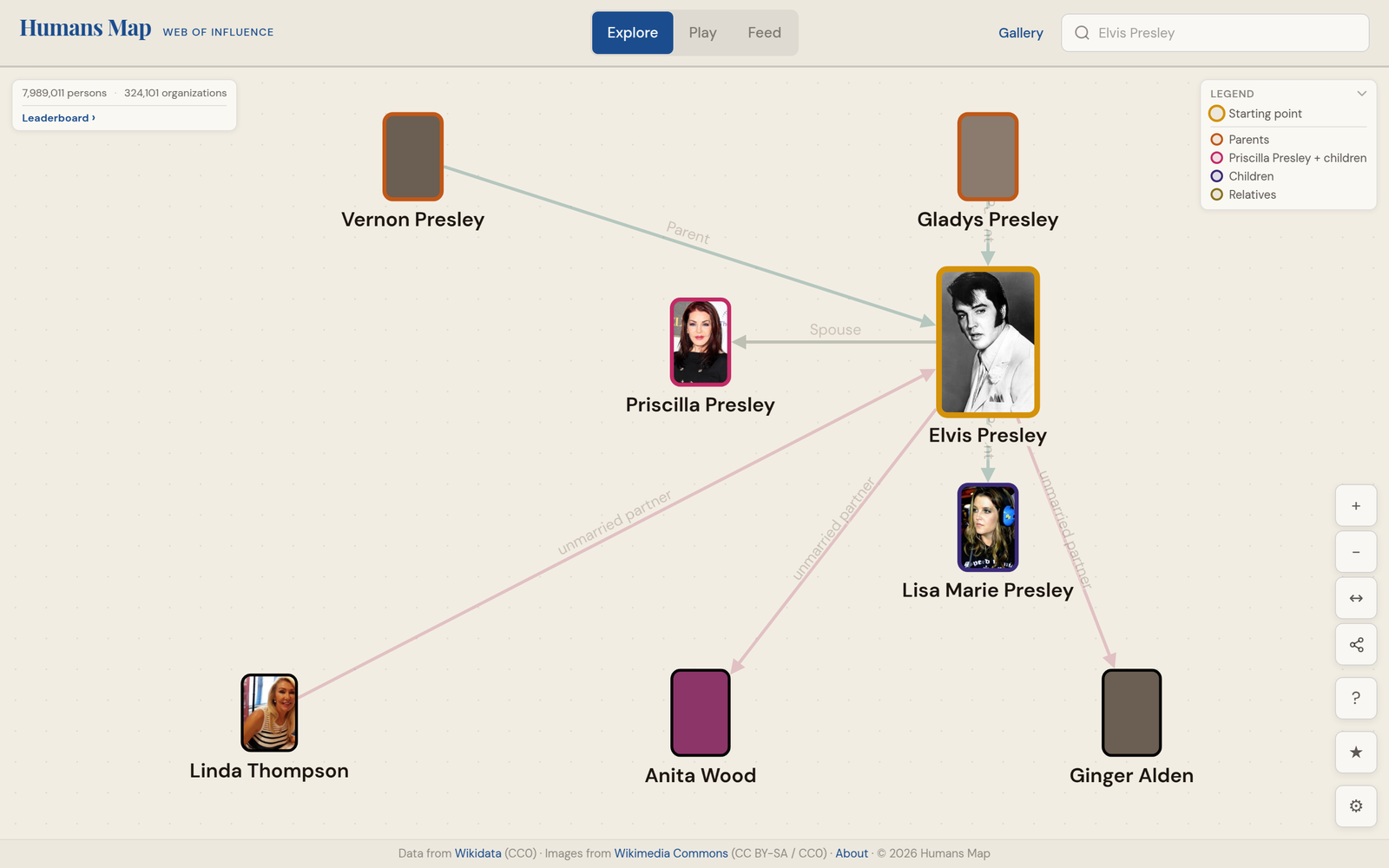
A knowledge graph for exploring connections between public figures — board seats, executive roles, ownership stakes, share transactions, institutional holdings.
Originally live at humansmap.com. The hosted service is being wound down; this repository is the permanent, open-source home of the project.
Three ways in:
Data comes from Wikidata (people, organizations, basic relations) and SEC EDGAR (DEF 14A directors, Form 3/4 ownership, 13F institutional holdings). Scope is global, with deeper SEC coverage for US-listed companies.
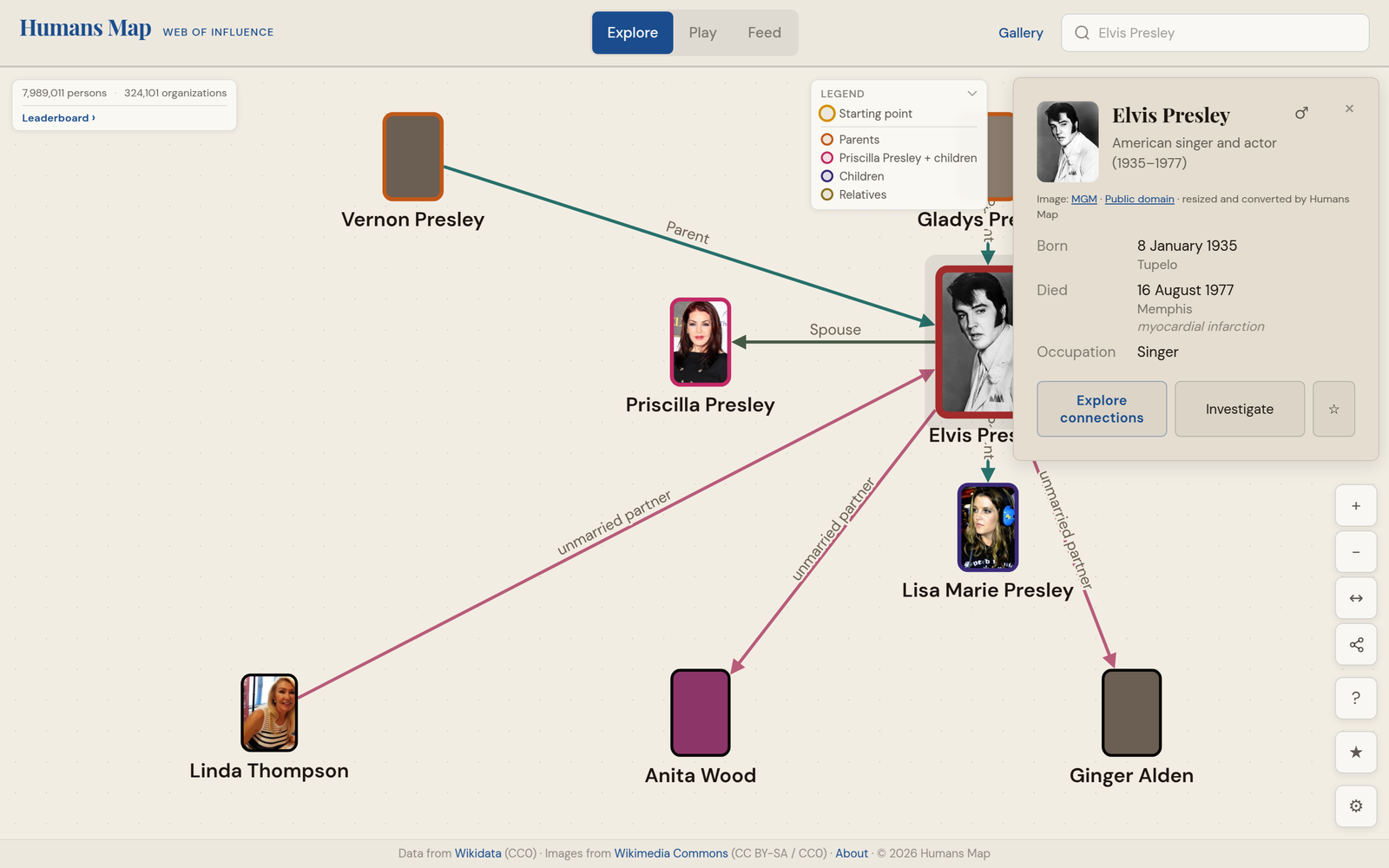
| Explore a network | Selected node detail |
|---|---|
 |  |
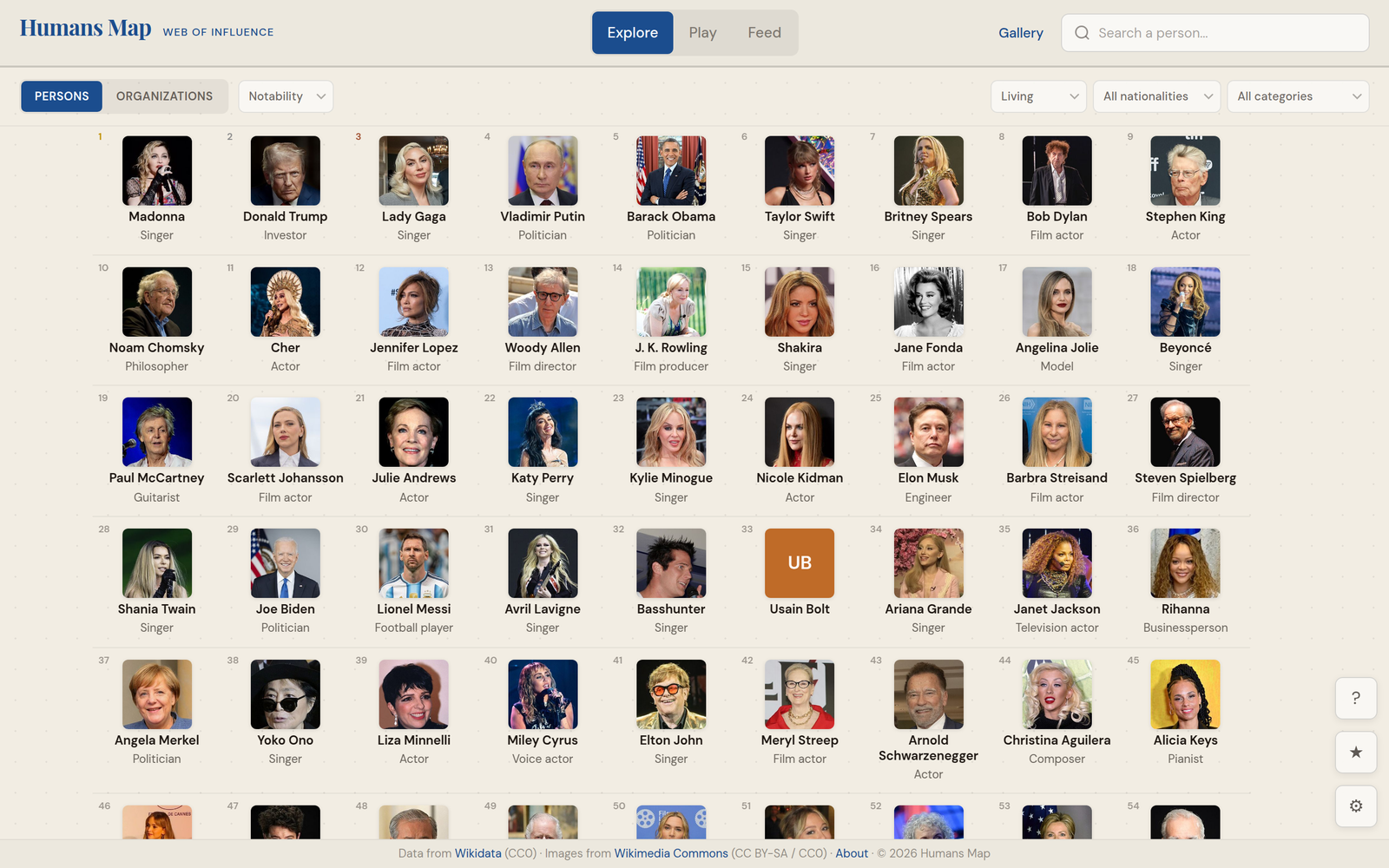
| Leaderboards | Play (trivia) | Feed |
|---|---|---|
 | 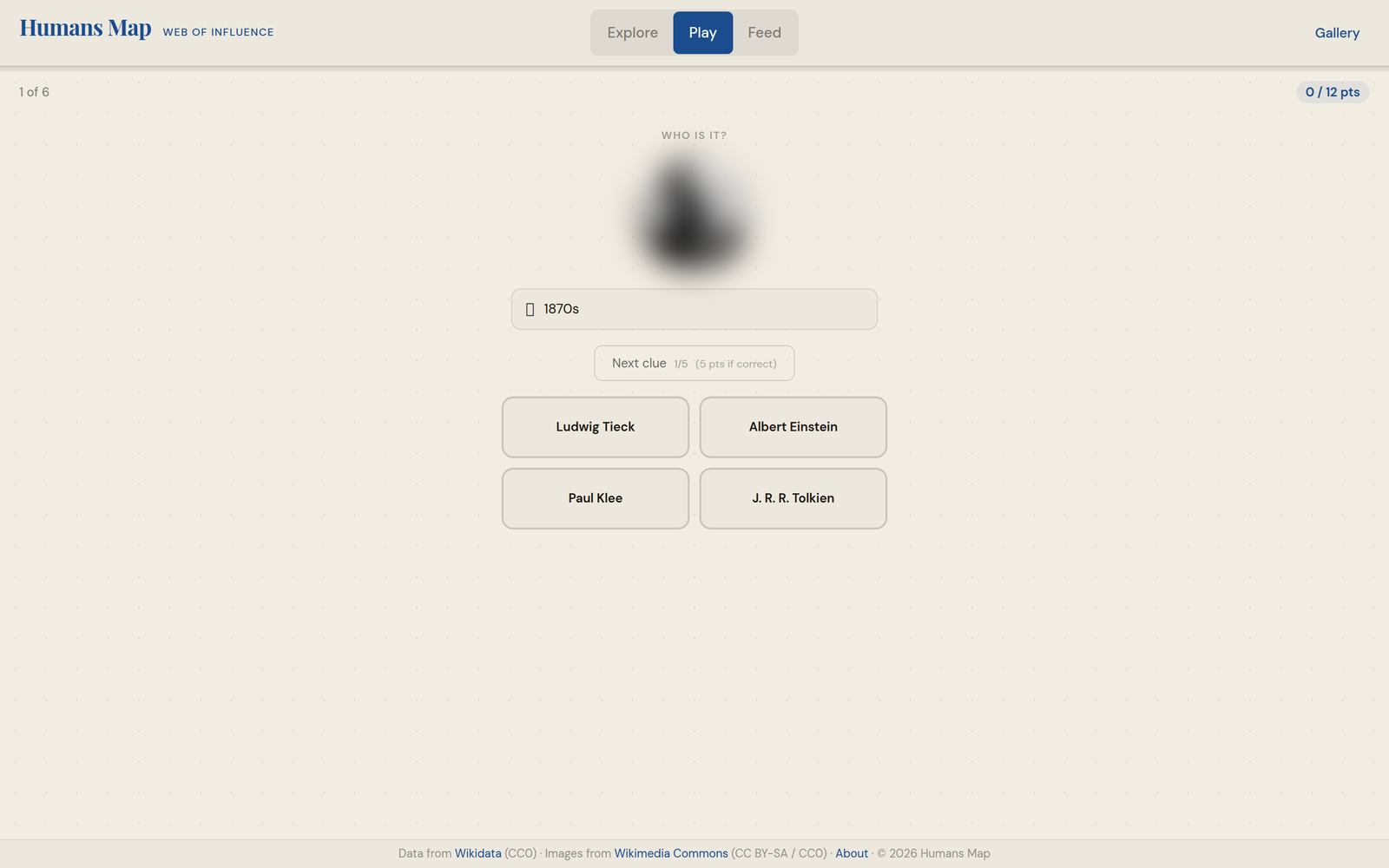 | 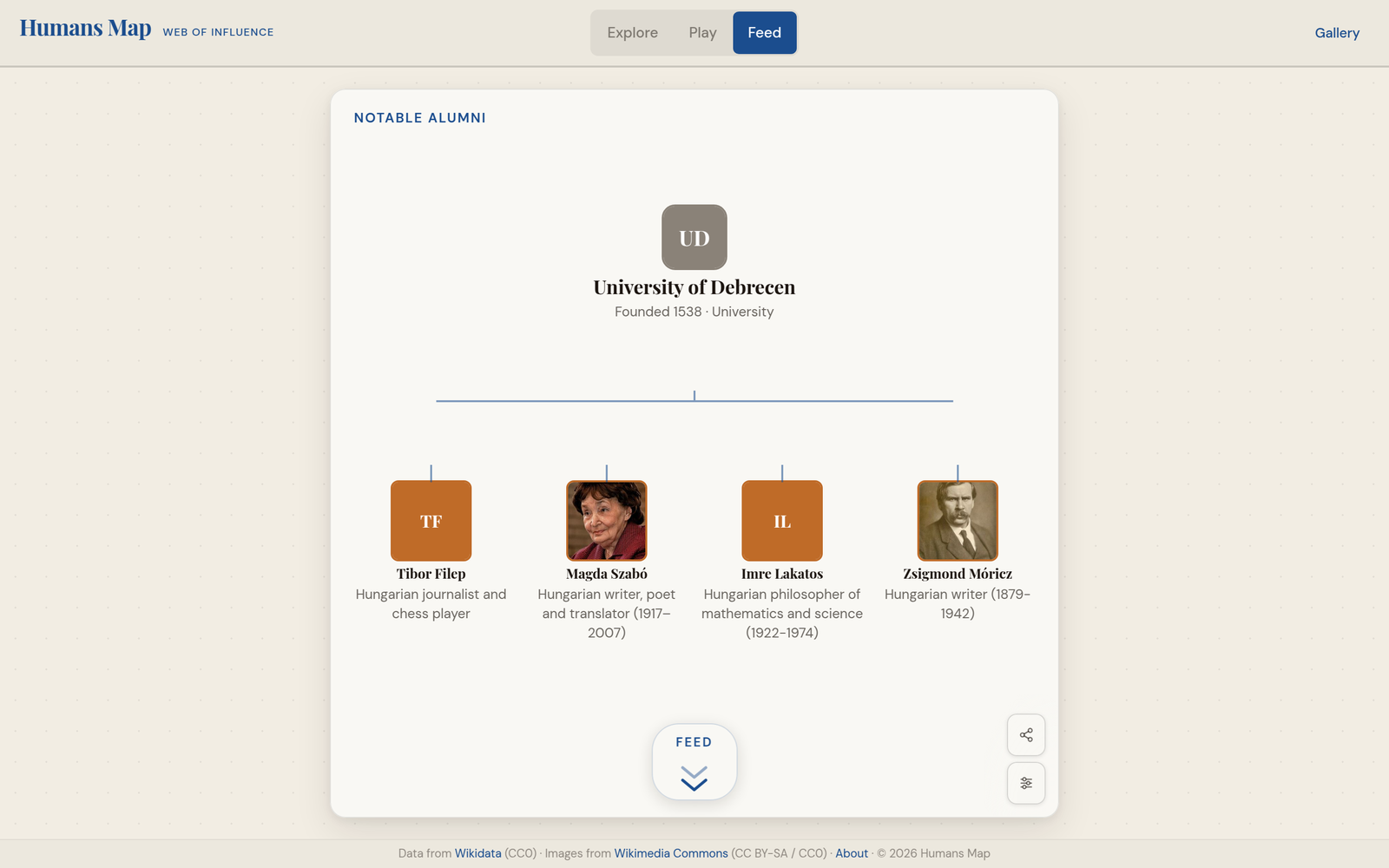 |
Flow recordings (WebM, captured with Playwright against the live service):
explore ·
feed ·
game. More in
docs/media/.
| Layer | Technology |
|---|---|
| Web server | Caddy 2 |
| Frontend | Vue 3 + Cytoscape.js + Vite |
| API | FastAPI + Uvicorn (Python 3.11) |
| Database | ArangoDB 3.11 (graph + search view) |
| Cache | Redis 7 (cache-aside, optional) |
| Orchestration | Docker Compose |
(from, to, type, property), so ingestion is idempotent. SEC filings are
joined to people through a CIK map (P5531) and a tiered name matcher.SHORTEST_PATH over a named
graph, and materialized leaderboards; Redis cache-aside with graceful
fallback when Redis is down.ARCHITECTURE.md has the full schema, API surface and data
flow.
The full graph needs a ~100 GB Wikidata dump. To make the project runnable without it, the repo ships a small real slice — ~50 real public figures and their relations, from Wikidata (CC0):
cp .env.example .env          # set ARANGO_PASSWORD and ARANGO_APP_PASSWORD
docker compose up -d --build

docker compose exec backend python scripts/seed_demo_data.py
docker compose exec redis redis-cli FLUSHDB
Open http://localhost. ArangoDB creates the database and restricted app_user
on first boot. See docs/DEMO.md.
docs/DEPLOYMENT.md.Wikidata is CC0; Wikimedia Commons images are cached only under reusable
licenses with attribution; SEC EDGAR filings are public-domain U.S. government
works used within SEC fair-access limits. See
THIRD_PARTY_NOTICES.md.
MIT — see LICENSE. Bug reports and contributions welcome
(CONTRIBUTING.md, SECURITY.md).
Explorable graph between Wikidata entities based on connections
See the code
A knowledge graph for exploring connections between public figures — board seats, executive roles, ownership stakes, share transactions, institutional holdings.
Originally live at humansmap.com. The hosted service is being wound down; this repository is the permanent, open-source home of the project.
Three ways in:
Data comes from Wikidata (people, organizations, basic relations) and SEC EDGAR (DEF 14A directors, Form 3/4 ownership, 13F institutional holdings). Scope is global, with deeper SEC coverage for US-listed companies.
| Explore a network | Selected node detail |
|---|---|
| |
| Leaderboards | Play (trivia) | Feed |
|---|---|---|
| | |
Flow recordings (WebM, captured with Playwright against the live service):
explore ·
feed ·
game. More in
docs/media/.
| Layer | Technology |
|---|---|
| Web server | Caddy 2 |
| Frontend | Vue 3 + Cytoscape.js + Vite |
| API | FastAPI + Uvicorn (Python 3.11) |
| Database | ArangoDB 3.11 (graph + search view) |
| Cache | Redis 7 (cache-aside, optional) |
| Orchestration | Docker Compose |
(from, to, type, property), so ingestion is idempotent. SEC filings are
joined to people through a CIK map (P5531) and a tiered name matcher.SHORTEST_PATH over a named
graph, and materialized leaderboards; Redis cache-aside with graceful
fallback when Redis is down.ARCHITECTURE.md has the full schema, API surface and data
flow.
The full graph needs a ~100 GB Wikidata dump. To make the project runnable without it, the repo ships a small real slice — ~50 real public figures and their relations, from Wikidata (CC0):
cp .env.example .env          # set ARANGO_PASSWORD and ARANGO_APP_PASSWORD
docker compose up -d --build

docker compose exec backend python scripts/seed_demo_data.py
docker compose exec redis redis-cli FLUSHDB
Open http://localhost. ArangoDB creates the database and restricted app_user
on first boot. See docs/DEMO.md.
docs/DEPLOYMENT.md.Wikidata is CC0; Wikimedia Commons images are cached only under reusable
licenses with attribution; SEC EDGAR filings are public-domain U.S. government
works used within SEC fair-access limits. See
THIRD_PARTY_NOTICES.md.
MIT — see LICENSE. Bug reports and contributions welcome
(CONTRIBUTING.md, SECURITY.md).



