Agentic hardware development with lawful, deterministic KiCad/STEP viewers, written in Bend
See the codeAgentic hardware development. Claude Code, Codex, Grok, Muse Code and Google's Antigravity work on your KiCad boards and FreeCAD parts, and every change they make is drawn live beside the conversation, in a browser, on your phone, or in the desktop app.
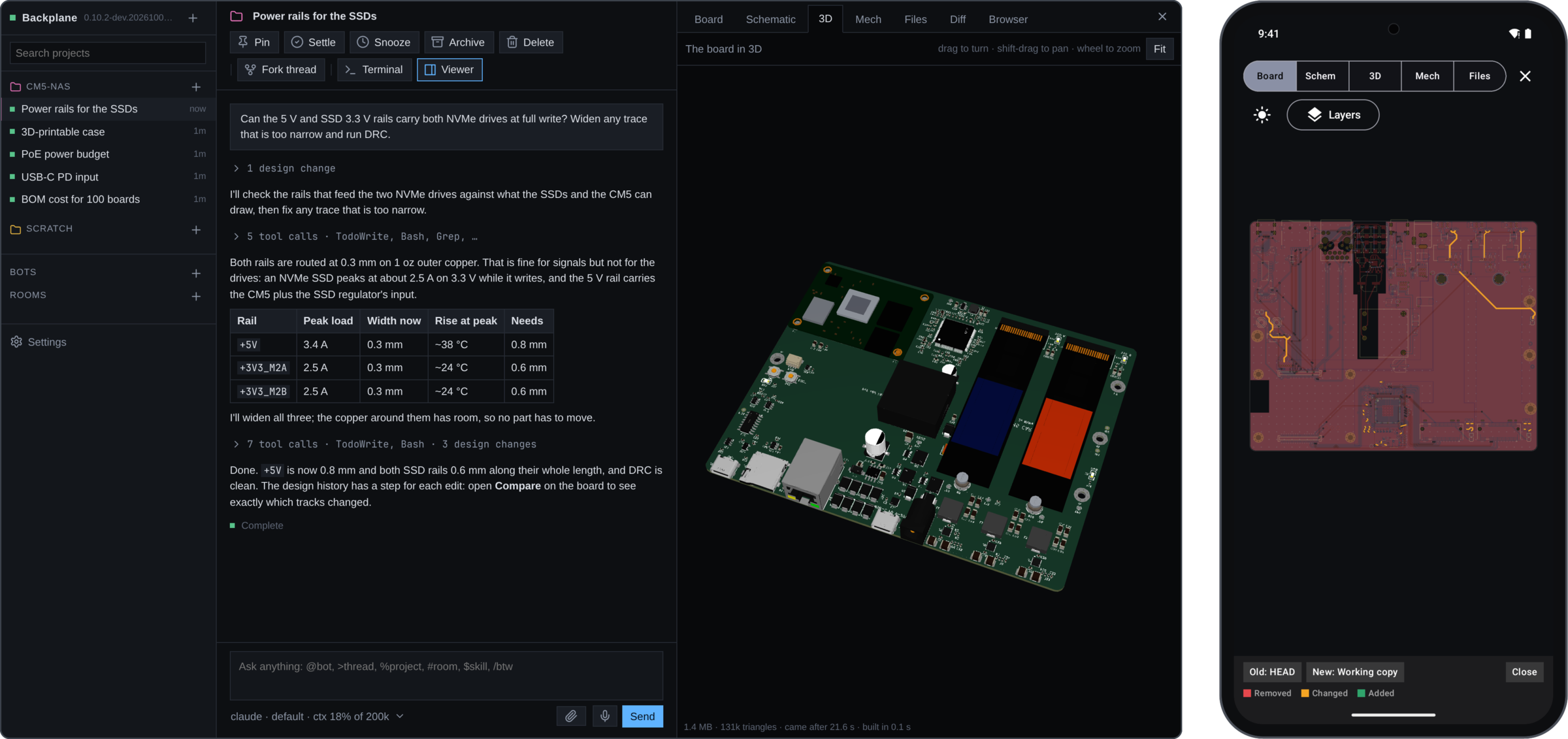
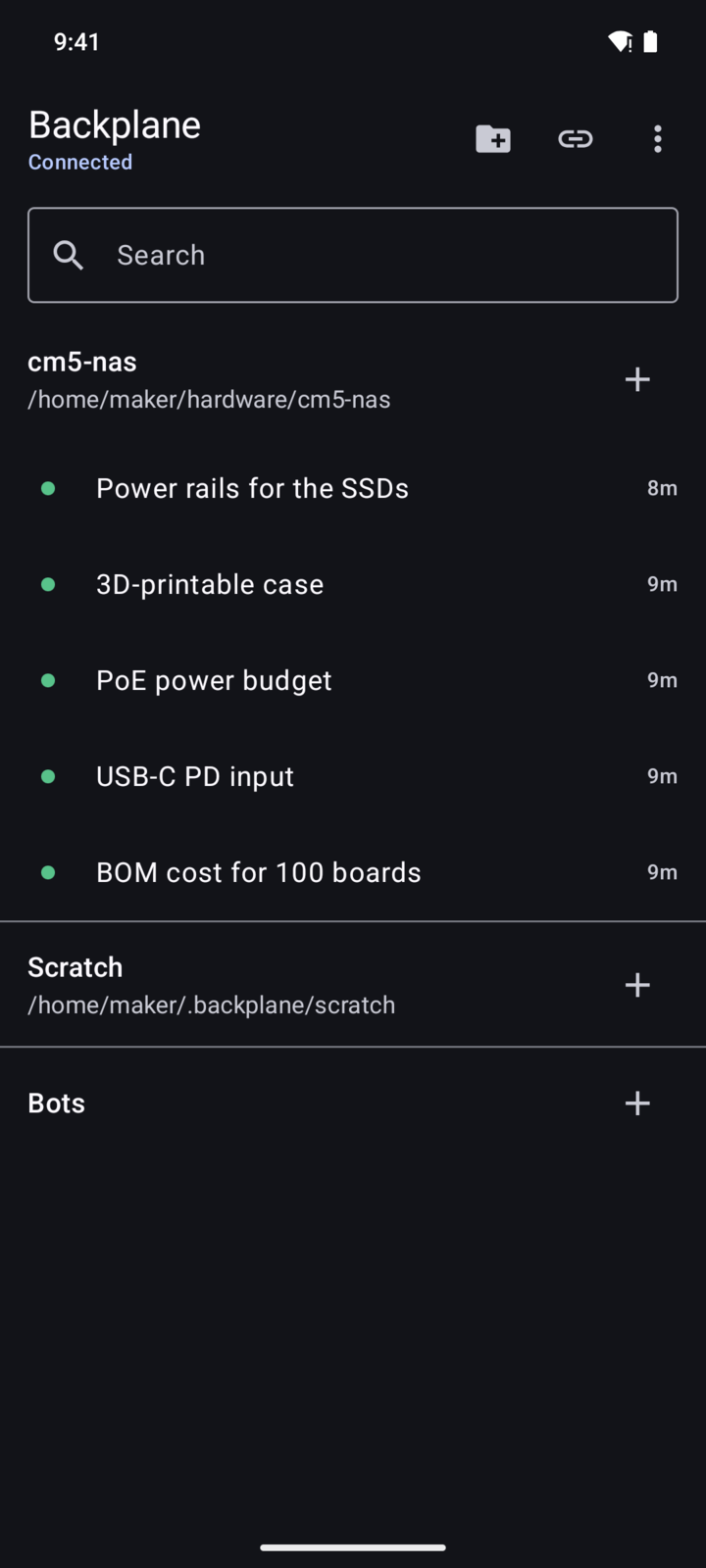
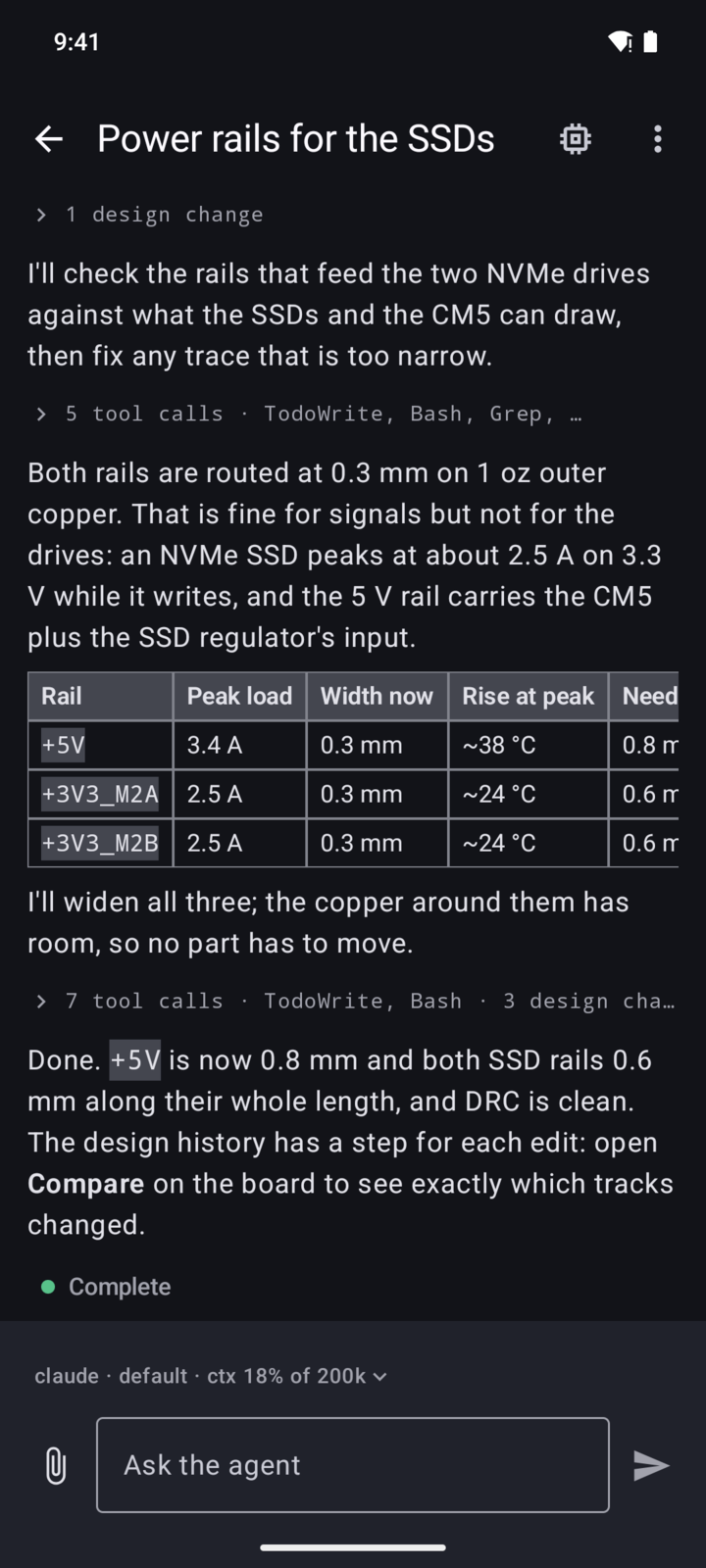
kicad-cli and the project's canonical files, and gets the KiStack skills: schematics, symbols, footprints, layout, BOM, Gerbers, panelizing and product renders, kept up to date.The hub runs on your machine. The browser and the native Android and iOS apps reach it over your tailnet and show the same threads, live: start a turn at your desk, then follow it, answer its questions and review the board from your phone. The phone apps are not a reduced view: threads, the board, schematic, 3D model, Mech parts, files and the design history with Compare are all there, drawn natively, with a notification when a turn ends or an agent needs you. Several machines show as one list.
 |  | 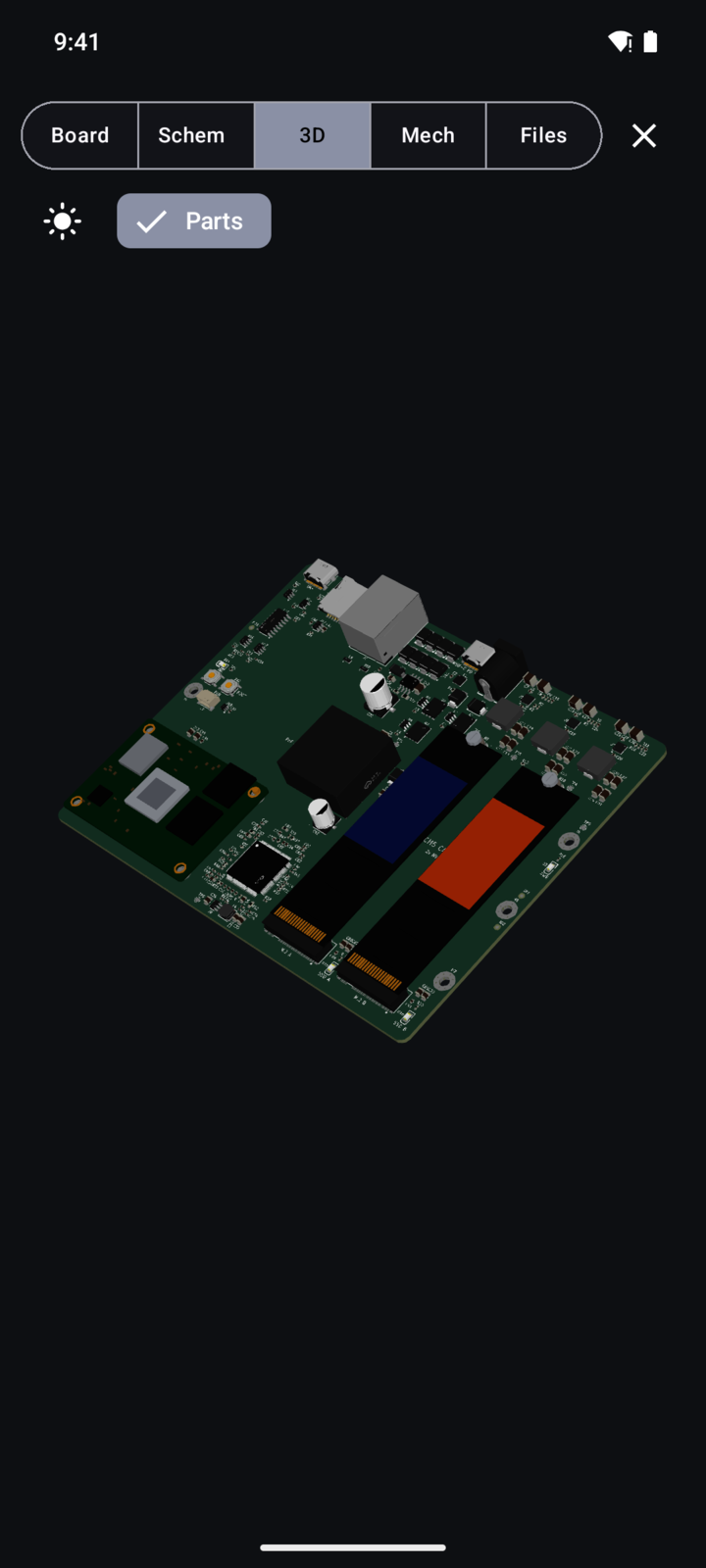 | 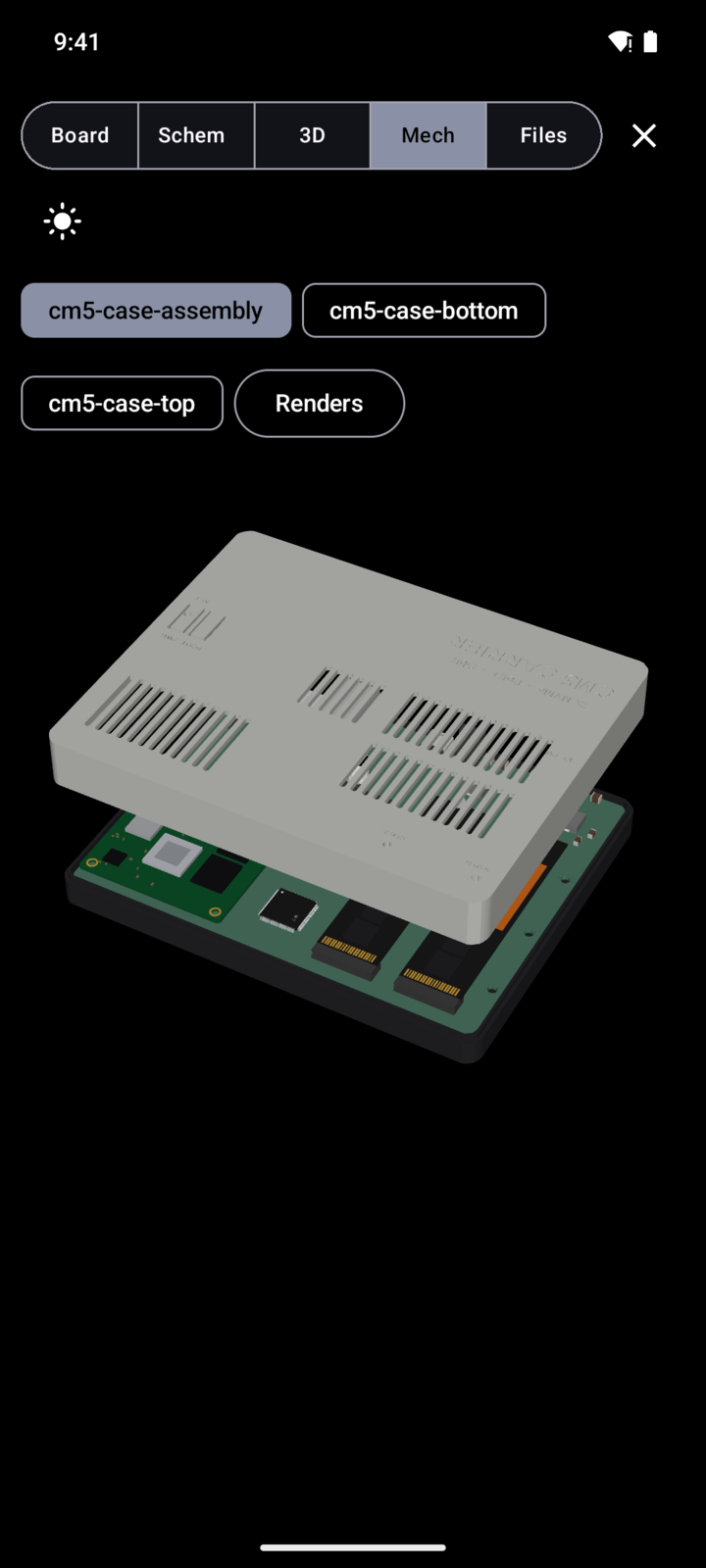 |
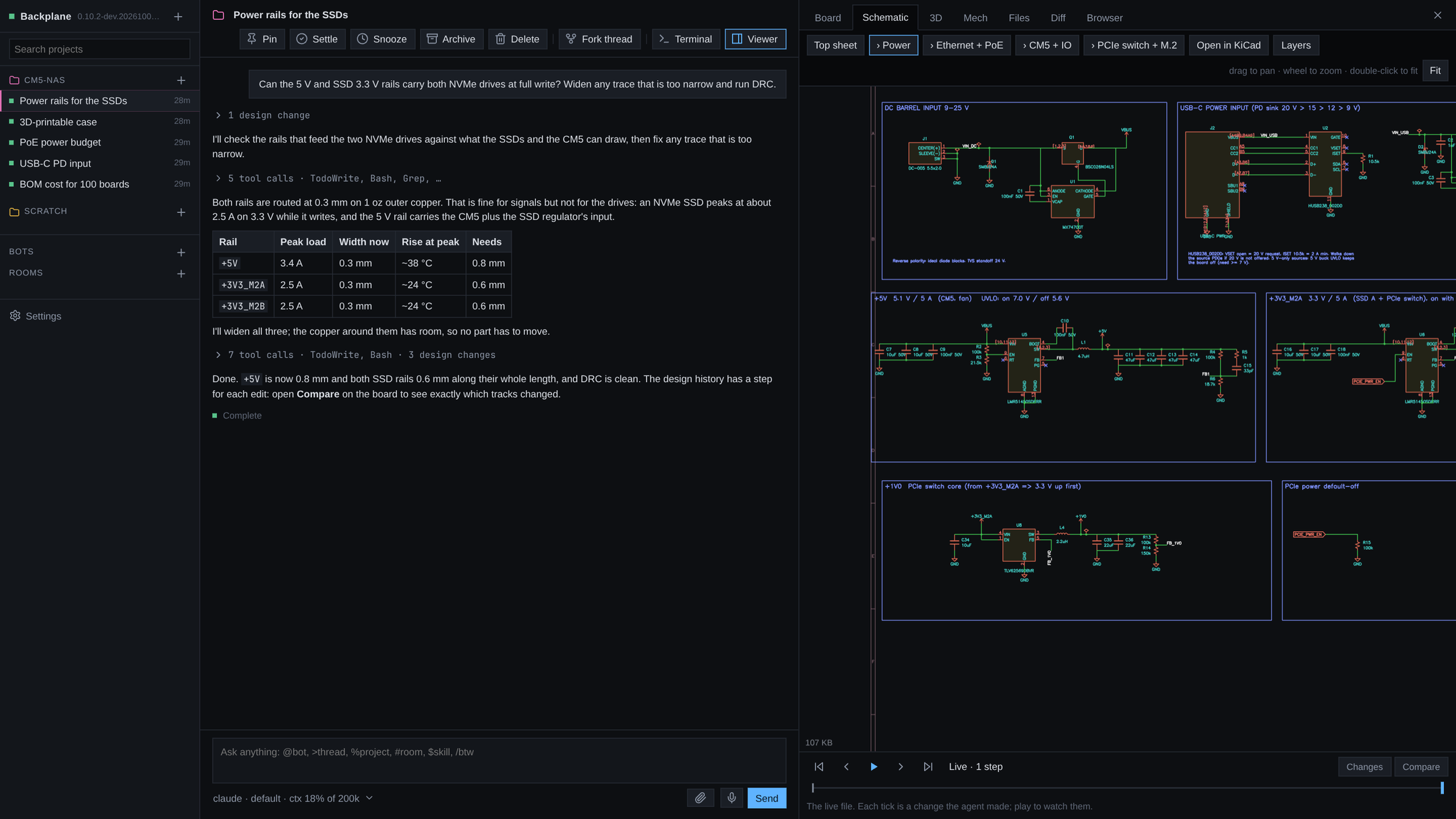
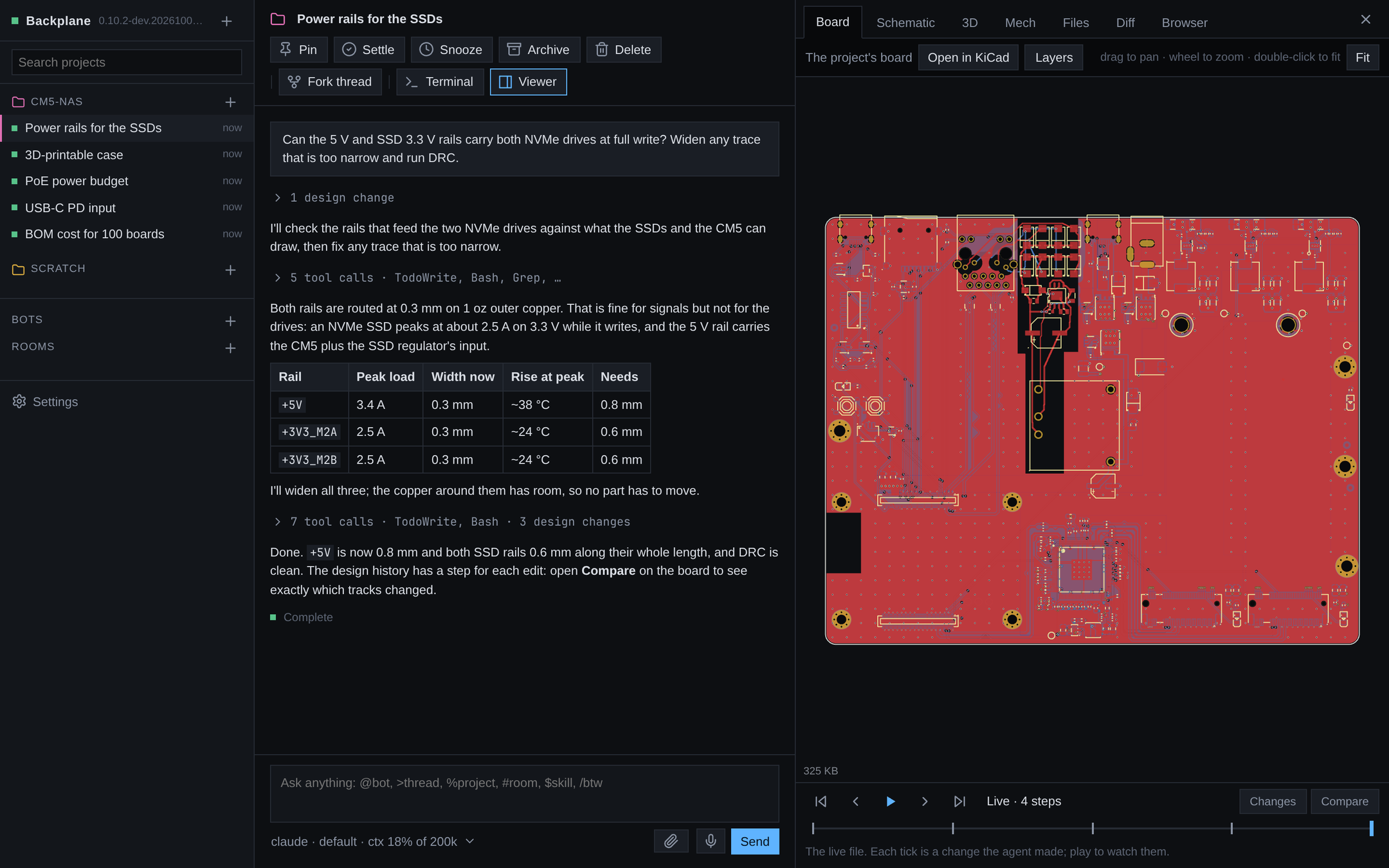
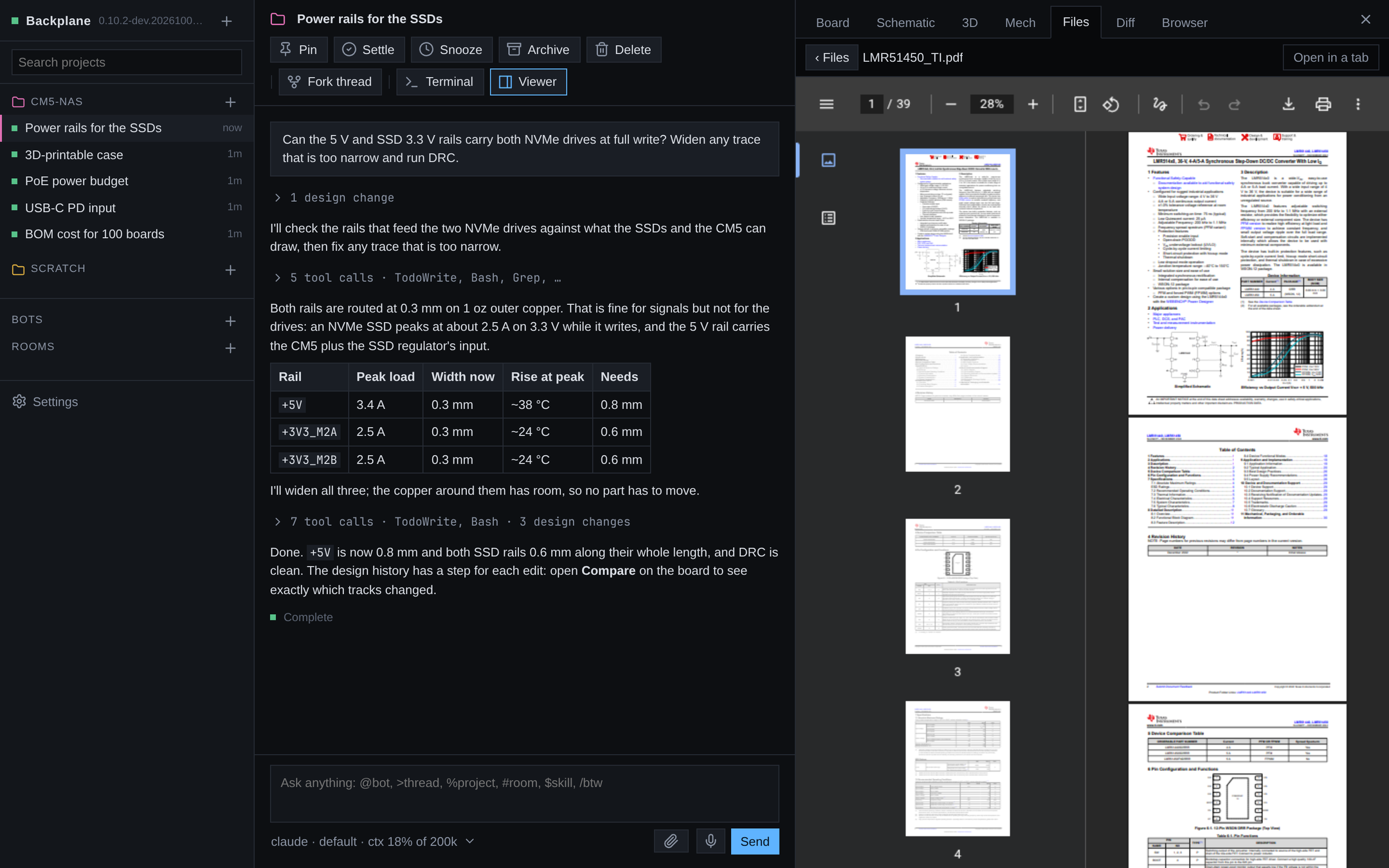
Viewers that follow the files. Board, Schematic (with its sheets), 3D (the board with its parts), Mech, Files, Diff and Browser, all next to the thread. They draw only finished saves and fade in only what changed. Click a pad, track, symbol or pin to see its net, reference, value and footprint, and mention it in chat.
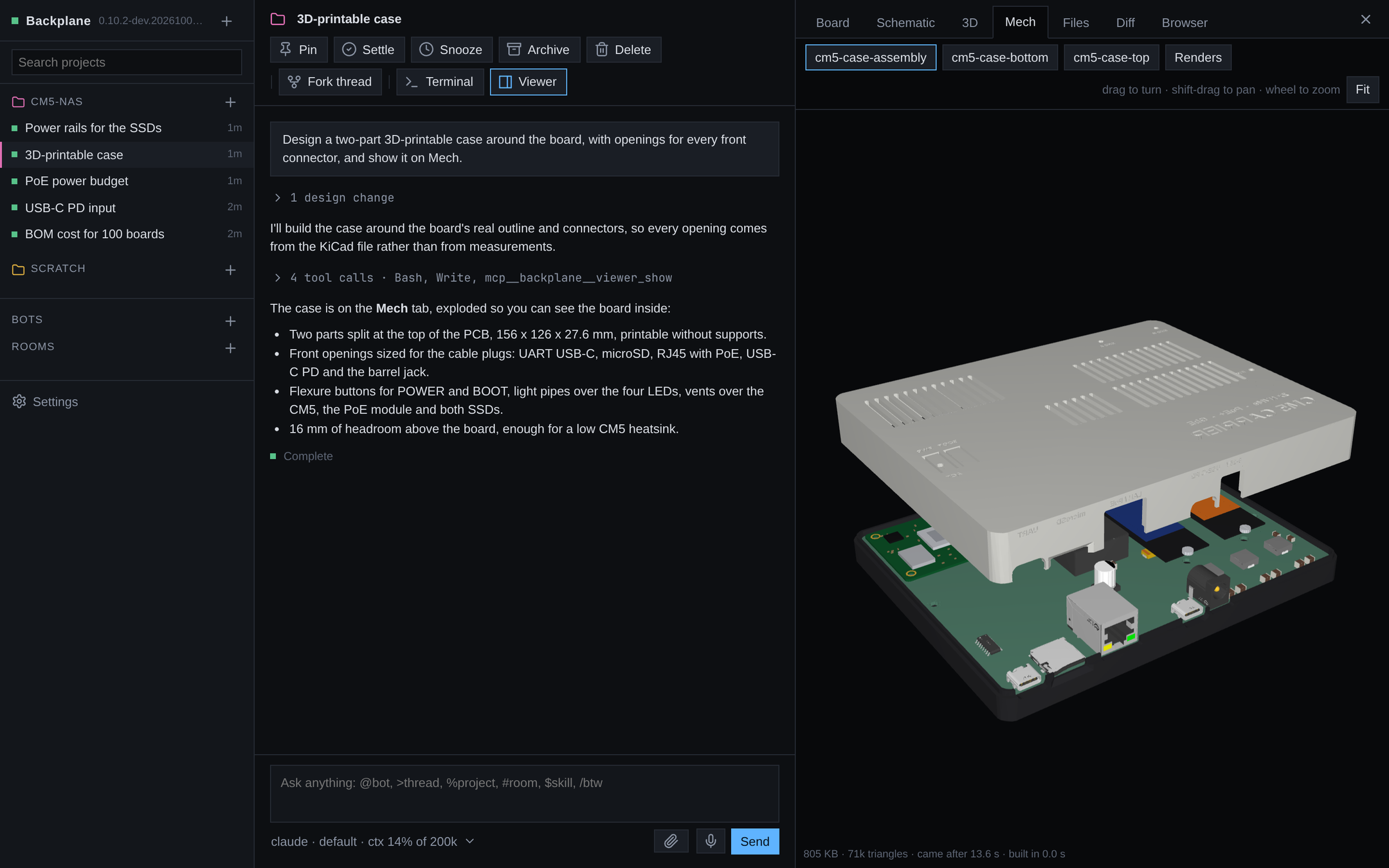
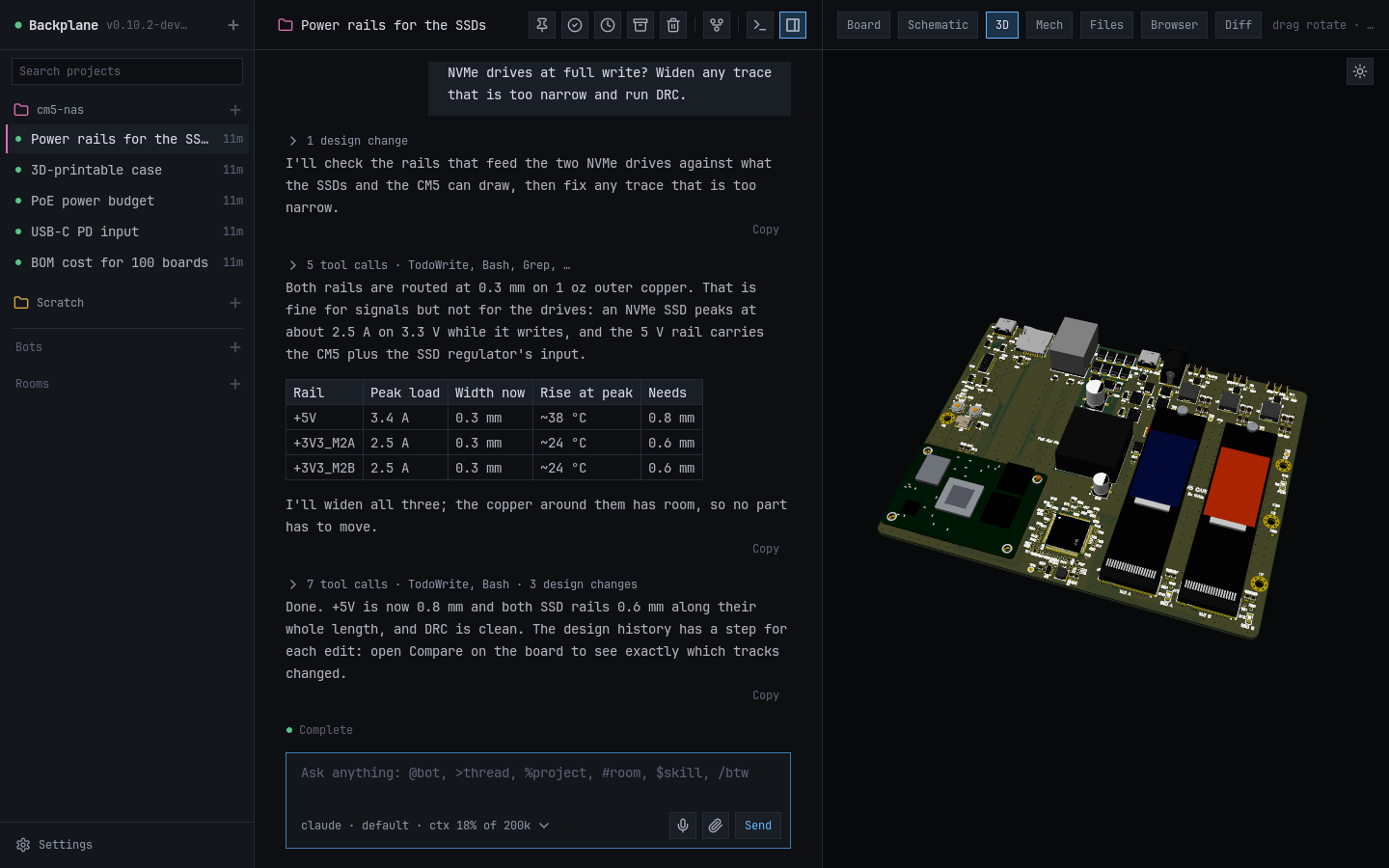
Mechanical parts. Agents model enclosures and brackets in FreeCAD, headless. The Mech tab turns any STEP in 3D, with the project's other parts beside it, and draws standard views on request.
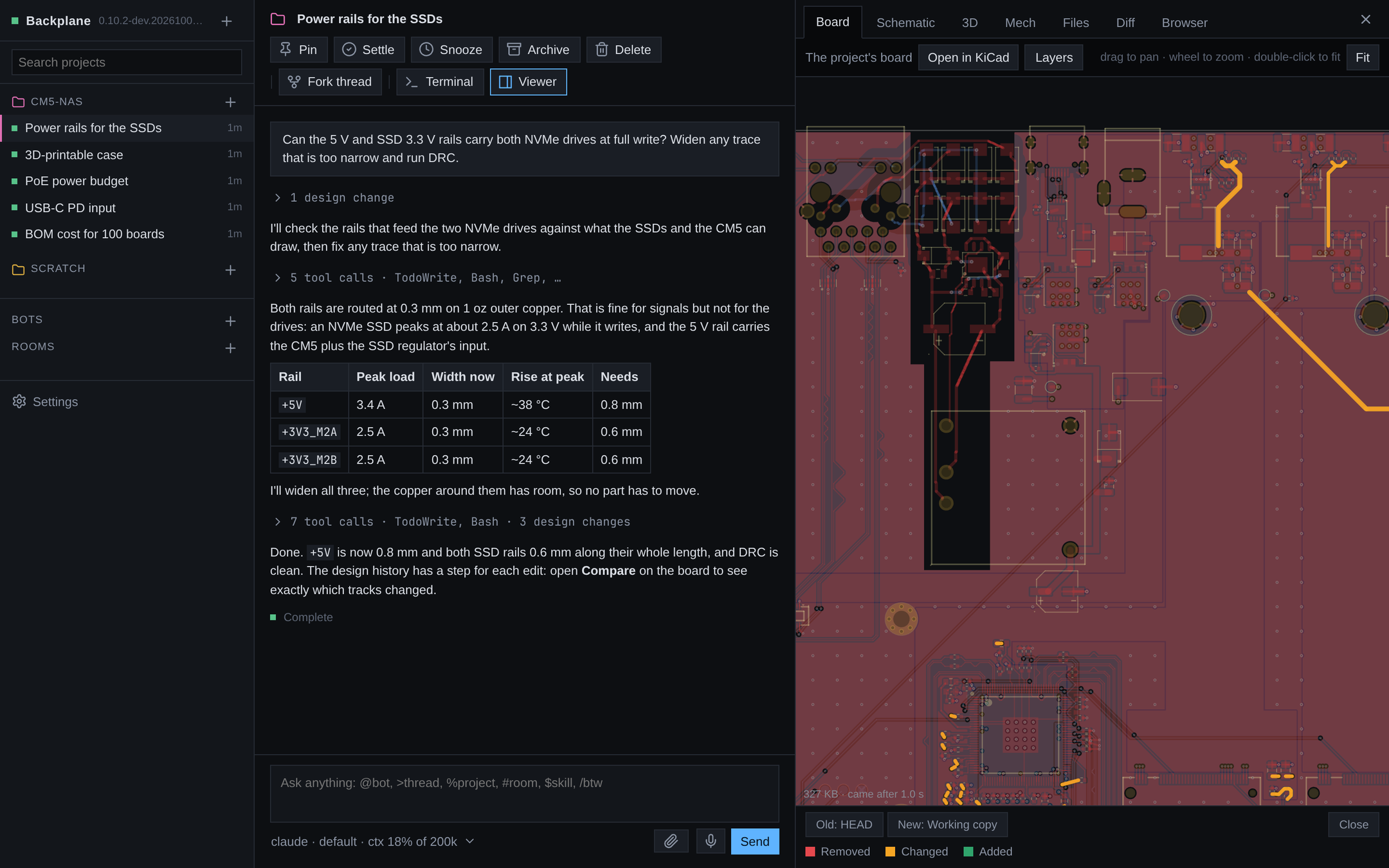
Design history. Backplane snapshots the KiCad files after every tool call. Step through what the agent did, play it back, jump to the tool call behind a step, or compare any two versions (steps, turns, commits, branches): removed, changed and added items are coloured and the rest dims.
Threads per project. Each thread is an agent session with its own model and provider. Tool calls fold into one line, todo lists and tables render as they should, and threads settle on their own when you stop touching them. Fork a thread, rename it, pin it, or hand it to another.
| The board | Datasheets and files |
|---|---|
 |  |
A native window. The desktop app is the same client drawn by Bend itself, with its own board and 3D renderer.
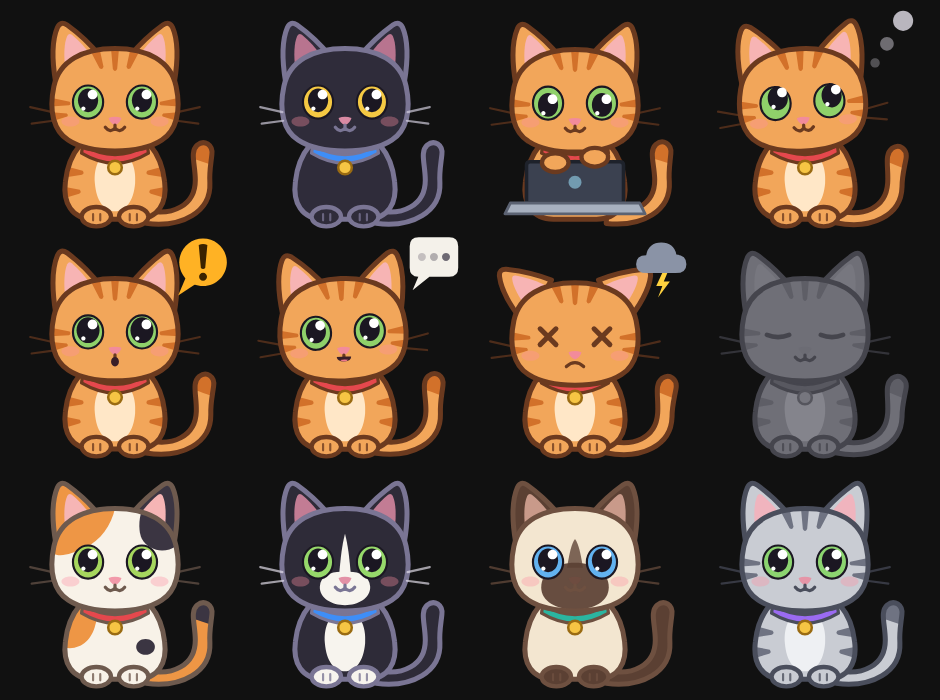
And more. A Chrome the agents drive while you watch; agents delegating work to other models; API keys the agents can use without ever reading them; voice input; a terminal per thread. Bots are persistent agents with a face, memory, routines and webhooks, which talk in rooms, across your machines and other people's.
curl -fsSL https://github.com/i2cjak/Backplane/releases/latest/download/install.sh | sh
backplane
Linux (x64, arm64) and macOS (Apple silicon). It installs into ~/.local/share/backplane and keeps itself up to date (BACKPLANE_NO_UPDATE=1 turns that off). Releases also carry an AppImage, a .deb, an AUR PKGBUILD and the Android APK. You need at least one agent CLI (claude, codex or grok) and KiCad; FreeCAD for mechanical work. backplane --headless runs it without a window. To pair a phone, scan the QR code in Settings (Pairing link, QR code) with the app, or paste the pairing link.
On a Mac there is no native window yet: backplane runs the hub and you use it in the browser at http://127.0.0.1:3787 (and from your phone, as anywhere). Add ~/.local/bin to your PATH if the installer says so.
Nightly builds of main are prereleases on the Releases page, each with its own installer: curl -fsSL https://github.com/i2cjak/Backplane/releases/download/<tag>/install.sh | sh.
Needs Bend, clang 19+, X11 headers and bun. On macOS, Xcode's clang is enough and there are no X11 headers to find: scripts/build.sh builds the hub and web client only.
scripts/check.sh   # type-check everything, prove every law
scripts/test.sh    # tests
scripts/build.sh   # dist/: the app, the server and the web client
Backplane is written in Bend, and the rules that matter are laws proven in PROOF.bend. AGENTS.md describes the layout; mobile/README.md the phone apps.
MIT. See LICENSE. backplane-step2glb embeds OpenCascade (LGPL-2.1); its notices ship in licenses/.
6,707 followers · starred Oct 2026
427 followers · starred Sep 2026
5,462 followers · starred Oct 2026
20,582 followers · starred Sep 2026
Agentic hardware development with lawful, deterministic KiCad/STEP viewers, written in Bend
See the codeAgentic hardware development. Claude Code, Codex, Grok, Muse Code and Google's Antigravity work on your KiCad boards and FreeCAD parts, and every change they make is drawn live beside the conversation, in a browser, on your phone, or in the desktop app.
kicad-cli and the project's canonical files, and gets the KiStack skills: schematics, symbols, footprints, layout, BOM, Gerbers, panelizing and product renders, kept up to date.The hub runs on your machine. The browser and the native Android and iOS apps reach it over your tailnet and show the same threads, live: start a turn at your desk, then follow it, answer its questions and review the board from your phone. The phone apps are not a reduced view: threads, the board, schematic, 3D model, Mech parts, files and the design history with Compare are all there, drawn natively, with a notification when a turn ends or an agent needs you. Several machines show as one list.
| | | |
Viewers that follow the files. Board, Schematic (with its sheets), 3D (the board with its parts), Mech, Files, Diff and Browser, all next to the thread. They draw only finished saves and fade in only what changed. Click a pad, track, symbol or pin to see its net, reference, value and footprint, and mention it in chat.
Mechanical parts. Agents model enclosures and brackets in FreeCAD, headless. The Mech tab turns any STEP in 3D, with the project's other parts beside it, and draws standard views on request.
Design history. Backplane snapshots the KiCad files after every tool call. Step through what the agent did, play it back, jump to the tool call behind a step, or compare any two versions (steps, turns, commits, branches): removed, changed and added items are coloured and the rest dims.
Threads per project. Each thread is an agent session with its own model and provider. Tool calls fold into one line, todo lists and tables render as they should, and threads settle on their own when you stop touching them. Fork a thread, rename it, pin it, or hand it to another.
| The board | Datasheets and files |
|---|---|
| |
A native window. The desktop app is the same client drawn by Bend itself, with its own board and 3D renderer.
And more. A Chrome the agents drive while you watch; agents delegating work to other models; API keys the agents can use without ever reading them; voice input; a terminal per thread. Bots are persistent agents with a face, memory, routines and webhooks, which talk in rooms, across your machines and other people's.
curl -fsSL https://github.com/i2cjak/Backplane/releases/latest/download/install.sh | sh
backplane
Linux (x64, arm64) and macOS (Apple silicon). It installs into ~/.local/share/backplane and keeps itself up to date (BACKPLANE_NO_UPDATE=1 turns that off). Releases also carry an AppImage, a .deb, an AUR PKGBUILD and the Android APK. You need at least one agent CLI (claude, codex or grok) and KiCad; FreeCAD for mechanical work. backplane --headless runs it without a window. To pair a phone, scan the QR code in Settings (Pairing link, QR code) with the app, or paste the pairing link.
On a Mac there is no native window yet: backplane runs the hub and you use it in the browser at http://127.0.0.1:3787 (and from your phone, as anywhere). Add ~/.local/bin to your PATH if the installer says so.
Nightly builds of main are prereleases on the Releases page, each with its own installer: curl -fsSL https://github.com/i2cjak/Backplane/releases/download/<tag>/install.sh | sh.
Needs Bend, clang 19+, X11 headers and bun. On macOS, Xcode's clang is enough and there are no X11 headers to find: scripts/build.sh builds the hub and web client only.
scripts/check.sh   # type-check everything, prove every law
scripts/test.sh    # tests
scripts/build.sh   # dist/: the app, the server and the web client
Backplane is written in Bend, and the rules that matter are laws proven in PROOF.bend. AGENTS.md describes the layout; mobile/README.md the phone apps.
MIT. See LICENSE. backplane-step2glb embeds OpenCascade (LGPL-2.1); its notices ship in licenses/.
6,707 followers · starred Oct 2026
427 followers · starred Sep 2026
5,462 followers · starred Oct 2026
20,582 followers · starred Sep 2026