A parallel native tool caling deep search agentic framework with base window retention observation masking context management.
Python
25
13 commits
updated Sep 22, 2026
Observation masking provides a narrow but informative lens on when context management helps, when retrieval is the bottleneck, and when saturated models start losing crucial evidence.


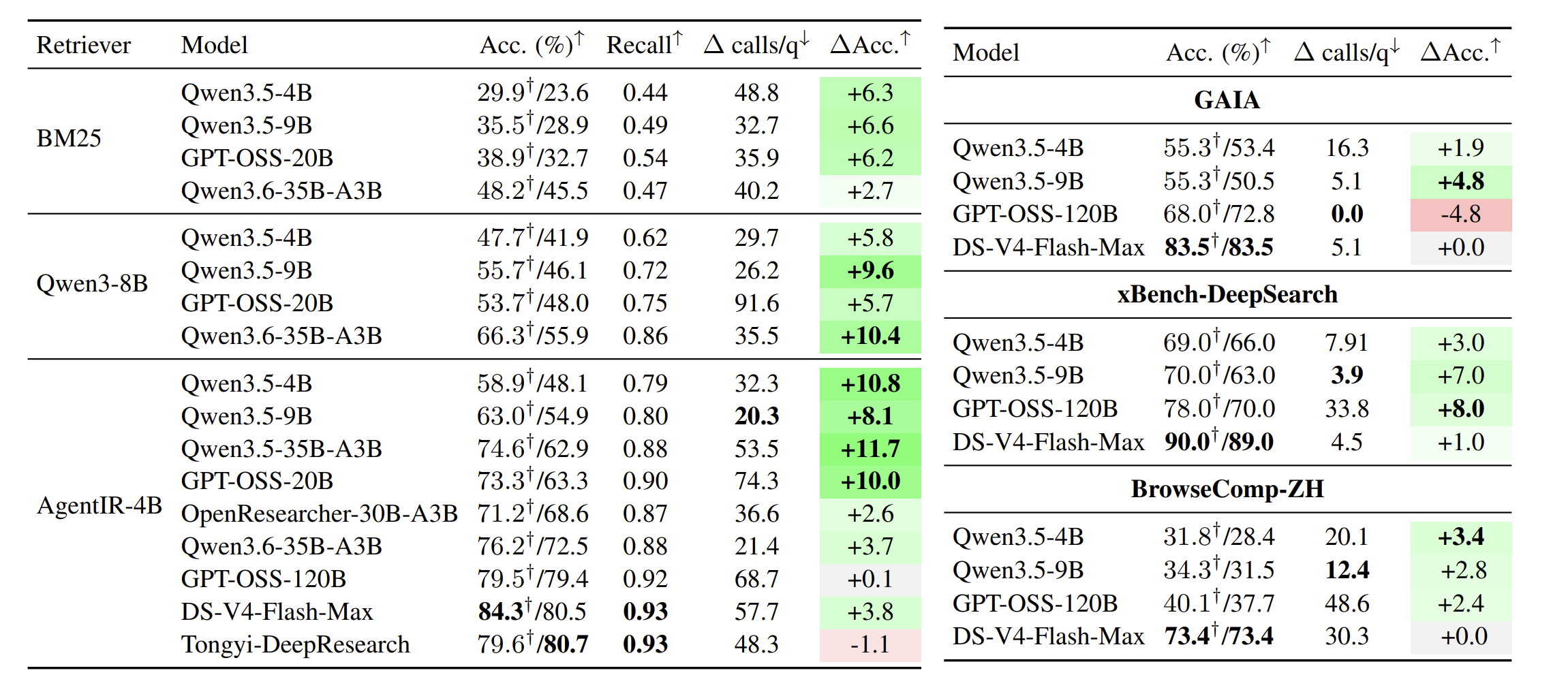
 DeepSeek-V4-Flash and ranks 3rd overall on both the BrowseComp-Plus (with AgentIR-4B) and BrowseComp-ZH (with Serper API) leaderboards.
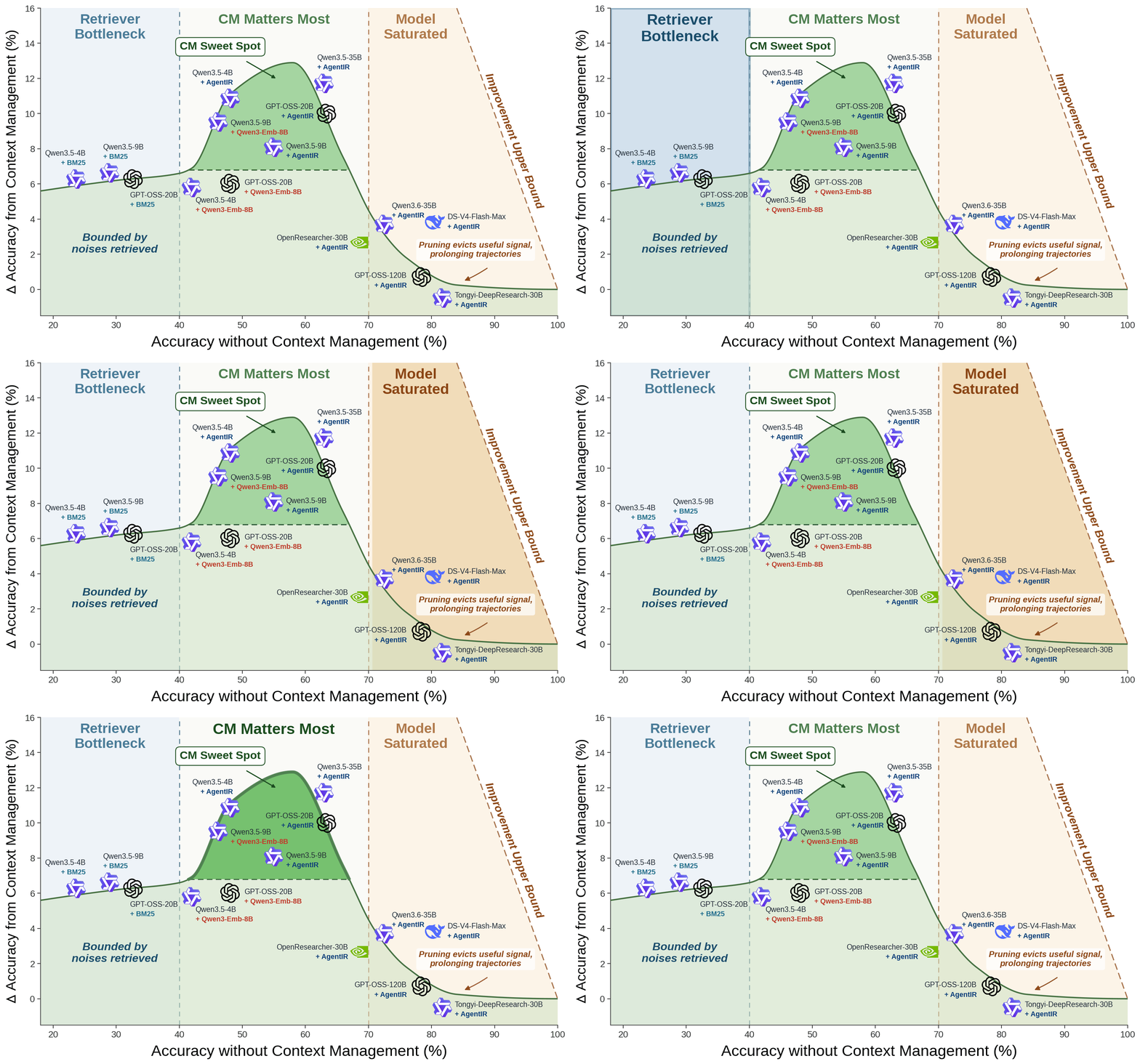
Deep search agents accumulate long observation traces while iterating through reasoning, search, and browsing. We study observation masking as a simple context-management (CM) intervention and find that its effect is highly regime-dependent across model-retriever pairs.
 Qwen3.5 / Qwen3.6 Family, DeepSeek-V4-Flash,
 NVIDIA Nemotron 3, and
 GPT-OSS.
One-click setup (optional, you can also install dependencies manually):
bash setup.sh
# Optional: system-wide OpenJDK 21, only if you have sudo.
sudo apt update
sudo apt install -y openjdk-21-jdk

# No sudo? Skip the apt commands above.
# setup.sh will download OpenJDK 21 into ./.jdk/jdk-21 when needed.

# install uv
curl -LsSf https://astral.sh/uv/install.sh | sh
uv venv --python 3.12
source .venv/bin/activate

# install tevatron for BrowseComp-plus
git clone https://github.com/texttron/tevatron.git
cd tevatron
uv pip install -e .
cd ..

# install all dependencies automatically
uv pip install -e .
Configure API keys for Serper-backed benchmarks and evaluation:
cp .env.template .env
Remember to config your API keys in .env file:
# Get API Key: https://serper.dev/
SERPER_API_KEY=your_serper_api_key_here

# OpenAI API for evaluation: https://platform.openai.com/api-keys
OPENAI_API_KEY=your_openai_api_key_here
BrowseComp-Plus uses a local search service on custom ports.
Attention: The dense and AgentIR search service will occupy about 10G of your GPU.
# BM25
bash scripts/start_search_service.sh bm25 8005

# Dense (Qwen3-Embedding-8B)
bash scripts/start_search_service.sh dense 8006

# AgentIR
bash scripts/start_search_service.sh agentir 8007
bash scripts/start_gptoss_servers.sh \
  8010 \
  "2,3,4,5,6,7" \
  "openai/gpt-oss-20b" \
  "0.9,0.9,0.9" \
  2 \
  24
This starts 3 two-GPU TP replicas on ports 8010 through 8012.
uv venv qwen35 --python 3.12
uv pip install vllm \
  --torch-backend=auto \
  --extra-index-url https://wheels.vllm.ai/nightly \
  --python qwen35/bin/python

bash scripts/start_qwen_servers.sh \
  8010 \
  "1,2,3,4,5,6,7" \
  "Qwen/Qwen3.5-9B" \
  "0.95,0.95,0.95,0.95,0.95,0.95,0.95" \
  1 \
  32
This starts 7 single-GPU replicas on ports 8010 through 8016.
For Qwen3.5/3.6-35B, GPT-OSS-120B, DeepSeek-V4-Flash, and NVIDIA Nemotron 3 deployment recipes, see 
assets/docs/deployment.md.
The last run_agent.sh argument controls max_concurrency_per_worker. Recommended values are 8 for DeepSeek-V4-Flash (dsv4) and GPT-OSS-120B, 24 for GPT-OSS-20B, and 32 for other models.
Start AgentIR search on port 8003, then run GPT-OSS-20B against BrowseComp-Plus:
bash scripts/start_search_service.sh agentir 8003

SEARCH_URL="http://localhost:8003" bash run_agent.sh \
  results/browsecomp-plus/gptoss-20b-agentir \
  8010 \
  3 \
  browsecomp_plus \
  local \
  "openai/gpt-oss-20b" \
  10000 \
  "" \
  on \
  24
Serper-backed benchmarks do not need a local search service. Make sure SERPER_API_KEY is set in .env.
bash run_agent.sh \
  results/browsecomp-zh/qwen3.5-9b-serper \
  8010 \
  7 \
  browsecomp-zh \
  serper \
  "Qwen/Qwen3.5-9B" \
  4 \
  "" \
  on \
  32
python eval.py --input_dir results/browsecomp-plus/gptoss-20b-agentir --model_name_or_path openai/gpt-oss-20b

python eval.py --input_dir results/browsecomp-zh/qwen3.5-9b-serper --model_name_or_path Qwen/Qwen3.5-9B
For full script arguments, see assets/docs/parameter.md.
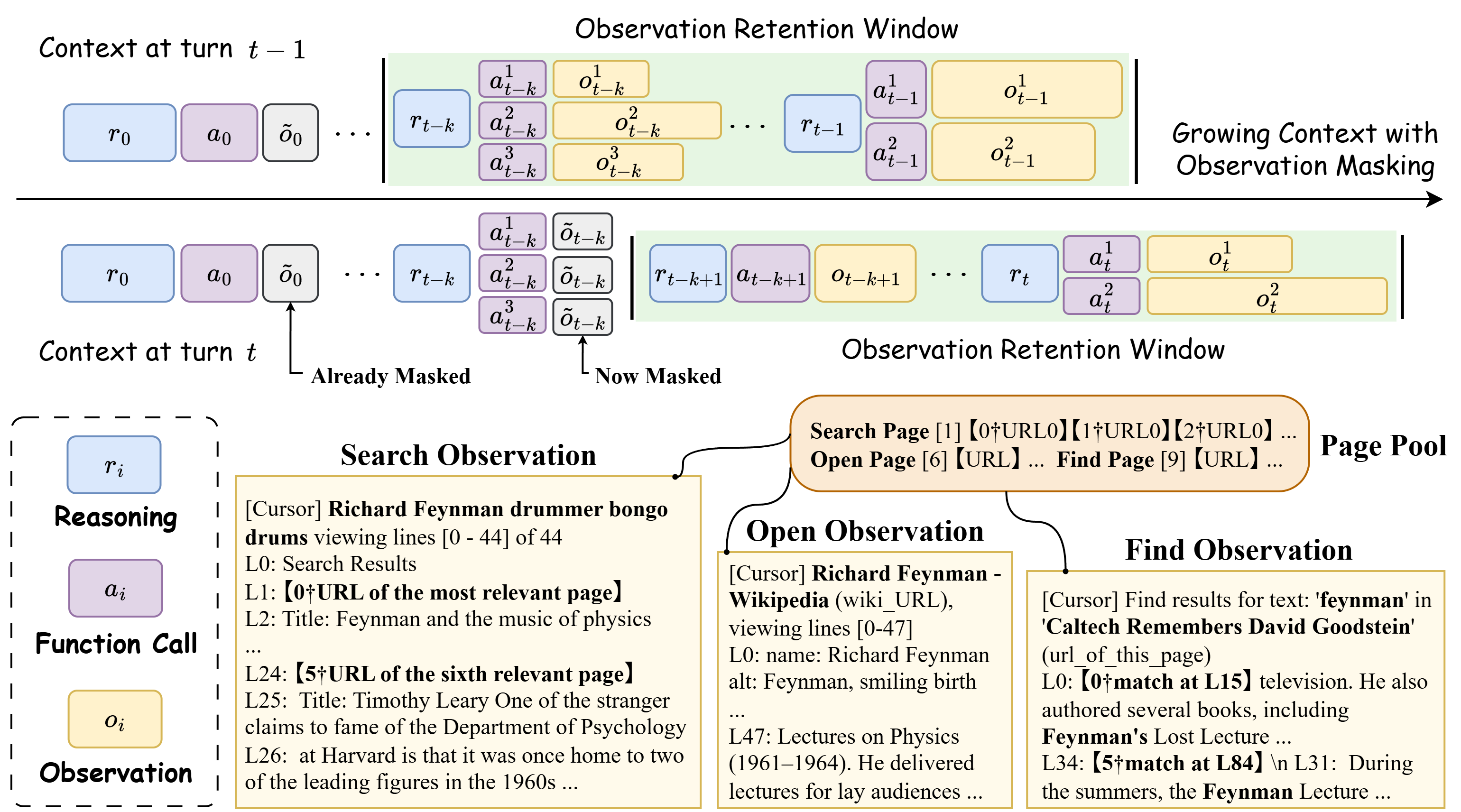
We decouples browser execution from model serving: a shared browser pool handles search, page opening, and observation collection, while model workers consume the resulting trajectories through configurable masking windows. This makes it easy to compare model-retriever pairs under the same browsing environment and CM policy.
| Benchmark | Key | Size | Language | Search Backend |
|---|---|---|---|---|
| BrowseComp-Plus | browsecomp_plus | 830 | EN | local |
| BrowseComp-ZH | browsecomp-zh | 289 | ZH | serper |
| GAIA-text | gaia | 103 | EN | serper |
| xbench-DeepSearch | xbench | 100 | ZH | serper |
For benchmark notes, see assets/docs/benchmarks.md.
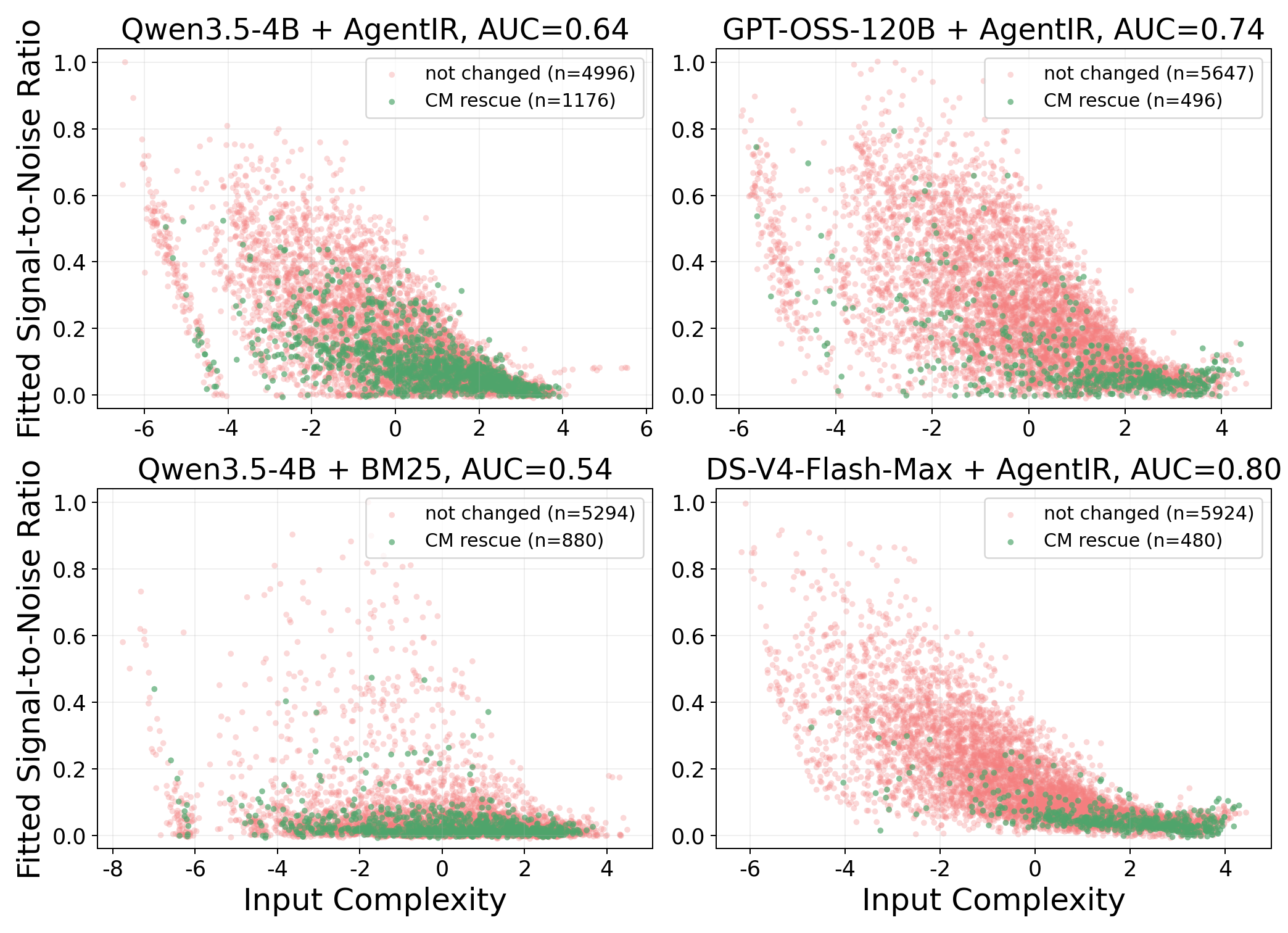
Observation masking (CM) helps most when the useful signal is sparse and the input trace is complex. Each point represents a sampled No-CM input prefix: the x-axis is the first principal component over input-trace features, where larger values indicate greater complexity, and the y-axis is the normalized fitted SNR. Green points are CM-rescued cases, while red points are unchanged cases. Saturated models show more separable rescued subsets, whereas retriever bottlenecks weaken the baseline signal and sharply suppress that separability.
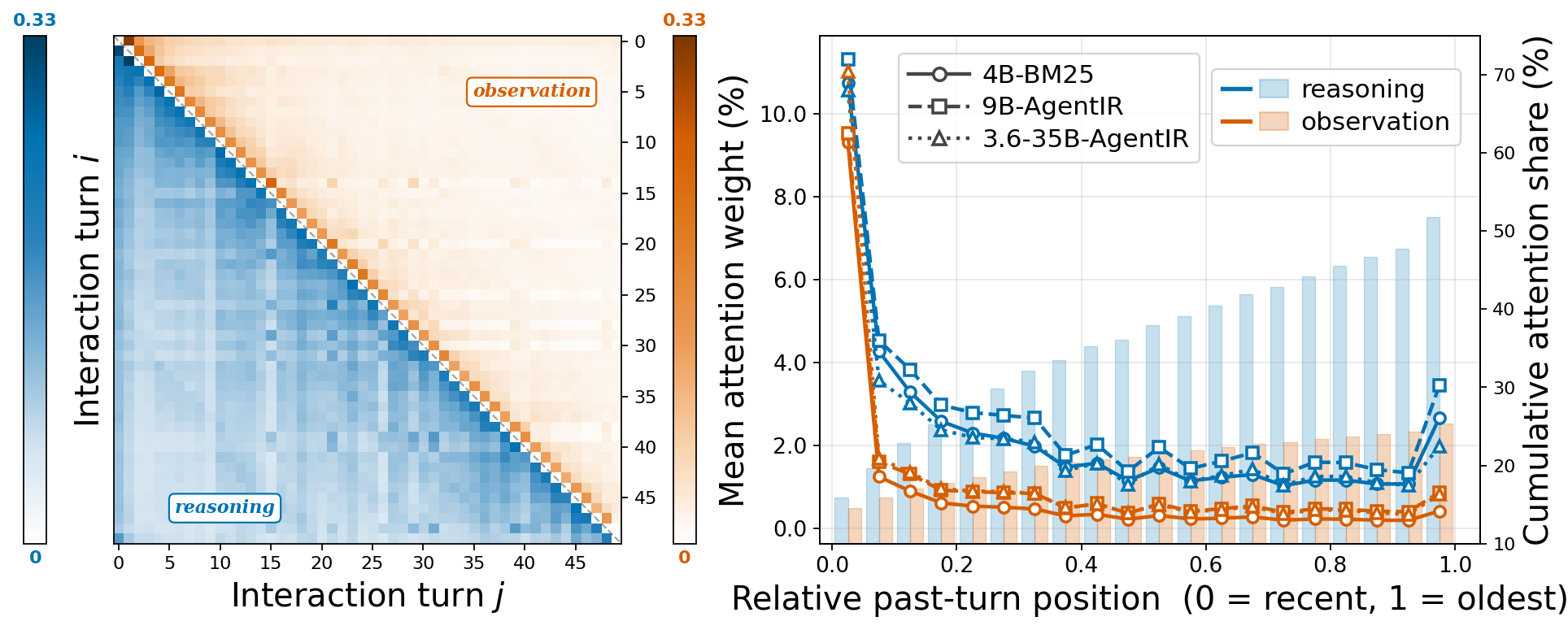
Observation masking improves context management when it preserves the tool results that the model still uses for reasoning. The analysis measures reasoning-token attention over tool-result tokens: cases with stronger CM gains maintain higher reasoning attention on useful tool results, while weaker settings show lower or more diffuse attention. The three model-retriever settings are Qwen3.5-4B + BM25, Qwen3.5-9B + AgentIR, and Qwen3.6-35B-A3B + AgentIR.
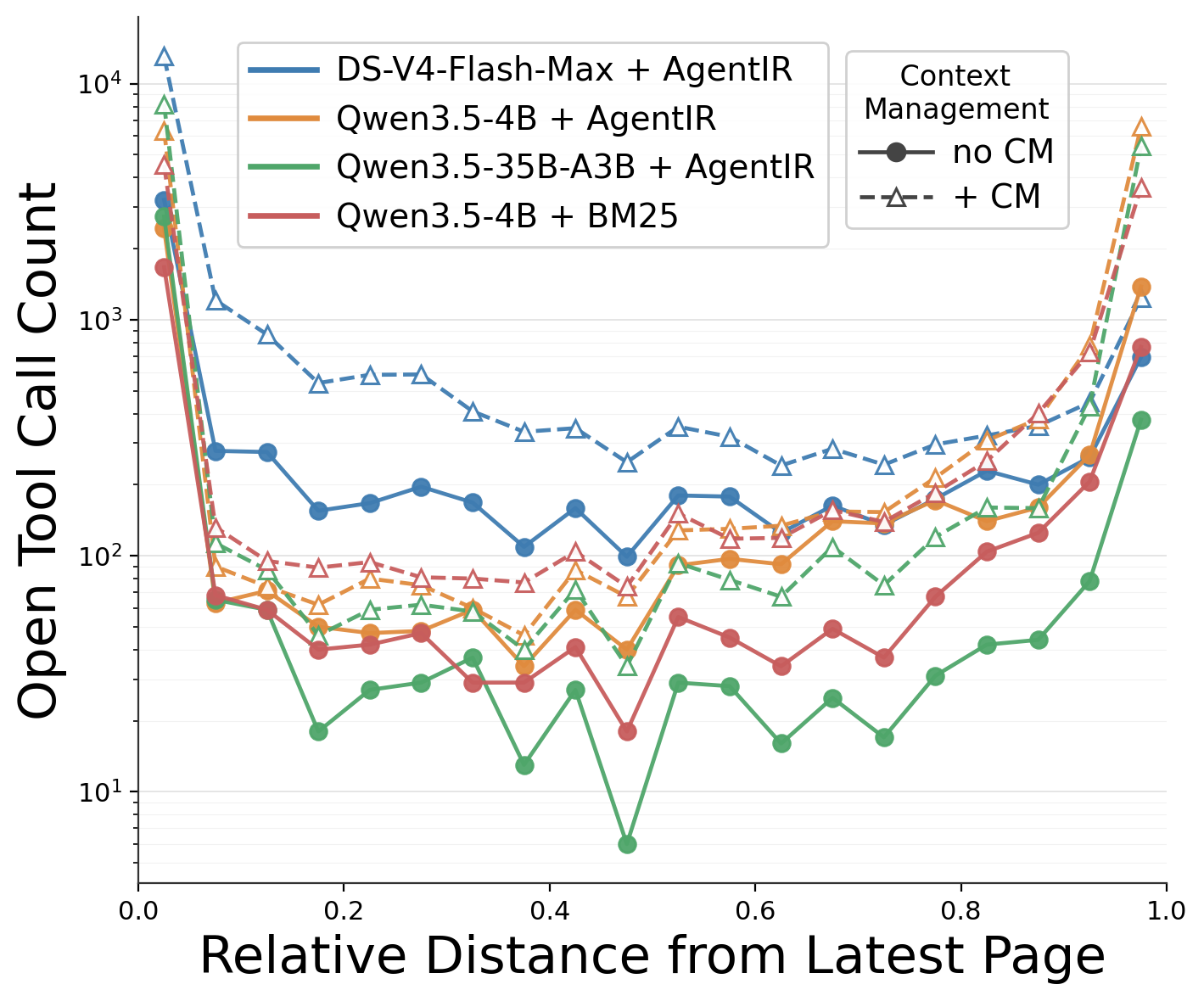
Agents reopen middle pages much less often. The figure shows the relative positions of open targets in the current page pool, where CM sharpens the U-shaped pattern: agents tend to revisit early or recent pages more often than pages in the middle of the pool.
We are grateful for all the help we got from our contributors.




We also thank the following open-source projects:
 vLLM for fast LLM inference support.
 OpenResearcher for early-stage exploration in scaffold-building and deep search benchmark collection.
@article{zhang2026masking,
  title={Masking Stale Observations Helps Search Agents -- Until It Doesn’t: A Regime Map and Its Mechanism},
  author={Zhang, Haoxiang and Xu, Qixin and Li, Zhuofeng and Zhang, Lei and Jiang, Pengcheng and Zhang, Yu and McAuley, Julian},
  journal={arXiv preprint arXiv:2606.00408},
  year={2026}
}
125 followers · starred Jul 2026
222 followers · starred Sep 2026
A parallel native tool caling deep search agentic framework with base window retention observation masking context management.
Python
25
13 commits
updated Sep 22, 2026
Observation masking provides a narrow but informative lens on when context management helps, when retrieval is the bottleneck, and when saturated models start losing crucial evidence.
DeepSeek-V4-Flash and ranks 3rd overall on both the BrowseComp-Plus (with AgentIR-4B) and BrowseComp-ZH (with Serper API) leaderboards.
Deep search agents accumulate long observation traces while iterating through reasoning, search, and browsing. We study observation masking as a simple context-management (CM) intervention and find that its effect is highly regime-dependent across model-retriever pairs.
Qwen3.5 / Qwen3.6 Family, DeepSeek-V4-Flash, NVIDIA Nemotron 3, and GPT-OSS.One-click setup (optional, you can also install dependencies manually):
bash setup.sh
# Optional: system-wide OpenJDK 21, only if you have sudo.
sudo apt update
sudo apt install -y openjdk-21-jdk

# No sudo? Skip the apt commands above.
# setup.sh will download OpenJDK 21 into ./.jdk/jdk-21 when needed.

# install uv
curl -LsSf https://astral.sh/uv/install.sh | sh
uv venv --python 3.12
source .venv/bin/activate

# install tevatron for BrowseComp-plus
git clone https://github.com/texttron/tevatron.git
cd tevatron
uv pip install -e .
cd ..

# install all dependencies automatically
uv pip install -e .
Configure API keys for Serper-backed benchmarks and evaluation:
cp .env.template .env
Remember to config your API keys in .env file:
# Get API Key: https://serper.dev/
SERPER_API_KEY=your_serper_api_key_here

# OpenAI API for evaluation: https://platform.openai.com/api-keys
OPENAI_API_KEY=your_openai_api_key_here
BrowseComp-Plus uses a local search service on custom ports.
Attention: The dense and AgentIR search service will occupy about 10G of your GPU.
# BM25
bash scripts/start_search_service.sh bm25 8005

# Dense (Qwen3-Embedding-8B)
bash scripts/start_search_service.sh dense 8006

# AgentIR
bash scripts/start_search_service.sh agentir 8007
bash scripts/start_gptoss_servers.sh \
  8010 \
  "2,3,4,5,6,7" \
  "openai/gpt-oss-20b" \
  "0.9,0.9,0.9" \
  2 \
  24
This starts 3 two-GPU TP replicas on ports 8010 through 8012.
uv venv qwen35 --python 3.12
uv pip install vllm \
  --torch-backend=auto \
  --extra-index-url https://wheels.vllm.ai/nightly \
  --python qwen35/bin/python

bash scripts/start_qwen_servers.sh \
  8010 \
  "1,2,3,4,5,6,7" \
  "Qwen/Qwen3.5-9B" \
  "0.95,0.95,0.95,0.95,0.95,0.95,0.95" \
  1 \
  32
This starts 7 single-GPU replicas on ports 8010 through 8016.
For Qwen3.5/3.6-35B, GPT-OSS-120B, DeepSeek-V4-Flash, and NVIDIA Nemotron 3 deployment recipes, see assets/docs/deployment.md.
The last run_agent.sh argument controls max_concurrency_per_worker. Recommended values are 8 for DeepSeek-V4-Flash (dsv4) and GPT-OSS-120B, 24 for GPT-OSS-20B, and 32 for other models.
Start AgentIR search on port 8003, then run GPT-OSS-20B against BrowseComp-Plus:
bash scripts/start_search_service.sh agentir 8003

SEARCH_URL="http://localhost:8003" bash run_agent.sh \
  results/browsecomp-plus/gptoss-20b-agentir \
  8010 \
  3 \
  browsecomp_plus \
  local \
  "openai/gpt-oss-20b" \
  10000 \
  "" \
  on \
  24
Serper-backed benchmarks do not need a local search service. Make sure SERPER_API_KEY is set in .env.
bash run_agent.sh \
  results/browsecomp-zh/qwen3.5-9b-serper \
  8010 \
  7 \
  browsecomp-zh \
  serper \
  "Qwen/Qwen3.5-9B" \
  4 \
  "" \
  on \
  32
python eval.py --input_dir results/browsecomp-plus/gptoss-20b-agentir --model_name_or_path openai/gpt-oss-20b

python eval.py --input_dir results/browsecomp-zh/qwen3.5-9b-serper --model_name_or_path Qwen/Qwen3.5-9B
For full script arguments, see assets/docs/parameter.md.
We decouples browser execution from model serving: a shared browser pool handles search, page opening, and observation collection, while model workers consume the resulting trajectories through configurable masking windows. This makes it easy to compare model-retriever pairs under the same browsing environment and CM policy.
| Benchmark | Key | Size | Language | Search Backend |
|---|---|---|---|---|
| BrowseComp-Plus | browsecomp_plus | 830 | EN | local |
| BrowseComp-ZH | browsecomp-zh | 289 | ZH | serper |
| GAIA-text | gaia | 103 | EN | serper |
| xbench-DeepSearch | xbench | 100 | ZH | serper |
For benchmark notes, see assets/docs/benchmarks.md.
Observation masking (CM) helps most when the useful signal is sparse and the input trace is complex. Each point represents a sampled No-CM input prefix: the x-axis is the first principal component over input-trace features, where larger values indicate greater complexity, and the y-axis is the normalized fitted SNR. Green points are CM-rescued cases, while red points are unchanged cases. Saturated models show more separable rescued subsets, whereas retriever bottlenecks weaken the baseline signal and sharply suppress that separability.
Observation masking improves context management when it preserves the tool results that the model still uses for reasoning. The analysis measures reasoning-token attention over tool-result tokens: cases with stronger CM gains maintain higher reasoning attention on useful tool results, while weaker settings show lower or more diffuse attention. The three model-retriever settings are Qwen3.5-4B + BM25, Qwen3.5-9B + AgentIR, and Qwen3.6-35B-A3B + AgentIR.
Agents reopen middle pages much less often. The figure shows the relative positions of open targets in the current page pool, where CM sharpens the U-shaped pattern: agents tend to revisit early or recent pages more often than pages in the middle of the pool.
We are grateful for all the help we got from our contributors.
We also thank the following open-source projects:
vLLM for fast LLM inference support. OpenResearcher for early-stage exploration in scaffold-building and deep search benchmark collection.@article{zhang2026masking,
title={Masking Stale Observations Helps Search Agents -- Until It Doesn’t: A Regime Map and Its Mechanism},
author={Zhang, Haoxiang and Xu, Qixin and Li, Zhuofeng and Zhang, Lei and Jiang, Pengcheng and Zhang, Yu and McAuley, Julian},
journal={arXiv preprint arXiv:2606.00408},
year={2026}
}
125 followers · starred Jul 2026
222 followers · starred Sep 2026