
a global index and media viewer for all of your offline videos
HTML
1
15 commits
updated Oct 2, 2026
See what people are saying
README
🎬 HuskVault
The Zero-Watt, Cold-Media Personal Cinema
Permanent metadata. Instant streaming. Physical media shelf organization.



Overview • Architecture • Quickstart • Physical Media Workflow • Configuration
💡 Overview
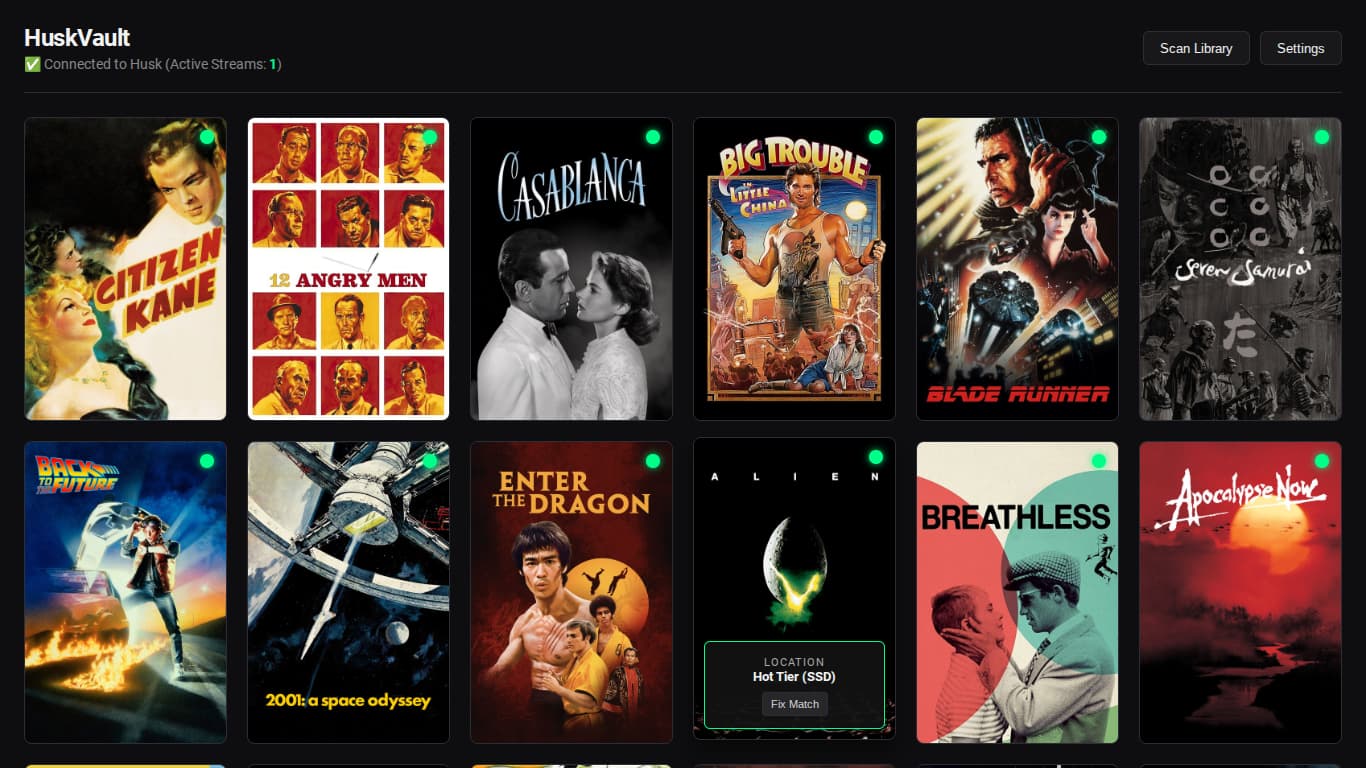
HuskVault is a lightweight cinema frontend and metadata orchestrator designed specifically for cold-tier media archives. It connects directly with the HuskHoard kernel daemon to bring streaming-service aesthetics to physical storage media.
- Permanent Metadata: Movie posters, synopses, and file records remain cached on your fast NVMe drive—even when the underlying payload is shelved on cold media.
- Zero Standby Power: Archive drives, optical disc binders (BD-R/M-DISC)(still testing this), and LTO tapes draw 0W while idle on your shelf.
- Physical Volume Prompts: Clicking an unmounted movie shows you the exact binder slot, disc number, or volume UUID to insert.
- StreamGate Direct Play: Once mounted, media streams directly from the raw block device via HTTP 206 Byte-Range requests without unpacking or extracting gigabytes to SSD.
- Built-in "Fix Match": Override ambiguous titles with an interactive TMDb search directly inside the UI while preserving all physical shelf locations.
⚡ Architecture
HuskVault coordinates with HuskHoard's kernel block daemon:
Browser Client (Desktop / TV / Tablet)
   │
   ├── [Port 5000: HuskVault Orchestrator]
   │     ├── index.html        (Responsive Poster Grid, Mount Modals, Settings)
   │     ├── server.py         (REST API: /api/scan, /api/status, /api/fix_match)
   │     ├── scraper.py        (Incremental TMDb + GuessIt Scraper)
   │     └── catalog.json      (Master index retaining tier and shelf placement)
   │
   └── [Port 8080: HuskHoard Kernel Daemon]
         ├── /api/dashboard    (Real-time volume states, UUID mapping, active streams)
         └── /stream/<file>    (HTTP 206 Byte-Range streaming from block storage)
🚀 Quickstart
Prerequisites
- Modern Linux OS (Ubuntu 22.04/24.04, Debian 12, Arch)
- Python 3.10+
- A running HuskHoard daemon (default port
8080) - A free TMDb API Key
1. Clone & Install Dependencies
git clone https://github.com/HuskHoard/HuskVault.git
cd HuskVault

# Install dependencies
pip install requests guessit
2. Launch the Server
python3 server.py
HuskVault is now online at http://localhost:5000 (or http://YOUR_LAN_IP:5000).
3. Configure from the UI
- Open the UI in your browser and click Settings.
- Enter:
- TMDb API Key: Your v3 auth key.
- Hot Tier Folder Path:
/path/to/huskhoard/hot_tier - HuskHoard Daemon Endpoint:
http://127.0.0.1:8080(or LAN IP)
- Click Save Configuration, then click Scan Library.
🗄️ Physical Media Workflow
HuskVault displays live badges based on volume telemetry:
| Badge | Status | Media Location | Playback Action |
|---|---|---|---|
| 🟢 | RESIDENT | Hot SSD Tier | Instant stream. |
| 🟢 | ONLINE | Nearline Drive / Mounted Disc | Wakes drive; streams immediately via StreamGate. |
| 🔴 | OFFLINE | Cold Shelf (BD-R / M-DISC / Tape) | Prompts: "Please insert Binder A · Disc #12". |
Fixing Ambiguous Titles ("Fix Match")
Hover over any card in the grid, click *Circle in upper left, and search TMDb by title or enter a numeric TMDb ID. The poster and metadata update immediately while preserving all physical storage locations.
📦 Supported Archival Media
- Optical Media (BD-R, BD-RE, M-DISC): Burn archives as standard ISO or raw UDF volumes. Label your disc sleeves; HuskVault points you to the exact slot.
- LTO Ultrium Tape: Native compatibility with LTO-5 through LTO-9 formatted by HuskHoard.
- Spun-Down External Hard Drives: Keep USB drives in protective cases on your shelf. Plug them in only when watching the box set.
📄 License
- HuskVault is open-source software licensed under the AGPL v3 License.
- Built to run alongside the HuskHoard storage tiering engine.
Similar repos


Languages
HTML
61.4%
Python
38.6%
a global index and media viewer for all of your offline videos
HTML
1
15 commits
updated Oct 2, 2026
See what people are saying
README
🎬 HuskVault
The Zero-Watt, Cold-Media Personal Cinema
Permanent metadata. Instant streaming. Physical media shelf organization.
Overview • Architecture • Quickstart • Physical Media Workflow • Configuration
💡 Overview
HuskVault is a lightweight cinema frontend and metadata orchestrator designed specifically for cold-tier media archives. It connects directly with the HuskHoard kernel daemon to bring streaming-service aesthetics to physical storage media.
- Permanent Metadata: Movie posters, synopses, and file records remain cached on your fast NVMe drive—even when the underlying payload is shelved on cold media.
- Zero Standby Power: Archive drives, optical disc binders (BD-R/M-DISC)(still testing this), and LTO tapes draw 0W while idle on your shelf.
- Physical Volume Prompts: Clicking an unmounted movie shows you the exact binder slot, disc number, or volume UUID to insert.
- StreamGate Direct Play: Once mounted, media streams directly from the raw block device via HTTP 206 Byte-Range requests without unpacking or extracting gigabytes to SSD.
- Built-in "Fix Match": Override ambiguous titles with an interactive TMDb search directly inside the UI while preserving all physical shelf locations.
⚡ Architecture
HuskVault coordinates with HuskHoard's kernel block daemon:
Browser Client (Desktop / TV / Tablet)
   │
   ├── [Port 5000: HuskVault Orchestrator]
   │     ├── index.html        (Responsive Poster Grid, Mount Modals, Settings)
   │     ├── server.py         (REST API: /api/scan, /api/status, /api/fix_match)
   │     ├── scraper.py        (Incremental TMDb + GuessIt Scraper)
   │     └── catalog.json      (Master index retaining tier and shelf placement)
   │
   └── [Port 8080: HuskHoard Kernel Daemon]
         ├── /api/dashboard    (Real-time volume states, UUID mapping, active streams)
         └── /stream/<file>    (HTTP 206 Byte-Range streaming from block storage)
🚀 Quickstart
Prerequisites
- Modern Linux OS (Ubuntu 22.04/24.04, Debian 12, Arch)
- Python 3.10+
- A running HuskHoard daemon (default port
8080) - A free TMDb API Key
1. Clone & Install Dependencies
git clone https://github.com/HuskHoard/HuskVault.git
cd HuskVault

# Install dependencies
pip install requests guessit
2. Launch the Server
python3 server.py
HuskVault is now online at http://localhost:5000 (or http://YOUR_LAN_IP:5000).
3. Configure from the UI
- Open the UI in your browser and click Settings.
- Enter:
- TMDb API Key: Your v3 auth key.
- Hot Tier Folder Path:
/path/to/huskhoard/hot_tier - HuskHoard Daemon Endpoint:
http://127.0.0.1:8080(or LAN IP)
- Click Save Configuration, then click Scan Library.
🗄️ Physical Media Workflow
HuskVault displays live badges based on volume telemetry:
| Badge | Status | Media Location | Playback Action |
|---|---|---|---|
| 🟢 | RESIDENT | Hot SSD Tier | Instant stream. |
| 🟢 | ONLINE | Nearline Drive / Mounted Disc | Wakes drive; streams immediately via StreamGate. |
| 🔴 | OFFLINE | Cold Shelf (BD-R / M-DISC / Tape) | Prompts: "Please insert Binder A · Disc #12". |
Fixing Ambiguous Titles ("Fix Match")
Hover over any card in the grid, click *Circle in upper left, and search TMDb by title or enter a numeric TMDb ID. The poster and metadata update immediately while preserving all physical storage locations.
📦 Supported Archival Media
- Optical Media (BD-R, BD-RE, M-DISC): Burn archives as standard ISO or raw UDF volumes. Label your disc sleeves; HuskVault points you to the exact slot.
- LTO Ultrium Tape: Native compatibility with LTO-5 through LTO-9 formatted by HuskHoard.
- Spun-Down External Hard Drives: Keep USB drives in protective cases on your shelf. Plug them in only when watching the box set.
📄 License
- HuskVault is open-source software licensed under the AGPL v3 License.
- Built to run alongside the HuskHoard storage tiering engine.
Similar repos
Languages
HTML
61.4%
Python
38.6%