
See what people are saying
README
Felucca


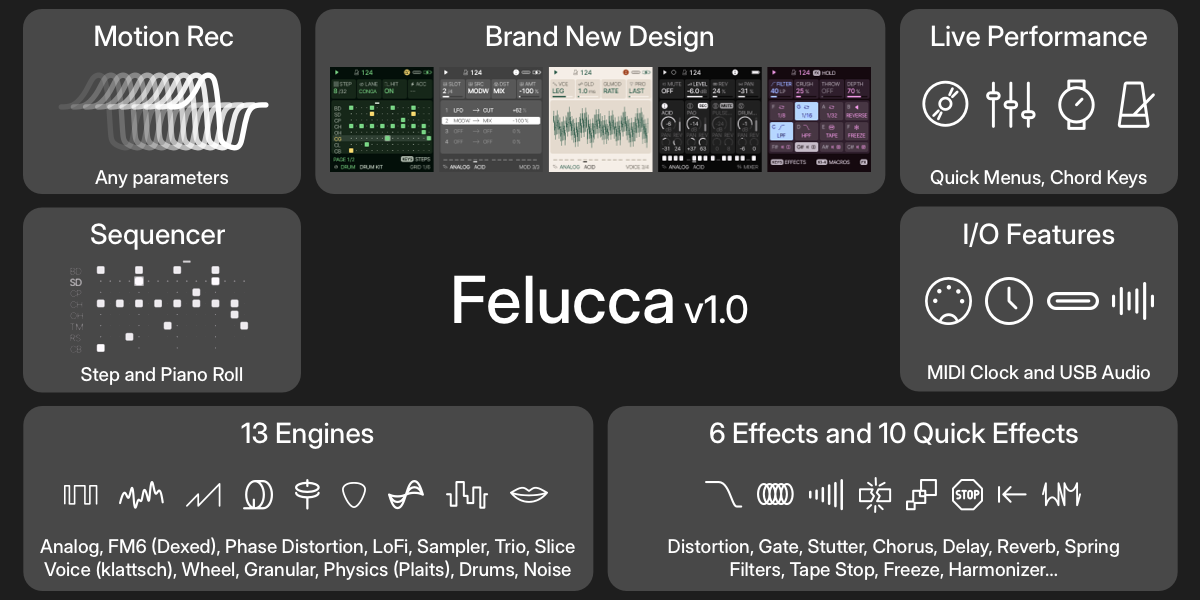
TL;DR: Felucca 1.0.5.2 — Big New Features, field testing. Connect your FM-1 to a computer by USB, open the web installer in Chrome or Edge, and press Install; no extra hardware is needed. Installing is at your own risk: M-VAVE's updater or the installer's Return to official V15 takes you back. Want to look around first? Try it in your browser, no FM-1 needed.
Multi-engine synthesizer firmware for the M-VAVE FM-1. Please report what you find in Issues.
- Install: web installer (Chrome or Edge, USB), or
tools/fm1_install.pyfrom a terminal - Try: Felucca in your browser: the same firmware compiled to WebAssembly, with the panel on screen (mouse, touch, computer keyboard, Web MIDI in)
- Editor: web editor; its development has moved to Felucca-WebApp
- Build: BUILDING.md

Features
- Thirteen engines (below), each with its own factory presets
- Four tracks, one synth part each with its own engine and sound (drums are the DRUM engine); 8 voices shared between them. ALGORITHM selects the track on every page
- Sequencer: 64 steps per track with chords, ties, accent, slide, per-step chance and ratchets (a step played 2, 3 or 4 times in its length); a piano roll of the steps; a drum grid (white keys = steps, black keys = lanes); automation (formerly motion): recording of knob moves per step (an automation icon marks the cards it drives); live loop recording with overdub; REC held on the SEQ pages clears the sequence (it asks first, and SAVE held undoes it); divisions listed by length, 4 bars to 1/32; loading a sound never touches your patterns
- Songs: chain patterns A–D
- Chord keys: one finger plays an in-key chord (triads or sevenths of the scale, or fixed chord shapes), with voicings; on the keys, MIDI in, recording and the arpeggiator
- Arpeggiator with REPEAT and a beat LED, 16 scales with a white-key mode, glide, MONO / LEGATO / UNISON
- Modulation matrix: 4 slots per track, MIDI controllers as sources
- Effects: distortion and the SLICER per track; chorus, delay and reverb sends (the reverb as ROOM or SPRING); master limiter
- FX layer: hold FX for repeat, reverse, filter sweeps, tape stop, freeze and a harmonizer (OCT UP / OCT DN with shimmer), and mutes on the black keys; MENU > FX LATCH makes them toggle, so nothing has to stay held
- Quick layers: hold FX, GLO, SCL or EDIT for shortcuts on the keys and knobs, or double-tap it to keep the layer open; one-step undo (SAVE held); REC on every page; OCT+ confirms, OCT- goes back; what can be pressed breathes softly instead of blinking
- Presets: factory presets, 32 user preset slots and 4 projects, named on the device (an FM6 sound keeps its own patch in both); projects from every earlier version load. The PRESETS knob changes the sound from every page that is not a list, and moves the step cursor on the SEQ pages
- Screen: flat UI with Inter Tight and Fukiai icons, FLAT or LINE style, 10 palettes including grayscale, black and white, high contrast and NIGHT; tracks numbered 1–4 on small cushions; MENU > LARGE for tall knob cards with larger labels and values; the menu in four tabs
- LEDs: idle buttons and keys glow dim so the panel can be found in the dark (MENU > LEDS: OFF, DIM LO, DIM HI or INV, the official firmware's look); PLAY turns green while playing; the keys show the notes the sequencer and MIDI IN play, and on SEQ > STEP (stopped) the notes of the step under the cursor
- USB: class-compliant MIDI in and out, and a 44.1 kHz stereo audio input ("Felucca") that records the master output on the computer, no driver needed (at a fixed level with MENU > USB LEVEL FIXED; on macOS 13–15, set MENU > USB SERIAL to OFF so the audio input appears)
- MIDI: USB and TRS MIDI in; with ROUT CH1-4, channels 1–4 play tracks 1–4 and 5–16 are ignored (ROUT SEL: every channel plays the selected track), and the keys send on the track's channel; pitch bend, sustain, panic; clock from internal, USB or TRS
- Web: editor for every parameter (with a 6-operator FM patch editor), step grid, mixer, preset library, sample upload and recording with trim, the MENU settings; full backup and restore; return to the official firmware; Felucca itself running in the browser
Controls
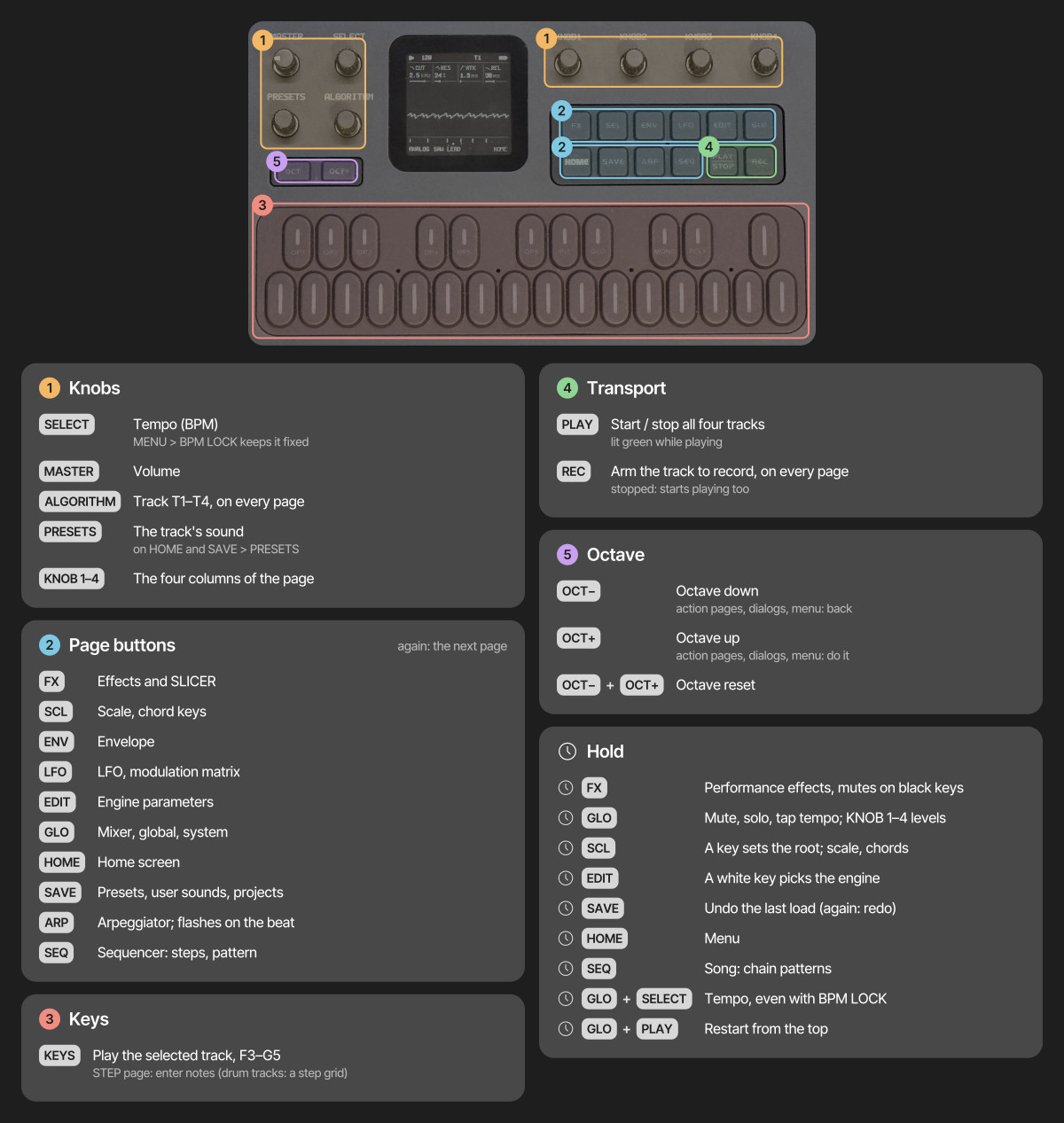
- Tap a page button for its page, again for the next; HOME returns home
- Hold FX, GLO, SCL or EDIT for its quick layer; hold SAVE to undo, HOME for the menu, SEQ for the song
- Double-tap FX, GLO, SCL or EDIT to keep its layer open without holding; tap it again to close
- Hold REC on SEQ > STEP (or the drum grid), PATTERN or CHANCE to clear the track's sequence: OCT+ clears, OCT− cancels
- On action pages and in dialogs, OCT+ does it and OCT− goes back; in the menu, OCT+ / OCT− change the value and HOME closes it
- Save a sound: stop, tap SAVE, pick a slot with KNOB 1, then OCT+ and OCT+ again (name it with the keys)
Menu
Hold HOME for the menu. Since 1.0.5 it is in four tabs: DISPLAY (COLOR to LEDS), CONTROL (HOLD to BPM LOCK), AUDIO (SPEAKER EQ, USB LEVEL) and SYSTEM (USB SERIAL, HARDWARE CALIBRATION, ABOUT). ALGORITHM moves between the tabs and PRESETS through the rows of one; any of KNOB 1–4, or OCT+ / OCT−, changes the value (OCT+ opens HARDWARE CALIBRATION and ABOUT); press HOME to close the menu. Every new setting defaults to the earlier behaviour. From 1.0.4 the web editor's Settings tab reads and changes them too (COLOR to USB SERIAL), saved the same way as from the menu; with 1.0.5 it groups them in the same tabs.
- COLOR: the palette. GREY (grayscale, called MONO up to 1.0.1), GREEN, AMBER, ICE, VIOLET, ROSE, PAPER (light), HI-CON (high contrast), NIGHT (the 0.9 look: true black, green-tinted text) and MONO (black and white)
- STYLE: FLAT (filled cards) or LINE (areas divided by thin lines)
- LARGE: OFF or ON: on HOME and the value pages the four knob cards grow tall, marked K1–K4, with larger labels and values about twice the size; the graph below becomes a strip. Lists, the piano roll, the drum grid and the quick layers keep their layout with larger labels
- ANIM: ON or OFF; OFF shows every change at once, without rolling digits or a gliding piano roll
- LEDS: OFF (no glow), DIM LO, DIM HI (default) or INV (the idle LEDs lit, the active ones dark). What can be pressed breathes up to about 60 % of a lit LED, about 30 % with DIM LO
- HOLD: how long FX, GLO, SCL or EDIT is held before its map shows
- KNOB ACCEL: OFF (one step per click) or ON: a fast, steady turn of a wide value moves 2 to 4 steps per click; lists never jump
- FX LATCH: ON, FX + an effect key turns the effect on until pressed again, the knob macros stay where you leave them, and FX + OCT− turns everything off
- BPM LOCK: ON, SELECT no longer changes the tempo; hold GLO and turn SELECT, tap F4 in the GLO layer or use GLO > GLOBAL instead
- SPEAKER EQ: FLAT, LOWCUT or BASS+, a tone setting for the built-in speaker (not a switch). It also shapes the headphone out and USB audio, so keep it on FLAT when recording. The firmware cannot turn the speaker off, but headphones in the jack do
- USB LEVEL: MASTER (the MASTER knob sets the USB audio level too) or FIXED (USB always at full level, MASTER sets only the speaker and headphones)
- USB SERIAL: ON or OFF, applied when the menu closes (the FM-1 reconnects). OFF leaves out the serial console, a developer tool, so the FM-1 is a plain audio + MIDI device; this lets macOS 13–15 see its USB audio input. MIDI, the editor and the installer work either way
- HARDWARE CALIBRATION and ABOUT
Engines
In the order the device lists them:
- ANALOG: virtual analog; two oscillators, noise, drive, resonant low-pass filter
- FM6: classic 6-operator FM (Dexed-based): 32 algorithms, a full patch per track edited in the web editor (which imports .syx files), macros on the device, an algorithm chart on screen; SLOT picks a factory patch (F1–F8) or the track's own (OWN)
- PHASE: phase distortion (ported from CrispyZebra)
- LOFI: chiptune; pulse, triangle, saw, noise and a 4-bit wave RAM, stepped envelope, sweep, arpeggio
- SAMPLE: multisampled instruments and 3 user sample slots
- VOICE: formant oscillator, sung vowels
- TRIO: 3 oscillators with ring modulation and sync, multimode filter
- WHEEL: tonewheel-style organ; drawbar registrations, percussion, key click, drive, rotary speaker
- GRAIN: granular textures from the built-in samples or a user slot
- PHYS: physical models: modal resonators, strings, struck membranes, sympathetic strings
- NOISE: noise from analog to digital: colours, crackle, shift-register and metallic tones
- SLICE: a drum break, a piano note (both built in) or your own sample cut into slices, one per key; set the slices by hand on the SLICES page
- DRUM: an 8-lane kit of Felucca's own drum voices on the General MIDI key map. KIT picks the standard kit or one of five virtual-analog (VA) kits in the manner of classic analog drum machines (the numbers are a hint), every lane its own voice: 80 (deep sine kick with a long decay, noisy snare, six-square hats), 10 (swept kick, white-noise snare, long-tailed claps, a cymbal), 66 (soft round kick, bright snare, noise hats, a conga), 55 (dropping kick, high metal hats, a metal bell) and 77 (swelling kick, multi-burst claps, claves, a cymbal). All of them are synthesized by Felucca, no samples
The DIGITAL engine of 0.9 has been replaced by FM6: projects and presets with DIGITAL sounds load as FM6 sounds converted from them. The SAMPLE engine's PERC kit was removed in 1.0.2: sounds and projects that used it load as the DRUM engine's kit, on the same key map. FM6's patch bank (the B slots) was removed in 1.0.3: user presets keep their own FM6 patch, and presets that used a B slot get that patch on the first start of 1.0.3. SLICE gained a second built-in sound in 1.0.4, PIANO (the SAMPLE engine's middle C), next to BREAK. Since 1.0.4 a missing sample (an empty user slot, or a set missing from the build) plays a plain sine at the note's pitch on SAMPLE, GRAIN and SLICE, and the screen says NO SAMPLE once. DRUM's KIT variants HAND, CYM and H+CYM were retired in 1.0.5: sounds and projects that used them play the 66, 10 and 77 kits.
SLICER (FX page, every track): a tempo-synced 16-step gate or stutter, with 16 patterns.
Scale keyboard
On the SCL page, set QNT to WHITE to play the selected scale using only the white keys (SNAP keeps every key and rounds it down to the scale). C4 plays ROOT; consecutive white keys play consecutive scale notes above and below it. Black keys are silent, including during live recording and step entry. TRN transposes the resulting notes; the octave buttons shift them by full octaves. Set QNT to OFF for the normal chromatic keyboard. QNT SEQ snaps the keys like SNAP and also maps the sequenced notes onto the current ROOT / SCALE as they play (the steps are not changed; drum kits are never quantized).
Available scales: chromatic (CHR), major (MAJ), natural minor (MIN), Dorian (DOR), Mixolydian (MIX), major pentatonic (PEN), minor pentatonic (MPEN), harmonic minor (HARM), Phrygian (PHRY), Lydian (LYD), Locrian (LOC), ascending melodic minor (MEL), minor blues (BLUES), whole tone (WHOLE), half-whole diminished (DIMHW), and whole-half diminished (DIMWH). Scales with other than seven notes continue across the white keys without repeating notes; their roots need not fall on every C key. Drum kits and incoming MIDI keep their own note mapping.
Press SCL again for the CHORD page: CHRD picks the chord keys (OFF, the scale's triads or sevenths, or a fixed shape) and VOIC the voicing.
Layout
| Path | What |
|---|---|
firmware/ | firmware sources: src/ app, hal/ hardware layer, loader/ update loader |
tools/ | build script, generators, package maker, installer and sample uploader |
assets/ | UI font, icon names, CC0 instrument samples |
web/ | the web installer, the earlier editor and the browser emulator (web/emu/); the new editor: Felucca-WebApp |
tests/ | tests that run on the build machine |
LICENSES/ | licence texts of the bundled fonts, icons, ported DSP and SDK files |
If the FM-1 does not start
If an update is interrupted and the FM-1 stays black, check whether a computer sees it as a USB device named WL80UBOOT (or a USB mass-storage device with ID 4C4A:8057). That is the chip's built-in boot mode, and the FM-1 can be brought back:
- First try another USB data cable, and close every other app that uses MIDI, then run the web installer again.
- If it stays in boot mode, FM-1 Transporter reads and writes the FM-1's flash from a Mac through a Seeed XIAO RP2040 (three wires to the FM-1's USB lines). Back up the flash first, then write the official firmware (M-VAVE's FM-1.fwsc).
- Questions: Issues.
Support
If Felucca is useful to you, sponsoring on GitHub or a donation on itch.io helps keep its development going.
Issues are for reproducible bugs (one per issue). Ideas and requests go to Discussions, and feature requests posted as issues will be moved there. Pull requests are welcome: see CONTRIBUTING.md.
Credits
- Hügelton Instruments (Leo Kuroshita, @kurogedelic): Felucca itself; the PHASE engine's waveforms (a C port of the oscillator of CrispyZebra, GPL-3.0); the DRUM voices and kits; the Hügelton Sample Pack (the drum samples, GPL-3.0-only, not CC0); the Fukiai icon font (MIT)
- Fonts: Inter Tight by The Inter Project Authors, SIL OFL 1.1; the browser emulator's labels: DotGothic16 by The DotGothic16 Project Authors, SIL OFL 1.1
- Samples: Versilian Studios VSCO-2 Community Edition and VCSL, CC0 1.0: the SAMPLE sets, also SLICE's PIANO (attribution)
- VOICE engine: after klattsch by Tony Gies (MIT); formant data from Klatt (1980) and Hillenbrand et al. (1995)
- PHYS engine: models ported from DaisySP by Electrosmith and Emilie Gillet (MIT) and from Emilie Gillet's eurorack code (MIT)
- FM6 engine: msfa from Dexed by Google Inc. and Pascal Gauthier (Apache-2.0)
- Browser emulator: after X0X by charlesvestal (GPL-3.0), a Felucca fork whose browser build showed the way
- Package format and boot files: JieLi AC79 SDK (Apache-2.0; three of its files are in every package, none in this tree)
- Contributions: keremimo (white-key scales, #2), ChanceTheMaker (TRS MIDI, bend, sustain and clock, palettes, favourites, editor display settings: #8, #10, #11, #12), andreahaku (sample recording and trim, #29; SLICE manual slices and tests, #27, #22), spinkham (the boot fix for 0.9 projects, #111), zednaked (ratchets, #100), jasonpersinger (the ROOM reverb click fix, #121)
Licence
Free software: GPL-3.0-only, the Hügelton Sample Pack included. The bundled fonts and the ported DSP keep their own licences (LICENSES/); details in LICENSING.md.
M-VAVE and FM-1 are trademarks of their respective owners. Felucca is not affiliated with or endorsed by them.
Copyright (C) 2026 Leo Kuroshita (@kurogedelic), Hügelton Instruments
Similar repos


See what people are saying
README
Felucca
TL;DR: Felucca 1.0.5.2 — Big New Features, field testing. Connect your FM-1 to a computer by USB, open the web installer in Chrome or Edge, and press Install; no extra hardware is needed. Installing is at your own risk: M-VAVE's updater or the installer's Return to official V15 takes you back. Want to look around first? Try it in your browser, no FM-1 needed.
Multi-engine synthesizer firmware for the M-VAVE FM-1. Please report what you find in Issues.
- Install: web installer (Chrome or Edge, USB), or
tools/fm1_install.pyfrom a terminal - Try: Felucca in your browser: the same firmware compiled to WebAssembly, with the panel on screen (mouse, touch, computer keyboard, Web MIDI in)
- Editor: web editor; its development has moved to Felucca-WebApp
- Build: BUILDING.md
Features
- Thirteen engines (below), each with its own factory presets
- Four tracks, one synth part each with its own engine and sound (drums are the DRUM engine); 8 voices shared between them. ALGORITHM selects the track on every page
- Sequencer: 64 steps per track with chords, ties, accent, slide, per-step chance and ratchets (a step played 2, 3 or 4 times in its length); a piano roll of the steps; a drum grid (white keys = steps, black keys = lanes); automation (formerly motion): recording of knob moves per step (an automation icon marks the cards it drives); live loop recording with overdub; REC held on the SEQ pages clears the sequence (it asks first, and SAVE held undoes it); divisions listed by length, 4 bars to 1/32; loading a sound never touches your patterns
- Songs: chain patterns A–D
- Chord keys: one finger plays an in-key chord (triads or sevenths of the scale, or fixed chord shapes), with voicings; on the keys, MIDI in, recording and the arpeggiator
- Arpeggiator with REPEAT and a beat LED, 16 scales with a white-key mode, glide, MONO / LEGATO / UNISON
- Modulation matrix: 4 slots per track, MIDI controllers as sources
- Effects: distortion and the SLICER per track; chorus, delay and reverb sends (the reverb as ROOM or SPRING); master limiter
- FX layer: hold FX for repeat, reverse, filter sweeps, tape stop, freeze and a harmonizer (OCT UP / OCT DN with shimmer), and mutes on the black keys; MENU > FX LATCH makes them toggle, so nothing has to stay held
- Quick layers: hold FX, GLO, SCL or EDIT for shortcuts on the keys and knobs, or double-tap it to keep the layer open; one-step undo (SAVE held); REC on every page; OCT+ confirms, OCT- goes back; what can be pressed breathes softly instead of blinking
- Presets: factory presets, 32 user preset slots and 4 projects, named on the device (an FM6 sound keeps its own patch in both); projects from every earlier version load. The PRESETS knob changes the sound from every page that is not a list, and moves the step cursor on the SEQ pages
- Screen: flat UI with Inter Tight and Fukiai icons, FLAT or LINE style, 10 palettes including grayscale, black and white, high contrast and NIGHT; tracks numbered 1–4 on small cushions; MENU > LARGE for tall knob cards with larger labels and values; the menu in four tabs
- LEDs: idle buttons and keys glow dim so the panel can be found in the dark (MENU > LEDS: OFF, DIM LO, DIM HI or INV, the official firmware's look); PLAY turns green while playing; the keys show the notes the sequencer and MIDI IN play, and on SEQ > STEP (stopped) the notes of the step under the cursor
- USB: class-compliant MIDI in and out, and a 44.1 kHz stereo audio input ("Felucca") that records the master output on the computer, no driver needed (at a fixed level with MENU > USB LEVEL FIXED; on macOS 13–15, set MENU > USB SERIAL to OFF so the audio input appears)
- MIDI: USB and TRS MIDI in; with ROUT CH1-4, channels 1–4 play tracks 1–4 and 5–16 are ignored (ROUT SEL: every channel plays the selected track), and the keys send on the track's channel; pitch bend, sustain, panic; clock from internal, USB or TRS
- Web: editor for every parameter (with a 6-operator FM patch editor), step grid, mixer, preset library, sample upload and recording with trim, the MENU settings; full backup and restore; return to the official firmware; Felucca itself running in the browser
Controls
- Tap a page button for its page, again for the next; HOME returns home
- Hold FX, GLO, SCL or EDIT for its quick layer; hold SAVE to undo, HOME for the menu, SEQ for the song
- Double-tap FX, GLO, SCL or EDIT to keep its layer open without holding; tap it again to close
- Hold REC on SEQ > STEP (or the drum grid), PATTERN or CHANCE to clear the track's sequence: OCT+ clears, OCT− cancels
- On action pages and in dialogs, OCT+ does it and OCT− goes back; in the menu, OCT+ / OCT− change the value and HOME closes it
- Save a sound: stop, tap SAVE, pick a slot with KNOB 1, then OCT+ and OCT+ again (name it with the keys)
Menu
Hold HOME for the menu. Since 1.0.5 it is in four tabs: DISPLAY (COLOR to LEDS), CONTROL (HOLD to BPM LOCK), AUDIO (SPEAKER EQ, USB LEVEL) and SYSTEM (USB SERIAL, HARDWARE CALIBRATION, ABOUT). ALGORITHM moves between the tabs and PRESETS through the rows of one; any of KNOB 1–4, or OCT+ / OCT−, changes the value (OCT+ opens HARDWARE CALIBRATION and ABOUT); press HOME to close the menu. Every new setting defaults to the earlier behaviour. From 1.0.4 the web editor's Settings tab reads and changes them too (COLOR to USB SERIAL), saved the same way as from the menu; with 1.0.5 it groups them in the same tabs.
- COLOR: the palette. GREY (grayscale, called MONO up to 1.0.1), GREEN, AMBER, ICE, VIOLET, ROSE, PAPER (light), HI-CON (high contrast), NIGHT (the 0.9 look: true black, green-tinted text) and MONO (black and white)
- STYLE: FLAT (filled cards) or LINE (areas divided by thin lines)
- LARGE: OFF or ON: on HOME and the value pages the four knob cards grow tall, marked K1–K4, with larger labels and values about twice the size; the graph below becomes a strip. Lists, the piano roll, the drum grid and the quick layers keep their layout with larger labels
- ANIM: ON or OFF; OFF shows every change at once, without rolling digits or a gliding piano roll
- LEDS: OFF (no glow), DIM LO, DIM HI (default) or INV (the idle LEDs lit, the active ones dark). What can be pressed breathes up to about 60 % of a lit LED, about 30 % with DIM LO
- HOLD: how long FX, GLO, SCL or EDIT is held before its map shows
- KNOB ACCEL: OFF (one step per click) or ON: a fast, steady turn of a wide value moves 2 to 4 steps per click; lists never jump
- FX LATCH: ON, FX + an effect key turns the effect on until pressed again, the knob macros stay where you leave them, and FX + OCT− turns everything off
- BPM LOCK: ON, SELECT no longer changes the tempo; hold GLO and turn SELECT, tap F4 in the GLO layer or use GLO > GLOBAL instead
- SPEAKER EQ: FLAT, LOWCUT or BASS+, a tone setting for the built-in speaker (not a switch). It also shapes the headphone out and USB audio, so keep it on FLAT when recording. The firmware cannot turn the speaker off, but headphones in the jack do
- USB LEVEL: MASTER (the MASTER knob sets the USB audio level too) or FIXED (USB always at full level, MASTER sets only the speaker and headphones)
- USB SERIAL: ON or OFF, applied when the menu closes (the FM-1 reconnects). OFF leaves out the serial console, a developer tool, so the FM-1 is a plain audio + MIDI device; this lets macOS 13–15 see its USB audio input. MIDI, the editor and the installer work either way
- HARDWARE CALIBRATION and ABOUT
Engines
In the order the device lists them:
- ANALOG: virtual analog; two oscillators, noise, drive, resonant low-pass filter
- FM6: classic 6-operator FM (Dexed-based): 32 algorithms, a full patch per track edited in the web editor (which imports .syx files), macros on the device, an algorithm chart on screen; SLOT picks a factory patch (F1–F8) or the track's own (OWN)
- PHASE: phase distortion (ported from CrispyZebra)
- LOFI: chiptune; pulse, triangle, saw, noise and a 4-bit wave RAM, stepped envelope, sweep, arpeggio
- SAMPLE: multisampled instruments and 3 user sample slots
- VOICE: formant oscillator, sung vowels
- TRIO: 3 oscillators with ring modulation and sync, multimode filter
- WHEEL: tonewheel-style organ; drawbar registrations, percussion, key click, drive, rotary speaker
- GRAIN: granular textures from the built-in samples or a user slot
- PHYS: physical models: modal resonators, strings, struck membranes, sympathetic strings
- NOISE: noise from analog to digital: colours, crackle, shift-register and metallic tones
- SLICE: a drum break, a piano note (both built in) or your own sample cut into slices, one per key; set the slices by hand on the SLICES page
- DRUM: an 8-lane kit of Felucca's own drum voices on the General MIDI key map. KIT picks the standard kit or one of five virtual-analog (VA) kits in the manner of classic analog drum machines (the numbers are a hint), every lane its own voice: 80 (deep sine kick with a long decay, noisy snare, six-square hats), 10 (swept kick, white-noise snare, long-tailed claps, a cymbal), 66 (soft round kick, bright snare, noise hats, a conga), 55 (dropping kick, high metal hats, a metal bell) and 77 (swelling kick, multi-burst claps, claves, a cymbal). All of them are synthesized by Felucca, no samples
The DIGITAL engine of 0.9 has been replaced by FM6: projects and presets with DIGITAL sounds load as FM6 sounds converted from them. The SAMPLE engine's PERC kit was removed in 1.0.2: sounds and projects that used it load as the DRUM engine's kit, on the same key map. FM6's patch bank (the B slots) was removed in 1.0.3: user presets keep their own FM6 patch, and presets that used a B slot get that patch on the first start of 1.0.3. SLICE gained a second built-in sound in 1.0.4, PIANO (the SAMPLE engine's middle C), next to BREAK. Since 1.0.4 a missing sample (an empty user slot, or a set missing from the build) plays a plain sine at the note's pitch on SAMPLE, GRAIN and SLICE, and the screen says NO SAMPLE once. DRUM's KIT variants HAND, CYM and H+CYM were retired in 1.0.5: sounds and projects that used them play the 66, 10 and 77 kits.
SLICER (FX page, every track): a tempo-synced 16-step gate or stutter, with 16 patterns.
Scale keyboard
On the SCL page, set QNT to WHITE to play the selected scale using only the white keys (SNAP keeps every key and rounds it down to the scale). C4 plays ROOT; consecutive white keys play consecutive scale notes above and below it. Black keys are silent, including during live recording and step entry. TRN transposes the resulting notes; the octave buttons shift them by full octaves. Set QNT to OFF for the normal chromatic keyboard. QNT SEQ snaps the keys like SNAP and also maps the sequenced notes onto the current ROOT / SCALE as they play (the steps are not changed; drum kits are never quantized).
Available scales: chromatic (CHR), major (MAJ), natural minor (MIN), Dorian (DOR), Mixolydian (MIX), major pentatonic (PEN), minor pentatonic (MPEN), harmonic minor (HARM), Phrygian (PHRY), Lydian (LYD), Locrian (LOC), ascending melodic minor (MEL), minor blues (BLUES), whole tone (WHOLE), half-whole diminished (DIMHW), and whole-half diminished (DIMWH). Scales with other than seven notes continue across the white keys without repeating notes; their roots need not fall on every C key. Drum kits and incoming MIDI keep their own note mapping.
Press SCL again for the CHORD page: CHRD picks the chord keys (OFF, the scale's triads or sevenths, or a fixed shape) and VOIC the voicing.
Layout
| Path | What |
|---|---|
firmware/ | firmware sources: src/ app, hal/ hardware layer, loader/ update loader |
tools/ | build script, generators, package maker, installer and sample uploader |
assets/ | UI font, icon names, CC0 instrument samples |
web/ | the web installer, the earlier editor and the browser emulator (web/emu/); the new editor: Felucca-WebApp |
tests/ | tests that run on the build machine |
LICENSES/ | licence texts of the bundled fonts, icons, ported DSP and SDK files |
If the FM-1 does not start
If an update is interrupted and the FM-1 stays black, check whether a computer sees it as a USB device named WL80UBOOT (or a USB mass-storage device with ID 4C4A:8057). That is the chip's built-in boot mode, and the FM-1 can be brought back:
- First try another USB data cable, and close every other app that uses MIDI, then run the web installer again.
- If it stays in boot mode, FM-1 Transporter reads and writes the FM-1's flash from a Mac through a Seeed XIAO RP2040 (three wires to the FM-1's USB lines). Back up the flash first, then write the official firmware (M-VAVE's FM-1.fwsc).
- Questions: Issues.
Support
If Felucca is useful to you, sponsoring on GitHub or a donation on itch.io helps keep its development going.
Issues are for reproducible bugs (one per issue). Ideas and requests go to Discussions, and feature requests posted as issues will be moved there. Pull requests are welcome: see CONTRIBUTING.md.
Credits
- Hügelton Instruments (Leo Kuroshita, @kurogedelic): Felucca itself; the PHASE engine's waveforms (a C port of the oscillator of CrispyZebra, GPL-3.0); the DRUM voices and kits; the Hügelton Sample Pack (the drum samples, GPL-3.0-only, not CC0); the Fukiai icon font (MIT)
- Fonts: Inter Tight by The Inter Project Authors, SIL OFL 1.1; the browser emulator's labels: DotGothic16 by The DotGothic16 Project Authors, SIL OFL 1.1
- Samples: Versilian Studios VSCO-2 Community Edition and VCSL, CC0 1.0: the SAMPLE sets, also SLICE's PIANO (attribution)
- VOICE engine: after klattsch by Tony Gies (MIT); formant data from Klatt (1980) and Hillenbrand et al. (1995)
- PHYS engine: models ported from DaisySP by Electrosmith and Emilie Gillet (MIT) and from Emilie Gillet's eurorack code (MIT)
- FM6 engine: msfa from Dexed by Google Inc. and Pascal Gauthier (Apache-2.0)
- Browser emulator: after X0X by charlesvestal (GPL-3.0), a Felucca fork whose browser build showed the way
- Package format and boot files: JieLi AC79 SDK (Apache-2.0; three of its files are in every package, none in this tree)
- Contributions: keremimo (white-key scales, #2), ChanceTheMaker (TRS MIDI, bend, sustain and clock, palettes, favourites, editor display settings: #8, #10, #11, #12), andreahaku (sample recording and trim, #29; SLICE manual slices and tests, #27, #22), spinkham (the boot fix for 0.9 projects, #111), zednaked (ratchets, #100), jasonpersinger (the ROOM reverb click fix, #121)
Licence
Free software: GPL-3.0-only, the Hügelton Sample Pack included. The bundled fonts and the ported DSP keep their own licences (LICENSES/); details in LICENSING.md.
M-VAVE and FM-1 are trademarks of their respective owners. Felucca is not affiliated with or endorsed by them.
Copyright (C) 2026 Leo Kuroshita (@kurogedelic), Hügelton Instruments