
See what people are saying
README
BaseDecision
Ask a question about a text. Get the answer and how sure the model is. Pick one option, answer yes/no, or give a rating, for texts up to 8,192 tokens. It runs on your own laptop or GPU, with no API key, or through OpenAI/Anthropic. It is a classifier, not a chatbot: it never writes text, it chooses among the answers you give it.
Install
pip install basedecision # needs Python 3.10+
That is all. It installs everything the examples below use, including PyTorch, so the first download is large. An NVIDIA GPU is used automatically; Apple-silicon Macs run the model on the CPU.
Already manage your own PyTorch and Transformers, or want a lean environment? Run
pip install --no-deps basedecision and add only what you use: torch, transformers, safetensors and
tokenizers for the local model, huggingface-hub for load_from_hub, openai and anthropic for the
cloud backends. A missing package gives an error that says what to install. Working from a clone of the
repository instead? Run pip install . inside it.
Try it
from basedecision import load

model = load('/path/to/model')   # the folder with model.safetensors; GPU if you have one, else CPU
result = model.choose(context='Please refund my purchase.',
                      question='What does the customer request?',
                      options=['Refund', 'Delivery status', 'Change address'])
print(result.answer)          # Refund
print(result.probabilities)   # Refund is about 0.99999, the other two about 0.000002
Loading takes 5 to 25 seconds, depending on your PyTorch version, and ~2 GiB of RAM; each answer takes about 0.05 s on a laptop CPU for short texts. No flags are needed.
How it performs
BaseDecision against GLiNER 2.5 base, GLiNER2.5-Decide, Decision 1.0 Kai 0.6B and Laya on eight benchmarks (higher is better):
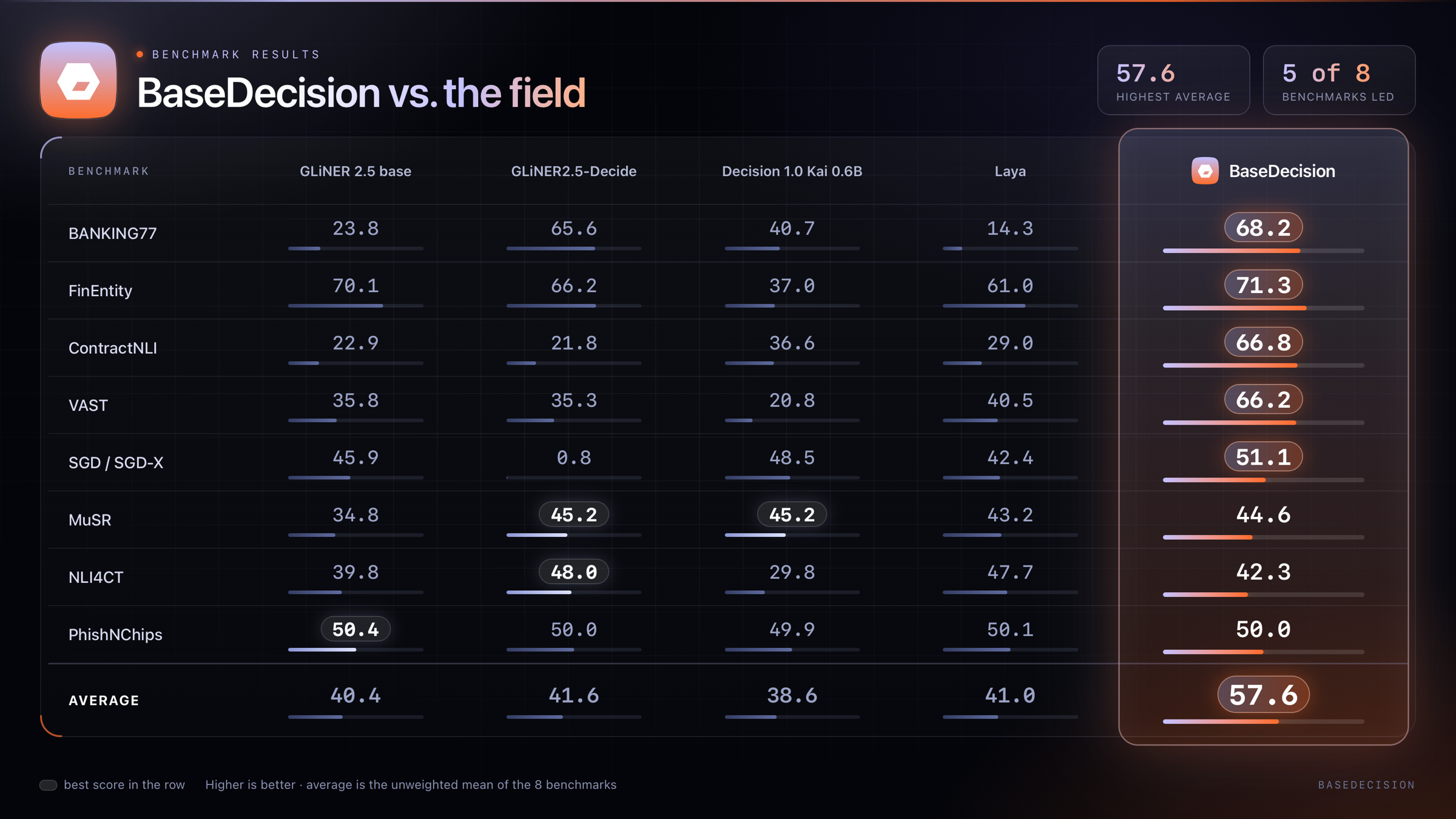
- Highest average: 57.6, against 38.6 to 41.6 for the other four models (the unweighted mean of the eight benchmarks).
- Ahead on five benchmarks: BANKING77, FinEntity, ContractNLI, VAST and SGD/SGD-X, by 1.2 to 30.2 points. The largest gaps are on ContractNLI and VAST.
- Behind on two: MuSR (44.6 against 45.2) and NLI4CT (42.3 against 48.0).
- PhishNChips does not separate the models: all five score between 49.9 and 50.4.
Treat this as a guide, not a guarantee. How a decision model does depends on the task and the wording of its questions, so try it on a sample of your own before relying on it. The probabilities it returns are raw softmax values, not calibrated confidence (see Calibration).
Examples
These examples reuse the model from above.
Yes or no: check
result = model.check(context='The account is active.', question='Is the account active?')
print(result.answer)   # True (a real Python bool)
A rating: score
result = model.score(context='I am satisfied.', question='How satisfied is the customer?',
                     levels=['Dissatisfied', 'Neutral', 'Satisfied'], values=[1, 2, 3])
print(result.answer, round(result.expected_value, 2))   # Satisfied 3.0
Several questions about one text: decide
from basedecision import decide

answers = decide(model, context='I was charged twice. Please refund the duplicate payment.',
                 questions={
                     'intent': {'kind': 'choice', 'question': 'What does the customer request?',
                                'options': ['Refund request', 'Delivery status', 'Other']},
                     'duplicate': {'kind': 'noul', 'question': 'Was the customer charged twice?'},
                 })
print(answers['intent'].answer, answers['duplicate'].answer)   # Refund request True
kind is choice, noul (yes/no) or score. Each question is answered independently.
Options with descriptions: Option
Plain strings are fine. If a label is ambiguous, add a description:
from basedecision import Option

result = model.choose(context='Where is my parcel?', question='What is requested?',
                      options=[Option('refund', 'Customer wants money back'),
                               Option('status', 'Customer asks where the parcel is')])
print(result.answer, '-', result.label)   # status - Customer asks where the parcel is
Many texts at once: predict_batch, predict_iter
from basedecision import Request

options = (Option('refund', 'Refund'), Option('status', 'Delivery status'))
requests = [Request('Please refund this purchase.', 'What is requested?', options),
            Request('Where is my parcel?', 'What is requested?', options)]
print([r.answer for r in model.predict_batch(requests)])    # ['refund', 'status']
for result in model.predict_iter(requests):                 # same, one at a time, for long streams
    print(result.answer)
Everything in a result
print(model.choose(context='Please refund my purchase.', question='What is requested?',
                   options=['Refund', 'Other']).to_dict())
# answer, option_id, label, probabilities, raw_logits, packed_tokens, kind, ...  (plain JSON types)
probabilities are the model's raw softmax, not calibrated.
Download the model from Hugging Face: load_from_hub
The repository name is a placeholder until the model is published.
from basedecision import load_from_hub

model = load_from_hub('YOUR_NAMESPACE/YOUR_MODEL', revision='YOUR_COMMIT_HASH')
A commit hash pins the exact weights. Add local_files_only=True to use only the local cache. Sign-in
uses the standard Hugging Face setup; no remote Python code is ever run.
Force the CPU or the GPU
model = load('/path/to/model', device='cpu', precision='fp32')
print(model.device, model.precision)    # cpu fp32
# load('/path/to/model', device='cuda')   # force the GPU; an error if there is none
load picks CUDA with BF16 when a suitable NVIDIA GPU exists, else the CPU with FP32. An explicit
choice is never second-guessed. Rough CPU timings on one 10-core Apple-silicon laptop (a guide, not a
benchmark):
| Text length | Time per answer | Peak memory |
|---|---|---|
| short (a few dozen tokens) | ~0.05 s | ~2 GiB |
| 512 tokens | ~0.4 s | ~2 GiB |
| 4,096 tokens | ~8 s | ~5 GiB |
| 8,191 tokens (the limit) | ~30 s | ~8 GiB |
Experimental CPU mode: cpu_fast
from basedecision import load, CPUFastUnavailable

try:
    model = load('/path/to/model', backend='cpu_fast')
except CPUFastUnavailable:                  # unsupported Torch/Transformers: nothing is changed
    model = load('/path/to/model')          # the normal CPU path
Opt-in and experimental: it checks itself at load time and never falls back silently. It needs
Transformers 4.48 to 4.57, and a fresh pip install basedecision brings Transformers 5, where it
politely refuses and the fallback above takes over (pip install "transformers<5" to try it). It was
developed on an Intel Xeon server and was 10-15x slower than the default on an Apple-silicon laptop,
so measure before you use it. See CPU support and limitations.
OpenAI or Anthropic instead of the local model
export OPENAI_API_KEY=... # or ANTHROPIC_API_KEY
from basedecision import BaseDecision

with BaseDecision.from_provider('openai', 'YOUR_OPENAI_MODEL_ID') as cloud:
    result = cloud.choose(context='Please refund this purchase.',
                          question='What does the customer request?',
                          options=['Refund request', 'Delivery status', 'Other request'])
    print(result.answer)   # same methods as the local model; swap in 'anthropic' for Anthropic
Your text is sent to that provider, and never as an automatic fallback. Cloud results have no
probabilities (result.probabilities is None). Reasoning models, errors, retries and costs:
docs/CLOUD.md.
Calibrated probabilities (optional, GPU only)
Raw probabilities are the default. For the assessed SGD service-intent workloads only, you can opt in
to calibrated ones. This needs a CUDA GPU with BF16 and handles choice questions only.
from basedecision import CalibratedDecision, calibration_profiles

print(list(calibration_profiles()))   # ['clinc', 'sgd_identifier', 'sgd_schema', 'vast']
calibrated = CalibratedDecision(model, profile='sgd_schema')   # raises on a CPU-only machine
result = calibrated.predict(sgd_request)    # a correctly formatted SGD request
print(result.probabilities, result.raw_probabilities)
These profiles do not apply to other questions. Coverage and caveats: docs/CALIBRATION.md.
Answer Jev / SystemOne requests: SystemOne
For the Jev/SystemOne wire format (a state and typed questions):
from basedecision import SystemOne

service = SystemOne(model)
response = service({'model': 'basedecision',
                    'state': 'Our checkout started returning errors and orders are blocked.',
                    'questions': {
                        'department': {'type': 'choice', 'instructions': 'Which team should handle it?',
                                       'criteria': {'billing': 'Payments or invoices',
                                                    'technical': 'Bugs or outages'}},
                        'outage': {'type': 'noul', 'instructions': 'Is a service down?'}}})
print(response['answers']['department']['choice'])   # technical
Or serve it over HTTP with the reference server in the repository's examples/ folder (bound to
localhost; see docs/SYSTEMONE.md before exposing it):
python examples/systemone_server.py --model /path/to/model
curl -s localhost:8080/v1/systemone -H 'Content-Type: application/json' \
  -d '{"model":"basedecision","state":"I was charged twice. Please refund me.","questions":{"refund":{"type":"noul","instructions":"Does the customer want a refund?"}}}'
Text only, one forward pass per question, no truncation, and no cloud providers (they return no probabilities).
Free the memory when you are done: close
with load('/path/to/model') as scratch:     # the weights are freed when the block ends
    print(scratch.check(context='The account is active.', question='Is the account active?').answer)   # True
print(scratch.closed)   # True: asking a closed model for an answer raises InputError
model.close() does the same without a with block, and is safe to call twice. It waits for a request
that is running, then frees the weights and, on a GPU, the memory they held. The cloud backend and
cpu_fast models work the same way.
Limits and errors
from basedecision import ContextLengthError, InputError

print(model.count_tokens(requests[0]))   # 22: how many tokens a request uses, before you run it
try:
    model.choose(context='word ' * 20000, question='Which?', options=['a', 'b'])
except ContextLengthError as error:
    print(error.required_tokens, error.maximum_tokens)   # 20014 8192
except InputError as error:                              # bad options, wrong types, duplicates
    print(error)
- The limit is 8,192 tokens in total: the question, every option and the text. Nothing is ever
silently truncated; an over-long input is a
ContextLengthErroryou can handle, for example by splitting the text. InputErrormeans the request itself is wrong. The context must be a string (serialize structured data yourself), and option ids and labels must be distinct.- A cloud call that fails raises
ProviderErrorwithcode,retryableandstatus_code, and never includes your key or text (docs/CLOUD.md). - A refused or invalid answer is an error, never a guessed label or a silent
False.
More
- Python API reference · Calibration · CPU mode · Cloud backends · Jev / SystemOne
- Benchmarks · Security · Changelog · Contributing
- Runnable scripts, in the repository's
examples/folder:python_quickstart.py,decide.py,systemone_quickstart.py,systemone_server.py.
From a clone of the repository, to run the tests:
python -m unittest discover -s tests -v                                          # no model needed
BASEDECISION_TEST_MODEL=/path/to/model python -m unittest discover -s tests -v   # + the real model
With a checkpoint, the tests run the examples above in order and check the output they print. The Hugging Face, cloud and GPU-calibration examples cannot run on a laptop, so they are only checked for syntax and imports.
BaseDecision is a decision model (ModernBERT-large encoder with a typed decision head, 8,192-token
window). It has no .generate(), no AutoModelForCausalLM, no chat endpoint, and no reasoning
comparable to a general chat model.
License
Apache 2.0. Developed by Hrudayaditya "Aady" Jallu.
Similar repos





See what people are saying
README
BaseDecision
Ask a question about a text. Get the answer and how sure the model is. Pick one option, answer yes/no, or give a rating, for texts up to 8,192 tokens. It runs on your own laptop or GPU, with no API key, or through OpenAI/Anthropic. It is a classifier, not a chatbot: it never writes text, it chooses among the answers you give it.
Install
pip install basedecision # needs Python 3.10+
That is all. It installs everything the examples below use, including PyTorch, so the first download is large. An NVIDIA GPU is used automatically; Apple-silicon Macs run the model on the CPU.
Already manage your own PyTorch and Transformers, or want a lean environment? Run
pip install --no-deps basedecision and add only what you use: torch, transformers, safetensors and
tokenizers for the local model, huggingface-hub for load_from_hub, openai and anthropic for the
cloud backends. A missing package gives an error that says what to install. Working from a clone of the
repository instead? Run pip install . inside it.
Try it
from basedecision import load

model = load('/path/to/model')   # the folder with model.safetensors; GPU if you have one, else CPU
result = model.choose(context='Please refund my purchase.',
                      question='What does the customer request?',
                      options=['Refund', 'Delivery status', 'Change address'])
print(result.answer)          # Refund
print(result.probabilities)   # Refund is about 0.99999, the other two about 0.000002
Loading takes 5 to 25 seconds, depending on your PyTorch version, and ~2 GiB of RAM; each answer takes about 0.05 s on a laptop CPU for short texts. No flags are needed.
How it performs
BaseDecision against GLiNER 2.5 base, GLiNER2.5-Decide, Decision 1.0 Kai 0.6B and Laya on eight benchmarks (higher is better):
- Highest average: 57.6, against 38.6 to 41.6 for the other four models (the unweighted mean of the eight benchmarks).
- Ahead on five benchmarks: BANKING77, FinEntity, ContractNLI, VAST and SGD/SGD-X, by 1.2 to 30.2 points. The largest gaps are on ContractNLI and VAST.
- Behind on two: MuSR (44.6 against 45.2) and NLI4CT (42.3 against 48.0).
- PhishNChips does not separate the models: all five score between 49.9 and 50.4.
Treat this as a guide, not a guarantee. How a decision model does depends on the task and the wording of its questions, so try it on a sample of your own before relying on it. The probabilities it returns are raw softmax values, not calibrated confidence (see Calibration).
Examples
These examples reuse the model from above.
Yes or no: check
result = model.check(context='The account is active.', question='Is the account active?')
print(result.answer)   # True (a real Python bool)
A rating: score
result = model.score(context='I am satisfied.', question='How satisfied is the customer?',
                     levels=['Dissatisfied', 'Neutral', 'Satisfied'], values=[1, 2, 3])
print(result.answer, round(result.expected_value, 2))   # Satisfied 3.0
Several questions about one text: decide
from basedecision import decide

answers = decide(model, context='I was charged twice. Please refund the duplicate payment.',
                 questions={
                     'intent': {'kind': 'choice', 'question': 'What does the customer request?',
                                'options': ['Refund request', 'Delivery status', 'Other']},
                     'duplicate': {'kind': 'noul', 'question': 'Was the customer charged twice?'},
                 })
print(answers['intent'].answer, answers['duplicate'].answer)   # Refund request True
kind is choice, noul (yes/no) or score. Each question is answered independently.
Options with descriptions: Option
Plain strings are fine. If a label is ambiguous, add a description:
from basedecision import Option

result = model.choose(context='Where is my parcel?', question='What is requested?',
                      options=[Option('refund', 'Customer wants money back'),
                               Option('status', 'Customer asks where the parcel is')])
print(result.answer, '-', result.label)   # status - Customer asks where the parcel is
Many texts at once: predict_batch, predict_iter
from basedecision import Request

options = (Option('refund', 'Refund'), Option('status', 'Delivery status'))
requests = [Request('Please refund this purchase.', 'What is requested?', options),
            Request('Where is my parcel?', 'What is requested?', options)]
print([r.answer for r in model.predict_batch(requests)])    # ['refund', 'status']
for result in model.predict_iter(requests):                 # same, one at a time, for long streams
    print(result.answer)
Everything in a result
print(model.choose(context='Please refund my purchase.', question='What is requested?',
                   options=['Refund', 'Other']).to_dict())
# answer, option_id, label, probabilities, raw_logits, packed_tokens, kind, ...  (plain JSON types)
probabilities are the model's raw softmax, not calibrated.
Download the model from Hugging Face: load_from_hub
The repository name is a placeholder until the model is published.
from basedecision import load_from_hub

model = load_from_hub('YOUR_NAMESPACE/YOUR_MODEL', revision='YOUR_COMMIT_HASH')
A commit hash pins the exact weights. Add local_files_only=True to use only the local cache. Sign-in
uses the standard Hugging Face setup; no remote Python code is ever run.
Force the CPU or the GPU
model = load('/path/to/model', device='cpu', precision='fp32')
print(model.device, model.precision)    # cpu fp32
# load('/path/to/model', device='cuda')   # force the GPU; an error if there is none
load picks CUDA with BF16 when a suitable NVIDIA GPU exists, else the CPU with FP32. An explicit
choice is never second-guessed. Rough CPU timings on one 10-core Apple-silicon laptop (a guide, not a
benchmark):
| Text length | Time per answer | Peak memory |
|---|---|---|
| short (a few dozen tokens) | ~0.05 s | ~2 GiB |
| 512 tokens | ~0.4 s | ~2 GiB |
| 4,096 tokens | ~8 s | ~5 GiB |
| 8,191 tokens (the limit) | ~30 s | ~8 GiB |
Experimental CPU mode: cpu_fast
from basedecision import load, CPUFastUnavailable

try:
    model = load('/path/to/model', backend='cpu_fast')
except CPUFastUnavailable:                  # unsupported Torch/Transformers: nothing is changed
    model = load('/path/to/model')          # the normal CPU path
Opt-in and experimental: it checks itself at load time and never falls back silently. It needs
Transformers 4.48 to 4.57, and a fresh pip install basedecision brings Transformers 5, where it
politely refuses and the fallback above takes over (pip install "transformers<5" to try it). It was
developed on an Intel Xeon server and was 10-15x slower than the default on an Apple-silicon laptop,
so measure before you use it. See CPU support and limitations.
OpenAI or Anthropic instead of the local model
export OPENAI_API_KEY=... # or ANTHROPIC_API_KEY
from basedecision import BaseDecision

with BaseDecision.from_provider('openai', 'YOUR_OPENAI_MODEL_ID') as cloud:
    result = cloud.choose(context='Please refund this purchase.',
                          question='What does the customer request?',
                          options=['Refund request', 'Delivery status', 'Other request'])
    print(result.answer)   # same methods as the local model; swap in 'anthropic' for Anthropic
Your text is sent to that provider, and never as an automatic fallback. Cloud results have no
probabilities (result.probabilities is None). Reasoning models, errors, retries and costs:
docs/CLOUD.md.
Calibrated probabilities (optional, GPU only)
Raw probabilities are the default. For the assessed SGD service-intent workloads only, you can opt in
to calibrated ones. This needs a CUDA GPU with BF16 and handles choice questions only.
from basedecision import CalibratedDecision, calibration_profiles

print(list(calibration_profiles()))   # ['clinc', 'sgd_identifier', 'sgd_schema', 'vast']
calibrated = CalibratedDecision(model, profile='sgd_schema')   # raises on a CPU-only machine
result = calibrated.predict(sgd_request)    # a correctly formatted SGD request
print(result.probabilities, result.raw_probabilities)
These profiles do not apply to other questions. Coverage and caveats: docs/CALIBRATION.md.
Answer Jev / SystemOne requests: SystemOne
For the Jev/SystemOne wire format (a state and typed questions):
from basedecision import SystemOne

service = SystemOne(model)
response = service({'model': 'basedecision',
                    'state': 'Our checkout started returning errors and orders are blocked.',
                    'questions': {
                        'department': {'type': 'choice', 'instructions': 'Which team should handle it?',
                                       'criteria': {'billing': 'Payments or invoices',
                                                    'technical': 'Bugs or outages'}},
                        'outage': {'type': 'noul', 'instructions': 'Is a service down?'}}})
print(response['answers']['department']['choice'])   # technical
Or serve it over HTTP with the reference server in the repository's examples/ folder (bound to
localhost; see docs/SYSTEMONE.md before exposing it):
python examples/systemone_server.py --model /path/to/model
curl -s localhost:8080/v1/systemone -H 'Content-Type: application/json' \
  -d '{"model":"basedecision","state":"I was charged twice. Please refund me.","questions":{"refund":{"type":"noul","instructions":"Does the customer want a refund?"}}}'
Text only, one forward pass per question, no truncation, and no cloud providers (they return no probabilities).
Free the memory when you are done: close
with load('/path/to/model') as scratch:     # the weights are freed when the block ends
    print(scratch.check(context='The account is active.', question='Is the account active?').answer)   # True
print(scratch.closed)   # True: asking a closed model for an answer raises InputError
model.close() does the same without a with block, and is safe to call twice. It waits for a request
that is running, then frees the weights and, on a GPU, the memory they held. The cloud backend and
cpu_fast models work the same way.
Limits and errors
from basedecision import ContextLengthError, InputError

print(model.count_tokens(requests[0]))   # 22: how many tokens a request uses, before you run it
try:
    model.choose(context='word ' * 20000, question='Which?', options=['a', 'b'])
except ContextLengthError as error:
    print(error.required_tokens, error.maximum_tokens)   # 20014 8192
except InputError as error:                              # bad options, wrong types, duplicates
    print(error)
- The limit is 8,192 tokens in total: the question, every option and the text. Nothing is ever
silently truncated; an over-long input is a
ContextLengthErroryou can handle, for example by splitting the text. InputErrormeans the request itself is wrong. The context must be a string (serialize structured data yourself), and option ids and labels must be distinct.- A cloud call that fails raises
ProviderErrorwithcode,retryableandstatus_code, and never includes your key or text (docs/CLOUD.md). - A refused or invalid answer is an error, never a guessed label or a silent
False.
More
- Python API reference · Calibration · CPU mode · Cloud backends · Jev / SystemOne
- Benchmarks · Security · Changelog · Contributing
- Runnable scripts, in the repository's
examples/folder:python_quickstart.py,decide.py,systemone_quickstart.py,systemone_server.py.
From a clone of the repository, to run the tests:
python -m unittest discover -s tests -v                                          # no model needed
BASEDECISION_TEST_MODEL=/path/to/model python -m unittest discover -s tests -v   # + the real model
With a checkpoint, the tests run the examples above in order and check the output they print. The Hugging Face, cloud and GPU-calibration examples cannot run on a laptop, so they are only checked for syntax and imports.
BaseDecision is a decision model (ModernBERT-large encoder with a typed decision head, 8,192-token
window). It has no .generate(), no AutoModelForCausalLM, no chat endpoint, and no reasoning
comparable to a general chat model.
License
Apache 2.0. Developed by Hrudayaditya "Aady" Jallu.