
VisualCloze: A Universal Image Generation Framework via Visual In-Context Learning
19
38 commits
11 linked in READMEs
updated Jan 7, 2026
README
VisualCloze: A Universal Image Generation Framework via Visual In-Context Learning
[Paper] [Project Page] [Github]
Graph200k is a large-scale dataset containing a wide range of distinct tasks of image generation.
If you find Graph200k is helpful, please consider to star ⭐ the Github Repo. Thanks!
📰 News
- [2025-5-15] 🤗🤗🤗 VisualCloze has been merged into the official pipelines of diffusers. For usage guidance, please refer to the Model Card.
- [2025-5-18] 🥳🥳🥳 We have released the LoRA weights supporting diffusers at LoRA Model Card 384 and LoRA Model Card 512.
🌠 Key Features
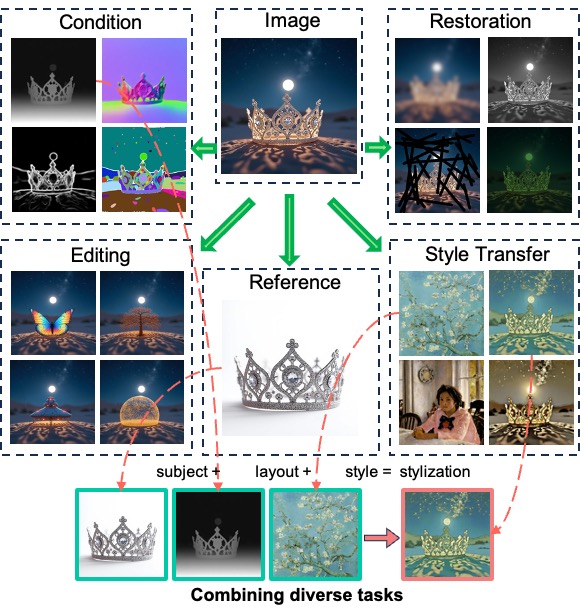
- Each image is annotated for five meta-tasks, including 1) conditional generation, 2) image restoration, 3) image editing, 4) IP preservation, and 5) style transfer.
- Using these tasks, we can also combine a wide range of complex tasks. For example, Style+Subject+Layout to Image as shown below.
🔥 Quick Start
Uasge
import datasets
grapth200k = datasets.load_dataset("lzyhha/test") # todo
train = grapth200k['train']
test = grapth200k['test']
# Reading depth map (PIL.Image) of the first image in the train set
train[0]['depth'].save(f'depth.jpg')
Quality filtering
Graph200K is built based on Subjects200K,
which provides quality scores.
In our VisualCloze method, we filter out image pairs that exhibit low subject consistency, specifically those where objectConsistency <= 3.
Annotations
In each item of the dataset, there are annotations as follows. We leave the discussions about data construction in our paper.
| Item | Meaning |
|---|---|
| ref | Inherited from Subjects200K, it depicts the subject object in the target image. |
| target | The original image inherited from Subjects200K. |
| InstantStyle_image_[0-3] | Stylized images with invariant semantics. |
| InstantStyle_ref_[0-3] | Style reference for InstantStyle. |
| ReduxStyle_image_[0-3] | Stylized images with variant semantics. |
| ReduxStyle_ref_[0-3] | Style reference for ReduxStyle. |
| FillEdit_image_[0-5] | Edited image with invariant background. |
| FillEdit_meta | The name and descripation of the new subject object after editing. |
| DepthEdit | Edited image with variant background. |
| qwen_2_5_mask | A high-quality segmentation mask generated by the Qwen-2.5-VL and SAM2. |
| qwen_2_5_bounding_box | The bounding boxes generated by the Qwen-2.5-VL. |
| qwen_2_5_meta | The coordinate and object name of each bounding box. And the mask color corresponding ro each box. |
| sam2_mask | A mask generated by the SAM2 model. |
| uniformer | The semantic segmentation generated by UniFormer. |
| foreground | The foreground mask generated by RMBG-2.0. |
| normal | Surface normal estimation generated by DSINE |
| depth | The depth estimation by Depth Anything V2. |
| canny | Edge detection in images, using the Canny edge detector. |
| hed | Edge detection in images, using the HED detector. |
| mlsd | Line segments generated using M-LSD. |
| openpose | Human keypoints generated by OpenPose |
Citation
If you find VisualCloze useful for your research and applications, please cite using this BibTeX:
@InProceedings{Li_2025_ICCV,
    author    = {Li, Zhong-Yu and Du, Ruoyi and Yan, Juncheng and Zhuo, Le and Li, Zhen and Gao, Peng and Ma, Zhanyu and Cheng, Ming-Ming},
    title     = {VisualCloze: A Universal Image Generation Framework via Visual In-Context Learning},
    booktitle = {Proceedings of the IEEE/CVF International Conference on Computer Vision (ICCV)},
    month     = {October},
    year      = {2025},
    pages     = {18969-18979}
}


Similar repos



Linked in READMEs


VisualCloze: A Universal Image Generation Framework via Visual In-Context Learning
19
38 commits
11 linked in READMEs
updated Jan 7, 2026
README
VisualCloze: A Universal Image Generation Framework via Visual In-Context Learning
[Paper] [Project Page] [Github]
Graph200k is a large-scale dataset containing a wide range of distinct tasks of image generation.
If you find Graph200k is helpful, please consider to star ⭐ the Github Repo. Thanks!
📰 News
- [2025-5-15] 🤗🤗🤗 VisualCloze has been merged into the official pipelines of diffusers. For usage guidance, please refer to the Model Card.
- [2025-5-18] 🥳🥳🥳 We have released the LoRA weights supporting diffusers at LoRA Model Card 384 and LoRA Model Card 512.
🌠 Key Features
- Each image is annotated for five meta-tasks, including 1) conditional generation, 2) image restoration, 3) image editing, 4) IP preservation, and 5) style transfer.
- Using these tasks, we can also combine a wide range of complex tasks. For example, Style+Subject+Layout to Image as shown below.
🔥 Quick Start
Uasge
import datasets
grapth200k = datasets.load_dataset("lzyhha/test") # todo
train = grapth200k['train']
test = grapth200k['test']
# Reading depth map (PIL.Image) of the first image in the train set
train[0]['depth'].save(f'depth.jpg')
Quality filtering
Graph200K is built based on Subjects200K,
which provides quality scores.
In our VisualCloze method, we filter out image pairs that exhibit low subject consistency, specifically those where objectConsistency <= 3.
Annotations
In each item of the dataset, there are annotations as follows. We leave the discussions about data construction in our paper.
| Item | Meaning |
|---|---|
| ref | Inherited from Subjects200K, it depicts the subject object in the target image. |
| target | The original image inherited from Subjects200K. |
| InstantStyle_image_[0-3] | Stylized images with invariant semantics. |
| InstantStyle_ref_[0-3] | Style reference for InstantStyle. |
| ReduxStyle_image_[0-3] | Stylized images with variant semantics. |
| ReduxStyle_ref_[0-3] | Style reference for ReduxStyle. |
| FillEdit_image_[0-5] | Edited image with invariant background. |
| FillEdit_meta | The name and descripation of the new subject object after editing. |
| DepthEdit | Edited image with variant background. |
| qwen_2_5_mask | A high-quality segmentation mask generated by the Qwen-2.5-VL and SAM2. |
| qwen_2_5_bounding_box | The bounding boxes generated by the Qwen-2.5-VL. |
| qwen_2_5_meta | The coordinate and object name of each bounding box. And the mask color corresponding ro each box. |
| sam2_mask | A mask generated by the SAM2 model. |
| uniformer | The semantic segmentation generated by UniFormer. |
| foreground | The foreground mask generated by RMBG-2.0. |
| normal | Surface normal estimation generated by DSINE |
| depth | The depth estimation by Depth Anything V2. |
| canny | Edge detection in images, using the Canny edge detector. |
| hed | Edge detection in images, using the HED detector. |
| mlsd | Line segments generated using M-LSD. |
| openpose | Human keypoints generated by OpenPose |
Citation
If you find VisualCloze useful for your research and applications, please cite using this BibTeX:
@InProceedings{Li_2025_ICCV,
    author    = {Li, Zhong-Yu and Du, Ruoyi and Yan, Juncheng and Zhuo, Le and Li, Zhen and Gao, Peng and Ma, Zhanyu and Cheng, Ming-Ming},
    title     = {VisualCloze: A Universal Image Generation Framework via Visual In-Context Learning},
    booktitle = {Proceedings of the IEEE/CVF International Conference on Computer Vision (ICCV)},
    month     = {October},
    year      = {2025},
    pages     = {18969-18979}
}