
README
MMFineReason
Closing the Multimodal Reasoning Gap via Open Data-Centric Methods



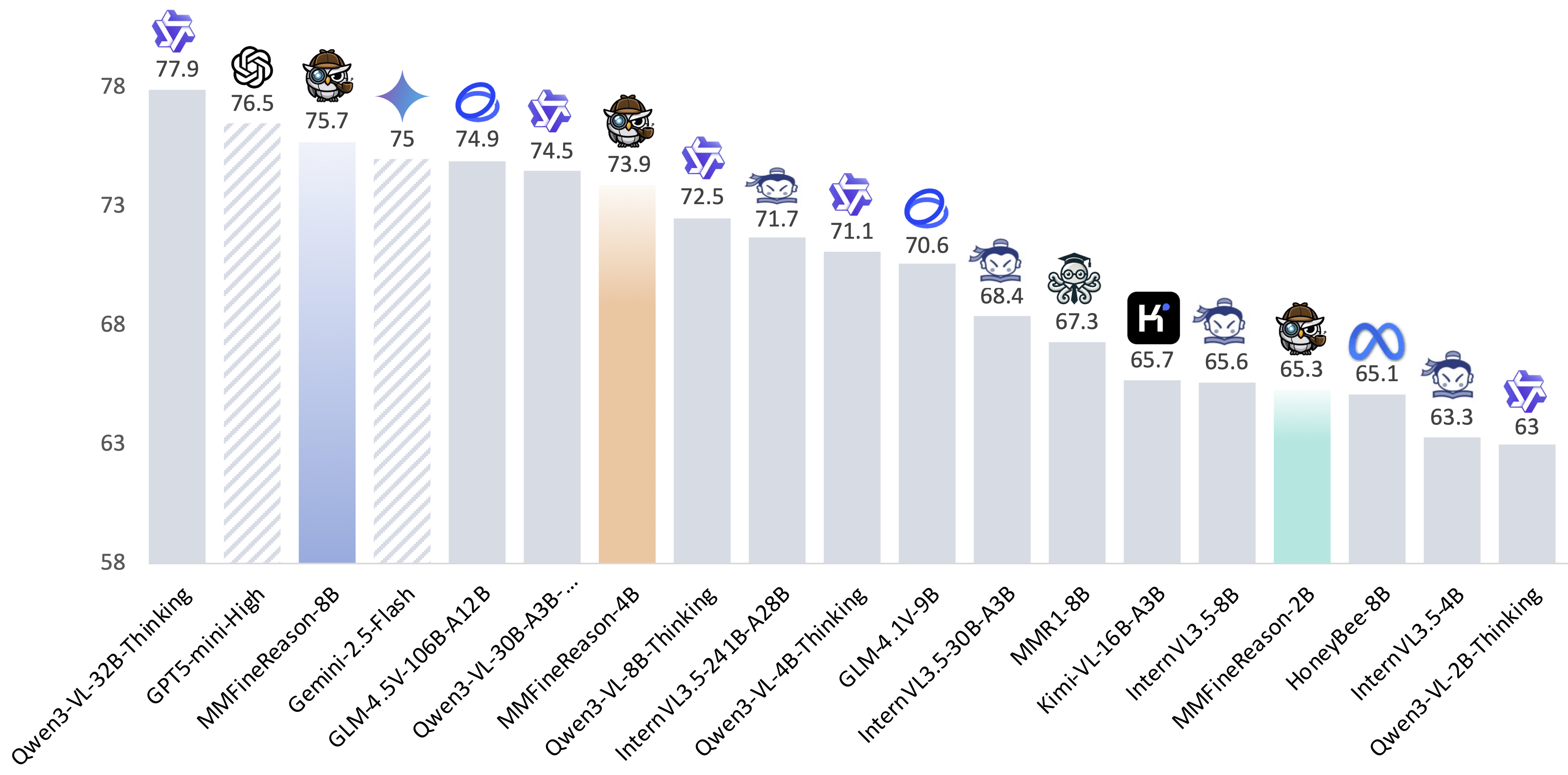 Average score across mathematical reasoning and multimodal understanding benchmarks.
📖 Overview
MMFineReason is a large-scale, high-quality multimodal reasoning dataset comprising 1.8M samples and 5.1B solution tokens, featuring detailed reasoning annotations distilled from Qwen3-VL-235B-A22B-Thinking.
🎯 Key Highlights
- 1.8M High-Quality Samples with 5.1B Solution Tokens
- Long-Form CoT: Average reasoning length of 2,910 tokens (2.7× HoneyBee, 4.3× OpenMMReasoner)
- 100% Caption Coverage: Dense visual descriptions averaging 609 tokens
- Multi-Domain: Mathematics (79.4%), Science (13.8%), Puzzle/Game (4.6%), General/OCR (2.2%)
- State-of-the-Art: Models trained on this dataset achieve SOTA performance in their size class
🏗️ Data Construction Pipeline
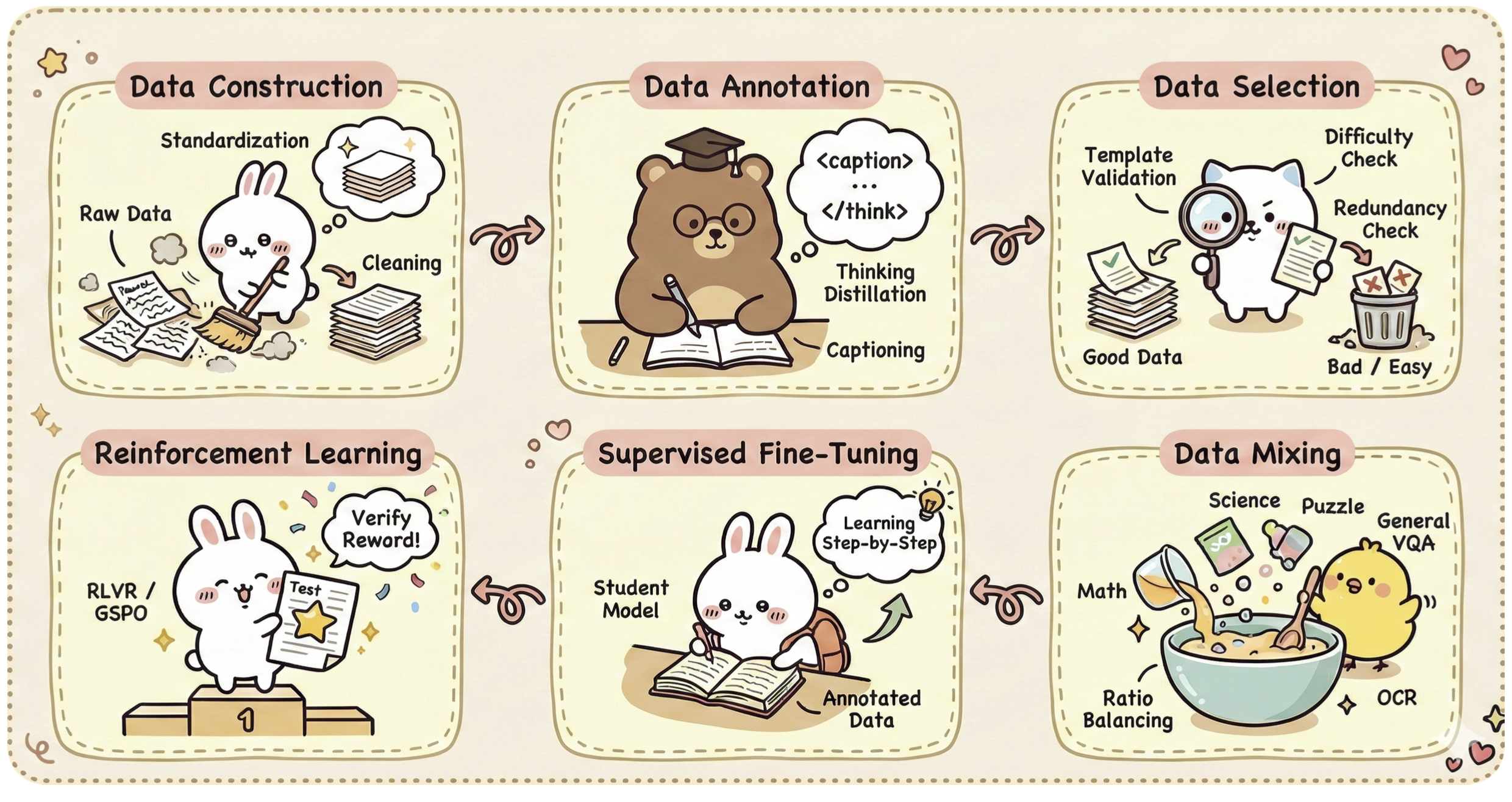 MMFineReason data pipeline and the two-stage training.
Stage 1: Data Collection & Standardization
- Aggregate diverse multimodal datasets from open-source community
- Translate non-English questions; remove noise and extraneous artifacts
- Rewrite shallow prompts into reasoning-encouraging instructions
- Filter non-reasoning tasks; clean corrupted/oversized images
Stage 2: Reasoning Distillation
- Teacher Model: Qwen3-VL-235B-A22B-Thinking
- Four-Phase Framework: Information Extraction → Problem Setup → Solution Execution → Validation
- Output: Reasoning in
<think>...</think>, final answer in<answer>...</answer> - Caption Generation: 100% coverage via Qwen3-VL-235B-A22B-Thinking
Stage 3: Data Selection
- Quality Filtering: Template/length validation, n-gram deduplication, correctness verification (~20% removed)
- Difficulty Filtering: Use Qwen3-VL-4B-Thinking pass rate as proxy
- MMFineReason-123K: Pass rate = 0 (hardest 7%)
- MMFineReason-586K: Pass rate ≠ 1 (challenging 33%)
🔧 Data Schema
| Field | Description |
|---|---|
source | Origin dataset name (e.g., "Geometry3K", "MMR1", "BMMR") |
id | Unique sample identifier within the source dataset |
original_question | Raw question text as obtained from the source |
original_answer | Raw answer as obtained from the source |
image | Visual input (PIL Image) |
question | Cleaned, standardized question in English |
answer | Verified answer extracted and standardized |
qwen3vl_235b_instruct_caption | Dense visual description generated by Qwen3-VL-235B-A22B-Instruct |
qwen3vl_235b_thinking_response | Long-form Chain-of-Thought reasoning generated by Qwen3-VL-235B-A22B-Thinking |
qwen3vl_4b_pass_rate | Difficulty proxy based on Qwen3-VL-4B-Thinking's performance (0.0 = hardest, 1.0 = easiest) |
is_consistent | Boolean indicating whether generated reasoning matches ground truth |
consistency_analysis | Detailed analysis of consistency verification |
🗂️ Dataset Composition
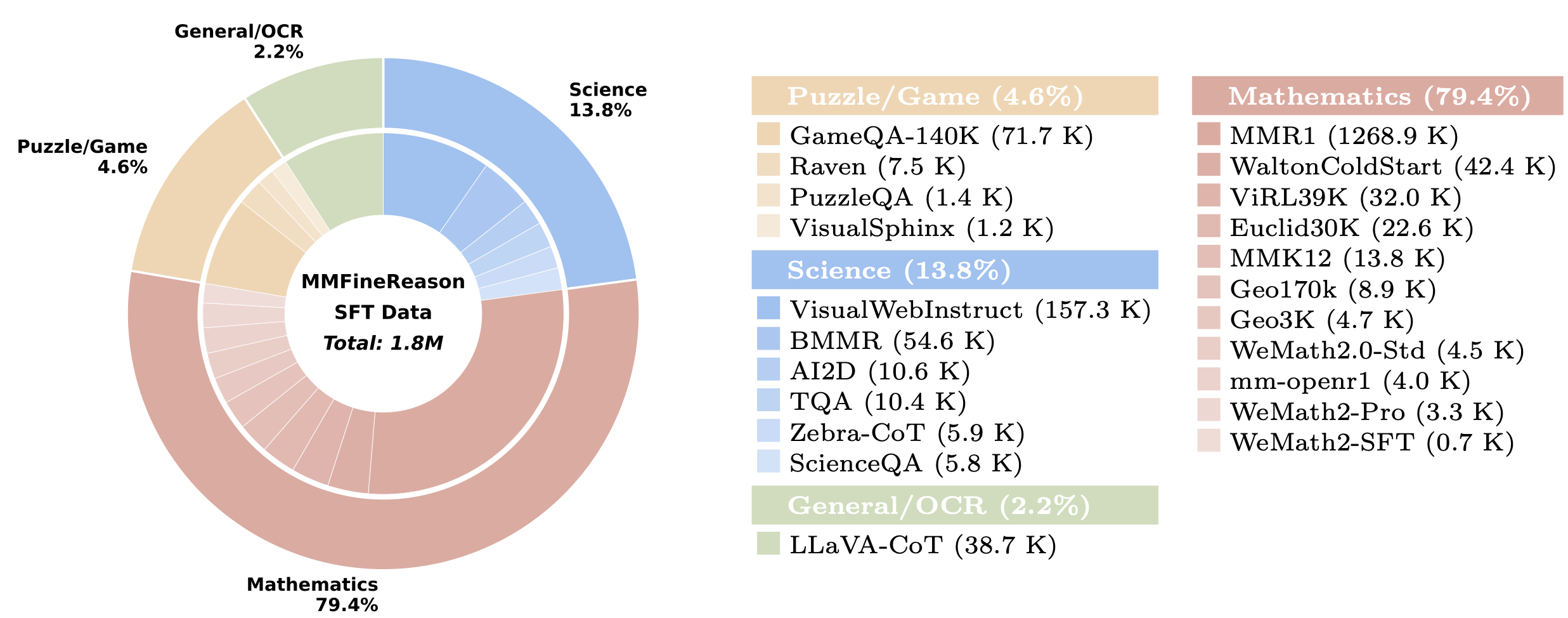 Dataset composition of MMFineReason-1.8M.
Mathematics (79.4%) forms the backbone, primarily sourced from MMR1 (1.27M) and enriched with WaltonColdStart, ViRL39K, Euclid30K, MMK12, Geo170K, Geo3K, mm-openr1, and the WeMath family.
Science (13.8%) is anchored by VisualWebInstruct (157.3K) and BMMR (54.6K), complemented by TQA, AI2D, Zebra-CoT, and ScienceQA.
Puzzle/Game (4.6%) targets strategic planning and abstract reasoning, dominated by GameQA-140K (71.7K) and enriched by Raven, VisualSphinx, and PuzzleQA.
General/OCR (2.2%) includes 38.7K samples from LLaVA-CoT, serving as regularization to preserve broad visual and OCR capabilities.
📊 Dataset Statistics
Token Length Comparison with Other Datasets
 Comparison of token length statistics across datasets.
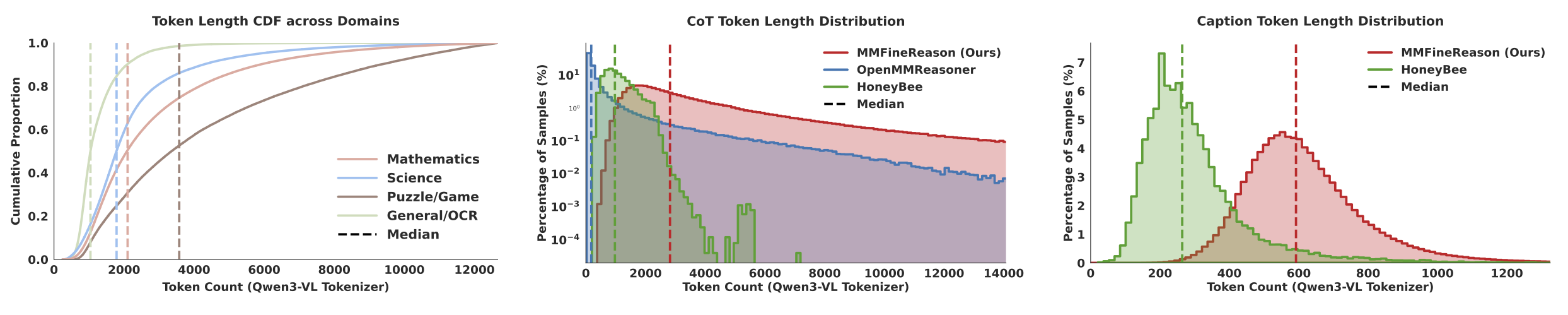 Token length analysis. (Left) Internal domain distribution; (Mid) External CoT comparison; (Right) Caption richness comparison.
MMFineReason achieves an average CoT length of 2,910 tokens—approximately 2.7× longer than HoneyBee and 4.3× longer than OpenMMReasoner. The extended tail (Max: 16,316) demonstrates capacity for highly complex, multi-stage reasoning tasks. For captions, MMFineReason averages 609 tokens with 100% coverage, compared to HoneyBee's 299 tokens at ~58% coverage.
🖼️ Image Category Distribution
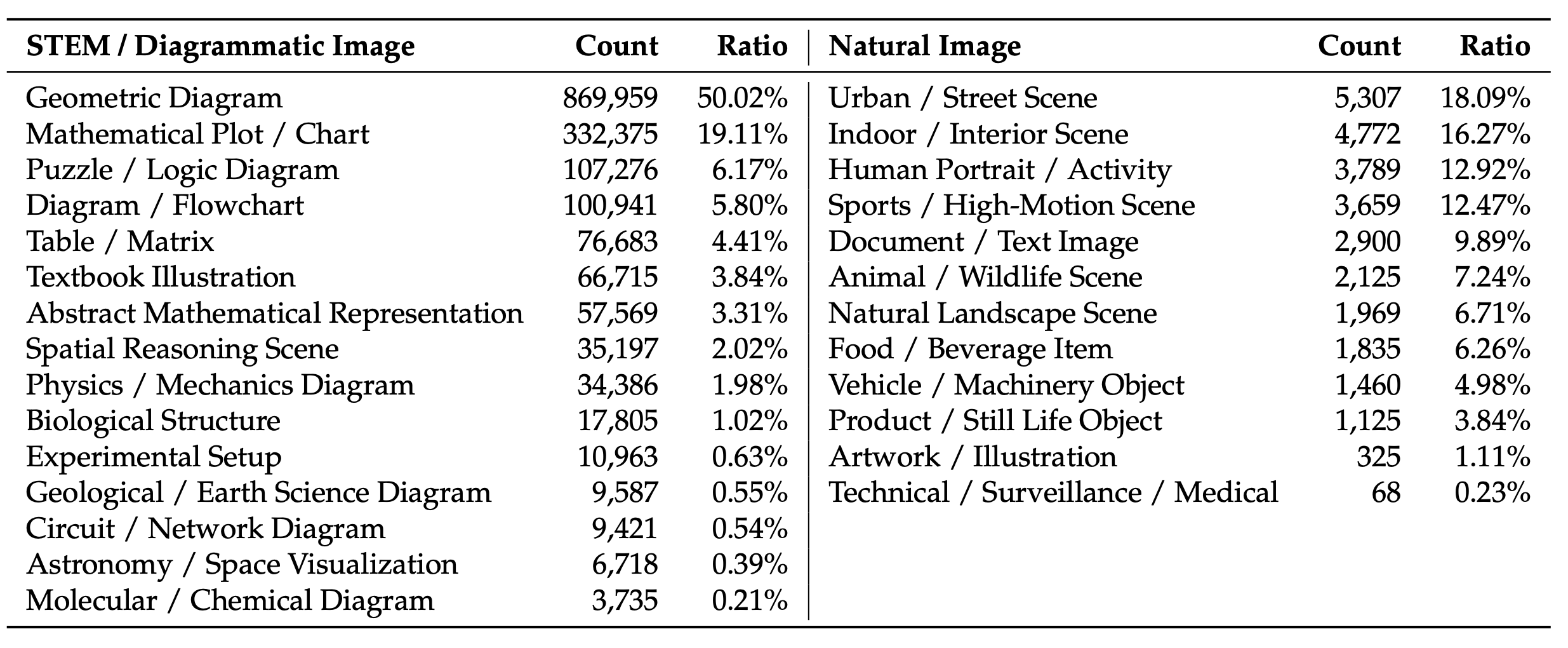 Image category statistics by group (STEM vs. Natural).
The corpus is predominantly STEM and diagrammatic content (98.3%), with geometric diagrams, mathematical plots, and logic puzzles accounting for 75.3%. Natural images (1.7%) provide diversity across urban scenes, indoor scenes, and human activities for generalization assessment.
📈 Difficulty Distribution
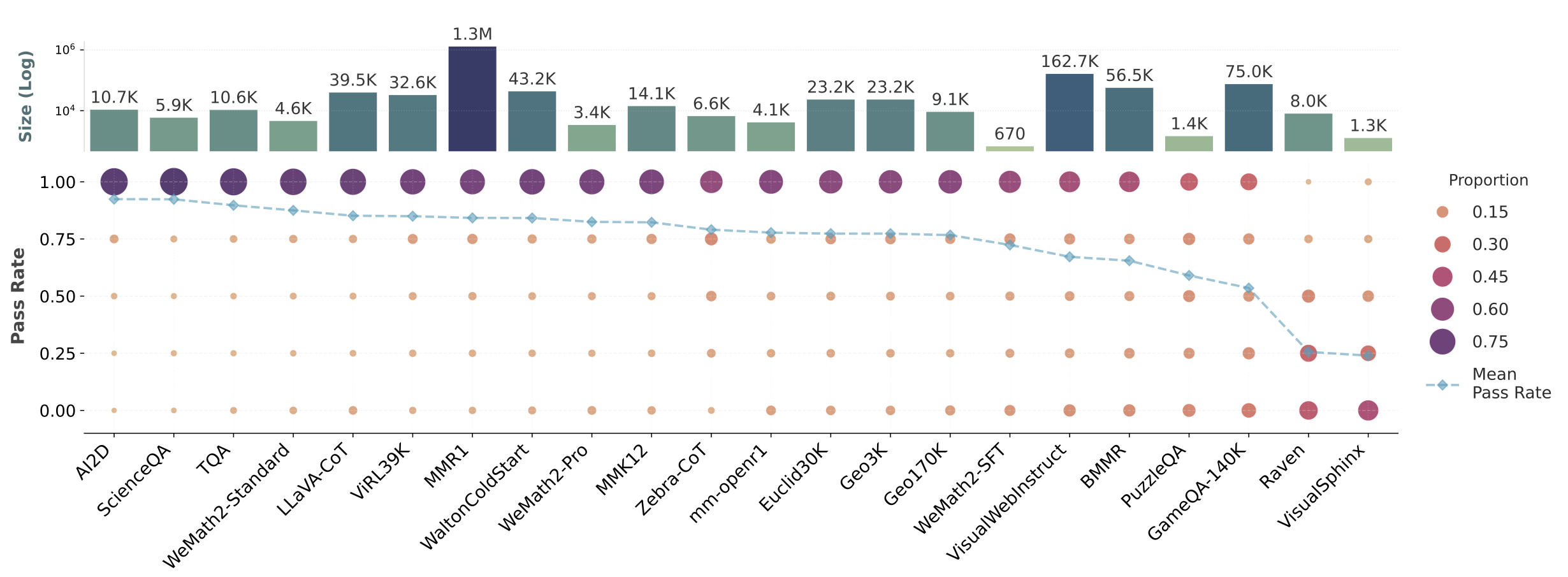 Pass rate distribution across sub-datasets, sorted by descending mean pass rate.
Science-oriented datasets (ScienceQA, AI2D, TQA) exhibit high pass rates due to clean diagrams and MCQ format. Puzzle/game datasets (GameQA-140K, Raven, VisualSphinx) show lowest pass rates, requiring multi-step abstract reasoning. The binary distribution pattern reflects that reasoning tasks often follow all-or-nothing outcomes.
📊 Benchmark Results
Main Results
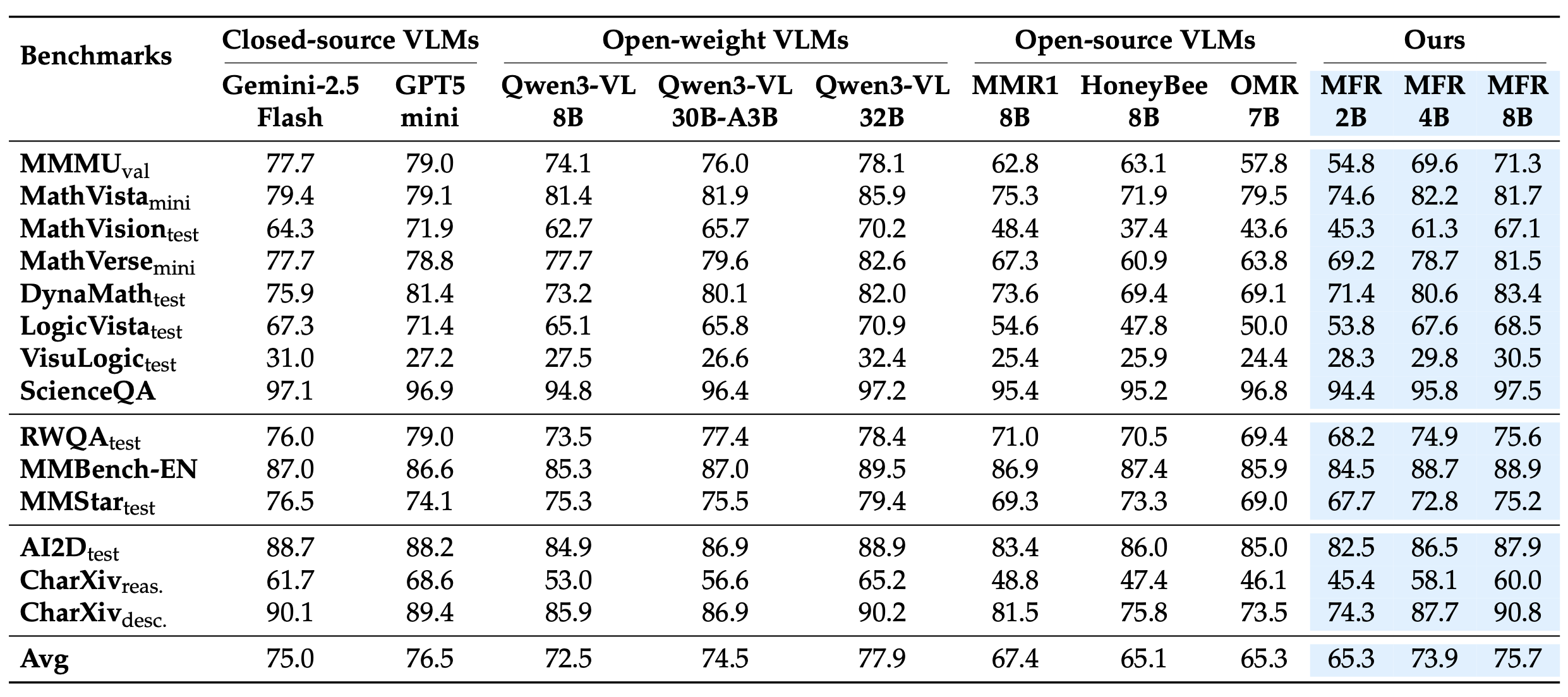 Comparison of MMFineReason models with state-of-the-art models.
MMFineReason-4B surpasses Qwen3-VL-8B-Thinking (73.9 vs 72.5), while MMFineReason-8B outperforms the larger Qwen3-VL-30B-A3B-Thinking (75.7 vs 74.5) and exceeds Gemini-2.5-Flash. On mathematical benchmarks, MFR-8B achieves 83.4% on DynaMath (vs Qwen3-VL-32B-Thinking's 82.0%) and 67.1% on MathVision, outperforming HoneyBee-8B and OMR-7B by 23-30 points. Despite minimal chart training data, MFR-8B generalizes well to CharXiv (90.8%) and RealWorldQA (75.6%).
SFT vs RL Training Analysis
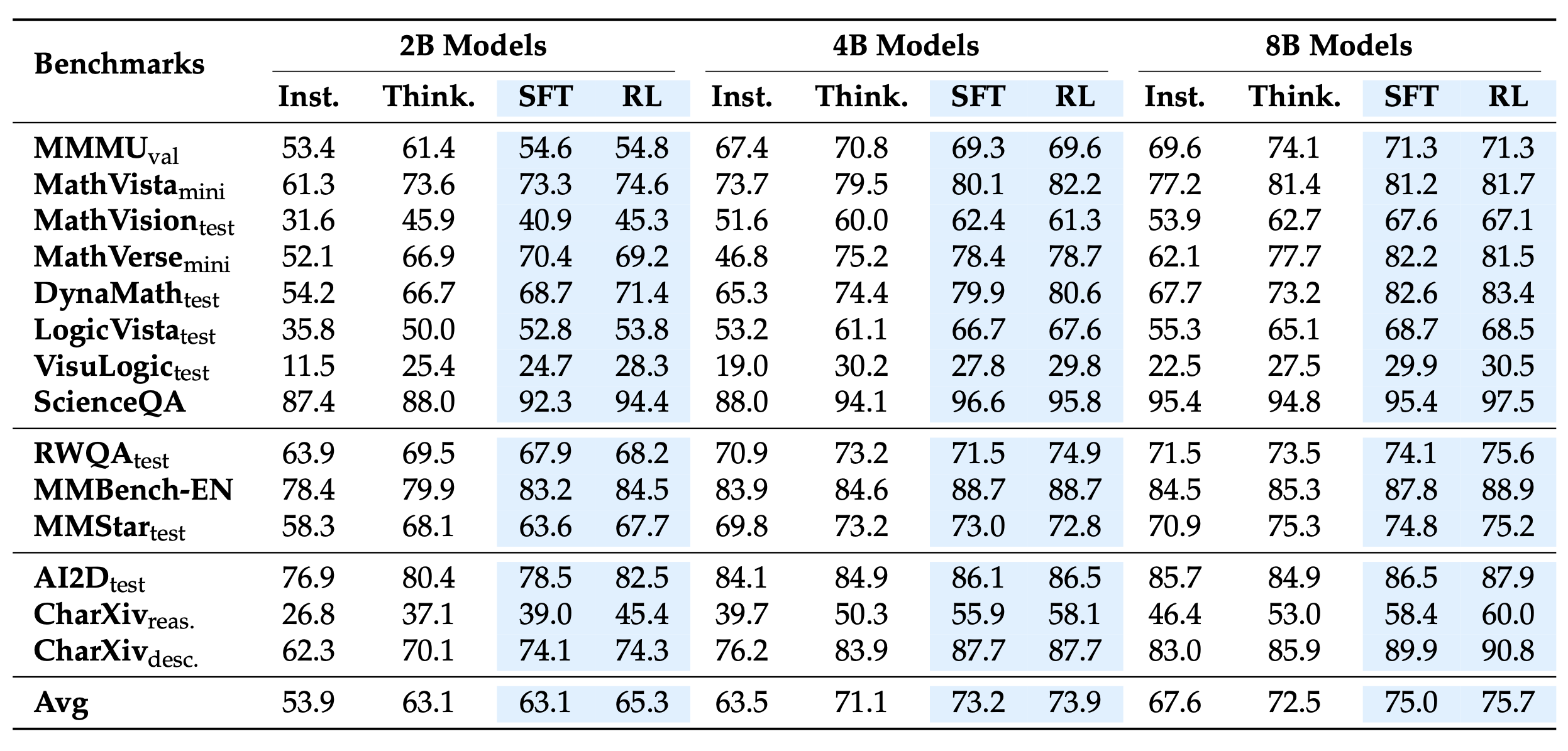 Results comparing MFR-SFT and MFR-Thinking models against base Qwen3-VL variants.
SFT drives major gains in mathematical reasoning (e.g., MathVision: 53.9% → 67.6% for 8B). RL enhances generalization on understanding benchmarks (e.g., AI2D: 78.5% → 82.5% for 2B) while showing variance on math benchmarks.
🔬 Ablation Studies
Data Efficiency ("Less is More")
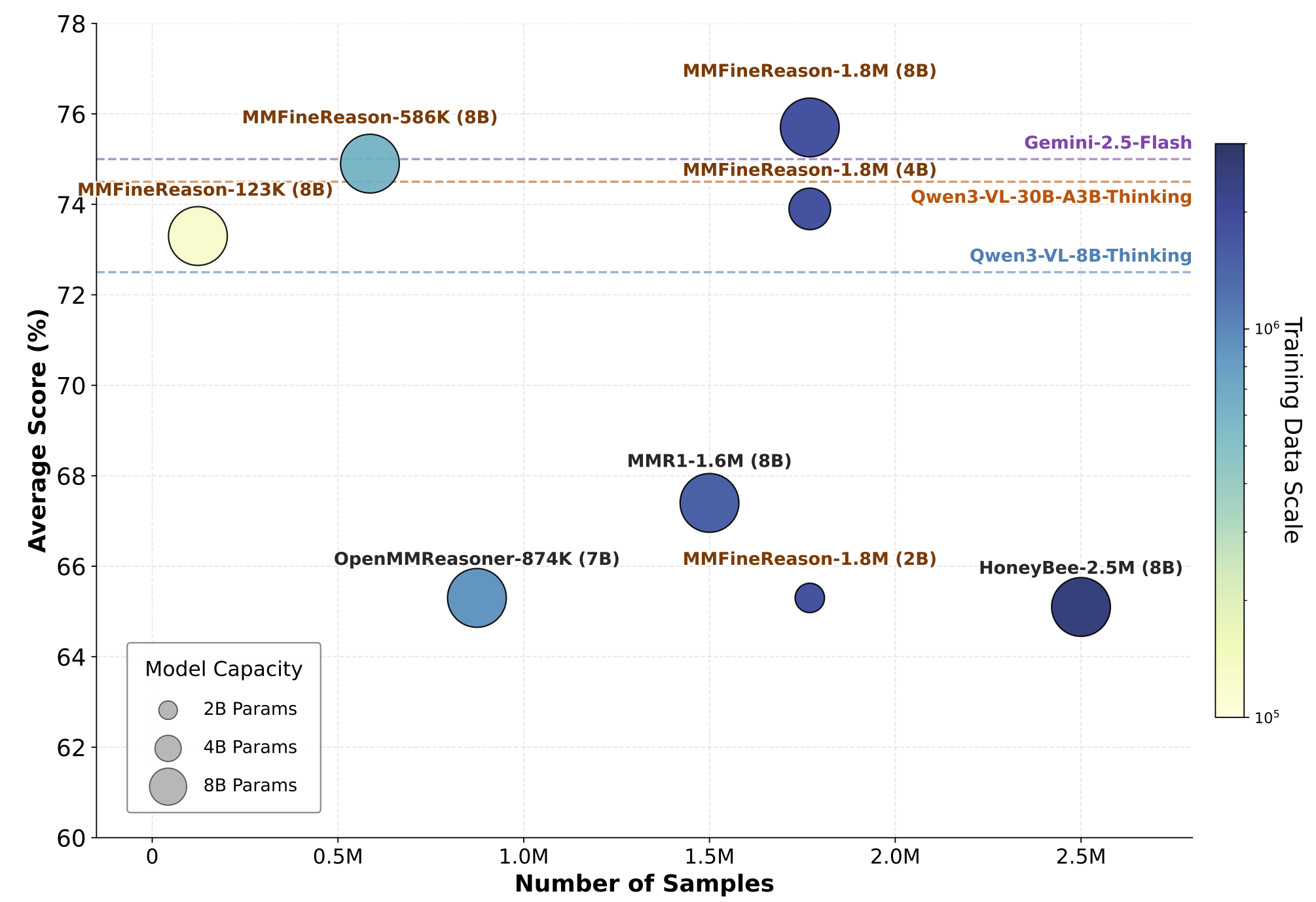 Performance comparison across different data scales and model sizes.
Removing 67% easy samples (Pass Rate = 1) improves performance by 0.6 points (75.0 → 75.6). Training on only the hardest 7% (123K samples) achieves 73.3—surpassing Qwen3-VL-8B-Thinking (72.5) with 14× less data. This demonstrates that challenging samples provide most training signal, and rigorous filtering eliminates redundancy in large-scale datasets.
Sub-Dataset Performance
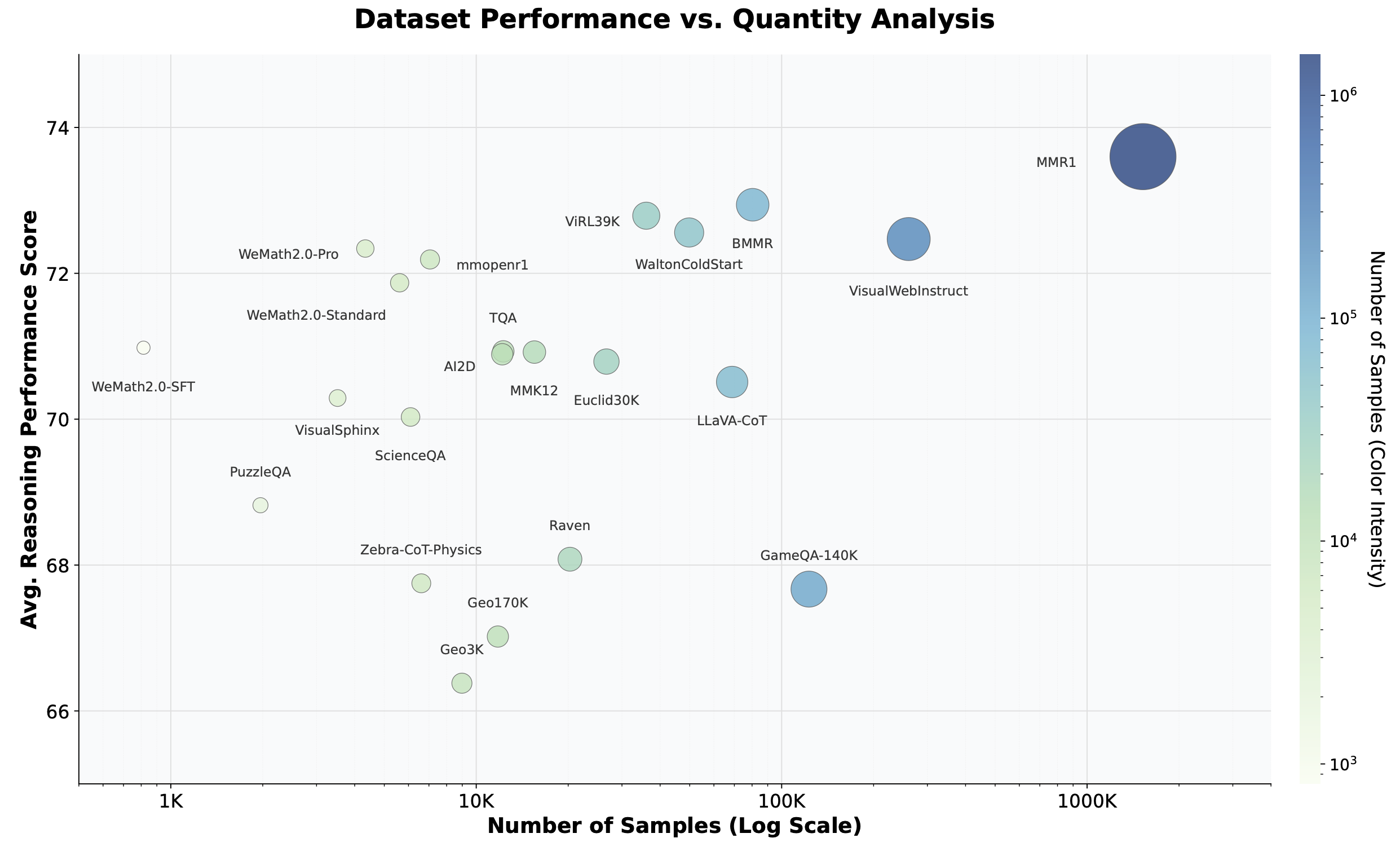 Performance landscape of distilled sub-datasets (x-axis: sample count, log scale).
ViRL39K (39K samples) retains 98.9% of MMR1's (1.5M) performance with only 2.4% data volume. WeMath2.0-SFT achieves 70.98% with just 814 samples, matching datasets 1000× larger. BMMR (80K, 300+ disciplines) outperforms the larger GameQA-140K (140K), showing that disciplinary diversity matters more than scale.
🏆 Trained Models
| Model | Parameters | Avg Score | HuggingFace |
|---|---|---|---|
| MMFineReason-2B | 2B | 65.3 | 🤗 Link |
| MMFineReason-4B | 4B | 73.9 | 🤗 Link |
| MMFineReason-8B | 8B | 75.7 | 🤗 Link |
📚 Citation
@misc{lin2026mmfinereasonclosingmultimodalreasoning,
      title={MMFineReason: Closing the Multimodal Reasoning Gap via Open Data-Centric Methods},
      author={Honglin Lin and Zheng Liu and Yun Zhu and Chonghan Qin and Juekai Lin and Xiaoran Shang and Conghui He and Wentao Zhang and Lijun Wu},
      year={2026},
      eprint={2601.21821},
      archivePrefix={arXiv},
      primaryClass={cs.CV},
      url={https://arxiv.org/abs/2601.21821},
}
📄 License
This dataset is released under the Apache 2.0 License. Individual source datasets may have their own licenses.
🤝 Acknowledgments
We thank the creators of FineVision, MMR1, BMMR, Euclid30K, GameQA-140K, LLaVA-CoT, WeMath, ViRL39K, and others. We also thank the Qwen team for the powerful Qwen3-VL series models.
Contributors

7 commits

6 commits
Similar repos







README
MMFineReason
Closing the Multimodal Reasoning Gap via Open Data-Centric Methods
Average score across mathematical reasoning and multimodal understanding benchmarks.
📖 Overview
MMFineReason is a large-scale, high-quality multimodal reasoning dataset comprising 1.8M samples and 5.1B solution tokens, featuring detailed reasoning annotations distilled from Qwen3-VL-235B-A22B-Thinking.
🎯 Key Highlights
- 1.8M High-Quality Samples with 5.1B Solution Tokens
- Long-Form CoT: Average reasoning length of 2,910 tokens (2.7× HoneyBee, 4.3× OpenMMReasoner)
- 100% Caption Coverage: Dense visual descriptions averaging 609 tokens
- Multi-Domain: Mathematics (79.4%), Science (13.8%), Puzzle/Game (4.6%), General/OCR (2.2%)
- State-of-the-Art: Models trained on this dataset achieve SOTA performance in their size class
🏗️ Data Construction Pipeline
MMFineReason data pipeline and the two-stage training.
Stage 1: Data Collection & Standardization
- Aggregate diverse multimodal datasets from open-source community
- Translate non-English questions; remove noise and extraneous artifacts
- Rewrite shallow prompts into reasoning-encouraging instructions
- Filter non-reasoning tasks; clean corrupted/oversized images
Stage 2: Reasoning Distillation
- Teacher Model: Qwen3-VL-235B-A22B-Thinking
- Four-Phase Framework: Information Extraction → Problem Setup → Solution Execution → Validation
- Output: Reasoning in
<think>...</think>, final answer in<answer>...</answer> - Caption Generation: 100% coverage via Qwen3-VL-235B-A22B-Thinking
Stage 3: Data Selection
- Quality Filtering: Template/length validation, n-gram deduplication, correctness verification (~20% removed)
- Difficulty Filtering: Use Qwen3-VL-4B-Thinking pass rate as proxy
- MMFineReason-123K: Pass rate = 0 (hardest 7%)
- MMFineReason-586K: Pass rate ≠ 1 (challenging 33%)
🔧 Data Schema
| Field | Description |
|---|---|
source | Origin dataset name (e.g., "Geometry3K", "MMR1", "BMMR") |
id | Unique sample identifier within the source dataset |
original_question | Raw question text as obtained from the source |
original_answer | Raw answer as obtained from the source |
image | Visual input (PIL Image) |
question | Cleaned, standardized question in English |
answer | Verified answer extracted and standardized |
qwen3vl_235b_instruct_caption | Dense visual description generated by Qwen3-VL-235B-A22B-Instruct |
qwen3vl_235b_thinking_response | Long-form Chain-of-Thought reasoning generated by Qwen3-VL-235B-A22B-Thinking |
qwen3vl_4b_pass_rate | Difficulty proxy based on Qwen3-VL-4B-Thinking's performance (0.0 = hardest, 1.0 = easiest) |
is_consistent | Boolean indicating whether generated reasoning matches ground truth |
consistency_analysis | Detailed analysis of consistency verification |
🗂️ Dataset Composition
Dataset composition of MMFineReason-1.8M.
Mathematics (79.4%) forms the backbone, primarily sourced from MMR1 (1.27M) and enriched with WaltonColdStart, ViRL39K, Euclid30K, MMK12, Geo170K, Geo3K, mm-openr1, and the WeMath family.
Science (13.8%) is anchored by VisualWebInstruct (157.3K) and BMMR (54.6K), complemented by TQA, AI2D, Zebra-CoT, and ScienceQA.
Puzzle/Game (4.6%) targets strategic planning and abstract reasoning, dominated by GameQA-140K (71.7K) and enriched by Raven, VisualSphinx, and PuzzleQA.
General/OCR (2.2%) includes 38.7K samples from LLaVA-CoT, serving as regularization to preserve broad visual and OCR capabilities.
📊 Dataset Statistics
Token Length Comparison with Other Datasets
Comparison of token length statistics across datasets.
Token length analysis. (Left) Internal domain distribution; (Mid) External CoT comparison; (Right) Caption richness comparison.
MMFineReason achieves an average CoT length of 2,910 tokens—approximately 2.7× longer than HoneyBee and 4.3× longer than OpenMMReasoner. The extended tail (Max: 16,316) demonstrates capacity for highly complex, multi-stage reasoning tasks. For captions, MMFineReason averages 609 tokens with 100% coverage, compared to HoneyBee's 299 tokens at ~58% coverage.
🖼️ Image Category Distribution
Image category statistics by group (STEM vs. Natural).
The corpus is predominantly STEM and diagrammatic content (98.3%), with geometric diagrams, mathematical plots, and logic puzzles accounting for 75.3%. Natural images (1.7%) provide diversity across urban scenes, indoor scenes, and human activities for generalization assessment.
📈 Difficulty Distribution
Pass rate distribution across sub-datasets, sorted by descending mean pass rate.
Science-oriented datasets (ScienceQA, AI2D, TQA) exhibit high pass rates due to clean diagrams and MCQ format. Puzzle/game datasets (GameQA-140K, Raven, VisualSphinx) show lowest pass rates, requiring multi-step abstract reasoning. The binary distribution pattern reflects that reasoning tasks often follow all-or-nothing outcomes.
📊 Benchmark Results
Main Results
Comparison of MMFineReason models with state-of-the-art models.
MMFineReason-4B surpasses Qwen3-VL-8B-Thinking (73.9 vs 72.5), while MMFineReason-8B outperforms the larger Qwen3-VL-30B-A3B-Thinking (75.7 vs 74.5) and exceeds Gemini-2.5-Flash. On mathematical benchmarks, MFR-8B achieves 83.4% on DynaMath (vs Qwen3-VL-32B-Thinking's 82.0%) and 67.1% on MathVision, outperforming HoneyBee-8B and OMR-7B by 23-30 points. Despite minimal chart training data, MFR-8B generalizes well to CharXiv (90.8%) and RealWorldQA (75.6%).
SFT vs RL Training Analysis
Results comparing MFR-SFT and MFR-Thinking models against base Qwen3-VL variants.
SFT drives major gains in mathematical reasoning (e.g., MathVision: 53.9% → 67.6% for 8B). RL enhances generalization on understanding benchmarks (e.g., AI2D: 78.5% → 82.5% for 2B) while showing variance on math benchmarks.
🔬 Ablation Studies
Data Efficiency ("Less is More")
Performance comparison across different data scales and model sizes.
Removing 67% easy samples (Pass Rate = 1) improves performance by 0.6 points (75.0 → 75.6). Training on only the hardest 7% (123K samples) achieves 73.3—surpassing Qwen3-VL-8B-Thinking (72.5) with 14× less data. This demonstrates that challenging samples provide most training signal, and rigorous filtering eliminates redundancy in large-scale datasets.
Sub-Dataset Performance
Performance landscape of distilled sub-datasets (x-axis: sample count, log scale).
ViRL39K (39K samples) retains 98.9% of MMR1's (1.5M) performance with only 2.4% data volume. WeMath2.0-SFT achieves 70.98% with just 814 samples, matching datasets 1000× larger. BMMR (80K, 300+ disciplines) outperforms the larger GameQA-140K (140K), showing that disciplinary diversity matters more than scale.
🏆 Trained Models
| Model | Parameters | Avg Score | HuggingFace |
|---|---|---|---|
| MMFineReason-2B | 2B | 65.3 | 🤗 Link |
| MMFineReason-4B | 4B | 73.9 | 🤗 Link |
| MMFineReason-8B | 8B | 75.7 | 🤗 Link |
📚 Citation
@misc{lin2026mmfinereasonclosingmultimodalreasoning,
      title={MMFineReason: Closing the Multimodal Reasoning Gap via Open Data-Centric Methods},
      author={Honglin Lin and Zheng Liu and Yun Zhu and Chonghan Qin and Juekai Lin and Xiaoran Shang and Conghui He and Wentao Zhang and Lijun Wu},
      year={2026},
      eprint={2601.21821},
      archivePrefix={arXiv},
      primaryClass={cs.CV},
      url={https://arxiv.org/abs/2601.21821},
}
📄 License
This dataset is released under the Apache 2.0 License. Individual source datasets may have their own licenses.
🤝 Acknowledgments
We thank the creators of FineVision, MMR1, BMMR, Euclid30K, GameQA-140K, LLaVA-CoT, WeMath, ViRL39K, and others. We also thank the Qwen team for the powerful Qwen3-VL series models.
Similar repos
Linked in READMEs
Contributors
7 commits
6 commits