[ICML 2026] Jacobi Forcing: Fast and Accurate Diffusion-style Decoding
See the code

Jacobi Forcing is a new training technique that converts LLMs into native causal parallel decoders. Jacobi forcing keeps the causal AR backbone and fixes the AR-to-diffusion mismatch by training the model to handle noisy future blocks along its own Jacobi decoding trajectories.
Jacobi Forcing yields an AR model which behaves like a diffusion-style decoder—decoding multiple tokens per pass, but still from left to right—with up to $4.5\times$ higher tokens-per-forward and $4\times$ wall-clock speedup on coding and math tasks, while retaining near-AR generation quality.
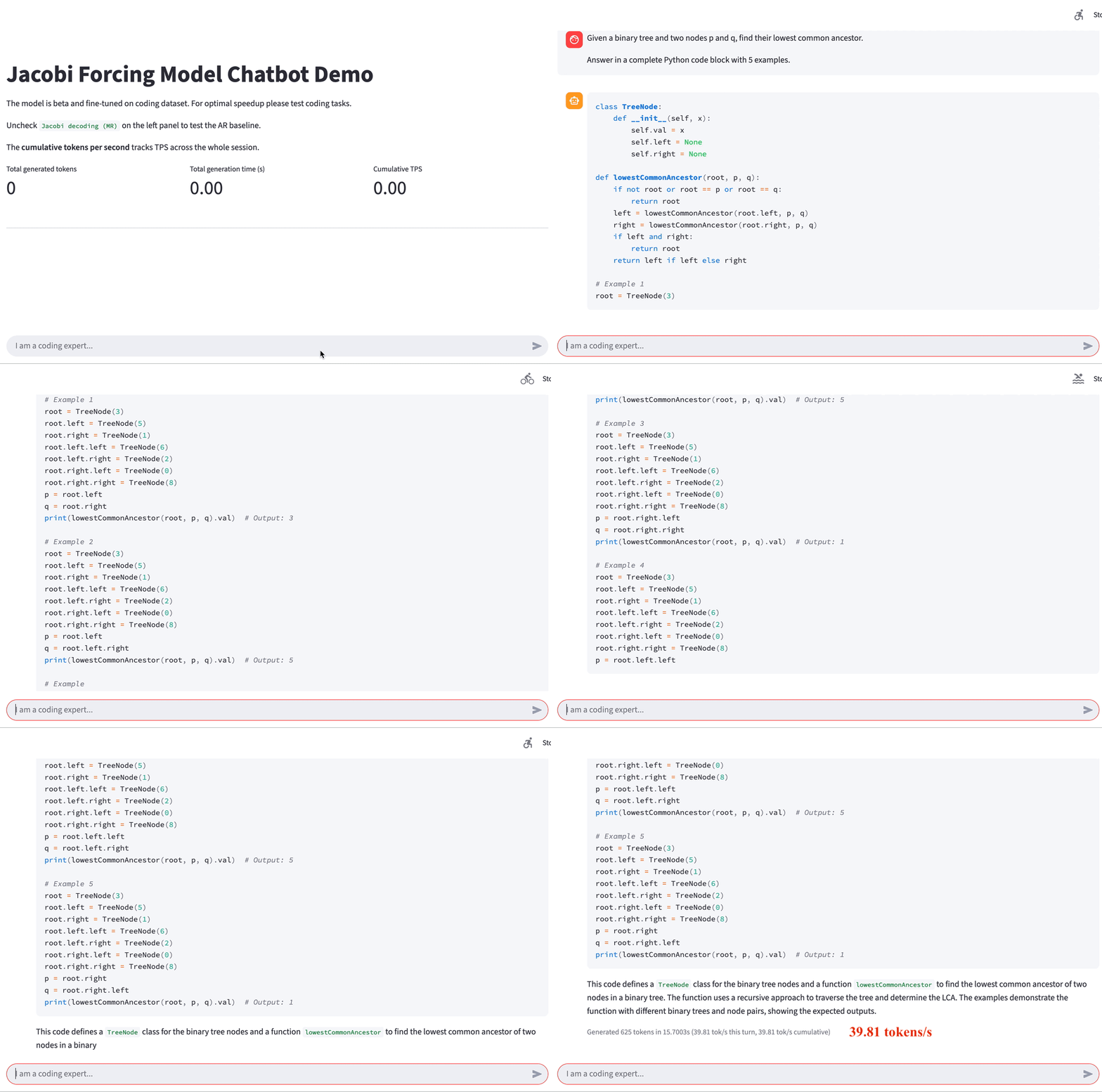
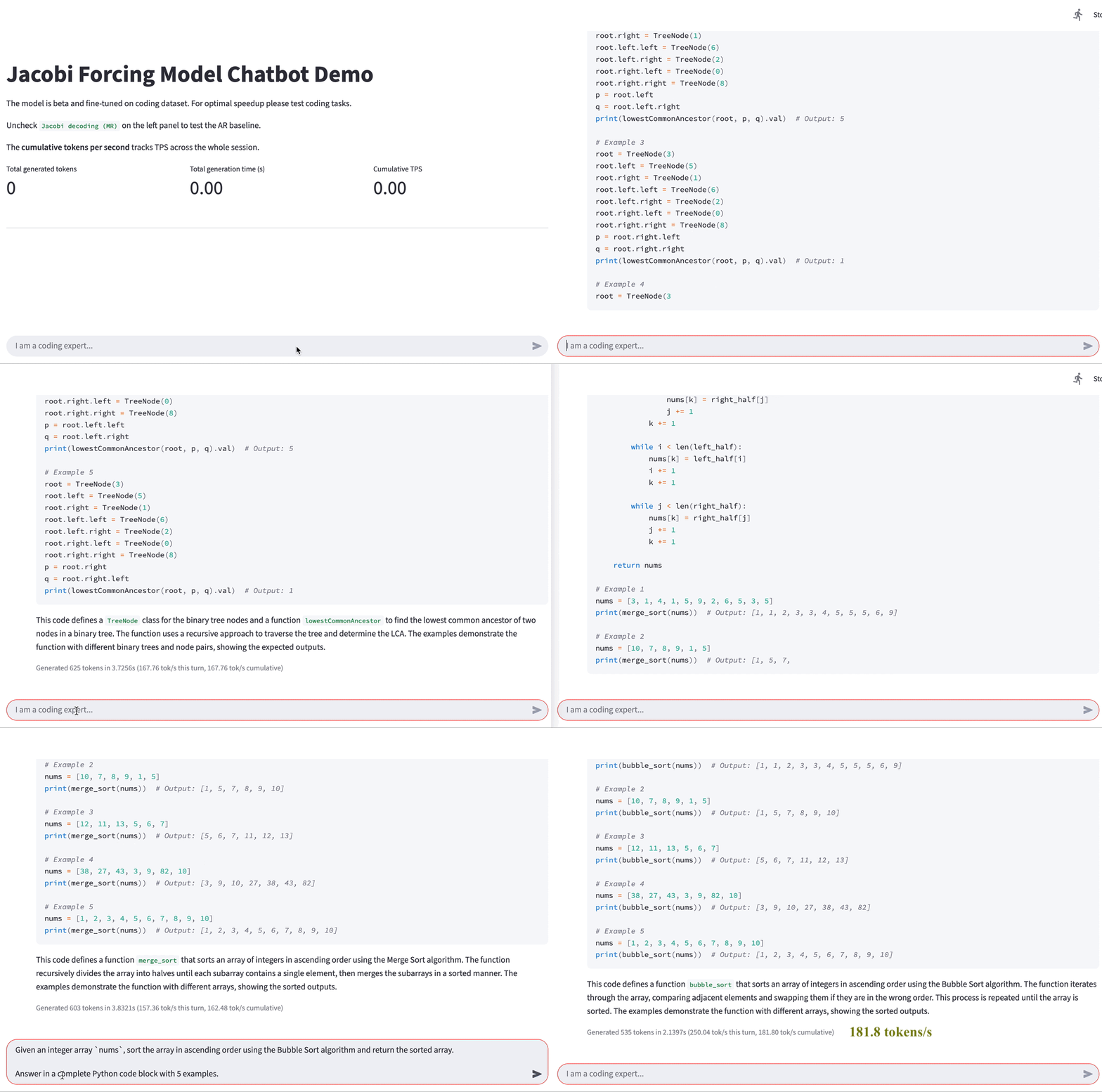
Demo of on average more than 4x speedup (181.8 TPS vs. 39.81 TPS) by Jacobi Forcing Model in comparison with the AR baseline (Qwen2.5-Coder-7B-Instruct) on coding sessions.
Try the chatbot yourself with:
# modify the script to use your local path
streamlit run applications/jacobi_model_chat.py
AR decoding is high-quality but serial: one forward pass per token. Diffusion language models can decode many tokens in parallel, but typically require non-causal objectives and often break KV-cache-friendly serving.
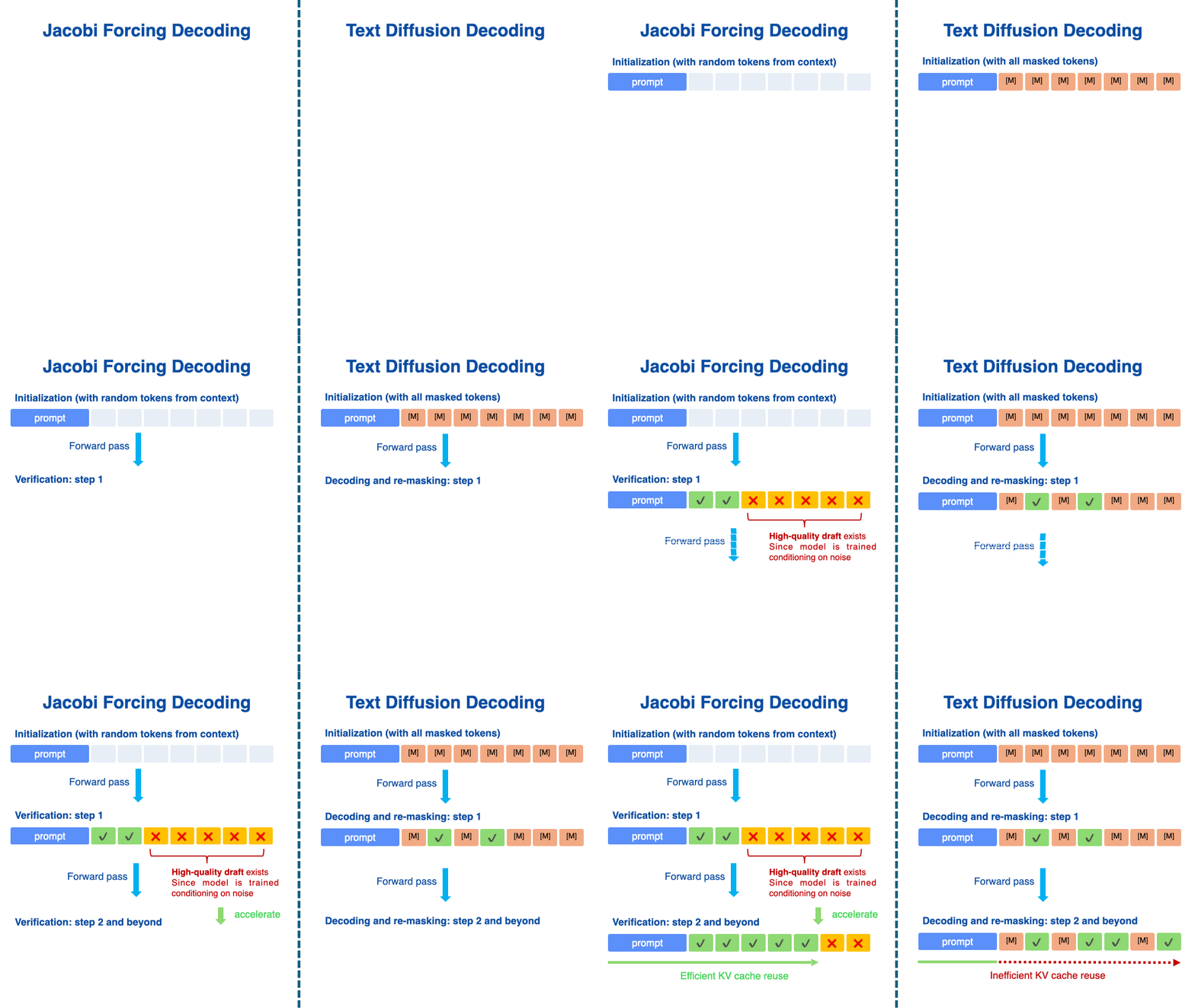
fig1: Side-by-side comparison between Jacobi forcing decoding and text diffusion decoding, where Jacobi forcing decoding comes with more efficient KV cache reuse and is trained to generate higher quality drafts over a long horizon.
Jacobi Forcing bridges this gap by training an AR model to behave like a diffusion-style decoder while staying causal:

fig2: Illustration of higher quality drafts that emerge from Jacobi Forcing model.
This section is demonstrative with path placeholders: adjust to match your repo structure.
conda create -n jacobi_forcing python=3.12 -y
conda activate jacobi_forcing
git clone https://github.com/hao-ai-lab/JacobiForcing.git
cd JacobiForcing
pip install -r requirements.txt
| Size | Domain | HuggingFace Repo |
|---|---|---|
| 7B | Code | Qwen/Qwen2.5-Coder-7B-Instruct |
| 7B | Math | Qwen/Qwen2.5-Math-7B-Instruct |
| Size | Domain | Data | HuggingFace Repo |
|---|---|---|---|
| 7B | Code | OpenCodeInstruct | JacobiForcing_Coder_7B_v1 |
| 7B | Math | OpenThoughts2 (math split) | JacobiForcing_Math_7B_v1 |
Jacobi Forcing training involves the following steps:
git lfs clone https://huggingface.co/datasets/JacobiForcing/OpenCodeInstruct_training_data_n32w16
# generate trajctories using customized models
bash generate_trajectory/generation/generate_trajectory_opencodeinstruct_greedy.sh
python3 generate_trajectory/data/2_prepare_efficient_cllm_training_data_progressive_noise_window.py \
    --input_path {trajectory_data_path} \
    --output_path {output_training_seq_path} \
    --n_token_seq_length {block_size} \
    --window_size {window_size} \
    --min_noisy_ratio 0 \
    --max_noisy_ratio 1.0 \
    --strategy "progressive"
Note: if the target model is not Qwen2.5, first modify generate_trajectory/generation/generate_trajectory_opencodeinstruct_greedy.sh to customize model path, trajectory data destimation, and input data path (you can download our length-bucketed input data from this link for code and this link for math).
Then adapt from the script generate_trajectory/generation/qwen2_modeling_jacobi_forcing_greedy.py to make your target model compatible.
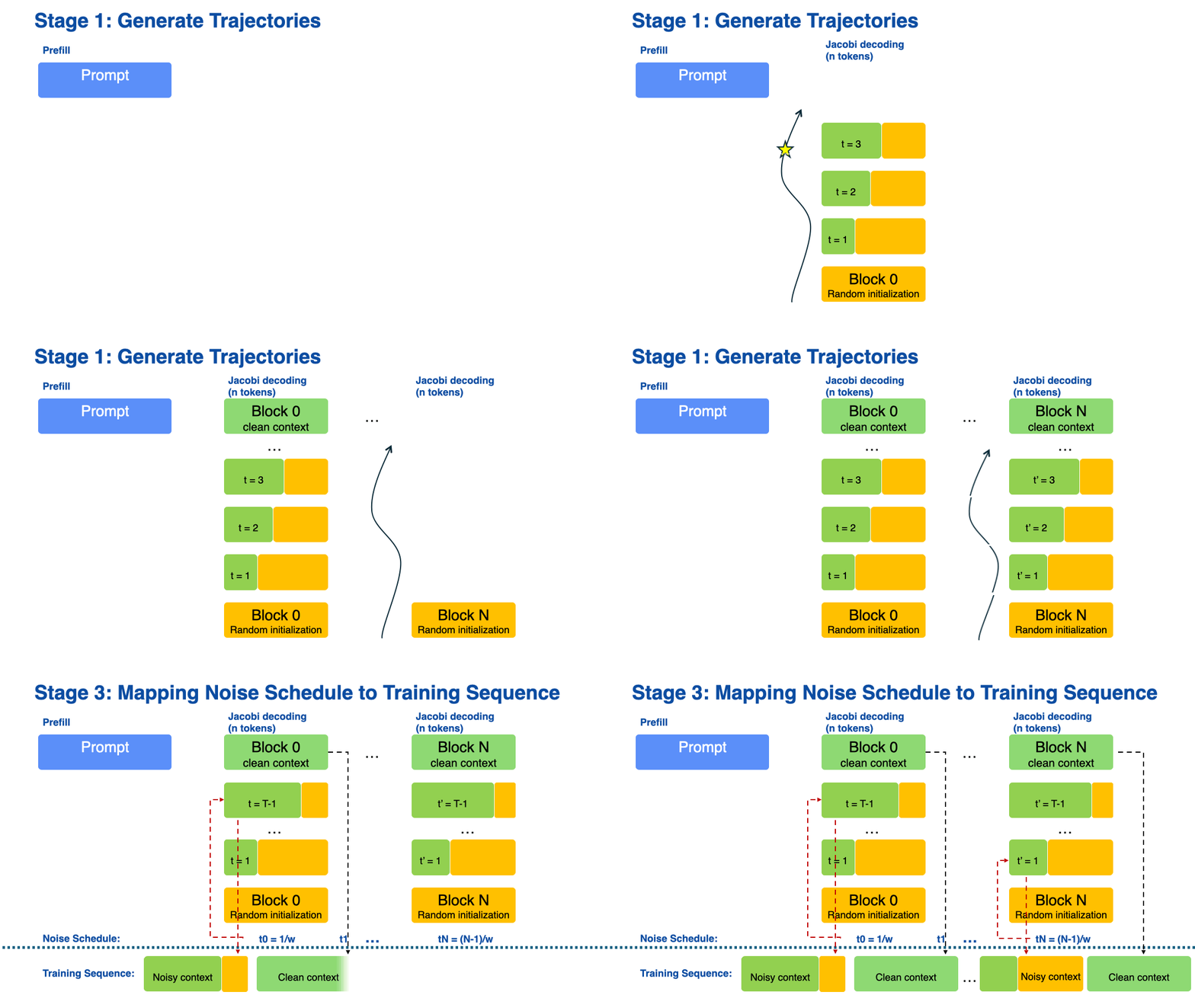
fig3: Illustration of the training sequence packing process with an example (linear progressive) noise schedule mapping.
cd /home/lah003/workspace/CLLM2/JacobiForcing
bash scripts/train/train_jacobi_forcing_coder_n32.sh
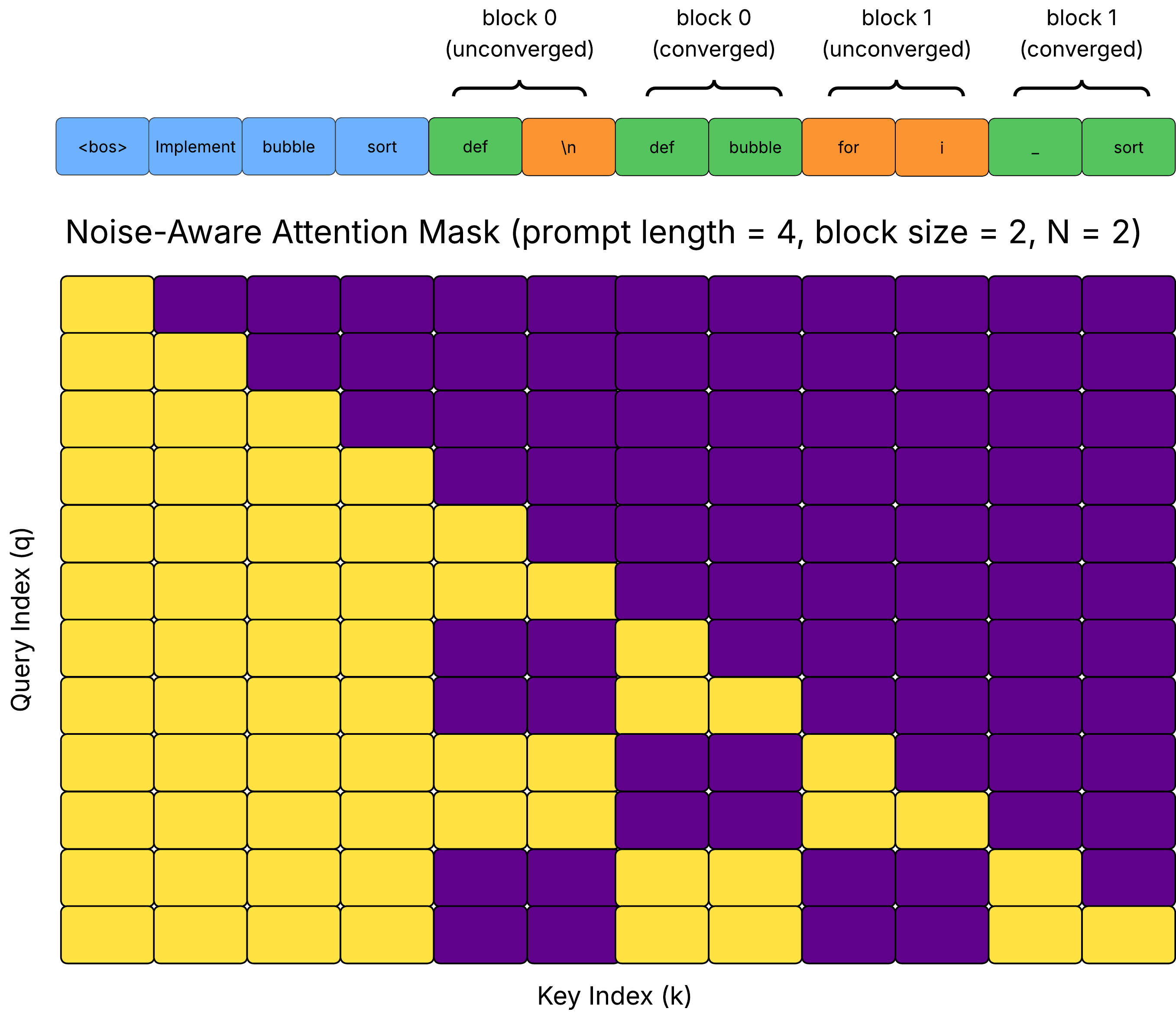
fig4: Jacobi Forcing uses the attention implementation shown above. It allows logits from clean blocks and noisy blocks to be generated with single forward pass to calculate the progressive consistency loss and AR loss.
A lightweight, self-contained inference engine lives in inference_engine/. It supports autoregressive and Jacobi decoding (greedy & non-greedy) with FlashAttention, paged KV cache, CUDA graph capture, and tensor parallelism implmetend on top of nano-vLLM. On a single GPU the engine reaches 800–1000 tokens/second with Jacobi Forcing models.
# greedy Jacobi correctness test
python inference_engine/tests/test_jacobi_decoding_greedy.py --model-path /path/to/model

# non-greedy distribution similarity test
python inference_engine/tests/test_jacobi_decoding_nongreedy.py --model-path /path/to/model
Jacobi Forcing decoding typically exposes knobs like:
block size n (tokens updated in parallel)
rejection recycling verification budget pool_size
block count K (maximum blocks “in flight”)
activation ratio r
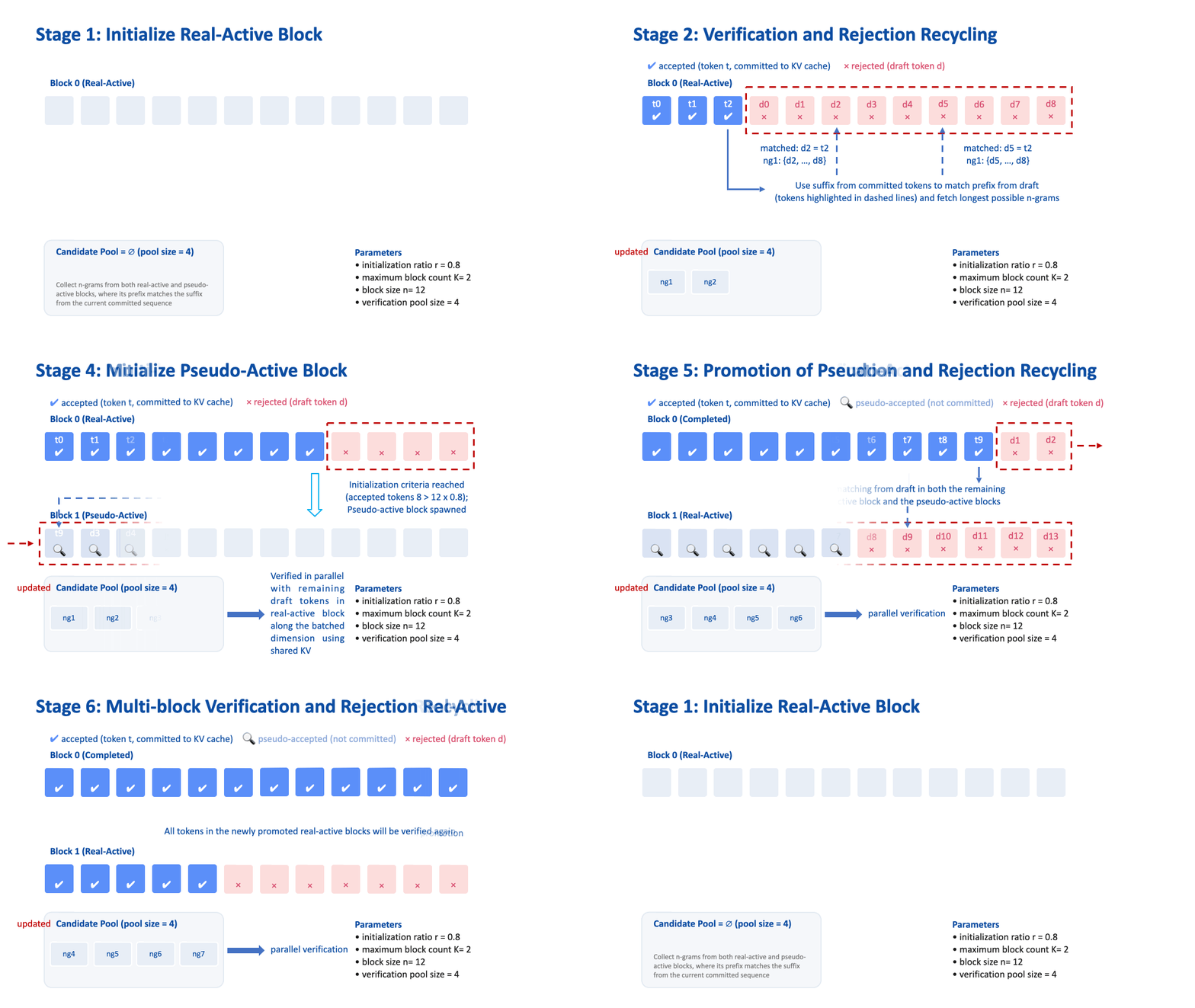
fig5: Illustration of multiblock Jacobi decoding with rejection recycling. High-quality n-grams from earlier iterations are reused as drafts.
Recommended starting point (from our grid search):
n=64, K=2, pool_size=4, r=0.85
To run comprehensive grid search profiling for TPS speedup and TPF across different settings, run:
cd JacobiForcing
bash scripts/inference/scanning_hyperparameter_jacobi_decoding_mr.sh
To run a specific decoding setting with multiblock decoding and rejection recycling, run:
# vanilla Jacobi decoding
python3 JacobiForcing/jacobi_forcing_inference_humaneval.py

# with multiblock decoding and rejection recycling
python3 JacobiForcing/jacobi_forcing_inference_MR_humaneval.py
We evaluate baseline models' and Jacobi Forcing models' performance on HumanEval, MBPP, GSM8K and MATH following the settings in evalchemy.
| Task | Method | Family | Speedup | TPF | TPS | Acc / Solve $\uparrow$ |
|---|---|---|---|---|---|---|
| HumanEval | AR | AR | $1.00\times$ | 1.0 | 41.3 | 87.8% |
| D2F | dLLM | $1.8\times$ | 2.5 | 73.2 | 54.3% | |
| Fast-dLLM | dLLM | $1.5\times$ | 1.8 | 60.0 | 53.0% | |
| dParallel | dLLM-distilled | $2.1\times$ | 2.9 | 88.5 | 54.3% | |
| EAGLE-3 | SD | $2.9\times$ | 6.4 | 120.7 | 68.9%* | |
| HASS | SD | $3.4\times$ | 5.5 | 138.7 | 61.6%* | |
| CLLM* | causal parallel | $2.5\times$ | 2.7 | 103.3 | 88.0% | |
| Jacobi Forcing model | causal parallel | $3.9\times$ | 4.0 | 159.5 | 83.5% | |
| Jacobi Forcing model (MR) | causal parallel | $4.0\times$ | 4.1 | 163.9 | 83.5% | |
| GSM8K | AR | AR | $1.0\times$ | 1.0 | 41.8 | 92.4% |
| D2F | dLLM | $2.2\times$ | 2.3 | 91.2 | 77.6% | |
| Fast-dLLM | dLLM | $1.2\times$ | 2.1 | 49.8 | 75.0% | |
| dParallel | dLLM-distilled | $3.1\times$ | 3.8 | 128.0 | 82.9% | |
| EAGLE-3 | SD | $3.3\times$ | 7.2 | 138.6 | 63.9%* | |
| HASS | SD | $3.1\times$ | 5.0 | 128.1 | 74.0%* | |
| CLLM* | causal parallel | $2.1\times$ | 2.3 | 86.8 | 92.2% | |
| Jacobi Forcing model | causal parallel | $3.5\times$ | 3.7 | 146.1 | 91.4% | |
| Jacobi Forcing model (MR) | causal parallel | $3.7\times$ | 4.0 | 154.9 | 91.4% |
*Here we report the strongest checkpoints released by the authors; in principle EAGLE-3 and HASS are lossless in comparison with greedy AR checkpoints if they were trained with the Qwen2.5-7B backbone. Note that SD has a worse acceptance length (TPF) to TPS conversion ratio due to other overheads in the algorithm like token drafting using draft head, tree-like verification overhead, feature merging from different layers etc.
Overall, Jacobi Forcing model consistently delivers up to $3-4\times$ wall-clock speedup on coding and math tasks with only minor accuracy changes versus greedy AR, while significantly outperforming both dLLMs and prior consistency-based parallel decoders in the accuracy–throughput tradeoff.
On a single B200 GPU with much higher FLOPs, the same Jacobi Forcing model with multiblock + rejection recycling can achieve an even more significant speedup at around 330 tokens/s (vs. around 80 tokens/s using AR), showing that the design continues to scale on newer accelerators.
| Method | Attention | Parallelism | Training Cost | Single-model Decoding (no draft–verifier) | Efficient KV Reuse | Real Speedup | Generation Quality |
|---|---|---|---|---|---|---|---|
| AR | Causal | None | None | No | Yes | No | Lossless |
| SD | Causal | Yes | No to Small: Draft model FT | $\textcolor{red}{\text{No}}$ | Yes | $<3.5\times$ | Lossless |
| dLLMs | Non-causal | Yes | High: from scratch or heavy diffusion FT | Yes | $\textcolor{red}{\text{No}}$ | $< 3\times$ | Low to near-AR quality |
| Jacobi Forcing | Causal | Yes | Small: noise-conditioned FT on trajectories | $\textcolor{green}{\text{Yes}}$ | $\textcolor{green}{\text{Yes}}$ | $\sim3-4\times$ | near-AR quality |
This is the official project repository for the following paper. If you find this repository helpful, Please kindly cite:
@misc{hu2025fastaccuratecausalparallel,
      title={Fast and Accurate Causal Parallel Decoding using Jacobi Forcing},
      author={Lanxiang Hu and Siqi Kou and Yichao Fu and Samyam Rajbhandari and Tajana Rosing and Yuxiong He and Zhijie Deng and Hao Zhang},
      year={2025},
      eprint={2512.14681},
      archivePrefix={arXiv},
      primaryClass={cs.CL},
      url={https://arxiv.org/abs/2512.14681},
}
641 followers · starred Dec 2025
125 followers · starred Dec 2025
65 followers · starred Dec 2025
53 followers · starred Dec 2025
[ICML 2026] Jacobi Forcing: Fast and Accurate Diffusion-style Decoding
See the code
Jacobi Forcing is a new training technique that converts LLMs into native causal parallel decoders. Jacobi forcing keeps the causal AR backbone and fixes the AR-to-diffusion mismatch by training the model to handle noisy future blocks along its own Jacobi decoding trajectories.
Jacobi Forcing yields an AR model which behaves like a diffusion-style decoder—decoding multiple tokens per pass, but still from left to right—with up to $4.5\times$ higher tokens-per-forward and $4\times$ wall-clock speedup on coding and math tasks, while retaining near-AR generation quality.
Demo of on average more than 4x speedup (181.8 TPS vs. 39.81 TPS) by Jacobi Forcing Model in comparison with the AR baseline (Qwen2.5-Coder-7B-Instruct) on coding sessions.
Try the chatbot yourself with:
# modify the script to use your local path
streamlit run applications/jacobi_model_chat.py
AR decoding is high-quality but serial: one forward pass per token. Diffusion language models can decode many tokens in parallel, but typically require non-causal objectives and often break KV-cache-friendly serving.
fig1: Side-by-side comparison between Jacobi forcing decoding and text diffusion decoding, where Jacobi forcing decoding comes with more efficient KV cache reuse and is trained to generate higher quality drafts over a long horizon.
Jacobi Forcing bridges this gap by training an AR model to behave like a diffusion-style decoder while staying causal:
fig2: Illustration of higher quality drafts that emerge from Jacobi Forcing model.
This section is demonstrative with path placeholders: adjust to match your repo structure.
conda create -n jacobi_forcing python=3.12 -y
conda activate jacobi_forcing
git clone https://github.com/hao-ai-lab/JacobiForcing.git
cd JacobiForcing
pip install -r requirements.txt
| Size | Domain | HuggingFace Repo |
|---|---|---|
| 7B | Code | Qwen/Qwen2.5-Coder-7B-Instruct |
| 7B | Math | Qwen/Qwen2.5-Math-7B-Instruct |
| Size | Domain | Data | HuggingFace Repo |
|---|---|---|---|
| 7B | Code | OpenCodeInstruct | JacobiForcing_Coder_7B_v1 |
| 7B | Math | OpenThoughts2 (math split) | JacobiForcing_Math_7B_v1 |
Jacobi Forcing training involves the following steps:
git lfs clone https://huggingface.co/datasets/JacobiForcing/OpenCodeInstruct_training_data_n32w16
# generate trajctories using customized models
bash generate_trajectory/generation/generate_trajectory_opencodeinstruct_greedy.sh
python3 generate_trajectory/data/2_prepare_efficient_cllm_training_data_progressive_noise_window.py \
    --input_path {trajectory_data_path} \
    --output_path {output_training_seq_path} \
    --n_token_seq_length {block_size} \
    --window_size {window_size} \
    --min_noisy_ratio 0 \
    --max_noisy_ratio 1.0 \
    --strategy "progressive"
Note: if the target model is not Qwen2.5, first modify generate_trajectory/generation/generate_trajectory_opencodeinstruct_greedy.sh to customize model path, trajectory data destimation, and input data path (you can download our length-bucketed input data from this link for code and this link for math).
Then adapt from the script generate_trajectory/generation/qwen2_modeling_jacobi_forcing_greedy.py to make your target model compatible.
fig3: Illustration of the training sequence packing process with an example (linear progressive) noise schedule mapping.
cd /home/lah003/workspace/CLLM2/JacobiForcing
bash scripts/train/train_jacobi_forcing_coder_n32.sh
fig4: Jacobi Forcing uses the attention implementation shown above. It allows logits from clean blocks and noisy blocks to be generated with single forward pass to calculate the progressive consistency loss and AR loss.
A lightweight, self-contained inference engine lives in inference_engine/. It supports autoregressive and Jacobi decoding (greedy & non-greedy) with FlashAttention, paged KV cache, CUDA graph capture, and tensor parallelism implmetend on top of nano-vLLM. On a single GPU the engine reaches 800–1000 tokens/second with Jacobi Forcing models.
# greedy Jacobi correctness test
python inference_engine/tests/test_jacobi_decoding_greedy.py --model-path /path/to/model

# non-greedy distribution similarity test
python inference_engine/tests/test_jacobi_decoding_nongreedy.py --model-path /path/to/model
Jacobi Forcing decoding typically exposes knobs like:
block size n (tokens updated in parallel)
rejection recycling verification budget pool_size
block count K (maximum blocks “in flight”)
activation ratio r
fig5: Illustration of multiblock Jacobi decoding with rejection recycling. High-quality n-grams from earlier iterations are reused as drafts.
Recommended starting point (from our grid search):
n=64, K=2, pool_size=4, r=0.85
To run comprehensive grid search profiling for TPS speedup and TPF across different settings, run:
cd JacobiForcing
bash scripts/inference/scanning_hyperparameter_jacobi_decoding_mr.sh
To run a specific decoding setting with multiblock decoding and rejection recycling, run:
# vanilla Jacobi decoding
python3 JacobiForcing/jacobi_forcing_inference_humaneval.py

# with multiblock decoding and rejection recycling
python3 JacobiForcing/jacobi_forcing_inference_MR_humaneval.py
We evaluate baseline models' and Jacobi Forcing models' performance on HumanEval, MBPP, GSM8K and MATH following the settings in evalchemy.
| Task | Method | Family | Speedup | TPF | TPS | Acc / Solve $\uparrow$ |
|---|---|---|---|---|---|---|
| HumanEval | AR | AR | $1.00\times$ | 1.0 | 41.3 | 87.8% |
| D2F | dLLM | $1.8\times$ | 2.5 | 73.2 | 54.3% | |
| Fast-dLLM | dLLM | $1.5\times$ | 1.8 | 60.0 | 53.0% | |
| dParallel | dLLM-distilled | $2.1\times$ | 2.9 | 88.5 | 54.3% | |
| EAGLE-3 | SD | $2.9\times$ | 6.4 | 120.7 | 68.9%* | |
| HASS | SD | $3.4\times$ | 5.5 | 138.7 | 61.6%* | |
| CLLM* | causal parallel | $2.5\times$ | 2.7 | 103.3 | 88.0% | |
| Jacobi Forcing model | causal parallel | $3.9\times$ | 4.0 | 159.5 | 83.5% | |
| Jacobi Forcing model (MR) | causal parallel | $4.0\times$ | 4.1 | 163.9 | 83.5% | |
| GSM8K | AR | AR | $1.0\times$ | 1.0 | 41.8 | 92.4% |
| D2F | dLLM | $2.2\times$ | 2.3 | 91.2 | 77.6% | |
| Fast-dLLM | dLLM | $1.2\times$ | 2.1 | 49.8 | 75.0% | |
| dParallel | dLLM-distilled | $3.1\times$ | 3.8 | 128.0 | 82.9% | |
| EAGLE-3 | SD | $3.3\times$ | 7.2 | 138.6 | 63.9%* | |
| HASS | SD | $3.1\times$ | 5.0 | 128.1 | 74.0%* | |
| CLLM* | causal parallel | $2.1\times$ | 2.3 | 86.8 | 92.2% | |
| Jacobi Forcing model | causal parallel | $3.5\times$ | 3.7 | 146.1 | 91.4% | |
| Jacobi Forcing model (MR) | causal parallel | $3.7\times$ | 4.0 | 154.9 | 91.4% |
*Here we report the strongest checkpoints released by the authors; in principle EAGLE-3 and HASS are lossless in comparison with greedy AR checkpoints if they were trained with the Qwen2.5-7B backbone. Note that SD has a worse acceptance length (TPF) to TPS conversion ratio due to other overheads in the algorithm like token drafting using draft head, tree-like verification overhead, feature merging from different layers etc.
Overall, Jacobi Forcing model consistently delivers up to $3-4\times$ wall-clock speedup on coding and math tasks with only minor accuracy changes versus greedy AR, while significantly outperforming both dLLMs and prior consistency-based parallel decoders in the accuracy–throughput tradeoff.
On a single B200 GPU with much higher FLOPs, the same Jacobi Forcing model with multiblock + rejection recycling can achieve an even more significant speedup at around 330 tokens/s (vs. around 80 tokens/s using AR), showing that the design continues to scale on newer accelerators.
| Method | Attention | Parallelism | Training Cost | Single-model Decoding (no draft–verifier) | Efficient KV Reuse | Real Speedup | Generation Quality |
|---|---|---|---|---|---|---|---|
| AR | Causal | None | None | No | Yes | No | Lossless |
| SD | Causal | Yes | No to Small: Draft model FT | $\textcolor{red}{\text{No}}$ | Yes | $<3.5\times$ | Lossless |
| dLLMs | Non-causal | Yes | High: from scratch or heavy diffusion FT | Yes | $\textcolor{red}{\text{No}}$ | $< 3\times$ | Low to near-AR quality |
| Jacobi Forcing | Causal | Yes | Small: noise-conditioned FT on trajectories | $\textcolor{green}{\text{Yes}}$ | $\textcolor{green}{\text{Yes}}$ | $\sim3-4\times$ | near-AR quality |
This is the official project repository for the following paper. If you find this repository helpful, Please kindly cite:
@misc{hu2025fastaccuratecausalparallel,
      title={Fast and Accurate Causal Parallel Decoding using Jacobi Forcing},
      author={Lanxiang Hu and Siqi Kou and Yichao Fu and Samyam Rajbhandari and Tajana Rosing and Yuxiong He and Zhijie Deng and Hao Zhang},
      year={2025},
      eprint={2512.14681},
      archivePrefix={arXiv},
      primaryClass={cs.CL},
      url={https://arxiv.org/abs/2512.14681},
}
641 followers · starred Dec 2025
125 followers · starred Dec 2025
65 followers · starred Dec 2025
53 followers · starred Dec 2025



