
[ICML 2024] CLLMs: Consistency Large Language Models
See the codeREADME
Consistency Large Language Models: A Family of Efficient Parallel Decoders




Consistency large language models (CLLMs) is a new family of models capable of reducing inference latency by efficiently decoding $n$ tokens in parallel. This decoding method is called Jacobi decoding, which improves inference efficiency in comparison with conventional auto-regressive (AR) decoding. CLLMs are trained with the objective of performing efficient Jacobi decoding by mapping any randomly initialized $n$-token sequence to the same result as AR decoding in as few steps as possible.
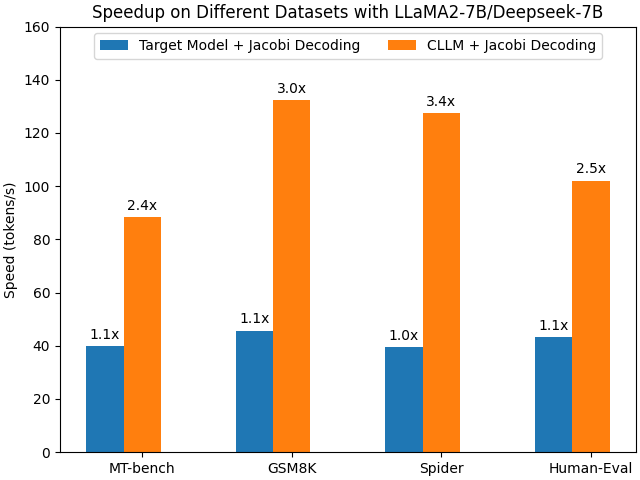
Experiment results have demonstrated the effectiveness of CLLMs, showing $2.4\times$ to $3.4\times$ improvements in generation speed on a variety of tasks.
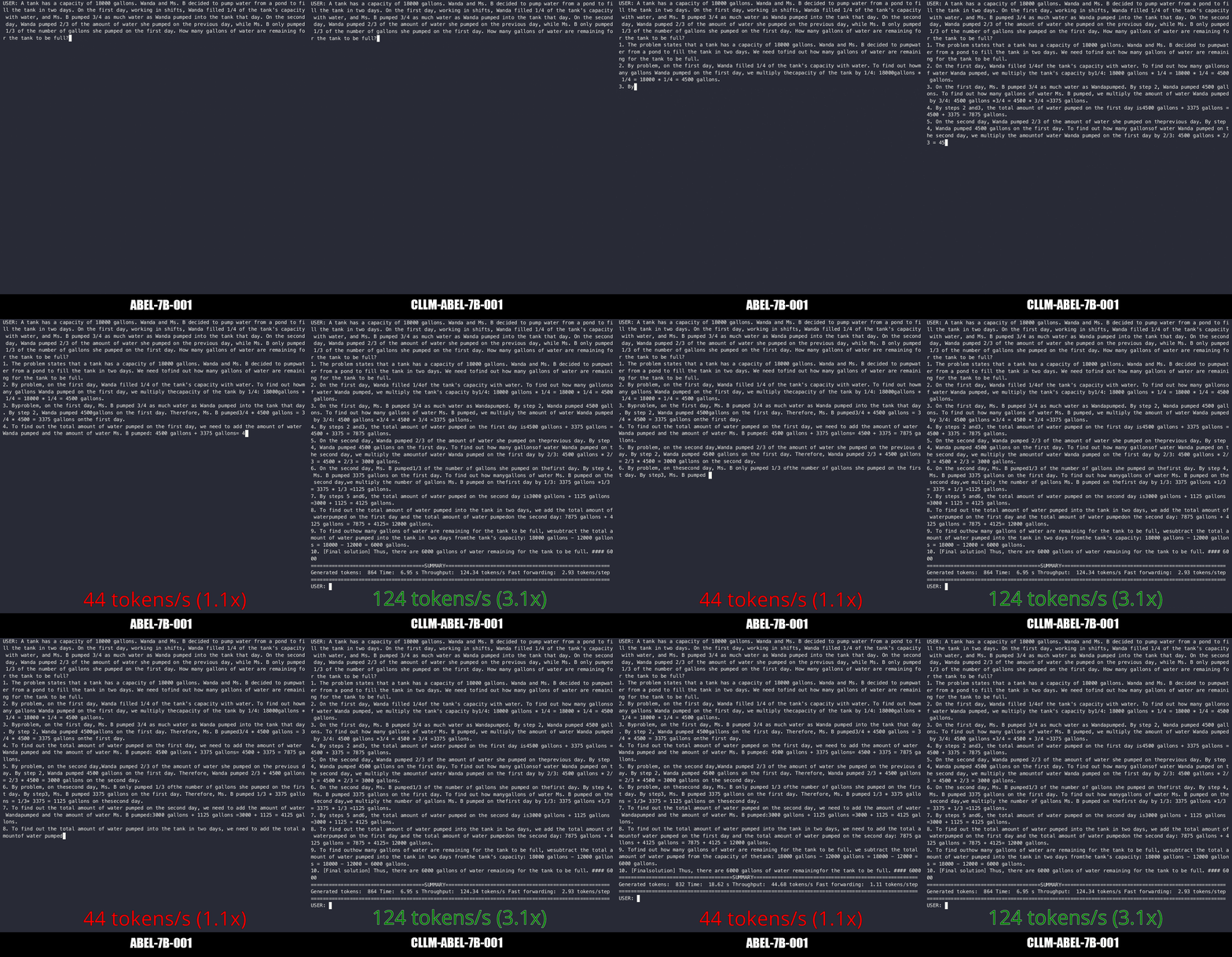
A demo of using CLLM to achieve significant improvements ($\sim3\times$) in generation speed to solve a basic math problem is shown below:
Contents
News 🔥
- [2024/3] CLLMs are integrated in FastChat!
- [2024/2] CLLM Paper now available on arXiv. CLLMs model checkpoints are released on Huggingface Hub.
Introduction
Consistency Large Language Models (CLLMs) is a family of efficient parallel decoders refined from pre-trained LLMs.
Compared with existing fast decoding techniques, CLLMs achieve fast parallel decoding without the need for:
- Draft models
- Architectural modifications/auxiliary model components
This introduces a number of advantages for CLLMs:
- CLLMs don't have to deal with the complexity of obtaining 'good' draft models and managing two different models in a single system.
- CLLMs share the same architecture with target LLMs and require no additional engineering efforts when adopting the technique to different models.
- CLLMs can be integrated seamlessly with other techniques for efficient LLM inference (e.g. Lookahead Decoding) to achieve even more significant speedup.
Installation
- Environment setup:
conda create -n cllm python=3.10
conda activate cllm
- Clone this repository and build from source:
git clone git@github.com:hao-ai-lab/Consistency_LLM.git
cd Consistency_LLM
- Install dependency:
pip install -r requirements.txt
pip install flash-attn==2.4.1
Model Weights
Target Pre-trained Models
| Size | Dataset | Huggingface Repo |
|---|---|---|
| 7B | ShareGPT | cllm/vicuna-7b-sharegpt-gpt4-48k |
| 7B | GSM8K (Math) | GAIR/Abel-7B-001 |
| 7B | Spider (Text-to-SQL) | cllm/deepseekcoder-7b-instruct-spider |
| 7B | Code-Search-Net Python | cllm/deepseekcoder_7b_codesearch_net_python |
CLLMs
| Size | Dataset | Huggingface Repo |
|---|---|---|
| 7B | ShareGPT | cllm/consistency-llm-7b-sharegpt48k |
| 7B | GSM8K (Math) | cllm/consistency-llm-7b-math |
| 7B | Spider (Text-to-SQL) | cllm/consistency-llm-7b-spider |
| 7B | Code-Search-Net Python | cllm/consistency-llm-7b-codesearchnet |
Usage
Inference
bash applications/run_chat_cllm.sh {model_path} {cllm_type}
cllm_type can take the value of spider, python, gsm8k, sharegpt.
Training
- Collect Jacobi trajectory:
- Method 1: Directly download Jacobi trajectory to
data/collected_jacobi_trajectory/from our Huggingface Hub page. - Method 2 (Generate trajectory suitable to your own target model and dataset): Some raw datasets that contain additional information like database dependency or cannot be directly loaded from Huggingface Hub (for example, Spider and ShareGPT are required to be installed in
data/raw_data). Then runscripts/generate_trajectory.shand the training dataset for a CLLM will be saved indata/collected_jacobi_trajectory/.
For example, for the gsm8k dataset, run:
# max_new_tokens corresponds to the size of n_token_sequence
CUDA_VISIBLE_DEVICES=0 bash scripts/generate_trajectory.sh {filename} {model_path} {n_token_seq_size} {max_new_seq_len}
Other command options
--filename: path to the raw dataset, currently supporting {data/raw_data/spider, code_search_net, data/raw_data/gsm8k_train.jsonl, data/raw_data/ShareGPT_V3_unfiltered_cleaned_split.json} \
--data_size: maximum number of prompts used to extract Jacobi trajectories \
--use_aug: use data augmentation technique \
--use_labels: add dataset's labels to the output file
- Train a CLLM:
bash scripts/train_cllm.sh {model_path} {trajectory_file} {output_path} {n_token_seq_size}
Evaluation
We follow the same settings in human-eval, Spider, MT-bench and GSM8K evaluate CLLMs' generation quality. An example code to evaluate CLLMs' throughput measured in tokens/s, fast-forwarded token count, stationary token count can be found in eval folder. Take GSM8K dataset as an example:
To test the speedup, run:
CUDA_VISIBLE_DEVICES=0 bash eval/gsm8k/speedup.sh {model_path} {target_model_path} {max_new_tokens}
To test the accuracy, run:
CUDA_VISIBLE_DEVICES=0 python eval/gsm8k/acc.py --model_dir path_to_cllm --temperature 0.0 --top_p 1.0 --output_file_name 'cllm_generated_gsm8k.jsonl' \
--dev_set "gsm8k" --prompt_type math-single --max_new_tokens_for_consistency 16 --max_tokens 1024 --use_consistency_decoding
Citation
This is the official project repository for the following paper. If you find this repository helpful, Please kindly cite:
@misc{kou2024cllms,
      title={CLLMs: Consistency Large Language Models},
      author={Siqi Kou and Lanxiang Hu and Zhezhi He and Zhijie Deng and Hao Zhang},
      year={2024},
      eprint={2403.00835},
      archivePrefix={arXiv},
      primaryClass={cs.CL}
}
Significant stargazers

354 followers · starred May 2024
Similar repos




Languages
Python
98.4%
Shell
1.6%
[ICML 2024] CLLMs: Consistency Large Language Models
See the codeREADME
Consistency Large Language Models: A Family of Efficient Parallel Decoders
Consistency large language models (CLLMs) is a new family of models capable of reducing inference latency by efficiently decoding $n$ tokens in parallel. This decoding method is called Jacobi decoding, which improves inference efficiency in comparison with conventional auto-regressive (AR) decoding. CLLMs are trained with the objective of performing efficient Jacobi decoding by mapping any randomly initialized $n$-token sequence to the same result as AR decoding in as few steps as possible.
Experiment results have demonstrated the effectiveness of CLLMs, showing $2.4\times$ to $3.4\times$ improvements in generation speed on a variety of tasks.
A demo of using CLLM to achieve significant improvements ($\sim3\times$) in generation speed to solve a basic math problem is shown below:
Contents
News 🔥
- [2024/3] CLLMs are integrated in FastChat!
- [2024/2] CLLM Paper now available on arXiv. CLLMs model checkpoints are released on Huggingface Hub.
Introduction
Consistency Large Language Models (CLLMs) is a family of efficient parallel decoders refined from pre-trained LLMs.
Compared with existing fast decoding techniques, CLLMs achieve fast parallel decoding without the need for:
- Draft models
- Architectural modifications/auxiliary model components
This introduces a number of advantages for CLLMs:
- CLLMs don't have to deal with the complexity of obtaining 'good' draft models and managing two different models in a single system.
- CLLMs share the same architecture with target LLMs and require no additional engineering efforts when adopting the technique to different models.
- CLLMs can be integrated seamlessly with other techniques for efficient LLM inference (e.g. Lookahead Decoding) to achieve even more significant speedup.
Installation
- Environment setup:
conda create -n cllm python=3.10
conda activate cllm
- Clone this repository and build from source:
git clone git@github.com:hao-ai-lab/Consistency_LLM.git
cd Consistency_LLM
- Install dependency:
pip install -r requirements.txt
pip install flash-attn==2.4.1
Model Weights
Target Pre-trained Models
| Size | Dataset | Huggingface Repo |
|---|---|---|
| 7B | ShareGPT | cllm/vicuna-7b-sharegpt-gpt4-48k |
| 7B | GSM8K (Math) | GAIR/Abel-7B-001 |
| 7B | Spider (Text-to-SQL) | cllm/deepseekcoder-7b-instruct-spider |
| 7B | Code-Search-Net Python | cllm/deepseekcoder_7b_codesearch_net_python |
CLLMs
| Size | Dataset | Huggingface Repo |
|---|---|---|
| 7B | ShareGPT | cllm/consistency-llm-7b-sharegpt48k |
| 7B | GSM8K (Math) | cllm/consistency-llm-7b-math |
| 7B | Spider (Text-to-SQL) | cllm/consistency-llm-7b-spider |
| 7B | Code-Search-Net Python | cllm/consistency-llm-7b-codesearchnet |
Usage
Inference
bash applications/run_chat_cllm.sh {model_path} {cllm_type}
cllm_type can take the value of spider, python, gsm8k, sharegpt.
Training
- Collect Jacobi trajectory:
- Method 1: Directly download Jacobi trajectory to
data/collected_jacobi_trajectory/from our Huggingface Hub page. - Method 2 (Generate trajectory suitable to your own target model and dataset): Some raw datasets that contain additional information like database dependency or cannot be directly loaded from Huggingface Hub (for example, Spider and ShareGPT are required to be installed in
data/raw_data). Then runscripts/generate_trajectory.shand the training dataset for a CLLM will be saved indata/collected_jacobi_trajectory/.
For example, for the gsm8k dataset, run:
# max_new_tokens corresponds to the size of n_token_sequence
CUDA_VISIBLE_DEVICES=0 bash scripts/generate_trajectory.sh {filename} {model_path} {n_token_seq_size} {max_new_seq_len}
Other command options
--filename: path to the raw dataset, currently supporting {data/raw_data/spider, code_search_net, data/raw_data/gsm8k_train.jsonl, data/raw_data/ShareGPT_V3_unfiltered_cleaned_split.json} \
--data_size: maximum number of prompts used to extract Jacobi trajectories \
--use_aug: use data augmentation technique \
--use_labels: add dataset's labels to the output file
- Train a CLLM:
bash scripts/train_cllm.sh {model_path} {trajectory_file} {output_path} {n_token_seq_size}
Evaluation
We follow the same settings in human-eval, Spider, MT-bench and GSM8K evaluate CLLMs' generation quality. An example code to evaluate CLLMs' throughput measured in tokens/s, fast-forwarded token count, stationary token count can be found in eval folder. Take GSM8K dataset as an example:
To test the speedup, run:
CUDA_VISIBLE_DEVICES=0 bash eval/gsm8k/speedup.sh {model_path} {target_model_path} {max_new_tokens}
To test the accuracy, run:
CUDA_VISIBLE_DEVICES=0 python eval/gsm8k/acc.py --model_dir path_to_cllm --temperature 0.0 --top_p 1.0 --output_file_name 'cllm_generated_gsm8k.jsonl' \
--dev_set "gsm8k" --prompt_type math-single --max_new_tokens_for_consistency 16 --max_tokens 1024 --use_consistency_decoding
Citation
This is the official project repository for the following paper. If you find this repository helpful, Please kindly cite:
@misc{kou2024cllms,
      title={CLLMs: Consistency Large Language Models},
      author={Siqi Kou and Lanxiang Hu and Zhezhi He and Zhijie Deng and Hao Zhang},
      year={2024},
      eprint={2403.00835},
      archivePrefix={arXiv},
      primaryClass={cs.CL}
}
Similar repos
Significant stargazers
354 followers · starred May 2024
Languages
Python
98.4%
Shell
1.6%